Chapter One, Part Three: Meeting the Pilot

It turned out that Phil Smith, Uncle Jack’s old pilot, lived with his wife, Mollie, in an old house perched on the side of a steep hill in the well-to-do North Shore suburb of Mosman. After exchanging letters for several months, my entire family – Mum, Dad, two sisters and me – found ourselves walking, slightly nervously in my case, up a short steep driveway that led past a carport to a set of steps up to the front porch. Though a few months off 80 years of age, the man who opened the door when we knocked was a surprisingly sprightly-looking chap.

Over the next couple of hours, and over a dining table groaning with breads, cheeses, salad and cut meats, we slowly got to know this remarkable but modest old fellow. He was a reserved sort of chap, quietly-spoken but with an unmistakable air of authority about him. He played down his experiences, telling us that he wasn’t sure how much he could help because he couldn’t directly remember our Uncle Jack. He couldn’t, or wouldn’t, tell us much about what happened on that final flight. The only tales I distinctly remember him telling us was a rather astonishing one about his troop ship hitting an iceberg mid-Atlantic on the way to England, and how he once, after the war, walked accidentally and unsupported all the way to the top of Mount Fuji in Japan. But Mollie persuaded him to retrieve a small wooden box from a drawer that was otherwise chock-full of papers and documents. Inside was the coloured ribbons and medals awarded for his service, including the polished silver decoration of the Distinguished Flying Cross. Even at the age of 12, I could tell that despite his modesty, Phil had been no ordinary pilot. And when Dad brought out a photo from Uncle Jack’s box, Phil immediately turned it over and pointed to his own handwriting on the back.

I wasn’t imaginative enough at the time to realise it, but this was just the first in what would become a series of connections that reached down through history, from that time to this. Ordinary items and moments, on the surface, that despite their very ordinariness somehow carried with them the weight of years, in a way more profound than you’d expect from the image on a simple photograph. Here was something that Phil himself had held, and had considered important enough to write on and send home, more than six decades previously. It was photograph of the inside of a briefing room, with Phil himself sitting in the middle of the crowd. Three other members of his – and Jack’s – crew sat in the back rows. The photo had been sent to my great grandfather, and then passed on down through the family to us, and on that summer’s day in 1997 it came back to Phil Smith.

After lunch, we went outside to the backyard, where the hill continued, covered in a verdant oasis of lush green ferns and mossy rocks. A photograph was taken to record the occasion.

Adam Purcell with Phil Smith – 1997

There’s me, the gangly pre-teen, with my polo shirt tucked badly into my shorts and my arms hanging awkwardly at my sides. And there’s Phil, the wizened old man, wearing a pair of thongs with his shorts pulled up high and a spectacle case hanging from a piece of cord looped around his neck. He has white hair and gazes steadily into the lens, but there’s a certain melancholy about him.

As he was at the time, and as in that photograph, I suppose, he somehow still is, Phil was the final living link to Uncle Jack’s crew. He was the only person still alive who had, in several senses of the phrase, “been there”.

He alone knew what it was like to be a member of the crew of B for Baker as it flew over Lille.

He alone had known Uncle Jack while he was in the Air Force.

He alone had survived.

And somehow it didn’t matter that he couldn’t tell us much directly about Uncle Jack and that final flight to Lille. Just being in the presence of this bloke, this one person who was there, was to feel a connection to the time. To see his deep-set eyes under a slightly furrowed brow was to wonder what else he’d seen, how life had treated him.

There’s a story there, I thought.

And I wanted to find out about it.

After that first meeting with Phil Smith, I was hooked. What sort of war had he experienced, I wondered? What sort of war had Uncle Jack experienced? Why were they – two Australians – flying for the British Royal Air Force? What, for that matter, was Bomber Command, and what sorts of things did it do?

I began reading books voraciously. I wrote letters to Phil, and a couple of times a year we’d journey to Sydney to spend a few precious hours in his and Mollie’s company. The conversation was rarely about his wartime service, though. An intensely private and reserved man, as we came to discover, he preferred to dwell on current things like how we were going at school and how the rest of the family was. On one wonderful occasion he took me down into the depths of the garage under the house, a cluttered space jam-packed with old tools and bits of wood accumulated over a lifetime, all the bits of junk  that ‘might be useful someday’, to share with me his collection of hand-made wooden propellers and electronics and old radios. Clearly Phil had a very technical and practical sort of mindset. But I could always detect a hint of gentle sadness in his eyes. Why had he, the captain of the aeroplane, survived, when the others did not? I suspect that question was never far away, though I can’t recall any direct mention of it. Nevertheless, we became friends. I kept writing him letters and I still have many of his replies.

But then, one day in 2003, we received a phone call from his son, telling us that Phil had died. He’d gone to bed as normal one night, and simply did not wake up the next morning. No fuss. A death befitting the quietly straightforward man he was. The final living link with the crew of B for Baker was no more.

This post is part of a series, publishing writing originally completed as part of my now-discontinued book project. Find an explanation of the series and an evolving table of contents here.

(c)2025 Adam Purcell
Chapter One, Part Two: A Logbook By The Fire

At the time, it was one of those moments that did not seem all that significant.

In mid 1993, I was a not-quite-ten-year-old boy who was interested in things like astronomy, science and space travel. I lived with my parents and two sisters in a big brick veneer house in a semi-rural village in the Southern Highlands region of New South Wales.

On this day, the sun was not yet above the horizon when, for once the first in the family to wake up, I opened my bedroom door and walked out to begin getting ready for school. Outside it was cold, the kind of cold where when it’s raining the freezing drizzle sticks to your face, and when it’s not raining, thick white frost  covers the lawn and crunches underfoot. In the corner of the family room was our old wood-burning fireplace, which was lit around Easter each year and which we usually kept burning all the way until my mother’s birthday in October. It was normal in our household for Mum and Dad – who were both teachers – to leave important things at our respective places on the dining table, for us to find the next day. Normally they were boring but necessary things like lunch money or signed permission slips for school excursions, but this time I found something different. On that morning, by the glow of the fire’s smouldering embers, I first saw the box.

 Of the old-fashioned foolscap size, the box was made out of rather tattered green and black cardboard. It might once have held overhead transparencies or some other tool of the teachers’ trade, but on this chilly morning, as I curiously opened it I found it now held very old photographs.

There was one of a man in uniform who, I thought, if I squinted a bit and looked at it from just the right angle, bore a startling resemblance to my dad.

There was one of several dark and indistinct figures, dramatically backlit, standing in front of a big aeroplane.

There were several photos that showed what looked like graves, marked with white crosses and covered in flowers.

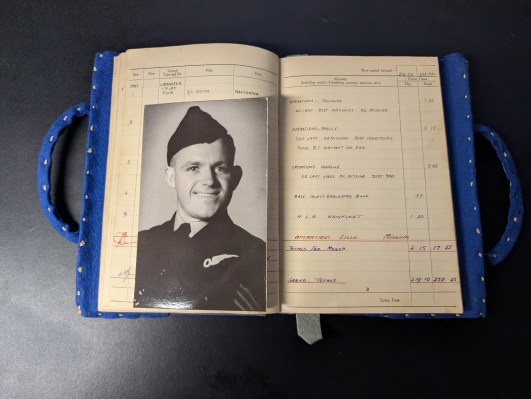
I found a small blue notebook in the box, too. Tucked into a hand-made cover of blue felt, the book was clearly old, its pages yellowed and brittle. It was filled with columns of numbers, times and unfamiliar place names, all inked in with a wide-nibbed fountain pen.

Nhill. Llandwrog. Lichfield.

Munich. Nuremberg. Berlin.

And on the final line, in red ink and different handwriting:

“OPERATIONS. Lille,” I read.

“MISSING.”

I had many questions for my father when he emerged from bed a short time later. Who was the man in the photograph? Why was he missing? And why did he look sort-of like Dad?

The man, it turned out, was “Uncle Jack”, and he had been a relative of ours. Dad told me that he had been in the Air Force , and that he’d been killed during the Second World War. The photos, and the logbook, were all that were left of him.

This post is part of a series, publishing writing originally completed as part of my now-discontinued book project. Find an explanation of the series and an evolving table of contents here.

(c) 2025 Adam Purcell

Chapter One, Part One: A Beginning, Of Sorts

From the very first day of the war, right up until the final week of hostilities in Europe more than five and a half years later, Royal Air Force Bomber Command operated on nearly every date in the calendar. It fought an exceptionally long war.

It was an exceptionally dangerous one, too. More than 125,000 aircrew served in Bomber Command; of those, at least 55,573 were killed in action or training. Thousands of the bombers that took off on bombing raids failed to return; from the majority of bombers that were lost there were no survivors.

Bomber Command fought in a way war had never been fought before, and in a way in which it will never be fought again. It was the biggest, most powerful aerial armada the world had ever seen – right up until the moment the first atomic bomb dropped on Hiroshima and rendered the whole operation instantly obsolete. There are several experiences that most veterans will mention when you ask them about their time in Bomber Command, things that together made the force a unique product of its time, place and context.

Some of these things might be the way you formed your own crew, for example, and the extraordinarily strong bonds that typically developed between the airmen thus joined. The high tension of the briefing room, with the collective gasps as the curtain was flung aside to reveal a long red ribbon stretching into the very heart of Germany. The ‘operational egg’, a genuine treat in severely rationed wartime Britain, and the predictable jokes about who would get yours if you didn’t come back tonight. The female drivers who ferried you out to your aeroplane, and the dread of waiting before take-off, with nothing to do except think about the upcoming operation. The sudden churning of your stomach as you heard the rear gunner’s voice in your headphones saying “corkscrew port, go!” The bomb aimer over the target, calmly guiding the pilot: “left left, steady, steeeaaaady… OK bombs gone, let’s get out of here!” The sudden silence and palpable sense of relief as the engines shut down after landing, and the dog-tiredness as you fell gratefully into bed as the sun came up. And then doing it again and again, all the while watching others simply disappear and knowing full well the high probability that you, too, would join them on the list of the missing well before you reached the magic number of thirty operations that entitled you to a rest.

It’s hard for anyone today to fathom just how dangerous a job it was. Consider this: in very rough numbers, your chances of dying by accident or some other external cause, on any one day, is approximately one in a million. The average RAF bomber aircrew, on the other hand, faced the same level of risk of violent death that you or I face in an entire day – one in a million – each and every second that they were in the air during an operation[1].

The longest operation in Jack Purcell’s logbook is a raid to Munich in April 1944 that lasted for a little over ten hours, or more than 36,000 seconds. That’s 36,000 times the daily risk of death for the average man on the street. Or, to put it another way, it would take you or I close to 100 years to be exposed to the same risk of death by external causes that a bomber crew faced on that single raid. And that was one raid, on one night, of a very long war.

This is something that still astonishes me, every time I think about the aircrew of Bomber Command. They were volunteers, every last one of them. They saw other bombers blowing up, they saw the empty places at the table the next morning. They could do the maths: five percent loss rates from every operation. 30 operations required for a tour. As one of them said, “we sort of end up owing them something…”[2] They knew the danger – and yet they went anyway, night after night.

What was it like, I wondered? What was it like to be a member of a bomber crew during the Second World War? What was it like to go to the other side of the world? To live on a wartime airfield? To knowingly face that level of risk, night after night?

What happened to these men happened within a unique and very specific intersection of place, time and context. Those things all combine with individual experiences to make what we call history. I suspect we cannot ever truly know wer es eigentlich gewesen – how it actually was – if we weren’t there, at that time, in that place, and influenced by that context. But any historical event leaves echoes that can be heard if you listen closely enough.

We can’t travel back in time. But nowhere, perhaps, are the echoes of the past stronger than in the places where the past happened. And that is somewhere to which we can go.

This post is part of a series, publishing writing originally completed as part of my now-discontinued book project. Find an explanation of the series here, and an evolving list of contents here.


[1] Taken from Blastand & Spiegelhalter (2013), The Norm Chronicles: Stories and numbers about danger. Profile Books Ltd Great Britain. p.17. They base the “one in a million” calculation on 18,000 recorded accidental deaths out of a population of 54 million in the UK in 2010. The RAF calculation is based on 55,000 deaths, 364,000 sorties and an average crew size of six. The figure is necessarily an approximation, but it’s a vivid illustration for our purposes.

[2] Charlwood, Don (2002), Australians at War Film Archive #0666. Accessed from http://www.australiansatwarfilmarchive.gov.au/aawfa/interviews/1767.aspx 13SEP12

An Announcement

“My ultimate aim with this research is to write a significant piece of work – a book – to tell the story of the crew of B for Baker.”

So starts a post on this blog that was written in March 2012.

That’s now more than thirteen years ago.

After I wrote that post, I spent a few years thinking about the idea of writing a book, then a bit of time thinking about actually writing it, and then maybe two more years organising and manipulating sources into something that I thought I might be able to turn into a coherent story. And finally, in July 2017, I started actually writing.

I wrote several thousand words, and then I pretty quickly realised I wasn’t getting anywhere useful, so I re-started my draft. And then I re-started it again, and again, so that the current file is version 5.

Ha, ‘current’. My laptop tells me the last time I opened my draft, before tonight, was on 6 June 2022.

I’ve not been able to prioritise this project enough to do something about it for more than three years. Heck, I’ve barely even posted on this blog.

Life has intervened, and other priorities have come up (not least of which, my partner and I are expecting a baby in a few weeks). I’m simply unable to make the time needed to finish a draft, edit it, and do all the other work that’s needed to get a book printed and promoted.

So, I’ve made a difficult but necessary decision. It’s time to stop kidding myself: the book about B for Baker that I was planning and working on is no longer going to happen, and I have accepted the need to abandon the project in its originally imagined form.

All is, however, not yet lost. I do still have that draft: all 56,000 words of it. And some of it, even if I do say so myself, is pretty good, actually. It seems a shame to just chuck that out without giving anyone else the chance to read it, without sharing the story of B for Baker, and what it was like for her crew, with a wider audience.

Like, say, the audience who reads this blog…

So though a book in the traditional sense is not going to happen, I’ve decided to share the guts of the story with you, right here. Over the next little while, I will turn each chapter of my draft into a series of posts, and then publish them one at a time. There will be no set posting schedule: you’ll get them as they come. The important thing is that the story will be out there, and seven more members of Bomber Command won’t be forgotten.

Because that, at the end of the day, is what I’ve been trying to achieve the whole time.

Let’s see how it goes!

An Evolving Table of Contents:
  • Chapter One: Beginnings
  • Chapter Two: Learning to Fly

(c) 2025 Adam Purcell