Chapter Two, Part Four: Tiger Moth

Decades later, in the skies around the pretty airfield at Camden, west of Sydney, I was also learning to fly a Tiger Moth.

It was not going well.

“Aww, what’d you go and do that for?!?”

The frustration in  the instructor’s voice, despite the distortion in the intercom, came clearly through my headset into my ears. It felt like the words were metaphorically slapping me upside the head as they did so, and I had to admit that in that they were perfectly justified.

Jim Drinnan, sitting in the front cockpit of the Tiger Moth, was one of those crusty old flying instructors who had been around forever. He’d seen it all. I was not the first ham-fisted student he’d had muck up an approach and landing, and I wouldn’t be the last. But at that particular moment, I was the student he was dealing with. The frustration he was feeling just then was being caused entirely by me.

It was a nice approach too, side-slipping in a continuous turn as we descended, popping out nicely lined up with the grass runway. But after we crossed the boundary fence and were over the runway proper,  I completely forgot to pull back on the stick to raise the nose for landing.

What happened in the next few seconds was less a landing than an arrival. The main wheels thumped violently into the ground and bounced us back into the air, the wood and the wires that held the wings together groaning in protest. I heard Jim swear and the engine surge, felt the stick jerk out of my hand as he took over and regained control and we touched down again, much gentler than my effort and more permanently this time. Now certain that the aeroplane was again safe, as we gently decelerated on the runway Jim hit the intercom switch and let my ears have it.   

“I was going to send you solo, today, too.”

It was my sixth flight in a Tiger Moth and we’d just spent an hour flying wide circuits of the aerodrome and practising taking off and landing. But the last ten feet, before we touched down, was still causing me problems. Maybe I was relaxing a tiny bit too soon, maybe I was getting distracted by something. Maybe I simply kept mucking it up. But there was to be no solo flight for me that day.

 In the autumn of 2010, when all this was happening, I was a licenced private pilot with about 180 flying hours in my logbook. Flying was something I did for fun. After I qualified for my licence, I quickly moved on from the little two-seater Cessna that I’d flown on my first solo to bigger four-seaters like the Piper Cherokee and Cessna 182. More recently I’d started flying aeroplanes with the little wheel at the back – “taildraggers” – called Citabrias, which, having the added bonus of being somewhat aerobatic, let me stretch my skills into flying upside down with some regularity. It was all good, clean fun.

I hired the aeroplanes from a flying school at Camden Airport, in south-western Sydney. Camden was a lovely little aerodrome, with one sealed runway that’s more than a mile long and another, shorter, runway with a surface of grass. Most of the hangars, laid out in a group to one side of the airfield itself, were of a single simple design called the Bellman. Skinned with corrugated iron, with big sliding doors at each end, a low-pitched roof and little rows of windows high on the side panels, these hangars began to be built in Australia and the UK from the mid-1930s and were designed to be easily erected using unskilled labour and to break down into transportable components. A large number survived around Australia, unsurprisingly usually located at airfields with wartime histories.

 In the back of one of the Bellmans, behind the modern all-metal aeroplanes, sat a petite and pretty fabric-covered biplane, painted in military camouflage on top and bright yellow underneath, with double-decker wings and a single wooden propeller. It was a Tiger Moth, and every time I saw it I thought of the purple stamp in Jack’s logbook. Wouldn’t it be nice to have a go at one of those, I thought, to see what it was like?

 Every proper flying school needed an instructor like Jim Drinnan. Career blokes, these fellows, with so many flying hours that they probably stopped counting before I was even born. Gruff and sometimes grumpy on the outside they might have been, but there was usually a gentle character that revealed itself as they got to know you. They loved to fly, but more importantly they loved to share the joy of flight with others. And what was more joyful than sailing through the air, on a cold but perfectly still and smooth autumn morning, in the open cockpit of a 1938 De Havilland DH82A Tiger Moth? So I approached Jim, and within a few weeks, wearing goggles and leather flying helmets, we taxied out for my first attempt at it.

This post is part of a series, publishing writing originally completed as part of my now-discontinued book project. Find an explanation of the series and an evolving list of contents here. (c) 2026 Adam Purcell
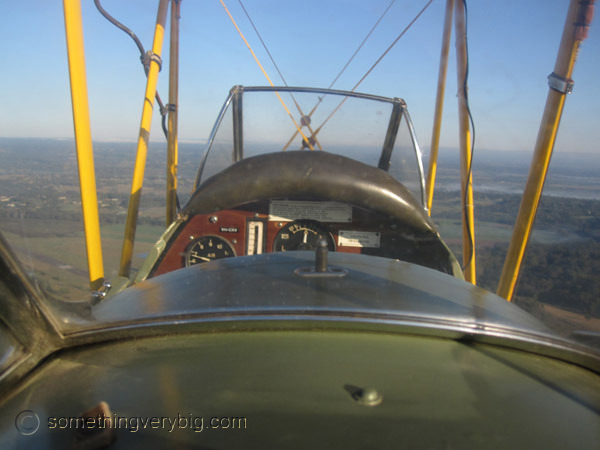
Tiger Moth

How I imagine Phil Smith’s solo might have happened…

“It’s all yours, Smith – just do what Maguire told you to”, the senior instructor yelled into Phil’s ear, as he dropped off the wing and walked away from the Tiger Moth. It was early on one of those mornings that had the promise of turning into a real stinker in Tamworth. “And don’t bend it!” He waggled the elevator up and down – oh yes, keep that stick back, Phil, you twit – as he left. Phil blipped the throttle to get her moving, pushing the rudder pedals one way and then the other to keep the Tiger Moth weaving but heading, on average at least, in the direction he wanted it to. As the nose moved to each side, he peeked down the other side of the fuselage to make sure they would not taxi into anything.

Still rolling, Phil pushed the throttle forward to carry out his run-up checks – reaching outside the cockpit to flick the magneto switches off and on one at a time while  listening for a faint drop in RPM, closing the throttle and checking it idled smoothly, ‘stirring the pot’ with the control stick and rudder pedals – then released the trim. Nearing the far end of the field now, he checked the windsock, satisfied that from here he could take off directly into the light breeze that was blowing. He checked for any approaching aeroplanes, then turned into the wind and opened the throttle.

As the Tiger started to accelerate, he added progressively more left rudder to counteract the swing to starboard – the tail came up and suddenly he could (after a fashion) see ahead. Like the graceful creature she was, the Tiger Moth lifted from the grass, seemingly all by itself. Wow, he wasn’t kidding, they do climb better empty. Phil pushed forward slightly on the stick to place the horizon just below the edge of senior instructor F/O Maddocks’ windscreen (speaking of Maddocks, where was he?), adjusted the throttle back to 2150 rpm and checked the airspeed indicator. Good, he thought, it’s reading about 55 knots, just where it should be. Gee, it’s chilly up here. Keep those b—-d wings level – still got the power on, still got the left boot jammed into the rudder pedal. Sneak a glance at the airfield behind, the slipstream clawing at the top of his leather cap. Flying straight, that’s good.

Approaching 500’ on the altimeter now – lead the turn with a little rudder, then ease into the bank. Stop the turn. Still climbing. Nearing 1000’, circuit altitude. Turn downwind, lower the nose a little and reduce the power to about 1900 rpm – there, that sounds about right. Trim out the control forces – airfield off to the left, its far boundary just outside the wingtip. There goes another Tiger, he thought, as a little yellow biplane lifted off. With the power back it’s marginally warmer, but it’s still jolly cold in here. Wow, I’m actually flying – by myself! He looked all around, but it was true – he was the only one in the aeroplane. Solo!

“Wings level”, growled Maddocks through the Gosport.  Or he would have, had he been there. Whoops. Phil came back to reality. His touchdown point slipped past the left wingtip and it was time to think about the approach. I thought I’d be more nervous than this. Pull the throttle back to idle now – the engine coughed a bit, must have moved the throttle a bit too fast. It settled, and Phil kept the nose up as the aeroplane decelerated. Rolling into the base turn – don’t forget that rudder – he looked through the wires at the touchdown point. Looks a little high, he thought. Wait… don’t fall for that one again. Maguire had always told him it was easier to lose height than try and find it again. With the power at idle, all went comparitively quiet and he listened to the sound of the wind through the wires. Whoops. The singing wires turned higher in pitch. Too fast. Nose up a bit – the noise fell away and the aeroplane slowed down. There. That’s better. He shifted his backside on his parachute – the aeroplane wobbling from the inadvertant rudder movement. Aiming point – that rough patch of grass – stayed framed by the wings, just where it should be.

He started rolling into the final turn – added a bit of right rudder to sideslip neatly towards the ground. Too high – watch that airspeed – more aileron and more rudder to steepen the sideslip, then the aiming point disappeared below the nose and it was time to straighten up. Kicked her straight, brought the wings level – put on a trickle of power for the extra control authority. Transitioning into the flare, Phil brought the stick back a little bit. Feeling for the runway – lots of little, almost imperceptible jerks on the controls – then he felt the wheels kiss the grass. Power off – a tiny bounce – then she settled. Stick forward a tiny bit to pin the wheels onto the deck. Keep her straight! The Tiger Moth slowed down and Phil’s view forward disappeared as the tailskid dropped neatly onto the ground. Keep her straight! At walking pace now. Phil turned off the runway. There’s Maddocks, out to the side – how curious, he almost looks pleased. Taxied to the flight line, weaving back and forth – there’s that erk again, waving him in. There now – throw the switches, the engine stopped, the Tiger Moth rolled tidily to a halt, perfectly lined up with all the others. Helmet off, harness unbuckled, stand up – on shaking legs – climb out of the aeroplane (don’t forget to turn off the front switches). It’s only then that he realises what he’s just achieved.

Big silly grin.

Solo.

First Solo in a Tiger Moth

(c) 2010 Adam Purcell

Read and post comments | Send to a friend