467 Postblog LXIVb: Monday 24 April, 1944

The Munich raid of 24 April 1944 was an attack delivered almost entirely by No. 5 Group, Bomber Command. It used, for the first time, a variation of the low-level marking system which had been so successful over French railway targets.[1] The first wave of the bomber stream overflew the target without bombing to provide support to the flare force which dropped hooded white flares to illuminate the target area. The Main Force then continued on a short distance and orbited, clear of the defences, north-west of the target, awaiting the order to come in again to bomb.

Unsurprisingly the requirement to cross Munich twice was not a popular one. Befitting its status as the spiritual home of the Nazi Party and as a major city in Germany, Munich was well-defended. Searchlights were extremely active and any aircraft unfortunate enough to be caught in them would find itself the target of a barrage of accurate, intense heavy-calibre flak. At least three aircraft are known to have gone down to flak over the target, two of them seen by Pilot Officer Dave Gibbs, who himself was coned but managed to escape.[2] Pilot Officer Jack Freeman was also amongst those coned over the target. It was, he said, a “very grim affair.”[3]  Flight Lieutenant Walter Marshall’s aircraft, LL846, was hit by flak and his bomb aimer – Pilot Officer John Kennedy – received a wound under an arm. Kennedy pressed on regardless and not entirely rewardless however, doing his job and telling no-one about his injury until after the aircraft landed. He would later be awarded a DFC for his actions on this operation. [4]

“The idea of flying through the target area while waiting for order to bomb is in my opinion totally unnecessary, particularly so on a target such as Munich,” seethed Pilot Officer Bill Felstead later. “Suggest orbit away from a defended area,” said Pilot Officer Arthur Bowman.[5]

But it seemed to work. The four target-marking Mosquitos led by Wing Commander Cheshire “arrived punctually at the moment when the first flares were dropped.” Conditions were clear and visibility was almost perfect. Cheshire swooped in at around 700 feet and reportedly dropped the first flares while coned in searchlights and lit by the flares falling from the Lancasters above. Under fire he managed to identify the aiming point and dropped his red spot fire markers accurately. The remaining Mosquitos followed to back up the original markers and the first wave of the Main Force, still circling to the north-west, could now be called back in.

The markers were accurate (save for one which dropped wide after the marking aircraft had to take last-minute avoiding action to prevent a collision with another aircraft at the point of bombing, and another off to the west of the aiming point which was thought to have been a German decoy) and the bombers hit the target hard. The bombing was, particularly for early crews, highly accurate:

Best concentration of [incendiaries] I have ever seen – Pilot Officer Roland Cowan

Attack was the best that I have ever seen by far – absolutely perfect – Flight Lieutenant Fred Smith

Wizard prang. – Flight Lieutenant Freddy Merrill

The accuracy of the attack is illustrated by the fact that 463 Squadron recorded five aiming point bombing photographs on this raid. One of the successful pilots was Flying Officer Bill Purdy, his second consecutive aiming point from only his second trip overall:

Bill Purdy provided this copy of his aiming point photo from Munich

The exact middle of the photo is where the bombs theoretically would land and this apparently was directly over Hitler’s favourite beer parlour. I received a message from Group saying that whilst war is a dirty and bloody business it was considered bad form to go around destroying the opposition’s pubs.[6]

The fires brightly illuminated the target – one crew said it looked like a photograph – and features like individual streets and even church spires stood out clearly.[7] Phil Smith could easily see the river as B for Baker left the target. A wireless failure meant that they could not receive the order to “bomb the red spot fires” which was broadcast around 01.44. Instead they stooged around and simply attacked when they saw other aircraft bombing.[8]

The bombing was undershooting and became a little scattered as the attack went on, but it did not matter. The ground defences appeared to be almost overwhelmed by the ferocity and force of the attack and were putting up a much reduced effort by the time the bombers left. Many smaller fires joined into large conflagrations and an hour after the attack, a large area of the centre of Munich was burning so strongly that the reconnaissance aircraft encountered trouble from smoke at 19,000 feet.[9]

Now began the long flight home. The glow from Munich could still be seen as far as the French border. Fifty miles north of the nominal return track, crews could see fires burning at what looked like Karlsruhe.

Few fighters were reported by crews returning from Munich, and it appears that the four different streams heading across Europe earlier in the evening – the Munich force, the Karlsruhe force, the OTU diversion and various groups headed to France – successfully thwarted attempts by the German fighter controllers to guess the target. The Night Raid Report suggests that for much of the night the Germans anticipated that Nuremberg or Frankfurt would be attacked. At least one aircraft did fall to a fighter over Munich, however, and others would be lost at Ulm and Strasbourg[10] in the first two hundred miles of the homeward journey. At least one crew was attacked by a fighter after stumbling off track over Paris. The rear turret was unserviceable and neither gunner saw the enemy aircraft but Dave Gibbs’ evasive action was successful in losing the fighter.[11]

Dawn was approaching as the stream crossed the French coast on the way home and it made many crews nervous. Strong headwinds slowed the return journey and sapped already stretched fuel supplies so numerous aircraft diverted to aerodromes in southern England. Two 467 Squadron aircraft were among those that diverted: R5868 (S for Sugar) with Pilot Officer Tony Tottenham and crew landed at Market Harborough, fifty miles short of Waddington, and DV372 (F for Fred) with Flight Lieutenant Jim Marshall and crew, landed at Ford, just after safely crossing the English coast at Selsey Bill.

The Munich operation of 24 April, 1944, at ten hours and five minutes, is the longest flight to appear in Jack Purcell’s logbook. It was so long that several wireless operators (among them Sergeant Macdonald on Flight Lieutenant Jack Colpus’ crew[12]) tuned their radios to the BBC news while airborne over England on the way home, and heard that Munich had been bombed last night and ‘x’ aircraft had failed to return. And they hadn’t even landed yet.
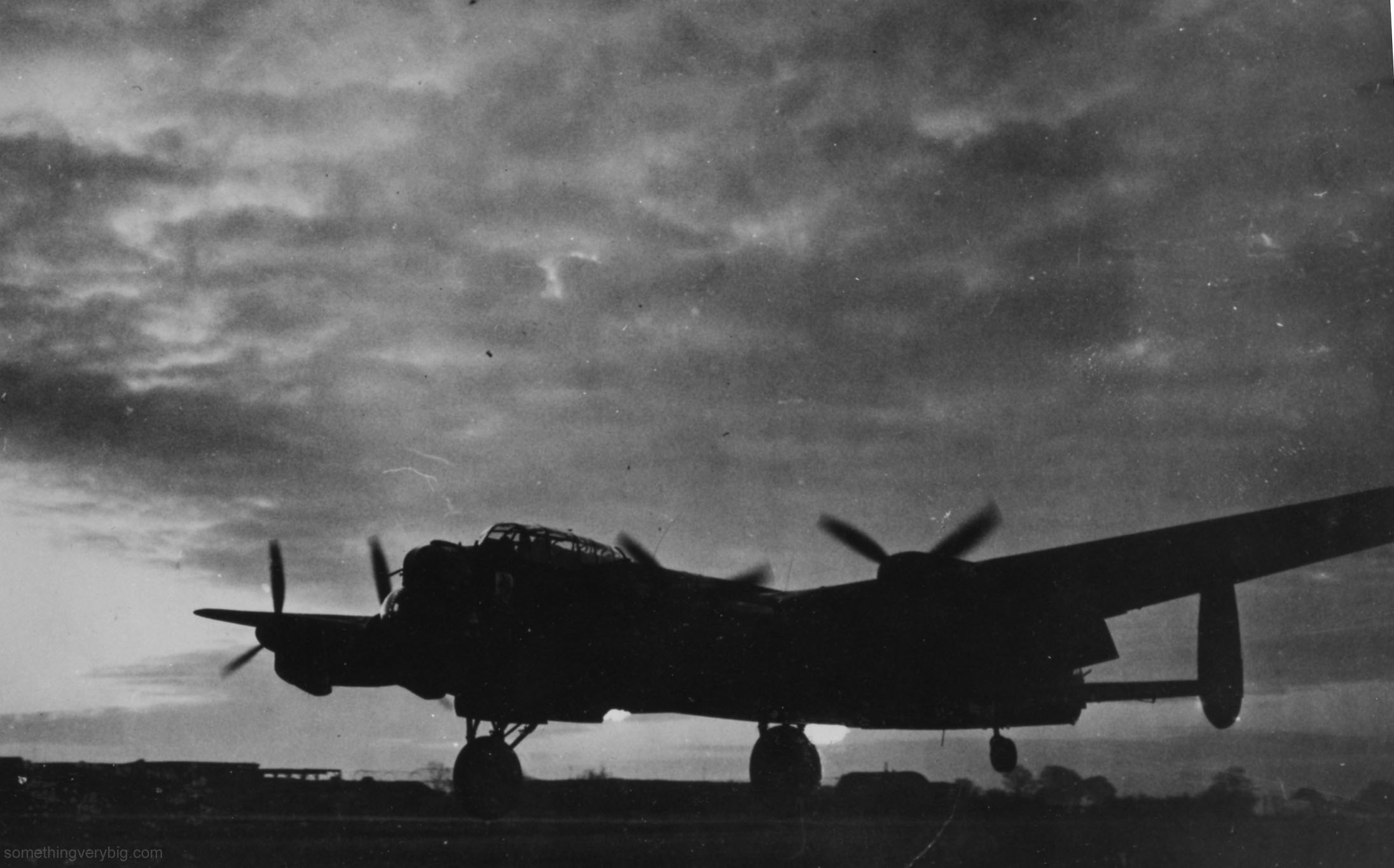
Original caption reads: "Lancaster JO-Q 'Queenie' (ME580/G) of 463 Sqn just about to touch down on 24 Apr '44 following an attack on Munich (Flying time 9 hrs 35 mins)." Courtesy RAF Waddington Heritage Centre
Original caption reads: “Lancaster JO-Q ‘Queenie’ (ME580/G) of 463 Sqn just about to touch down on 24 Apr ’44 following an attack on Munich (Flying time 9 hrs 35 mins).”
Courtesy RAF Waddington Heritage Centre

The roundabout routing – while long – achieved its goal and casualties were much lower than usual. Nine bombers failed to return from Munich: four by flak, three by fighters and two to unknown causes. Sadly, one of the missing aircraft was a 463 Squadron machine. Pilot Officer Eric Page and crew disappeared in LL848. This was most probably the aircraft seen to fall to a fighter over Munich. They crashed near the village of Sulzemoos, sixteen miles north-west of Munich. There were no survivors.

A few days later Gilbert Pate sent one of his many letters home to his parents in Kogarah, in Sydney’s southern suburbs. He included the front page from Wednesday’s Daily Mail newspaper, which he had pinched from the RAF Waddington Sergeant’s Mess.

“RAIDS PRODUCING MASS CHAOS,” blares the headline. “RAF Out Again Last Night in Force.”

There was an incessant roar over the coast last night as our heavy bombers set out again for the Continent. Radio Luxemburg closed down just after 10.50pm because of “approaching Allied planes.”

…By night the battle is more severe. Munich and Karlsruhe, deep inside Germany, were still burning yesterday after Bomber Command’s great attack during Monday night.

Operating in very great strength the R.A.F. showered more than 500,000 incendiaries and a great weight of high explosive on these two manufacturing and transport centres.

…The Munich raid lasted from 1.35am to 2am. It was described by the Germans as the city’s ‘worst ever’.

‘We must not be broken by the terror; we must answer it with a soldier-like courage’, said a radio spokesman.

“Munich was my target,” Gilbert scribbled on the front page. “Ten hours is a lifetime in the air.”

This post is part of a series called 467 Postblog, posted in real time to mark the 70th anniversary of the crew of B for Baker while they were on operational service with 467 Squadron at RAF Waddington, Lincolnshire. See this link for an in-depth explanation of the series, and this one for full citations of sources used throughout it. © 2014 Adam Purcell

Sources:


[1] Description of tactics for this raid taken from Nigth Raid Report No. 586 and Lawrence 1951, p.175-7

[2] Night Raid Report No. 586

[3] 463 Squadron Operational Record Book, 24APR44

[4] 467 Squadron Operational Record Book, 09MAY44.

[5] 463 and 467 Squadron Operational Record Books, 24APR44

[6] Purdy, Bill, pers. comm. to the author, 21DEC13

[7] Various reports in 463 and 467 Squadrons Operational Record Books, 24APR44

[8] 467 Squadron Operational Record Book, 24APR44

[9] 463 Squadron Operational Record Book, 24APR44

[10] Night Raid Report No. 586

[11] 467 Squadron Operational Record Book, 24APR44

[12] Colpus, Jack 2003, interview at Australians at War Film Archive

Thanks to Chris Foote for picking up an error in the original version of this post, where I used the wrong month – corrected in January 2023
467 Postblog LXIVa: Monday 24 April, 1944

Our latest big effort was on Munich so we put paid to Hitler’s beer cellars. – Dale Johnston in a latter to his father, 1 May 1944[1]

It was going to be a long night.

The fuel tanks on the bombers scattered at their dispersals around RAF Waddington had been filled ‘to the gunwales,’ a maximum figure of 2,154 gallons.[2] At nearby Skellingthorpe, the aircrew of 50 Squadron had the disquieting revelation at briefing that even with full tanks they might be cutting it fine to get back home:[3]

On arriving at the briefing room and being shown the map of England and Europe, we asked why the cotton track-marking thread finished in the middle of nowhere, or should I say, near the Ruhr Valley on the ‘wrong side’. We were then given to understand that if and when we arrived at that point there would be nowhere else to go except straight through, because by then fuel would be getting low…

At Waddington, the crews were making a similar discovery. Like their comrades at Skellingthorpe, they were off to Munich, deep in the south of Germany. But, in one of the more extravagant examples of route planning during the war, the bomber stream would fly south over France, cross into Italy almost to Milan before turning north over the Swiss Alps and setting course via parts of Austria for their target.  In a sign that this attack would be aimed directly at the city itself rather than its industries, bomb loads were almost entirely made up of incendiaries. Only two crews carried high-explosive bombs from Waddington. Squadron Leader Bill Brill captained one of them.

The other was Phil Smith’s crew. They took their normal aeroplane, LM475 B for Baker. Phil had a second dickie pilot along for the trip as well. Pilot Officer Tom Davis was on his third observation trip as a new captain, having in the past week flown with Bill Mackay to La Chapelle and Brunswick.[4]

The Munich raid would be carried out by a significant force of heavy bombers. In all 244 Lancasters and 16 Mosquitos were sent, mostly from No. 5 Group. But this would not be the biggest operation of the night. 637 aircraft were sent to Karlsruhe, just over the French border near Strasbourg. The raid would be spoilt by unexpected cloud over the target and strong winds which affected the accuracy of the Pathfinders. Various parts of the Main Force even got lost and bombed Mannheim (30 miles to the north) and a small number of other German cities instead.[5] Nineteen bombers failed to return. Elsewhere, a small number of Stirlings attacked a railway target at Chambly in France, Mosquitos bombed Dusseldorf and there was also the usual mining sorties (off French ports and the Frisians), Serrate and intruder patrols, leaflet drops and special operations. 165 OTU aircraft made a diversionary sweep over the North Sea, getting within 75 miles of the coast (two were lost). And finally, in direct support of the Munich operation, six 617 Squadron Lancasters dropped target indicators and flares only – no bombs – as a diversion on Milan.[6]

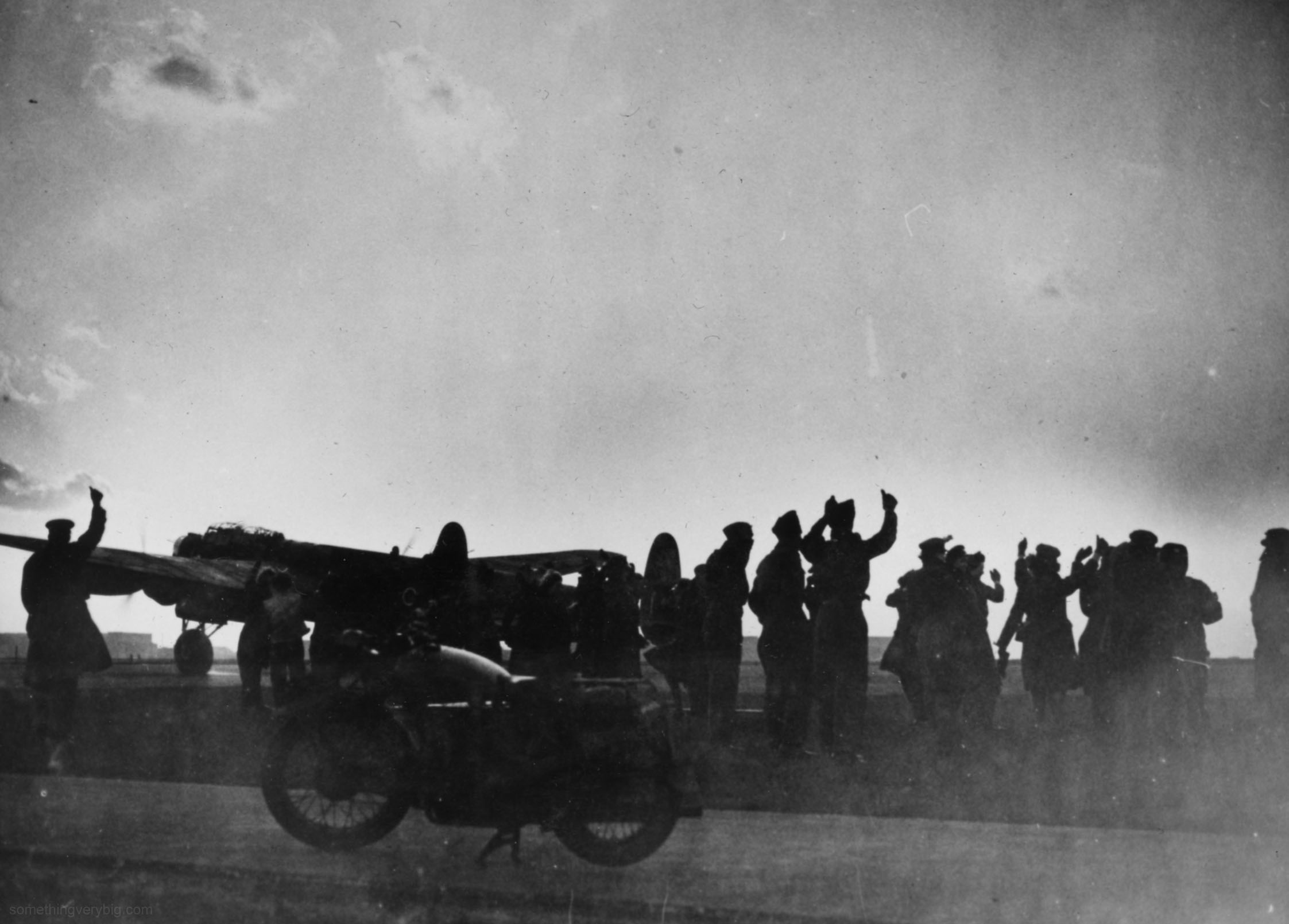
Take-off was from around 20.45 in the evening. With Double British Summer Time in force, sunset was not until around 11pm local time so for once, the ‘send-off party’ of WAAFs and ground staff who gathered at the end of the runway each time the Squadrons took off for an operation were clearly visible.[7]

Original caption reads: "The take-off for Munich on 24 April 1944. Sunset at Waddington as one of the heavily loaded Lancasters taxies round to the take-off point; waved on their way by the usual crowd of well-wishers." Courtesy RAF Waddington Heritage Centre
Original caption reads: “The take-off for Munich on 24 April 1944. Sunset at Waddington as one of the heavily loaded Lancasters taxies round to the take-off point; waved on their way by the usual crowd of well-wishers.”
Courtesy RAF Waddington Heritage Centre

The bombers crossed the French coast near Cabourg and headed south. Near Orleans they turned more towards the south-east and aimed for a point which would see them skirting just south of the Swiss border.

Before they got there, though, Pilot Officer Col James of 463 Squadron encountered carburettor icing in all four engines north-west of Lyon. They were unable clear the fault and, struggling to maintain height and with the very high terrain of the Alps looming further down the route, it was pointless going on. With heavy hearts they turned for home, having already flown almost as far east, and a good deal further south, than they did when they went to Aachen almost two weeks ago.  They landed at Waddington having been airborne for a tick over six hours. The Aachen trip took them four and netted them a full operation onto their individual tallies – but frustratingly, this early return would get them nothing.[8]

Meanwhile, of course, the majority of the force flew on. Near Lake Annecy they turned east and were treated to spectacular views of the Alps to starboard and the spoof flares and target indicators going down on Milan to port. (To assist with the deception, the crews carrying out the Milan part of the operation were reportedly told to use their radios to issue instructions and talk on the VHF as if a major attack was commencing.[9]) Pathfinders dropped red route markers at turning points over the Alps and they “made a terrific sight cascading down the sides of snow covered mountains.”[10] 165 miles east of the Annecy turning point lay a further route marker to indicate the rendezvous point. To ensure saturation of the defences it was essential that the bomber stream remained compact when it arrived at the target. Crews were therefore ordered not to leave this point until a specified time.[11] At that time, the bombers turned north-east and flew almost directly towards Munich. They crossed Switzerland and Austria and then, fifty miles ahead, was the target.


Next: Over Munich, and the long flight home


This post is part of a series called 467 Postblog, posted in real time to mark the 70th anniversary of the crew of B for Baker while they were on operational service with 467 Squadron at RAF Waddington, Lincolnshire. See this link for an in-depth explanation of the series, and this one for full citations of sources used throughout it. © 2014 Adam Purcell

Sources:


[1] Quoted in a letter by Dale’s father Charles Johnston to Don Smith, Phil’s father, 16JUL44. Part of Mollie Smith’s collection.

[2] Both Phil Smith and Arnold Easton note this figure in their respective flying logbooks

[3] AUS414986 F/L Ernest ‘Bill’ Berry, a 50 Sqn pilot, quoted in Blundell, HM 1975, p.19

[4] 467 Squadron Operational Record Book

[5] Bomber Command Campaign Diary, April 1944

[6] Night Raid Report No. 586 and Bomber Command Campaign Diary, April 1944

[7] Berry, Bill, in Blundell, HM 1975, p.19

[8] 463 Squadron Operational Record Book, 24APR44

[9] Lawrence, WJ 1951 p.175

[10] Berry, Bill, in Blundell, HM 1975, p.20

[11] Lawrence 1951, p.175

467 Postblog LXIII: Sunday 23 April, 1944

Sleeping off the fatigue from last night’s flying, there were no operations planned for the airmen of 463 and 467 Squadrons tonight. After about midday, however, some training was organised. 463 Squadron carried out some fighter affiliation sorties but Phil Smith and his crew took B for Baker to the Wainfleet range, about thirty miles west of Waddington, for some high-level bombing practice. The sortie lasted an hour and a half. Following this they did another test flight, again at the request of Avro, in W5004, the aircraft Phil had tested the previous day.[1] This time Jack Purcell came along too, for another half an hour in the air. The aircraft does not appear in either logbook again so it seems that whatever fault it carried had been cured by the two air tests and it was cleared to go back into service, albeit with a training unit rather than an operational squadron.

Bomber Command aircraft on operations on this night included a small group of Stirlings which attacked a signals depot near Brussels, 25 Mosquitos which went to Mannheim and a force of 113 heavies which dropped mines in the Baltic Sea. Six Wellingtons scattered leaflets over northern France, twelve Halifaxes carried out special operations over Europe, four Mosquitos completed Serrate patrols and another one did a weather reconnaissance flight. Two Stirlings and three Halifaxes from the mining force failed to return.[2]


This post is part of a series called 467 Postblog, posted in real time to mark the 70th anniversary of the crew of B for Baker while they were on operational service with 467 Squadron at RAF Waddington, Lincolnshire. See this link for an in-depth explanation of the series, and this one for full citations of sources used throughout it. © 2014 Adam Purcell

Sources:


[1] Flying logbooks of Phil Smith and Jack Purcell

[2] Night Raid Report No. 585

467 Postblog LXIIa: Saturday 22 April, 1944

More operations tonight. And just for something different, the Waddington crews would leave French railway targets alone for a night and go back to a German city.

But first, Wing Commander Arthur Doubleday was posted out today. The outgoing ‘B’ Flight Commander of 467 Squadron had been at Waddington since 10 December last year, and went to take command of 61 Squadron[1] at nearby Skellingthorpe. His replacement would not arrive at Waddington for another two weeks.

There was also some daytime flying. Phil Smith’s logbook records a half-hour-long “Air Test for AVRoes” in Lancaster W5004. This was not a 467 Squadron aircraft. It appears that it had come out of a period of maintenance or repair, and in May 1944[2] it went to 5 Lancaster Finishing School at RAF Syerston, about 20 miles south west of Waddington. It’s likely that this air test with Phil Smith was part of the re-acceptance of the aircraft after its rebuild, possibly something to do with the Avro maintenance unit based at Bracebridge Heath which was immediately adjacent to Waddington airfield.

Phil did not record names of the airmen he flew with on non-operational trips in his logbook, referring to them as simply “CREW”. While this can normally be understood to include all members of his usual crew, it’s probable that on this occasion he only took the bare minimum (perhaps only flight engineer Ken Tabor). If it was only a local flight a navigator would not necessarily be required – and indeed Jack Purcell’s logbook does not show this air test. Instead, Jack flew to Predannack and back in Cornwall with a 463 Squadron crew, with a different pilot in each direction.

And after all that, the crew of B for Baker were not on the battle order for tonight anyway. Pilot Officer Doug Hislop took LM475 again and the only member of Phil Smith’s crew to operate was Flight Sergeant Gilbert Pate who once more filled the rear turret of LL792 with Pilot Officer Bill Mackay’s crew.

In all more than 1100 aircraft would be flying for Bomber Command tonight. The largest single raid was carried out by 596 aircraft which attacked Dusseldorf. Other operations included 181 aircraft on railway yards at Laon, diversionary raids to Mannheim, Wissand and airfields throughout north-west Europe, some Serrate patrols, leaflet flights and special operations. Meanwhile 463 and 467 Squadrons would be part of a 265-strong force of Lancasters and Mosquitos sent to Brunswick, home to 100,000 people with an aircraft component works as its main industry.[3]

For the past few weeks, Bomber Command – and 5 Group particularly – had been heavily engaged in attacks on French railway targets in preparation for D-Day. The need for more careful bombing on these sorts of operations saw the development of some specialised tactics for improved marking and bombing accuracy, mostly using low-flying Mosquitos to mark the aiming point visually with red spot fires. It was decided to see if these tactics would also work on a larger-scale city-busting attack, and Brunswick was chosen for the first test.

The raid would take place in two waves. The first wave of the Main Force would fly over the target to support the ‘flare force’, which dropped hooded flares to illuminate the ground, against the defences. The Main Force was then told to orbit clear of the target to allow the Mosquitos to do their bit. After the accuracy of the markers had been assessed the Main Force would be called back in, and after bombing they would make a hard right turn and vacate the target area heading south. By this time the second wave would be approaching and would have renewed red spot fires to aim at. If the spot fires were off the target or the enemy put up spoof flares, cascading green target indicators (Wanganui flares) would be dropped to emphasise the correct spot fires for the Main Force to aim at, with full Wanganui skymarking available as an ultimate back-up if the weather failed to cooperate. And for the first time, the new ‘J’type’ liquid-filled incendiary bomb would be used in operations.


Next: The Waddington crews take off for Brunswick

This post is part of a series called 467 Postblog, posted in real time to mark the 70th anniversary of the crew of B for Baker while they were on operational service with 467 Squadron at RAF Waddington, Lincolnshire. See this link for an in-depth explanation of the series, and this one for full citations of sources used throughout it. © 2014 Adam Purcell

Sources:


[1] Service Record, 402945 Doubleday, AW

[2] Robertson, Bruce 1964, p.155

[3] 463 Squadron Operational Record Book, 22APR44

467 Postblog LXIIb: Saturday 22 April, 1944

The Waddington contribution to the Brunswick raid on 22 April 1944 was 20 aircraft from 463 Squadron and 18 from 467. Two pilots from the latter went sick before take-off so the final tally was 36. Take-off was from 22.30.

To keep the German defences guessing, the strategy called for a twisting, turning route to the target. From England, the bombers flew eastwards to a point just north of the island of Terschelling, in the Frisian chain. They turned south-east for sixty miles, then crossed the German frontier on another sixty-mile leg heading almost due east (passing Emden at this point, off track to the north, Pilot Officer David Gibbs reported being engaged by flak, but no damage was recorded). Just when it would have looked like the target could have been Bremen, Hamburg or even Berlin itself, the bombers jinked again to the south-east, now threatening Hanover or perhaps Leipzig. The final turn to Brunswick was made south of Hanover, with a cascading green target indicator dropped nearby for the benefit of the early crews. “Numerous alterations of course on route seemed to be a very good idea”, said Flight Lieutenant Eric Scott, and indeed it was, with very few fighters seen by crews on the way out and no combats recorded. About the only trouble to befall a Waddington crew on the way to the target was a dicky engine on Flight Lieutenant Freddy Merrill’s 463 Squadron Lancaster, LL790. They climbed a few more thousand feet while the engine was still producing power, but eventually it needed to be shut down and they consequently gradually lost height until the heavy bomb load left the aircraft over the target (without the benefit of either the bomb sight or the Monica anti-fighter warning system, which were both run by power generated by the errant engine.[1] Merrill later said that subsequently his “gunners were human Monica’s” [sic].

The Waddington crews were all to be part of the second wave. Ahead of them, the markers were going in to do their work. There was some low, broken thin cloud present and some crews had to duck beneath more cloud at their operating height to be able to bomb. The flare force illuminated the target successfully and the Mosquitos dived in to drop their spot fires. The markers were assessed as being in the right spot so the first wave was called back in to bomb.

While the Night Raid Report claims that some 60% of all attacking aircraft successfully bombed the ground markers, slant visibility through the cloud made it difficult for the bomb aimers to sight the markers until they were almost on top of them, if they saw them at all. Adding to the confusion, the new J-type incendiaries were burning with an orange colour which too closely resembled the glow of the red spot fires.

This was precisely the situation for which green target indicators had been included in the marking crews’ loads. The TIs were dropped, but an unspecified ‘technical hitch’ meant they went wide, a few miles south of the aiming point. By the time the second wave arrived, the scene in front of them included smoke from the earlier bombs and incendiaries, haze and cloud and a confusing mix of the unfamiliar J-type incendiaries and red spot fires burning on the ground with the occasional green target indicator slowly drifting in the air. Crews simply bombed what they could find.

The confusion is best illustrated by a quote from Wing Commander Willie Tait, who once again was flying with a 463 Squadron crew and aircraft:

When attack opened 2 Red Spot Fires seen, one backed up with green T/I to the north. Principle bombing appeared around Southern Red Spot Fire. 1 red T/I seen to N.W. Some bombing seen around this believed spoof. Ran up to target after flares had been released and as first red spot fires went down. 2 markers about 1 to 2 miles apart and a red T/I were visible, so we orbited to North and approached again. One of the markers had been backed up by a Green, so we made a bombing approach. Marker and Green seemed to go out but a new Green T/I went down, and we bombed it. Red Spot Fire was then faintly visible.

The idea of using a distinctive green target indicator to emphasise the correct aiming point, and to assist in finding the flares marking the correct aiming point in conditions of poor ground visibility such as those encountered at Brunswick, was certainly sound:

There was a good fire burning around the Green T/I. This T/I made it easier to steady on a run. Doubtful if red spot fires only would have been seen in time. – Pilot Officer Graham Fryer, 463 Squadron

Green T/I is much more easily distinguished than red spot fire and in our case enabled us to get lined up and carry out a good bombing run. – Flying Officer Bruce Buckham, 463 Squadron

The bombing of the cascading green marker itself was certainly accurate. The problem was that it needed to be in the correct position itself, and at Brunswick it was not. Several crews realised that the marker was illuminating fields instead of the built-up area, but it still attracted much of the bombing.

But despite the scattered nature of the attack, Brunswick was left burning with fires developing as the crews left the target. An hour later a reconnaissance aircraft reported a “large conflagration”[2] at the city. German defences were unusually quiet. Flak over the target was only moderate or even negligible, and the fighters only arrived when the attack had been underway for some 20 minutes. “They made some attempt to harass our bombers on the way home, but even so only ten attacks were reported,” said the Night Raid Report. This was probably a result of the twisting, turning route taken to Brunswick and the distraction caused by the other bomber streams that were also out tonight.

Bombers began arriving back at Waddington around 04.30. There was some bother caused by interference on the Waddington frequency but a little over an hour later all were back on the ground.
Except one.

Pilot Officer Charles Schomberg and crew never came back. After the war it was discovered that their aircraft – LL892 – crashed on the outbound journey a little north of track near Groningen in the Netherlands. All on board were killed.[3]  It was one of only four bombers to be lost on this trip and was the first 463 Squadron loss since Pilot Officer Gardner and crew failed to return from Frankfurt on 18 March.

The raid itself had been a mixed bag. “Think it should be O.K.”, thought Flight Lieutenant Walter Marshall. He was only partly right. While six 463 Squadron crews and three 467 Squadron crews came back with aiming point photographs, only about 160 of the total force of 265 managed to bomb within three miles of the target. Areas south of the centre of the city suffered serious damage and various sites associated with the railways through Brunswick were also hit, but some of the attack also fell on open fields. As for the new ‘J’type incendiaries, they burned brightly and quickly and gave off less smoke than the standard incendiaries did. But when burning on the ground they were easily confused with the red spot fire target indicators and during ten trials conducted on operations between April and September 1944, it was discovered that they were “only half as effective per ton as the 4-lb incendiary”[4] and production was discontinued.

Of the other forces operating tonight, 29 aircraft failed to return from Dusseldorf and nine from Laon.


This post is part of a series called 467 Postblog, posted in real time to mark the 70th anniversary of the crew of B for Baker while they were on operational service with 467 Squadron at RAF Waddington, Lincolnshire. See this link for an in-depth explanation of the series, and this one for full citations of sources used throughout it. © 2014 Adam Purcell

Sources:


[1] The bomb sight was operated by an air compressor run by this engine, and a generator also attached to the engine supplied power to various services including radios – Air Ministry 1944, p.10 and 36

[2] Night Raid Report No. 584

[3] Storr, Alan 2006, 463 Squadron p.19. Thanks also to Graham Wallace for the serial number correction.

[4] Harris, Arthur 1995, section II

467 Postblog LXI: Friday 21 April, 1944

Good weather in the morning turned into a wet afternoon but, having operated the previous night, the Waddington crews were given today off. There was no local flying today, not even training flights.

Most of the rest of the Main Force was also rested on this night, but the Mosquitos were among the aircraft that were sent out over Europe. A small number went on intruder patrols or bombed airfields and 24 attacked Cologne again, a harassing raid designed to keep the sirens going in that city for the second night running after 379 aircraft had raided it last night.

Elsewhere, 15 OTU crews scattered leaflets over France, a small number of Halifaxes and Wellingtons carried out special sorties and 58 Stirlings and Halifaxes laid mines off the Frisians, the Dutch coast, Brest and Lorient. All aircraft involved in tonight’s operations returned safely to base.[1]

This post is part of a series called 467 Postblog, posted in real time to mark the 70th anniversary of the crew of B for Baker while they were on operational service with 467 Squadron at RAF Waddington, Lincolnshire. See this link for an in-depth explanation of the series, and this one for full citations of sources used throughout it. © 2014 Adam Purcell

Sources:


[1] Night Raid Report No. 583

467 Postblog LXb: Thursday 20 April, 1944

The second wave of bombers arrived at La Chapelle having flown 60 miles south-east from Cabourg, turned east for a further sixty miles and then headed north east for the final leg towards the target, which was situated less than five miles north of the centre of Paris. There was no cloud but much smoke and some fires in the area caused by the earlier attack.

While very few fighters had been seen on the way out, the French capital was a defended city and flak, both heavy and light, was fierce on the run-up to the target. This was not entirely surprising considering that their route took the bombers directly over the centre of Paris and passed within a couple of miles of the Eiffel Tower. The intensity died off somewhat closer to the aiming point itself but it still packed a fair punch. Pilot Officer David Gibbs called it the “hottest flak experienced yet.” Flight Lieutenant Fred Smith saw two aircraft get hit and go down over or near the target. Flight Lieutenant Jim Marshall’s navigator, Flying Officer Arnold Easton, saw an aircraft shot down over the target and his bomb aimer, Flight Sergeant Jack Bormann, had a lucky escape when a piece of flak went through the nose of their aircraft.[1] But Pilot Officer Noel McDonald’s crew endured one of the more ‘exciting’ experiences over the target on this operation. Their first bombing run was “unsatisfactory” so they made a tight right-hand circuit to come around for a second try. This time however the run was upset by a flak burst just as the red spot fires marking the aiming point were reached. They went round again for a third attempt – but just when they were about to bomb they “were attacked by [a] JU.88. Defensive manoeuvre again spoiled bombing run.” Shaken by the experience, they decided they had tempted fate enough and turned for home with their bombs still on board.

As happened during the first wave, the spot fires fell directly on the aiming point. One or two fell wide but it appears that the Master Bomber was effective and no bombs were seen to go down there. The bombing, in turn, was accurate, leading to problems for later crews (notably that of Flying Officer Bruce Buckham, at 01.50 the last Waddington aircraft to bomb) when smoke and fires obscured or even obliterated the markers. On French railway targets, where accuracy was so important not only for the effectiveness of the attack but also to reduce casualties among the civilian population, this was becoming a common problem, and if the Transportation Plan was to produce the results required of it a solution would need to be found.

The bombers set off on the homeward journey leaving more smoke, fires and the occasional large explosion in their wake. Later photo reconnaissance revealed that the damage caused to the marshalling yards was significant. The Night Raid Report states that the southern part of the yards suffered the most. This was, of course, the target for the first wave, who did not have existing smoke or fires to contend with when they arrived at the target as the second wave did. Tracks, rolling stock, installations and industrial plants and buildings were all heavily damaged.

Six Lancasters failed to return from the La Chapelle raid. Four were missing from the first wave and two from the second. Sadly for 467 Squadron, among the latter was the crew of Pilot Officer Ken Feeney and crew, flying in ND732. They were hit by flak and crashed about six miles east of the target, and all on board were killed.[2]

The standard ‘tour of operations’ for Main Force Bomber Command squadrons was thirty trips, or the equivalent thereof.[3] Any operation into German territory counted as a full raid, but flights to France (such as the La Chapelle raid) or other targets in occupied Western Europe were seen as somewhat ‘easier’ in comparison and as such only counted for one-third of an operational sortie for the purposes of administering the length of an airman’s tour. On operations such as Tours or Juvisy the bombers had hardly been troubled by any defences (and correspondingly had suffered just a single loss on each raid) so it could be argued that this was fair enough. Certainly the effort, tension and danger faced on trips of this nature was far less than what crews needed to contend with on, for example, the Nuremberg raid or on any Berlin trip. But with the increasing frequency of shorter flights into France in preparation for the coming invasion – which, though the crews did not know it was by this point less than seven weeks away – defences on French targets were heating up, and the 463 and 467 Squadron crews were starting to think they were getting a rough deal. The Operational Record Books for the La Chapelle raid are full of thinly-veiled ‘suggestions’ that, despite the shorter length of time spent getting there and back, railway targets were beginning to rival German cities for ferocity of defences:

Don’t mind going to WAINFLEET for 1/3rd of a trip, but this target was a bit too warm. – Flight Lieutenant Jim Marshall, referring to a practice bombing range

As these present Targets are as vitally important as previous GERMAN Targets, suggest they be counted as a WHOLE trip and not as a THIRD. – Flight Lieutenant Alexander Vowels

SHOULD BE WORTH MORE THAN ONE-THIRD. – Squadron Leader Bill Brill

There are more entries expressing similar sentiments. Most eloquent out of the Waddington crews, though, is that from Pilot Officer Harold Coulson. He had seen a couple of aircraft go down during this trip, most likely including Ken Feeney’s. “They did not have three chances,” he said. “There is no question of their going for a third of a burton.”

The airmen would, as it turned out, get their wish. But it would not be applied entirely retrospectively and it would take a disaster before the authorities took any notice.

This post is part of a series called 467 Postblog, posted in real time to mark the 70th anniversary of the crew of B for Baker while they were on operational service with 467 Squadron at RAF Waddington, Lincolnshire. See this link for an in-depth explanation of the series, and this one for full citations of sources used throughout it. © 2014 Adam Purcell

Sources:


[1] Easton, Arnold, Flying Logbook

[2] Storr, Alan 2006. 467 Squadron p. 63

[3] Middlebrook, Martin 1973, p.52

467 Postblog LXa: Thursday 20 April, 1944

The Waddington crews were back on operations tonight.

The aircrew busied themselves with preparing for the night’s operation and some also managed to fit in some training. Flight Lieutenant Jim Marshall and his crew in DV372 ‘Old Fred’ took their aircraft for a quick trip to the Wainfleet bombing range for some high-level bombing practice. They were able to get up to 10,000 feet but all their bombs overshot the target, due to an apparent fault in the bomb sight.[1] The fault was repaired in time for the evening’s raid, however.

Also at the training range was Squadron Leader Phil Smith and the entire crew of B for Baker. Because of low cloud they were restricted to dropping their practice munitions from 2,500 feet before returning to Waddington. However, Gilbert Pate would be the only member of Phil Smith’s crew to operate tonight, flying in the rear turret of LL792 with Pilot Officer Bill Mackay at the controls. It would be the first of three extra trips Pate would complete in April. The rest of the crew had the night off, and their aircraft was taken by another crew flown by Pilot Officer Doug Hislop. B for Baker’s usual wireless operator Flight Sergeant Dale Johnston used the time off to write a long letter home[2] to his twin brother Ian. In it he described his aircraft, and told of his crew and the nicknames some of them went by:

She is the latest thing in kites, four Merlin 28s and boy she behaves well over the other side. We took her from the hangar for her first trip. The skipper the boss of ‘A’ Flight liked her so much he decided to let another crew keep our old kite, and we kept this one. […] The Skipper is a grand guy, Ian, a Squadron Leader at 26, Smith by name but [he] gets Smithy from us all. I get Rex, Pepper, Johno, some of the others I won’t mention.

The target for those who did go out tonight was another railway marshalling yard, this time at La Chapelle in the north of Paris. Nineteen aircraft from each Waddington squadron joined a total force of 269 Lancasters and Mosquitos on the raid which was to be split into two parts, timed to be an hour apart. They were to attack two distinct aiming points, the first in the southern part of the yards and the other in the north. The Waddington crews were all part of the second wave.

Other railway targets in the firing line for tonight were Ottignes (near Brussels, attacked by 196 aircraft), Lens (175 aircraft) and Chambly (14 Stirlings). The largest force of the night was made up of 379 Lancasters and Mosquitos which attacked Cologne. Elsewhere, Mosquitos attacked Berlin, carried out intruder patrols and harassed airfields in France, Holland, Belgium and western Germany. 30 Stirlings and Halifaxes dropped mines off the French ports and Wellingtons scattered leaflets.[3] In all some 1,155 sorties were flown by Bomber Command on this night, it being hoped that so many bomber streams flying in so many different directions would confuse the German fighter controllers.

The bombers began taking off shortly before 11pm. They flew south via Reading to leave the English coast via their usual point at Selsey Bill. One 463 Squadron crew suffered a generator failure at take-off. They pressed on to Northampton (about 70 miles down the track) but when a smell of hot wiring developed and both accumulators became too hot to touch, Pilot Officer Keith Schultz turned ME611 around and returned to Waddington.

An hour ahead of the Waddington crews, the first wave of the attack were beginning the raid on the southernmost of the two aiming points at La Chapelle.

Both waves would use the same general tactics. A small force of Mosquitos from No. 8 Group opened each attack by dropping cascading green target indicators by Oboe to guide the following bombers to the approximate area. Over the next three minutes No 5 Group Lancasters would drop illuminating flares, by the light of which Mosquitos from 617 Squadron were to sweep in at low level to visually identity the aiming point and  mark it with red spot fires. A Master Bomber would then assess the accuracy of the spot fires, remarking himself if necessary, and would then direct the main attack. The Oboe Mosquitos of the first wave were a fraction late and communications between the marking and controlling aircraft were not entirely effective but the markers, when they were dropped, were accurate and the bombing that developed was concentrated.[4] Three aircraft of the first wave were shot down over Paris (one to a fighter, one to flak and one to an unknown cause) and one was lost to a fighter on the homeward leg near Beauvais.

Meanwhile the second wave of the force crossed the enemy coast near Cabourg. They lost one of their number to a fighter near Bernay, 35 miles inside the coast, and another of the Waddington contingent returned early. This time it was the aircraft commanded by Base Operations Commander Wing Commander JB ‘Willie’ Tait, who despite holding a non-flying desk job still regularly flew operations with Waddington crews. He had borrowed the crew of Pilot Officer Tom Davis from 467 Squadron and Lancaster LM438 from 463 Squadron for this trip but, with an unserviceable airspeed indicator he felt that he would be “unable to perform the bombing operation successfully”.[5] Halfway between the French coast and the target they turned around, jettisoning their bombs off the coast near Le Havre. They would not be credited with an ‘op’ for this trip despite having flown most of it, perhaps doing so to set an example for the rest of the crews. One wonders how Davis felt about that decision. In all nine aircraft ‘boomeranged’ from both waves.


Next: The second wave reaches the target…

This post is part of a series called 467 Postblog, posted in real time to mark the 70th anniversary of the crew of B for Baker while they were on operational service with 467 Squadron at RAF Waddington, Lincolnshire. See this link for an in-depth explanation of the series, and this one for full citations of sources used throughout it. © 2014 Adam Purcell

Sources:


[1] Easton, Arnold – Flying Log Book

[2] Johnston, Dale, Letter to brother Ian, 20APR44. Transcript in Mollie Smith’s collection.

[3] Details of tonight’s other operations from RAF Bomber Command Campaign Diary, April 1944, and Night Raid Report No. 582.

[4] Tactics and first wave results from Night Raid Report N. 582 and RAF Bomber Command Campaign Diary, April 1944

[5] 463 Squadron Operational Record Book, 20APR44

467 Postblog LIX: Wednesday 19 April, 1944

Nothing doing today – 467 Squadron Operational Record Book, 19 April 1944

Which summed it up, really. Nothing of any note whatsoever occurred at Waddington on Wednesday. Some 463 Squadron crews took part in some fighter affiliation exercises in the afternoon but apart from that there was no flying. No other Bomber Command units operated tonight either – even the leaflet-droppers got the night off.

This post is part of a series called 467 Postblog, posted in real time to mark the 70th anniversary of the crew of B for Baker while they were on operational service with 467 Squadron at RAF Waddington, Lincolnshire. See this link for an in-depth explanation of the series, and this one for full citations of sources used throughout it. © 2014 Adam Purcell

467 Postblog LVIII: Tuesday 18 April, 1944

A full week after the Aachen operation, and after two planned trips had been scrubbed at short notice, Waddington was finally back at war tonight. Preparations were made under an almost cloudless blue sky as the crews worked towards their 20.30 take-off time.

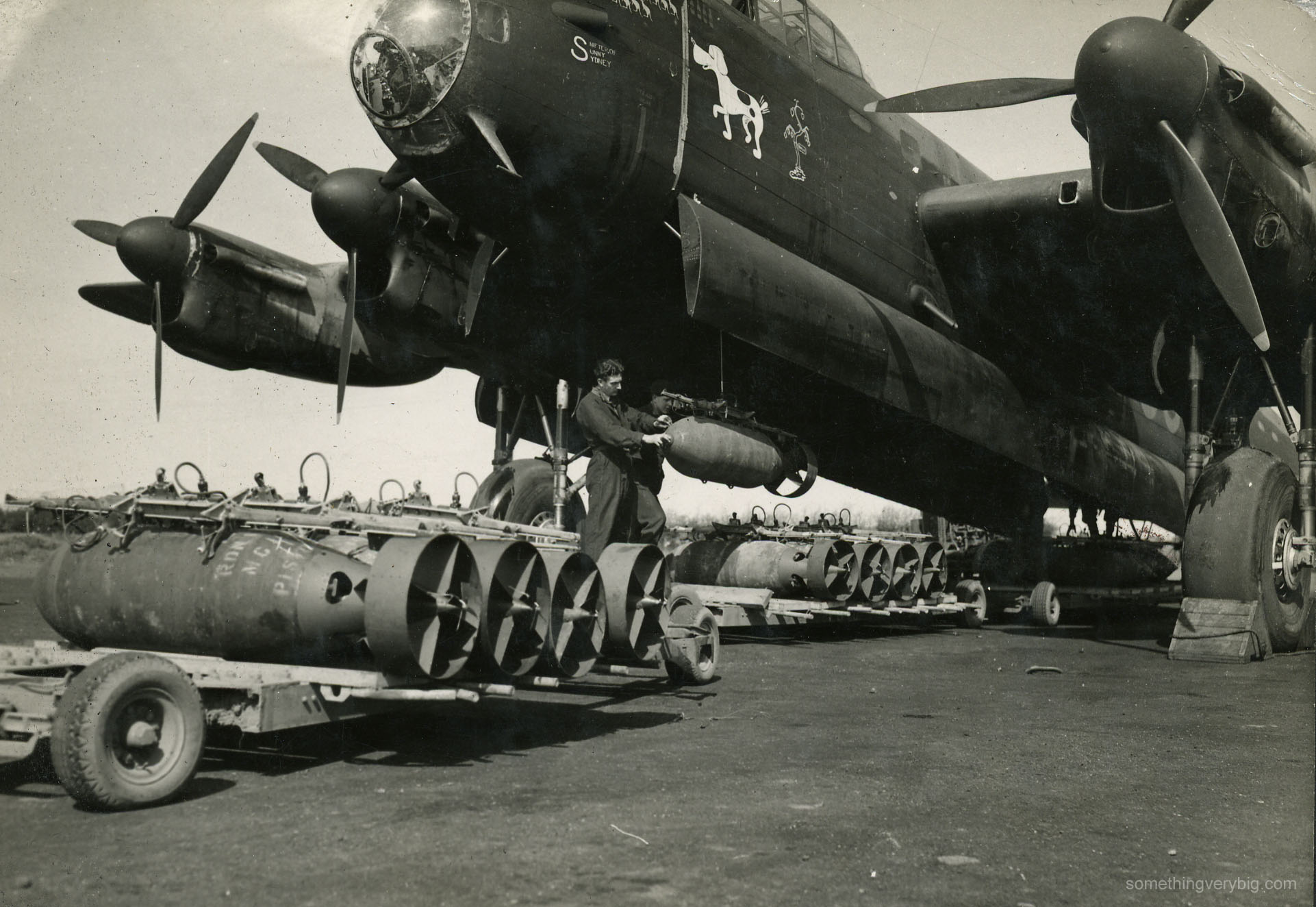
Bombing up DV280, JO-S "Snifty from Sunny Sidney" for Juvisy, 18 April 1944. Photo from the Waddington Collection, RAF Waddington Heritage Centre
Bombing up DV280, JO-S “Snifty from Sunny Sidney” for Juvisy, 18 April 1944. Photo from the Waddington Collection, RAF Waddington Heritage Centre

The target for tonight was the railway marshalling yards at Juvisy, about ten miles south of the centre of Paris. This would be one of four attacks on railway targets on this night, all part of the Transportation Plan. The other targets were at Rouen, 40 miles east of Le Havre, which was bombed by 273 Lancasters and 16 Mosquitos, Noisy-le-Sec north east of Paris attacked by 181 aircraft, and Tergnier, south of St Quentin and attacked by 171 bombers.[1] Other Bomber Command operations on this night included 168 heavies laying mines in Swinemünde, Mosquitos attacking Berlin, Osnabrück and Le Mans and assorted Radio Counter-Measure, Serrate and training sorties.

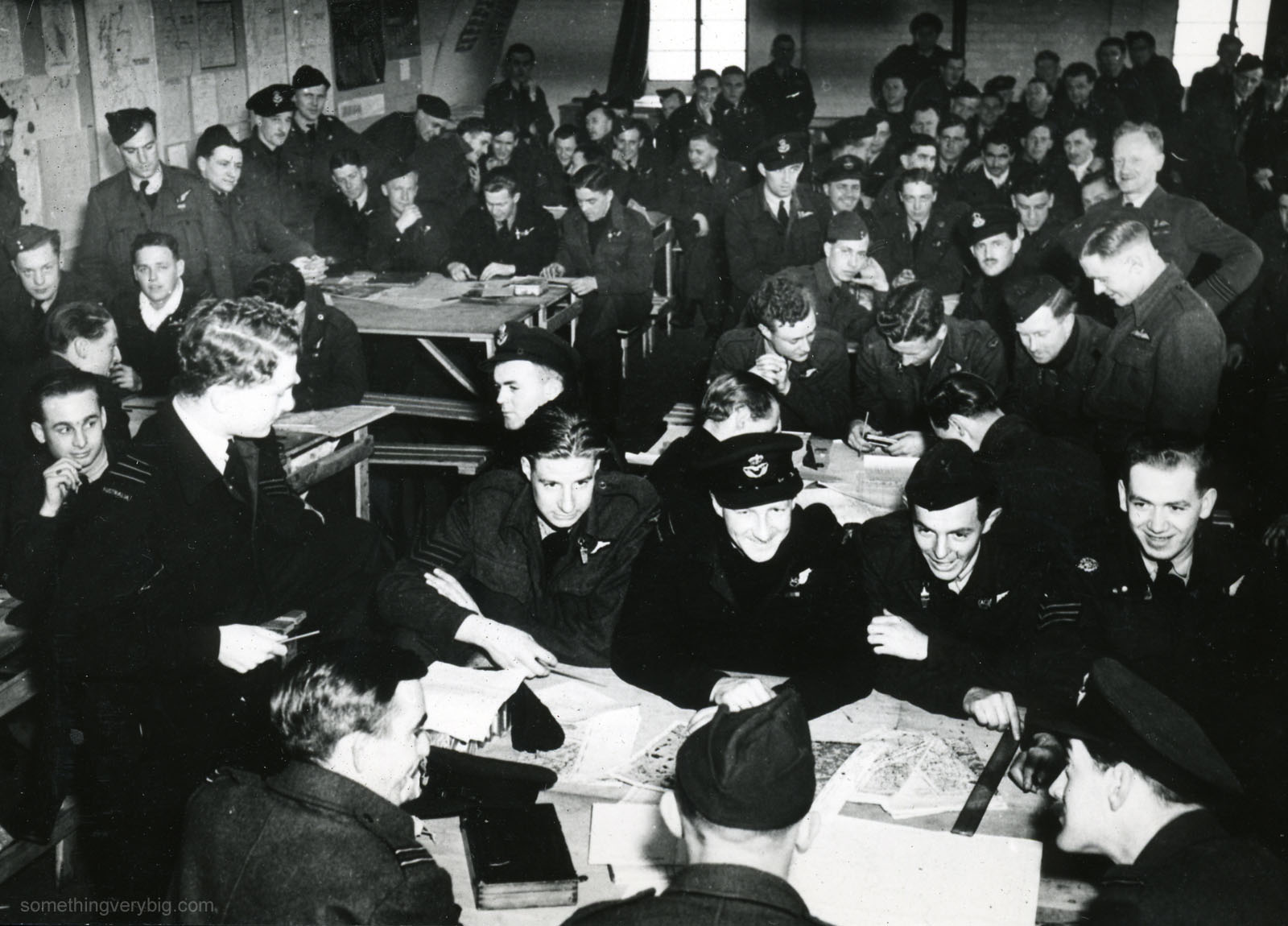
463 Squadron crews in the briefing hut before the raid on 18 April 1944. From the Waddington Collection, RAF Waddington Heritage Centre
463 Squadron crews in the briefing hut before the Juvisy raid on 18 April 1944. From the Waddington Collection, RAF Waddington Heritage Centre

More than 200 aircraft were sent to Juvisy, including seven Mosquitos. Waddington’s contribution was 37 Lancasters: 17 from 463 Squadron and 20 from 467. All got away though not without some excitement. The 467 Squadron Operational Record Book shows that one aircraft, ND732 being flown by Pilot Officer Ken Feeney, swung off the runway on its first take-off roll, but after taxiing back to the start of the runway for another go Feeney took off successfully. Pilot Officer Bill Felstead lost brake pressure in ED657 at the critical moment and also took to the grass. The fault was easily rectified and they were eventually on their way only a few minutes behind the rest of the bombers.

As they had not been on the Tours operation a little over a week ago, this was the first time that the crew of B for Baker took part in a Transportation Plan ‘pre-invasion’ raid. Joining them as second pilot in LM475 was Waddington’s new Station Commander, Group Captain David Bonham-Carter. “He was, in my view, quite an elderly chap,” wrote Phil later. “I would put him between 40 and 50 and not ‘fit full flying duties”.[2]

The bomber stream flew across the Channel via Selsey Bill and tracked between Caen and Le Havre to a point near Argentan. There they turned south east and flew nearly 80 miles to a point south of Chartres. They then turned north east.

It was at the final turning point before the target that Phil Smith committed what he later called “one of the classical flying errors:”

We approached the target flying about east until we were just south of Paris. We then had to make a sharp turn left for a very short leg up to the target. The course was to be 009, however the target markers did not turn up almost immediately, as expected. It quickly became clear that we were on a course of 090 instead of 009.

Once he recognised the error he was able to make a quick course correction and they bombed only a few minutes late, but Phil was quite embarrassed to have made such an elementary mistake in front of the new station commander.

The attack was to use tactics which by this stage of the war were becoming routine for Transportation Plan raids. It would open with three 8 Group Mosquitos dropping green target indicators as ‘proximity markers’ in the general target area. Guided by those markers, other aircraft would drop ‘hooded’ parachute flares to light up the target area. By the light of those flares, Mosquitos would mark the two aiming points with red spot fires. The Master Bomber, also in a Mosquito, was to assess the fall of the markers and instruct the Main Force to bomb accordingly. One aircraft – the Controller – was to act as a relay between the Master Bomber and the Main Force.[3] Bombing was to be from a much lower level than that used on German targets – the heights recorded in the 463-467 Squadron Operational Record Books vary between 7,000 and 11,000 feet.

It appears that the first ‘proximity markers’ were dropped some seven miles west of the aiming point, but “before anyone bombed more flares were dropped over [the] marshalling yard and red spot fires followed.”[4] The illuminating flares went down at zero hour (23.15) and there ensued a delay of about fifteen minutes while the target was marked and the markers assessed. The orbiting caused some dramas for a few skippers because of the sheer number of aeroplanes and lack of a defined plan. “Definite position should be given when a/c [aircraft] have to orbit target,” said Pilot Officer Col James of 463 Squadron. “Not so much orbitting [sic] as at Tours but still needs improvement.”[5]

Notwithstanding the delay, once the markers were down and bombing commenced a highly concentrated attack developed. There was no cloud and no moonlight. Some crews reported clear weather and that the marshalling yards were clearly visible, either by the naked eye or with the aid of illumination from the hooded flares or exploding photo flashes, but later on smoke and haze kicked up by the bombing spoilt the otherwise ideal conditions. But the markers had fallen true and many crews reported seeing bombs bursting on or very near to the target indicators.

replace
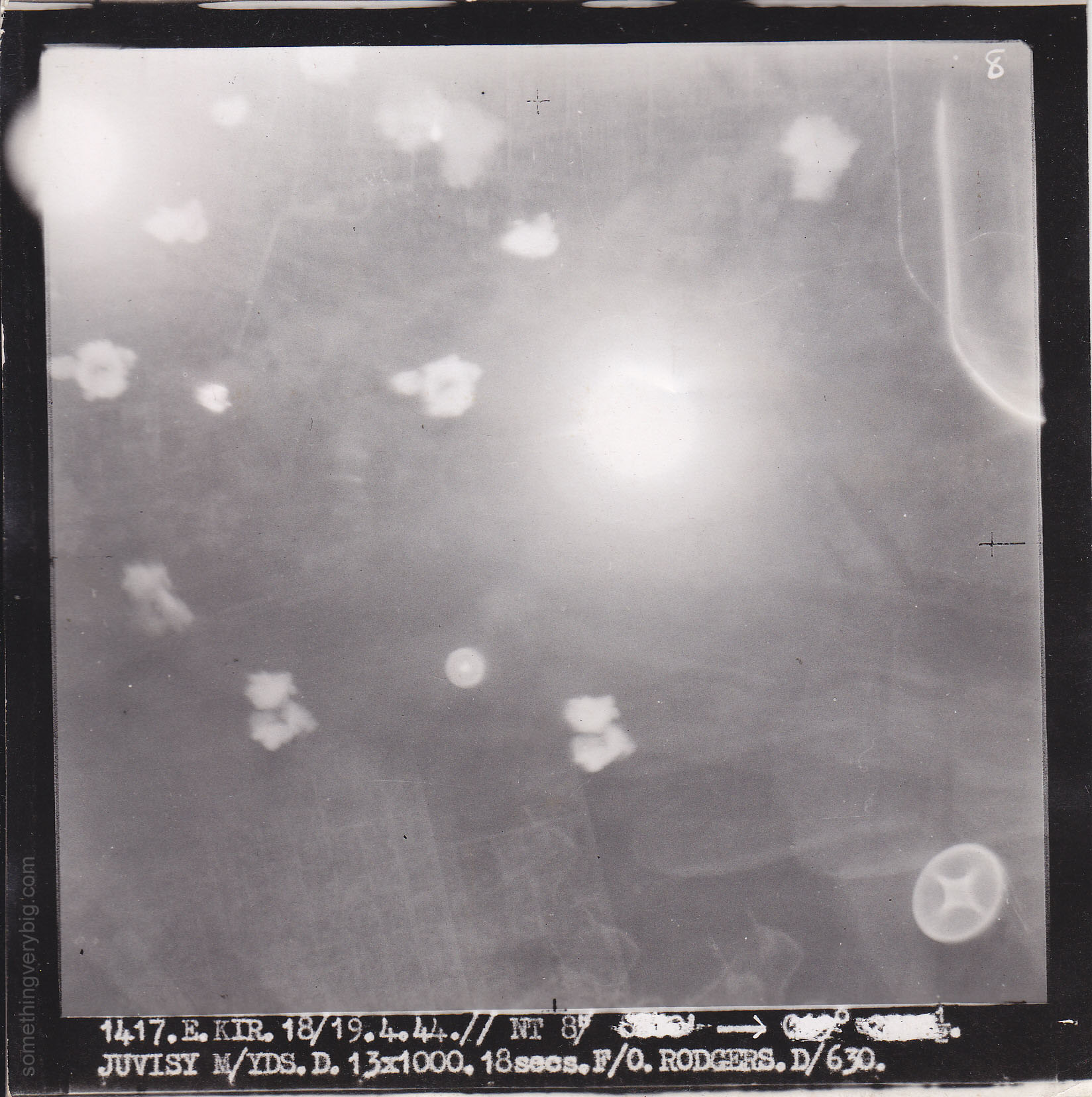
This bombing photograph from the Juvisy raid shows flak or bomb bursts in the target area with some ground detail also visible. The time of bombing has been scratched out, possibly by the censor. The caption on the rear of this photograph indicates that the crew concerned – piloted by C Wade Rodgers of 630 Squadron – achieved an aiming point. From the Wade Rodgers collection, courtesy Neale Wellman

As had become more or less standard on railway raids, the bombers each carried fourteen 1,000lb Medium Capacity high-explosive bombs. Most were fused with a 0.025 second delay to allow the bombs to bury themselves slightly before they went off, thereby maximising their crater-digging potential and ensuring their blast effects did not dissipate harmlessly at ground level. Other aircraft, though, carried bombs with a six-hour delayed fuse to make life difficult for repair crews. Indeed, there were later reports that bombs were still exploding up to a week after raid at Noisy-le-Sec which also occurred on this night.[6]

If anything the bombers were too concentrated. Photo flashes were going off everywhere and causing problems for some bomb aimers and 463 Squadron Commanding Officer Wing Commander Rollo Kingsford-Smith reported being bracketed by exploding photo flashes dropped from aircraft flying above. Pilot Officer Fred Smith said the risk of collision over the target was high. “Photograph will probably be unsuccessful”, he reported, “because of a very near collision with another Lanc. just before [the] camera turned over.” And Pilot Officer Roland Cowan complained that the red spot fires at which the crews were to aim were “soon knocked out by bombs bursting on them.” This would be a problem which would plague Bomber Command’s railway raids for some time – and it would, on a future operation, prove critical for the crew of B for Baker.

Flight Lieutenant Jack Colpus had one of his thousand-pounders hang up over the target. Sometime after he closed the bomb bay doors the bomb fell from its hooks and was rolling around on the doors in the bottom of the bomb bay. Colpus nursed the munition half way to the French coast before he opened the doors and it fell out into open French countryside 60 miles north west of the target.

The bombing continued almost entirely unhindered by enemy activity. Very few fighters were seen and flak was generally described as ‘negligible’. The defences was not entirely absent however, as some crews found out the hard way. The only loss suffered by the force that attacked Juvisy was a single 9 Squadron Lancaster which was seen to explode on leaving the target.[7] Flight Lieutenant Dan Conway, meanwhile, was tempting fate a little. He made a dummy run over the target in LM450 while waiting for the order to bomb, and then aborted a second run because he was not quite on the correct bombing heading. So they went round again, and the flak finally got them on their third run. It damaged the fuselage, mid-upper turret and bomb sight and punched a few odd holes elsewhere in the aeroplane. The damaged sight caused yet another aborted run as the bomb aimer adjusted to using it as a fixed sight. The matter-of-fact way this is reported in the Operational Record Book exemplifies the press-on-regardless attitude to getting the job done and demonstrates the great emphasis on accuracy placed on French targets in particular by the crews of Bomber Command.

But otherwise, everything went off nearly perfectly. Communications between the Master Bomber, Controller and Main Force worked well, the markers were accurate and the bombing was well concentrated. On the way home the returning bombers could see the night’s other operations in progress – Fred Smith judging that “quite a good show appeared to be going on at each” – and the return was trip was more or less uneventful. After some five hours in the air the first aircraft returned to Waddington shortly after 1am and by 02.30 all were safely home.

The 463 Squadron Operational Record Book called the devastation caused at Juvisy “very complete”, and modestly noted that sixteen out of a possible seventeen crews from that unit returned aiming-point photographs:

Good show!

The Night Raid Report shows that immense damage was caused to the marshalling yards, with tracks and rolling stock hit and engine sheds, carriage works and freight sheds all “at least 80% destroyed.” Further damage was caused to railway flyovers, road bridges and an oil depot and other factories located outside the target. Sadly, considerable damage was caused to residential areas to the north west of the target.

Juvisy and Rouen sustained the most crippling damage out of the four railway targets attacked on this night, but Noisy-le-Sec and Tergnier were also hit hard. Ten Halifaxes were lost on the latter two operations, as well as three bombers from the mining force and another three from the Rouen force, shot down by intruders while approaching to land at their bases at Binbrook and Littleport.

The Buckham crew at debriefing after Juvisy, 18APR44. Left to right, they are: F/S EJ Holden, Sgt W Sinclair, F/O RW Broad, F/O BA Buckham, F/O EH Giersch, F/S LJ Manning, P/O A Giles (Intelligence Officer) and F/O JW Muddle
The Buckham crew at debriefing after Juvisy, 18APR44. Left to right, they are: F/S EJ Holden, Sgt W Sinclair, F/O RW Broad, F/O BA Buckham, F/O EH Giersch, F/S LJ Manning, P/O A Giles (Intelligence Officer) and F/O JW Muddle. From the Waddington Collection, RAF Waddington Heritage Centre

This post is part of a series called 467 Postblog, posted in real time to mark the 70th anniversary of the crew of B for Baker while they were on operational service with 467 Squadron at RAF Waddington, Lincolnshire. See this link for an in-depth explanation of the series, and this one for full citations of sources used throughout it. © 2014 Adam Purcell

Sources:


[1] RAF Bomber Command Campaign Diary, April 1944

[2] Smith, Phil, Recollections of 1939-45 War, p.22

[3] Description of tactics from Night Raid Report No. 581

[4] Colpus, Jack, in 467 Squadron Operational Record Book, 18APR44

[5] 463 Squadron Operational Record Book, 18APR44

[6] RAF Bomber Command Campaign Diary, April 1944

[7] Easton, Arnold, Flying Logbook, 18APR44, and Night Raid Report No. 581. While the Night Raid Report says this aircraft – LM361, flown by an Australian, F/S Dudley Bates – fell to a fighter, Theo Boiton’s Nachtjagd War Diaries suggest it was actually shot down by flak.