467 Postblog LVII: Wednesday 12 – Monday 17 April, 1944

No operations for a few days at Waddington so the crews took the opportunity to do some flying training. On Thursday 13 April Phil Smith took the crew of B for Baker on a ‘height test’ in JA846. Interestingly this was a 97 Squadron machine. The fact that two representatives of Avro, the makers of the Lancaster, came along for the ride suggests that this was perhaps a test flight at the request of the Avro repair facility at Bracebridge Heath, which was just across the road from RAF Waddington. In any case, they climbed all the way to 26,000 feet, well over the 18-21,000ft range of most operational trips, and Phil said after the war that it was the highest he ever went in an aeroplane he was flying. “It was a clear but hazy day and the view of the ground was similar to that seen from a modern jet.”[1] Later that night they took B for Baker out for some night circuits. Other crews completed air-to-sea firing or bombing practice.[2]

Twice during this period, on Friday 14th and Monday 17th, operations were laid on but were scrubbed at late notice, one as the aircraft were warming up their engines before take-off. The preparation kept the air and ground crews busy but didn’t achieve much else. Two new crews arrived at 467 Squadron on Wednesday 12th April. “This will give some of the others a rest for every crew has had an aircraft lately which means all crews operate every time work is to be done,” said the Operational Record Book.

Phil Smith wrote a couple of letters home during this period. He was able to tell his mother that he “thoroughly enjoyed” the Messiah performance he saw on leave in London (“it was conducted by Malcolm Sargent and included the following soloists – all very fine singers – Isobelle Bailie, Kathleen Terries, Hiddle Nash and Robert Easton”) and said that he “‘went to war’ the first day back”, which was the Aachen trip the previous day. [3]

Here they have their own slang for operational work – instead of saying that ‘ops are on’ they say that the ‘war is on’ or not on as the case may be. When flights are authorised the duty used to be described as ‘ops as detailed’ but here they put ‘into battle’.

Also writing letters was Phil’s rear gunner, Gilbert Pate. One of them – to his mother and sister, Joyce[4] – is a fantastic summary of his time in England to date. It describes what happened after his first pilot (with 49 Squadron) went missing in November 1943, how he crewed up with a Canadian pilot until the pilot’s nerves played up and the crew was split up and how he came to be posted to Phil Smith’s crew at Waddington. He even looks towards the future, one of the only times this sort of thing appears in the quite extensive collection of Gilbert’s letters that I’ve seen.

As things stand now, I think I should wind up my tour of ops about August + then I shall have to do a course of instructing which I am not repeat not looking forward to. Of course there is a possibility of my going home but I can’t see that happening before another 12 or 18 months

There’s also a hint of bitterness here:

Of course there is a lot of talk about the war ending soon, but most of that comes from people who aren’t really in there slogging.

There are similar sentiments in another letter written to his mother the same day:

Still appears quite a lot of dodgers in this country, I don’t know how they manage it.

It’s unclear what brought on these feelings.

Elsewhere, of course, other elements of Bomber Command were still out and about during this period. On Wednesday 12 April, 39 Mosquitos made a harassing raid on Osnabrück, 50 Stirlings and Halifaxes laid mines off the Friesian and Dutch coast and in the Heligoland Bight. 11 Wellingtons dropped leaflets over France. Two Mosquitos made a Serrate patrol and another made a weather recce. Finally, 21 Halifaxes and Stirlings made special operations over Europe. The two Stirlings which failed to return from the latter were the only two casualties of the night.

The next night, 29 Mosquitos went to Berlin, six to Duren and three to Dortmund. 16 Stirlings Halifaxes were sent to lay mines off three French ports (one returned early with engine trouble). And on Monday April 17, 26 Mosquitos attacked Cologne, two went to the marshalling yards at Le Mans and 20 Stirlings and Halifaxes laid mines in Kiel Harbour and the Frisian Islands. Two Mosquitos made uneventful Serrate patrols and 20 Wellingtons with two Stirlings dropped leaflets over France, Holland and Belgium. One of the minelayers failed to return.[5]


Next post in this series: 18 April

This post is part of a series called 467 Postblog, posted in real time to mark the 70th anniversary of the crew of B for Baker while they were on operational service with 467 Squadron at RAF Waddington, Lincolnshire. See this link for an in-depth explanation of the series, and this one for full citations of sources used throughout it. © 2014 Adam Purcell

Sources:


[1] Smith, Phil, Recollections of 1939-45 War, p.22

[2] As recorded in Arthur Easton’s logbook

[3] Smith, Phil, Letter to Father, 12APR44

[4] Pate, Gilbert, Letter to Mother and Joyce, 14APR44

[5] Other operations recorded in Night Raid Reports Nos. 578-580

467 Postblog LVI: Tuesday 11 April, 1944

The Gestapo Headquarters in Den Haag, the Netherlands, was a white five-storey building near the Peace Palace. A former art gallery, the building now housed the Dutch Central Population Registry, holding copies of all the legally-issued identity papers of Dutch civilians, which allowed papers falsified by the Resistance to be recognised. As such, the Dutch requested that the RAF smash the building from the air. On this fine April morning, in an operation described later as “probably the most brilliant feat of low-level precision bombing of the war,” six Mosquitos of 613 Squadron attacked and completely destroyed it. The leader of the highly successful raid, Wing Commander R.N. Bateson, was awarded the Distinguished Service Order as a result, and later added to it the Dutch Flying Cross, presented by Prins Bernhard of the Netherlands.[1]

Meanwhile, an operation was laid on for the night for the two Australian squadrons at RAF Waddington. The target was Aachen, in particular its marshalling yards, and as the 467 Squadron Operational Record Book said, “this time it is a full trip.” While it is inside the seven degrees of latitude line which was used as the trigger point on French, Belgian or Dutch raids, Aachen is also – just – inside Germany. Consequently this operation would count for a full trip for the purposes of counting a tour of operations rather than the ‘third’ of a trip earned for the previous couple of raids that were on French targets. Fifteen 463 Squadron crews were briefed for this trip, which would see a total of 350 Lancasters and Mosquitos fly to Aachen. Eighteen were on the battle order from 467 Squadron but one crew missed out when their skipper – Pilot Officer John McManus – fell sick before take-off.[2]

An hour or so before departure, in fine conditions and with the beginnings of a sunset filling the sky, the crew truck deposited the airmen at their dispersals. As ground staff made last-minute adjustments and plugged in the trolley accumulators, the crews gathered around their aircraft, waiting for the time to climb aboard, fire up the Merlins and taxi out for take-off. It is this scene – showing B for Baker and her crew and based loosely on the conditions as they were for the Aachen raid – which was painted in 2010 by aviation artist Steve Leadenham:

lancaster_7-little1 copy

Also preparing for operational sorties on this night were the usual bunch of Mosquitos to carry out intruder operations, Serrate patrols and attacks on Hanover, Osnabrück and Duisburg. They would also hit airfields throughout France, Holland, Belgium and western Germany. Some training aircraft would scatter leaflets in France and 26 aircraft were to fly special Resistance support operations. Finally, a small force of Halifaxes and Stirlings were planned to drop mines off Brest and in the Kattegat.[3]

The first aircraft took off from Waddington at 20.15. There was one early return with Pilot Eric Scott’s aircraft (LL795 of 463 Squadron) suffering an engine failure approaching the Dutch coast. They jettisoned eight of their fourteen 1,000lb bombs and turned back, landing at Waddington at 23.14. This was one of eight aircraft to return early out of the 350 dispatched to Aachen.

The rest of the force converged on the rendezvous point, off the Dutch coast about 40 miles west of Rotterdam. They formed into a highly concentrated[4] stream that headed directly to Aachen. A few fighters were encountered patrolling the islands in the South Holland delta but they made no serious attacks and, except for one bomber which wandered south of track and fell to the guns of Antwerp, none were lost until the target was reached. Half the nightfighters had apparently been drawn north by the small force of bombers dropping mines in the Kattegat. Most of the remainder were sent to Bonn, some 35 miles beyond Aachen, trying to cover a possible deeper penetration by the bombers. Four Mosquitos, as part of the overall deception, also dropped spoof fighter flares at Almelo in the east of the Netherlands, some 115 miles north of Aachen, perhaps intending to make the Osnabrück or Hanover deceptions look more convincing to the defenders.

The biggest problem encountered by the bombers was that the forecast winds were significantly different to the actual winds encountered in flight. The result was that most of the bomber stream needed to lose significant time en route – Squadron Leader Phil Smith noting the figure of 14 minutes – meaning that almost all crews had to orbit, fly doglegs or otherwise waste time. Phil suggested the use of a ‘floating’ zero hour in future as a way to avoid this, an idea shared by Pilot Officer Anthony Tottenham, who put it rather more bluntly:

No future in continuous orbiting.

The target was blanketed in broken cloud when the bombers arrived overhead, but it was only thin and would not cause any problems. There was some accurate predicted flak in the early stages of the attack but it soon died down into only a loose barrage, and only a single bomber was lost to the ground defences of Aachen. There were a small number of combats with fighters over the target but with no conclusive result for either side.[5]

Though the Night Raid Report says that the bombing was “well-timed”, there are a number of reports in the Operational Record Books which suggest that the Pathfinder Mosquitos that were supposed to precede the Main Force into the target area were in fact a couple of minutes late. Apparently some airmen got sick of waiting for them, perhaps frustrated by the need to orbit in the target area, because numerous crews reported seeing incendiaries dropping before the first target indicators went down, drawing complaints from other pilots. “Cannot something be done to stop this prevalent practice,” complained Flight Lieutenant Freddy Merrill. Whatever the case, once the markers did go down they were highly accurately placed and “could be plainly recognised”[6] through the thin cloud. The Main Force then proceeded to drop their bomb loads almost entirely unharassed by the defences. The bombing was so concentrated that crews reporting seeing sticks of bursting bombs straddling the target indicators, and some fires were beginning to get a hold in the city as the bombers left. “A wizard prang if PFF spot on”, thought Flight Lieutenant Walter Marshall. About the only trouble encountered was that four 467 Squadron aircraft had bombs hang up over the target, including B for Baker. The crew attempted to jettison the offending munition over the North Sea on the way home, but it was frozen in place and they had to land back at base with the bomb still hanging in its rack.

After bombing the force continued east over Aachen for another few miles before turning to the north and, eventually, back towards home. It was on the homeward journey that the nightfighters finally began to have a little success, claiming five bombers on this leg. The first was shot down near Roermond, then another fell south of Eindhoven, a third near the Luftwaffe nightfighter base at Gilze-Rijen, the next at Overflakke in the South Holland delta and a final victim over the North Sea. One crew reported seeing air-to-air rockets on the homeward journey but it is unknown if any bombers were shot down this way.[7] Some nightfighter intruders did follow the bombers back to their bases and several returning aircraft came under attack from them but it does not appear that any were shot down.

The first aircraft to land back at Waddington did so at 00.22. B for Baker was home thirteen minutes later after a little less than four and a half hours in the air. DV372 with Flight Lieutenant Jim Marshall at the controls landed at 01.05. Their radio was unserviceable on return so, unable to call the control tower, they needed to wait until everyone else was down before commencing their approach.[8] With their arrival, all 32 Waddington crews were safely back on the ground.

Nine aircraft failed to return from this operation. Seven had fallen to known causes but the losses of the remaining two remain a mystery. Seven aircraft returned damaged by flak, fighters or ‘friendly’ incendiaries. The effect of the bombing on Aachen was significant. The bombers left the city in flames that were visible from some distance away on the return flight, and the Night Raid Report records that the attack was “well centred on the station and marshalling yards” and the centre and south of the town was hit hard. It lists serious damage to the passenger train station, loco and goods sheds and the marshalling yards themselves. Even the bridge spanning the middle of the yards was hit by three bombs. Textile factories and residential property, particularly in the southern suburb of Burtschied, suffered “severely”.[9]

It was for the city of Aachen the worst raid of the war.

This post is part of a series called 467 Postblog, posted in real time to mark the 70th anniversary of the crew of B for Baker while they were on operational service with 467 Squadron at RAF Waddington, Lincolnshire. See this link for an in-depth explanation of the series, and this one for full citations of sources used throughout it. © 2014 Adam Purcell

Sources:


[1] Bowman 2003, p.190

[2] 467 Squadron Operational Record Book, 11APR44

[3] Night Raid Report No. 577 and RAF Bomber Command Campaign Diary, April 1944

[4] As reported by Flying Officer Arnold Easton in his logbook, and by Pilot Officer Arthur Bowman in the 463 Squadron Operational Record Book, 11APR44

[5] Weather and defence details from Night Raid Report No. 577

[6] Pilot Officer David Gibbs in the 467 Squadron Operational Record Book

[7] Nightfighter kills from Night Raid Report No. 577, rockets reported by Pilot Officer Noel McDonald in the 467 Squadron ORB

[8] Easton, Arnold, flying log book, 11APR44

[9] Catalogue of damage from RAF Bomber Command Campaign Diary, April 1944

467 Postblog LVb: Monday 10 April, 1944

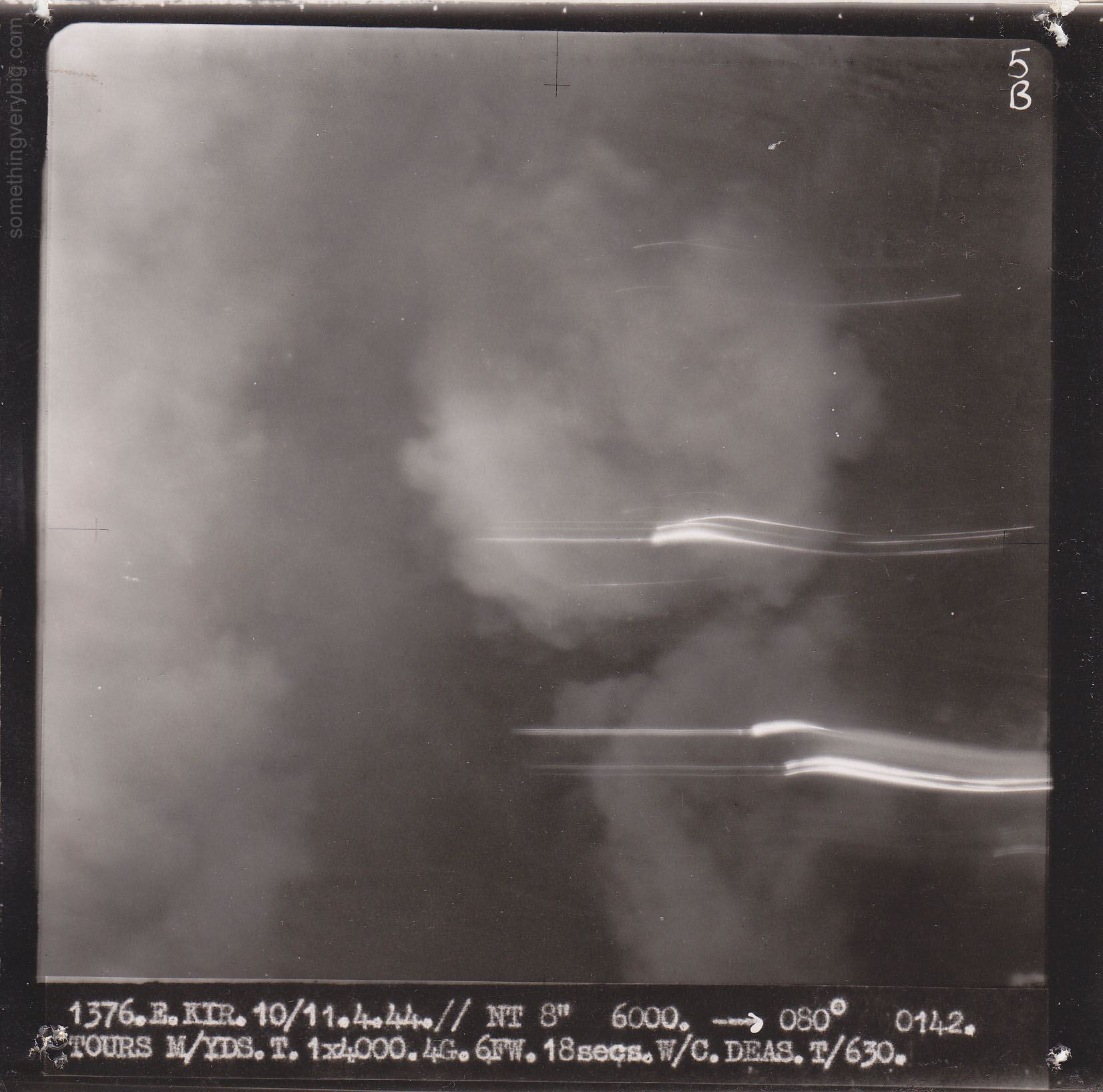
Target Photo shows smoke at 01.42 during the first attack - from the Wade Rodgers collection, courtesy Neale Wellman
Target Photo shows smoke at 01.42 during the first attack – from the Wade Rodgers collection, courtesy Neale Wellman

The first aircraft of the second wave arrived over Tours around fifteen minutes before 2 a.m. When the leader got to the marshalling yards he found thick clouds of black smoke from the earlier attack billowing up to and beyond his bombing height, stretching west and obscuring the western part of the target and preventing an immediate identification of their briefed aiming point. The Master Bomber thus ordered crews of the second wave to stand off to allow time for the exact aiming point to be identified and marked, and the new target indicators assessed. At this stage the last aircraft of the first wave were still bombing and some crews of the second – who perhaps had missed or even ignored the order to stand by – decided that the bombing they could see in progress was most likely the raid of which they were supposed to be part, and proceeded to drop their bombs as well. At least two Waddington crews bombed before 02.00 and eight more before 02.15, probably among crews of the other squadrons that were also on this raid. One was Pilot Officer Harold Coulson who ruefully reported that their error was “realised on return journey when we saw red spot flares going down.” While it’s understandable why Coulson bombed when he did, the “indiscriminate bombing” and “unauthorised chatter on R/T” induced 467 Squadron Commanding Officer Wing Commander Sam Balmer to label the operation “a failure from a disciplinary point of view.”[1]

It took some time for the spot fires eventually seen by Coulson to be dropped however, the delay mainly caused by the blanket of smoke obscuring the target and the desire to ensure the accuracy of the markers to avoid French civilian casualties as much as possible. It would appear that the target was finally marked at around 02.24, and due to the smoke and the easterly wind crews were ordered to bomb from east to west, on the reciprocal to their planned heading, and told to overshoot the spot fire by 100 yards.

There is a report by one crew in the 467 Squadron Operational Record Book that a second order to stand by was received at 02.32 after about nine more Waddington aircraft had bombed. Flight Lieutenant Jim Marshall was the only pilot to report this however (it came as they were on their bomb run so they did not drop anything and returned to the datum point again), and other aircraft continued to bomb. It was only a short break however and shortly thereafter the Master Bomber ordered the attack to continue.

By far the majority of the Waddington crews bombed between 02.29 and 02.48, dropping 28 bomb loads in all in nineteen minutes. Interestingly four crews bombed twice in this time. They were some of the crews carrying cookies and these were dropped first. They then made another run to drop their incendiaries. The concentration of bombers was so heavy over the aiming point that one pilot – Freddy Merrill – needed to corkscrew out of the path of another aircraft which, bomb doors agape, was directly above him and about to release its munitions.[2]

The continual stop-start progress of the attack, combined with undisciplined radio chatter, communication difficulties and the smoke that obscured the target resulted in much confusion and probably explains why so many crews simply carried on bombing despite orders to hold off. Some aircraft had been waiting, circling either the target area or the datum point, for up to an hour and by now fuel was a potential issue for the homeward journey. Defences were almost ludicrously light. No fighters were seen and the flak at the target was described by one pilot as “negligible.” The bright moonlight and clear skies reduced the risk of collisions between the bombers. But Jim Marshall’s crew reported seeing a ‘scarecrow’ (allegedly a German pyrotechnic designed to simulate the demise of a bomber) exploding at 02.45 and two minutes later the Master Bomber called the bombing off. [3]

There’s no future in this – stop bombing and return to base.

Since in fact the Germans had no such things as ‘scarecrows’[4] and only one aircraft was lost to light flak over the target, there is a good chance that what Marshall saw actually was the lost bomber blowing up. Perhaps this made the Master Bomber recognise that they had tempted fate long enough. The bombers flew home more or less uneventfully, most of the Waddington aircraft arriving back at base between four and five in the morning.

Despite the smoke and confusion over the target itself, the operation was successful. Six of the 17 crews from 463 Squadron returned an aiming point photograph (Flight Sergeant McMahon – Bill Brill’s bomb aimer – being congratulated in the Operational Record Book for obtaining the “best photograph in Base”) and out of the five marshalling yards attacked on this night, the one at Tours suffered the heaviest damage. Interestingly, Flying Officers Eric Scott and Keith Schultz both suggested that delayed action bombs may have been more appropriate for concentrated, multiple-wave precision operations like these. They were perhaps influenced by their experiences on the successful Toulouse raid on 5 April where this tactic was used.

The exploding Halifax possibly seen by Jim Marshall was the only casualty from this part of the night’s operations. Ten aircraft failed to return from the 167 sent to Tergnier (a high percentage which the Night Raid Report speculated may have been caused by the bright moonlight), seven from Aulnoye and one from Laon. All returned safely from Ghent. Three Special Operations aircraft – two Stirlings and a Halifax – were the only other casualties.[5]

This post is part of a series called 467 Postblog, posted in real time to mark the 70th anniversary of the crew of B for Baker while they were on operational service with 467 Squadron at RAF Waddington, Lincolnshire. See this link for an in-depth explanation of the series, and this one for full citations of sources used throughout it. © 2014 Adam Purcell

Sources:


[1] 467 Squadron ORB 10APR44

[2] 463 Squadron ORB, 10APR44

[3] 467 Squadron ORB 10APR44

[4] Hastings 1979, p.197

[5] Night Raid Report No. 576

467 Postblog LVa: Monday 10 April, 1944

A bright and sunny day began at Waddington with the news that operations were planned for the coming night, and so the aircrews would be going to war. Before they began their preparations for the coming night’s work, however, navigator Arnold Easton’s logbook shows that his crew took a French sergeant from the Intelligence Branch and someone called ‘Taffy’ along on a combined cross country and fighter affiliation exercise in the morning. He did not however record what their two passengers thought of the evasive manoeuvres that would have been part of the flight.

Though the crew of B for Baker were due back from their leave today they were not among the 35 crews on the battle orders of both squadrons. Those that were would be part of a force of 166 aircraft, all from 5 Group, sent to attack the marshalling yards at Tours in southern France. Similar forces were sent to other railway targets at Tergnier, Ghent, Aulnoye and Laon. Elsewhere, Mosquitos were to attack Hannover and Duisburg, Wellingtons would drop leaflets over Northern France, 54 special operations sorties would be flown, some Stirlings would lay mines off France and a small number of Lancasters and a Mosquito from 617 Squadron would attack a Luftwaffe signals depot and airfield at St Cyr, very close to the Palace of Versailles west of Paris.[1]

It was a reasonably late take-off, with the first aircraft – captained by Squadron Leader Arthur Doubleday – rolling down the Waddington runway at 22.39. Just under fifty minutes later all 35 were away. There were no early returns.

The bombers flew down through England via the town of Newbury, then left the coast as usual at Selsey Bill and crossed the Channel to Cabourg. Pilot Officer Bill Felstead suffered an engine failure at this point in LL788. The recalcitrant powerplant was feathered and the trip completed on three. At a point east of Le Mans the bombers turned almost due south for a point about 12 miles west of the target. A flare marked this datum point, though a couple of crews did not see it and others complained that it did not burn for very long.[2]

The marshalling yards at Tours, between the Loire and Cher rivers, stretch some two and a half miles from west to east. There are two distinct sections with a ‘bottleneck’ of train tracks joining the two.

Tours marshalling yards in 2010 - pic: Google Earth
Tours marshalling yards in 2010 – pic: Google Earth

No. 5 Group sent two groups of bombers to Tours on this night: the first was to attack the eastern section and the second wave, of which all the Waddington aircraft were planned to be a part, were to bomb the western part. With clear conditions and bright moonlight expected over the target red spot fires were to be dropped by the leaders of each force, with a Master Bomber to assess the markers and issue instructions to the rest of the force by radio.

Unfortunately the available information for these smaller operations to France is not as detailed as it is for the bigger city-busting operations, so the exact plan – and therefore how far actual events deviated from it – is unclear. The following has been reconstructed from a detailed reading of the Night Raid Report and the 463 and 467 Squadron Operational Record Books. The latter two sources in particular do not include much of the story from the point of view of any of the other squadrons that took part in the attack but if we take it as representative of crews in the second wave there is enough detail to build a picture of what happened.

The first markers fell near the bottleneck in the centre of the two sections of the yards, and the Master Bomber ordered the force to aim their bombs 500 yards to the east of the bright red spot fire. The resulting bombing was described in the Night Raid Report[3] as “most concentrated,” though it did not look like this to crews in the second wave.

While most aircraft appear to have been carrying 13,500lb of general purpose high explosive bombs, a proportion of crews had one 4,000lb ‘cookie’ and 8,400lb of incendiaries in their bomb bays. The problem, however, was that the incendiaries caused fires to break out, resulting in a great deal of smoke to rise from the target. An easterly wind at ground level then blew that smoke westwards, over the second portion of the marshalling yards, and into the path of the second wave of attackers.


Next: The second wave arrives at Toulouse…

This post is part of a series called 467 Postblog, posted in real time to mark the 70th anniversary of the crew of B for Baker while they were on operational service with 467 Squadron at RAF Waddington, Lincolnshire. See this link for an in-depth explanation of the series, and this one for full citations of sources used throughout it. © 2014 Adam Purcell

Sources:


[1] Night Raid Report No. 576

[2] Pilot Officers JH Dechastel (463 Squadron) and Ed Dearnaley (467 Squadron), in Operational Record Books

[3] No. 576

Bomber Command Commemorative Day 1 June 2014 – Events Around Australia

Sunday 1 June 2014 will see the annual Bomber Command Commemorative Day take place in locations around Australia. The headline event, as usual, is a weekend of activities and ceremonies in Canberra but there will be ceremonies taking place right across the country:

  • Canberra:
    • Sunday June 1 2014, 10.50am for 11.00, at the Bomber Command Memorial, Sculpture Garden, Australian War Memorial
    • Canberra will also host a Meet & Greet function at the War Memorial on Saturday night and a Luncheon following the ceremony on Sunday. Further details to come.
  • Brisbane:
    • Sunday 1 June 2014, 10.15am for 11.00 at Memorial Gardens, front gates of RAAF Amberley. Contact: Ted Vowles, 0418 758 072 or 07 3396 3004
  • Adelaide:
    • Sunday 1 June 2014, 11.00am at Air Force Memorial, Torrens Parade Ground, Victoria Drive, Adelaide. Contact: Dave Helman dave.helman@internode.on.net
  • Perth:
    • Sunday 25 May 2014, 10.00am at RAAFA (WA) Headquarters, 2 Bull Creek Dr, Bull Creek. Contact: Grahame Bland, RAAFA (WA) State President, 08 9311 4445
  • Melbourne:
    • Sunday 1 June, 2014, 2.00pm at Nurses Memorial Centre, 431 St Kilda Rd [entrance off Slater Rd]. Tram Stop No. 23. Contact Robyn Bell, 03 9890 3107.
    • Note the change of venue, a temporary measure for this year only due to ongoing renovations at the Shrine of Remembrance
  • Sydney:
    • Details TBA


467 Postblog LIV: Sunday 9 April, 1944

Operations were planned tonight – on Easter Sunday – but the misty and overcast conditions at Waddington forced a cancellation shortly after the squadrons had organised a battle order. The scrubbing was the “quickest on record for many months”, observed Flying Officer McDonald in the 467 Squadron Operational Record Book. Apart from some limited flying training, that was the end of Waddington’s day.

Other Bomber Command units were, however, in action on this date. There were the by now usual small groups of Mosquitos that went to the cities of Mannheim, Osnabruck, Duisburg, Dusseldorf and Cologne, bombed fighter airfields and made fighter patrols. Lancasters laid mines and other aircraft made special sorties over the Continent. Eleven aircraft were missing from these operations.

The heavies were out as well. More than two hundred of them bombed the marshalling yard in Villeneuve St George (near Paris), and another 239 attacked the marshalling yards at Lille.[1]

Both railway targets were hit hard, but it is the Lille trip in which we have a special interest. The plan was for the target to be marked by Oboe-equipped Mosquitos, with markers to be laid on two distinct aiming points. In a concession to the close proximity of French civilian homes and businesses, if no markers were visible, the crews were told to bring their bombs back home.

Fighter flares were dropped by the Germans before the bombers had even crossed the French coast but, apart from these and a small number of aircraft seen over the target, there was little fighter activity on this trip. The target area was clear of cloud with a slight ground haze. Both target indicators fell within 300 yards of the precise aiming point, and the Main Force proceeded to drop their bombs in a “fine” concentration around the markers. There was a little heavy flak over Lille, cooperating with some 20 searchlights, and only a single Halifax was lost.

The marshalling yards received heavy damage. Tracks were severed, repair workshops were destroyed, rolling stock was badly hit and an ammunition train blew up in a siding. For the time being, the Lille marshalling yards were out of commission. But railway yards are relatively easy to repair, and a month later they would need to be attacked again. Next time – critically for B for Baker and her crew – the attackers would not be so lucky.


This post is part of a series called 467 Postblog, posted in real time to mark the 70th anniversary of the crew of B for Baker while they were on operational service with 467 Squadron at RAF Waddington, Lincolnshire. See this link for an in-depth explanation of the series, and this one for full citations of sources used throughout it. © 2014 Adam Purcell

Sources:


[1] Details of all operations on this day from Night Raid Report No. 575

467 Postblog LIII: Thursday 6 – Saturday 8 April, 1944

Aircraft trickled in to Waddington from late morning on Thursday, making the quick hop over from their diversions to Silverstone after the previous night’s highly successful raid. For the next couple of days there would be no operations flown from Waddington, and the opportunity was taken to do some practice flying. It was not always successful however, and once again on Saturday 8 April Flight Lieutenant Jim Marshall and his crew were among some crews who needed to return from a sortie to the bombing range at Wainfleet without dropping anything because of poor weather.[1]

Bomber Command operations continued as usual, though the Main Force was not used. Mosquitos were very active on Thursday night, attacking Hamburg, Duren, Rheinhausen, Hagen, Wuppertal, Aachen, Essen and Cologne. On the same night three other aircraft made special operations sorties over the Continent. Aircraft laid mines off Texel and the Dutch coast and made fighter patrols and special sorties on Friday night, and on Saturday Mosquitos went back to Essen and also attacked Duisburg and Osnabruck. Other aircraft laid mines in a similar area to Thursday’s operations or carried out special operations. The only casualty during this period was one Mosquito which failed to return from Hamburg on Thursday night.[2]

Meanwhile, Phil Smith was still enjoying his leave in London. He had spent four days with Tate & Lyle and, when he wrote his letter (leaning on his knee) on the evening of Good Friday, he was sitting in Hyde Park waiting for a concert at Albert Hall. Earlier in the week, he had managed to catch a couple of shows in the capital. ‘Lisbon Story’ he did not like much, but he thought ‘Arsenic and Old Lace’ quite amusing. “I shall let you know how I liked the Messiah” – tonight’s concert – “in my next letter”, he promised his mother.[3] After dinner with a representative from the sugar refinery, the next day Phil went to visit his uncle Jack and family in Denham, just outside London to the west, where he would stay for the weekend before catching a train back to Waddington. It was a quiet visit but “that suited me as I wanted to take things easily,” he wrote.[4]


Next post in this series: 9 April

This post is part of a series called 467 Postblog, posted in real time to mark the 70th anniversary of the crew of B for Baker while they were on operational service with 467 Squadron at RAF Waddington, Lincolnshire. See this link for an in-depth explanation of the series, and this one for full citations of sources used throughout it. © 2014 Adam Purcell

Sources:


[1] Easton, Arnold, Flying Logbook, and 467 Squadron Operational Record Book, 08APR44

[2] Operational details from Night Raid Reports Nos. 572-4

[3] Smith, Phil. Letter to Mother, 07APR44

[4] Smith, Phil. Letter to Father, 12APR44

467 Postblog LII: Wednesday 5 April, 1944

Most of the Waddington aircrews were off on leave today, but the war was still going on and someone had to fight it. The bright moonlight – it was three days off the full moon – precluded any long penetrations to Germany’s heavily defended cities by the massed Main Force, but made for ideal conditions for precision raids. In the south of France, aircraft factories and repair sheds at Toulouse were engaged on work on Heinkel HE111 and Junkers Ju88 aircraft, and Bomber Command wanted that work disrupted. 148 aircraft, all from 5 Group, were sent to four adjacent sites in the city and 21 of them were from Waddington, taking off around 20.30. With its usual crew on leave, LM475 B for Baker was flown on this operation by Pilot Officer Bill Mackay and crew.

The bombers left the English coast at Selsey Bill as usual, flying south via Cabourg and Marmande before turning south-east towards the target.[1] Only two fighters are mentioned in the Night Raid Report as being seen on the way to Toulouse. The German controllers were apparently expecting a raid on southern Germany and held their fighters for that possibility. While some predicted heavy flak and a lot of ‘hosepiped’ light flak was encountered in the target area, it had little effect on what transpired next.

Conditions, on arrival, were just about perfect for this type of bombing. The target was lit by bright moonlight and there was no cloud and “perfect” visibility. The operation was led by 467 Squadron Commanding Officer Wing Commander Sam Balmer, and though his first marker failed to ignite he dropped a second one on a hangar in the north east corner of the aiming point.[2] Following aircraft just needed to aim at that marker.

And they did. If anything the raid was too concentrated: at least two crews required evasive action when on their bombing runs, not from fighters or flak but from other Lancasters.[3]

A few aircraft carried the ‘normal’ load of ‘cookie’ and incendiaries but most aircraft dropped loads of 1,000lb and 500lb bombs, all fused with a six-hour delay. The effect was that the view of the target remained unobstructed by smoke. Consequently crews could not report immediately on results of the raid, but the general feeling appears to have been that it would prove to be a successful one. The only loss was a single Lancaster which was seen to blow up over the target; probably a victim of flak.[4]

Most of the Waddington aircraft diverted to Silverstone, landing a half-hour or so either side of 04.30. Flight Sergeant Ed Dearnaley had a scare on landing when a 1,000lb bomb which had hung up over the target “came adrift” and knocked a bulge in the bomb doors of LL788, and Pilot Officer Noel McDonald caused a scare when a live 1,000-pounder dropped out on opening the bomb bay doors on arrival at dispersal. “As it was a delayed action it was hurriedly worked out that it was due to go off at any moment,” says the Operational Record Book. “From all reports, there was no report,” it adds drily, “and it was made safe.”

As the crews had thought, the Toulouse operation was indeed a highly effective one. Seven out of ten 463 Squadron aircraft returned with aiming-point photographs, as did nine of the eleven from 467 Squadron. One of the two crews from the latter that did not come home with an aiming point had a last-minute aircraft swap and took one that had no photo flash fitted, and the other – that of Wing Commander Balmer – had a photo flash failure. He had, of course, dropped the target indicators so “there was no doubt that he was on the spot.”[5] Later photo reconnaissance revealed that all four factories at the site had suffered “tremendous damage.”

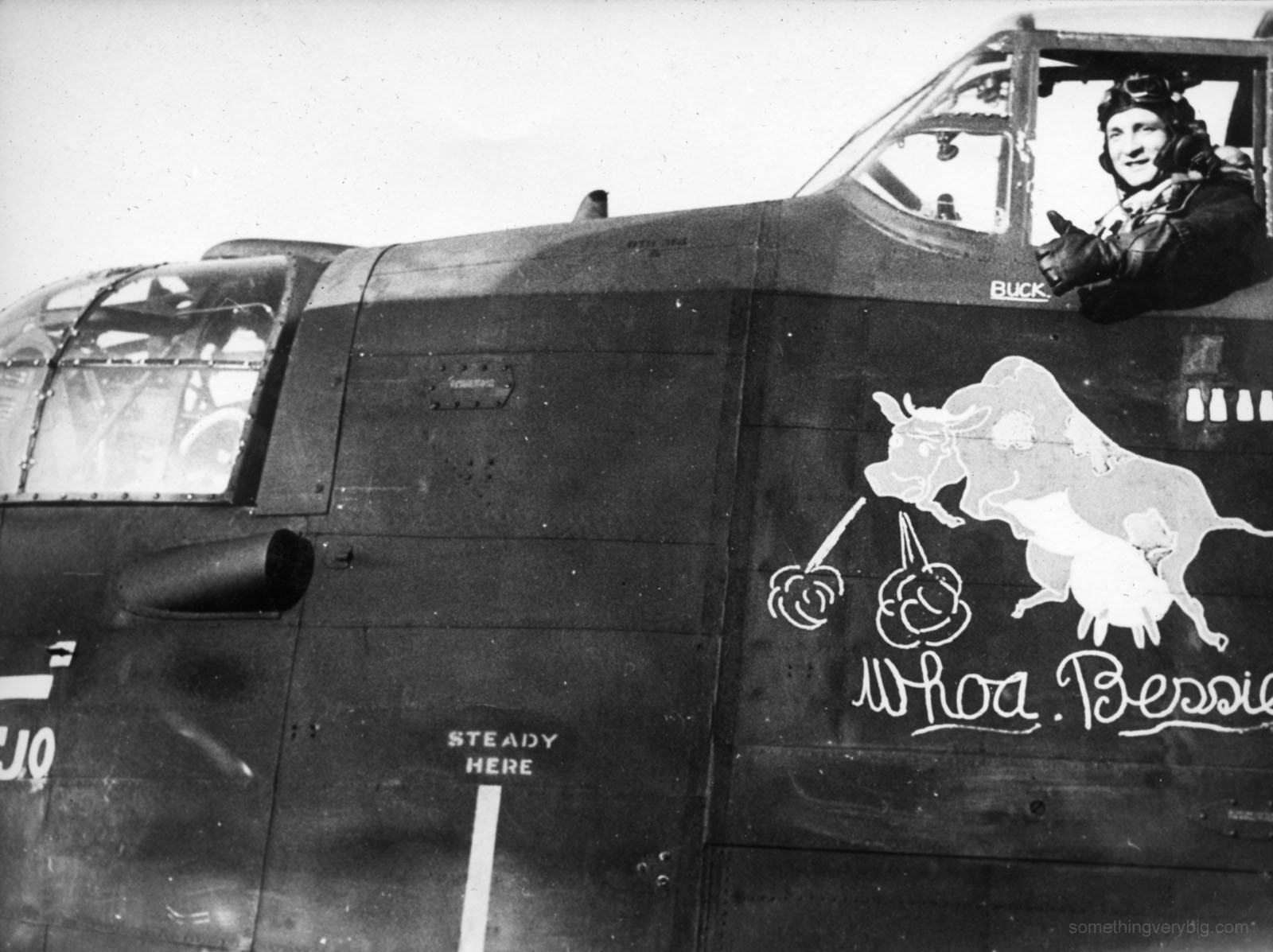
Special mention was made in the 463 Squadron Operational Record Book of Flying Officer Bruce Buckham, whose Lancaster suffered an engine failure near Reading on the outward journey. His crew pressed on and bombed the target, albeit from a lower altitude than most so that they could maintain a reasonable cruising airspeed, and returned safely, landing at Silverstone at 04.16.

Bruce Buckham in the cockpit of his usual steed, ME701 JO-F 'Whoa Bessie'. Photo from the Waddington Collection, RAF Waddington Heritage Centre
Bruce Buckham in the cockpit of his usual steed, ME701 JO-F ‘Whoa Bessie’. Photo from the Waddington Collection, RAF Waddington Heritage Centre

In other operations, 24 Stirlings laid mines in the Bay if Biscay and 37 Stirlings, Hudsons and Lysanders flew special operations over the Continent, all without loss. And, in a move that was widely believed to be a sign of the coming invasion, all leave for ground personnel at Waddington was cancelled with effect from today. “It must be coming soon”, wrote Flying Officer McDonald in the Operational Record Book.


This post is part of a series called 467 Postblog, posted in real time to mark the 70th anniversary of the crew of B for Baker while they were on operational service with 467 Squadron at RAF Waddington, Lincolnshire. See this link for an in-depth explanation of the series, and this one for full citations of sources used throughout it. © 2014 Adam Purcell

Sources:


[1] Route from Easton, Arnold, Flying Log Book

[2] 467 Squadron Operational Record Book, 05MAR44

[3] Captains were Flight Lieutenant Walter Marshall and Flight Lieutenant Alec Vowels, in both ORBs

[4] Night Raid Report No.571

[5] 467 Squadron Operational Record Book, 06APR44

467 Postblog LII: Saturday 1 – Tuesday 4 April, 1944

The fallout from Nuremberg continued with an article published in the Daily Mail on Saturday which was cut out and sent home by Gilbert Pate. Perhaps still shaken by the experience of watching a nearby Lancaster explode under a nightfighter attack, he noted in the margin, “I guess I’m lucky.”[1]

A period of poor weather now began at Waddington and, together with the increasing moon, this meant there would be no flying and most crews were on leave. Very little happened at the station over the next few days. Some personnel endured lectures and a film about security and there was very limited flying on Tuesday afternoon. One crew to do some flying was that of Flight Lieutenant Jim Marshall, who attempted a practice bombing flight in DV372 (‘Old Fred’) which was aborted because of poor visibility.[2] Later that night a dance was put on in the old Sergeants’ Mess and, despite a lot of the aircrew being absent because they were on leave, “it was difficult to move with the large number present,” according to the 467 Squadron Operational Record Book. The compiling officer – Flying Officer Alan McDonald – also recorded the welcome news on Monday that the 467 Squadron Commanding Officer, Wing Commander John (Sam) Balmer, had been awarded a DFC to go with his Order of the British Empire.

The crew of B for Baker were among those away, departing for eight days’ leave from Sunday 2 April. Gil Pate proceeded to London,[3] as, separately, did Phil Smith. Phil maintained a healthy interest in the goings-on in the sugar industry, in which he had been an industrial chemist before he enlisted in the Air Force, so as he had done in February, he looked up a company – Tate & Lyle – and arranged to spend a few days “pottering around a couple of their factories and most interesting it has been.”[4]

The Mosquito Light Night Striking Force still went out, of course, despite the Main Force being kept on the ground for the time being. 35 Mosquitos harassed Hanover on Saturday 1 April. On the same night, more Mosquitos hit Aachen and Krefeld and a flying bomb site at La Glacerie, on the Cherbourg Peninsula, Halifaxes laid mines off the Dutch coast and the Frisian Islands, four Mosquitos made Serrate patrols and ten aircraft made ‘special sorties’ over the Continent.[5] They did not fly on the 2nd or 3rd, but on Tuesday 4 April they were back up again. 41 Mosquitos harassed Cologne and smaller forces went to Essen, Aachen, Duisburg, Krefeld and La Glacerie. No bombers were lost.[6]

Next post in this series: 5 April

This post is part of a series called 467 Postblog, posted in real time to mark the 70th anniversary of the crew of B for Baker while they were on operational service with 467 Squadron at RAF Waddington, Lincolnshire. See this link for an in-depth explanation of the series, and this one for full citations of sources used throughout it. © 2014 Adam Purcell

Sources:


[1] Transcript of newspaper comments in papers of Gilbert Pate, by kind permission of Gil Thew

[2] Easton, Arnold, Flying Log Book

[3] Pate, Gilbert, letter to Mother 14APR44

[4] Smith, Phil, letter to mother, 07APR44

[5] Night Raid Report No. 569

[6] Night Raid Report No. 570

467 Postblog LI: Friday 31 March, 1944

Last night, on reflection, could have been worse, thought the Orderly Officer who compiled the 467 Squadron Operational Record Book. But last night’s losses, their first since 25 February, were bad enough. “It had looked like being our first clear month since the Squadron formed”, he wrote ruefully. It had been a busy month, too, with nine operations and 135 operational sorties carried out by the Squadron during March. Their counterparts in 463 Squadron had endured a slightly worse month with two crews failing to return and one lost in a collision near base.

But those who were left could look forward to a little bit of an immediate future. Most crews now went on the leave that they were expecting before the disaster that was Nuremberg. Among them was Dan Conway who, after a short snooze to shake off the worst of the effects of last night’s operation, got the train to 27 Operational Training Unit at Lichfield to visit a friend there. “Despite the Nuremberg losses or perhaps because of them,” he wrote, “it was quite a party that night at Lichfield.” Conway would later catch up with the rest of his crew in London.[1]

The Sydney Morning Herald had sent their London correspondent to Waddington around the time of the Nuremberg raid. Betty Wilson spent three days on the station and the article she wrote about the visit, eventually published on 20 May 1944, captures something of the atmosphere of a bomber station at war.[2] Wilson wrote about the music they played in the Mess:

At the moment, “Salome” is the Australians’ favourite gramophone record, probably because they have their own words which they sing when the W.A.A.F. officers have gone home. Anyhow, they put it on at least 50 times a day.

She wrote about the strange life of bomber aircrew:

These men are living an unnatural life and, at the same time, a completely absorbing one. There are long periods when they have little or nothing to do. There are equally long periods of concentrated activity when all the sickness of waiting and anticipation is crystallised into Lancasters crawling up runways like great earth-bound insects; when the day’s work comes to a climax in the planes’ lovely, inimitable lift as they become airborne and ends, for some men, with a burst of bullets from a fighter’s machine-guns, for others, with breakfast and the “operational egg.”

And she wrote about watching the squadrons taking off for a raid. There is a good chance that it was the Nuremberg operation that she was witnessing:

There is always a knot of people waiting to see them take off, standing there with thumbs jerked up as the Lancasters taxi up to the runway, accelerating with brakes on until the aircraft get off on a sort of a catapult release which will lift them and their bomb-load. The rear-gunner waggles his guns in farewell, and all Lancasters – from A – Apple to Z – Zero – waddle forward to become airborne like great swans and circle the airfield until the sky seems full of planes against the gathering dusk.

And she finishes with an evocative description of the ‘emptiness’ left behind when the bombers were on their way:

The Lancasters get off to their rendezvous. The watchers go back to the crew rooms to tidy up and get ready for the crews’ return. In the mess the gramophone, rewound by W.A.A.F. stewards, still grinds out “Salome” in a horrid – but temporary – emptiness.

And yet the war went on. Still somewhat stunned by the previous night’s disaster, the Main Force was given the night off, but three Mosquitos attacked Essen, 28 aircraft carried out ‘Special Operations’ and fifteen aircraft from Training Command scattered leaflets over France. The only casualty was a Halifax which failed to return from a Resistance supply-dropping mission.[3]


This post is part of a series called 467 Postblog, posted in real time to mark the 70th anniversary of the crew of B for Baker while they were on operational service with 467 Squadron at RAF Waddington, Lincolnshire. See this link for an in-depth explanation of the series, and this one for full citations of sources used throughout it. © 2014 Adam Purcell

Sources:


[1] Conway, p.137

[2] Wilson, Betty 1944

[3] Night Raid Report No. 568 and RAF Bomber Command Campaign Diary, March 1944