Bonus Photo Post: Bomber Command Commemorative day, Amberley, Queensland

While many of us were in Canberra last weekend for the annual Commemorative Day Weekend, simultaneous events were also being held elsewhere around the country. Groups of veterans, families and interested others gathered to remember the men and the deeds of Bomber Command at ceremonies held in Sydney, Adelaide, Melbourne and Brisbane.

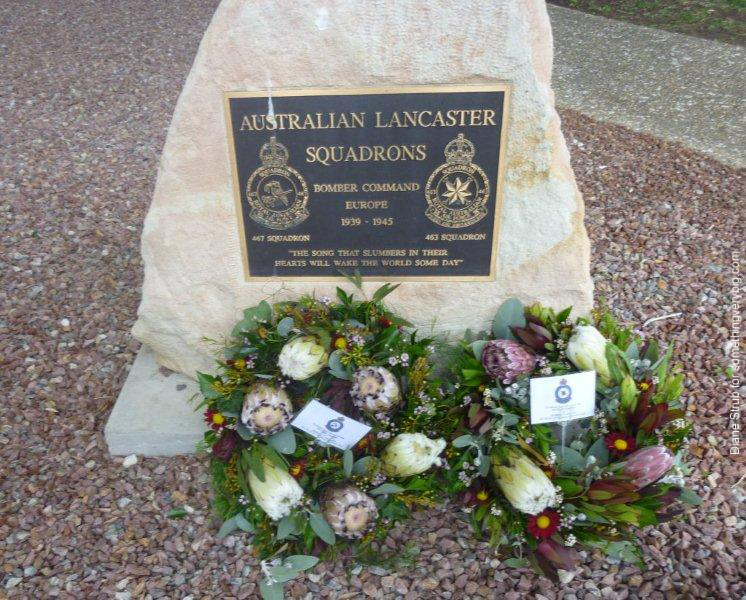
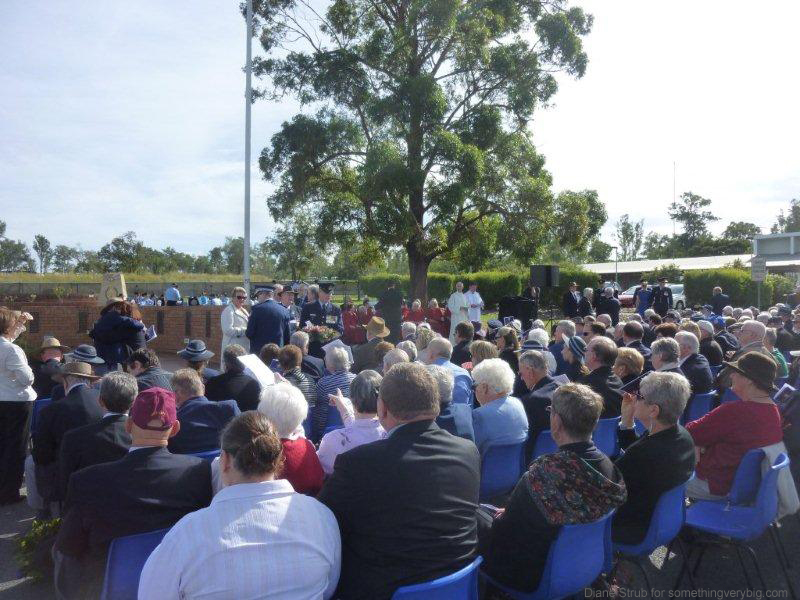
I had a ‘spy’ at the Brisbane event, held at RAAF Amberley (itself the site of the wartime No 3 Service Flying Training School, to which Phil Smith was posted in 1941). Diane Strub, the Honorary Secretary of the 467-463 Squadrons Association in Queensland, was there and sent me these photos:

 bcm-day-467-463-wreaths-bcm-day-amberley-2013 copy

bomber-command-veterans-bcm-day-amberley-2013 copy

the-crown-amberley-bcm-day-2013 copy

It looks like a fair-sized crowd was there, with a good number of veterans present (I counted 23 in the above photo). Everyone looks a little warmer than we were in Canberra!

Good show, Brisbane. And thanks to Diane for the photos.

Bomber Command in Canberra 2013

It was a very wet weekend in south-eastern Australia.

It rained so much in Adelaide on Friday that the automatic rain gauge at the airport gave up. 70mm fell in Melbourne on the same day. It was still raining when I walked to the train station in Sydney on my way to the airport on Sunday morning and, as we were taxying out, the heavy jets weren’t so much ‘landing’ as ‘splashing down’. We were in cloud all the way to Canberra.

Things were not looking good for the sixth annual Bomber Command Commemorative Day.

Though the tarmac was noticeably wet on arrival, the sky showed signs of clearing as I took a taxi to the Australian War Memorial. On arrival I discovered that, because the grass near the Bomber Command sculpture was still rather squelchy underfoot, the ceremony had been moved to the Commemorative Area within the War Memorial itself. As the clouds gradually moved off parts of the crowd were soon sitting in that glorious autumn sunshine for which Canberra is famous.

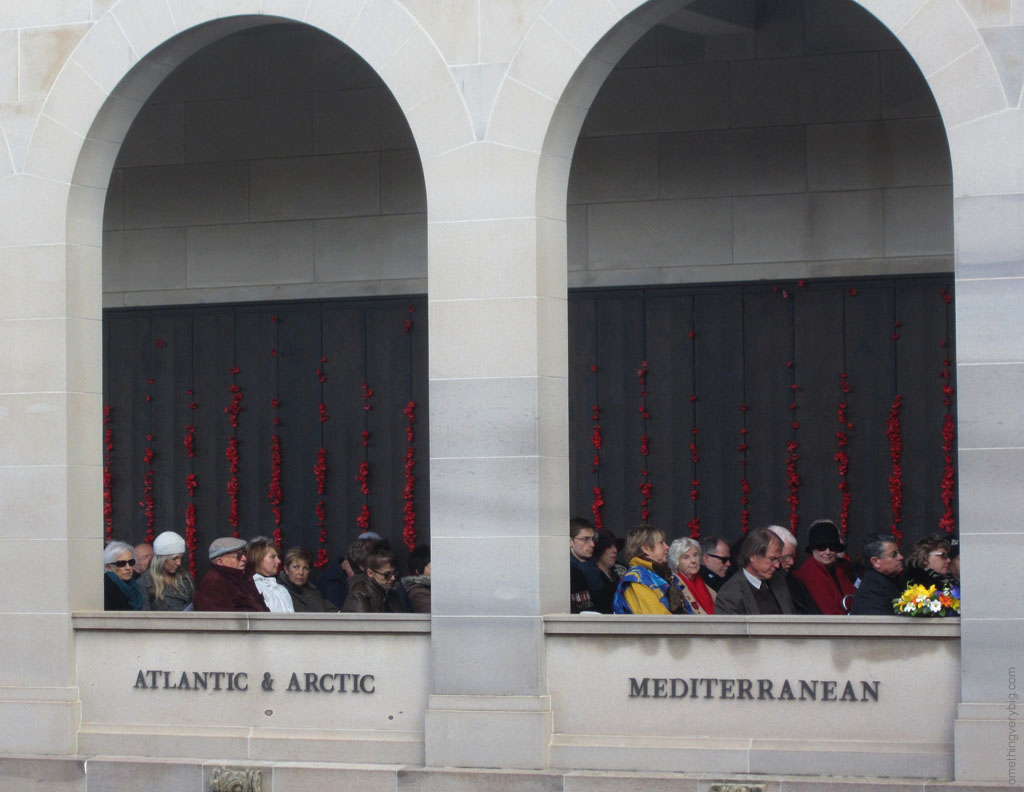
The Commemorative Area was a spectacular location for the ceremony.

13jun-weedingcanberra-092 copy

13jun-weedingcanberra-091 copy

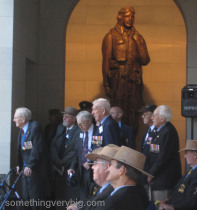
The crowd was sitting underneath the thousands of names on the Roll of Honour. A statue of an airman, on the eastern side, in turn cast his bronze gaze down onto the gathered crowd. To the rear, immaculately dressed members of the current iterations of 460 and 462 Squadrons, Royal Australian Air Force, were lined up in parade order. Those veterans who could were invited into the Hall of Memory to watch and take part in the wreath-laying, at the Tomb of the Unknown Australian Soldier. As the bugler sounded the Last Post, the notes echoed off the cloisters and faded away to silence. The singing of the Australian National Anthem, with the support of the Australian Rugby Choir, was spine-tingling stuff. The ceremony was enhanced by the atmosphere of the place it was in.

13jun-weedingcanberra-099 copy
The speakers, too were excellent: in particular, former Defence Minister and Leader of the Opposition Dr Brendan Nelson who is now the Director of the Australian War Memorial. His opening address, delivered mostly without notes, was impressive. He quoted the words of Charles Bean which are scribed on the wall in the Welcome Gallery of the War Memorial:

Here is their spirit, in the heart of the land they loved; and here we guard the record which they themselves made.

Some of those who made that record, of course, were the veterans of Bomber Command.

Following the ceremony itself came an organised photo opportunity in the shadow of G for George, with almost all the veterans present. My count is 32 (including one who is not in this photo):

13jun-weedingcanberra-119 copy

And then to lunch. Once again, the networking and reunion opportunities offered at this function for someone like me in this country are second to none. Among others, I met a Mosquito navigator named Alan Beavis, and his good mate Alan Pugh, who was training at 1661 Heavy Conversion Unit (Winthorpe – Jack Purcell was there in 1943) at the end of the war. And of course I also caught up with many of the usual suspects again – Don and Ailsa McDonald, the three other Dons Southwell, Huxtable and Browning, Keith Campbell, Harry Brown and Tommy Knox (the latter commenting to me, ‘you can really see it this year… age is certainly catching up with them!’). There was some good discussion on a few potential projects for the next couple of years, much reminiscing and many stories.

The Southwells dropped me off at the airport again, and I flew home to Melbourne with a notebook full of ideas and addresses to follow up on.

Bomber Command, over the last few years, is finally beginning to see some recognition for its deeds during the Second World War, and acknowledgement of the legacy it left. This was a common theme among many of the speakers at the weekend this year. Peter Rees (who recently published Lancaster Men and is rumoured to be planning a follow-up for the next couple of years) spoke briefly at the lunch and cited this as one of his key motivations. Air Marshal Geoff Brown, current Chief of Air Force, also gave a good talk at the lunch about what today’s Air Force can learn from the bomber offensive. His main points were that a coalition of nations in a common cause is far more powerful than trying to do it alone, a reminder of the importance of close links with technological and research organisations, how vital it is to gain and maintain control of the air in a combat scenario, the continued value of electronic countermeasures and the critical importance of teamwork and people all united by a common purpose and common aims. He effectively demonstrated that, while the airmen of Bomber Command fought their battles so long ago, and while they fought a battle so unique in scale and circumstance, what they did has continued relevance in current operations – and that in that very practical way their legacy will live on.

13jun-weedingcanberra-108-copy copy

Remembering the history – the raids, the stories, the men – is of course vital. But learning from that history and applying the lessons in practical ways in modern times can also form part of the legacy of Bomber Command. It is far too late for most of those who served, but I hope that some of the veterans who were in Canberra over the weekend can take some comfort in the knowledge that this legacy is living on and will continue to do so.

© 2013 Adam Purcell

A photoset by the Australian War Memorial’s official photographer is available to view here.

Book Review: Lancaster Men: The Aussie Heroes of Bomber Command, by Peter Rees

Published in April this year, Lancaster Men: The Aussie Heroes of Bomber Command is a new book by Australian journalist and author Peter Rees. It’s one of many books by Australian authors to be published on the subject over the last few years, and I think it’s one of the better ones.

Inspired by the stories told to him by Kathie Pickerd, daughter of Ted, a 463 Squadron navigator and later one of Australia’s highest-ranking Air Force officers, Rees began interviewing a large number of Bomber Command veterans and came to realise, he says, “that history had treated them harshly. It was time for their stories to be told in their own words.” The book, then, does not claim to be a definitive account of Australia’s role in Bomber Command – the Official Histories take care of that. Instead, it’s based on personal accounts taken from interviews, transcripts and memoirs, both published and unpublished. The result is a more or less chronological account of the experiences of Australians in Bomber Command, from enlistment to operations and from the earliest bombing raids to Dresden and beyond, as seen by those who were there. Given the vast spread of the campaign, over time, over different units and over a large geographical area, this is an appropriate way to look at things, though the concentration on Australians sometimes omits the airmen of other nationalities who flew in the same crews.

Rees’ journalistic talent is evident in his vivid descriptions and the book is well-written in an engaging style. The focus on the personal shows in the way that he tends to use first names for the main ‘storytellers’ throughout his book, and in some of the stories of off-duty life in wartime England, which arguably were as much a part of the experience of Australians in Bomber Command as the operational trips themselves. He also covers some interesting ground looking at life under the bombs – notably the effects of the 22 November 1943 raid to Berlin, which caused a tiger to escape from the zoo. The beast “made its way to the Café Josty, gobbled up a pastry and promptly [fell] down dead. […] Although nearly all the major hotels had been wrecked, the premier hotel of the Third Reich, the Adlon, survived relatively intact, but it had no heating and could muster up only cold cuts and potato salad.” (p.138) Stories like these add life to the history and are an important reminder that there were indeed people in those cities too.

There is a good section putting D-Day in the context of the war in general, and Bomber Command’s operations in the context of that (Chapter 26 and on and particularly p.242-243), and a very interesting discussion of the politics between Australia and Britain when dealing with Australian bomber crews, as evidenced by a ‘manpower fiddle’ that left 463 and 467 Squadrons short of aircrew in April 1944, when the British wanted to avoid disadvantaging RAF squadrons after the Australians demanded tour-expired airmen be sent home to fly against the Japanese (p.181 and on).

And then we get to Dresden, for which Rees says the reputation of the airmen has been unfairly tarnished. He is at great pains to note that it was not Arthur Harris who chose Dresden as a target (despite his copping much of the blame in the aftermath of the war), but Churchill (p.342). Rees’ sympathies clearly lie with the airmen but he gives, in my view, a reasonably balanced examination of the politics of the raid, explaining the origins of the inflated casualty figures and looking at the Dresden Stadt Museum to see current German views on the issue. The airmen who took part, he argues, “have had to wear the blame for the destruction wrought on the city for far too long due to their political leaders distancing themselves from responsibility.” (p. 356)

The only problem with Lancaster Men is that Rees is a journalist, not necessarily a historian. As a result historical rigour is not necessarily always present and he tends to take quotes directly from secondary sources without checking the original documents for accuracy. For example, he quotes the 467 Squadron Operational Record Book but cites another book (Dan Conway’s The Trenches in the Sky) as its source. He also takes figures for aircraft losses on the 10 May 1944 Lille raid directly from Rollo Kingsford-Smith’s memoirs without cross-checking with the ORBs… and so perpetuates the error that seven aircraft were lost on that trip from 463 and 467 Squadrons (it was only six – the mistake probably has its genesis in Nobby Blundell’s Squadron histories). He gets the figure right on a later page but the contradiction hasn’t raised any flags in the editing phase. Errors like these are an occupational hazard when dealing with personal accounts of history, particularly when those accounts were created upwards of seventy years after the events described, so it would have been nice to see a little more cross-referencing occurring.

But otherwise Peter Rees has painted a vivid picture of life as an Australian in Bomber Command. Lancaster Men is well-written, engaging, shocking, exciting, funny and sad, and well worth a read.

Lancaster Men (ISBN 9781741752076) is published by Allen & Unwin, and retails for AU$32.99.

An interview with Peter Rees, as broadcast on Radio National on ANZAC Day 2013, is available for download here.

(c) 2013 Adam Purcell

It’s all a bit much, really.

Anyone interested in Bomber Command is probably aware that last night marked the seventieth anniversary of what, in popular culture, is probably the most famous air raid of all time. The ‘Dambusters’ raid of 16/17 May 1943 – more properly known as Operation Chastise – was the daring, novel, unique, dangerous, costly and mostly effective operation by the RAF’s 617 Squadron that used the so-called ‘bouncing bombs’ to destroy two of Germany’s great dams and severely damage a third. The morale boost to Britain, in the middle of 1943 during a dark patch in the war, was arguably greater than the material effect on Germany, but the raid entered the popular consciousness and made the leader of 617 Squadron, Guy Gibson, into one of, if not the, most famous airman in Bomber Command.

So naturally there have been many activities and events to commemorate exactly seven decades since this auspicious event. The Battle of Britain Memorial Flight Lancaster has made a fly-over of the Derwent Dam in Derbyshire, England, where the squadron practiced before the raid. There’s been black and white footage of bouncing bombs on the television news in Australia (though Sky News showed the later ‘Highball’ devices which were never used operationally and were more or less spherical in shape, rather than ‘Upkeep’s cylindrical bomb, and dropped by Mosquitos rather than Lancasters, but I’ll let that slide for the moment). There have been commemorative services at Woodhall Spa (the later home of 617 Squadron), Lincoln Cathedral, RAF Scampton and in Germany. The Royal Air Force has even been live-tweeting wireless messages and key events from the raid, seventy years to the minute since they occurred.

It’s all a bit much really.

It’s an awful lot of fuss over just one operation, just one night of a very very long war. Taking absolutely nothing away from the 53 aircrew who were killed on the raid – out of 133 men, all of whom were already highly experienced – but there has indisputably been a very strong focus on this raid in the years since, perhaps at the expense of the rest of Bomber Command. So much so, in fact, that in much the same way as ‘Battle of Britain’ means ‘Spitfire’ to the average Englishman or Australian, to the detriment of the Hurricane and all the other parts of Britain’s defensive effort that summer of 1940, ‘Lancaster’ has come to mean ‘Dambuster’. And don’t worry about all the rest of Bomber Command, thanks very much.

Much of this is probably due to the Dambusters film of 1955, based on Paul Brickhill’s 1951 book. So much so, in fact, that one newspaper in the UK chose to mark the 70th anniversary with a collection of photographs… from behind the scenes in the making of the movie. Which, all rather interesting, but really??? It’s a sign that the anniversary has become all about the legend, and much less about the blokes who did the job that night – and indeed, the blokes who did the job every night.I mean no slur on 617 Squadron, either to the original members or anyone else involved with it. I mean no slur against Barnes Wallis, the engineer who came up with the concept. I mean no slur against the makers or the actors in the movie (which is probably still one of the greatest war movies ever made). But it would be really nice to see some of the interest, scholarship and mythology associated with the Dambusters carry over into the rest of Bomber Command.

I’ll close with a quote on the Professional Pilot Rumour Network forum by a member calling himself ‘Chugalug2,’ who in this case says it far more eloquently than I can:

The pride that the Royal Air Force has rightly expressed since WW2 over the subject exploits of this thread was not similarly expressed over those of Main Force, when almost every night was one of Maximum Effort.

The Dambusters played an incredible part in the Second World War bomber offensive. But there were many others, just like them, who played an equally important role and who have not been nearly so recognised. Think about them on May 16 each year, too.

(c) 2013 Adam Purcell

Talking

I did my first research project about my great uncle Jack at the age of about 12. It was for an entry in a national history competition and my project was to write a series of letters as if Jack had been writing home from the war. This work led directly to our discovering that Phil Smith, who had been Jack’s pilot, was still alive and was living in Sydney. We first met Phil and his wife Mollie in early 1997.

There then came a break of a few years. We stayed in contact with Phil and Mollie and occasionally travelled to Sydney to visit them and while I was aware of ‘Uncle Jack’ the bug had not yet bitten in earnest to find out more about him myself. In 2003 I took a year off between school and university, and that’s when I had some time to once again delve into the subject. Sadly the catalyst for this work was news of Phil’s death in March of that year. The starting point this time was all the original documents that we had about Jack, which I scanned and wrote explanatory notes about to put on a CD-ROM and share around my family. Then university and moving out of home got in the way and it was some years before I felt the urge again and started the work that has evolved into SomethingVeryBig.

The slightly frustrating thing is that I never had the opportunity to speak to Phil in detail about his experiences. I was quite young when I first started researching the story of B for Baker. This phase of work was what led us to him in the first place – and the second phase started after he passed away. I remember one discussion, over the lunch table at Phil and Mollie’s home in Sydney, when my father was asked to read out Phil’s wartime letter about the time his troop ship hit an iceberg in mid-Atlantic (a story in itself) while Phil added comments here and there, but that’s the only occasion that I can recall where we spoke directly about his experiences. I’m lucky that since his death I’ve had access to the superb archive of letters and photos and other documents that his father carefully collated while Phil was in the Air Force, but there’s nothing like actually talking to the people who were there for a ‘feel’ of what it was like.

Which is why I’m slowly collecting veterans, so to speak – contacting as many as I can, writing letters (yes, real letters, with stamps and envelopes and everything), phoning up and generally picking their brains. Each has a story to tell and each little insight adds to what I understand of what it was like to fly for Bomber Command. I can’t ask my great uncle or any members of his crew what their war was like – but I can still talk to other veterans. While it’s not quite the same story, they would have shared many similar experiences with each other so I reckon it’s enough to build a picture of the ‘feel’ of the times they lived in and the tasks they carried out.

© 2013 Adam Purcell

Sixty Nine Years

a05-019-001-med copy

10th May, 1944.

Lest we forget.

This post was published at 21.57 on 10 May 2013. At the same time on the same day in 1944, the crew of B for Baker took off from Waddington, bound for Lille in northern France.

They did not come back.

ANZAC Day 2013

Sydney turned on an absolute sparkler for ANZAC Day yesterday. The sky was clear, blue and brilliant, it was warm in the sun (but with that delicious autumn chill to the air in the shade) and the air was almost perfectly still. Perfect conditions, then, for an ANZAC Day march.

I flew up from Melbourne early, catching the fast, clean and efficient (but horribly expensive) airport train into the city centre and arriving with enough time to spare to walk around and enjoy the atmosphere for a little while. The contingents from some current naval ships in particular, stepping off as I crossed Castlereagh Street, displayed some very impressive marching. I headed for Elizabeth Street and the usual starting point for the Air Force veterans.

At first, I couldn’t find many from 463-467 Squadrons. But then the banner arrived, safe in the care of Bryan Cook, and suddenly they all melted out of the crowd:Setting up the Banner

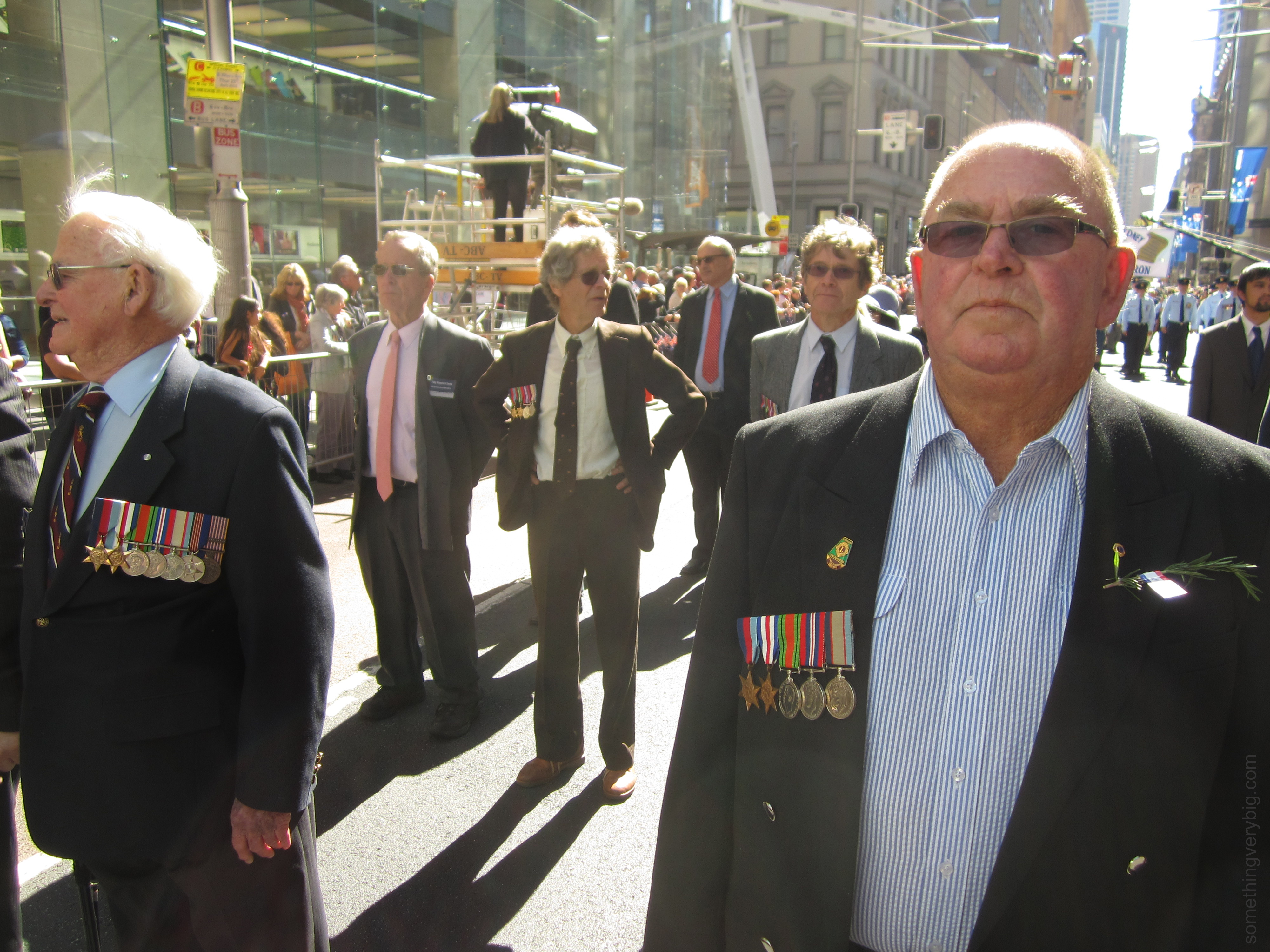
In all there were six veterans marching, with one more traveling along the march route in a truck provided by the Australian Army. They were Don Browning, Hugh McLeod, Don Huxtable, Bill Purdy, Don Southwell and George Douglass, with Harry Brown in the truck. As usual, shortly after setting off from Elizabeth St we reached King St… and stopped, again, for about forty minutes:

img_1284 copy

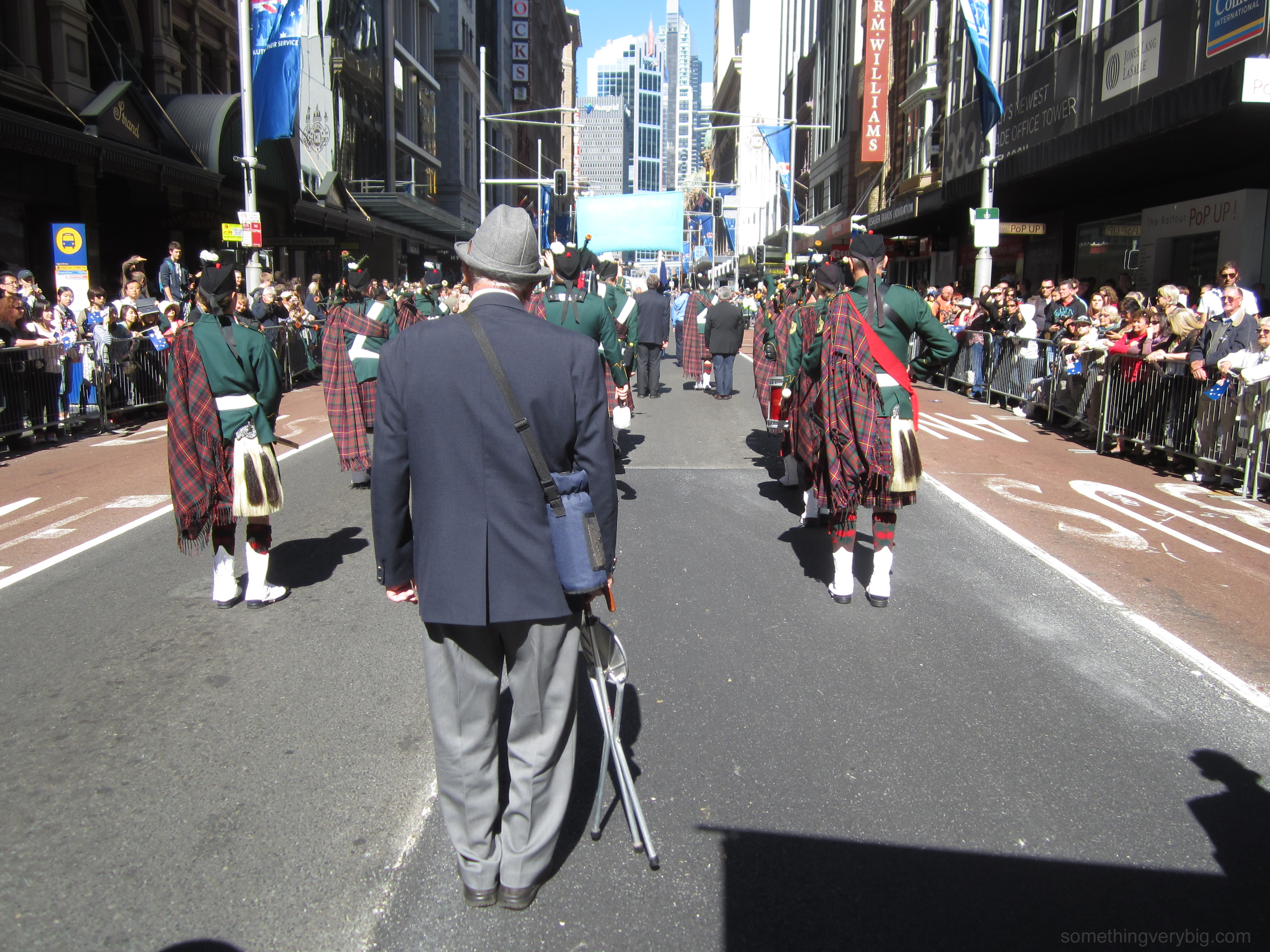
I placed my end of the banner in the safe hands of veteran pilot and rear gunner Hugh McLeod for a few moments, and quickly snapped a photo of an animated conversation which was taking place between Bill Purdy, David Southwell and Don Browning (who had again come prepared for the long wait with his own walking-stick-with-inbuilt-stool):

img_1285 copy

As much as we complain about the delay I’ve found in the last few years that it’s during this stop that some of the best conversation happens among those marching. And this year we were joined at this point by a group of people wearing kilts and carrying bagpipes and drums who inserted themselves into the column in front of us. They looked suspiciously like a pipe band… They turned out to be the Castle Hill RSL Pipe Band, who had already ‘done their bit’ making one round of the march course earlier in the day. But one of their members was also marching in memory of a relation with the 466-462 Squadron Association, which was the unit in front of us. So they decided to support him and ‘go round again’. All of which worked in our favour. They sounded superb, and at the end of the march I overheard Don Southwell exclaim, “That was the best march of recent years…. we were all in step!

A friend was watching the ABC Television coverage of the march and spotted us as we went past the cameras. He later sent me a photograph he had taken of his screen:

facebook_1821365055 copy

At the conclusion of the march I tried to find the band to thank them for their music but they had done like pipers generally do and taken off in a hurry to the nearest pub. Meanwhile, we headed across the road for lunch at the Pullman Hotel, the same venue as has been used in the last couple of years. Once again, the food was great, the service attentive and the conversation outstanding. I was lucky enough to find myself on a table in the company of no fewer than three of our veterans (Don Huxtable, Hugh McLeod and George Douglass). At one point, Association President Don Browning was telling a story about a raid he was on, with appropriate deadpan asides added from Don Huxtable who had been on the same trip (“I recall the weather was awful… do you remember that Don?” “Fifty-foot ceiling, mate!”). When Browning related that his bomb aimer had called for them to go around again, I heard a grim chuckle from Hugh: “I’ve experienced that too…” There were stories flying left right and centre and it was a very enjoyable afternoon. We were again joined by the young musicians of the Australian Army Cadet Band, who played a few numbers and got a certain old pilot to drum along with them:

img_1301 copy

In all, a really good day. There were lots of familiar faces to catch up with, and a few new people to talk to as well. I even met Col Edwards, whose uncle was Bob Coward, a 463 Squadron mid-upper gunner who was killed over Holland in 1944. Col first got in touch with me through the Lancaster Archive Forum and again through a comment on this blog. Bob Coward’s crew took a second dickie pilot along with them on one of their operations. The pilot? One Don Huxtable, who at yesterday’s lunch was sitting at the same table as Col, three seats along.

A few further photos from the day follow. Click on the image for full-size.

img_1288 copy

img_1289 copy

img_1292 copy

img_1299 copy

A top day, and well worth the flying visit to Sydney. I’ll be back next year.

(c) 2013 Adam Purcell

Four posts in a week! There will consequently be a short delay before I publish the next update on SomethingVeryBig. Next post is due on May 10.

Event: Bomber Command Commemoration Weekend, Canberra, 1-2 June 2013

Details have just been mailed out for people interested in attending the sixth annual Bomber Command Commemorative Day weekend in Canberra, 1-2 June 2013.

There are three parts to this weekend:

  • The Ceremony

Grass area in front of the Bomber Command Memorial, in the grounds of the Australian War Memorial

Sunday 2 June 2013

Ceremony begins 11am (please be seated by 10.50am).

Attending the Ceremony is free but if you intend to be there please RSVP to Don Southwell, details below, by 27 May.

  • The Meet & Greet Function

ANZAC Hall, Australian War Memorial (under the shadow of G for George)

6-8pm Saturday 1 June 2013

Canapes, beer, wine, soft drink all included, $50 per head.

  • The Luncheon

Rydges Lakeside Hotel, Canberra

12pm for 1pm lunch, until 4pm, Sunday 2 June 2013

Two-course sit-down lunch included – note a cash bar will be in operation on the day. $60 per head.

To book for the Meet and Greet and/or the Luncheon, please contact Don Southwell on (02) 9499 6515 or southwelldonald@gmail.com.

RSVP for the Meet and Greet and/or Luncheon closes 17 May 2013.

RSVP for the Ceremony closes 27 May 2013.

This is by far the largest gathering of Bomber Command veterans, relatives, friends, family and other interested parties in Australia and is always a good event. Highly recommended!

“Lancaster 739:” 60 Minutes, Crashes and Cover-Ups

Australian investigative journalism program 60 Minutes last night broadcast a very interesting story about a 97 Squadron navigator called Ron Conley, who went missing on a raid on the Pointe du Hoc gun emplacements, very early on D-Day morning, 6 June 1944. The report, called “Lancaster 739”, followed the story of Conley’s crew who were presumed lost at sea. The reporter, Michael Usher, suggested that there had been an official cover-up about the circumstances of the crash, and that a ‘top secret’ radar system that was on board might have had something to do with it. As always, I like to think cock-up before I think conspiracy, so on hearing this bit my ears pricked up. I thought I would do a little digging.

Conveniently, Conley’s Casualty File[1] is available to view at the National Archives of Australia website. It contains a letter written after the crew failed to return by the new 97 Squadron Officer Commanding to the RAF Air Ministry. It’s a poor-quality photostat and is rather difficult to read, but it does appear to report the circumstances of the loss of Lancaster LD739 ND739 (Edit September 2014: see comments below). There was an extra man in the crew – the eighth member being named in this letter as a Special Air Bomber. Pathfinder crews regularly had extra men on board to operate some of the special navigational equipment they carried – in this case possibly the Oboe blind-bombing aid. Ground defences were “inactive”, the letter says, but “a few fighters were known to be over the target area”. Critically, the pilot of this aircraft, W/C EJ (Jimmy) Carter, DFC, who was the 97 Squadron CO until he failed to return from this trip, had been nominated Deputy Controller for the operation and so was required to keep in radio communication with the rest of his force over the target, relaying orders from the Master Bomber who was flying a Mosquito. Carter’s voice was heard but apparently “ceased in the middle of a sentence” just after 5am and no further signals were received from the aircraft. “It is believed,” wrote the replacement CO to Conley’s father, “that an enemy fighter must have intercepted the aircraft while over the target, but although one or two of our aircraft were seen to be shot down, nothing much could be identified owing to a certain amount of cloud.”

Also in the Casualty File is a copy of an internal signal dated 22 December 1944 sent from London to the RAAF in Melbourne advising that enquiries made to the International Red Cross Committee in Geneva had failed to turn up any news of Conley or the rest of his crew. This shows that the RAAF had made efforts to trace the missing crew. But in the absence of any further word, in March 1945 they wrote to Mr Conley again advising that “it has now become necessary to consider the question whether in these circumstances an official presumption of your son’s death should be made.” I’ve seen very similar letters in the files of many of my great uncle Jack’s crew as well. In May 1945 Conley was officially presumed dead.

In 1949, the Air Force explained (and this letter was quoted in the report). “All efforts to find any trace of your son’s aircraft or to establish whether the bodies of any of the crew were ever recovered for burial have proved unsuccessful. In view of this complete lack of evidence, it is now concluded that your son and his comrades were lost at sea. It is proposed, therefore, to commemorate your son by including his name on a memorial which will be erected at a later date by the Imperial War Graves Commission, to the memory of those deceased members who have no known grave.” Ron Conley’s name, and those of the rest of his crew, are now on the Runnymede memorial in England.

So far, all of this is very much like so many other stories about Bomber Command airmen. The 60 Minutes team interviewed cousins of Ron Conley and found family of other members of the crew as well. What sets this story apart just a little, however, is that an English aviation archaeologist named Tony Graves has only recently found the remains of the aircraft – not in the English Channel as was officially presumed, but in a field on an abandoned farm in Normandy. The wreck was positively identified on the basis of a gold wedding ring engraved with the initials “A.C.” and with the words “Love Vera” on the inside. This was traced to F/L Albert Chambers, the wireless operator on the crew, whose wife was named Vera. They also showed a small fragment of a uniform with the remains of a Distinguished Flying Medal ribbon still sewn on. Three members of the crew had received that particular decoration. (In fact this was a highly experienced and decorated crew. As well as the Squadron Commander, W/C Carter, it also carried the Gunnery and Signals Leaders. Six of the eight had already been awarded DFMs or DFCs, and Conley himself would be posthumously given a DFC as well.) Though smashed into almost unrecognisable fragments from the force of the impact of the crash, what remained had been preserved remarkably well, with paper maps and charts that would have been from Conley’s nav bag recovered from the wreckage. How Graves knew that the wreck was there was not explained beyond a reference to “enough evidence and eyewitness accounts,” but congratulations are due to him for making the discovery and following the story up to the extent that he has.

The report was, I thought, going well up to this point. But then they started talking about the “new, secret” radar called “HS2” that was on this “customised” Lancaster.

Oh dear.

By the middle of 1944, H2S (note not ‘HS2’) was well-established as a ground-mapping radar system. So while it was still nominally a ‘secret’, it certainly was not a brand-new piece of equipment and was in general use by the Main Force throughout the Battle of Berlin period (November 1943 – March 1944). It’s mentioned many times in the Night Raid Reports[2] of this period, being fitted to both heavy bombers and Mosquitos. In fact, the interrogation of German nightfighter commander Josef ‘Beppo’ Schmid after the war confirmed that as early as November 1943 the Germans were using the emissions from the H2S sets to home in on the bomber stream.[3] In short, it was by no means an unusual thing to find on a Lancaster at that time, and cannot therefore be used as a reason for a potential cover-up.

Also appearing in the report was Keith Dunning, the son of P/O Guy Dunning, the flight engineer on ND739. He remembered a visit to his family, after the war, by an RAF airman who said he was on the same trip and had seen the aircraft go down over land. The RAF had, Keith said, later written to Dunning’s family to say that this had been a “mistake” and the airman had later withdrawn his testimony. This was presented in the 60 Minutes report as further evidence of a cover-up. However, as was written in the CO’s letter to Conley’s father I quoted earlier, cloud prevented the exact identification of any of the aircraft that were seen to be shot down. There is also the fact that the raid took place half an hour or so before dawn so light levels would have been low. It’s difficult to say, in the face of that, that the airman was definitively correct in his original identification of the crashing aircraft, and with no further evidence to support the theory coming to light after the event, the Air Force appears to have acted quite reasonably in discounting his report.

The logbook belonging to Guy Dunning was featured, with some pages apparently removed covering the operation on which the crew went missing. Keith Dunning said other logbooks that he has seen from the same crew showed the same pages missing. Again, 60 Minutes called this evidence of a cover-up. But the final pages would have been filled in by someone at the squadron after the crew failed to return, not by the aircrew themselves (who were dead by this stage). Jack Purcell’s logbook records the wrong aircraft for his final flight,  and squadron Operational Record Books are littered with similar clerical errors. It’s quite possible that whoever wrote the last entry in the logbooks made a mistake and decided to remove the pages and start again.

Finally, there is the fact that no bodies were found when the aircraft was excavated. No-one appears to know where the bodies are, or who might have moved them. “Eight bodies don’t vanish”, said Dunning. 60 Minutes, by now predictably, again called it a cover-up. But an understanding of RAF Missing Research and Enquiry Service methods would suggest that, more likely, the investigators simply couldn’t find anyone who could tell them what happened. Tony Graves apparently found reports by eyewitnesses to the crash but perhaps any witnesses to the burial did not survive the fairly intense fighting that occurred in the general area in the immediate aftermath of the invasion (as happened to a young Dutch girl who witnessed a Tempest crash in March 1945). There would have been considerable confusion in the area in the following weeks and months and if any records were made of the burials, they could well have simply disappeared in the fog of war. There are, according to the report, some graves marked as ‘unknown airmen’ in the local cemetery and there is of course a possibility that these hold the crew of ND739. But two 97 Squadron aircraft were lost on this raid so they could also belong to the other crew. The MRES could well have been aware of these graves and opened them up (though no MRES report appears in Conley’s A705 file), but perhaps were unable to make a positive identification of the airmen buried there. There was some talk on the program, if the required documents could be found, of identifying the men in the graves and giving names to the headstones, but as the crew are already appropriately commemorated elsewhere (at Runnymede), this is not something that the Commonwealth War Graves Commission would approve.

So most of the evidence that 60 Minutes used to decide there had been a cover-up could, and in my view probably does, have a far less sinister explanation. On the positive side, I’m happy to see some Bomber Command coverage on a high-rating television program in the lead-up to ANZAC Day. Another crash site has been identified, and, though graves have not been found, some more families now have a little more closure on what really happened to their lost airmen. It’s a fascinating story. But that’s just the point. It’s a fascinating story in its own right, and it does not need to be sensationalised.


Further information about the Conley crew can be found here:  http://www.97squadron.co.uk/Coningsby%20crew%20Carter.html

Sources:

[1] NAA: A705, 166/8/495. CONLEY, Ronald John – (Flight Lieutenant); Service Number – 425606; File type – Casualty – Repatriation; Aircraft – Lancaster LD739; Place – Cherbourg, France; Date – 6 June 1944

[2] The National Archives of the UK (TNA): Public Record Office (PRO), AIR 14/3411, B.C. (O.R.S.) Final Reports on operations, Night Raids Nos. 416-620, September 1943 to May 1944, vol. 4

[3] Isby, David C (2003) p.104: Fighting the Bombers: the Luftwaffe’s Struggle against the Allied Bomber Offensive, Greenhill Books 2003, Lionel Leventhal Limited, Park House, 1 RussellGardens, London, NM11 9NN. ISBN 1-85367-532-6

© 2013 Adam Purcell