Book Review: A Grave Too Far Away – A Tribute to Australians in Bomber Command Europe

Note this photo - from the publisher's website - appers to be of an earlier version of the book, with a different subtitle to that on the copy I bought.

A Grave Too Far Away: A Tribute to Australians in Bomber Command Europe is a new book by military historian and lecturer Kathryn Spurling. Essentially the book comprises stories about many Australian aircrew who were killed in action during WWII, adding together with each name a little bit of information about their backgrounds and eventual fates. Interestingly for me, included in the book is a short paragraph or two about the crew of B for Baker, along with a photograph of my great uncle Jack.

The general intention of this book was to tell the stories of some of Australia’s Bomber Command airmen and the effects that their deaths had on the families they left behind. It was certainly a worthwhile aim, but unfortunately A Grave Too Far is somewhat let down in its execution.

The book has a definite Australian focus. This becomes quite parochial in places, with much criticism of the way that Australian airmen were placed under the unfettered control of the British. The focus continues even to the point of completely failing to mention non-Australian airmen in some crews or, as for the crew of B for Baker, relegating the names of the three Englishmen to an endnote. The author has made heavy use of records from the National Archives of Australia, predominantly files from the A9300 and A705 series (service records and casualty files). This is conceivably a reason for the lack of information on some of the other members of the crews – it’s far easier to get access to Australian service records than it is British. It is clear that Spurling has accessed and read an extraordinarily large number of files from the NAA, and she should be congratulated for that, but the result overall appears to have favoured quantity over quality. The sections where the author has had more information available from a wider range of sources are done quite well – for example those concerning Don Charlwood and her own father Max Norris – but where the NAA files were the only sources used there is little to tie the individual stories together. Consequently the book reads like an endless stream of names, facts and figures, presented in a repetitive and almost formulaic manner. As such, I must admit that it becomes rather monotonous to read at times.

Unfortunately the overall impact of the book is diminished by poor editing. In places it appears not to have been effectively proof-read at all, with confused sentences and spelling errors littered throughout and entire sentences apparently missing. There are also a number of factual errors and inconsistencies: for example, on a couple of occasions the conversion between metric and imperial weights is messed up, and more than once there is confusion between aircraft and aircrew numbers lost on the Mailly-le-Camp raid of 3 May 1944.

Kathryn Spurling’s father was a Bomber Command wireless operator (indeed, he is mentioned in the dedication). Consequently she has a close connection with the overall Bomber Command story. Perhaps here is an explanation for some of the deeper structural problems with this book. It would appear that the emotional impact of the material covered, when combined with the author’s very personal stake in the story, has gotten in the way of a more balanced result. A desire to honour as many individual Australians as possible is a noble one, but here it has interfered with the coherence and hence the quality of the narrative presented. This shows the danger of ‘history as a tribute’ – where emotion hinders the dispassionate analysis of the story and indeed affects the factual accuracy of the writing.

History is, by its nature, a very human subject, both in its making and in its telling. And humans are emotional creatures. As such, one would expect a certain amount of emotion to come out in the telling of a story like that of Bomber Command, its airmen and the families so many of them left behind. But in this case, that emotion has been allowed to influence the author too much, resulting in an apparent ‘scattergun’ approach that tries to do too much for too many different people. In the end, sadly, some of it is not done particularly well.

A Grave Too Far Away – A Tribute to Australians in Bomber Command Europe is published by New Holland Publishers (Australia) Pty Ltd, ISBN 9781742571614. RRP $29.95.

© 2013 Adam Purcell
Just Jane to fly again?

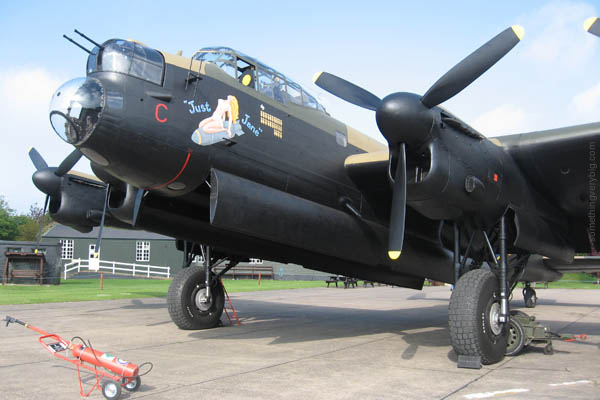
Twenty miles east of Lincoln lies a small village called East Kirkby. In fields nearby are the remains of a Royal Air Force Bomber Command station of the same name. It would be just one of many similar old airfields liberally scattered around Lincolnshire, except that in a corner of this one is the Lincolnshire Aviation Heritage Centre – the home of Avro Lancaster NX611, better known as Just Jane.

29APR09033

I went on a taxi run on Jane during my Bomber Command ‘pilgrimage’ to the UK in April 2009. It was undoubtedly one of the highlights of my trip. Sitting in the wireless operator’s seat (while the desk is still there, the navigator’s seat has been removed), feeling the vibrations as the aircraft moved and hearing the roar of the engines and the hiss of pneumatic brakes as we bumped our way around a small part of the old airfield, it was very easy to close my eyes and feel just a small taste of What It Was Like.

29APR09108

There has been some significant press coverage in the last couple of weeks about a possible restoration to airworthiness for Just Jane. Indeed, a report on BBC News was reportedly the most viewed and most shared video on the website the day it was released. The museum has secured four airworthy Merlin engines and is slowly gathering more parts, including an almost complete Martin mid-upper turret. Certainly it would appear that the Panton brothers are serious about getting their treasure into the air again.

But restoring another Lancaster to flying status will be a significant challenge. It took a decade to get Canadian Warplane Heritage’s Mynarski Lancaster airworthy. Just Jane is in quite good condition but there are far more regulations and requirements surrounding an airworthy aircraft than those relevant to one that stays on the ground – maintenance becomes instantly more expensive as it would need to be signed off by a licensed engineer, for example. The Pantons are reportedly planning to carry out the restoration on site at East Kirkby. As I discovered when I visited in 2009, they do already have some heroic if limited restoration work already underway on projects like a Hampden light bomber, but a Lancaster – to flying status – is in a whole new level of complexity. Obstacles like these can be overcome, given sufficient determination, but they also need piles and piles of cold hard cash. Taxi rides on Just Jane are by far the biggest attraction of the Lincolnshire Aviation Heritage Centre, and with Jane inaccessible for two seasons at the very least, that’s a large proportion of their revenue affected.

I don’t know the full story, and it is entirely possible (even likely, given the increase in news coverage recently) that the museum has planned and saved already towards the restoration. There are a number of static Lancasters around the world so I feel the risk of losing one in a crash, while very real, is not a reason to leave it on the ground – after all, an aeroplane’s natural environment is the sky. But there is another perhaps more philosophical reason that I think should be considered before any work is commenced.

At the moment, Just Jane provides the only opportunity in the world for members of the general public to crawl all over a Lancaster in something close to wartime configuration. Following the taxi run, you are given the complete run of the machine – sitting in each crew position (though the mid-upper turret is at the moment a shell only), clambering over the main spar, handling the bomb sight and of course manipulating the flying controls in the pilot’s seat. The point is that once the aircraft is certified for flight, it will need to comply with civil aviation regulations and as such this freedom will necessarily need to be curtailed. And having gone to the trouble and expense of returning the Lancaster to flying condition, it’s debatable whether the museum would then tolerate the additional cost and wear and tear of public ground runs.

As current EU regulations stand, flying paying passengers on the aircraft would be nearly impossible (inflexible security laws introduced in 2008 mandate things like bulletproof cockpit doors and escape slides in large aircraft carrying paying passengers, requirements that are impossible or at least extremely impracticable for vintage aircraft of this nature). And about 20 miles down the road is the RAF Battle of Britain Memorial Flight, with its own flying Lancaster, so people can already see one of the old bombers flying on a regular basis. If Just Jane does ever fly again, the very accessible opportunity for members of the public to experience being in a Lancaster with its engines running will probably be lost. As good as it would be to see two Lancasters in the air at once, I feel that, rather than simply watching another aeroplane fly past, experiencing one of Just Jane’s taxi rides is a far more effective way to give modern audiences a personal feeling of What It Was Like.

Which, for people like me, is the whole point of the exercise.

© 2013 Adam Purcell

The Scroll of Honour

A few weeks ago I took some days off work and my girlfriend and I drove a rented campervan up to Echuca, on the Murray River which borders New South Wales and Victoria. While exploring the surrounding area we stopped at a small winery in neighbouring Moama (on the NSW side of the river) to escape the stinking heat of the day. The winery also happened to have attached to it a small military museum, so we went in to have a look.

In the museum – which, alas, was not air-conditioned – was a quite remarkable gathering of old vehicles on the ground floor, some restored and some not so restored. Upstairs, arranged in a collection of dusty display cabinets, were uniforms, rifles, medals, badges and other assorted items of militaria. What caught my eye was this:

12nov-britzingthemurray-023 copy

It is a scroll as presented to the families of Australian servicemen who died as a result of their military service in World War II. A similar scroll hangs on a wall at my parents’ place, bearing the name of my grandfather’s uncle, RW Purcell. The scroll in Moama commemorates one Flight Sergeant I H Smead – but apart from the name on the scroll itself, there were no details on who he might have been or what might have happened to him. I thought it looked quite sad sitting there all but forgotten in a display case in a roasting tin shed next to the Murray River, so I decided to see what I could find out about him when I got home.

The first place to look, as with any Australian casualty from either of the World Wars, was the Commonwealth War Graves website. This gave me a few further details to work with:

SMEAD, IRWIN HAROLD

Rank: Flight Sergeant

Service No: 419228

Date of Death: 21/04/1944

Age: 20

Regiment/Service: Royal Australian Air Force

Grave Reference Plot A. Row D. Grave 14.

Cemetery BUNDABERG GENERAL CEMETERY

I now had a name, service number and date of death – and, most interestingly, information that he is buried in Bundaberg, Queensland. Bundaberg was the site of No. 8 Service Flying Training School at that time. Being a training unit, this suggested an accident rather than enemy action.

Going out on a limb, I tried a quick Google search – and came up with Peter Dunn’s Oz At War website which revealed what happened. Irwin Smead was a navigator. He was flying in a Bristol Beaufort on a formation flying exercise on 21 April 1944 when it collided with another Beaufort of the same formation about 15 miles west of Bundaberg. All eight airmen – four in each aircraft – were killed.

I also found a copy of the “Preliminary Report Internal External of Flying Accident or Forced Landing” for this accident in the Casualty or Repatriation File of F/Sgt Hardy, the pilot of the other aircraft*, which is digitised at the National Archives of Australia website (A705, 166/17/544). It gives the probable cause of the collision as ‘UNKNOWN’.

It’s not much, but finding even this small amount of information adds that little bit more to Irwin Smead’s story. It reminds us that he was more than just a name on a page.

*Interestingly there appears to be a disagreement between this source and Peter Dunn’s information about which aircraft were involved in this accident. Both agree on Hardy’s aircraft, A9-476 – but the NAA file shows Smead’s as A9-426. This shows the value of going back to the original documents wherever possible!  

This will be the last post on SomethingVeryBig for 2012. Thanks to all for your support and comments throughout the year. Have a great Christmas, and I’ll be back in mid-January.

© 2012 Adam Purcell

Happy First Solo Day!

On 28 November 1940 – exactly seventy-two years ago today – Phil Smith flew solo for the first time. Like many (if not all) Australian pilots under the Empire Air Training Scheme, it was in a little yellow Tiger Moth, serial A17-58, at No. 6 Elementary Flying Training School, Tamworth, NSW. Phil didn’t seem too excited about it when he wrote to his parents later that day (A01-132-001), reporting simply that “[…] altogether I made three solo flights and landed satisfactorily each time.”

But there is no doubt that the first solo is a significant milestone for any pilot. Witness the following small collection of thoughts and memories from various pilots, taken from the excellent Australians at War Film Archive:

Barry Finch, eventually of 3 Squadron, quoted his instructor:

“Well you might want to kill yourself but I’m precious and I’m getting out. That’s all I can say. Be careful. I’m going to let you go off on your own.” The bloody thing leapt into the air like a young buck, it was incredible what a difference it made without his weight in the front, and to actually find myself going up into the air without any head in front of me, it was unbelievable. And I thought, “Well, I’m here, all I’ve got to do is to get down again.”[After landing] I went over to where he was and he said, “That’s alright, I’m coming with you next time. I reckon you’re safe […] Unforgettable!” (C06-072-013)

John Boland, 61 Squadron:

“So when I had 5 hours instruction up, I got in the aircraft and did a circuit and the instructor got out of the front seat, took the pilot stick out and said, “Righto, take it around again” and I got the shock of my life. I got that big a shock, that when I come around to land, I was that nervous, the instructor had confidence that I could land it, and as I come in to touch down the tail hit the ground first and it bounced.” (C06-073-005)

Colin Morton, 450 Squadron:

“Scared bloody hell out of me. […] I flew an aeroplane before I drove a motor car. It’s – the impact was enormous and I loved it” (C06-081-003)

Alf Read, 463 Squadron:

“I can still remember it because it’s marked with a tree, which you see as you drive past the old airport at Narromine. My instructor said, “Just a minute and I’ll get out, and I’ll sit under this tree while you take your first solo,” and I can assure you it was a wonderful feeling just to be able to take that plane off and bring it back in one piece. And it’s a little incident in your life that you never forget.” (C06-086-006)

Noel Sanders, 463 Squadron:

“I went solo at about nine hours, I think it was. It should have been seven, but they took me up for a check, and by the time I finished the check and got back, the wind had strengthened up so strong that they wouldn’t let a learner pilot go out. So he said, “Well, you’ll have to do it tomorrow.” Tomorrow came and it was still blustery and rough and nobody flew that day. And the following day he said, “You’ve got to have another check.” So I had another check, then he said, “Right, off you go. Just do one circuit and down again and that’s your baptism on your own.” (C06-090-011)

Lionel Rackley, 630 Squadron

“Eventually I went solo, on the 1st of April, 1942. […] Every instructor said it, “Now, okay Rackley. Be careful, because we’re very short of aeroplanes. We don’t care if you get back or not, because we can always replace you. But we’re short of aeroplanes.” So you go around, and I came in and I stood too close to the field, and I had to go around again. And of course the second time I got in. You know then, okay, “I’ve done it. I’m going to get through this course now. I’m not going to get scrubbed. The worst of it is over.” […] And I remember sending a telegram to my mother. I’ve still got the telegram in my album there: ‘Went solo today’”. (C06-075-004)

As it turns out, today is also the tenth anniversary of my own first solo. It was in a Cessna 152, registered VH-WFI, from runway 16 at Wollongong, south of Sydney. After an hour or so of flying circuits, my instructor got out and I proceeded to fly one by myself. It was a slightly wobbly but passable exercise and I logged a princely 0.1 hours solo time in the process.

Some years later, by this time a fully qualified private pilot, I would also experience solo flight in a Tiger Moth, in my own small way experiencing something of what these young men had been doing seven decades ago. And while that flight remains one of the most memorable ones in my logbook, I still remember the tremendous sense of achievement that followed my first solo.

© 2012 Adam Purcell

Motivations

Daily life at a Bomber Command airfield could not exactly be described as ‘calming’.

I learned what the target was about midday, and for the whole afternoon I wandered around with a feeling of having half a pound of cold lead in the pit of my stomach. – Bill Brill, 467 Sqn skipper and later CO – C07-036-142

In an effort to explain their feelings about what they were to do, some airmen turned to thoughts of sport – as Hank Nelson wrote in his excellent book Chased by the Sun, for many airmen “sport was one place where their capacity to perform at their best under stress had been tested”. Nelson quotes Arthur Doubleday comparing the lead up to an operation to waiting to go into bat in cricket: “You know, the fast bowler looked a lot faster from the fence, but when you get in there it’s not too bad” (C07-036-142).

But as tours dragged on, as airmen witnessed more and more empty places at the Mess tables, it would have been only natural to begin to feel the cumulative tension of one operation after another. On his eleventh operation, Bill Brill was ‘getting a little accustomed to being scared’ (C07-036-159). And there is no doubt that airmen knew very well exactly how low their chances of surviving a tour were. Gil Pate wrote to his mother in November 1943 (A01-409-001): “It seems an age since I last saw you all + I guess I’ll need a lot of luck to do so again, the way things happen.”

So why did they go on?

Much has been made of the ‘stigma’ of being branded ‘LMF’ (Lacking Moral Fibre), a fate seemingly worse than death. And certainly there were instances of aircrew who had gone beyond their breaking point being publicly stripped of their ranks and their aircrew brevets, and given humiliating menial duties for the rest of the war. The loose stitching and unfaded spots left on their uniforms were a cruel reminder of what they once were. Certainly the threat of being branded LMF was a big motivator for some aircrew to carry on. But despite how much it was feared by the aircrew, a very low number of verdicts of LMF were ever officially handed down – Leo McKinstry quotes about 1200 in all, or less than 1% of all airmen in Bomber Command (C07-048-225).  There were also instances of compassionate squadron Commanding Officers recognising an airman at his limit and quietly moving him off flying duties, without the humiliation of accusations of cowardice. One veteran I know told me of the case of a mid-upper gunner who had been so traumatised by discovering the mutilated remains of his rear gunner comrade after an attack by nightfighters that he was clearly not in a state to continue flying. He was given a month’s compassionate leave on return to base, and on his return from leave was transferred to the Parachute Section of the same Squadron where he worked for the rest of the war (C03-021-051).

One of the most significant motivators, in my view, was the bonds shared by the crews themselves. Dennis Over – a 227 Sqn rear gunner, writing on the Lancaster Archive Forum in December 2010 – says “our greatest fears may well have been not wanting to let our crew down”. When I visited Dennis in June 2010 he said that he could not remember feeling fear while actually on an operation. That, he said, came later.  He had instead, he told me, “a sense of complete concentration on my duties, for the benefit of my entire crew”. No matter what the enemy could throw at them, no matter the hazards of weather or mechanical failure, their crew came first. That bond carries on today with many veteran aircrew still very close to surviving members of their crews. It’s one of the unique aspects of the Bomber Command experience and goes a long way to explaining why, in the face of dreadful odds, they pressed on regardless.

© 2012 Adam Purcell

Does a blog count?

When Bomber Command: Failed to Return was in its final stages of preparation before printing, Steve Darlow, the publisher, asked all the contributing authors to write a short bio for the front flap. “This is your chance to crow unabashed about your work to date”, he wrote.

With precisely no published work to date, for me this was going to be a challenge. My first attempt was pretty lame. But then Steve wondered, what about my blog? Surely that’s a significant piece of work?

That was an interesting point. A blog by definition is something quite personal, where literally anything that I want can be published for all to read without requiring the rigorous editing and reviewing that goes into a traditional book. There are thousands, if not millions, of blogs out there, all of varying quality and accuracy. I hadn’t considered my own to be worthy of much ‘crowing’, and I suppose it’s telling of my mindset at the time that I was excited about Bomber Command: Failed to Return being my first piece of ‘proper’ in-print writing. But then I thought about it. The button I will click on to send this post spinning into cyberspace is marked ‘Publish’. And once I have clicked that button, my words can be read by anyone with an internet connection – just like a book can be read by anyone who happens to pick it up. I’ve tried to note sources as I go along and, though no-one else ever sees my posts before they go live I make sure I edit them for spelling or grammar before I hit ‘Publish’. So why can’t a blog be published work?

I’ve decided that it can indeed count as ‘work to date’, and so my bio on the front flap of Bomber Command: Failed to Return includes the web address for this blog. With the decline of the printed word on paper in society (one just needs to see the long and growing list of failed ‘traditional’ bookshops in Australia to see this), the telling of history needs to evolve. This is not at all incompatible with the idea of a traditional book. I still want to eventually write a real book, made of real paper and ink, on the tale of the crew of B for Baker and where they fit into the overall Bomber Command story. But in the meantime, this blog can help spread the word.

James Daly, an English historian specialising in the military history of Portsmouth, wrote on his Daly History blog: “Just like the internet has broken down doors for music artists, it’s done the same for historians”. Blogs give a vehicle for making history accessible, on sometimes a very local level. The stories get told – which is, of course, the most important thing – to people who want to read them.

© 2012 Adam Purcell

Book Review: Bomber Command – Australians in World War II


In June the Australian Government’s Department of Veterans’ Affairs released a book called Bomber Command: Australians in World War II. Launched at the Australian War Memorial in the presence of three Bomber Command veterans, it’s DVA’s second book in a series looking at Australians and their experiences in World War II (the first looked at Greece and Crete). Dr Richard Reid, of the Department’s Commemorations Branch, was the author (though interestingly he is not credited on the front cover). A couple of weeks after the launch DVA gave a copy of the book to each of the Australian veterans who went to London for the opening of the Bomber Command memorial.

The first half of the book contains an overview of Australia’s role in Bomber Command. Starting with a description of a raid over Berlin, it goes on to cover in some detail the typical path followed by many aircrew, from enlistment to training and right through to their operational squadrons. Reid makes good use of the Australians at War Film Archive (another DVA project in which he was involved) among other resources, to build a picture of ‘what it was like’, with a focus on individual Australian airmen. Unfortunately, though a well-respected and experienced military historian, Reid is not a Bomber Command specialist, and in places it shows. For example, on p. 150 he mistakenly calls the Avro Manchester the “prototype” of the Lancaster. While the Lanc was indeed a development of the Manchester, the final product was an entirely different aircraft – ergo, not a prototype. There are also some editing errors (which I admit may not be the historian’s fault): throughout the text, altitudes are converted to metres, an annoying move that betrays a fundamental misunderstanding of technical terminology (in the Western world altitudes are and have always been measured in feet, regardless of whether the country uses metric measurements elsewhere). And, unforgivably, the airfield from which the Dambusters took off on the Dams raid is misspelt as ‘Scrampton’ and, on at least two occasions, the name of Britain’s first four-engined heavy bomber is misspelt as ‘Sterling’. Though minor errors in isolation, they all add up to an overall impression of a certain amount of ‘slapdashery’.

But then you reach the imagery. The entire second half of the book is taken up by a rather impressive collection of photos and other artwork, mostly taken from the Australian War Memorial’s collections. And this part of the book is very good. There are the obligatory photos that everyone has seen before (like the one of S-Sugar being bombed up at Waddington) but there are also many that are more unusual. They cover the entire journey through Bomber Command: enlistment, training, operations and homecoming (or, for those less fortunate, burial and remembrance). It’s a good collection, reproduced in high quality and with informative and comprehensive captions.

According to the press release that accompanied the launch, the book is “an invaluable resource, helping Australians learn about the important history of Bomber Command, including stories of those who served and died”. I’d agree with almost all of that. It will certainly make many of the stories of Bomber Command more accessible to Australians in the future – and in that sense, the Department have achieved something worthwhile – but it can only be an ‘invaluable resource’ if its facts are correct. Being a Government publication, it can be seen as an official record of what happened, and therefore it needs to be done right. Their hearts were in the right place, but unfortunately it would appear that those who produced this book settled for merely ‘close enough for government work’.

Bomber Command: Australians in World War II – which is, if you can look past its problems, still worth a look simply because of the images – is available from the Australian War Memorial Online Shop


(c) 2012 Adam Purcell


Niet weggooien!

There’s an interesting campaign underway in the Netherlands at the moment, spearheaded by a loose conglomeration of WWII museums. Called ‘Actie Niet Weggooien’ (translated to ‘Don’t Throw It Away’), the aim is to bring to light the ‘stuff’ from the war years that people might have hidden away in a box somewhere. What better place to save these historical artefacts and documents for the future, say the organisers, than in a museum?

It’s an admirable sentiment, and the campaign has brought many amazing bits and pieces out of the woodwork – the website (link above) has photos of an SS flag from a public building in Groningen, for example, and a pair of ordinary-looking scissors with a story: they were recovered during the war from the wreck of a 150 Squadron Wellington that crashed in Friesland. Both artefacts would have sat, forgotten, in a box somewhere, perhaps until their owners died and the stories associated with them had been forgotten and a little piece of history lost. But thanks to the campaign by the Dutch museums, the stories of the flag and the scissors can be shared and the history lives on.

You never really know what might still be out there undiscovered. Just recently Kerry Stokes purchased and donated to the Australian War Memorial the ‘Lost Diggers’ collection of some 3000 glass photographic plates taken in the French village of Vignacourt on the Somme. The collection had been lying in an attic of an old farmhouse once owned by the French couple who had made them – whose descendants had no idea of the historical significance of the collection. On a level a little closer to home, Leo McAuliffe’s letter recently sent to me by William Rusbridge had been hiding in a box of his late mother’s papers and was only discovered recently. Gil Thew knew of a box of letters and documents relating to his uncle Gil Pate, B for Baker’s rear gunner, but said no-one had touched it for thirty years – until I contacted him out of the blue a few years ago.

What has been lost forever, forgotten or even thrown out by people who didn’t realise what they have? And on a brighter note, what else might still be in a dusty box in an attic somewhere, waiting to be found? Each new find adds a layer to the story of these men and each layer adds to our understanding of who they were and what they did – so helping to ensure that their stories will live on.

© 2012 Adam Purcell


Sam Alexander

In September 1916, Private Sam Alexander, of the 9th Brigade, 34th Battalion, 3rd Division, Australian Imperial Force, began writing in a diary. Over the next three years or so he would scrawl a few lines on most days about his experiences as a soldier on the Western Front.

Two decades later, as the world was plunging into yet another global conflict, a young neighbour called Kevin Jeffcoat sat spellbound as Sam showed him spiked helmets, medals, gas masks and guns, amazing him with stories of the trenches. “It was awful, it was terrible”, Sam told him. “But it was a grand adventure!”

Kevin would eventually become a professional author, writing books like More precious than gold: An illustrated history of water in New South Wales and Burrinjuck to Balranald: The Early Days. But he also wrote an unpublished manuscript based on his memories of conversations with his childhood neighbour. Called From Kangaroo Valley to Messines Ridge: A Digger’s Diary 1917-1918, it’s a remarkable mix of transcripts of Sam Alexander’s diary entries, with context added by explanatory notes based on research and on Kevin’s own memories.

My parents live in the NSW Southern Tablelands town of Goulburn, where my father is the Principal at one of the two state high schools in the town. Dad transferred to Mulwaree High School almost two years ago, though it took a year before he and my mother moved there. When we visited them a few days after they moved into their new house at Christmas last year, Dad managed to find a little time to show me one of Mulwaree’s hidden secrets. In an unassuming little cinder block building near the school’s main entrance is the Mulwaree High School Remembrance Library.

12apr-firstquarter2012-001-e1347075108685 copy

Started in 1992, it’s a collection of some 4,000 artefacts, photos and documents relating to local men at war, dating from Vietnam all the way back to the New Zealand-Maori War of the mid-nineteenth century. The Australian War Memorial has described it as perhaps the best collection, outside its own, of war memorabilia in Australia.

Kevin Jeffcoat’s granddaughter is a student at Mulwarree. And in August 2012 she donated to the Remembrance Library a signed copy of her grandfather’s manuscript. It is beautifully written and a fantastic resource for the school. Kevin Jeffcoat has put Sam Alexander’s story into an easily understood form and so has ensured that those stories that he was lucky enough to hear ‘from the horse’s mouth’, so to speak, will remain accessible to new generations into the future.

© 2012 Adam Purcell

Captain Over

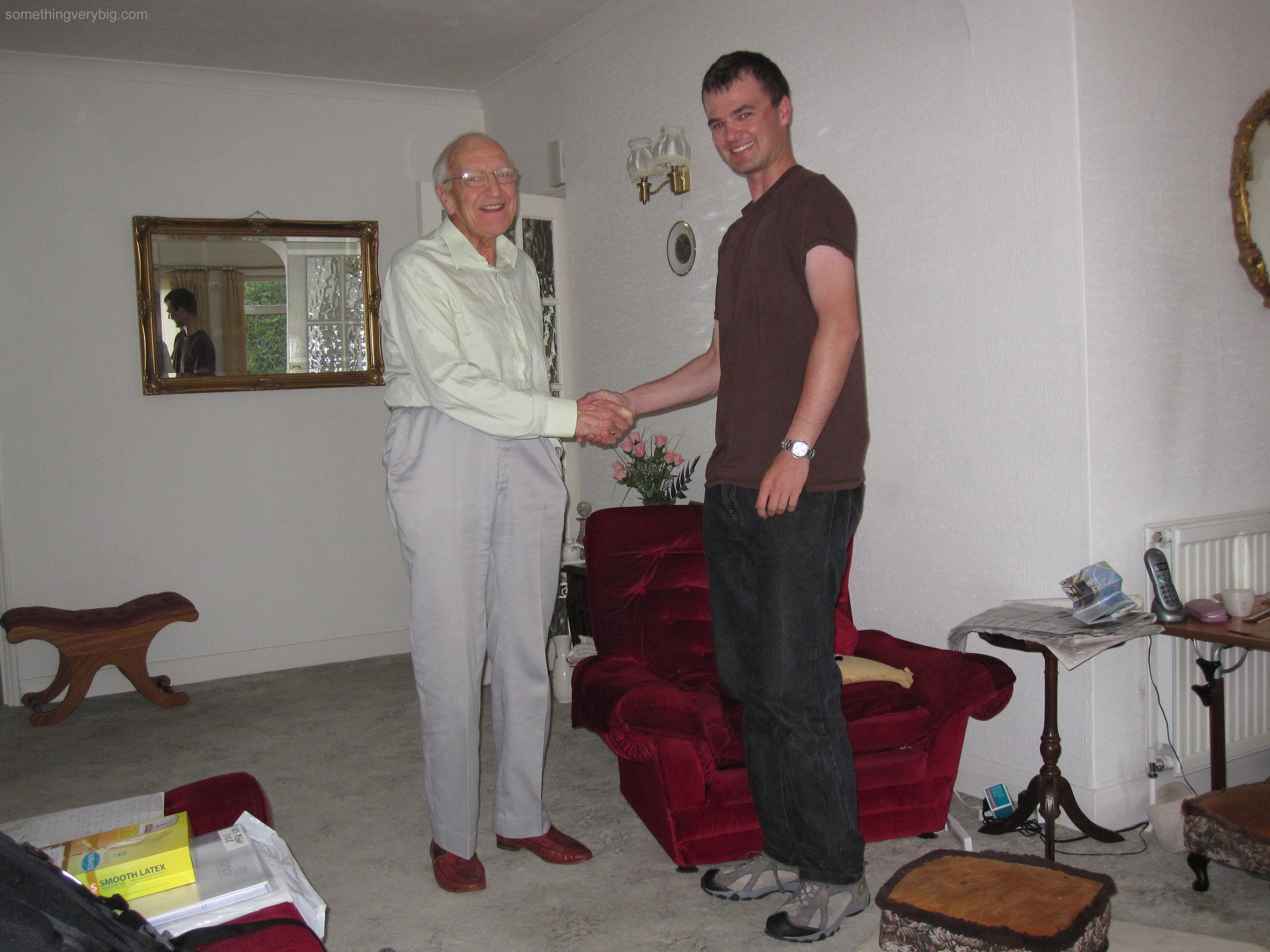
I first got in touch with Dennis Over through the Lancaster Archive Forum a few years ago, on which he is a much-loved and highly prolific member. Dennis began the war, too young to join the forces, working on fitting out air-sea rescue launches. Once old enough he joined the RAF as aircrew, serving on 106 and 227 Squadrons as a rear gunner. Following the war he was station manager at Heathrow for first BOAC and later for British Airways. Consequently Dennis has a wealth of stories. I therefore couldn’t miss the opportunity when I was in the UK in 2010 to meet him and his wife of 66 years, Peggy, at their home in London.

We talked for hours and hours and hours. We spoke about Concordes. We spoke about Queen’s Tours, L1011s and B707s. We discussed Dennis’ unconfirmed but more or less definite claim for a nightfighter. We talked about air-sea rescue launches, Comets (exploding or otherwise), Constellations, RAF dinghies, Irish jokes, 5th pods, cheese and rocket-powered sailplanes. And of course, we told stories about Tiger Moths.

As a rear gunner, Dennis told me that he felt a real sense of isolation. He was physically removed from the rest of the crew and, of course, was the only one flying backwards. He said he never felt any panic or fear while on operations. That came either before or after. While actually flying he felt only a sense of complete concentration on his duties, for the mutual benefit of his entire crew. He did mention a feeling of unreality, almost of detachment, as if he had been viewing the events he was describing from the position of a third party. Partly at least, I imagine this was a means of dealing with the enormity of the situations he found himself in.

The conversation was wide-ranging and ever changing. At one point I used his telephone to ring the family I was staying with in London and tell them I wouldn’t be home for dinner. This discussion was far too good to cut short!

I always love talking to veteran aircrew. They are a living link to the past. While I can learn facts from official documents and get a personal picture from reading letters and diaries, oral history is far more interactive. It is subject to the limitations of memory, but when supported by other sources a witness account can add much colour to a history. Dennis has some fantastic memories and it was a real pleasure to drag the hangar doors open and listen in some awe for a few hours.

29jun10-045 copy

© 2012 Adam Purcell