Bicester

Scattered across the fields of England are the remains of hundreds of former military aerodromes. Some have disappeared entirely, the runways excavated for hard fill and the buildings demolished. Some have been turned into business parks, showgrounds, residential estates and even prisons. Some have reverted back to agricultural land, with pig or chicken sheds where once were runways. A scant few are still operational airfields, civilian light aeroplanes replacing the bombers. And many more have simply been mothballed – still owned by the Ministry of Defence but all but abandoned, externally intact but uncared for, quietly decaying away to dust. One such airfield is RAF Bicester, and a group called Bomber Command Heritage  is determined to save it.

Bicester, at least according to English Heritage, “retains – better than any other aviation site in Britain – the layout and built fabric relating to both the first expansion period of the RAF and subsequent developments up to 1940”. While not an operational front-line Bomber Command station, Bicester was home to 13 Operational Training Unit, part of the great training pipeline which kept those front-line squadrons supplied with aircrew. The all-grass flying field is still used by gliders of the  Windrushers Gliding Club. Bomber Command Heritage sees an opportunity to preserve the site by turning the disused Technical Site into a significant museum.

On the face of it, it’s a fantastic idea. But it’s a large site (348 acres). Just purchasing the site from the MOD is expected to cost upwards of £2 million. There are also a large number of buildings on the site, some of which, the hangars in particular, are quite large. Many are in an advanced state of disrepair. Restoring the buildings is estimated to cost about £35 million, a lot of money for a volunteer organisation to come up with. And once they are restored, the costs involved in maintaining an active aerodrome and keeping the buildings in good repair are also not inconsiderable. It’s likely that gate takings alone from what would be, let’s face it, a niche market of Bomber Command enthusiasts would be insufficient to keep the museum open for long. There is always the possibility of lottery grants and other government support, but to rely on these as long-term funding appears less than sustainable.

So how could a site like Bicester be saved –with space for a significant museum on site – but still be a going concern in its own right? There needs to be something else other than just the museum to make the site commercially viable. ‘Developers’ have become a dirty word in today’s society with their ‘knock down and rebuild it bigger better and newer’ disregard for history. But development doesn’t have to be incompatible with heritage.

On the northern head at the entrance to Sydney Harbour lies the old Quarantine Station. It’s a magnificent site with many extremely significant buildings, used between 1832 and 1984 to quarantine passengers from arriving ships affected by infectious diseases. After its closure as an active facility the site passed into the management of the NSW Parks and Wildlife Service. NPWS did considerable work to the site to care for it (and conducted fantastic ghost tours, one of which I well remember going on in the mid 1990s) but they never had the funding required to ensure that the site was preserved properly. Things came to a head in 2002 when the 180-year-old hospital building burnt down, a fire thought to have been caused by an electrical fault. Shortly afterwards it was decided that government funding by itself was not enough to properly care for the site, and that private development was a possible solution. Unsurprisingly there was considerable public protest towards the idea, but – now that the site has indeed been leased to a private operator and has been reopened as a boutique accommodation, function and conference venue with a museum and guided tours – it’s actually turned out quite well. The commercial activities generate an income which supports the upkeep of the site, while being sympathetic to the heritage of the old station. The buildings are restored to their former glory. Even the old hospital that burnt down has been completely rebuilt, from scratch and using period methods, into a faithful and quite spectacular reproduction of the old building. Government funds alone would never have been sufficient to cover the work at the extraordinarily high standard required. Most importantly, the site retains the ‘feel’ of the old Quarantine Station – the work carried out has remained sympathetic to the original buildings and the activities that now take place there are compatible uses for them – and the public still has access to the site to be able to enjoy, appreciate and learn from it. The site is still alive.

I use the Quarantine Station simply as an example of what I think is a well-thought-out, sympathetic and viable use for a historical site. I’m not advocating that RAF Bicester is turned into a ‘boutique accommodation, function and conference centre’. But despite having all the best intentions, sentiment alone will not provide the cold hard cash that’s needed to acquire and restore a large site like a historic airfield. There needs to be some sort of income generating activities in place if the site is to remain viable, beyond just a museum. Imaginative and creative – and commercially viable – uses for significant historical sites are not necessarily incompatible with the idea of preserving the heritage value of them.

There need to be carefully thought-out controls in place to ensure that any development remains true to the heritage of the site. But developers are not necessarily the enemy, if they have the funding that will make the difference between the site falling further into disrepair, or it remaining in the long-term as an example of a Bomber Command airfield.

© 2012 Adam Purcell    
460 Squadron in Brisbane

I was in Brisbane for a work trip for the last week or so of January. It didn’t stop raining all week.

I had a short chance to stop by the Sir Charles Kingsford-Smith Memorial that is on the road leading to Brisbane Airport. Under a large curved roof, preserved in a glass ‘hangar’, is Smithy’s original Fokker Fokker F.VII/3m three-engined aircraft, the Southern Cross. It’s a very important part of Australia’s aviation heritage and it is fantastic to see the old aeroplane is being well looked after.

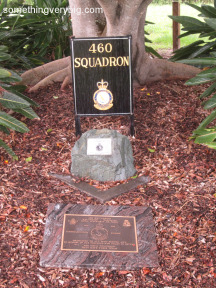
But what does this have to do with Bomber Command, I hear you ask? Well, if I’m honest, very little. But a short distance from the Southern Cross is a tree. Under the tree are three plaques dedicated to 460 Squadron, arguably one of the most famous of the Australian bomber units.

12apr-firstquarter2012-200 copy

Beneath one of the plaques is a representation of a boomerang, symbolising the motto of the Squadron: ‘Strike and Return’. Sadly, many of the airmen of 460 Squadron struck… but did not return. In fact, the Squadron suffered by far the highest casualty rate of any Australian unit in WWII: out of around 2700 airmen who served in the Squadron, more than 1000 were killed in action – 589 of those being Australians. 181 aircraft were lost on operations in the four years of the Squadron’s existence.

One of 460 Squadron’s aeroplanes survives. It is, of course, W4783 G for George, today forming the centrepiece of the Australian War Memorial’s Striking by Night sound and light exhibit. It is an extremely impressive memorial. And in Queensland, under a tree near Brisbane Airport, those three plaques also help ensure that the deeds of this Squadron are not forgotten.

© 2012 Adam Purcell

Treasure Trove(.nla.gov.au)

On a yellowing piece of old newsprint, under a photograph of a Lancaster in flight, is a headline in large black letters. “BOARDING WITH THE BOMBERS”, it says. “Salome and the Operational Egg at a British Station”. The article below the headline describes one Australian war correspondent’s visit to an airfield in Britain. The article was roughly cut out of the newspaper and details like which newspaper it was out of and when it dates from are missing. Some lines have had the first few words cut off. But what remains paints a vivid portrait of life on a bomber station, written from the perspective of an outsider looking in.

I found the article lurking in Don Smith’s archive of letters and papers concerning his son Phil’s wartime service. The collection was kindly loaned to me by Phil’s widow Mollie. Though the original is short on some details, I thought there were enough clues to perhaps fill in the missing pieces.

Almost certainly the author was writing about a visit to Waddington. “Pilots of two Lancaster bomber squadrons which operate from a station at which I was permitted to stay for three days, are all Australians”, they say. There were five nominally Australian squadrons in Bomber Command: 460, 462, 463, 466 and 467 Squadrons. 462 and 466 flew Halifaxes and 460 Squadron operated alone from RAF Binbrook. Only 463 and 467 Squadrons were both operating Lancasters and both operating from the same airfield at the same time. The author also writes that the visit was “the day after the Nuremburg raid when the Air Force losses reached their highest”. This places the visit in late March and early April 1944 – which means that Phil Smith and his crew were on the station at the time. So for me it is a very valuable insight into what was going when they were there.

But if I want to use the article as a reference, I need to know where it came from. And as it turned out a little bit of research was all that was needed to answer that question, thanks to a magnificent tool from the National Library of Australia.

First of all, I figured that there was a good chance that searching for the journalist’s name could reveal which newspaper the article was written for. Betty Wilson is the name on the byline, and she is described as ‘our London Staff Correspondent’. First stop, then, was my old friend Google. And very quickly I had a match, turning up a number of articles from the Sydney Morning Herald written by Ms Wilson and dating from the war years.

So having established that, I remembered that the National Library of Australia’s fantastic Trove website has, among many, many other things, digitised the Herald from 1842 until 1954. And from there it was a very simple process to search for a phrase that was unlikely to have appeared anywhere else in the newspaper over more than one hundred years.

The phrase I searched for was ‘Operational egg’. And bingo, there it was, the first result. The Trove search engine links to a digital scan of the original article, and also has an automatic text conversion tool to make reading it a little easier. This is still in its early versions and precision is a little hit and miss but for the most part it is accurate, so finding my missing words was a very easy thing.

So I now know that my article (my catalogue number A06-052-001) is in fact from the Sydney Morning Herald, and was published on 20 May 1944. And all of that from about half an hour ratting around on the Trove website. It’s a very aptly named tool and is a real treasure trove (sorry) of sources for Australian social history. Highly recommended.

© 2012 Adam Purcell

Enlisting

I went for an interview with the Air Force people this afternoon

– Phil Smith writing to his father, 27MAR40 (A01-118-001)

In 1940, said Don Charlwood, some 60,000 young men applied for the first 4,000 training places in the Royal Australian Air Force (C06-063-001). At that early stage of the war, competition for places was intense and the selection panels could afford to be a little choosy in the potential airmen they accepted. The process was quite involved.

In March 1940, Phil Smith was one of the 60,000. He wrote a detailed account of his first experiences in a letter to his father later that day (A01-118-001). The interview panel consisted of three officers who asked general questions about aeroplanes, about Phil’s motives for joining up, and some technical questions about centrifugal force and specific gravity (“the first I explained only fairly and the second exactly,” he told his father).  And that, he wrote, was about the limit of it. Then it was time for the medical exam.

There was, he said, a long form to fill in. Then a general physical examination, including a colour blindness check, height and weight (while stripped), measurements of “buttocks to toes” and a check of the pulse. The eye exam appears to have been quite complicated, though in his matter-of-fact way Phil declined to describe the details as “I do not know what each was for”.

The next three doctors came equipped with a battery of weird and wonderful tests. Ears were checked first with tuning forks and then with the aid of a little light. The same light was then used on the nose and throat. Phil was spun around ten times on a swivel chair and told to stand up straight afterwards. A dentist carefully checked his teeth. Blood pressure was measured. And then it was time for ‘the torture machine’. With a clip on his nose, Phil had to take a deep breath and then support an inch-high column of mercury for as long as possible. “I kept it up for over two minutes”, he wrote to his father, “but my ears are still singing”. Finally his reflexes were tested by scraping his instep with a sharp piece of iron. Recruit Dennis Over, who would eventually become a 227 Sqn rear gunner, concurred with the general contents of the medical, adding that he was also subjected to a hemorrhoids test (“bend over & let me see if your hat’s on straight”…) and a test for “rupture” (“Just cough for me, will you?”). He also encountered the ‘torture machine’, actually a test for diseases of the lungs.

At the end of an exhausting day of being grilled, poked and prodded, Phil was told he would be accepted for the Air Force Reserve but that he would be required to have his tonsils removed and six teeth filled at his own expense first. After some indecision he had the required work done and was duly enlisted in the Royal Australian Air Force Reserve, to await call-up. He was given a badge to wear to say that he had enlisted and continued to work at the Yarraville Sugar Refinery for another six months.

Though Phil doesn’t mention it, it appears that recruits would be given a course of study in mathematics, physics and navigation to do while they were awaiting call-up, to improve their chances of coping with the early, theoretical stages of their training. This is what Don Charlwood called the ‘twenty-one lessons’. In his memoir ‘Journeys into Night’ he describes the course as ‘extraordinarily well-arranged’. Recruits living in towns could attend night schools to complete the course; others living further out (like Charlwood himself) needed to work by correspondence, helping mates out as they went. Morse code was taught by local postmasters (C07-034-xiii).

Reservists were on the Reserve for differing periods of time. Don Charlwood’s mates Jim Riddoch and Claude Austin were called up after seven months; Charlwood himself had to wait eleven (C07-034-xiv). In fact Riddoch would be in Canada beginning his training before Charlwood received his call-up papers. Phil Smith was waiting for ‘only’ about six months. But the letter arrived, and on 14 September 1940 Phil found himself on a train from Melbourne to his Initial Training School at Bradfield Park, Sydney. Life would never again be the same.

© 2012 Adam Purcell   


Leo’s Letter

It started, as many of these things do, with a simple Google search. In mid May, I saw in my site stats that someone had run a search for “222 squadron leo mcauliffe’. A day or so later a comment appeared in my inbox. It was from a man named William Rusbridge. Cleaning out his late mother’s papers, he had found a letter written by a young Australian airman whose squadron had been based for a time at the Selsey Advanced Landing Ground in southern England.

William’s parents owned a farm that had been requisitioned by the RAF for the landing ground in the lead-up to D-Day. They managed to convince the Air Force to allow them to stay living in their house, as William says more or less in the middle of the air base. They subsequently got to know many of the airmen posted to the base and, as the letter shows, remained in touch with at least one young Australian – Leo McAuliffe. Deciding to find out more about who might have written the letter so long ago, William tried an internet search… and so found this blog.

William very kindly typed out and sent me a transcript of the letter. It is, in every way, a typical letter as written by aircrew during the war. There’s a bit of news about Leo’s rest period when he was “flying an Anson backwards and forward from the continent to England”, some talk about other airmen the recipients would have known (“You remember the C.O. S/L Rigby the chap who was going around with that girl you know from Chichester well both he and Ernie Broad got a bar to their DFC’s before going on rest which they both deserved”), and a story of how he celebrated Christmas. “What a time it turned out to be”, he wrote, “drunk for two days without remembering a thing”. Leo wrote this letter on 2 February 1945, just six weeks before he was killed.

Just reading the transcript was amazing enough. But then, having no further use for it himself, and in an extraordinarily generous move, William mailed me the original letter.

It’s written on four pages of blue paper with an Air Force letterhead, in fountain pen ink and with a flowing old-fashioned script. Leo McAuliffe wrote this letter with his own fountain pen and in his own hand. And though the words he used themselves add something to what I know about him, the letter also represents something more. It is a real, tangible connection to the man whose grave we first stumbled upon in the east of The Netherlands in 1995. Suddenly the story has a human element to it. The man is more than a face in a photograph, and more than a name on a white stone.

I’m extremely grateful to William Rusbridge for his generosity – and ever hopeful that more people who look through dusty boxes of papers are curious enough to try to find out more about the people they belonged to.

 © 2012 Adam Purcell

Sergeant Taylor

On 10 May 1944, the crew of B for Baker failed to return from an operation to Lille in France. As the next day dawned at Waddington and the survivors of the raid began to come to terms with what had been the worst night of the war for the station, a new crew was posted in to 463 Squadron. Led by 16203 P/O J.F. Martin, it was made up mainly by Australians. The Flight Engineer, one 1324017 Sgt P.D. Taylor, was the sole Englishman. This crew, flying Lancaster LM571 JO-E, would make eleven un-eventful trips, mainly to targets supporting the invasion in France, but would be lost on their twelfth, to Prouville on 24/25 June 1944. The bomb aimer would be the only survivor, and his six crewmates today lie in Bussuss-Bussuel Communal Cemetery in France. They were one of three 463 Sqn crews to be lost that night, while 467 Sqn lost two. Only the 10 May Lille raid was more costly.

I received an email last night from Phil Bonner, who was the Squadron Leader who showed me around RAF Waddington when I visited in 2009. Now retired from the RAF, he runs Aviation Heritage Lincolnshire and remains a key contact for me in the area. Phil passed on a query from the sister-in-law of Sgt Taylor, a Mrs Joni Taylor, who is searching for relatives of the Australians in this crew. He wondered if I might be able to help.

The full crew list is as follows:

Pilot: 16203 P/O J.F. Martin

Flight Engineer: 1324017 Sgt P.D. Taylor

Navigator: 415430 W/O B.E. Kelly

Bomb Aimer: F/S T.A. Malcolm

Wireless Operator: 417327 F/S G.W. Bateman

Mid-Upper Gunner: 424761 F/S L.G.L. Hunter

Rear Gunner: 408433 F/S B.R. Barber

The National Archives of Australia has digitised records for W/O Kelly and F/S Barber. Before enlistment Kelly was a ‘Junior Clerk’ with the Chief Secretary’s Department of the Government of Western Australia. His next-of-kin was listed as an aunt, Mary O’Grady of 70 Lindsay St, Perth, WA. Also to be informed of any news was Miss Valerie O’Sullivan, 45 London St, Mt.   Hawthorn, WA. Barber was a bank clerk from Ulverstone in Tasmania. His next of kin was recorded as his father, Fletcher Bramwell Barber, 12 Richards Ave, Launceston, TAS.

I’ve pointed Phil towards the secretaries of the Queensland and the NSW Branches of the 463-467 Squadron Association, and in the meantime thought I’d try to publicise Mrs Taylor’s search online. If anyone has any leads that may be of assistance, please leave a comment below or drop me an email – details through this link.

© 2012 Adam Purcell

Caterpillar Club

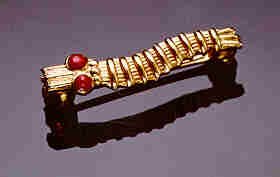
One night in September 2008 I was at a formal dinner put on by the Royal Aeronautical Society’s Sydney branch. Sitting at my table was a very interesting man. On his lapel was a tiny golden caterpillar, with bright ruby red eyes, not unlike this one:

That suggested he had a story to tell!

Peter Batten was his name, and indeed he did have a story. In March 1987 he became the last Australian to eject from a Mirage jet fighter, after his engine flamed out off the coast near Newcastle, NSW. He was rescued by a fishing boat with only minor injuries. I had recognised the golden badge on his lapel as the emblem of the Caterpillar Club, a loose association of airmen united by one common thread (ahem): taking to the silk to escape from a disabled aeroplane. Started by Irvin Aerospace in 1926, the Club recognises aircrew regardless of their nationality.

The first member of the Caterpillar Club that I met was Phil Smith, pilot of Lancaster LM475 B for Baker. He once showed me his caterpillar badge, which is how I recognised Peter’s some years later. In 2003 I wrote to Irvin to see what information they held on Phil’s escape but due to British privacy laws they could not release anything. Lucky, then, that I now have a copy of an unpublished manuscript that Phil originally wrote for his grandson, in which he relates exactly what he could remember:

We were just about to drop our bombs when everything went hot and dry and red. When the flame had gone out, I was still in my seat but could feel no aeroplane around me. I immediately released my seatbelts and then my parachute. It seemed to open immediately. There was sufficient light for me to see that one of the two straps supporting me had been half cut through. I floated to the ground holding with both hands the damaged strap above the cut. This helped soften my landing which was on what appeared to be a flat grassy field. […] I seemed to be all in one piece but my flying helmet and one flying boot had gone. (C03-004-024)

As we now know, Phil sheltered with a French family until the invasion forces passed his position in September 1944. There is a letter in Mollie Smith’s collection from the great Leslie Irvine himself, written to Phil in October congratulating him for his escape – it took a little longer for the badge to reach him, “owing to supply restrictions” (A01-042-001).

And when I visited Phil in the late 1990s, hanging on his wall was a frame enclosing the tiny golden caterpillar with the ruby red eyes.

Text © 2012 Adam Purcell

Image from http://www.merkki.com/images/ccpin.jpg

Leader

Every Monday in my postbox I receive a copy of the local newspaper. The Moonee Valley Leader usually shrinks to less than half its thickness once the advertising flyers are removed, but every now and then it reports on interesting stories with local connections. Just after ANZAC Day this year it ran this story  about a 100 Squadron airman, P/O Jack Wilson, killed in action over Holland in January 1945. He and his wife were living in Essendon when he enlisted, and the story was about how his daughter – two years old at the time of her father’s death – made contact with a British researcher after by chance finding an earlier article in the Leader seeking information about P/O Wilson.

The British man is Paul Kurn, whose father was a ground mechanic with 100 Squadron, responsible for Lancaster JB603, the aircraft on which P/O Wilson had died. Mr Kurn’s search for the story of his father’s war began in 1998 and was originally centred around the operations carried out by this aircraft, before shifting into looking for the airmen who had flown it. He contacted the newspaper using P/O Wilson’s wartime address. It took a year, but eventually the right person saw the article and made contact.

Writing to local newspapers is a tactic that can, as this story demonstrates, be very effective. People of that era tended not to move around nearly as much as we might do today and so if they are still alive there is a good chance of their being in the same area six or seven decades later, if not in the same house. Articles also being published online these days greatly strengthens the chances of finding the right person by bringing them within the reach of a simple Google search. All it takes is one curious relative to look for something as straightforward as a name. Patience – and a good deal of luck – can certainly pay off in this research caper.

Paul Kurn set out on his journey with similar intentions to my own. Finding descendants of the crew, he said, gives him “…a chance to maybe tell them of what happened to their relative and […] to shed light on something that they may have wondered about for 60 years without any idea what happened in those final moments and where it happened… The story has grown beyond anything I could have imagined”.

Telling the crews’ stories, and remembering. That’s why we do it.

© 2012 Adam Purcell


Bomber Command in Canberra 2012

The 2012 Bomber Command Commemoration Weekend has just wrapped up in Canberra. There were slightly fewer people present, to my eye, than on previous years but I think it was still a fair turnout. Perhaps the forecast rain kept some away – it certainly was a wet welcome to Canberra when my Virgin E-Jet broke clear of the thick cloud that we’d been descending through just before landing.

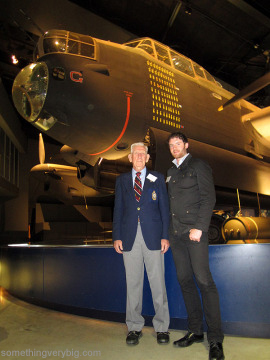
This was the fifth such commemoration to be held in the nation’s capital and the event has settled down into a familiar but effective pattern. G for George provided the setting for the now traditional ‘Meet & Greet’ function. There were indeed many people to meet and greet. Tommy Knox and Pat Kerrins, who I’d met here last year, were both there again. Don Browning and Ross Pearson traded their usual good-natured banter about which between the Halifax and the Lancaster was the ‘proper’ aircraft to have flown in (at least we all thought it was good-natured…). And I met a few new people too.

12-jun-bomber-command-in-canberra-007 copy

Early in the evening as I was wandering around to see who else I recognised, out of the shadows of the Lancaster’s nose came a man named Don McDonald, a 466 Sqn Halifax skipper from Melbourne, a veteran I had not yet met. He was a lovely bloke and we chatted about all sorts of things for a good while – and upon learning that I now also live in the southern capital he and his wife Ailsa promptly invited me to visit them for dinner sometime. You never do know who you will meet at these events! I also spoke with the former Commanding Officer of the reformed 462 Squadron, which was previously a Halifax squadron of Bomber Command and is now an electronic intelligence unit based at RAAF Edinburgh in Adelaide. The superb Striking by Night sound and light show was again played at the end of the event. The final moments of the production feature a WAAF speaking about the Australian airmen she worked with. “They were young… handsome…” she says, “…and full of life.” At which point Don Huxtable was heard to mutter “well two out of three ain’t bad…”12-jun-bomber-command-in-canberra-012 copy

Many of us repaired to the hotel bar at the Rydges after returning from the AWM. It was a memorable night, sharing beers with the two Toms Knox sitting on one side and Hux on the other as a great variety of stories, of both tall and short varieties, were told.

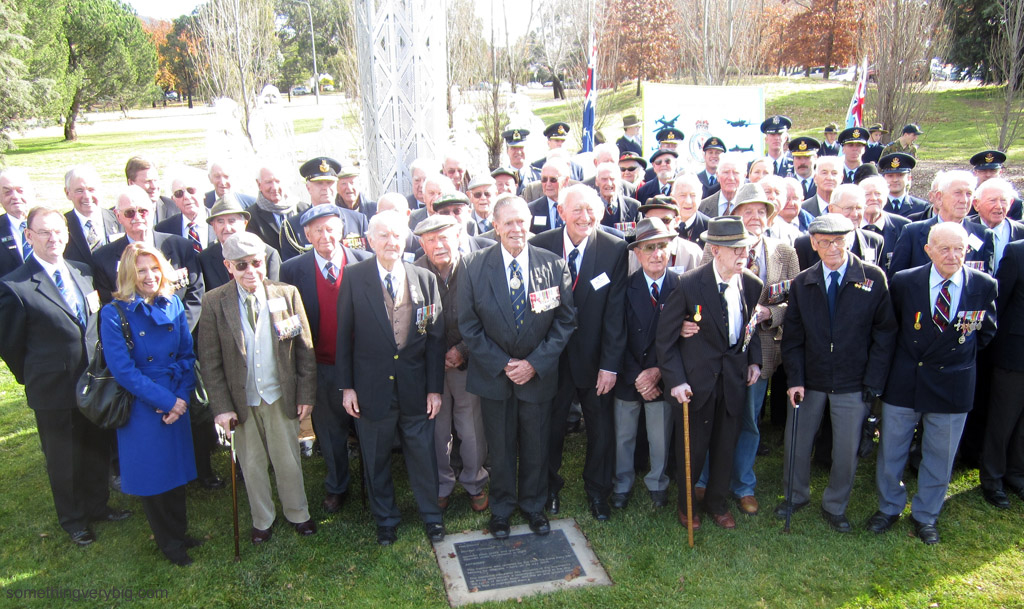
Canberra received almost an inch of rain on Saturday and it looked very much like it had set in for a week. But upon peering out of my hotel room window in the morning I saw a scene that was wet, but not actually raining. The clouds gradually cleared as the morning went on and in fact it turned out into a delightfully mild Canberra morning. The Commemorative Address was given by Air Marshal Mark Binskin, Deputy Chief of  Defence Force (and a former Chief of Air Force), who spoke about the legacy of teamwork from the men of Bomber Command, and how the Air Force has reformed two Bomber Command squadrons as a tribute. Fittingly a large group of 460 Squadron personnel were present standing in three neat rows at the back of the crowd. There was an attempt to get an official photo of all the veterans who were present but it was not as organised as last year’s effort:

12-jun-bomber-command-in-canberra-032 copy

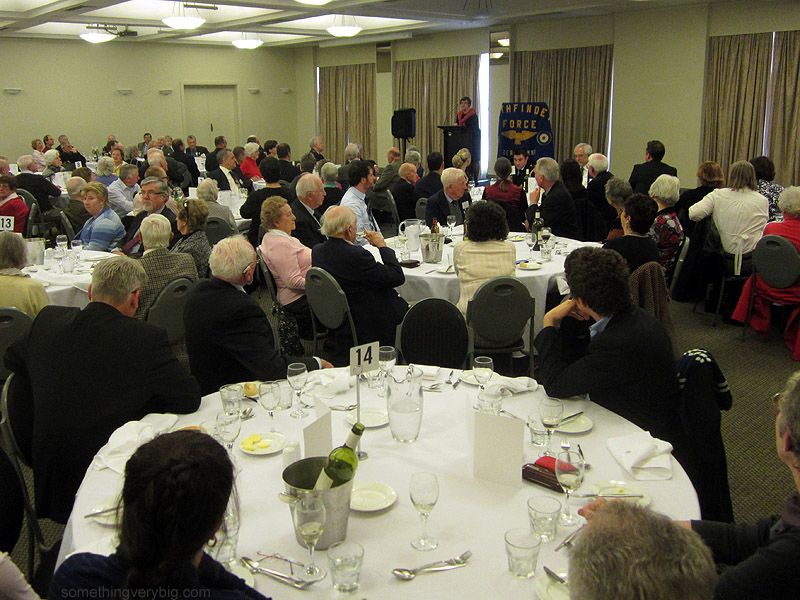
Back to the Rydges, then, for the luncheon, always for me the highlight of the weekend. Despite the slightly lower numbers present this year, it is still one of the largest gatherings of Bomber Command veterans, families and other interested people in this country. Once again there were many extremely interesting people to talk to. I finally met Diane Strub of the Queensland Branch of the 463-467 Squadrons Association, and Fred Murray-Walker, whose father was killed in the crash of 463 Squadron Lancaster JO-G on the Scottish hillside in 1944. Peter Rees, a Canberra-based author who is currently finalising a book focusing on Australians in Bomber Command, was also there, and brought with him a magnificent folio of target photographs cheekily entitled “The Collected Works of 463 Squadron, as told to the Third Reich, September 1944 to May 1945”.

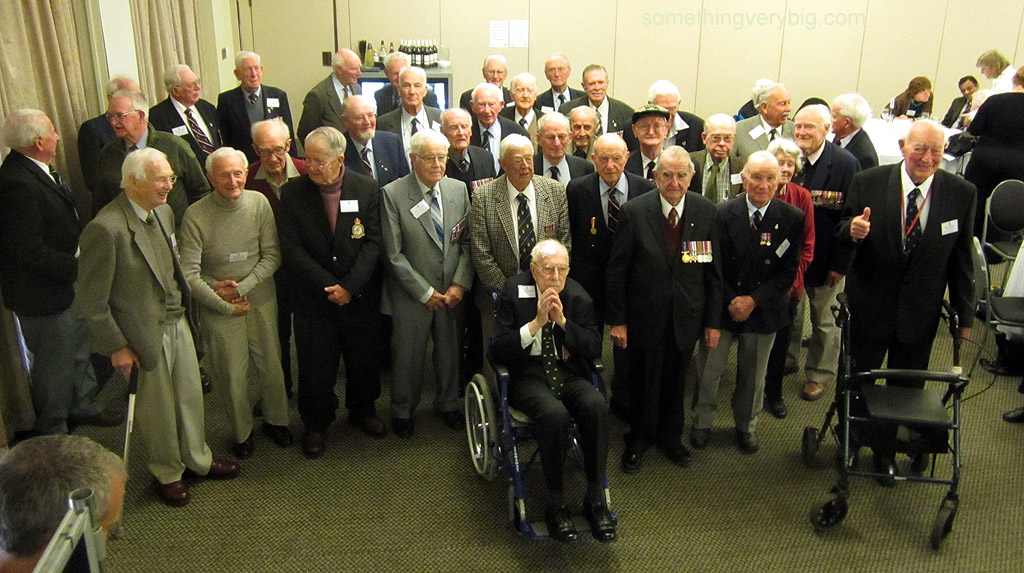
Perhaps the most remarkable person I met was sitting at a table at the back of the function room with her son and daughter in law. An Englishwoman, her name was Maude and, as it turned out, she had been on the staff at Bomber Command Headquarters – she was Deputy Commander in Chief Sir Robert Saundby’s secretary from 1943 until the end of the war. I asked her what the atmosphere was like at Bomber Command HQ. She said it was always busy – she was at work whenever her boss was and might – might – get the occasional half-day off on a Sunday if she was lucky. It was only a short conversation but it was an absolute pleasure to meet and talk to a unique lady. I even managed to convince her to get up for the group photo of all present who had served in Bomber Command (she is front right here, wearing red, behind Tommy Knox):

12-jun-bomber-command-in-canberra-066 copy

Some more photographs from the weekend:

Some of the crowd at the Meet & Greet function in the shadow of Lancaster G for George:

12-jun-bomber-command-in-canberra-010 copy

The Ceremony, in front of the AWM’s Bomber Command memorial:

12-jun-bomber-command-in-canberra-015 copy

The Three Dons: Don Southwell reading a copy of a ‘Tribute to Mr Don Huxtable’ as tabled in NSW State Parliament recently, while Don Browning and Don Huxtable himself look on:

12-jun-bomber-command-in-canberra-041 copy

Bryan Cook, Don Huxtable, Don Browning and Adam Purcell in Canberra, 03JUN12:

12-jun-bomber-command-in-canberra-048 copy

Part of the 220-strong crowd at the Lunch that followed the Ceremony on Sunday:

12-jun-bomber-command-in-canberra-052 copy

In all, then, another fine weekend of commemoration and friendship. Another pile of things to follow up on. Another piece of proof that, even after almost seventy decades, the deeds of Bomber Command live on. I’ll leave the closing words to Don Southwell, who delivered the Reflections address during the Ceremony on Sunday.

“I will always be proud”, he said, “that I flew with Bomber Command”.

Text and images (c) 2012 Adam Purcell