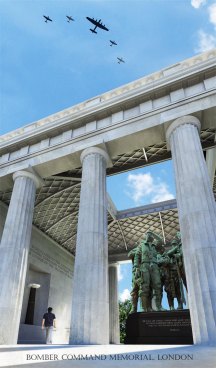
Bomber Command Memorial London

On 28 June 2012, the Bomber Command Memorial will be officially dedicated and opened in London by the Queen. The Memorial will be a lasting tribute to more than 125,000 Commonwealth aircrew who served with Bomber Command during World War II.
The bomber offensive was perhaps the longest, most sustained single campaign of the war – crews were in action from almost the first day of the conflict and the final sorties were flown at the very end of hostilities in Europe. Their contribution to the final victory was immense – as, sadly, was the cost. Out of those 125,000 airmen, more than 55,000 were killed in action. As an overall group, only the German U-Boat crews suffered a higher casualty rate.

Some 10,000 Australians served with Bomber Command. Almost three and a half thousand of them died while on active service. Bomber Command represented some 2% of total Australian enlistments in WWII but suffered 20% of Australian casualties. One Australian unit, 460 Squadron, lost more than 1,000 men over the course of the conflict – the equivalent of being completely wiped out five times.

Yet despite their terrible sacrifice, despite their enormous contribution to the war effort, the men of Bomber Command have never received the recognition that they deserve. A campaign medal was never awarded. And it has taken until now – nearly seven decades after the cessation of hostilities – for an official Memorial to be built. It’s been estimated that some 150 Bomber Command veterans remain alive in Australia. The youngest of these are fast approaching their 90th birthdays. Naturally our surviving veterans are very keen to travel to London to take part in the dedication ceremony. Due to the ravages of age not all 150 are well enough to attend, but at least 80 have registered interest with the Bomber Command Association of Australia.

The Australian Government initially announced a Commemorative Mission of five veterans would be fully sponsored and supported to go to the Ceremony. No family members or carers were included. A further forty grants of up to $3,000 each were to be available to assist other veterans in defraying their travel costs. In contrast, the New Zealand Government announced in a media release (through Veteran’s Affairs New Zealand) that they will be sending an RNZAF Boeing 757 to London with any veterans who are willing and able to make the trip, plus carers. Veterans’ Affairs New Zealand will cover all accommodation, transport, travel and medical expenses. This is a superb effort and shows how much the New Zealand Government respects and appreciates the efforts of their veterans.

So the Bomber Command Commemorative Day Foundation started a campaign for proper recognition of our veterans. And it was successful, sort of. The Government announced on May 12 that they will now be taking 30 veterans, with $5,000 grants available to those who miss out on being part of the official delegation. This is a good improvement, but more is still needed. There are practical difficulties associated with travelling at such an advanced age and having a family member or carer travelling alongside is almost a necessity. The Australian Government was quite happy to send these brave men all-expenses-paid to England seventy years ago. The least they deserve is help so that they have the chance to see that their efforts – and the memories of the 3,486 Australian airmen who never came home – are properly recognised in London.

I’ve written letters supporting this cause to my local Member of Parliament, the Minister for Veterans Affairs, the Prime Minister and the Opposition Leader. So far (a week and a half later) the only response has come from the Office of the Opposition Leader, in a phone call this afternoon. The staffer who rang me suggested I also contact the Shadow Minister for Veterans Affairs, so a new letter will be on the way shortly. I’ll be very interested to hear the responses of the others and will post here with any updates.

In the meantime, for those who wish to give practical support, please see details for making donations to the Bomber Command Commemorative Day Foundation’s London Visit Appeal here.


Edit 03JUN12:

An article in the Hornsby Advocate featuring a great photo of two of our 463-467 Sqn veterans.

I’ve also received a reply from Warren Snowdon’s office advising that the official mission is now 32 men – 44 applications were received and all those assessed as medically fit to join the mission were accepted.  The number of $5,000 grants is uncapped. This, to me, appears a reasonable response – it is certainly an improvement over the initial proposal. I’m still awaiting a response from my local member.

Picture: http://www.hydro.com/pagefiles/846261563/BCM-Poster_800x1365.jpg

Text (c) 2012 Adam Purcell 

Learning to Fly

The chance to learn to fly an aeroplane was probably a factor in why many young men joined the Air Force in WWII. Those lucky enough to pass the tests and be selected for pilot training would soon have found themselves at a dusty Elementary Flying Training School, climbing aboard at a bright yellow Tiger Moth for what would be, in many cases, their first ever flight.

“This afternoon we had our first flying experience, a trip of about 1/2 hours duration. It was a very interesting business and it was just sufficient to demonstrate just how difficult a business it is to fly. The controls vary greatly in sensitivity and to the beginner in changing your attention from one thing to another it is very easy to loose [sic] control completely.” – Phil Smith, in a letter to his father written 14NOV40 (A01-125-001)

Despite spending a week in hospital with influenza (he had a temperature of 101 degrees – A01-126-001), it did not take Phil long to go solo for the first time. “When I recommenced flying on Monday [following hospitalisation] I found that I could do everything except land”, he wrote to his father on 28 November 1940, the day of his first solo (A01-132-001). “All my flying time since then has been in picking this up. I still don’t make good landings but they say I am fairly safe. So, this morning I did my first solo flight. Altogether I made three solo flights and landed satisfactorily each time.” He had about eight hours flying time in his logbook at this stage.

But as big an achievement as one’s first solo is when learning to fly, there is a big gap between a pilot who has flown solo and one who is fully qualified. Phil’s letter home two days after his first solo reveals that he was acutely aware of how new everything still was, and of how far he had yet to go (A01-127-001):

“From time to time I get very nasty turns, for example, this morning another plane and I only missed a side-on collision because he was about 20′ below me. This was mostly because I had not kept a good enough lookout. […] Yesterday also I had a scare when on the glide into the aerodrome I was turning and hit a bump which I swear l neally [sic] turned the plane vertical on its side. However, to get down safely is the big thing in flying so they say and the sooner I wake up to the responsibilities the better it will be for me. I find the landings are coming much easier to me now but they still are far from good. I find that steep turns are giving me a bit of trouble too.”

Trainee pilots had to contend with lectures on meteorology (“I think I shall have to learn the Beaufort scale of winds”, he wrote to sister Wenda in March 1941), photography and navigation. They even carried cameras to take photos of turning points to prove they got where they were supposed to go on their solo cross country flights (A01-147-001). The instructors were a mixed bunch. Phil was fined a tin of Craven A cigarettes by one of his, for letting the aeroplane slow down too much on final approach (A01-139-001 02FEB41). On another occasion an instructor rapped him over the knuckles with a ruler for a similar offence. Life was not made any easier, Phil wrote, by having multiple instructors all with slightly differing ideas on how things should be done. But sometimes they could be more relaxed as well. Phil’s letters reveal a number of instances where they got up to some fun. In December 1940 a train derailed near Tamworth and they stooged over to have a look (A01-130-001):

“After we had seen all we wanted my instructor and the other plane’s became playful and staged a mock dogfight. My instructor was very expert at this business and had the other plane at his mercy almost all the time. It was a very fast-moving business and consisted mostly of steep turns almost on our sides and short and quick dives and climbs […]”

And on another day, during a three-hour dual cross country flight (A01-140-001):

“The instructor I was with on that occasion was very playful and delighted in flying over the country schools trying to make the children walk around the school first one way and then the other to keep the plane in sight. We pupils, three of us, lean out and wave at the kids, all quite good fun.”

Aeroplanes being aeroplanes, the forces that keep them in the air are still the same today as they were when Phil Smith took his first few faltering steps into the sky. While the technology might have advanced considerably over the decades, the general techniques and principles of flight remain unchanged. And so I can relate some of my own flying lessons to those of Phil Smith. I had no less than nine instructors over the course of my first 35 or so flying hours so I can relate very much to Phil’s frustrations at being told different things by different pilots. One of those instructors wielded the fuel dipstick instead of a ruler when I got too slow in the circuit. I even did my own first solo on 28 November 2002 – 62 years to the day after Phil Smith did the same thing.

But not everything was the same. It took me about 17 hours of instruction before being let loose for my first solo in a Cessna – a result that would have very quickly resulted in a scrubbing from pilot training if I was learning to fly in a wartime EFTS. There was a radio in the Tiger Moth that I flew last year – there was no radio in Phil’s day. And, perhaps most importantly, I was learning to fly purely for the fun of it. While undoubtedly there were fun times for pilots like Phil Smith along the way, they were ultimately training for a deadly serious job.

© 2012 Adam Purcell

Briefing Room

While the photograph that is now finding a wider audience as the cover shot of Bomber Command: Failed to Return is the only known image showing the entire crew of B for Baker, there is one more photo that shows at least four of them. It is from the small collection that was with my great uncle Jack’s logbook and it shows a large group of airmen in a briefing room. The three men furthest back in the photograph are, left to right, Ken Tabor, Eric Hill and Gil Pate. In the middle of the second row, next to the man wearing the round officer’s cap, is Phil Smith:

Briefing - Still 1

It has been thought that the man in the middle of the row immediately behind Phil Smith was Jack Purcell, on the basis of an arrow that my father says used to be attached to the photo. Certainly Edward Purcell, Jack’s brother and recorded next-of-kin, thought initially that this man was the one who looked most like Jack, writing to Don Smith in November 1944 that:

“The actual features are, as you will notice, very vague, but the general head conformation is identical with that of the boy.” (A01-110-001)

But a month later, after Don had provided another enlarged photo, Edward reconsidered:

“It was most kind of you to send the photos but, I am sorry to say, the enlarged view establishes that the boy marked is definitely not Jack.” (A01-111-001)

The photo has an interesting history. When we first met Phil Smith in 1997, we showed him the print. He turned it over – and immediately recognised his own handwriting on the reverse, naming the three members of his crew sitting at the back of the group. But there is an intriguing inconsistency in the photo. At close inspection, the date on the blackboard at top left reads 11 March. The target is given as Berlin. But in neither Jack’s nor Phil’s logbooks is there an operation recorded on that date – to anywhere, let alone to the ‘Big City’. In fact, neither logbook records any flying of any kind on that day. Perhaps, we thought, the briefing had been for an operation that was subsequently scrubbed.

As it turns out, the real answer is even better. Also appearing in the photo – the man in the centre wearing the officer’s hat – is Dan Conway, an A Flight skipper. After the war he wrote a superb book called The Trenches in the Sky, in which he explained the situation. A film unit was visiting Waddington to take shots for a short feature called The RAAF in Europe. The briefing was staged for the benefit of the cameras and, according to Conway, included “references to tracking at low level over the Ruhr etc. Maybe because we were laughing [the CO] was made to go through the procedure again and then again…” (C07-014-160). The photo is in fact a still taken from that film. Our copy has a purple stamp on the back saying “RAF Photographic Section”.

So how did this official photo end up in Jack’s collection? Phil Smith had much extended family in England and his letters reveal that he visited them often while on leave. One uncle was Jack Smeed, who worked for a film studio in London… and it was this studio that produced the film from which the photograph was pulled. It appears that Jack Smeed arranged for copies to go to Phil, who captioned them and then forwarded them to his parents. After the crew went missing, Edward Purcell’s letters from late 1944 show that Don Smith spread them around to the families of some of the rest of the crew.

A few years before he died, Phil Smith was visiting the Australian War Memorial with his wife Mollie. In a corner of the Second World War gallery at the time was a small Bomber Command display, which included a short film. It was a grab from The RAAF in Europe, and Phil recognised himself as one of the reluctant film stars in it. I remember seeing the same display myself some years later (edit September 2013: it’s still there!), and the footage still crops up occasionally in documentaries and the like.

© 2012 Adam Purcell

ANZAC Day 2012

ANZAC Day dawned cold and wet in Melbourne. The conditions didn’t stop 35,000 people attending the Dawn Service at the Shrine of Remembrance. I wasn’t one of them, though – instead, I got on board a Virgin jet and headed towards the north.

Descending into Sydney, the city looked an absolute picture. It was one of those sparkling autumn days that I don’t think you really get anywhere else in the world. Only the whitecaps on the rolling seas hinted at the presence of some wind.

I caught the train into the city. Emerging from the pedestrian tunnels out of St James station, I smelt rosemary and heard marching drums somewhere in the depths of the city. Yes, the March was well and truly underway.

The Air Force veterans traditionally hit the circuit around 11am so I had a bit of time to spare. A marching band moved past, its mighty horns echoing off the skyscrapers. Walking out of the tunnels I spied a familiar figure. It was Tommy Knox, a Stirling flight engineer from 149 Squadron who I had met in Canberra last year. He was clutching a free cup of tea that he’d been given by Legacy volunteers at the train station. I’d received a letter from Tommy just a couple of days before. We had a quick chat before he hurried off to find the rest of the ‘Odd Bods’, the group he marches with.

Returning to Elizabeth Street, I patrolled up and down the assembling throng, looking for people I knew. The first veteran I recognised was Hugh McLeod, a 49 Sqn rear gunner who, at “eighty seven and a half” says he is one of the youngest in the group. Hugh was adopted by the 463-467 Sqn Association some years ago and now joins them for the march and lunch each year. Once the banner arrived, safe in the care of Bryan Cook whose grandfather was a 463 Sqn mid upper gunner, it became the focal point and more familiar faces detached themselves from the growing crowd. In recent years it has become something of a tradition for Bryan and I to carry the banner for the Squadrons and we were again honoured to do so this year.

Only six veterans actually marched this year. Even the indefatigable Don Southwell was absent, having pulled a hamstring recently. He rode in an RSL-provided Land Rover instead. The rest of the bunch was made up by numerous families and friends of veterans, numbering perhaps a couple of dozen in all.

Some photos of the march:

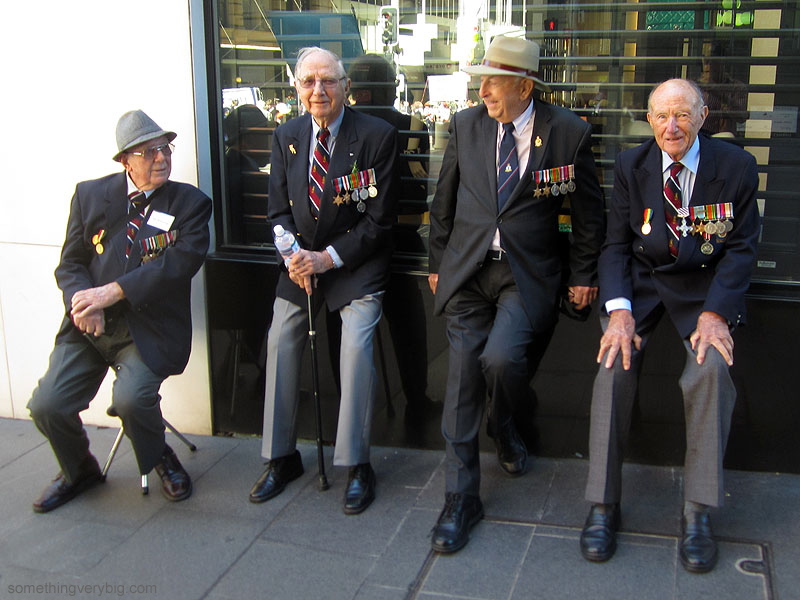
After setting off up Elizabeth Street, we turned down Market Street– where, as has become normal each year, we halted for perhaps half an hour to avoid congestion further down the route. President of the Association Don Browning came prepared, wielding one of those walking sticks with a built-in stool. The other three in this photo took advantage of a handy window sill:

12apr-anzac-day-009 copy

Meanwhile the wind had picked up. While we were waiting to continue Bryan and I had a good chat with Hugh, our 49 Sqn rear gunner, while he clung gamely to one of the banner’s guy ropes to keep it under control in the breeze:

12apr-anzac-day-010 copy

Following the march, lunch was at the Sydney Marriott hotel, on the other side of Hyde Park. Once again it was a superb meal. 48 people were present, including the same ten veterans who we had last year. Again a group photograph was organised (ignore the two young blokes holding the banner up in the background!):

12apr-anzac-day-008 copy

Left to right, they are Don Southwell, David Skinner, Bill Purdy, Alan Buxton, Hugh McLeod, George Douglass, Don Huxtable, Don Browning, Albert Wallace and Harry Brown.

Five of these distinguished gentlemen will be travelling to London in late June for the dedication of the new Bomber Command Memorial in Hyde Park.

During lunch I sat next to Alan Buxton, a navigator. Alan never flew operationally with 467 Sqn – he actually flew his tour with 617 Sqn, the famed Dambusters. In late 1944 he baled out of his crippled Lancaster over Norwich after a harrowing return trip across the Channel with all four engines ablaze, a story hinted at by the tiny golden caterpillar badge with ruby red eyes that he was wearing on his tie. He proudly showed me his Caterpillar Club membership card, which he still carries in his wallet. After VE Day Alan was posted to 467 Sqn at Metheringham, in preparation for the planned Tiger Force operations against Japan. Thankfully the war ended before they were required to fight in that theatre. Alan appears in this photo on the left:

12apr-anzac-day-017 copy

And so another ANZAC Day passes. It is always wonderful to see these blokes each year, and long may it continue. President Don Browning made a toast to absent friends during the lunch – but added that, as long as there was someone to carry the banner, there would be someone to march with it, and so the spirit of the two Squadrons will live on.

© 2012 Adam Purcell

Vale Cliff Leach

I’m very sad to report that Clifford Leach, a 150 Squadron Pilot/Flight Engineer, died last week after a short illness. Cliff, perhaps unusually for his generation, plunged right in to the world of computers and forums in his later years, posting on a number of forums about his wartime experiences as ‘cliffnemo’. His magnum opus, however, was a thread that he started on PPRuNe in June 2008 called ‘Gaining an RAF Pilot’s Brevet in WWII’. Cliff posted about his experiences while in training, backed up with original notes and drawings. This drew a number of other contributors into the open, among them the much-missed Reg Levy, a 51 Sqn Halifax skipper who later  (among other things in a very long and varied career) flew Boeing 707s with Sabena. Four years and close to 2,500 posts later, that thread is still more than going strong, with a former Vultee Vengeance pilot named Danny now holding court.

On another forum, one of Cliff’s first posts was typical of the modesty of his generation:

I didn’t do much only three opps

Well, you might not have thought so, Cliff, but what a legacy you leave behind. The PPRuNe thread likely would not have come into existence without Cliff’s input. And it’s the interactive nature of those kinds of threads that makes them so valuable – being able to read experiences written first-hand, then asking questions either about those stories or on anything else even remotely related to the topic at hand. That little post in June 2008 brought into the open many fascinating stories and the thread now contains a goldmine of information for researchers like me – adding colour to the dry facts and figures.

His son Bill has posted on the thread following the death of his father, saying how proud Cliff was of the thread and how he had arranged for a printed copy of it to be left for his grandson. He also related the story of Cliff’s final flight, just a week before he died. A friend arranged for a local flying school to take him up, and he was, says Bill, “astounded that he was ordered straight into the pilots seat and took the controls for the whole flight. He was told that if it wasn’t for a strong cross wind he would have been allowed to land the plane.”

I never had the chance to meet Cliff, though we corresponded through the thread and through email over the last few years. His input assisted greatly in my earlier post on Flight Engineer training, and his recollections about the Lancaster contributed to th final look of the painting of B for Baker that I commissioned a couple of years ago. “On final check before switching off engines [the] engineers final check included raise flaps”, he wrote. “I think that if we had arrived at ‘dispersal’ and found the flaps down, we would have informed ‘Chiefy’.” And that settled it, so I asked Steve to depict B for Baker with her flaps up!

Another remarkable man has, in the words of the late Neptunus Lex, ‘stepped into the clearing at the end of the path’. Blue skies and tailwinds, Cliff. Blue skies and tailwinds.

Edit 25APR12: Link to a story in the local newspaper of Cliff’s final flight, published only a few days before he died.

(c) 2012 Adam Purcell

Event: Bomber Command Commemorative Day, Canberra, 2-3 June 2012

The Bomber Command Commemorative Day Foundation, with the support of the Australian War Memorial, will hold their 5th annual Commemorative Day in Canberra on the weekend of 2-3 June 2012. Three events are planned: a ‘Meet and Greet’ function on the Saturday night, then a Memorial Service and Luncheon on Sunday.

The Meet and Greet function takes place in the shadow of G for George, the AWM’s Lancaster, in the ANZAC Hall from 6 to 8pm on Saturday 2 June. Cost is $50, hot and cold canapes will be served with beer, wine, soft drink and juice also provided.

The Luncheon takes place at the Rydges Lakeside, Canberra, 12.30 for 1pm to 4pm. $55 covers a sit-down two-course meal with tea and coffee, with a cash bar operating.

To attend the Lunch and/or the Meet and Greet, contact Keith Campbell by 18 May: 142 Coonanbarra Road Wahroonga NSW 2076. Cheques to be made out to Bomber Command Commemoration Day Foundation.

The focus of the weekend, however, is the Memorial Service. This is held outdoors in the Sculpture Garden of the Australian War Memorial, by the Bomber Command Memorial. To allow the organisers to anticipate numbers, please RSVP to the AWM by 11 May: rsvp@awm.gov.au or 02 6243 4363.

In the group photo taken at this event last year, I counted 50 veterans. This is one of the largest gatherings of Bomber Command aircrew (and at least one WAAF) in Australia and for that reason alone it is well worth attending. Talking to so many veterans in the one place at the one time is an opportunity that doesn’t come around too often. I’ve been to three of the last four of these events (though at this stage it is looking unlikely that I’ll be able to make it to this one) and they never fail to impress. More information can be found at http://commemorativedayfoundation.com/.

Update 21APR12: I’ve managed to organise the weekend off so I’ve booked my flights to Canberra for this event. There are also events on in other parts of Australia, for those who can’t make it to Canberra:

VICTORIA: Hastings RSL, 11am Sunday 3rd June

QUEENSLAND: Memorial Gardens at RAAF Amberley, 11am Sunday 3rd June

I think there are also plans for NSW and SA, but I haven’t got details yet.

Grisly

War is a terrible business. The violent nature of the tools used in combat – guns, bombs, explosions, fire – can do dreadful things to human bodies. In the course of this sort of research, you sometimes come across some shocking stories. A P-47 Thunderbolt pilot, for example, was killed in a crash in eastern Holland in November 1943. A young girl found a loose boot belonging to the pilot near the wreck of the aeroplane… with a foot still inside. Or the unfortunate Charlie Nash, a 467 Sqn mid-upper gunner who was killed on the 10 May 1944 Lille raid. Such was the force of the explosion that brought his Lancaster down that Nash was dismembered. He was initially buried in two distinct graves, one in Hellemmes and one in Forest sur Marque.

Many of these sorts of stories are revealed in the files of the Missing Research and Enquiry Service, a team of RAF investigators who combed what had been occupied Europe to establish the fate of as many missing airmen as possible after the liberation of each area. The reports can sometimes make for disturbing reading. So much so, in fact, that full MRES reports are not released to the public in the UK if authorities believe they will be too distressing for next-of-kin or other researchers to read.

There is no doubt that these reports can contain some very grisly details. But factual reports of this nature are just that – factual. The details contained within them are very real. The events they deal with really happened – to real people. How much should modern-day sensibilities take precedence over knowing the truth?

This is an extremely difficult question to answer, and it’s one that every researcher must give serious thought to. There are two conflicting priorities here: the natural desire of the historian to tell the truth, the whole truth, and nothing but the truth, versus the need to protect families from some pretty disturbing feelings about what might have happened to their relative. It is sometimes easier for the researcher to deal with these sorts of unpleasant revelations if they have no direct family connection to their subject. What they need to be careful of, however, is the sensitivities of those who do have that direct connection. I’ve been guilty of this myself, once or twice blithely telling a story to a relative of one of my great uncle’s crew without first considering how they might take the news. It’s only after I’d finished, when I saw their reaction that I realised, whoops, perhaps I could have dealt with that one with a little more sensitivity.

Ultimately, it is the researchers themselves who are responsible for making this very difficult decision. I disagree with the authorities determining what will and will not be released because I think it should be the duty of the researcher to decide what they do and don’t tell their audience. Researchers must be sensitive about how they communicate these sorts of stories.

Personally, I tend to prefer the truth, warts and all. After all, this is what actually happened. But I need to be very careful about how I get the message across.

 © 2012 Adam Purcell

More Connections

The internet has made it a lot easier in recent years to make connections between people sharing common interests. One comment I received on this blog in recent times led to me linking up two people with an association with the same aircraft (ME739 of 630 Sqn): one whose great uncle flew it at the beginning of its career in April 1944 and one whose neighbour was shot down in it on its last operation exactly a year later. I’ve also had a comment from an artist preparing an entry for the 2012 RAAF Heritage Prize. And I received a comment a few months back from James Hollinworth, who has been researching Tamworth’s aviation history for some time. He was able to add significantly to what I now know about Andrew MacArthur-Onslow, the man with whom Gilbert Pate first tasted flight in the last few days of peace in 1939.

Given MacArthur-Onslow had held a pilot’s licence before the war (he had to have one if he had taken Gilbert with him!) I knew he already had some sort of flying experience. But I had no idea of just how much. James says he was an aerial surveyor prior to his enlistment, and as early as 1936 had visited Tamworth for the Diamond Jubilee Air Pageant that was held there, flying one of six machines from the Royal Aero Club. He enlisted in the RAAF in January 1937. But for me, the most staggering fact that James has revealed is that, in 1938, Andrew MacArthur-Onslow, along with his brother Denzil, flew their own aircraft from England to Australia. Even today this is no mean feat, let alone in the 1930s.

So it is evident that MacArthur-Onslow was a well-experienced airman, and the Air Force was not going to allow that expertise to go begging. In September 1940 (when Phil Smith was preparing for call-up for his posting to Initial Training School), MacArthur-Onslow was already an instructor at 6 Elementary Flying Training School atTamworth, NSW. The Air Force used his experience as part of a Board of Inquiry into 6 EFTS’s first accident in early October, when Tiger Moth A17-59 crashed, killing the student LAC WM Aspinall. Incidentally I suspect Phil Smith was alluding to this accident when he wrote to his mother shortly after arriving atTamworth in November 1940:

“The discipline up here appears unpleasantly severe, partly, we are told, because there was a fatal accident not long ago due to lack of flying discipline.” (A01-126-001)

I did have a look through Phil’s logbook for his time at Tamworth (November and December 1940) but MacArthur-Onslow’s name does not appear in it so the two did not fly together.

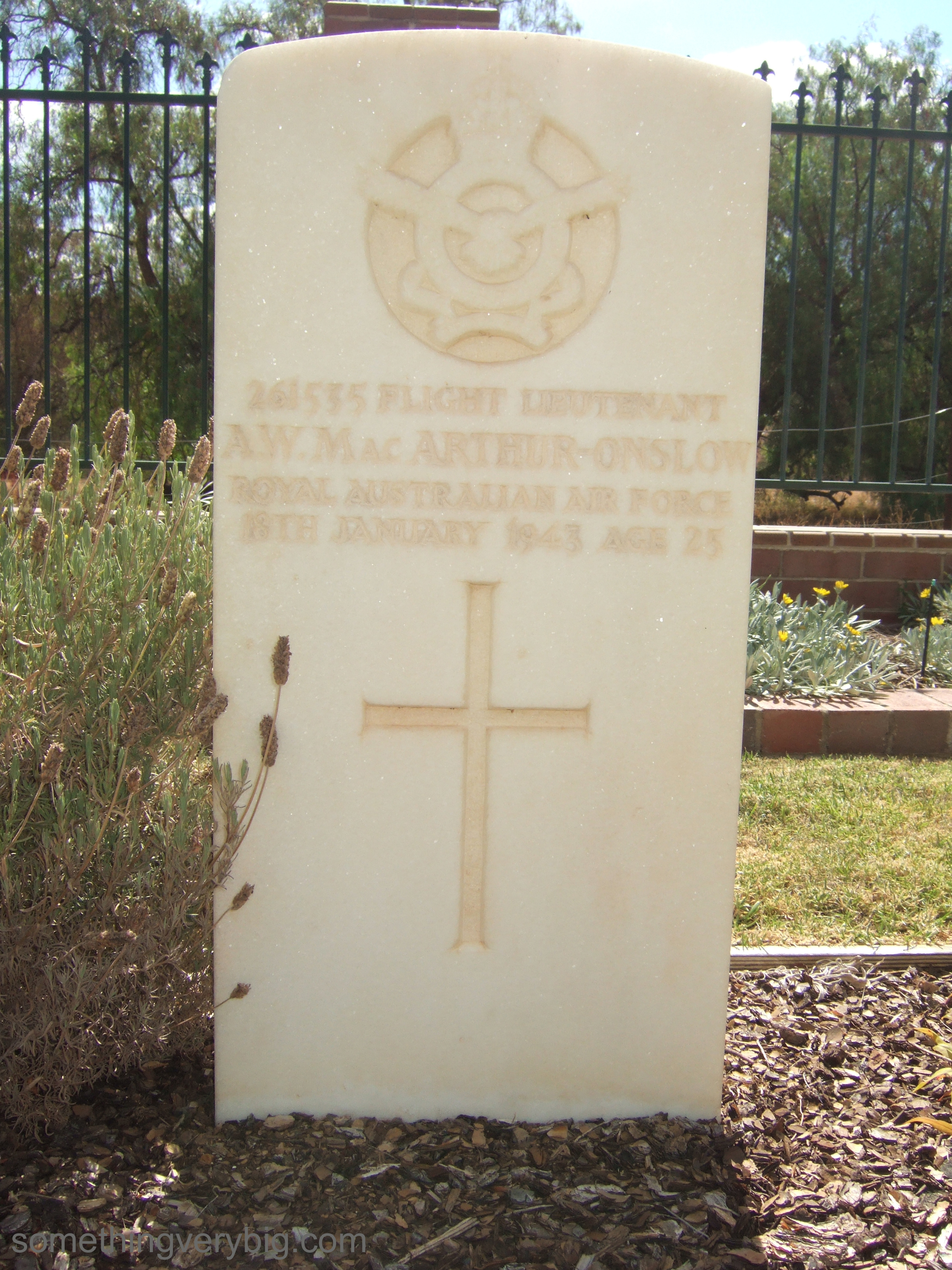
MacArthur-Onslow, James tells me, remained at Tamworth when 6 EFTS was disbanded in March 1942. The unit was replaced by the Central Flying School, which had the task of training the Air Force’s future instructor pilots. It was in this capacity that Flight Lieutenant Andrew William MacArthur-Onslow was flying with Sgt Thomas Myles Dawson on 18 January 1943 when, two and a half miles south west of Currabubula – about thirty kilometres south west of Tamworth– the Wirraway they were flying crashed while on a low flying exercise. Along with his unfortunate student, MacArthur-Onslow was killed and is buried in Tamworth War Cemetery.

c05-234-001 copy

© 2012 Adam Purcell


Thanks to James Hollinworth for the information that went into this post and the photograph of the grave.

Writing

My ultimate aim with this research is to write a significant piece of work – a book – to tell the story of the crew of B for Baker, who they were, where they came from and what part they played in the overall context of the bomber offensive. Much of this blog has been about the actual research that I’ve completed in this project. But I haven’t looked much at that important second bit – the writing thing. And that’s probably the bit that I need most practice in. What follows, then, is a basic framework for how I approach writing a short piece. It will need to be developed when I get around to writing the book that I’d like to end up with, because that will probably end up significantly longer than anything I’ve written before, but it’s a place to start from. This is, in broad terms, the process I use.

My writing evolves through a number of distinct phases. First comes the research part, where I find sources, take notes and build up a picture in my mind of what actually happened. Only when I think I have enough information to have the bare bones of a story in my head do I actually start to write.

My first draft is usually not a particularly eloquent or efficient piece of writing. My aim initially is to simply get everything down on paper (or, more correctly, on my computer screen). Usually I’m writing a historical story so I work more or less chronologically. At this stage I’m not worried too much by structure, length or style. I’m simply using my notes and research and putting everything relevant into a document. This process will quickly reveal any gaps in my research, and it is here that I will go back to my sources to try and fill those gaps. My aim is simply to tell the story – it doesn’t yet matter how long the story is, or how easy it is to read. It just needs to have every part in it. The resulting ‘first draft’ can sometimes be very, very long – for Bomber Command: Failed to Return it was almost 50% longer than my allocated word limit. I like to reference as I go along (usually by footnotes). This means that at all subsequent stages I know exactly where all of my evidence comes from and can easily go back to the primary sources to fact-check if required later on. The references are not normally formatted correctly yet – the important thing is that I know precisely where to find what I’m looking for if needed,

The second draft is where the structure gets fixed up. This is where I shift passages around into a more logical, flowing sequence – even if the language used at this point is far from flowing. A clear introduction, body and conclusion develops (evidently Year 12 English taught me something!). I’m still not too worried about length or efficiency of phrase.

The third phase of my writing is where I start getting creative. The emphasis to this point has been in getting the story right. From here, however, I’ve got the story itself organised. How the story is told is what concerns me next. If writing to a tight word limit, this is where the culling begins. Irrelevant bits get cut and long-winded passages get shortened. Awkward passages get re-written into more efficient language. Parts get condensed or lengthened if further emphasis is required.

By this stage, the main work is just about done. Phase four – the edit – can now begin. I give the piece the once-over myself, checking spelling, grammar, formatting and references. Then I call in outside help – and it’s amazing what another pair of eyes will spot. My sister and mother provided their ‘red pen’ services for Bomber Command: Failed to Return. The revised draft gets revised again, and again, and sometimes again. At this point it’s not unusual to go back to phase three to re-jig phrases or keep culling if I’m really pushing a word limit. Spelling and grammar are given a last check and references are checked for consistency and formatted correctly.

Then, at last, the piece is ready to be submitted.

© 2012 Adam Purcell

Leo

There are fifteen Commonwealth War Graves in the cemetery belonging to the small village of Hellendoorn, in the east of The Netherlands. My family and I lived in Nijverdal – the next town along – throughout the year 1995 and when we discovered that there was one Australian among the graves we decided to see what we could discover about him.

Flight Lieutenant Leo McAuliffe was a fighter pilot attached to No. 222 Squadron, RAF. He was killed on 17 March 1945, a matter of weeks before that part of the Netherlands was liberated. He was 24 years old and came from Bexley, NSW. While still overseas, we wrote to the Commonwealth War Graves Commission to see what they could tell us about Leo. He had been killed in a ‘flying battle’, they said, and another letter to the Air Force after we returned to Australia in 1996 revealed he crashed while leading a section of two aircraft on a patrol and weather reconnaissance mission over enemy occupied territory.

Late last year I decided to obtain copies of Leo’s service record and A705 files from the National Archives of Australia. This was not intended to be as in-depth a study as I am doing on my great uncle Jack and his Lancaster crew. It was just a side-line interest, more for general interest of our family than anything overly complicated. I had vague plans of reading through the files and writing a short ‘interpretation’ of them so I could then bind the whole lot up and give it to Dad for Christmas. Unfortunately the National Archives are experiencing ‘high demand’ for copies at the moment, and the month turnaround that I was expecting turned into two – too late for Christmas. Dad got a packet of liquorice instead.

But I now have the files, and have spent the last couple of weeks reading through them and beginning to write my little story. And guess what? It’s turned out into something far bigger than I was intending it to. I’m not under the deadline of ‘Christmas’, so I have time to delve into the story a little deeper, following leads that I would have otherwise left alone. So questions raised in the NAA files have led to posts on the RAFCommands forum, which in turn led to the discovery that Leo served in Northern France following the invasion… meaning that my friend Joss le Clercq is also interested in Leo’s story and has been in touch.

The account of Leo’s final flight, from his wingman, suggests to me that he simply became disoriented and lost control in thick cloud – more accident than ‘flying battle’. And the story of how a young Dutch woman witnessed the crash and recovered a dog tag but was later killed in an air attack on Nijverdal caused me to contact a friend who volunteers at the small World War II museum that is now in that town. This, in turn, resulted in numerous emails from her contacts at the museum, and much information about the crash and the attack on Nijverdal.

All quite amazing. I’ve spent the last few hours translating those emails from Dutch and using Google Earth to try and pinpoint a crash location. But a line needs to be drawn somewhere. There is a lot of information out there – the tough part is deciding when you have enough, when you can stop researching and start writing. Leo’s story is well on its way to becoming known now. A couple more questions to my new Dutch contacts, and the writing can begin.

© 2012 Adam Purcell