Letters

I’m currently reading through and transcribing Phil Smith’s wartime letters. Phil joined the Air Force in September 1940 and was discharged in December 1945 – and, except for a notable period between May and September 1944 when he was ‘otherwise occupied’ in France, he tried to write home once a week. Lucky for me, his father kept more or less every one of his letters. So going through the lot – a couple of hundred in all – has not been a trivial (or short) job.

Phil’s letters reflect his methodical, calm personality. For example, he wrote about his first solo in a letter to Don Smith, his father, 28NOV40. For most aspiring pilots, the moment of flying an aeroplane alone for the first time is one of the most memorable of all. But to Phil, it was just another day:

I still don’t make good landings but they say I am fairly safe. So, this morning I did my first solo flight. Altogether I made three solo flights and landed satisfactorily each time. I had flown about 8 hours dual before going solo which is slightly longer than the average but, considering that a week without flying came in the 8 hours I think it is satisfactory. (A01-132-001).

Or in July 1941, after dropping his first practice bombs:

I actually dropped bombs for the first time this week. It was low level attacking which is a matter of judgement only. I am sorry to say that I did very badly but feel that with practice I could improve. (A01-145-001)

Perhaps my favourite example of Phil’s understated way of writing letters comes from April 1943 at RAF Honeybourne, where he was an instructor for a year or so between his two operational tours. On a training flight a practice bomb ‘hung up’ in one of the Operational Training Unit’s Whitleys. After landing Phil clambered down from the aircraft to find out what had happened and instructed his pupil to open the bomb bay doors, and the offending bomb crashed out onto the tarmac in front of his nose. It failed to explode. Phil described this rather alarming incident as merely “another minor adventure” (A01-270-001).

The meaty stuff that I’m really interested in, of course, is Phil’s thoughts on operational flying. Once he got onto an operational squadron he wrote in a letter about his first raid. The language used here is indicative of his new status as operational aircrew – note the RAF slang:

“I was cracking at the real job three days after I arrived and took part in a raid on theRuhrdistrict. It was quite an adventure. We dropped our bombs OK but had engine trouble on the way back and had quite a shaky do getting back on terra firma” (A01-177-001).

The ‘shaky do’ he referred to was an emergency landing on one engine at Martlesham Heath, a coastal aerodrome that they needed assistance from the ground to find. This is one of the only times that Phil actually mentions in one of his letters an incident that occurred on operations, and it’s also the only time the RAF slang comes out. Later letters are much more restrained.

While security concerns were undoubtedly a consideration, I suspect that this lack of detail of what Phil was doing in his letters home was more a product of the type of person he was. Before the war – and after he returned – Phil was a chemist with the Commonwealth Sugar Refining Company (CSR), and his father Don was an engineer. He therefore always had a very practical and straightforward personality. Though he was living in quite extraordinary times in theUKand despite having a rather unique job flying a heavy bomber, for Phil it was just that – a job. While he was there, he just got on with it. And so in a letter in December 1941 (A01-194-001) Phil says ‘we were busy on Sunday evening” (referring to an operation to Wilhelmshafen, 28DEC41) and writes simply that Christmas was menaced “by a constant threat of work which fortunately did not come off.” Just another day at the office.

So while there is the odd little tidbit in Phil’s letters that I can pull out to derive some idea of his operational flying, overall they are remarkable mainly for their ordinariness. He would typically spend some time and ink apologising for his letter being late this week, then list the mail and parcels he had received from home since his last letter, ask about the family in Australia, report on the family he had visited in England, talk about the weather and conclude with words to the effect of “no more news at the moment”. And that was that. It’s almost frustrating at times to read what amounts to the same thing in every letter, over and over again. Nevertheless, I still read and transcribe them all. You never know where your next clue might come from.

Phil is one of two members of the crew for whom I have significant collections of letters. Reading so much that was written by the men I am studying opens a unique door into the thoughts, minds and personalities of the men concerned. I remain grateful to Mollie Smith and Gil Thew for so kindly letting me open those doors.

© 2012 Adam Purcell

Girlfriends: the plot thickens

Late last year I had, on behalf of my grandfather, embarked on a search to see if I could find out anything more about Joy Gisby, the woman who was probably Jack Purcell’s girlfriend while he was in England.

Somewhat at a loss for how best to carry out that search, I roped Kerry Tarleton in to assist. Kerry is a distant relation of mine (second cousin twice removed, I believe) who has been working on the family tree. While the name Joy Gisby was unfamiliar to her, she had some immediate results via a contact in the UK. It appears that a woman named Joyce E Gisby was born in West Ham in 1923, and while she has since died her husband is still alive. We do not know if this is even the person we are after, but it’s the closest we have to a lead at the moment and Kerry tells me moves are afoot to see if we can identify her based on the photograph from Jack’s collection. Watch this space.

Meanwhile, I’ve made an interesting find about Nurse MC Sands, of Summer Hill Hospital. As usual, it was a chance discovery. I was transcribing the last few letters from Phil Smith’s collection when I came across one written by Mollie Jansen, Jack’s sister, to Edith Smith (Phil’s mother). In it she writes (my bolding):

“Have you had any word from W/C Brill I have not up to date, am hoping for some, his girl friend had a very nice letter, from him last week, which she sent on to me I thought it strange that I haven’t had a letter too.” (A01-358-002)

Hmmm.

Though the letter is undated, it contains a few clues that I can use to pin it down to late June or early July 1944. Mollie wrote that she had only just found out Mrs Smith’s address. As we know, it was Don Smith (Phil’s father) who first sought out the addresses of the Australian next of kin and who initiated correspondence with them. I have what I suspect is Edward Purcell’s reply to the first letter he received from Don (A01-344-001); it is dated 01JUL44. It is therefore reasonable to guess that Mollie received the Smiths’ address around this time and so her reply, if indeed she had ‘just found out’ the address, was most likely written sometime around then as well. So if this letter was written around the beginning of July 1944, it follows that the letter from Bill Brill to Jack’s girlfriend that Mollie writes about was received by the girlfriend a week or so beforehand.

So why is it so important to know when this letter was written? Jack’s Casualty or Repatriation File at the National Archives of Australia (A04-071, NAA: A705, 166/33/163) includes copies of two almost identical letters from Bill Brill. One is for Edward Purcell, but we already know about him. The other is addressed to one Nurse MC Sands. There is a covering letter from the RAAF that went along with the Brill note. It states that the arrival of this letter from England was the first time that the Air Force had heard of Miss Sands, and offers to forward copies of any further communications concerning Jack to her. Critically, it is dated 17JUN44 – or just before when I suspect Mollie Jansen wrote her letter to Don Smith. Any other letters from Brill would also have been in Jack’s A705 file. As the only two there are addressed to Edward Purcell and Nurse Sands, there is I believe a good chance that Nurse Sands is the ‘girlfriend’ that Mollie was referring to.

So now we probably have two girlfriends – one in England and one in Australia. Kerry is chasing up a Mona Collinette Sands who served in the RAAF briefly in 1942. It appears she then abruptly left the Air Force and what happened subsequently is as yet unclear. Could she have ended up as a nurse at Summer Hill Hospital? We’ll keep searching.

Thanks to Kerry Tarleton for assistance with this research.

© 2012 Adam Purcell

Why the Japanese really threw in the towel

I’ve recently discovered the Australians at War Film Archive,  a massive resource made up of more than 2000 oral histories from people ‘who were there’ in various conflicts ranging from World War One to the current operations in Afghanistan. Included in the collection are transcripts of interviews of a large number of Australian Bomber Command aircrew, and it was in one of these that I found this little gem.

Rod Allcot, DFM, was a bomb aimer with 460 Squadron. After VE Day, Rod was on his way back to Australia to join the rumoured Tiger Force, flying Avro Lincolns against the Japanese. But events turned out somewhat differently:

“[…] When we were half way across the Atlantic, they [the Japanese] must have heard the news that a great team of Aussies was back on its way home to form a Lincoln squadron and fight against [them]. And that’s when they decided to toss it in… some people think it’s because of the atom bomb!”

Always modest, the airmen of Bomber Command.

This will be the last post on SomethingVeryBig for 2011. Best wishes to everyone for Christmas and the New Year, and I’ll be back in mid January. 

Mystery woman

Part of the small collection of photos that we have as part of my great uncle Jack’s personal effects is this one, showing a young woman:

joygisby copy

This is one of the enduring mysteries of Jack’s story. Her name was Joy Gisby, according to my grandfather who has just begun a mission to find out what happened to her, and he says she was Jack’s English girlfriend. There is certainly some evidence that Jack had a girlfriend while he was overseas. His brother Edward wrote the following to Don Smith in December 1944:

“I have, since last hearing from you, had two letters from Jack’s English sweetheart […]. She is very upset over the final news of the boy, but that, I suppose, is only to be expected. It was to me, however, most comforting to know that his all-too-brief span over there was, at least, very happy.” (A01-111-001)

Unfortunately, Edward made no mention of the girl’s name, which makes it rather difficult to find any more information about who she might have been. All I have to go with in the search for information is my grandfather’s memory of a name he first heard a very long time ago and an otherwise unidentified photo. There is a family story that says Jack was engaged to Joy, and that they were to be married on the Saturday after Jack was shot down. As Jack’s letters disappeared decades ago I have no documentary evidence of this, as tragic as the story sounds. And adding to the intrigue are a number of official letters from the Air Force (that I found in A04-071 Jack’s Casualty/Repatriation File from the National Archives of Australia) addressed to Nurse MC Sands, Renwick Hospital, Liverpool Road, Summer Hill – who Jude Findlay suggested may have been a girlfriend of Jack’s in Australia. Nurse Sands was notified along with Edward Purcell of Jack being posted missing so she was obviously close in some way. She could be a red herring, but where I do not have documentary evidence of Joy Gisby’s name, I do for Nurse Sands.

But nothing ventured, nothing gained and all of that, so I’ve been doing some preliminary searching. It turns out that there are a lot of Gisbys around the world. I found a website called The Gisby Saga, a rather well-written account of one particular branch of the family. There’s a Facebook group (The Worldwide Gisby Empire) . And there are thousands of possible hits on Ancestry.com. I’m not really sure where to go from here. Any ideas gratefully received!

© 2011 Adam Purcell

Dealing with the stress

“I promise that if you had witnessed normal Mess night booze up “goings on” during stand-downs then you would think that we were all ‘Flack Happy'” – Dennis Over, 227 Sqn rear gunner (C03-021-020).

Aircrew have always had something of a reputation for wildness, and in wartime particularly so. The mess on a wartime bomber station was often the scene of raucous gatherings of airmen getting up to no good. Often there was a reason to celebrate – a crew finished a tour of operations, perhaps, or a Lancaster chalked up 100 operations. Phil Smith, while at 103 Sqn, Elsham Wolds, learnt one day that the Squadron commander was posted overseas and was to leave early the next morning:

We had a party in the mess last night to wish him farewell. It was a very noisy and rowdy affair but quite good fun. It ended up with us all, including the C.O, with our coats off, cockfighting and wrestling on the floor. (A01-207-001).

As Phil wrote in his usual understated way in his diary the next day, “Good fun but not very dignified” (B03-001-001).

On another occasion Phil and a few comrades received visitors at RAF Long Marston in September 1943:

The Chief Instructor + my old flight commander and some others came over from Honeybourne to pay a friendly call. We ended up by returning the compliment – to liven up their mess. It resulted in a certain amount of broken furniture cups and glasses…. The met man had quite a brawl with the chief bombing leader up in the rafters like monkeys (A01-296-002).

Peter Brett, a 183 Sqn Typhoon pilot in France late in the war, was not the only airman to write of aircrew leaving blackened footprints on the ceiling during an impromptu mess party resulting from a three-day stand-down:

Most of us used to drink a pint or two every night but on party nights it was almost obligatory to become legless!

At first glance, there’s nothing surprising about a bunch of young men in the armed forces drinking and carrying on in the mess. Mess parties were a way to blow off a bit of steam, to maybe forget for a while the stresses and never-ending tension of nightly raids over enemy territory. But there is evidence that some men figured it was more important than that. Bob Murphy, a navigator on 467 Sqn then 61 Sqn, spoke about this in a video interview, taped for a documentary called “Wings of the Storm” in the 1980s:

Those who stayed home in the mess – read books, wrote letters home every night – for some reason or other seemed to be the ones that got shot down early’ […] others, a little bit wild like myself, seemed to be the ones who lived. (C07-044-001).

Letting off steam through drinking was (and still is) a common reaction to a prolonged stressful situation. Murphy took it even further when his pilot, Arthur Doubleday, took command of 61 Sqn in 1944. The entire crew was posted to Skellingthorpe, as Hank Nelson writes in Chased by the Sun (C07-036-178):

Given short warning of his posting, Doubleday and his crew arrived at Skellingthorpe to find that 61 Squadron had suffered high losses overBerlinand had just had three aircraft shot down on the Nuremburg raid and another two damaged in crashes. Bob Murphy said that they walked into the mess, and ‘you could hear a pin drop’. On their second night at Skellingthorpe, Doubleday’s crew tried to lift morale: ‘We decided to put on a party. Got the beer flowing, blackened a few bottoms and put the impressions on the ceiling of the mess – generally livened the place up’

Rollo Kingsford-Smith, Nelson wrote, “said that in the dark days of early 1944 he ‘was keeping going by drinking solidly’ and the company in the bar was part of the ‘therapy’.” (C07-036-178)

Nelson also reports that when Dan Conway, a 467 Sqn skipper, needed a new flight engineer,

…he asked the ‘spruce RAF sergeant’ who came forward, ‘Do you drink?’ The sergeant hesitated, but confessed that he did. Conway immediately said, ‘You’ll do’.Conway had decided that the camaraderie of the pubs was important to the crew and was not to be jeopardised. (C07-036-081)

Bomber Command aircrew were lucky that they had access to the mess and pubs and fairly frequent opportunities to visit them. But wartime restrictions meant that the English beer did not impress everyone. The last word on that subject goes to Don Huxtable, a 463 Sqn skipper. The beer was so weak it took 16 pints to really get started, he said. “It couldn’t go flat ‘cos it was flat already… and it couldn’t go warm ‘cos it was warm already too!”

Following the ANZAC Day march in Sydney this year, Don beat all of us to the bar.

© 2011 Adam Purcell

 Wings of the Storm interviews are available to view in the Research Centre of the Australian War Memorial

Flight Engineer

In the early days of the bomber offensive, British aircraft like the Wellington would typically fly with a ‘second pilot’ in a support role to operate flaps and throttles or to take over for a while in the cruise. Phil Smith was operating on his first tour with 103 Sqn at this time, and his logbook records that he completed ten operations as second pilot before being given his own crew. The second pilot would be a fully-trained and qualified pilot who was usually less experienced than the ‘first pilot’ who commanded the aeroplane. But this meant, of course, that to lose one aircraft would mean losing two pilots – and pilots were perhaps the hardest (and most expensive) out of the aircrew categories to train and replace.

The Stirlings, Lancasters and Halifaxes that began coming on line around then had more complex systems than those on, for example, the Wellington, so a more specialised member of the crew was required. Around the beginning of 1942 the second pilot was starting to be replaced by a dedicated member of the crew whose job it was to know where every single switch and dial and gauge on their aeroplane was (and in the dark), and what they did: the flight engineer.

Initially, flight engineers were taken from the ranks of the ground crew already serving at RAF bases: the engine fitters and mechanics whose technical knowledge was already of a high standard. But when the demand for heavy bomber crews really ramped up the supply of suitable ground crew available to take conversion training began to slow. So the RAF began training ‘direct entry’ flight engineers from scratch.

One of these direct entry flight engineers was Tom Knox, a Glaswegian who moved to Australia after the war and still retains his beautiful accent. I had the distinct pleasure of meeting Tom in Canberra in June, and recently spent an afternoon visiting him at home onSydney’s northern beaches.

Tom had begun an engineering apprenticeship when he was 16. Being a reserved occupation, the only way he could get out of it was to join up as aircrew. “So I did it!”, he wrote to me in a letter in June 2011. He reported to Lords Cricket Ground just after his 18th birthday, did his ‘square bashing’ in Devon and went to No. 4 School of Technical Training, St Athan.

It was here where young men learnt everything there was to know about their aeroplanes. The training was remarkably solid. Cliff Leach (a pilot who retrained as a flight engineer late in the war) remembers copying diagrams of the various systems from a blackboard and being asked to reproduce from memory some of them in exams. Cliff, aided by his classroom notes which he still has, remembers a lot of the systems of the Lancaster more than six decades later.

During their course the trainee flight engineers covered fuel systems, instrument panels, flight controls, engines, electricals, hydraulics and pneumatics. They learnt how to do the pre-flight inspection. They experienced hypoxia in a decompression chamber, to be able to recognise it if it arose on operations. They spent a week on a ‘Maker’s Course’, visiting Avro or Short Brothers or Handley-Page to gain an insider’s view of their specific aircraft. The final assessment consisted of written tests on each of the subjects they had studied followed by a face-to-face test.

But perhaps the most remarkable thing about their training is that, even after receiving the half-wing brevet with an E – the mark of a fully qualified flight engineer – most of them had in fact never been up in the air. And when they got to the next stage, a Heavy Conversion Unit, the men that they would join had already been a crew for some months.

In Tom’s case, crewing up was very simple. He was approached by a young Australian Flight Sergeant who asked if he wanted to join the crew – and that was that. His first experience of flight was in the rear turret of a Stirling shortly afterwards. “It was scary”, he says, but he handled it ok and went on to fly operationally with 149 and 199 Squadrons.

The flight engineer on B for Baker was a young man named Ken Tabor. He joined the RAF on his 18th birthday and was at St Athan between February and August 1943. In this photograph he is standing with his parents, wearing his Flight Engineer’s brevet:

a05-226-001-orig copy

The brevet shows that the photo was taken after he graduated from St Athan, which happened in August 1943 – perhaps the snap was taken while Ken was visiting his family on leave in Dorset before he went to an operational squadron.

Ken Tabor was the youngest man on board B for Baker when it went missing over Lille in May 1944. He had not yet reached his 20th birthday.

(c) 2011 Adam Purcell

Image: Steve Butson

Thanks also to Tom Knox and Cliff Leach for their input to this post.

The Men in the Photographs

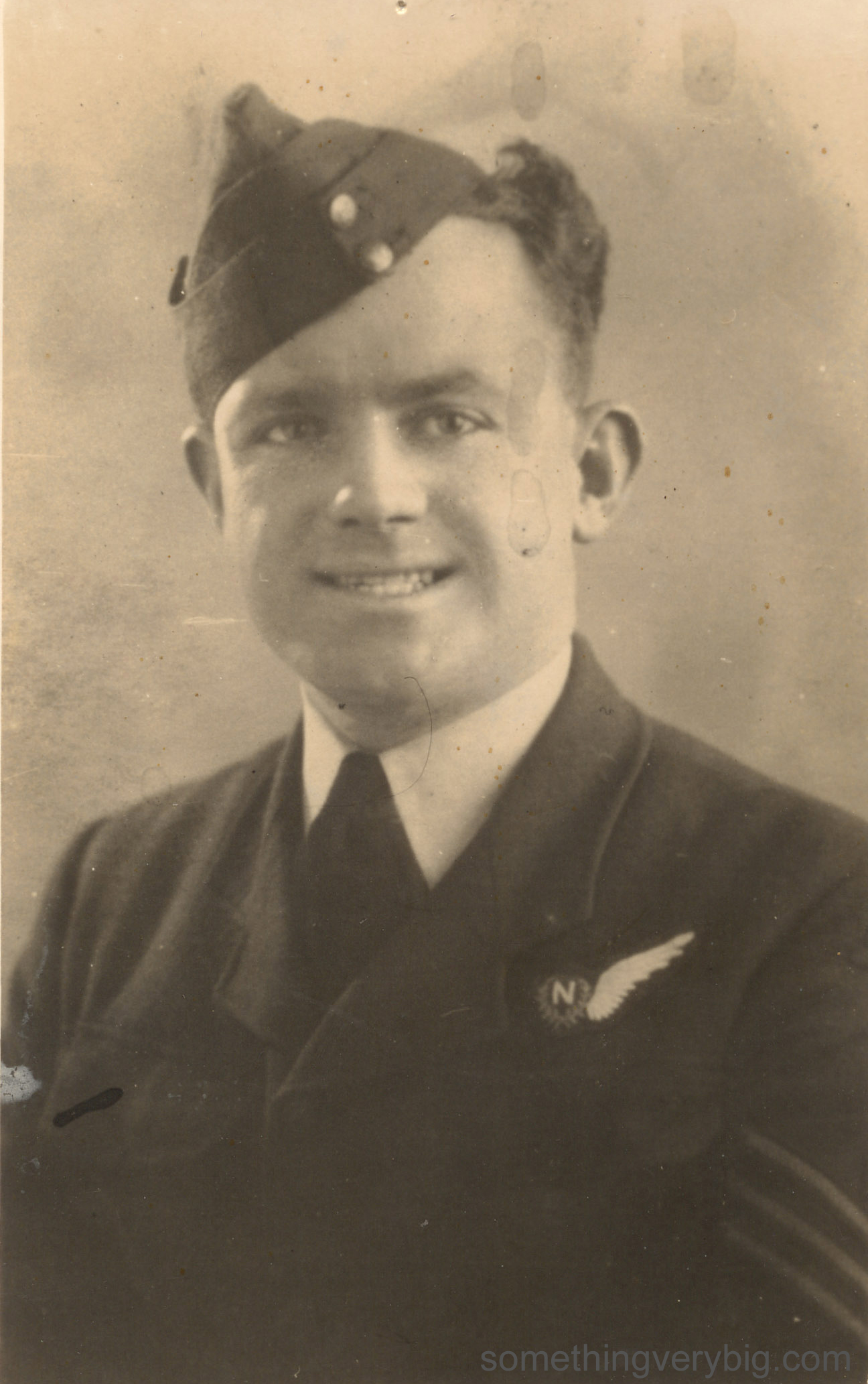
Before he left Australia, Jack Purcell had a formal portrait taken of him wearing his Royal Australian Air Force uniform. The half-wing with the ‘N’, denoting a qualified navigator, is clearly visible, as are his Sergeant’s stripes. It is one of only a small number of photos that we have of Jack and, along with his logbook, it was that photograph of Jack that first fired my interest in the subject of Bomber Command and the part that he played in it.

Giving a face to match a man’s name is an important part of telling his history. It makes the stories somehow more real – as if saying that they are not mere words. They are real stories about real people. As such finding photographs of each of the seven men who flew in B for Baker was something I have been very keen to achieve. And now, having recently made contact with the final family, I have done exactly that.

So here, all together for the first time, are photographs of each of the crew of B for Baker. As is traditional, we will begin with the pilot.

Pilot: Squadron Leader Donald Philip Smeed Smith (Phil)

A05-081-001 large

A fine portrait of a remarkably young-looking Phil Smith, taken while on leave in London.

Flight Engineer: Sergeant Kenneth Harold Tabor

Tabor-big copy

By far the youngest on the crew, Ken was just 19 when he was killed over Lille. This photograph shows him on the left, with his brother Bill. He is wearing the Flight Engineer’s brevet so it was probably taken in late 1943.

Navigator: Warrant Officer Royston William Purcell (Jack)

A05-041-001 large

The presence of an N half wing and sergeants’ stripes (and the stamp from a Sydney photographer on the back of it) dates this photo to mid 1942. This was the photo of Jack that started my journey to find out more about him.

Bomb Aimer: Flight Sergeant Jeremiah Parker (Jerry)

A05-071-001 large

At 30, Jerry Parker was the oldest member of the crew. He was married with a young daughter.

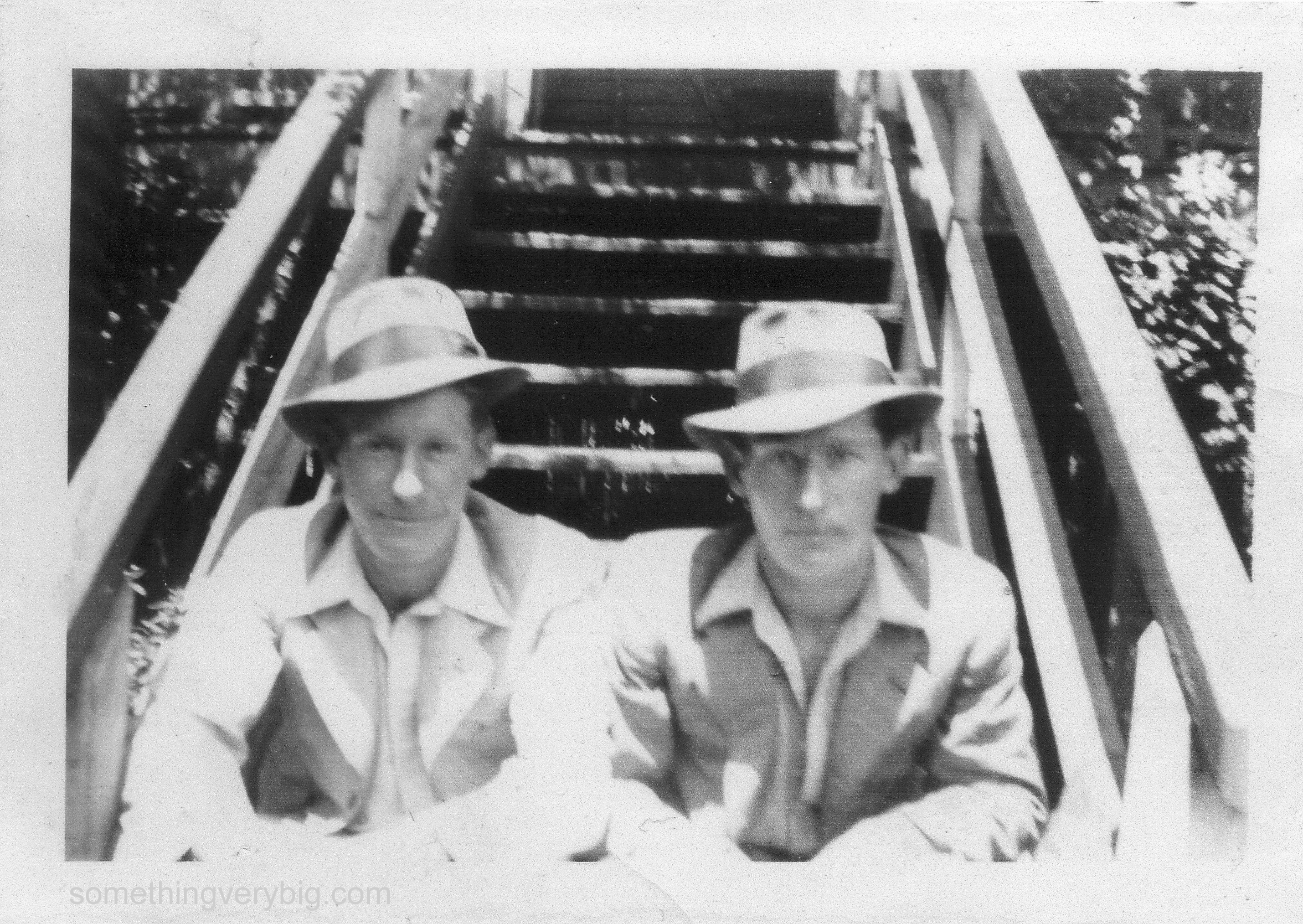
Wireless Operator: Flight Sergeant Alastair Dale Johnston (Dale)

A05-144-001 large

Dale Johnston was from Queensland. He is seen here on the left on the steps of the family home with his twin brother Ian.

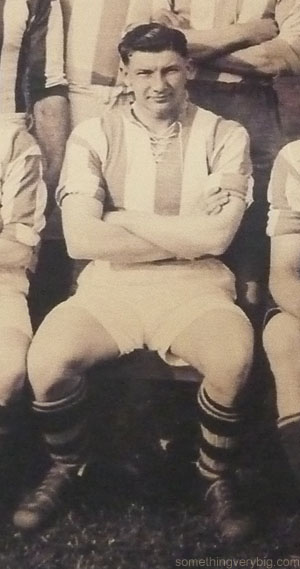
Mid-Upper Gunner: Sergeant Eric Reginald Hill

Hill-small copy

From Goring in Berkshire, Eric Hill served in the RAF Regiment before he became a member of aircrew. He first enlisted in June 1940, by far the first member of the crew to begin war service.

Rear Gunner: Flight Sergeant Gilbert Firth Pate (Gil)

A05-118-001 med

A short stocky man, Gilbert had a brief flirtation with becoming a jockey as a teenager, until his father put a stop to all further dealings with the stables where he was working. He trained as a wool classifier before joining up.

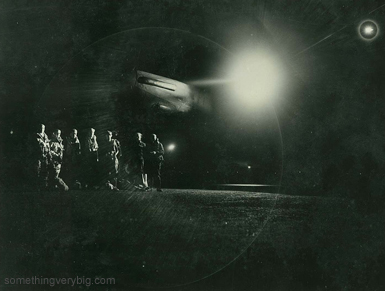
The Crew of B for Baker

There is just one photograph that shows the entire crew. It is backlit by the landing light of a Lancaster, it’s shadowy, grainy and indistinct, but it’s an atmospheric photo.

a05-019-001-med copy

Photos kindly provided by:

Mollie Smith

Steve Butson

Martin Purcell

Freda Hamer

Don Webster

Barry Hill

Gil Thew

(c) 2011 Adam Purcell 

Forage Cap

Gil Thew recently sent me this fantastic photograph of his uncle Gilbert Pate:

 a05-212-001 copy

Gilbert is in uniform, wearing a peaked forage cap parked at a jaunty angle upon his head. Tucked into the fold at the front of the cap is a white ‘flash’ of fabric. This flash was the mark of an airman under training. Gilbert’s serious expression and immaculate uniform coupled with the trainee flash suggests this might be a copy of his enlistment identity photograph. The photo was therefore most likely taken in late June 1942, when Gilbert would have been 26 years old. He barely looks out of his teens.

While not unique to Bomber Command itself, photographs of airmen from Commonwealth air forces in WWII will frequently show them wearing caps just like this one. The forage cap had been part of the uniform of the Royal Australian Air Force since the First World War. It was designed to look reasonably respectable even after being folded up and jammed into a corner in the cramped cockpit of an aeroplane. A battered cap was a sign that its owner was no sprog.

In May 2009 I visited Lezennes on the anniversary of the Lille operation to see the graves of my great uncle and his crew. I wasn’t prepared for the reception I was given by the locals. There was a small but moving ceremony at the cemetery, presided over by the Mayor with perhaps 20 people attending. After the cemetery we walked into the town to the local library, where a display had been set up telling the story of the crew. There was a television camera crew to document the occasion. I even met a man who had been 10 at the time of the Lille raid, and who remembered standing next to the graves the day after the funerals, singing ‘God Save the King’.

But most amazing of all was the man on the left of this photo:

img_3783 copy

His name is Laurent Messiaen. He is presenting me with a pristine original RAAF forage cap. The exact origins of the cap are unknown. I was told it had been with a local family since the war. Apparently Laurent read about my impending visit in the local newspaper and came along specifically to give it to me.

There is no doubt that it is RAAF. Stamped inside, it says “MADE IN AUSTRALIA 1943”. A direct link with the Lille operation cannot be ruled out.

The cap now sits on my shelf. It’s become one of my most treasured possessions.

© 2011 Adam Purcell

Bomber Command – Failed to Return

I have just received a new book called Bomber Command – Failed to Return. From Fighting High Publishing in the UK, it contains eleven chapters, written by six different authors, each chapter concentrating on the story of a particular airman or crew who failed to return from operations. I was one of the contributing authors, writing a chapter profiling rear gunner Gilbert Pate. Keen eyes might also recognise the photograph that appears on the cover of the book. It is, of course, the only known photo of the entire crew of 467 Sqn Lancaster LM475, B for Baker.

This is the first time I’ve written anything for publication in an actual book, and it was rather exciting to spy on my front step the package containing my copy, open it up and see the front cover, with my name one of the six underneath the title. I’m also stoked that Steve chose the crew photograph for the cover. Its prominent position (and there’s a full double-page spread of it inside too) means that the story of B for Baker and her crew can now reach an even wider audience.

I am indebted to Gil and Peggy Thew, the nephew and sister of Gilbert Pate, who extremely graciously allowed me full access to and use of Gilbert’s papers for this project. Much of my chapter was based on those letters and reading them all gave me a very good idea of who the man was. I can only hope that in what I’ve written I’ve done justice to Gilbert’s story.

Steve says the book has received some very good feedback in the UK already, and there was a launch event in early September at Duxford, attended by among others two of the airmen who feature in the book. If you’ll excuse the blatant plug, copies of Bomber Command – Failed to Return are available from the Book Depository, or direct from the publisher.

© 2011 Adam Purcell

Questions

In 2003 Phil Smith, my great uncle’s wartime pilot, passed away. In a way, Phil’s death was a catalyst for me. I’d done some work on the topic when I was very young – indeed this is what led us initially to finding and contacting the old pilot – but I was now old enough that I could start doing some work in my own right. But where to start?

One evening I first used what has become a very useful technique. Sitting at my desk in my little granny flat at my parents’ place in the Southern Highlands of NSW, I pulled out the dusty old photos and documents that I’d found the first time around. I read through the lot, with a notebook and a pencil alongside. I wrote notes as I went.

And most importantly, I also wrote down what I didn’t know. And I wrote down what I thought might be interesting to delve further into.

The resulting list of questions gave me my place to start. But as I answered each one, more questions would arise. So, despite the work I’ve done so far, the list remains as long, if not longer, than it was in 2003. I suppose that is a good thing – it means there will always be more out there, just waiting to be discovered.

I’ve used this technique a few times since – most recently in the search for the family of Eric Hill. By going back through what I already had, I could figure out where I might go next. Knowing where Eric came from, I could contact local history groups in the area – and they found the connection to a living relative.

There is one big question that I would still like to answer:

“What was it like?”

Ultimately this is why I’m studying this story. I never had the opportunity to talk to my great uncle, to find out first-hand what his war was like. I have his logbook and I have a couple of photos, but that’s more or less it. Everything else I know about him has been inferred from other sources: letters from Phil Smith and others, official records, and talking to as many veterans as I can. I can even draw on some of my own experiences: the taxi ride in Just Jane, for example, or flying a Tiger Moth. That’s as close as I can come to experiencing something of the Bomber Command story. To try and answer that never-ending question – what was it like?

Answering that question is, for me, the best way to ensure that airmen like my great uncle Jack and his crew are remembered.

© 2011 Adam Purcell