The Thrill of the Chase

“I figured there would be a letter from someone, somewhere… I was just about to give up when I turned over a page and found it.”

-Historian Helen Harris, on the search to identify Ned Kelly’s bones

In recent days it’s been confirmed that a set of human bones exhumed from an unmarked mass grave in what used to be Melbourne’s Pentridge Prison belonged to Edward ‘Ned’ Kelly, perhaps the most infamous and celebrated of the Australian bushrangers. One of the great mysteries of the Kelly legend – what actually happened to the body after his execution in 1880 – has been solved, using modern-day technology and a bit of old-fashioned sleuthing.

Which is how a post about a 19th Century bushranger finds its place on a blog about a WWII bomber crew. There was an excellent article in the weekend newspaper last week that explained exactly how the identification was made and eventually confirmed through DNA matching with one of Kelly’s descendants. But it was the quote that opens this post, from a historian engaged in the search, which caught my eye. Harris was looking for police documents that could challenge contemporary newspaper reports that said Kelly’s body had been dismembered by autopsy, a crucial piece of evidence in determining that a skull long thought to have been Kelly’s was in fact not. Harris had a theory, born out of many years studying Victoria’s early police records, that the Superintendant of the time would have tried to find out the truth or otherwise of the newspaper report in question from the governor of Melbourne Gaol. She looked in the archives and, after a methodical search, found the letter she was looking for.

This is how a good historian works. Start with a mystery, work out where the gaps are in the story and consider where the missing piece of the jigsaw might be. Then go searching for it – and there is nothing quite like the thrill of turning over an old yellowing bit of paper in an ancient file somewhere and finding exactly what you are looking for.

Of course, it takes a long while sometimes to find that elusive document. Harris has, over the course of her career, looked at 400 boxes of old Victorian police documents – and the article says there are still a few hundred left to go. There could be anything in that archive – it takes a dedicated researcher to methodically work through each one, missing nothing, to fully extract all of the details.

Though the volume of documents that I have found in my research into B for Baker and her crew will not go even one twentieth of the way towards filling 400 boxes, I’ve gathered a fair bit now. And I still have a large pile that I’m working through – among them, documents that I copied at the National Archives of Australia well over a year and a half ago. As I work through each page, I sometimes find information that adds another piece to other puzzles I’ve been trying to solve. Finding letters written by one parent to another in one archive, and the replies to those letters in another, I’ve discovered that everything really is connected.

The information is out there, somewhere. Sometimes it’s in front of our very noses, it just hasn’t been properly extracted yet.

 (c) 2011 Adam Purcell

This blog post inspired by an article by Mark Chew, A Question of Identity, The Sunday Age Good Weekend Magazine, 03SEP11
Shrine

On the south side of the Yarra River in Melbourne, a mile or so from Flinders Street Station, is a large and rather imposing stone building. The Shrine of Remembrance sits on slightly elevated ground, with large Doric columns on all sides and a truncated pyramid soaring into the sky.

I went for a ride on my bicycle last month, down the Moonee Ponds Creek trail, over the Yarra at Docklands, and along St Kilda Road. I could see the Shrine in the distance. I cycled across and stopped for a visit.

Underneath the Shrine is the Crypt – a quiet space with bronze panels on the walls, regimental flags hanging from the ceiling and a sculpture in the middle. Climbing some stairs through the middle of the stone walls of the Shrine, I emerged in the Sanctuary, which is the heart of the memorial. Perhaps it may have felt more sanctuary-like had a busload of tourists not also shown up at that exact moment. It is a space reminiscent of the Hall of Memory at the Australian War Memorial in Canberra, perhaps not surprising given the particular functions of both spaces. In the middle, sunk below floor level, is a slab of marble upon which is the Biblical inscription, ‘GREATER LOVE HATH NO MAN’. On Remembrance Day, November 11, each year, at precisely 1100, a beam of sunlight comes in through a special hole in the roof and falls onto the stone.

Marvelling at the effort and calculations that would have been needed to make that little party trick work, I climbed some more stairs up to the Balcony level. It’s not a particularly tall building when compared with the skyscrapers across the river, but it’s still a nice outlook from the top. The view to the east reminded me a little of Greenwich in England. And to the west, a couple of miles away, I could see Albert Park and, beyond it, the bay.

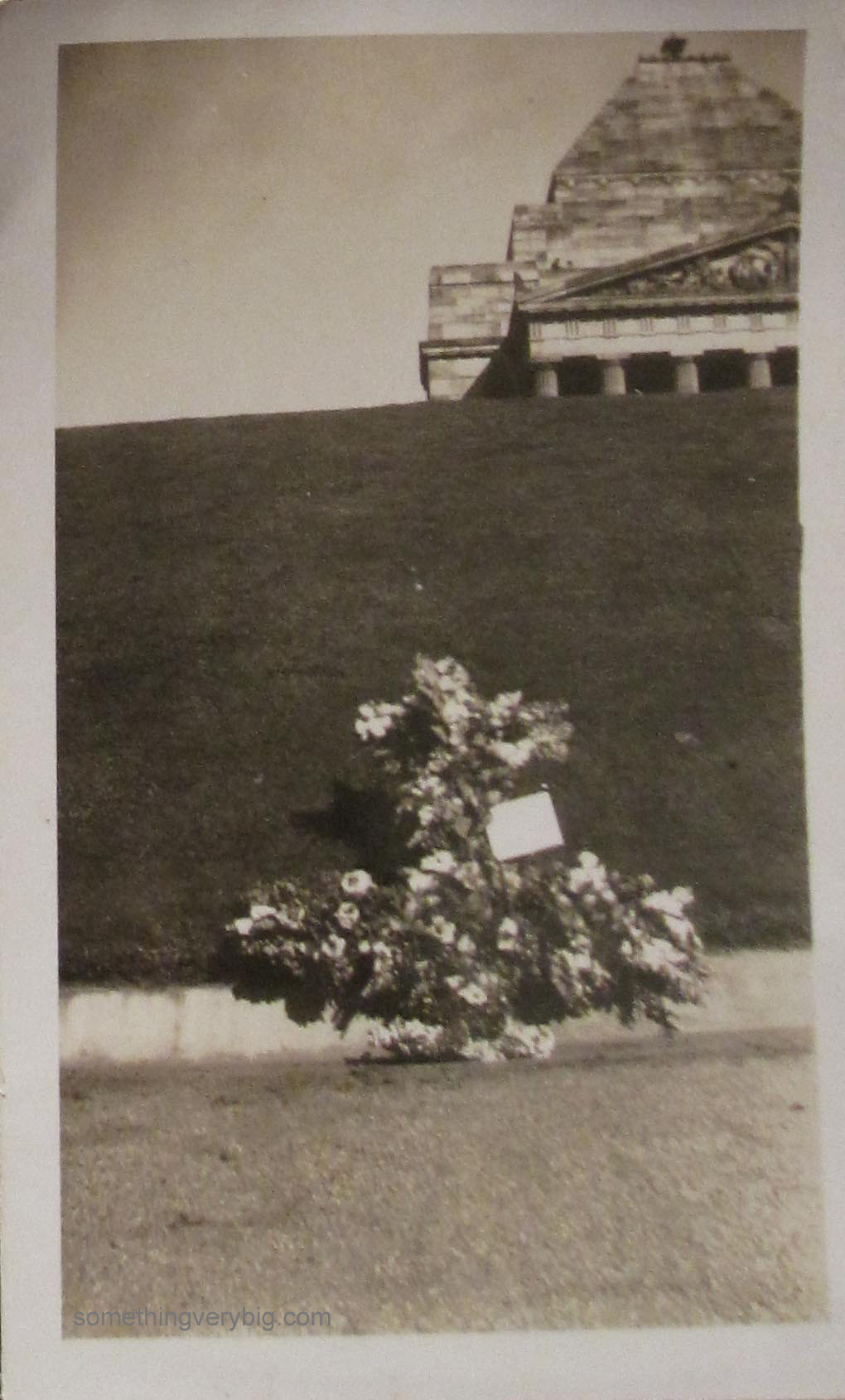
A couple of years after the war ended, Fannie Johnston left her “little rose + honeysuckle covered cottage” (A01-114-001) in Dayboro, Queensland, and moved to Melbourne. In September 1949 she made the short journey from her new home in Barrett St, Albert Park, to the Shrine of Remembrance. There, she left a large floral arrangement, “in precious memory of Dale and his pals” (A05-184-004). She sent some photographs of the flowers on the steps of the memorial to the families of some of Dale’s crew mates. Copies survive in the collections of Freda Hamer, Gil Thew and Steve Butson.

a05-184-005-small copy

Carefully wrapped up alongside the photos in Gil’s box is a small sprig of pressed rosemary.

a05-138-004-small copy

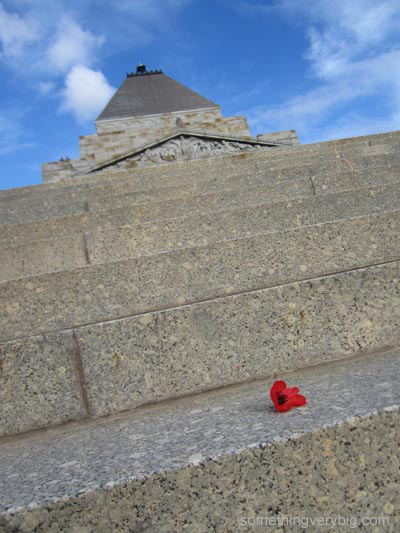
As I walked back towards my bicycle, I turned and looked back at the Shrine. In my mind’s eye I could see Fannie Johnston placing her large bunch of flowers on the steps.

All I had was a small red poppy.


11aug-shrine-013 copy

Photos: Freda Hamer, Gil Thew and author

© 2011 Adam Purcell

How They Crewed Up

The concept of the ‘crew’ is of far-reaching significance to the Bomber Command legend. A Lancaster needed seven men to operate efficiently. Each man would be specially trained in his respective trade, and each trade underwent their training separately. The way those individual airmen formed into crews remains one of the more unique parts of the story. In an Air Force so demanding of rigid procedures and highly developed organisation, the majority of crews came together in a curious, almost haphazard fashion.

The typical venue was a large hall at an Operational Training Unit. In the room would be gathered equal numbers of each aircrew ‘trade’. After a welcoming speech from the Commanding Officer, the assembled airmen would be told, essentially, to sort themselves out. Hank Nelson, in his excellent book Chased by the Sun, described it like “selecting a horse in a yard or a girl at a dance. You made your choice then the test of performance came later.” (C07-039-080). While seemingly chaotic, the system appeared to work well. Individual airmen would learn to work as an effective team and by the time they got to a squadron, most crews would live, work and play together. In the air they would fight together as a more or less autonomous unit. And the camaraderie would develop into extremely close friendships, some of which continue even to this day. It all started, in so many cases, in some draughty hangar at an Operational Training Unit.

Yet despite this being the ‘traditional’ way that crews were made, the men of B for Baker got together in entirely different ways. The available evidence suggests that only three of them crewed up at an OTU in what could be considered the conventional sense. After qualifying as their respective trades, Jerry Parker, Dale Johnston and Eric Hill all arrived at 14 OTU, RAF Cottesmore, in early June 1943. Just over three months later, on 08SEP43, all three were posted to 1661 Conversion Unit at RAF Winthorpe. The fact that all three were posted on the same day suggests that they were all part of the same crew.

The first member of the eventual crew of B for Baker to reach Winthorpe was actually Ken Tabor, the flight engineer, a week or so before the three arrived from Cottesmore. Because the aircraft flown at the OTU stage of training were typically Wellingtons which were less complicated than the four-engined heavies, flight engineers would normally go straight from their School of Technical Training to the HCUs and meet a crew there. This is exactly what happened in Ken’s case. In fact, it is highly likely that he had not yet even been flying until this point – Tom Knox, who flew on Stirlings with 149 Sqn, recently told me that like many flight engineers, “at this stage I had never had my feet off the ground” (C01-480-002).

Meanwhile Jack Purcell was undergoing his own operational training. He was the only member of the eventual crew of B for Baker to pass through 27 OTU at RAF Lichfield, from 22JUN43. What became of his OTU crew is not (yet) known – but on 19SEP43, Jack found himself posted to RAF Winthorpe, where the other four had been for at least week and a half. He most likely joined their crew at this stage. All five would be posted to 9 Squadron, RAF Bardney, on 31 October. After their pilot, a man named JG ‘Paddy’ McComb, was lost on a second dickey trip to Berlin on 18 November, at the end of the month the crew – none of whom had completed any operational flying with 9 Squadron – were posted to 1668 Heavy Conversion Unit, Syerston.

In parallel with the other five, Gilbert Pate went to an OTU (No. 17 at Silverstone) shortly after arriving in England in June 1943. He also went to 1661 Conversion Unit, Winthorpe, in September 1943. However instead of Bardney, Gilbert’s crew was posted to 49 Squadron at Fiskerton on the 22nd of that month. On 3 November, Gilbert took part in his first operational sortie, a raid on Dusseldorf. He was filling in for an injured gunner with an experienced crew. On the same night, P/O JEW Teager, Gilbert’s own pilot, went on the same operation as a ‘second dickey’. But Teager didn’t return. He was shot down and became a prisoner of war. Like five of his future crewmates, Gilbert’s crew now found themselves without a pilot. They went to 1654 Conversion Unit and got a new pilot, but, returning to flying after an accident, the pilot lost his nerve and this time the powers that were split the crew up. Gilbert went to 1668 Heavy Conversion Unit, Syerston, on 14 November 1943. Two weeks later, on 1 December, Jack, Jerry, Dale, Ken and Eric were posted to the same unit.

Also posted in to Syerston on 1 December was an Australian Squadron Leader, DPS (Phil) Smith. He was already an experienced operational pilot, having completed a tour on Wellingtons with 103 Squadron in 1941 and 1942. Phil had been ‘screened’, instructing for a year at 24 Operational Training Unit in Honeybourne. He joined up with the three Australians and three Englishmen at Syerston and his logbook shows that his first flight with these men was 10 December 1943. After flying a total of 16.45 hours by day and 16.05 hours at night in a Lancaster, all seven were posted to 467 Squadron, Waddington, on the last day of 1943.

The crew was now formed, and ready for battle.

Sources for this post:

Service records of all seven men in the crew, from the National Archives of Australia or the RAF Disclosures Section

Phil Smith’s logbook – courtesy Mollie Smith

Chased by the Sun by Hank Nelson

Tom Knox – Stirling flight engineer, 149 and 199 Sqns

9 Sqn Association – Roger Audis

The 4T9ers – 49 Sqn Association and Dom Howard

© 2011 Adam Purcell

Found.

B for Baker now has a flight engineer.

This afternoon, I received in the post a slightly fat envelope from England. As I opened it, a dozen or more photographs tumbled out onto my desk. The letter inside was from Steve Butson, to whom I had sent the latest of my speculative letters.

“In answer to your question”, it said, “yes, Kenny Tabor was the Uncle I never knew”.

With that simple phrase, the great relative search was complete.

Steve wrote me a fantastic four-page letter in which he explained a lot about his family. Some of the names were familiar, thanks to Chris Tabor’s careful work on Ancestry.com. Some were new to me. But they were all connected to the buck-toothed young chap who appeared in some of the photographs.

img_0123-copy copy

Sgt Kenneth Harold Tabor had an older brother and a sister called Bill and Betty, and a younger brother called Don. He worked at a garage in Westbourne before he joined the Royal Air Force on his eighteenth birthday. Perhaps it was unsurprising, then, that he would train and fly as a flight engineer. Ken was killed when Lancaster LM475 B for Baker failed to return from Lille on 10 May 1944. The youngest member of the crew, he was just nineteen years old.

The crew is complete. I am now in contact with relatives of each of the seven men who were on board B for Baker when it was lost. It’s taken about three years of fairly steady work to reach this point. Now it’s time to find out as much as I can about each one, to give a human face to the story.

And ultimately? The seven men in the crew of B for Baker were drawn together long ago by events well beyond their comprehension or control. These same forces now forever link their seven families. It’s my goal to one day bring all seven together again – for the first time in nearly seven decades.

Like crewing up, once more.

© 2011 Adam Purcell

Still looking

In recent weeks I’ve stepped up the search for relatives of
the last remaining member of the crew of B for Baker. Sgt Kenneth Harold Tabor was the crew’s Flight Engineer. His service record (which I have just received from the RAF) shows that he was the youngest on the crew, enlisting on his 18th birthday. Sadly he was killed before reaching his 20th.

To this point, the search has been a case of sending letters willy-nilly to Tabors scattered all around the UK, simply because that is their name. I’m up to 12 so far. Many of those I have heard back from have been related to each other. Not all have replied yet but to date I have hit dead ends. As it has turned out, there are many more Tabors around than I previously anticipated and, well, to continue in this direction will take (a) a very long time and (b) lots of money. So a new direction has been needed.

Enter Chris Tabor, the latest to receive one of my speculative letters. He is no relation to Ken, but it happens that he is into family history research, has an Ancestry.com membership and, most importantly, knows how to use it. So he’s been doing some digging for me. Chris has uncovered records showing that Ken had two older siblings – a sister and a brother who appear to have been twins. Both married and had children who would now be in their 60s. I plugged the names that Chris sent me into a useful website called 192.com, and it has come up with postal addresses for a number of people of those names.

Those six people will shortly be sent one of my now legendary speculative letters. Only this time, I’m hoping that the letters are slightly less speculative than they have been in the past. This time there is a document trail that suggests we might be on the right track.

I’ll let you know how it goes.

© 2011 Adam Purcell

The Story So Far

It occurred to me this week that some people who have been reading this blog might not know the basic background to the story I’m attempting to tell. So this post is a general introduction to The Story So Far.

In broad terms, this blog charts the development of my research into my grandfather’s uncle and his wartime story. W/O Royston William Purcell (known as Jack) was a navigator with 467 Squadron, Royal Australian Air Force. He was shot down and killed on a bombing operation to Lille in France in May 1944. Jack was 22 years old.

There were seven men in Jack’s Lancaster crew. The pilot was Phil Smith, an industrial chemist from Mosman in Sydney. Flight engineer was Ken Tabor from Bournemouth, England. Jack Purcell, of course, was the navigator. He was from Strathfield, NSW, and had been a shop boy with NSW Government Railways. Wireless operator Dale Johnston was a motor mechanic from Dayboro, Queensland. Postal worker Jerry Parker, from Leyland in the UK, was the bomb aimer. Englishman Eric Hill, from Goring in Berkshire, manned the mid-upper turret, and Gilbert Pate, a wool classifier from Kogarah, NSW, was the rear gunner. They ranged in age from 19 to 30. Only one would see the end of the war.

Over Lille that May night in 1944, their Lancaster exploded. Ejected by the force of the blast, Phil Smith parachuted to safety, evaded capture and was sheltered by a French farmer before Allied invasion forces passed his position four months later. His six crewmates were killed in either the blast or the ensuing crash and are now buried in French soil a few miles from the crash site.

The perception of ‘Uncle Jack’ and his place in the collective Purcell family memory has been passed down through the generations, and indeed down  different branches of the family tree. I was lucky that it was my father who showed an interest in, and was eventually given, Jack’s logbook and the handful of photographs and documents that goes along with it. When he first showed them to me (I was eight or nine years old at the time), it planted the seed that in recent years has turned into something approaching obsession. I have now gathered a fairly significant body of information about this crew and what they were doing in a Lancaster over Northern France in May 1944. I have traced and contacted the families of six of the all seven men in the crew. I have a worldwide network of research contacts. I have even travelled overseas twice in an effort to chase down leads and visit some of the significant sites associated with Jack’s war. Most importantly, I’ve realised that this story – one of more or less ordinary lads caught up in far from ordinary times and doing far from ordinary things – is well worth telling.
So where to from here?

I’m aiming to write a book about this story over the next few years. There remains much work still to do. At this stage I am focussing on the crew themselves, looking at where they came from, who they were and the very different paths that they took to 467 Squadron – while also continuing the search for the family of Ken Tabor, the one member of the crew remaining outstanding. I’m planning future work to concentrate on training and the journey to an operational squadron for each of these men. Then I’ll look at bomber operations in the first part of 1944 when they were on squadron, particularly emphasising the Lille raid on which the men were lost and its part in the overall context of the war in the lead-up to the Normandy invasion. I’m also hoping to investigate some theories on what actually caused the loss of B for Baker, the Lancaster they were flying.

This is the story so far. Who knows where it will end up!

© 2011 Adam Purcell

Searches

WordPress gives you access to some interesting tools and statistics about your blog. For example, this blog has clocked up nearly 1,500 total views since I migrated it to the WordPress platform last year. I can see which links people have clicked, both from the blog to get to other places and on other web pages to get here (hello Lancaster Archive Forum!). Most interestingly, though, it also gives me a list showing the search terms that people have used to find me (numbers show how many hits came from each term):

Some are interesting:

  • dinas dinlle world war (11)
  • air traffic control tower dinas dinlle north wales (1)
  • llandwrog caernarfon raf training in the war (1)
  • llandwrog airfield wartime (2)
  • avro lancaster outline (2)
  • gil thew (2)
  • tail end charlie fradley raf (2)
  • adam purcell (1)
  • jack purcell family (1)
  • lancaster bomber elsham crash site (1)
  • avro lancaster line drawings (1)
  • a painting of a lancaster avro in a field (1)
  • fradley airodrome during the war (1)
  • lancaster bomber crews 467 (1)
  • jude findlay and adam purcell (1)

Some probably didn’t quite find what was being searched for:

  • lancaster jb467 (4)
  • old rcaf airfields firestation (2)
  • wartime bomb shelters in scotland (2)
  • 102 squadron pocklington (2)
  • “102 squadron” (2)
  • wartime fire service models (1)
  • canberra bomber navigator station (1)
  • wartime fire service stations (1)
  • photos binbrook dispersal apron (1)
  • air traffic control dinas dinlle (1)
  • lancaster lm550 (1)
  • sir arthur harris raf gravestone (1)
  • roger audis of 9 squadron (1)
  • very big canvas (1)

Some are just plain strange:

  • raf bardney ghosts (2)
  • irish sea paintings (1)
  • how to canvas something (1)
  • is the control tower raf bardney haunted (1)
  • are jack purcells still cool? (1)
  • repainting jack purcell (1)

But every so often comes one which makes me sit up and take
notice:

  • ken tabor  (2)
  • ” lille raid “+ smith (2)
  • lm475 purcell (1)
  • navy veteran dale johnston (1)
  • don smith 463 squadron (1)
  • who was eric hill born to (1)
  • search for dale johnston (1)
  • charles erskine johnston (1)

It’s this last group that gets me a little excited. Sure, there could be many ‘Dale Johnstons’ and ‘Eric Hills’ in the world. But from these searches, someone is looking for people of that name. Could they be the same ones that I’m looking for?

The lack of any comments or emails suggests maybe not. But I’ll keep hoping. And if you are one of the people who find this blog through a search engine while looking for someone, please leave me a comment. You never know where a connection might be.

© 2011 Adam Purcell

Training

I was talking to 463 Squadron veteran Don Southwell on ANZAC Day in April about his training to become a navigator in WWII. Among other things he spoke about life at Initial Training School at Bradfield Park. He said that days started with physical training and drill, and were then full of theory classes – and when the trainee aircrew had time off from formal classes, they were expected to study. He remembers some particularly challenging subjects keeping him working at his desk until one or two in the morning. “The blokes in my hut”, he told me on the phone recently, “used to say that they didn’t have to go to classes because they’d hear everything from me… while I was talking in my sleep!”

This got me thinking (as happens every so often). In some ways, I can draw some parallels with what I understand of Air Force training and what I’m currently experiencing as a trainee air traffic controller. For example, the eleven other lads in my group and I are known by the simple name ‘Course 44’. We are timetabled as a course and subsequently we do everything together. We’ve become a reasonably close-knit group, with friendships forged in the furnace of shared challenges. We’re all (mostly) young men. Many have travelled from all over the country, and some from overseas, to do this training. We are learning a highly technical discipline, and we’re under considerable time pressure. We work hard, and we have to. There is the ever-present threat of being ‘scrubbed’ and washout rates are not insignificant. In short, this course is by far the most intense thing that I’ve ever attempted.

But there are a few key differences. Most of us are in our late 20s or early 30s, which is older than an average Australian airman in training during WWII (Don celebrated his 21st birthday on a bombing raid over a German city). There’s no mandated physical exercise or drill to worry about. We don’t live on site. But most importantly, the end result of our training – if we actually get through it – is a high-pressure but ultimately civil job. Sure, we’ll be on shift at all hours of the day and night, we’ll be working some pretty tough days and nights and there is no ‘pause’ button in air traffic control. But we won’t be going into combat. We are not facing the prospect of half of our number going missing in action. We can be pretty sure that at the end of our shift we will get home safely.

Which is a lot more than could be said for the airmen of Bomber Command.

© 2011 Adam Purcell

Eureka!

Janet Hurst has been busy in Goring. She wrote a small article about my search for Eric Hill, and it has just been published in the village newsletter. And guess what?

It worked!

She was contacted by a local lady whose daughter married Eric Hill’s nephew. Janet sent me an email last night to tell me this good news… and half an hour later I received an email that started with this:

Hello Adam,

I am Barry Hill son of Frederick Roland Hill who was the brother of Eric Reginald Hill.

Bingo!

This is the same tactic that I successfully used in the search for relatives of Jerry Parker. I’m extremely grateful to Janet for her hard work over the last couple of weeks.

Barry says that his father died a few years ago but he does have a couple of stories that have been passed down through the family about Eric. Apparently he was something of a dare-devil. Those sorts of things will go a long way towards giving a story to the blurry photos I have of the man.

So Barry Hill makes it six families out of seven of the crew of B for Baker who I am now in touch with. Only flight engineer Ken Tabor remains outstanding. I’ve been working on that one as well recently, but not getting very far with it as yet. But getting this welcome news from Goring is very encouraging and keeps the spark alive.

I’ll keep searching.

(c) 2011 Adam Purcell

Stationmaster

An intriguing email popped into my inbox the other day. I had written to Janet Hurst, of the Goring and Streatley Local History Society in England, seeking assistance in the search for living relatives of Eric Hill, the mid-upper gunner on B for Baker. She replied with these details on E R Hill, from a book published a decade or so ago on the war casualties of that area:

Eric Rowland Hill

Rank: Leading Aircraftsman (LAC)

Service No: 1295905

Unit: Royal Air Force Volunteer Reserve, served as clerk, special duties, 250 Wing, Middle East Command

Died: 21 September 1942 of enteric fever (typhoid)

Memorial: Ismailia War Memorial, Egypt 7C9

Next of kin: Mr & Mrs F. Hill (parents) of Goring

Home address: Station House,Wallingford Road, Goring

Educated: Goring School, 1928-1935

Personal details: He was employed in the office of Smallbones, builders. His father was stationmaster at Goring 1917 1947 and assistant organist at Goring Parish Church

Comparing this with my information raises a few conflictions. Most notably, the ER Hill buried in Lezennes – and therefore not in Egypt – was named Eric Reginald Hill, not Rowland. The service numbers and ranks do not match. Either do the dates of death (1942 vs 1944).

But his parents’ names and address do support what I have for Sgt Hill. I had a suspicion that the local historian who researched the book in Goring might have muddled up his details with another entry in the Commonwealth War Graves database. But how could I be sure?

The first thing was to establish beyond reasonable doubt that the man I was looking for was indeed Eric Reginald Hill. This might seem a reasonably obvious fact, but I decided to go back to primary sources to be sure. I have a copy of a ‘Circumstantial Report’ from 467 Sqn to the Air Ministry in London, dated 11 May 1944, that confirms “1352851 Sgt Hill ER, MU/AG” as a member of the crew posted missing the previous night. This service number matches that on the Commonwealth War Graves Commission database in the record for Eric Reginald Hill. It (unsurprisingly) also matches the service number on the gravestone in Lezennes. Phil Smith’s logbook has many entries including a “Sgt Hill”, and of course these entries are dated 1944, well after LAC Hill died in Egypt. This is to me fairly solid evidence that we have the right man – barring an extremely serious error by CWGC.

Next, I needed to find some sort of connection between Eric Reginald and his parents. CWGC records his next of kin as “Frederick and Fanny Rebecca Hill, of North Weald, Essex”. The names match Janet’s information, but the address does not. Wanting to discount the possibility of an error on the part of CWGC, I went back to some primary sources.

I found a letter written by Gilbert Pate’s father Sydney to Don Smith, the father of the pilot of B for Baker, dated 12NOV44:

“Your mention of Mr F Hill of Goring (Berks) completes the “tally” of 7 names, and we are obliged for this.”

Also in my files was a letter from W/Cdr Bill Brill, CO of 467 Sqn, dated 01SEP44 and again written to Don Smith:

“The addresses of the English members are:-

Mr F Hill (Father)

Station House

Goring

Reading

Berks.”

Janet then sent confirmation of an entry in the Goring Parish registers showing the baptism of Eric Reginald Hill at Goring on 26 June 1921. Critically, she says, he is recorded there as the son of “Frederick and Fanny Rebecca Hill, stationmaster of Goring”.

So I now had a name and address match for Eric Reginald Hill’s parents. But it still did not tally exactly with what is on the CWGC database. There was the remote possibility of another Fred Hill existing, one who also had a son named Eric R Hill. I needed a link between Goring and North Weald. And as it happened, I found something that, while not absolutely incontrovertible, is fairly strong evidence. It is a note on a scrap of paper found amongst Gilbert Pate’s box of letters. Scrawled on it, in an unknown hand, is this:

“Mr Fred Hill, 18 Bassett Gardens, North Weald,Essex. Father of Eric Hill”

This appears to match what is in the CWGC database. But can I explain the reason for the two addresses?

I can’t, at least not from what primary sources I have found to date. But I do have a possible scenario. I do not know when the unknown note was written, but perhaps the Hills initially lived in Goring and after the war moved to North Weald. According to Janet’s email Fred Hill was stationmaster until 1947 so a move around then is certainly within the bounds of possibility. Certainly it is plausible that, as it took CWGC some years to sort out all of their casualties following the war, their records were updated with a new address. The note may have been a record of that new address for the family of Gilbert Pate.

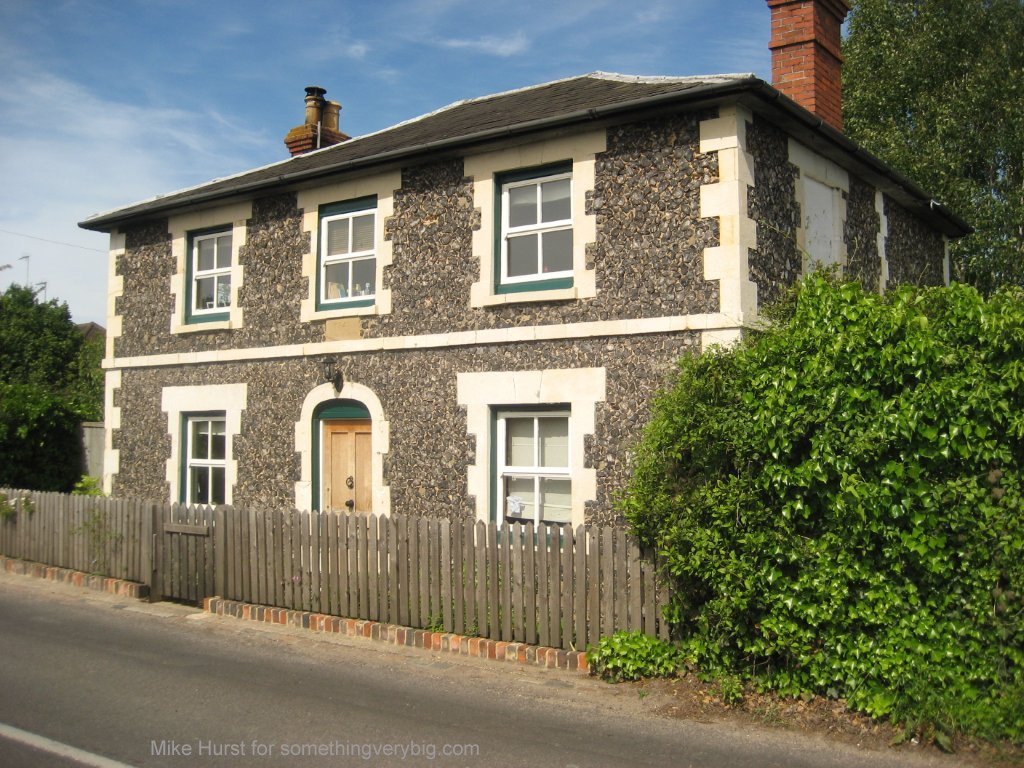
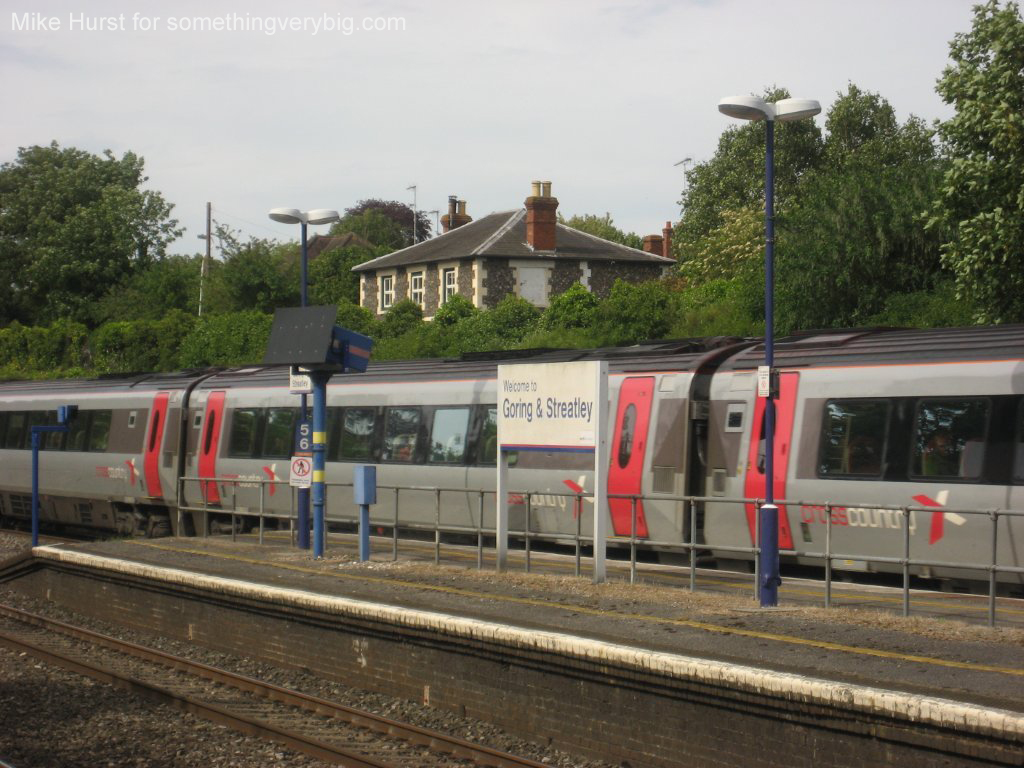
Having established, in any case, that Eric Hill’s father Frederick was the stationmaster at Goring, Janet sent me some photos of a rather pretty stone house in Goring Village.

It is called the Station House – and it is where Eric Hill once lived.

c05-215-003 copy

c05-215-004 copy

Janet tells me she will ask around the village in the next little while to see if anyone remembers or knows what happened to the Hills. She also suspects that the family tree on Ancestry.com that gave some information on Eric’s siblings may not be entirely accurate, so will have a dig through some primary sources for me.

The search goes on.

Image credit: Mike Hurst

Other sources: Janet Hurst, Mollie Smith, Gil and Peggy Thew

© 2011 Adam Purcell