467 Postblog XXXIX: Wednesday 15 March, 1944

After a much-welcomed break of a few days, war was on again for the Waddington squadrons tonight. It was a bright, sunny day as the ground staff began to prepare the aircraft with 1,950 gallons of fuel and more than ten tons of bombs each,[1] and the crews began their own preparations. Phil Smith was among a number of crews who took their aircraft on air tests during the day. Also on the air test with him was Pilot Officer Anthony Tottenham, a new pilot who would also accompany the crew of B for Baker on the operation tonight.

The target was Stuttgart and it was to be a big effort from both squadrons: 463 detailed seventeen crews and 467 had nineteen on the battle order, with at least one of them (skippered by Flight Sergeant Roland Cowan) taking a 463 Squadron aircraft as their own was not available.[2] For Pilot Officers Roland Llewelyn and John Roberts it was to be a significant day. They were on their first solo operations as captains.

The first aircraft to depart Waddington, with Roberts at the controls, departed at 19.04 hours. They faced a flight of some 1500 miles, or almost eight hours in the air.

In all, a force of 863 bombers were sent to the city. Ten Mosquitos were sent on a diversionary raid to Munich in support of the Main Force, to drop spoof route markers and target indicators in a bid to look like the opening of a large attack. Meanwhile more Mosquitos were to attack Stuttgart ten minutes before the Main Force arrived, then twice more after it left. Other planned targets were to be the Amiens marshalling yards by 140 Halifaxes and Stirlings, an aero-engine factory at Woippy (near Metz) by 22 Lancasters and airfields in Holland by Mosquitos. Finally, other aircraft would be engaged on Serrate anti-nightfighter patrols, mining sorties, Resistance operations and some leaflet trips by Operational Training Unit crews.[3]

The two Australian squadrons flew their aircraft via Reading to cross the coast near Selsey Bill, just east of Portsmouth. Not for the first time, the crew of Flight Lieutenant Jack Colpus encountered mechanical trouble in JA901. On this trip most of the crew felt ill from a defect in the oxygen system, and there was also a problem with the hydraulics that powered both turrets. The mid-upper gunner needed to refill the ‘spindle’ that supplied the system with oil “at least 40 times before getting to [the] target.”[4] At least on this occasion they reached their objective and returned safely: since late January, mechanical breakdowns had forced this crew to make two early returns from operations.

The first aircraft to fall to enemy action was shot down by a nightfighter over the Channel. The bombers crossed the French coast near Le Havre, where flak claimed another aircraft. South-west of Paris, the bombers turned towards the east for a long leg of some 350 miles. A number of crews complained that the length of this segment of the route made navigation difficult. “Suggest on such a long leg as tonight a route marker off track would have given a good check,” said Flying Officer Alan Finch in his post-raid interrogation report. Perhaps this contributed to the loss of four aircraft which were shot down by flak on this leg.[5]

An hour before reaching the target, Pilot Officer Colin James of 463 Squadron had a starboard engine catch fire and lose oil pressure. He feathered the engine but was struggling to maintain height on three. They jettisoned their two thousand-pounders, discovered they could now just about stay in straight and level flight, and so limped on to Stuttgart.[6]

Seeing the large force of bombers approaching on their radar screens, the German nightfighter controllers had to judge where the likely target would be and subsequently where they should deploy their aircraft. Tonight they split their forces into two: one group was positioned near Metz, north of the bombers’ outward track – perhaps drawn there by the Woippy force – and the second was even further to the north. The first group caught up with the main stream near Epinal. From here they fought a running battle all the way to the target, making a reported 24 attacks and in the process claiming ten bombers. Not far from Lake Constance on the Swiss-German border (which would become infamous as the site of one of the world’s worst mid-air collisions in 2002), the diversionary Mosquitos continued another 120 miles east towards Munich. The Main Force, however, turned north towards the real target – Stuttgart.[7] But the controllers were not deceived by the spoof flares and bombs at Munich. They moved their second group of fighters into the target area, waiting for the bombers.

During an operation, experienced crews would act as ‘wind finders’ for the entire force (Jack Colpus’s crew were tasked with this role on this trip). The navigators of these crews would calculate the wind they were experiencing at regular intervals, and then transmit it back to Bomber Command headquarters, where it would be compared against the results of all other windfinders, and an average re-broadcast to the rest of the Main Force. Tonight, it was discovered that the wind was stronger than forecast and the stream was running late. The first Pathfinder markers dropped at 23.09, one minute before the planned zero hour but four minutes later than scheduled. Subsequent Pathfinders and Main Force crews were up to fifteen minutes late, and the attack became a little drawn-out. Some crews even dropped their bombs on a flare believed to have been a German decoy (possibly the one seen by Pilot Officer Victor Trimble, about 20 miles short of the target).

Reading the crews’ post-raid reports in the Operational Record Books, the salient feeling is one of disappointment. The Pathfinders were late, and though there appear to have been short periods when the target indicators were reasonably concentrated there were other times where only a single Wanganui skymarker flare was visible. One crew were even forced to bomb the “estimated centre” of the position where they had just seen three Wanganuis fizzle out (this was the crew of Pilot Officer Fred Cassell, who had lost an engine earlier in the trip and were the last Waddington aircraft to bomb as a result[8]). Many crews reported seeing incendiaries burning on the ground well short of the aiming point. The stream itself appears to have been reasonably concentrated however: at 23.24 hours no less than nine Waddington aircraft bombed in the same minute. One of them, captained by Flying Officer Jim  Marshall, passed so close behind another aircraft it was thrown around by wake turbulence violently enough to upset the gyro compass.[9]

Surprisingly, the target was only relatively lightly defended. The flak guns put up a loose barrage as the bombers arrived, and there was virtually no searchlight activity. Even so, the ground defences claimed three attackers. Many crews reported seeing fighters over the target and twenty three attacks were reported, but only two more bombers were shot down at this point.

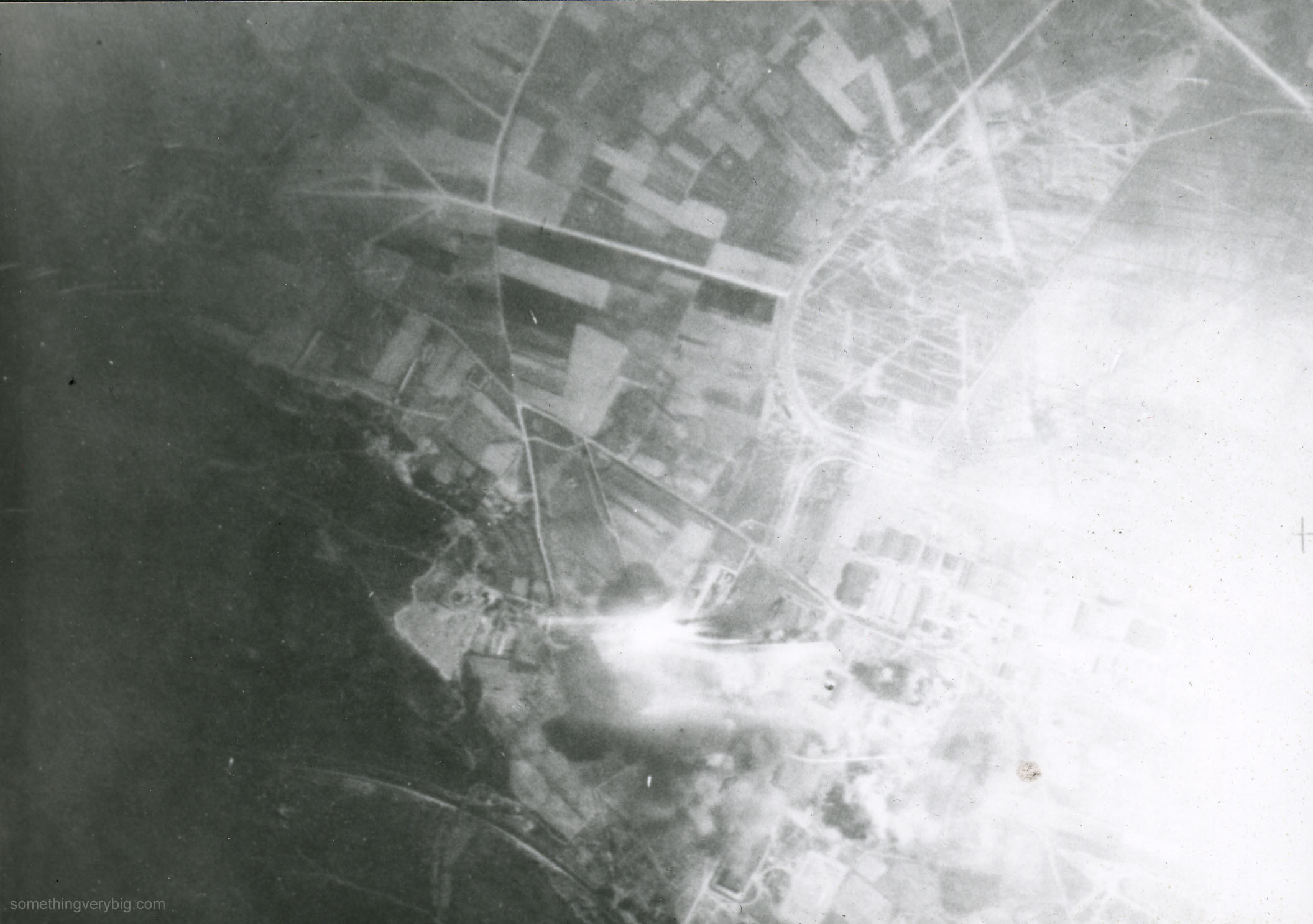
Bombing photo from mid-way through the attack. Courtesy Neale Wellman

After bombing, the stream flew on another twenty or so miles beyond the target before starting a big turn towards the south west (Jim Marshall’s aircraft got a little lost here and ended up passing between Karlsruhe and Mannheim, a little to the north west of the intended track, a result of the compass upset they suffered over the target). Two bombers fell to nightfighters before the French frontier was reached south of Strasbourg, and flak claimed one more there as the bomber stream turned west towards the coast. A further two aircraft were shot down by radar-controlled nightfighters over France.[10] A few crews complained that, once again, some bombers had jettisoned incendiaries on the way home. Pilot Officer Harold Coulson opined afterwards that Something Should Be Done to stop the practice as the route home was marked clearly by them, increasing the risk of fighter interception. The crew of one bomber bailed out near Beauvais on the final run to the French coast, though it was not certain whether or not this was due to enemy action.[11]

The bombers finally crossed the enemy coast again near Dieppe, returning to their bases the same way they came out via Selsey Bill and Reading. Approaching Waddington just before four o’clock in the morning, the crew of 463 Squadron Lancaster ED606 – captained by Pilot Officer William Graham – could perhaps have been forgiven for relaxing just a tiny bit. After all, they had just completed their very first operation as a crew. They had flown deep into enemy territory, taken part in a massed bombing attack and were now back safely over a friendly country. But disaster struck while they were circling overhead the airfield awaiting their turn to land. A 625 Squadron Halifax, returning to its base at Kelstern (22 miles north east of Waddington), flew straight through the Waddington ‘stack’ and collided with the Lancaster. They crashed at Branston, just a couple of miles from Waddington. All on board both aircraft were killed.

All 467 Squadron aircraft returned safely, but as well as the men involved in the collision so close to home, 463 Squadron lost one more crew on this trip. ME573, captained by John Roberts, had been the first aircraft to depart Waddington earlier in the evening. Their Lancaster crashed just north of Stuttgart with the loss of all on board.[12]

Roberts led one of a total of thirty six crews which failed to return from Stuttgart. Nine of these were known to have fallen to flak and seventeen to nightfighters. Two were believed destroyed in a collision over the channel. The remaining ten simply vanished. The two aircraft which collided near Waddington were in addition to these losses, as were a further three aircraft damaged beyond repair in landing accidents and one lost in a ditching. On the other side of the ledger, seven enemy fighters had been destroyed.[13]

The general impression of the raid, according to one 463 Squadron crew, was that the attack “generally fell short.” Another crew called it a “very poor prang.” Pilot Officer James – who had suffered the engine failure an hour before the target, jettisoned his thousand-pounders and carried on to attack on three engines – said it was “not a very healthy trip.”[14] James also had to deal with the failure of the Monica early-warning system, half the guns in the rear turret and the entire mid-upper turret. In the circumstances this comment is a remarkable understatement.

Phil Smith’s logbook shows that his target photograph was plotted some six miles south-west of the aiming point. He would not have been alone. The crews’ initial impressions would prove correct when the photo reconnaissance results came in a week and a half later, showing that the raid was “scattered over a large area, mostly to the S.W. of the target.” [15] Staggeringly, no bombing photographs, according to the Night Raid Report, showed evidence that any aircraft (out of the 778 that reported attacking the target) got within three miles of the aiming-point. Once again, the critical importance of the Pathfinders had been made clear. If the Pathfinders were on target, the bombs would fall on the target. But if the markers missed, so did the following bombs. On this occasion, the Night Raid Report records, the weight of the attack “evidently fell outside the town”. Nevertheless, there did occur what it called “useful industrial damage,” albeit in suburbs and outlying districts rather than in the city itself. It also records a direct hit on a large railway viaduct and damage to a number of factories, but cautions that, as American bombers had attacked the city after this operation and before photographic reconnaissance was able to be carried out, some of the damage found must also be attributed to that later raid.

While the Stuttgart raid was perhaps not the most successful in terms of damage inflicted, the Amiens force had better success. They caused heavy damage to the marshalling yards, for the loss of three heavy bombers. But the factory at Woippy escaped entirely when the attacking force found the target covered in cloud; all bombers brought their bombs home safely. The only other casualty from the evening’s operations was one Mosquito which failed to return from a Serrate patrol.[16]

This post is part of a series called 467 Postblog, posted in real time to mark the 70th anniversary of the crew of B for Baker while they were on operational service with 467 Squadron at RAF Waddington, Lincolnshire. See this link for an in-depth explanation of the series, and this one for full citations of sources used throughout it. © 2014 Adam Purcell

Sources:


[1] Easton, Arnold, Flying Log Book

[2] 467 Squadron ORB, cross-referenced with Robertson (1964)

[3] Details of all operations for this night are in Night Raid Report No. 553

[4] 467 Squadron ORB, 15MAR44

[5] Night Raid Report No. 553

[6] 463 Squadron ORB, 15MAR44

[7] Nightfighter activity in Night Raid Report No. 553

[8] 463 Squadron ORB, 15MAR44

[9] Navigator on this aircraft was Arnold Easton, and the incident is mentioned in his logbook

[10] Night Raid Report No. 553

[11] Night Raid Report No. 553

[12] Casualty details from Storr, Alan 2006

[13] Night Raid Report No. 553

[14] 463 Squadron ORB, 15MAR44.

[15] Night Raid Report No. 553

[16] Night Raid Report No. 553
467 Postblog XXXVIII: Saturday 11 – Tuesday 14 March, 1944

After the build-up, training and flying the Marignane operation, and then recovering all the diverted aeroplanes from Cornwall, the Waddington crews would not fly operationally again for a few days. Both squadrons had recently been joined by some new crews so, mainly for their benefit (though everyone else joined in as well), a certain amount of training was carried out: Bullseye exercises on Saturday, night flying on Sunday and again on Monday and some more training and cross-country exercises on Tuesday. Phil Smith logged 1.40 hours on the Monday on a night-time High Level Bombing sortie, though the flight does not appear in Jack Purcell’s logbook.

Otherwise, very little happened at Waddington. 463 Squadron Commanding Officer Rollo Kingsford-Smith went on leave for a few days, to be temporarily replaced by Squadron Leader Bill Brill. Three 467 Squadron officers received promotions to Flight Lieutenant, among them Dan Conway. The RAF Film Unit was still hanging around on Saturday taking some more footage. Phil Smith wrote to thank his family for a telegram he had received a few days earlier to celebrate his 27th birthday (which was on Monday 13th). A Church Parade was held at Waddington on Sunday and the usual Squadron Parade on Tuesday. Later that same day 467 Squadron aircrew were shown a film about ‘Pre Flight Inspection of Aircraft.’[1] Life was, for the moment, about as normal as it got on a bomber airfield.

Of course, other Bomber Command units were continuing the fight. A look at Saturday night (11 March) gives a good overview of the various sundry activities that were carried out on most nights throughout this period in the war. Twenty Mosquitos were sent to Hamburg, eleven to München-Gladbach, five to Krefeld, seven to Aachen and four to Duisburg. 43 heavies laid mines off the French Atlantic ports and the Frisians. Twenty Wellingtons and Whitleys dropped leaflets over France, three Mosquitos carried out Serrate patrols and 10 Stirlings went out on ‘special operations’. One Stirling minelayer was the only casualty of the night.

On Sunday night (12 March), eleven Mosquitos went to Aachen and three to Duisburg, for no losses. On Monday, 222 Halifaxes and Mosquitos attacked marshalling yards at Le Mans, for the loss of one heavy bomber, the Mosquitos were out again, making harassing raids on Frankfurt and the Ruhr and other aircraft laid mines off the French coasts, attacked enemy airfields and dropped leaflets. One minelayer and one fighter were lost. Finally, on Tuesday night thirty Mosquitos were sent to Dusseldorf. Another Mosquito made a weather reconnaissance flight and five other aircraft took part in special operations. All aircraft returned safely.[2]


Next post in this series: 15 March

This post is part of a series called 467 Postblog, posted in real time to mark the 70th anniversary of the crew of B for Baker while they were on operational service with 467 Squadron at RAF Waddington, Lincolnshire. See this link for an in-depth explanation of the series, and this one for full citations of sources used throughout it. © 2014 Adam Purcell

Sources:


[1] Details of activities at Waddington from 463 and 467 Squadron ORBs, 11-14MAR44. Phil Smith’s letter to sister Wenda was written 11MAR44.

[2] Night activities for this period recorded in Night Raid Reports Nos. 549-552

467 Postblog XXXVII: Friday 10 March, 1944

After a few hours sleep, the Waddington crews who had been on the Marignane raid last night left their diversion airfields in Cornwall and began trickling back to their own station, where the fog had cleared. After a two-hour flight the first aircraft arrived back at about 11.45.

463 Squadron left three aircraft unserviceable at Predannack. Almost joining them on the list of the broken was 467’s LM450 at St Eval. This was the aircraft which had apparently suffered an overheating port outer engine on the homeward flight last night. The Coastal Command engineers at St Eval had a look and couldn’t fault the engine, though they were not Merlin experts, and suggested that the trouble may have been a defective gauge in the cockpit. With that in mind, and not wanting to spend another day in Cornwall or risk the chance of a long train trip back to Waddington the aircraft’s captain, Dan Conway, discussed with his crew and decided on an unorthodox and highly unofficial plan of action: [1]

I said to Engineer Ray, ‘It’s a long runway and possible to get off on three motors. What say we start it up and let it run at low revs? Probably the gauge anyhow. Once about ready to get airborne you can shut it down and we can always unfeather it again to look good on landing. I can’t see the Flying Control letting us take off with one engine feathered.’

And so they did, taking off with all four props turning to keep up appearances for the controllers, feathering the offending engine shortly afterwards and proceeding to Waddington on three. But by this time the Waddington weather had closed in again and they found themselves diverting to nearby Bardney, where they unfeathered the propeller so it windmilled on arrival, again looking good for the tower. And finally, when word was received that Waddington was again clear, they went through the same process for the short flight back to base, where a ground inspection revealed – surprise, surprise – that the oil temperature and pressure gauges were both unserviceable. The Lancaster had performed beautifully on three engines. “As a matter of fact”, Conway later wrote,[2] “the tricky bit was the taxying on the port inner and starboard outer, rather than using the two outer motors as usual. This was because the two outer throttles were longer than the others and bent in over them for ease of taxying normally.”

Waddington crews would be given the night off, but 5 Group were still active elsewhere on Friday night. Small forces of Lancasters were despatched to four factories throughout France. One aircraft failed to return but all targets were hit hard. Particularly noteworthy was an attack by 16 aircraft from 617 Squadron on a needle bearing works at La Ricamerie, near St Etienne. Both the leader (Wing Commander Leonard Cheshire) and the deputy leader encountered trouble while trying to mark the target as cloud meant they could not see it from an angle, only from directly above it. Essentially on the fly, Cheshire came up with a new marking technique. Diving low under the clouds, he dropped 30lb incendiaries on both the eastern and the western edge of the target area, and told the crews to aim at the middle of the glow coming through the clouds. Later photo reconnaissance showed the improvised technique had been most effective and the factory was completely destroyed.[3]

Bomber Command also sent Mosquitos to Duisburg and almost a hundred aircraft on various special operations over the Continent. One Stirling was lost.[4]


This post is part of a series called 467 Postblog, posted in real time to mark the 70th anniversary of the crew of B for Baker while they were on operational service with 467 Squadron at RAF Waddington, Lincolnshire. See this link for an in-depth explanation of the series, and this one for full citations of sources used throughout it. © 2014 Adam Purcell

Sources:


[1] This quote, and the story, is from Conway (1995), The Trenches in the Sky, p.128-9. The ORB makes no mention of shutting down the engine on return from Marignane.

[2] Conway (1995), p.129

[3] Lawrence, W.J. (1951), No. 5 Bomber Group, R.A.F. 1939-1945, p.161

[4] Night Raid Report No. 548

467 Postblog XXXVI: Thursday 9 March, 1944

It was on.

Eleven crews from each Waddington squadron discovered at briefing that tonight they would use the special tactics that they had been learning over the last few days. The target was an aircraft factory at Marignane, near Marseilles – a long stooge south into France. Half of the 44 aircraft detailed for this raid came from Waddington. 9 Squadron at Bardney and 50 Squadron at Skellingthorpe made up the rest.[1]

For Phil Smith and his crew, this would be their first operational flight in B for Baker. Squadron Leader Bill Brill, flying LL790, led the two squadrons away at 20.19 hours. The bombers flew across France at fairly low level (10,000 feet), in good visibility and bright moonlight. They even went far enough to see the Swiss Alps from the air. “It has always been my ambition to see Switzerland though I should like to get a closer look”, Phil commented wryly when describing the incident in a letter written to his sister a few days later.[2]

It was a thoroughly uneventful trip. “It turned out a bore”, wrote Dan Conway.[3] “Everything was quiet, which possibly stretched our nerves more than usual.” The operation did not entirely go to plan however. A Gee coding failure made the use of that navigation aid difficult, and a number of pilots (including Phil Smith) later complained[4] that the incendiaries marking the rendezvous point – from which the timed bombing runs were planned to begin – were badly placed, leading to a delay in locating the target (one crew, who arrived at the rendezvous point with everyone else, would fail to find the target at all and ended up bringing their bombs home[5]).

But in the end it didn’t matter much. There was a little flak around but not much. Revelling in the complete lack of nightfighters, the bombers circled around the target area while waiting for the red spot fire target marker to be dropped.

And then they blew the factory out of existence. Most aircraft bombed between 8,000 and 10,000 feet, though Wing Commander Arthur Doubleday and Squadron Leader Bill Brill were right down at 6,000 feet when they dropped their cargo. While some incendiaries appeared a little scattered, many crews reported seeing their high explosives bursting on the target buildings and one (Flight Sergeant Eric Page in HK595) even claimed to have felt the blast of his own bombs. A large explosion, “orange-red in colour and lasting 2-3 secs”[6] was seen at 01.30, in the middle of the attack, followed by a thick pall of smoke reaching up to six or seven thousand feet. “Should be a complete wipe-out,” reported a very satisfied Pilot Officer Clive Quartermaine later.

There was a little excitement over the target for the crew of B for Baker. On the run-up to the target, Phil Smith heard an urgent call from Eric Hill in the mid-upper turret:

Weave, Skipper, weave – there’s a bloke right above us with his bomb doors open and I can see the eggs hanging there!

With all the aircraft milling around in the target area, however, evasive action was impossible. The crew nervously watched and waited, but eventually the other aircraft drifted off to one side and they carried on to drop their bombs “none the worse, apart from being frightened.”[7]

The bombers left the target well pranged with a mass of fires burning, and much smoke and dust rising. The Night Raid Report[8] lists a catalogue of damage:

All the buildings of the factory had been damaged, especially the assembly shops, the heat treatment shops, M/T. park, stores, and flight and repair hangars. The adjacent airfield also suffered heavily, many hangars and administration buildings being affected by fire and blast. Hits were scored on roads bounding the site and on the internal network of roads

It had been an extraordinarily accurate raid, with eight out of ten successful 467 Squadron crews scoring aiming point photographs. The only two to miss out were the leaders, Balmer and Doubleday, who both suffered photographic failure.[9] Despite circling the target for over half an hour, out of the total force of 44 Lancasters just three received minor flak damage and nightfighters were entirely absent.

Marignane, well and truly under attack. Photo: The Waddington Collection, RAF Waddington Heritage Centre

Flight Lieutenant Dan Conway’s crew encountered a little trouble on the homeward leg when their port outer engine apparently overheated and needed to be feathered.[10] As forecast, fog formed at Waddington overnight rendering the airfield unusable so the entire force was diverted to Cornwall. 463 Squadron were sent to Predannack, a nightfighter base in the south, where Wing Commander Rollo Kingsford-Smith complained they landed “in poor visibility without any flying control assistance of any kind.”[11] 467 Squadron went to St Eval, a Coastal Command base on the western coast. With the sudden influx of crews accommodation was at a premium. After nine hours and fifty minutes in the air Phil Smith in B for Baker was the last to land (at 06.30), so they would have had to make do with whatever they could scrounge.

Elsewhere, eight Mosquitos bombed Dusseldorf and two made Serrate patrols over the Continent. No aircraft were lost from the night’s operations.[12]

This post is part of a series called 467 Postblog, posted in real time to mark the 70th anniversary of the crew of B for Baker while they were on operational service with 467 Squadron at RAF Waddington, Lincolnshire. See this link for an in-depth explanation of the series, and this one for full citations of sources used throughout it. © 2014 Adam Purcell

Sources:


[1] This was a 53 Base only operation, notes the ORB. The other two stations under 53 Base, apart from Waddington, were Bardney and Skellingthorpe, each hosting one squadron (9 and 50).

[2] Smith, Phil, Letter to sister Wenda, 11MAR44

[3] Conway, Dan (1995), The Trenches in the Sky, p.128

[4] Reports are in both the 463 and 467 Squadrons ORBs, 09MAR44

[5] This was P/O H.W. Coulson in DV240 and the 467 Squadron ORB records that, despite almost getting there, he and his crew would not be awarded credit for this operation.

[6] F/O M.F. Smith in LL788, in 467 Squadron ORB, 09MAR44

[7] Smith, Phil, Phil’s Recollections of 1939-1945 War, p.21

[8] No. 547

[9] 467 Squadron ORB, 10MAR44

[10] Conway, 1995 p.128

[11] 463 Squadron ORB, 09MAR44

[12] Night Raid Report No. 547

467 Postblog XXXV: Monday 6 – Wednesday 8 March, 1944

The pattern of the last two days continued on Monday with operations scheduled but cancelled late in the day. At the very least 463 Squadron were able to get two cross-country flights away, but that was all.

On a completely different note, a member of the RAAF Public Relations team arrived at Waddington on Monday in conjunction with the Royal Air Force Film Production Unit. They were making a film called ‘RAAF Over Europe,’ the later stages of which would feature 467 Squadron. “Wait until this appears and our Clark Gable’s [sic] come forward!” said the Operational Record Book.

No ops were scheduled for 7 March, but despite having spent three consecutive days shovelling snow or preparing for ops that never happened the crews would not get the stand-down they were waiting for. All available aircrew instead found themselves in the briefing room for the benefit of the cameras. “Whilst the Director conferred with the CO and the cameramen fiddled with their equipment time dragged. Until then I thought film making glamorous,” wrote Dan Conway after the war.[1]

The Wingco [Wing Commander Sam Balmer, 467 Squadron CO] took us through a dummy briefing on a Berlin trip, which was highly entertaining with references to tracking at low level over the Ruhr etc. Maybe because we were laughing he was made to go over the procedure again and then again. Our hopes of an early release were ruined when we had to move to the crew room for shots of us dressing for flight and then clambering onto, and off, transport to the aircraft.

The resulting film[2] features, among others, Phil Smith and three other members of his crew, “all trying to look intelligent while being briefed:”[3] Eric Hill, Gilbert Pate and Ken Tabor. After the war Phil managed to get copies of some stills from this film which he distributed to the families of his crew.[4] This is one of them, from the small collection of photos amongst Jack Purcell’s effects:

Waddington Briefing
Waddington Briefing

Something else was brewing at Waddington at this time. “We are being kept up to the collar recently, no doubt with a big object in view,” wrote Gilbert Pate to his mother.[5] A special operation was planned for some time in the near future and the Squadrons needed to carry out some extra training in preparation for it. “Rumour had it that this was a special raid of the same category as the Dams raid,” wrote Dan Conway. “We were rather proud at being selected.” The exact target – and indeed the exact time that this operation was planned to take place – was still a secret, but the tactics would involve bombing from a much lower height than usual and a special technique for bomb release: “We were to follow the time and distance technique, rather favoured by our Group which had been used by them on the famous Peenemunde raid. The idea was to fly over a marker or pinpoint, on a set heading and speed, then release the bombs at the end of a calculated time.”[6]

Gilbert Pate joined the rest of his crew in a two-hour ‘Special Training’ flight on the night of 7 March[7] and the rest of the squadron followed suit the next day (while the Film Unit took footage of them taxying out, taking off and landing). “This ‘Op’, when it comes off, will be staged by No. 53 Base personnel only,” said the ORB. “One to ourselves for a change.”

As well as the by-now usual Mosquito attacks on Germany to Hanover, Kiel and Krefeld on Monday night and various targets in the Ruhr on Tuesday, other attacks on enemy airfields and special operations on both nights,[8] Bomber Command began a new phase of operations this week as part of preparations for the Allied invasion of the occupied territories. A series of attacks were planned on railway targets in France, Belgium and Western Germany, in order to “prevent the flow of reinforcements and supplies for the German army in the invasion area.”[9] The first of these raids occurred on the night of 6 March 1944, when 267 Halifaxes carried out a “most accurate groundmarking attack on the marshalling yards at Trappes,” near Paris, causing “enormous damage” for no loss. The next night 304 Halifaxes, Lancasters and Mosquitos bombed marshalling yards at Le Mans. Over 100 direct hits were claimed despite unexpected cloud covering the target.[10]

The Transportation Plan would come to play a decisive role in the future of the crew of B for Baker.

Next post in this series: 9 March

This post is part of a series called 467 Postblog, posted in real time to mark the 70th anniversary of the crew of B for Baker while they were on operational service with 467 Squadron at RAF Waddington, Lincolnshire. See this link for an in-depth explanation of the series, and this one for full citations of sources used throughout it. © 2014 Adam Purcell

Sources:


[1] Conway, Dan, 1995. The Trenches in the Sky, p.157

[2] Australian War Memorial: F01372, RAAF over Europe

[3] Smith, Phil, Letter to sister Wenda, 11MAR44

[5] Pate, Gilbert, Letter to his mother, 08MAR44. In Gil Thew’s collection

[6] Conway, p.128

[7] Recorded as ‘Special Training’ in Jack Purcell’s logbook. Phil Smith called it ‘Bombing Procedure’.

[8] Night Raid Reports Nos. 545 and 546

[9] Lawrence, W.J. (1951), No. 5 Bomber Group, R.A.F. 1939-1945, p.164

[10] Night Raid Reports Nos. 545 and 546

467 Postblog XXXIV: Saturday 4 – Sunday 5 March, 1944

Many crews from Waddington were on leave on Saturday due to the moon period so fewer crews were available than usual for an operation planned for that night. But as take-off time approached, so did the snow clouds. At 18.45 it began to snow heavily and the operation was cancelled.

This happened again on Sunday. Each time the ground crew prepared, armed and fuelled the aircraft. Each time the aircrew were briefed, fed their operational eggs and taken to their dispersals. And each time the operation was scrubbed. The snow still lay thick on the ground and now the aircrew were put to work to clear it. Phil Smith wrote to his father:[1] “We are all heartily sick of the stuff – most of us have taken a turn with shovels trying to clear the aerodrome,” he wrote. “It is amazing how much work it takes to make an aerodrome serviceable after a good, heavy fall.”

Bomber Command still sent small forces out however. On Saturday night 15 Mosquitos went to Berlin, six to Duisburg and one each to Aachen and Sottevast. Meanwhile 15 Lancasters from 617 Sqn attacked needle bearing factory at La Ricamarie “but owing to weather conditions, it proved impossible to identify the target, and on the instructions of the leader, the force abandoned its task.” On Sunday night, nine Mosquitos went to Duisburg and one to Aachen. Other aircraft carried out Serrate anti-nightfighter patrols, weather reconnaissance and leaflet drops. Some Resistance support operations were also flown, with one loss. This was the only aircraft lost over the two nights. [2]

Next post in this series: 6 March

This post is part of a series called 467 Postblog, posted in real time to mark the 70th anniversary of the crew of B for Baker while they were on operational service with 467 Squadron at RAF Waddington, Lincolnshire. See this link for an in-depth explanation of the series, and this one for full citations of sources used throughout it. © 2014 Adam Purcell

Sources:


[1] Smith, Phil. Letter to Father, 05MAR44. In Mollie Smith’s collection.

[2] Night Raid Reports No. 543 and No. 544

467 Postblog XXXIII: Friday 3 March, 1944

Something momentous occurred for Phil Smith and his crew on Friday 3 March, though they probably didn’t realise its significance at the time. On this day, the serial number LM475 appeared in Phil’s logbook for the first time. A new aircraft (possibly delivered at the same time that 463 Squadron collected their three from Coningsby yesterday) for 467 Squadron, as wireless operator Flight Sergeant Dale Johnston would later write to his brother Ian, “the skipper liked her so much he decided to let another crew keep our old kite, and we kept this one.”[1] It would become PO-B, and apart from an occasional flight with another crew would remain with Phil Smith’s men. They were now, truly, the crew of B for Baker.

That first flight in their new aeroplane was a training flight to a practice bombing range at Owthorpe, east of Nottingham. Also on board were 467 Squadron Commanding Officer, Wing Commander John (‘Sam’) Balmer and the Squadron Bombing Leader, Flight Lieutenant Pat McCarthy, and Phil’s logbook notes that along the way they landed at Hunsdon, which was a nightfighter airfield some 20 miles north of London.[2]

It was a clear day but still the snow lay around the airfield and the ground crew got no respite on the shovels. No operations were scheduled so training was the order of the day for the aircrew, with Phil Smith’s flight in B for Baker being one of many that were completed.

A second practice high-level bombing sortie appears in both Phil Smith’s and Jack Purcell’s logbook for this evening, again one of many carried out by 467 Squadron crews. Pat McCarthy went along with them again, though there was no Sam Balmer this time. The target was in the Epperstone bombing range, north of Nottingham, and Phil recorded an average 145 yards bombing error. “With the moonlight conditions were ideal,” notes the ORB. “The snow showed up well and looked very pretty from above.”

Elsewhere, Bomber Command sent 16 Mosquitos to Berlin, 10 to Dusseldorf, one to Krefeld and one to a flying bomb site at Sottevast. 45 bombers laid mines off French ports and a small force of Wellingtons scattered leaflets over northern French towns. All aircraft returned safely.[3]


This post is part of a series called 467 Postblog, posted in real time to mark the 70th anniversary of the crew of B for Baker while they were on operational service with 467 Squadron at RAF Waddington, Lincolnshire. See this link for an in-depth explanation of the series, and this one for full citations of sources used throughout it. © 2014 Adam Purcell

Sources:


[1] Johnston, Dale, Letter to Ian Johnston 20 April 1944, transcription probably by Don Smith, In Mollie Smith’s collection.

[2] There are some inconsistencies associated with this flight in some of the records. See this post for an explanation.

[3] Night Raid Report No. 542

467 Postblog XXXII: Thursday 2 March, 1944

Another one of those night jobs

– Gilbert Pate, annotation on a newspaper report about the Stuttgart trip that he sent to his family

More than 550 aircraft were in the bomber stream headed for Stuttgart in the very early hours of Thursday morning. They were over thick cloud for most of the way and this, combined with an apparent overall failure of the Gee navigation aid, made work difficult for the navigators.[1] As expected, the stream was in bright moonlight until about an hour before the target.[2] Nevertheless, the outbound trip was a reasonably quiet one, with only limited flak en-route. Though “the enemy controllers were obviously making real efforts to intercept the stream” and numerous fighters were seen, no attacks were reported and the bombers remained “almost unmolested.” The Munich diversion is likely to have distracted the fighters enough to delay their arrival at the target. [3]

Various crews were dealing with mechanical issues during the approach to the target. Pilot Officer Alan Finch reported intercom trouble, a broken mid-upper turret and a faulty oxygen system. Warrant Officer Jack Purcell, Phil Smith’s navigator in EE143, had to contend with a broken compass on top of the unserviceable Gee system right from the start of the trip. Pilot Officer Jim Marshall, on his first trip with his own crew, lost the use of the Monica early-warning radar an hour and a half before the target. The rear turret failed in Flight Lieutenant Jack Colpus’ aircraft an hour before the target. And five minutes before reaching the target area Flight Lieutenant F.D. Wilson’s flight engineer needed to go to the assistance of the rear gunner whose oxygen tube had split.[4]

The bombers found the target area eerily quiet. Flight Sergeant Ed Dearnaley, bombing towards the end of the attack at 03.16, reported that “all that could be seen was Wanganui flares, some flak bursts and a glow beneath cloud”. Stuttgart was covered in thick cloud with occasional small breaks. There was some heavy-calibre predicted flak but clouds severely restricted the effectiveness of searchlights and most crews considered the defences only slight. Indeed, only a single aircraft would fall to flak over the target. The first Pathfinder markers went down on time but it appears the subsequent marking never achieved the concentration that was hoped for. This was, according to the Night Raid Report, mainly due to poor serviceability of H2S radar among the backer-up Pathfinder crews.

What comes through from a reading of the 463 and 467 Squadron Operational Record Books is a feeling of being somewhat let down by the Pathfinders. Not many flares were actually dropped and those that were tended towards the scattered side.

A single Wanganui skymarker flare was visible when Phil Smith’s crew ran into the target in EE143. Bomb aimer Sergeant Jerry Parker directed his pilot:

Left… left… steady… right right… steeeaaaaady…

Then, with the flare squarely in his sight, he pressed the bomb release button. And…

Nothing happened.

All the bombs had ‘hung up’ and were still firmly in the bomb bay. They were forced to ‘go round again’, turning against the bomber stream to go back and make another run on the target, while Parker tried to work out what was wrong with the bomb release circuit. The second time everything worked and the bombs were dropped manually at 03.13.

Jim Marshall was on his bombing run when his aircraft was attacked suddenly by a FW190. A cannon shell put a large hole in the starboard wing and put the flaps out of action, and another destroyed the radio and set a fire under the wireless operator’s desk, which was put out using an extinguisher. They were the last Waddington aircraft to bomb, at 03.19, and then they turned into the wind and set course for home in their damaged aircraft.[5]

The fighters finally became organised as the bombers left the target. Seventeen combats were reported in the first 100 miles of the return route and three bombers were shot down near Strasbourg as a result. No combats were reported west of that city however, apart from one near Nancy.[6] The rest of the trip home was uneventful for the majority of the force.

The first Waddington aircraft, ED657 with Pilot Officer Bruce Simpson at the controls, touched down at exactly 07.00 on Thursday morning. Just under an hour later the last one arrived (HK536 with Flight Sergeant Eric Page and crew). All Waddington aircraft landed safely, but not all at their own base. Four aircraft had diverted. The headwinds caused Pilot Officer Victor Trimble to land at Tangmere, short of fuel. Flight Sergeant Roland Cowan in LM338 diverted to Dunsfold, presumably for the same reason.[7] Jim Marshall, who had been shot up over the target, nursed his damaged aircraft back to England but decided he had gone far enough and landed at Wittering with no flaps, no W/T radio and not much fuel.

Phil Smith also diverted. The ORB notes his TR1196 radio had failed so he would have had difficulty contacting the control tower at Waddington. Phil apparently decided it was too dangerous to try and ‘push in’ to the circuit without a radio and, with only 40 gallons of fuel left in each wing, he was unable to wait until the last aircraft landed. So he instead landed at Coleby Grange, an airfield just three miles from Waddington. “A bloody awful trip”, he wrote in his logbook afterwards, “with lots of small snags”.

The bombers left Stuttgart with a “deep red” [8] glow visible through the clouds from up to 150 miles away and later on Mosquitos reported several fires scattered throughout the city. Photographic reconnaissance from 9 March revealed “very considerable industrial damage,” although because the 20 February raid appeared to the crews to be much more concentrated than this one did it’s likely that most of the damage was attributable to the earlier operation.[9]

The Night Raid Report lists a number of factories and railway workshops that were severely hit, with some residential areas also damaged. There was no spread of fire.

Against this, Bomber Command lost just four aircraft missing, with two more Halifaxes being damaged beyond repair in landing and taxying accidents on return. “The loss rate is small for an operation of this penetration and strength”, wrote the scientists in the Night Raid Report.

With most aircrews still asleep from the effects of their night’s work, the only activity at Waddington during the day on Thursday was the continued clearance of snow under a sunny sky, five local flights and the arrival of three new aircraft for 463 Squadron, all collected from Coningsby.[10] There was some night flying in the evening, but no operations for the two Australian squadrons.

Other parts of Bomber Command, however, did not sleep. Halifaxes attacked an aircraft factory at Meulan les Meureaux, near Paris, with such a concentrated raid that the Germans abandoned it entirely afterwards. Lancasters from 5 Group attacked an aero engine factory near Albert with similar success. Mosquitos went to the Ruhr and the flying bomb site at Sottevast again, and other aircraft laid mines off France, dropped leaflets and attacked enemy airfields. ‘From the night’s operations”, said the Night Raid Report, “all our aircraft returned undamaged.”

This post is part of a series called 467 Postblog, posted in real time to mark the 70th anniversary of the crew of B for Baker while they were on operational service with 467 Squadron at RAF Waddington, Lincolnshire. See this link for an in-depth explanation of the series, and this one for full citations of sources used throughout it. © 2014 Adam Purcell

Sources:


[1] Three 463/467 Squadron crews – including Phil Smith’s – reported ‘Gee u/s from the start’ or words to that effect in the ORBs

[2] As reported by Pilot Officer H.S.A. Hemsworth of 467 Squadron in the ORB, 01MAR44

[3] Night Raid Report No. 540

[4] All accounts from the 463 and 467 Squadron ORBs, 01MAR44

[5] Account from 467 Squadron ORB, 01MAR44, and an entry in Arnold Easton’s logbook (navigator on this aircraft)

[6] Night Raid Report No. 540

[7] This is a hand-written amendment on the 467 Squadron ORB; no reason is given but Dunsfold is only about 20 miles north of Tangmere and close to the bombers’ route back from making landfall at Beachy Head.

[8] P/O J.W. McManus in R5868 in 467 Squadron ORB, 01MAR44

[9] Night Raid Report No. 540

[10] 463 and 467 Squadron ORBs, 02MAR44

467 Postblog XXXI: Wednesday 1 March, 1944

The snow of the past few days was beginning to thaw on Wednesday, though the work parties were still trying to shift it from the movement areas of the Waddington aerodrome.[1]

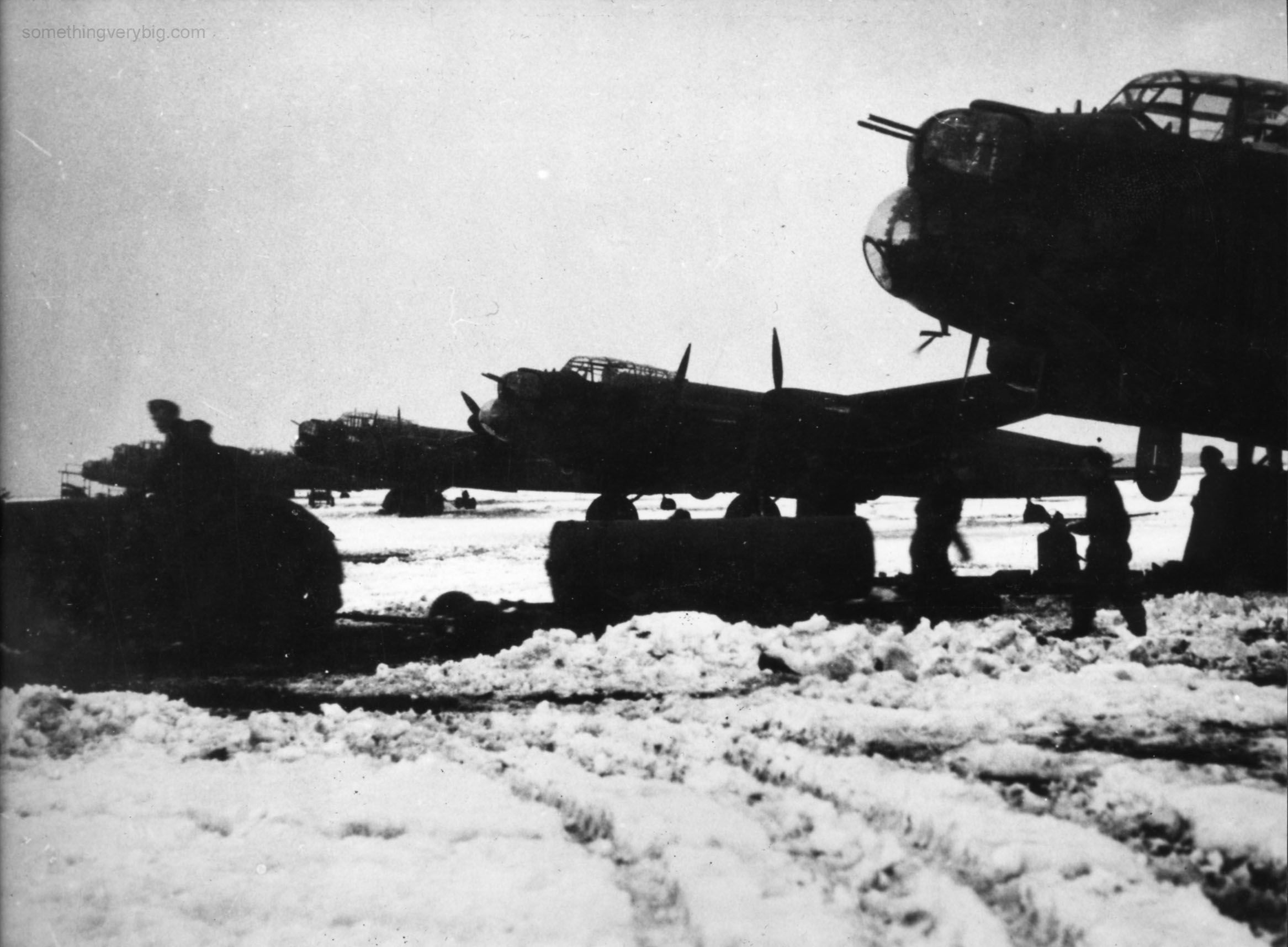
Snow at Waddington, 1 March 1944. From the Waddington Collection, RAF Waddington Hertiage Centre

Bomber Command’s Main Force had not operated since last Friday (the 25 February raid on Augsburg) and it was now time to resume their fight against the enemy. The target for tonight was Stuttgart, being attacked in force for the second time in a fortnight.

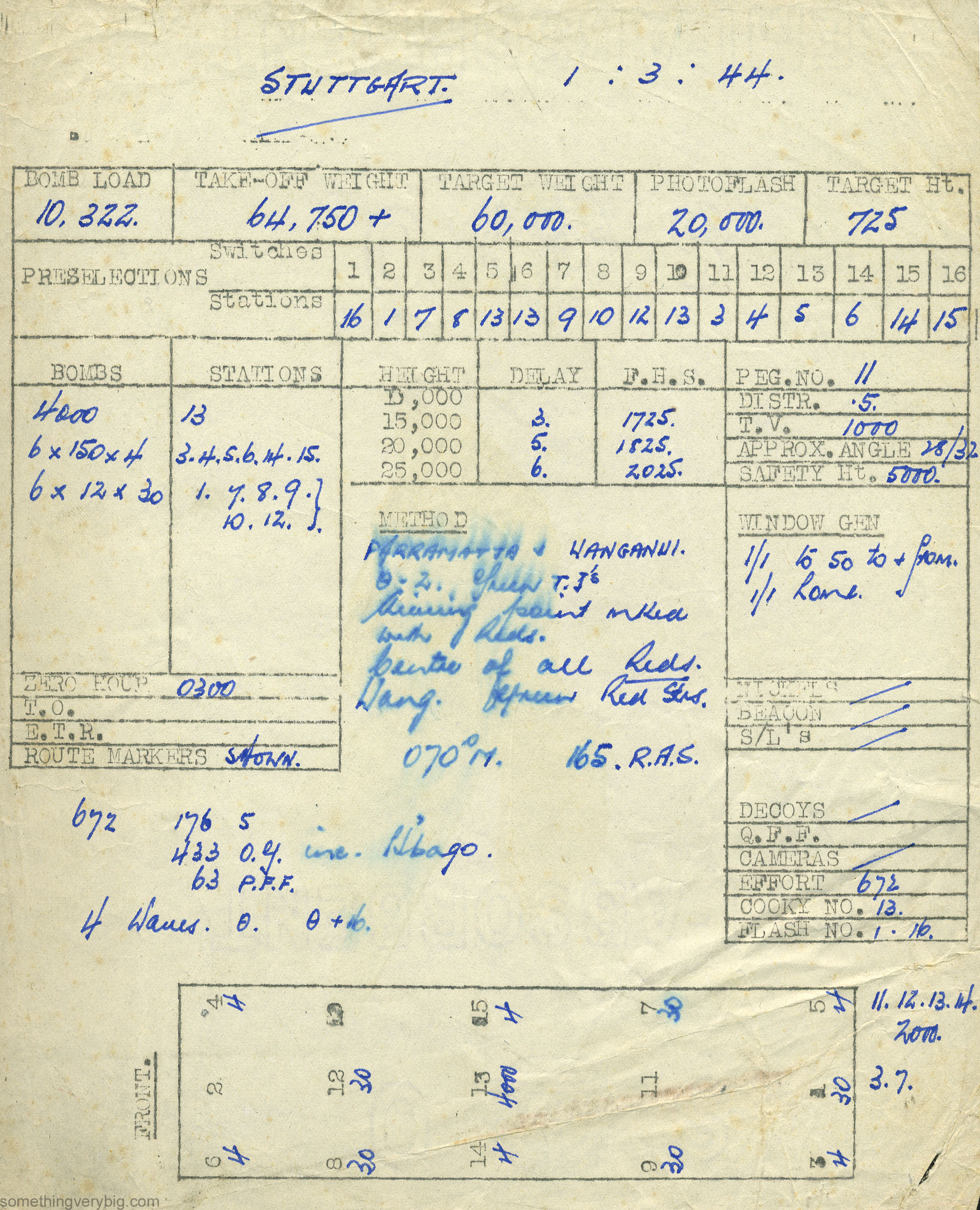
It was not considered practicable to use the ‘splitting’ tactics which had proven so useful in recent raids of this scale because a bright moon was expected to be above the horizon for the early part of the route to the target and strong winds were forecast for the return leg. Consequently the bomber stream was planned on a course keeping south of Strasbourg while the moon was up, and home on almost the shortest possible route.[2] Heavy cloud was forecast along most of the route and so a mixed Parramatta and Wanganui attack was planned using ground target indicators and airborne release-point flares, both dropped using H2S.

Bombing instructions as carried on the Stuttgart trip by Bill Kelleher, Fred Smith's bomb aimer. From the Waddington Collection, RAF Waddington Heritage Centre
Bombing instructions as carried on the Stuttgart trip by Flying Officer Bill Kelleher, Pilot Officer Fred Smith’s bomb aimer. From the Waddington Collection, RAF Waddington Heritage Centre

Supporting the Main Force tonight were small forces of Mosquitos on a diversion raid to Munich and attacking airfields in Holland, six Radio Counter-Measure sorties and ten Serrate patrols. Also planned were a number of Special Duties sorties, some OTU bullseyes and a single Mosquito attacking a flying bomb site.[3]

557 aircraft were sent on this operation. Among them were thirteen Lancasters from 463 Squadron and fifteen from 467 Squadron. Low, icing-type cloud hung over Waddington just before 11pm as the first aircraft, LM458 piloted by 463 Squadron Commanding Officer Rollo Kingsford-Smith, rolled down the runway. Phil Smith, with his normal crew plus the addition of Pilot Officer Bill Felstead, a newly-arrived pilot on a ‘second dickie’ observation flight, was the last to leave, lifting into the murk in EE143 a little more than an hour later.

All available aircraft from 467 Squadron had taken off for this raid (the remainder being ‘Cat A.C.,’ or requiring repair by the manufacturer, according to the Operational Record Book). Three however made early returns, all due to problems with their starboard engines.[4] The Operational Record Book later attributed the three engine failures to the heavy snowfall creating difficulties for the engine fitters working at exposed dispersals.

Bombing up for operations in March 1944. From the Waddington Collection, RAF Waddington Heritage Centre

463 Squadron didn’t get off entirely scot-free either with two aircraft making ‘boomerangs’ – one because of frozen guns in the rear turret (thought to have been caused by a faulty valve) and the second due to an oxygen failure in the mid-upper turret. “Being such a clear moonlight night”, reported the crew concerned, “it was too risky to carry on”.[5]

Meanwhile, the Main Force continued on towards Germany.

This post is part of a series called 467 Postblog, posted in real time to mark the 70th anniversary of the crew of B for Baker while they were on operational service with 467 Squadron at RAF Waddington, Lincolnshire. See this link for an in-depth explanation of the series, and this one for full citations of sources used throughout it. © 2014 Adam Purcell

Sources:


[1] 463 Squadron ORB, 01MAR44

[2] Night Raid Report No. 540

[3] RAF Bomber Command Campaign Diary, March 1944

[4] The pilots concerned were F/L W.D. Marshall in LM376, P/O N.R. McDonald in ED532 and P/O W. Mackay in DV240 – 467 Squadron ORB, 01MAR44

[5] P/O C.M. Schomberg was the pilot of ME614 with the rear turret issue (landed 02.03), and P/O A.R.S. Bowman was flying ME573 with the mid-upper issue. He landed at 02.29. 463 Squadron ORB, 01MAR44

467 Postblog XXX: Saturday 26 – Tuesday 29 February, 1944

Things go on as usual here with work depending mainly on the moon and the weather. The first sticks to the normal routine but the weather is very changeable. We are having a bad spot at the moment… – Letter Phil Smith to his mother, 27FEB44

After the busy few days of operations aircrews were given Saturday off. Phil Smith headed in to Lincoln to send an urgent telegram. He had received some unsettling news in the last day or so. In a letter from his sister Wenda, he was told that his mother had been involved in an accident involving a tram and a Peters icecream truck on Spit Road, just near the family home in Mosman, Sydney.[1] The accident resulted in Edith Smith losing a leg and for the rest of her life she used a prosthetic. Phil followed his telegram up with a letter written the next day (from which the quote that opens this post also comes). “It was rather a shock to hear how bad it really was,” he wrote, “and I am rather glad I did not get incomplete details only in a cable. I do hope that the wound is healing satisfactorily and that the enforced activity does not depress you un-necessarily.”

While he was in Lincoln, to escape the rain Phil went in search of a picture theatre. It appears, however, that the show was not to his taste, and he “walked out and came ‘home’”.

On Sunday it started to snow, heavily. The entire station – air and ground crews alike – was put on snow fatigues to attempt to clear the runways and taxiways. It was a losing battle: “It was quite remarkable how ineffective this project was,” Phil wrote after the war,[2] “apart from the fact that the exercise was very good for us. Our efforts were rewarded with a rum ration at the end of the day.”

Clearing snow at Waddington, probably February 1944. The original caption identifies Fred Smith as the centre one of the five men with shovels. From the Waddington Collection, RAF Waddington Heritage Centre
Clearing snow at Waddington, probably February 1944. The original caption identifies Pilot Officer Fred Smith with a shovel at the rear of the group. From the Waddington Collection, RAF Waddington Heritage Centre

The snow clearing operation carried on, in two-hour shifts, all night. Monday found a bright sunny morning with snow 12-18 inches thick blanketing the aerodrome. “Very pretty,” remarked the 467 Squadron Operational Record Book, “but it is going to take some shifting.” Almost unbelievably, operations were scheduled for Monday night. Then it started snowing again, and just before seven o’clock the raid was cancelled. The first Bomber Command aircraft to go out on operations since Augsburg was raided three nights ago were eight Wellingtons from Operational Training Units. They dropped nothing more dangerous than thousands of leaflets over France and all returned safely. A Mosquito also carried out a meteorological reconnaissance flight, but the Main Force remained grounded.

It was a “really brilliant day with sunshine all day” at Waddington on the last day of February. But the station was still covered in thick snow and all hands were set to snow clearing again. It would have been a curious sight for two new crews as they arrived at Waddington on posting to 463 Squadron.[3]

Bomber Command’s offensive operations began again later that night, though once again the Main Force was not involved. Fifteen Mosquitos bombed Dusseldorf. One more was sent to a flying bomb site at Sottevast and 20 Whitleys and Wellingtons scattered yet more ‘bumphlets’ over France. One Whitley failed to return.[4]

In all of February, 467 Squadron had operated to five targets, all in Germany. 74 completed operational sorties were flown involving 583 hours of flying, for a total of 356 tons of bombs dropped. Just one crew had been lost (Herbert Stuchbury and crew on Augsburg on 25 February).

February had been not as easy for their sister unit at Waddington. 463 Squadron lost four crews during the month: those of Ernie Fayle (Leipzig, 19 February), Charles Martin and Ron Mortimer (both on Schweinfurt, 24 February) and Kevin McKnight (Augsburg, 25 February).

Next post in this series: 1 March

This post is part of a series called 467 Postblog, posted in real time to mark the 70th anniversary of the crew of B for Baker while they were on operational service with 467 Squadron at RAF Waddington, Lincolnshire. See this link for an in-depth explanation of the series, and this one for full citations of sources used throughout it. © 2014 Adam Purcell

Sources:


[1] Story of the accident related to me by Phil’s widow, Mollie Smith, in an interview 15JUL09

[2] Smith, Phil. Phil’s Recollections of 1939-1945 War, p.19

[3] 463 Squadron ORB, 28-29FEB44

[4] Night Raid Report No. 539, and RAF Bomber Command Campaign Diary, February 1944