ANZAC Day 2013

Sydney turned on an absolute sparkler for ANZAC Day yesterday. The sky was clear, blue and brilliant, it was warm in the sun (but with that delicious autumn chill to the air in the shade) and the air was almost perfectly still. Perfect conditions, then, for an ANZAC Day march.

I flew up from Melbourne early, catching the fast, clean and efficient (but horribly expensive) airport train into the city centre and arriving with enough time to spare to walk around and enjoy the atmosphere for a little while. The contingents from some current naval ships in particular, stepping off as I crossed Castlereagh Street, displayed some very impressive marching. I headed for Elizabeth Street and the usual starting point for the Air Force veterans.

At first, I couldn’t find many from 463-467 Squadrons. But then the banner arrived, safe in the care of Bryan Cook, and suddenly they all melted out of the crowd:Setting up the Banner

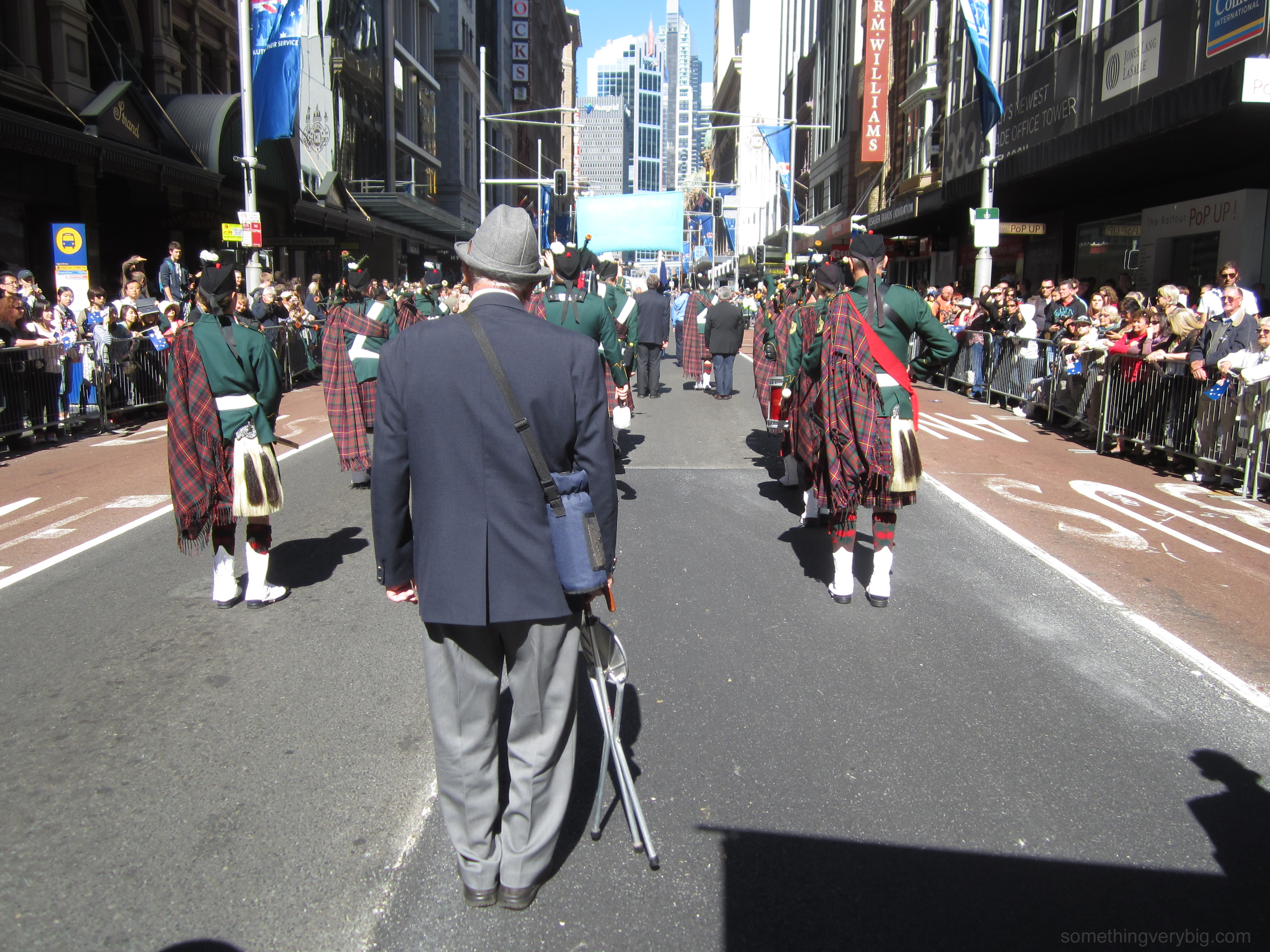
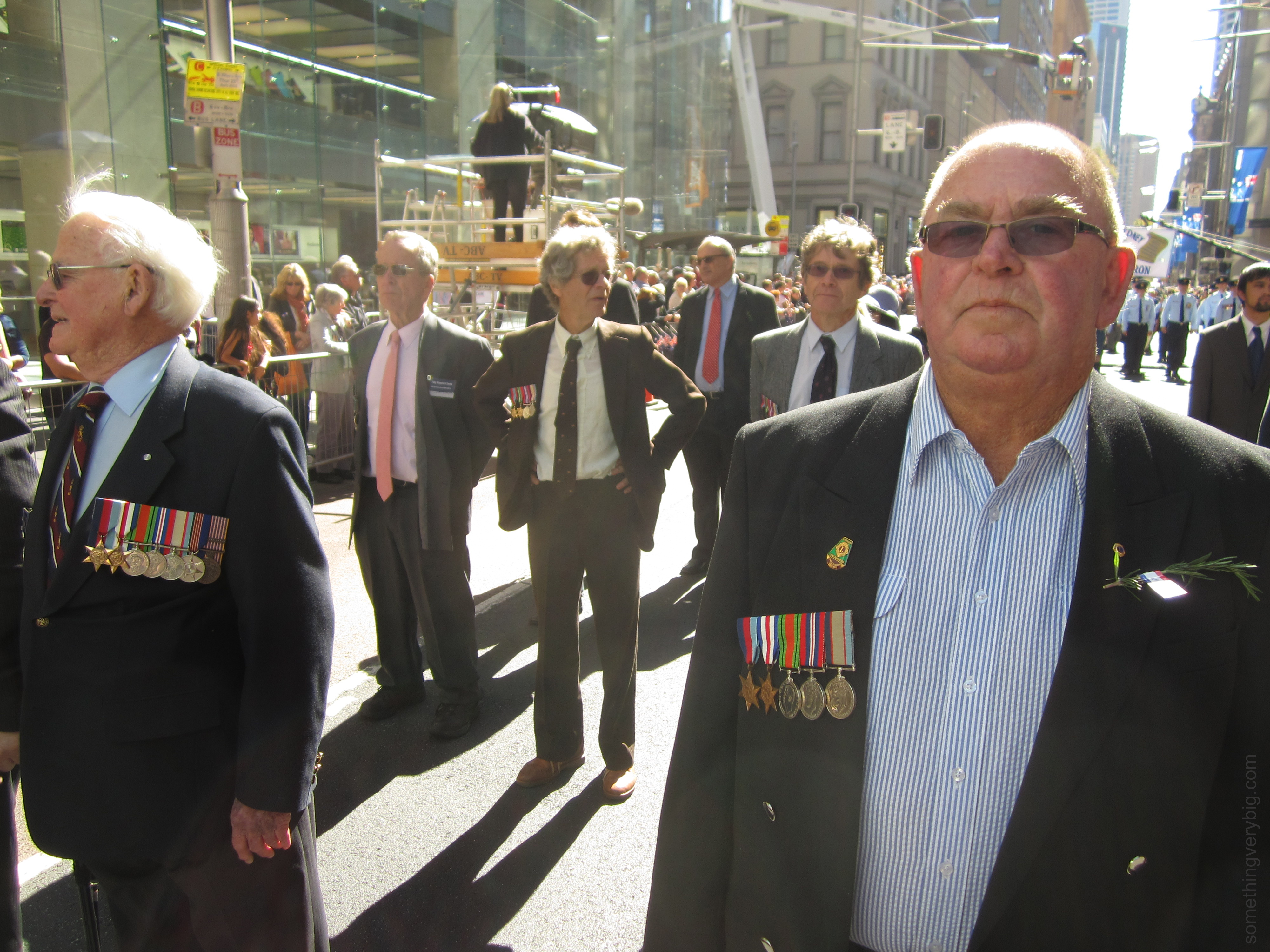
In all there were six veterans marching, with one more traveling along the march route in a truck provided by the Australian Army. They were Don Browning, Hugh McLeod, Don Huxtable, Bill Purdy, Don Southwell and George Douglass, with Harry Brown in the truck. As usual, shortly after setting off from Elizabeth St we reached King St… and stopped, again, for about forty minutes:

img_1284 copy

I placed my end of the banner in the safe hands of veteran pilot and rear gunner Hugh McLeod for a few moments, and quickly snapped a photo of an animated conversation which was taking place between Bill Purdy, David Southwell and Don Browning (who had again come prepared for the long wait with his own walking-stick-with-inbuilt-stool):

img_1285 copy

As much as we complain about the delay I’ve found in the last few years that it’s during this stop that some of the best conversation happens among those marching. And this year we were joined at this point by a group of people wearing kilts and carrying bagpipes and drums who inserted themselves into the column in front of us. They looked suspiciously like a pipe band… They turned out to be the Castle Hill RSL Pipe Band, who had already ‘done their bit’ making one round of the march course earlier in the day. But one of their members was also marching in memory of a relation with the 466-462 Squadron Association, which was the unit in front of us. So they decided to support him and ‘go round again’. All of which worked in our favour. They sounded superb, and at the end of the march I overheard Don Southwell exclaim, “That was the best march of recent years…. we were all in step!

A friend was watching the ABC Television coverage of the march and spotted us as we went past the cameras. He later sent me a photograph he had taken of his screen:

facebook_1821365055 copy

At the conclusion of the march I tried to find the band to thank them for their music but they had done like pipers generally do and taken off in a hurry to the nearest pub. Meanwhile, we headed across the road for lunch at the Pullman Hotel, the same venue as has been used in the last couple of years. Once again, the food was great, the service attentive and the conversation outstanding. I was lucky enough to find myself on a table in the company of no fewer than three of our veterans (Don Huxtable, Hugh McLeod and George Douglass). At one point, Association President Don Browning was telling a story about a raid he was on, with appropriate deadpan asides added from Don Huxtable who had been on the same trip (“I recall the weather was awful… do you remember that Don?” “Fifty-foot ceiling, mate!”). When Browning related that his bomb aimer had called for them to go around again, I heard a grim chuckle from Hugh: “I’ve experienced that too…” There were stories flying left right and centre and it was a very enjoyable afternoon. We were again joined by the young musicians of the Australian Army Cadet Band, who played a few numbers and got a certain old pilot to drum along with them:

img_1301 copy

In all, a really good day. There were lots of familiar faces to catch up with, and a few new people to talk to as well. I even met Col Edwards, whose uncle was Bob Coward, a 463 Squadron mid-upper gunner who was killed over Holland in 1944. Col first got in touch with me through the Lancaster Archive Forum and again through a comment on this blog. Bob Coward’s crew took a second dickie pilot along with them on one of their operations. The pilot? One Don Huxtable, who at yesterday’s lunch was sitting at the same table as Col, three seats along.

A few further photos from the day follow. Click on the image for full-size.

img_1288 copy

img_1289 copy

img_1292 copy

img_1299 copy

A top day, and well worth the flying visit to Sydney. I’ll be back next year.

(c) 2013 Adam Purcell

Four posts in a week! There will consequently be a short delay before I publish the next update on SomethingVeryBig. Next post is due on May 10.

Event: Bomber Command Commemoration Weekend, Canberra, 1-2 June 2013

Details have just been mailed out for people interested in attending the sixth annual Bomber Command Commemorative Day weekend in Canberra, 1-2 June 2013.

There are three parts to this weekend:

  • The Ceremony

Grass area in front of the Bomber Command Memorial, in the grounds of the Australian War Memorial

Sunday 2 June 2013

Ceremony begins 11am (please be seated by 10.50am).

Attending the Ceremony is free but if you intend to be there please RSVP to Don Southwell, details below, by 27 May.

  • The Meet & Greet Function

ANZAC Hall, Australian War Memorial (under the shadow of G for George)

6-8pm Saturday 1 June 2013

Canapes, beer, wine, soft drink all included, $50 per head.

  • The Luncheon

Rydges Lakeside Hotel, Canberra

12pm for 1pm lunch, until 4pm, Sunday 2 June 2013

Two-course sit-down lunch included – note a cash bar will be in operation on the day. $60 per head.

To book for the Meet and Greet and/or the Luncheon, please contact Don Southwell on (02) 9499 6515 or southwelldonald@gmail.com.

RSVP for the Meet and Greet and/or Luncheon closes 17 May 2013.

RSVP for the Ceremony closes 27 May 2013.

This is by far the largest gathering of Bomber Command veterans, relatives, friends, family and other interested parties in Australia and is always a good event. Highly recommended!

“Lancaster 739:” 60 Minutes, Crashes and Cover-Ups

Australian investigative journalism program 60 Minutes last night broadcast a very interesting story about a 97 Squadron navigator called Ron Conley, who went missing on a raid on the Pointe du Hoc gun emplacements, very early on D-Day morning, 6 June 1944. The report, called “Lancaster 739”, followed the story of Conley’s crew who were presumed lost at sea. The reporter, Michael Usher, suggested that there had been an official cover-up about the circumstances of the crash, and that a ‘top secret’ radar system that was on board might have had something to do with it. As always, I like to think cock-up before I think conspiracy, so on hearing this bit my ears pricked up. I thought I would do a little digging.

Conveniently, Conley’s Casualty File[1] is available to view at the National Archives of Australia website. It contains a letter written after the crew failed to return by the new 97 Squadron Officer Commanding to the RAF Air Ministry. It’s a poor-quality photostat and is rather difficult to read, but it does appear to report the circumstances of the loss of Lancaster LD739 ND739 (Edit September 2014: see comments below). There was an extra man in the crew – the eighth member being named in this letter as a Special Air Bomber. Pathfinder crews regularly had extra men on board to operate some of the special navigational equipment they carried – in this case possibly the Oboe blind-bombing aid. Ground defences were “inactive”, the letter says, but “a few fighters were known to be over the target area”. Critically, the pilot of this aircraft, W/C EJ (Jimmy) Carter, DFC, who was the 97 Squadron CO until he failed to return from this trip, had been nominated Deputy Controller for the operation and so was required to keep in radio communication with the rest of his force over the target, relaying orders from the Master Bomber who was flying a Mosquito. Carter’s voice was heard but apparently “ceased in the middle of a sentence” just after 5am and no further signals were received from the aircraft. “It is believed,” wrote the replacement CO to Conley’s father, “that an enemy fighter must have intercepted the aircraft while over the target, but although one or two of our aircraft were seen to be shot down, nothing much could be identified owing to a certain amount of cloud.”

Also in the Casualty File is a copy of an internal signal dated 22 December 1944 sent from London to the RAAF in Melbourne advising that enquiries made to the International Red Cross Committee in Geneva had failed to turn up any news of Conley or the rest of his crew. This shows that the RAAF had made efforts to trace the missing crew. But in the absence of any further word, in March 1945 they wrote to Mr Conley again advising that “it has now become necessary to consider the question whether in these circumstances an official presumption of your son’s death should be made.” I’ve seen very similar letters in the files of many of my great uncle Jack’s crew as well. In May 1945 Conley was officially presumed dead.

In 1949, the Air Force explained (and this letter was quoted in the report). “All efforts to find any trace of your son’s aircraft or to establish whether the bodies of any of the crew were ever recovered for burial have proved unsuccessful. In view of this complete lack of evidence, it is now concluded that your son and his comrades were lost at sea. It is proposed, therefore, to commemorate your son by including his name on a memorial which will be erected at a later date by the Imperial War Graves Commission, to the memory of those deceased members who have no known grave.” Ron Conley’s name, and those of the rest of his crew, are now on the Runnymede memorial in England.

So far, all of this is very much like so many other stories about Bomber Command airmen. The 60 Minutes team interviewed cousins of Ron Conley and found family of other members of the crew as well. What sets this story apart just a little, however, is that an English aviation archaeologist named Tony Graves has only recently found the remains of the aircraft – not in the English Channel as was officially presumed, but in a field on an abandoned farm in Normandy. The wreck was positively identified on the basis of a gold wedding ring engraved with the initials “A.C.” and with the words “Love Vera” on the inside. This was traced to F/L Albert Chambers, the wireless operator on the crew, whose wife was named Vera. They also showed a small fragment of a uniform with the remains of a Distinguished Flying Medal ribbon still sewn on. Three members of the crew had received that particular decoration. (In fact this was a highly experienced and decorated crew. As well as the Squadron Commander, W/C Carter, it also carried the Gunnery and Signals Leaders. Six of the eight had already been awarded DFMs or DFCs, and Conley himself would be posthumously given a DFC as well.) Though smashed into almost unrecognisable fragments from the force of the impact of the crash, what remained had been preserved remarkably well, with paper maps and charts that would have been from Conley’s nav bag recovered from the wreckage. How Graves knew that the wreck was there was not explained beyond a reference to “enough evidence and eyewitness accounts,” but congratulations are due to him for making the discovery and following the story up to the extent that he has.

The report was, I thought, going well up to this point. But then they started talking about the “new, secret” radar called “HS2” that was on this “customised” Lancaster.

Oh dear.

By the middle of 1944, H2S (note not ‘HS2’) was well-established as a ground-mapping radar system. So while it was still nominally a ‘secret’, it certainly was not a brand-new piece of equipment and was in general use by the Main Force throughout the Battle of Berlin period (November 1943 – March 1944). It’s mentioned many times in the Night Raid Reports[2] of this period, being fitted to both heavy bombers and Mosquitos. In fact, the interrogation of German nightfighter commander Josef ‘Beppo’ Schmid after the war confirmed that as early as November 1943 the Germans were using the emissions from the H2S sets to home in on the bomber stream.[3] In short, it was by no means an unusual thing to find on a Lancaster at that time, and cannot therefore be used as a reason for a potential cover-up.

Also appearing in the report was Keith Dunning, the son of P/O Guy Dunning, the flight engineer on ND739. He remembered a visit to his family, after the war, by an RAF airman who said he was on the same trip and had seen the aircraft go down over land. The RAF had, Keith said, later written to Dunning’s family to say that this had been a “mistake” and the airman had later withdrawn his testimony. This was presented in the 60 Minutes report as further evidence of a cover-up. However, as was written in the CO’s letter to Conley’s father I quoted earlier, cloud prevented the exact identification of any of the aircraft that were seen to be shot down. There is also the fact that the raid took place half an hour or so before dawn so light levels would have been low. It’s difficult to say, in the face of that, that the airman was definitively correct in his original identification of the crashing aircraft, and with no further evidence to support the theory coming to light after the event, the Air Force appears to have acted quite reasonably in discounting his report.

The logbook belonging to Guy Dunning was featured, with some pages apparently removed covering the operation on which the crew went missing. Keith Dunning said other logbooks that he has seen from the same crew showed the same pages missing. Again, 60 Minutes called this evidence of a cover-up. But the final pages would have been filled in by someone at the squadron after the crew failed to return, not by the aircrew themselves (who were dead by this stage). Jack Purcell’s logbook records the wrong aircraft for his final flight,  and squadron Operational Record Books are littered with similar clerical errors. It’s quite possible that whoever wrote the last entry in the logbooks made a mistake and decided to remove the pages and start again.

Finally, there is the fact that no bodies were found when the aircraft was excavated. No-one appears to know where the bodies are, or who might have moved them. “Eight bodies don’t vanish”, said Dunning. 60 Minutes, by now predictably, again called it a cover-up. But an understanding of RAF Missing Research and Enquiry Service methods would suggest that, more likely, the investigators simply couldn’t find anyone who could tell them what happened. Tony Graves apparently found reports by eyewitnesses to the crash but perhaps any witnesses to the burial did not survive the fairly intense fighting that occurred in the general area in the immediate aftermath of the invasion (as happened to a young Dutch girl who witnessed a Tempest crash in March 1945). There would have been considerable confusion in the area in the following weeks and months and if any records were made of the burials, they could well have simply disappeared in the fog of war. There are, according to the report, some graves marked as ‘unknown airmen’ in the local cemetery and there is of course a possibility that these hold the crew of ND739. But two 97 Squadron aircraft were lost on this raid so they could also belong to the other crew. The MRES could well have been aware of these graves and opened them up (though no MRES report appears in Conley’s A705 file), but perhaps were unable to make a positive identification of the airmen buried there. There was some talk on the program, if the required documents could be found, of identifying the men in the graves and giving names to the headstones, but as the crew are already appropriately commemorated elsewhere (at Runnymede), this is not something that the Commonwealth War Graves Commission would approve.

So most of the evidence that 60 Minutes used to decide there had been a cover-up could, and in my view probably does, have a far less sinister explanation. On the positive side, I’m happy to see some Bomber Command coverage on a high-rating television program in the lead-up to ANZAC Day. Another crash site has been identified, and, though graves have not been found, some more families now have a little more closure on what really happened to their lost airmen. It’s a fascinating story. But that’s just the point. It’s a fascinating story in its own right, and it does not need to be sensationalised.


Further information about the Conley crew can be found here:  http://www.97squadron.co.uk/Coningsby%20crew%20Carter.html

Sources:

[1] NAA: A705, 166/8/495. CONLEY, Ronald John – (Flight Lieutenant); Service Number – 425606; File type – Casualty – Repatriation; Aircraft – Lancaster LD739; Place – Cherbourg, France; Date – 6 June 1944

[2] The National Archives of the UK (TNA): Public Record Office (PRO), AIR 14/3411, B.C. (O.R.S.) Final Reports on operations, Night Raids Nos. 416-620, September 1943 to May 1944, vol. 4

[3] Isby, David C (2003) p.104: Fighting the Bombers: the Luftwaffe’s Struggle against the Allied Bomber Offensive, Greenhill Books 2003, Lionel Leventhal Limited, Park House, 1 RussellGardens, London, NM11 9NN. ISBN 1-85367-532-6

© 2013 Adam Purcell

Vale Pat Kerrins

Bomber Command attracted, and got, the best men of a generation. They were (in general) more highly educated than many of their time, they were carefully selected and they were highly trained. Many achieved great things during their time with the Air Force. A significant proportion – those who didn’t come back – never got the chance to follow that achievement up with similar success in post-war life. For some who did survive, their few short months on an operational squadron would come to define the rest of their lives. But there were also others who went to war, flew a tour of operations, returned to Australia – and, putting all thoughts of the war behind them, simply got on with life. One of those was Pat Kerrins, who died on Easter Sunday.

Pat was a Lancaster pilot. He grew up on a farm just outside the northern Victorian town of Tatura and, after leaving home, worked for the Postmaster General’s department in Melbourne and Sale. It was while he was at Sale that war broke out and, perhaps having caught the flying bug from the close proximity to the RAAF base nearby, as soon as he was old enough he joined up, first as a transport driver but eventually as a trainee pilot.

Pat trained in Australia and was selected as a fighter pilot. He travelled via the US to England, but on arrival found a long wait to get onto a fighter squadron. Bomber pilots, on the other hand, were needed immediately – so he swapped over, and would eventually fly 32 operations with 115 Squadron. He ended the war as a Flying Officer.

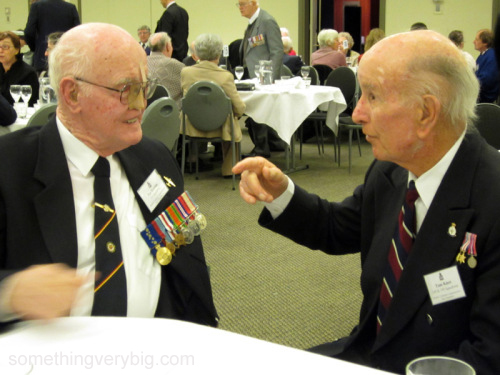
I first met Pat at the Bomber Command Commemorative Day weekend in Canberra  in June 2011. He was engaged at the time in a lively conversation with another veteran (Tommy Knox, a 149 Squadron Stirling flight engineer) about a mutual acquaintance both had known during the war, and I took a photo of them both in the midst of it:

11jun-bombercommandcanberra-067s copy

I sent Pat a copy of this photo (he’s on the left), and after exchanging a few letters I even drove up to Tatura to visit him for lunch one day. We pored over his logbook and a few photos and he shared a story or two of his service. It turned out that, along with his mid-upper gunner Nobby Clarke, he had been interviewed by writer and broadcaster Michael Veitch for a book called Fly, published in 2008. It’s worth quoting a passage from this book (p.83) which I think reveals much about Pat’s character and cheeky sense of humour:

“You’re writing a story about us old blokes, are you?’ asked Pat. ‘Why didn’t you get onto us fifty years ago when we could remember something?’

‘Sorry about that, Pat,’ I replied. ‘So when did you join up?’

’26 June 1942,’ he rattled off in a flash. Somehow I didn’t think his memory would present too much of a problem.

I think it was Pat’s favourite self-deprecating joke; he asked me the same thing the day that I visited him!

But talking about his wartime experiences was only a fairly recent development. After the war, Pat never flew an aeroplane again. He returned to Tatura and settled down on the family farm. He raised a family (eventually becoming a grandfather and then a ‘2-Pa’), played an important role in the developing Tatura dairy industry and was generally involved in the life of the town, volunteering with groups like Legacy, the local AFL club and horseracing club. He was awarded the Order of Australia Medal in 2001 for his services to the local community. Pat was such a legend in and around Tatura that about one thousand people attended his funeral there last week, and a large crowd of those who couldn’t fit inside the church spilled over into the driveway outside. He had been baptised and married in the same church.

I spotted perhaps my most favourite tribute to a real character of the local area as I was driving out of Tatura after the funeral on Saturday. Pat had a lifelong love of horses and was heavily involved in the Tatura horseracing club, officiating as a steward for many years at race meetings. I happened to glance to my left as I was passing the racecourse, just in time to flash past a sign proudly proclaiming the name of a large expanse of dirt. It was, the sign said, the Pat Kerrins Carpark.

I only knew Pat because he was a Bomber Command veteran. But while his two or three years in the Air Force were an important part of his life, they did not come to define it, and arguably his greatest successes came after he returned to Australia. His impish grin and cheeky sense of humour will be much missed.

© 2013 Adam Purcell

Halam Lancaster

There was an article published in the Sydney Morning Herald in April 2011, about a couple of Australian aircrew who had been killed when their Lancaster crashed while on a training flight. It was 10 April 1943, and the crew was on their last exercise at 1661 Heavy Conversion Unit, Winthorpe, before being posted to an operational squadron. Shortly after take-off the aircraft crashed in the small village of Halam, eight miles from the aerodrome and aligned with the runway they had departed from.

Sixty nine years later to the day, a memorial was unveiled in Halam commemorating the seven men who died in the crash. It was the culmination of some years of work by a local man named Andrew Paris who has now researched the story of the crew and how they came to be on that aircraft.

Jack Purcell was posted to RAF Winthorpe between September and November 1943 and I visited the excellent Newark Air Museum that now occupies a corner of the old airfield while visiting the UK in 2009. But that wasn’t why the story in the Herald set some faint bells of recognition chiming in my mind. As part of his research Andrew had been looking for information on what the crew might have been up to during their time at 1661 HCU. I got in touch with him through the Lancaster Archive Forum and was able to share an extract of Jack’s logbook covering the time he had been at the unit. While only a very small piece of the overall story, every little bit helps towards developing an understanding of ‘what they were doing there’.

It’s another good demonstration, I think, of how the Internet has revolutionised historical research. The reach of the web is world-wide, and it’s made finding this information much easier because it’s now a simple matter to find someone on the other side of the world who might have the information that you seek. And it’s then made it very easy to share the results of your work with a much greater audience than in the past.

(c) 2013 Adam Purcell

Event: ANZAC Day 2013,with 463-467 Squadrons Association NSW, Sydney

Arrangements for commemorating ANZAC Day on April 25 with the 463-467 Squadrons Association in Sydney remain much the same as usual.
The Association will assemble for the march at the corner of Elizabeth and King Streets in the Sydney CBD. The Banner should be in place from 1015.

Following the march, a lunch will be held in the Parkview Room of the Pullman Hotel, from about 1230 or 1300. Note this is the same venue as last year but the hotel has had a name change – it was formerly the Sydney Marriott, Hyde Park. Cost for the lunch is $55pp.
All are welcome. To book, email Association Secretary David Southwell at davidrfs@icloud.com.

I’m flying up from Melbourne for the day, and will be carrying one end of the Banner during the march. Looking forward to it.

Remembering Scredington

In June 1943, a seven year old lad named Neil Trotter was in the playground at school in a tiny English village called Scredington when he saw a big black bomber flying very low overhead. After walking home that afternoon, he was told by his mother that the aircraft had crashed in the fields behind the house (about two miles from the school). Neil later learnt that his mother had approached the aircraft intending to render what assistance she could, but because of exploding ammunition was unable to get anywhere near the wreck. All on board perished in the crash.

The aircraft was Lancaster I ED439, of 83 Squadron. It had taken off from Wyton at around 11.00am on 18 June 1943 with a crew of seven, plus two passengers believed to have been wireless technicians:

Pilot: AUS409804 F/Sgt M.K. Cummings

Flight Engineer: AUS6756 Sgt H.W. Luker

Navigator: 537936 Sgt F.W. Wilcox

Bomb Aimer: 1431821 Sgt J. Roughley

Wireless Operator: 1396788 Sgt Cheshire

Mid Upper Gunner: 1588938 Sgt N. Woodcock

Rear Gunner: Can. R113958 Sgt R. Taylor

Passengers: 1024724 Cpl Bond and 1544915 Cpl. Sloss

The ‘Report on Flying Accident or Forced Landing Not Attributable to Enemy Action’ in Max Cummings’ casualty file at the National Archives of Australia shows that the aircraft was on a practice bombing flight “but did not carry out [its] detail”. It was seen to dive out of cloud near Highgate Farm, Scredington, about 45 minutes after take-off. The aircraft burnt on impact. While the Commanding Officer, 83 Squadron, recommended a Court of Enquiry be held as “this was a fully capable crew”, he appears to have been overruled by the Station Commander, RAF Wyton, Group Captain H.R. Graham, who wrote that “pending [the] report of Accident Investigation branch, I doubt that any useful purpose can be gained by holding [a] Court of Enquiry”. A report by the Engineer Officer, 83 Squadron, written after examination of the accident scene, states that “the starboard wing hit a farm building, and demolished one end wall, the fuselage and probably undercarriage nacelle tore off the roof of an unoccupied house close to the Barn.” The aircraft was identified by means of a number plate attached to one of the four engines. Because of the lack of a formal Court of Enquiry, the exact cause of the crash remains unknown to this day.

The idea to properly commemorate the men who died in this crash has been percolating around in Neil Trotter’s mind for some years and, now he’s retired after a long career in the post-war RAF, he’s had the time to do something about it. With the assistance of the RAF Association (Lincolnshire Branch), he has been working on organising for an appropriate memorial plaque to be placed in the village church in memory of the crew. He has managed to contact the families of six of the nine men who were on board the Lancaster when it crashed, and representatives of some of these families will be attending the unveiling ceremony in June this year. Other parties involved in the ceremony will be a large crowd of Scredington villagers, the Mayor of the local area, a considerable current RAF presence from the stations at Waddington, Coningsby and Wyton, and the local Air Training Corps, who will become custodians of the memorial after the ceremony. All in all, it’s a significant undertaking and it all comes, primarily, from Neil Trotter’s desire to find out more about that fleeting childhood glimpse of a Lancaster.

Ultimately stories like these are about the airmen themselves. They deserve to be remembered, and it’s heartening to see the work that people like Neil have done in the UK to ensure the stories live on.


© 2013 Adam Purcell


Sources:

Emails between Neil Trotter, Ian Milnes, Bill Hauxwell, Gerrit Kuijper and myself, November 2012- March 2013

Research into P/O Max Cummings, carried out by Victor Harbour RSL Sub Branch, South Australia

NAA: A705, 166/8/141; CUMMINGS, Max Keiran – (Pilot Officer); Service Number – 408904; File type – Casualty – Repatriation; Aircraft – Lancaster ED 439; Place – Lincolnshire; Date – 18 June 1943

I became involved in this story through a very small part that I played in the search for the family of P/O Cummings.

The Scroll of Honour

A few weeks ago I took some days off work and my girlfriend and I drove a rented campervan up to Echuca, on the Murray River which borders New South Wales and Victoria. While exploring the surrounding area we stopped at a small winery in neighbouring Moama (on the NSW side of the river) to escape the stinking heat of the day. The winery also happened to have attached to it a small military museum, so we went in to have a look.

In the museum – which, alas, was not air-conditioned – was a quite remarkable gathering of old vehicles on the ground floor, some restored and some not so restored. Upstairs, arranged in a collection of dusty display cabinets, were uniforms, rifles, medals, badges and other assorted items of militaria. What caught my eye was this:

12nov-britzingthemurray-023 copy

It is a scroll as presented to the families of Australian servicemen who died as a result of their military service in World War II. A similar scroll hangs on a wall at my parents’ place, bearing the name of my grandfather’s uncle, RW Purcell. The scroll in Moama commemorates one Flight Sergeant I H Smead – but apart from the name on the scroll itself, there were no details on who he might have been or what might have happened to him. I thought it looked quite sad sitting there all but forgotten in a display case in a roasting tin shed next to the Murray River, so I decided to see what I could find out about him when I got home.

The first place to look, as with any Australian casualty from either of the World Wars, was the Commonwealth War Graves website. This gave me a few further details to work with:

SMEAD, IRWIN HAROLD

Rank: Flight Sergeant

Service No: 419228

Date of Death: 21/04/1944

Age: 20

Regiment/Service: Royal Australian Air Force

Grave Reference Plot A. Row D. Grave 14.

Cemetery BUNDABERG GENERAL CEMETERY

I now had a name, service number and date of death – and, most interestingly, information that he is buried in Bundaberg, Queensland. Bundaberg was the site of No. 8 Service Flying Training School at that time. Being a training unit, this suggested an accident rather than enemy action.

Going out on a limb, I tried a quick Google search – and came up with Peter Dunn’s Oz At War website which revealed what happened. Irwin Smead was a navigator. He was flying in a Bristol Beaufort on a formation flying exercise on 21 April 1944 when it collided with another Beaufort of the same formation about 15 miles west of Bundaberg. All eight airmen – four in each aircraft – were killed.

I also found a copy of the “Preliminary Report Internal External of Flying Accident or Forced Landing” for this accident in the Casualty or Repatriation File of F/Sgt Hardy, the pilot of the other aircraft*, which is digitised at the National Archives of Australia website (A705, 166/17/544). It gives the probable cause of the collision as ‘UNKNOWN’.

It’s not much, but finding even this small amount of information adds that little bit more to Irwin Smead’s story. It reminds us that he was more than just a name on a page.

*Interestingly there appears to be a disagreement between this source and Peter Dunn’s information about which aircraft were involved in this accident. Both agree on Hardy’s aircraft, A9-476 – but the NAA file shows Smead’s as A9-426. This shows the value of going back to the original documents wherever possible!  

This will be the last post on SomethingVeryBig for 2012. Thanks to all for your support and comments throughout the year. Have a great Christmas, and I’ll be back in mid-January.

© 2012 Adam Purcell

Book Review: Bomber Command – Australians in World War II


In June the Australian Government’s Department of Veterans’ Affairs released a book called Bomber Command: Australians in World War II. Launched at the Australian War Memorial in the presence of three Bomber Command veterans, it’s DVA’s second book in a series looking at Australians and their experiences in World War II (the first looked at Greece and Crete). Dr Richard Reid, of the Department’s Commemorations Branch, was the author (though interestingly he is not credited on the front cover). A couple of weeks after the launch DVA gave a copy of the book to each of the Australian veterans who went to London for the opening of the Bomber Command memorial.

The first half of the book contains an overview of Australia’s role in Bomber Command. Starting with a description of a raid over Berlin, it goes on to cover in some detail the typical path followed by many aircrew, from enlistment to training and right through to their operational squadrons. Reid makes good use of the Australians at War Film Archive (another DVA project in which he was involved) among other resources, to build a picture of ‘what it was like’, with a focus on individual Australian airmen. Unfortunately, though a well-respected and experienced military historian, Reid is not a Bomber Command specialist, and in places it shows. For example, on p. 150 he mistakenly calls the Avro Manchester the “prototype” of the Lancaster. While the Lanc was indeed a development of the Manchester, the final product was an entirely different aircraft – ergo, not a prototype. There are also some editing errors (which I admit may not be the historian’s fault): throughout the text, altitudes are converted to metres, an annoying move that betrays a fundamental misunderstanding of technical terminology (in the Western world altitudes are and have always been measured in feet, regardless of whether the country uses metric measurements elsewhere). And, unforgivably, the airfield from which the Dambusters took off on the Dams raid is misspelt as ‘Scrampton’ and, on at least two occasions, the name of Britain’s first four-engined heavy bomber is misspelt as ‘Sterling’. Though minor errors in isolation, they all add up to an overall impression of a certain amount of ‘slapdashery’.

But then you reach the imagery. The entire second half of the book is taken up by a rather impressive collection of photos and other artwork, mostly taken from the Australian War Memorial’s collections. And this part of the book is very good. There are the obligatory photos that everyone has seen before (like the one of S-Sugar being bombed up at Waddington) but there are also many that are more unusual. They cover the entire journey through Bomber Command: enlistment, training, operations and homecoming (or, for those less fortunate, burial and remembrance). It’s a good collection, reproduced in high quality and with informative and comprehensive captions.

According to the press release that accompanied the launch, the book is “an invaluable resource, helping Australians learn about the important history of Bomber Command, including stories of those who served and died”. I’d agree with almost all of that. It will certainly make many of the stories of Bomber Command more accessible to Australians in the future – and in that sense, the Department have achieved something worthwhile – but it can only be an ‘invaluable resource’ if its facts are correct. Being a Government publication, it can be seen as an official record of what happened, and therefore it needs to be done right. Their hearts were in the right place, but unfortunately it would appear that those who produced this book settled for merely ‘close enough for government work’.

Bomber Command: Australians in World War II – which is, if you can look past its problems, still worth a look simply because of the images – is available from the Australian War Memorial Online Shop


(c) 2012 Adam Purcell


Sam Alexander

In September 1916, Private Sam Alexander, of the 9th Brigade, 34th Battalion, 3rd Division, Australian Imperial Force, began writing in a diary. Over the next three years or so he would scrawl a few lines on most days about his experiences as a soldier on the Western Front.

Two decades later, as the world was plunging into yet another global conflict, a young neighbour called Kevin Jeffcoat sat spellbound as Sam showed him spiked helmets, medals, gas masks and guns, amazing him with stories of the trenches. “It was awful, it was terrible”, Sam told him. “But it was a grand adventure!”

Kevin would eventually become a professional author, writing books like More precious than gold: An illustrated history of water in New South Wales and Burrinjuck to Balranald: The Early Days. But he also wrote an unpublished manuscript based on his memories of conversations with his childhood neighbour. Called From Kangaroo Valley to Messines Ridge: A Digger’s Diary 1917-1918, it’s a remarkable mix of transcripts of Sam Alexander’s diary entries, with context added by explanatory notes based on research and on Kevin’s own memories.

My parents live in the NSW Southern Tablelands town of Goulburn, where my father is the Principal at one of the two state high schools in the town. Dad transferred to Mulwaree High School almost two years ago, though it took a year before he and my mother moved there. When we visited them a few days after they moved into their new house at Christmas last year, Dad managed to find a little time to show me one of Mulwaree’s hidden secrets. In an unassuming little cinder block building near the school’s main entrance is the Mulwaree High School Remembrance Library.

12apr-firstquarter2012-001-e1347075108685 copy

Started in 1992, it’s a collection of some 4,000 artefacts, photos and documents relating to local men at war, dating from Vietnam all the way back to the New Zealand-Maori War of the mid-nineteenth century. The Australian War Memorial has described it as perhaps the best collection, outside its own, of war memorabilia in Australia.

Kevin Jeffcoat’s granddaughter is a student at Mulwarree. And in August 2012 she donated to the Remembrance Library a signed copy of her grandfather’s manuscript. It is beautifully written and a fantastic resource for the school. Kevin Jeffcoat has put Sam Alexander’s story into an easily understood form and so has ensured that those stories that he was lucky enough to hear ‘from the horse’s mouth’, so to speak, will remain accessible to new generations into the future.

© 2012 Adam Purcell