467 Postblog LXb: Thursday 20 April, 1944

The second wave of bombers arrived at La Chapelle having flown 60 miles south-east from Cabourg, turned east for a further sixty miles and then headed north east for the final leg towards the target, which was situated less than five miles north of the centre of Paris. There was no cloud but much smoke and some fires in the area caused by the earlier attack.

While very few fighters had been seen on the way out, the French capital was a defended city and flak, both heavy and light, was fierce on the run-up to the target. This was not entirely surprising considering that their route took the bombers directly over the centre of Paris and passed within a couple of miles of the Eiffel Tower. The intensity died off somewhat closer to the aiming point itself but it still packed a fair punch. Pilot Officer David Gibbs called it the “hottest flak experienced yet.” Flight Lieutenant Fred Smith saw two aircraft get hit and go down over or near the target. Flight Lieutenant Jim Marshall’s navigator, Flying Officer Arnold Easton, saw an aircraft shot down over the target and his bomb aimer, Flight Sergeant Jack Bormann, had a lucky escape when a piece of flak went through the nose of their aircraft.[1] But Pilot Officer Noel McDonald’s crew endured one of the more ‘exciting’ experiences over the target on this operation. Their first bombing run was “unsatisfactory” so they made a tight right-hand circuit to come around for a second try. This time however the run was upset by a flak burst just as the red spot fires marking the aiming point were reached. They went round again for a third attempt – but just when they were about to bomb they “were attacked by [a] JU.88. Defensive manoeuvre again spoiled bombing run.” Shaken by the experience, they decided they had tempted fate enough and turned for home with their bombs still on board.

As happened during the first wave, the spot fires fell directly on the aiming point. One or two fell wide but it appears that the Master Bomber was effective and no bombs were seen to go down there. The bombing, in turn, was accurate, leading to problems for later crews (notably that of Flying Officer Bruce Buckham, at 01.50 the last Waddington aircraft to bomb) when smoke and fires obscured or even obliterated the markers. On French railway targets, where accuracy was so important not only for the effectiveness of the attack but also to reduce casualties among the civilian population, this was becoming a common problem, and if the Transportation Plan was to produce the results required of it a solution would need to be found.

The bombers set off on the homeward journey leaving more smoke, fires and the occasional large explosion in their wake. Later photo reconnaissance revealed that the damage caused to the marshalling yards was significant. The Night Raid Report states that the southern part of the yards suffered the most. This was, of course, the target for the first wave, who did not have existing smoke or fires to contend with when they arrived at the target as the second wave did. Tracks, rolling stock, installations and industrial plants and buildings were all heavily damaged.

Six Lancasters failed to return from the La Chapelle raid. Four were missing from the first wave and two from the second. Sadly for 467 Squadron, among the latter was the crew of Pilot Officer Ken Feeney and crew, flying in ND732. They were hit by flak and crashed about six miles east of the target, and all on board were killed.[2]

The standard ‘tour of operations’ for Main Force Bomber Command squadrons was thirty trips, or the equivalent thereof.[3] Any operation into German territory counted as a full raid, but flights to France (such as the La Chapelle raid) or other targets in occupied Western Europe were seen as somewhat ‘easier’ in comparison and as such only counted for one-third of an operational sortie for the purposes of administering the length of an airman’s tour. On operations such as Tours or Juvisy the bombers had hardly been troubled by any defences (and correspondingly had suffered just a single loss on each raid) so it could be argued that this was fair enough. Certainly the effort, tension and danger faced on trips of this nature was far less than what crews needed to contend with on, for example, the Nuremberg raid or on any Berlin trip. But with the increasing frequency of shorter flights into France in preparation for the coming invasion – which, though the crews did not know it was by this point less than seven weeks away – defences on French targets were heating up, and the 463 and 467 Squadron crews were starting to think they were getting a rough deal. The Operational Record Books for the La Chapelle raid are full of thinly-veiled ‘suggestions’ that, despite the shorter length of time spent getting there and back, railway targets were beginning to rival German cities for ferocity of defences:

Don’t mind going to WAINFLEET for 1/3rd of a trip, but this target was a bit too warm. – Flight Lieutenant Jim Marshall, referring to a practice bombing range

As these present Targets are as vitally important as previous GERMAN Targets, suggest they be counted as a WHOLE trip and not as a THIRD. – Flight Lieutenant Alexander Vowels

SHOULD BE WORTH MORE THAN ONE-THIRD. – Squadron Leader Bill Brill

There are more entries expressing similar sentiments. Most eloquent out of the Waddington crews, though, is that from Pilot Officer Harold Coulson. He had seen a couple of aircraft go down during this trip, most likely including Ken Feeney’s. “They did not have three chances,” he said. “There is no question of their going for a third of a burton.”

The airmen would, as it turned out, get their wish. But it would not be applied entirely retrospectively and it would take a disaster before the authorities took any notice.

This post is part of a series called 467 Postblog, posted in real time to mark the 70th anniversary of the crew of B for Baker while they were on operational service with 467 Squadron at RAF Waddington, Lincolnshire. See this link for an in-depth explanation of the series, and this one for full citations of sources used throughout it. © 2014 Adam Purcell

Sources:


[1] Easton, Arnold, Flying Logbook

[2] Storr, Alan 2006. 467 Squadron p. 63

[3] Middlebrook, Martin 1973, p.52

467 Postblog LXa: Thursday 20 April, 1944

The Waddington crews were back on operations tonight.

The aircrew busied themselves with preparing for the night’s operation and some also managed to fit in some training. Flight Lieutenant Jim Marshall and his crew in DV372 ‘Old Fred’ took their aircraft for a quick trip to the Wainfleet bombing range for some high-level bombing practice. They were able to get up to 10,000 feet but all their bombs overshot the target, due to an apparent fault in the bomb sight.[1] The fault was repaired in time for the evening’s raid, however.

Also at the training range was Squadron Leader Phil Smith and the entire crew of B for Baker. Because of low cloud they were restricted to dropping their practice munitions from 2,500 feet before returning to Waddington. However, Gilbert Pate would be the only member of Phil Smith’s crew to operate tonight, flying in the rear turret of LL792 with Pilot Officer Bill Mackay at the controls. It would be the first of three extra trips Pate would complete in April. The rest of the crew had the night off, and their aircraft was taken by another crew flown by Pilot Officer Doug Hislop. B for Baker’s usual wireless operator Flight Sergeant Dale Johnston used the time off to write a long letter home[2] to his twin brother Ian. In it he described his aircraft, and told of his crew and the nicknames some of them went by:

She is the latest thing in kites, four Merlin 28s and boy she behaves well over the other side. We took her from the hangar for her first trip. The skipper the boss of ‘A’ Flight liked her so much he decided to let another crew keep our old kite, and we kept this one. […] The Skipper is a grand guy, Ian, a Squadron Leader at 26, Smith by name but [he] gets Smithy from us all. I get Rex, Pepper, Johno, some of the others I won’t mention.

The target for those who did go out tonight was another railway marshalling yard, this time at La Chapelle in the north of Paris. Nineteen aircraft from each Waddington squadron joined a total force of 269 Lancasters and Mosquitos on the raid which was to be split into two parts, timed to be an hour apart. They were to attack two distinct aiming points, the first in the southern part of the yards and the other in the north. The Waddington crews were all part of the second wave.

Other railway targets in the firing line for tonight were Ottignes (near Brussels, attacked by 196 aircraft), Lens (175 aircraft) and Chambly (14 Stirlings). The largest force of the night was made up of 379 Lancasters and Mosquitos which attacked Cologne. Elsewhere, Mosquitos attacked Berlin, carried out intruder patrols and harassed airfields in France, Holland, Belgium and western Germany. 30 Stirlings and Halifaxes dropped mines off the French ports and Wellingtons scattered leaflets.[3] In all some 1,155 sorties were flown by Bomber Command on this night, it being hoped that so many bomber streams flying in so many different directions would confuse the German fighter controllers.

The bombers began taking off shortly before 11pm. They flew south via Reading to leave the English coast via their usual point at Selsey Bill. One 463 Squadron crew suffered a generator failure at take-off. They pressed on to Northampton (about 70 miles down the track) but when a smell of hot wiring developed and both accumulators became too hot to touch, Pilot Officer Keith Schultz turned ME611 around and returned to Waddington.

An hour ahead of the Waddington crews, the first wave of the attack were beginning the raid on the southernmost of the two aiming points at La Chapelle.

Both waves would use the same general tactics. A small force of Mosquitos from No. 8 Group opened each attack by dropping cascading green target indicators by Oboe to guide the following bombers to the approximate area. Over the next three minutes No 5 Group Lancasters would drop illuminating flares, by the light of which Mosquitos from 617 Squadron were to sweep in at low level to visually identity the aiming point and  mark it with red spot fires. A Master Bomber would then assess the accuracy of the spot fires, remarking himself if necessary, and would then direct the main attack. The Oboe Mosquitos of the first wave were a fraction late and communications between the marking and controlling aircraft were not entirely effective but the markers, when they were dropped, were accurate and the bombing that developed was concentrated.[4] Three aircraft of the first wave were shot down over Paris (one to a fighter, one to flak and one to an unknown cause) and one was lost to a fighter on the homeward leg near Beauvais.

Meanwhile the second wave of the force crossed the enemy coast near Cabourg. They lost one of their number to a fighter near Bernay, 35 miles inside the coast, and another of the Waddington contingent returned early. This time it was the aircraft commanded by Base Operations Commander Wing Commander JB ‘Willie’ Tait, who despite holding a non-flying desk job still regularly flew operations with Waddington crews. He had borrowed the crew of Pilot Officer Tom Davis from 467 Squadron and Lancaster LM438 from 463 Squadron for this trip but, with an unserviceable airspeed indicator he felt that he would be “unable to perform the bombing operation successfully”.[5] Halfway between the French coast and the target they turned around, jettisoning their bombs off the coast near Le Havre. They would not be credited with an ‘op’ for this trip despite having flown most of it, perhaps doing so to set an example for the rest of the crews. One wonders how Davis felt about that decision. In all nine aircraft ‘boomeranged’ from both waves.


Next: The second wave reaches the target…

This post is part of a series called 467 Postblog, posted in real time to mark the 70th anniversary of the crew of B for Baker while they were on operational service with 467 Squadron at RAF Waddington, Lincolnshire. See this link for an in-depth explanation of the series, and this one for full citations of sources used throughout it. © 2014 Adam Purcell

Sources:


[1] Easton, Arnold – Flying Log Book

[2] Johnston, Dale, Letter to brother Ian, 20APR44. Transcript in Mollie Smith’s collection.

[3] Details of tonight’s other operations from RAF Bomber Command Campaign Diary, April 1944, and Night Raid Report No. 582.

[4] Tactics and first wave results from Night Raid Report N. 582 and RAF Bomber Command Campaign Diary, April 1944

[5] 463 Squadron Operational Record Book, 20APR44

467 Postblog LVIII: Tuesday 18 April, 1944

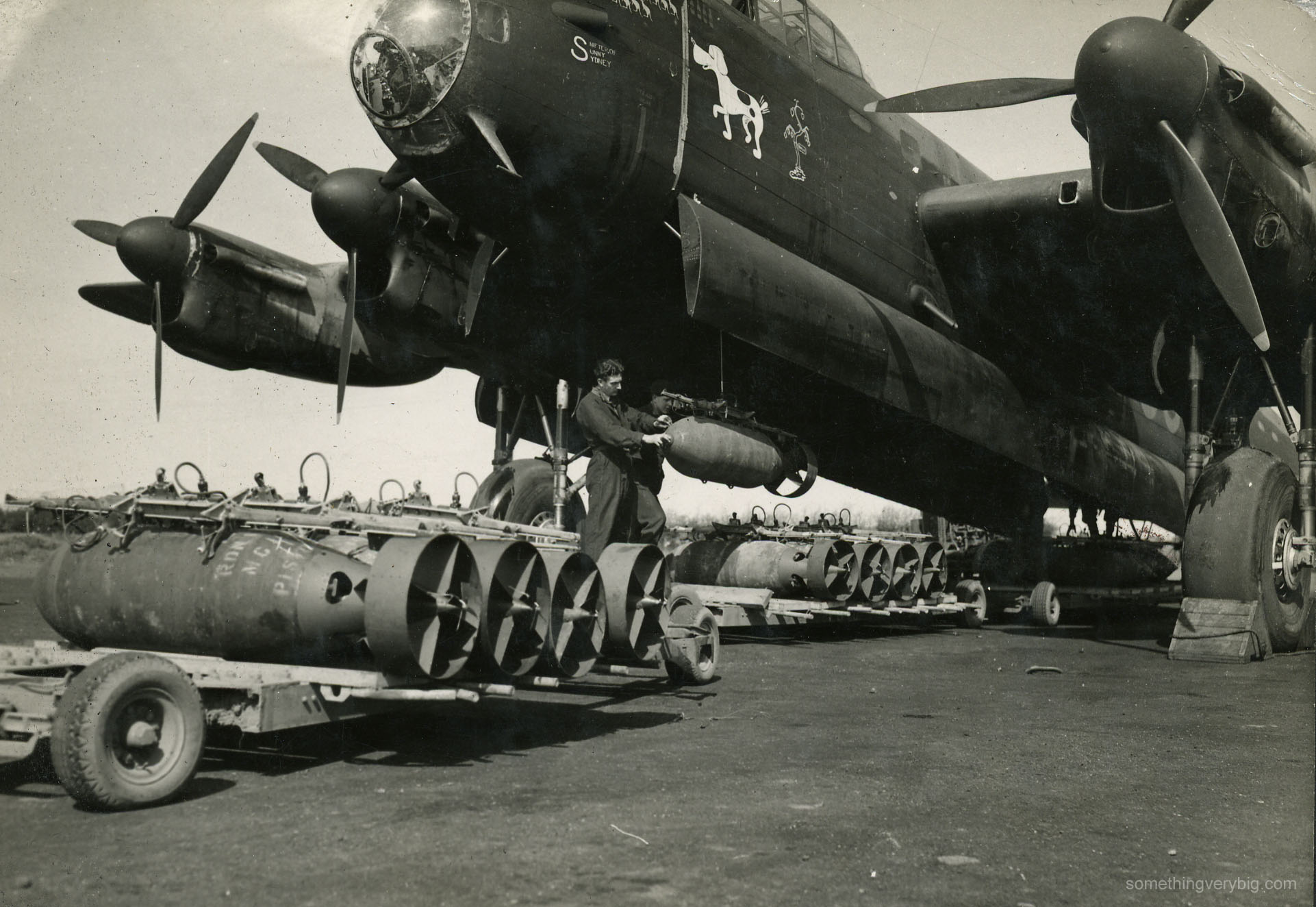
A full week after the Aachen operation, and after two planned trips had been scrubbed at short notice, Waddington was finally back at war tonight. Preparations were made under an almost cloudless blue sky as the crews worked towards their 20.30 take-off time.

Bombing up DV280, JO-S "Snifty from Sunny Sidney" for Juvisy, 18 April 1944. Photo from the Waddington Collection, RAF Waddington Heritage Centre
Bombing up DV280, JO-S “Snifty from Sunny Sidney” for Juvisy, 18 April 1944. Photo from the Waddington Collection, RAF Waddington Heritage Centre

The target for tonight was the railway marshalling yards at Juvisy, about ten miles south of the centre of Paris. This would be one of four attacks on railway targets on this night, all part of the Transportation Plan. The other targets were at Rouen, 40 miles east of Le Havre, which was bombed by 273 Lancasters and 16 Mosquitos, Noisy-le-Sec north east of Paris attacked by 181 aircraft, and Tergnier, south of St Quentin and attacked by 171 bombers.[1] Other Bomber Command operations on this night included 168 heavies laying mines in Swinemünde, Mosquitos attacking Berlin, Osnabrück and Le Mans and assorted Radio Counter-Measure, Serrate and training sorties.

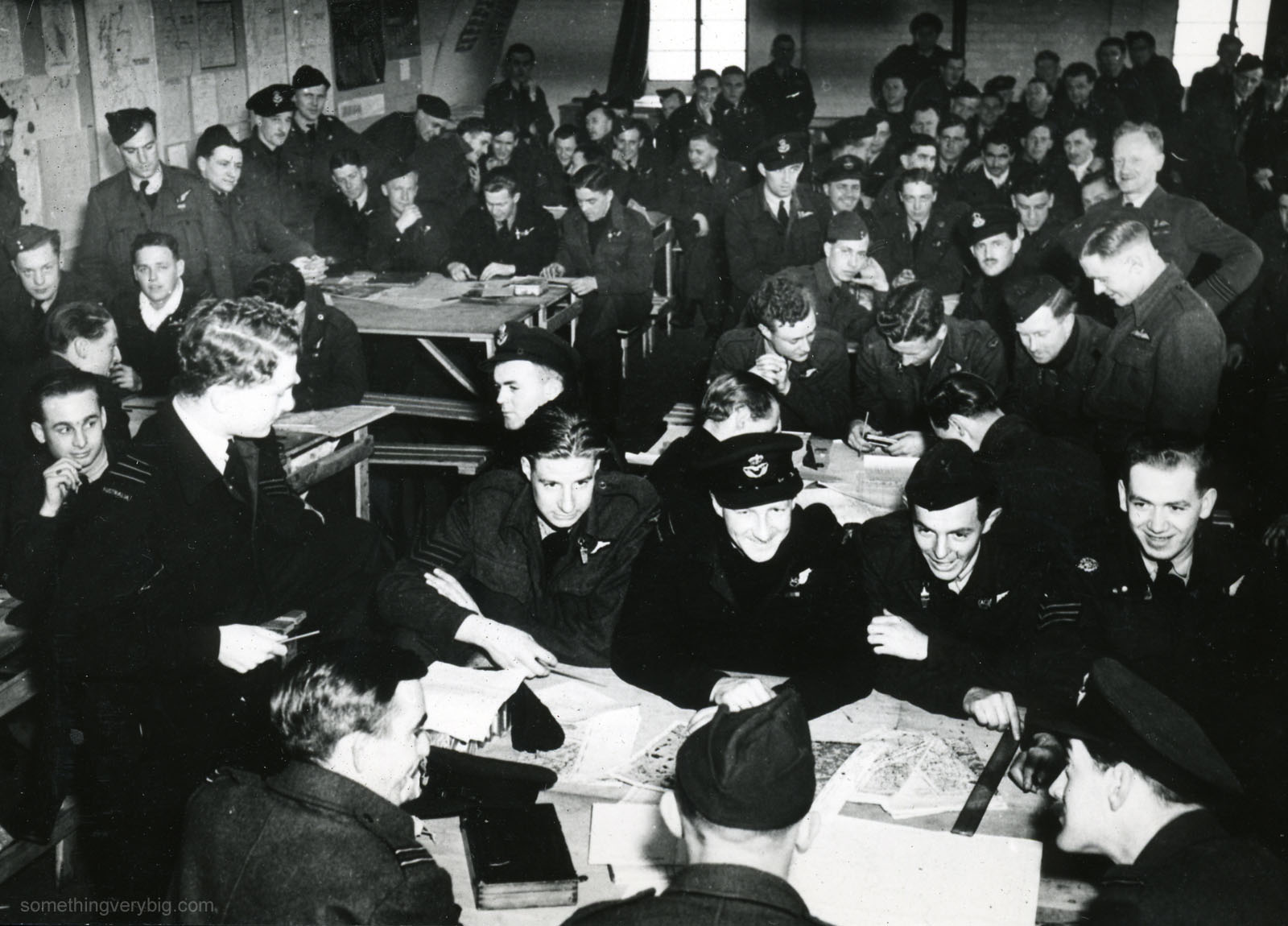
463 Squadron crews in the briefing hut before the raid on 18 April 1944. From the Waddington Collection, RAF Waddington Heritage Centre
463 Squadron crews in the briefing hut before the Juvisy raid on 18 April 1944. From the Waddington Collection, RAF Waddington Heritage Centre

More than 200 aircraft were sent to Juvisy, including seven Mosquitos. Waddington’s contribution was 37 Lancasters: 17 from 463 Squadron and 20 from 467. All got away though not without some excitement. The 467 Squadron Operational Record Book shows that one aircraft, ND732 being flown by Pilot Officer Ken Feeney, swung off the runway on its first take-off roll, but after taxiing back to the start of the runway for another go Feeney took off successfully. Pilot Officer Bill Felstead lost brake pressure in ED657 at the critical moment and also took to the grass. The fault was easily rectified and they were eventually on their way only a few minutes behind the rest of the bombers.

As they had not been on the Tours operation a little over a week ago, this was the first time that the crew of B for Baker took part in a Transportation Plan ‘pre-invasion’ raid. Joining them as second pilot in LM475 was Waddington’s new Station Commander, Group Captain David Bonham-Carter. “He was, in my view, quite an elderly chap,” wrote Phil later. “I would put him between 40 and 50 and not ‘fit full flying duties”.[2]

The bomber stream flew across the Channel via Selsey Bill and tracked between Caen and Le Havre to a point near Argentan. There they turned south east and flew nearly 80 miles to a point south of Chartres. They then turned north east.

It was at the final turning point before the target that Phil Smith committed what he later called “one of the classical flying errors:”

We approached the target flying about east until we were just south of Paris. We then had to make a sharp turn left for a very short leg up to the target. The course was to be 009, however the target markers did not turn up almost immediately, as expected. It quickly became clear that we were on a course of 090 instead of 009.

Once he recognised the error he was able to make a quick course correction and they bombed only a few minutes late, but Phil was quite embarrassed to have made such an elementary mistake in front of the new station commander.

The attack was to use tactics which by this stage of the war were becoming routine for Transportation Plan raids. It would open with three 8 Group Mosquitos dropping green target indicators as ‘proximity markers’ in the general target area. Guided by those markers, other aircraft would drop ‘hooded’ parachute flares to light up the target area. By the light of those flares, Mosquitos would mark the two aiming points with red spot fires. The Master Bomber, also in a Mosquito, was to assess the fall of the markers and instruct the Main Force to bomb accordingly. One aircraft – the Controller – was to act as a relay between the Master Bomber and the Main Force.[3] Bombing was to be from a much lower level than that used on German targets – the heights recorded in the 463-467 Squadron Operational Record Books vary between 7,000 and 11,000 feet.

It appears that the first ‘proximity markers’ were dropped some seven miles west of the aiming point, but “before anyone bombed more flares were dropped over [the] marshalling yard and red spot fires followed.”[4] The illuminating flares went down at zero hour (23.15) and there ensued a delay of about fifteen minutes while the target was marked and the markers assessed. The orbiting caused some dramas for a few skippers because of the sheer number of aeroplanes and lack of a defined plan. “Definite position should be given when a/c [aircraft] have to orbit target,” said Pilot Officer Col James of 463 Squadron. “Not so much orbitting [sic] as at Tours but still needs improvement.”[5]

Notwithstanding the delay, once the markers were down and bombing commenced a highly concentrated attack developed. There was no cloud and no moonlight. Some crews reported clear weather and that the marshalling yards were clearly visible, either by the naked eye or with the aid of illumination from the hooded flares or exploding photo flashes, but later on smoke and haze kicked up by the bombing spoilt the otherwise ideal conditions. But the markers had fallen true and many crews reported seeing bombs bursting on or very near to the target indicators.

replace
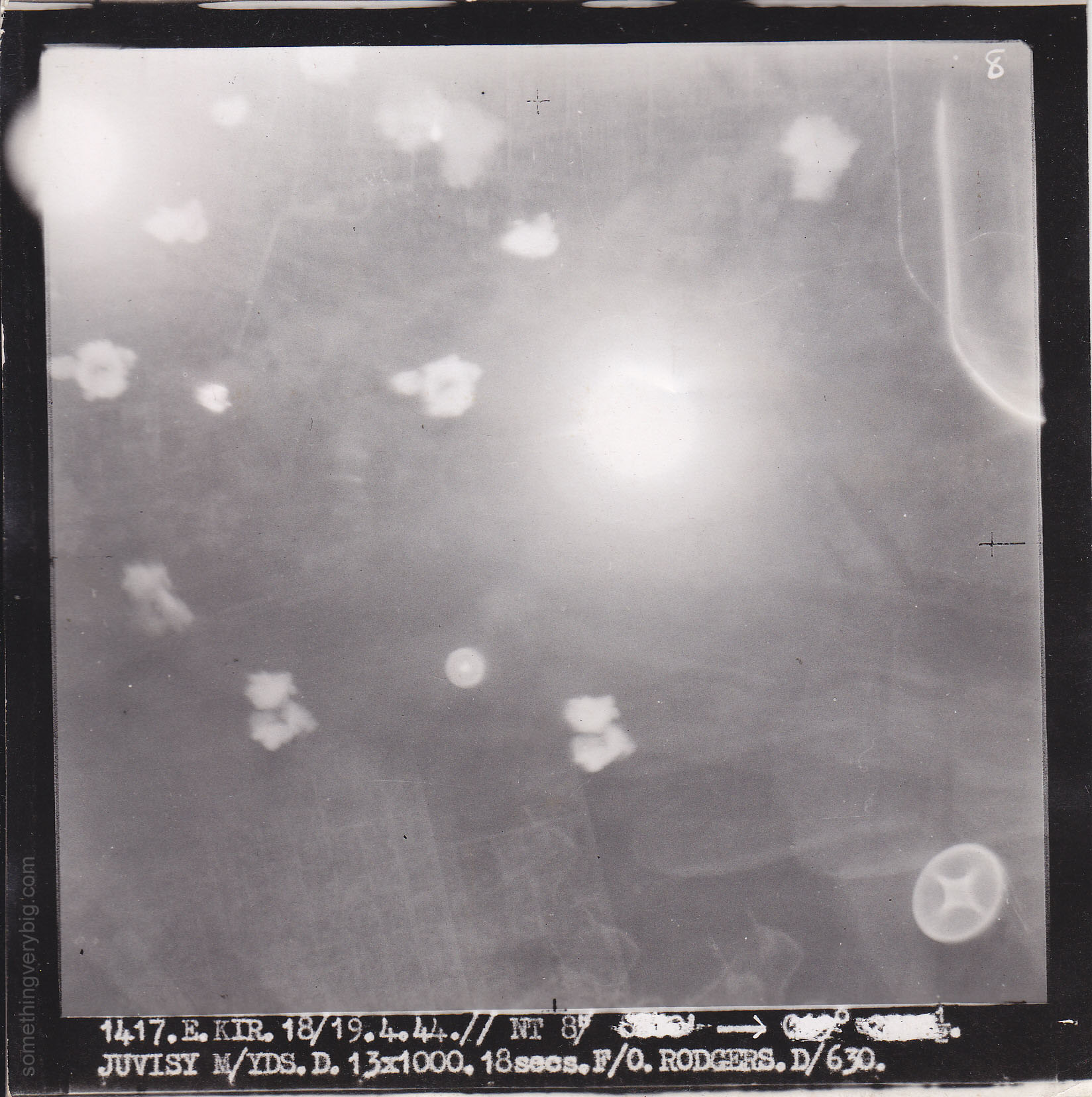
This bombing photograph from the Juvisy raid shows flak or bomb bursts in the target area with some ground detail also visible. The time of bombing has been scratched out, possibly by the censor. The caption on the rear of this photograph indicates that the crew concerned – piloted by C Wade Rodgers of 630 Squadron – achieved an aiming point. From the Wade Rodgers collection, courtesy Neale Wellman

As had become more or less standard on railway raids, the bombers each carried fourteen 1,000lb Medium Capacity high-explosive bombs. Most were fused with a 0.025 second delay to allow the bombs to bury themselves slightly before they went off, thereby maximising their crater-digging potential and ensuring their blast effects did not dissipate harmlessly at ground level. Other aircraft, though, carried bombs with a six-hour delayed fuse to make life difficult for repair crews. Indeed, there were later reports that bombs were still exploding up to a week after raid at Noisy-le-Sec which also occurred on this night.[6]

If anything the bombers were too concentrated. Photo flashes were going off everywhere and causing problems for some bomb aimers and 463 Squadron Commanding Officer Wing Commander Rollo Kingsford-Smith reported being bracketed by exploding photo flashes dropped from aircraft flying above. Pilot Officer Fred Smith said the risk of collision over the target was high. “Photograph will probably be unsuccessful”, he reported, “because of a very near collision with another Lanc. just before [the] camera turned over.” And Pilot Officer Roland Cowan complained that the red spot fires at which the crews were to aim were “soon knocked out by bombs bursting on them.” This would be a problem which would plague Bomber Command’s railway raids for some time – and it would, on a future operation, prove critical for the crew of B for Baker.

Flight Lieutenant Jack Colpus had one of his thousand-pounders hang up over the target. Sometime after he closed the bomb bay doors the bomb fell from its hooks and was rolling around on the doors in the bottom of the bomb bay. Colpus nursed the munition half way to the French coast before he opened the doors and it fell out into open French countryside 60 miles north west of the target.

The bombing continued almost entirely unhindered by enemy activity. Very few fighters were seen and flak was generally described as ‘negligible’. The defences was not entirely absent however, as some crews found out the hard way. The only loss suffered by the force that attacked Juvisy was a single 9 Squadron Lancaster which was seen to explode on leaving the target.[7] Flight Lieutenant Dan Conway, meanwhile, was tempting fate a little. He made a dummy run over the target in LM450 while waiting for the order to bomb, and then aborted a second run because he was not quite on the correct bombing heading. So they went round again, and the flak finally got them on their third run. It damaged the fuselage, mid-upper turret and bomb sight and punched a few odd holes elsewhere in the aeroplane. The damaged sight caused yet another aborted run as the bomb aimer adjusted to using it as a fixed sight. The matter-of-fact way this is reported in the Operational Record Book exemplifies the press-on-regardless attitude to getting the job done and demonstrates the great emphasis on accuracy placed on French targets in particular by the crews of Bomber Command.

But otherwise, everything went off nearly perfectly. Communications between the Master Bomber, Controller and Main Force worked well, the markers were accurate and the bombing was well concentrated. On the way home the returning bombers could see the night’s other operations in progress – Fred Smith judging that “quite a good show appeared to be going on at each” – and the return was trip was more or less uneventful. After some five hours in the air the first aircraft returned to Waddington shortly after 1am and by 02.30 all were safely home.

The 463 Squadron Operational Record Book called the devastation caused at Juvisy “very complete”, and modestly noted that sixteen out of a possible seventeen crews from that unit returned aiming-point photographs:

Good show!

The Night Raid Report shows that immense damage was caused to the marshalling yards, with tracks and rolling stock hit and engine sheds, carriage works and freight sheds all “at least 80% destroyed.” Further damage was caused to railway flyovers, road bridges and an oil depot and other factories located outside the target. Sadly, considerable damage was caused to residential areas to the north west of the target.

Juvisy and Rouen sustained the most crippling damage out of the four railway targets attacked on this night, but Noisy-le-Sec and Tergnier were also hit hard. Ten Halifaxes were lost on the latter two operations, as well as three bombers from the mining force and another three from the Rouen force, shot down by intruders while approaching to land at their bases at Binbrook and Littleport.

The Buckham crew at debriefing after Juvisy, 18APR44. Left to right, they are: F/S EJ Holden, Sgt W Sinclair, F/O RW Broad, F/O BA Buckham, F/O EH Giersch, F/S LJ Manning, P/O A Giles (Intelligence Officer) and F/O JW Muddle
The Buckham crew at debriefing after Juvisy, 18APR44. Left to right, they are: F/S EJ Holden, Sgt W Sinclair, F/O RW Broad, F/O BA Buckham, F/O EH Giersch, F/S LJ Manning, P/O A Giles (Intelligence Officer) and F/O JW Muddle. From the Waddington Collection, RAF Waddington Heritage Centre

This post is part of a series called 467 Postblog, posted in real time to mark the 70th anniversary of the crew of B for Baker while they were on operational service with 467 Squadron at RAF Waddington, Lincolnshire. See this link for an in-depth explanation of the series, and this one for full citations of sources used throughout it. © 2014 Adam Purcell

Sources:


[1] RAF Bomber Command Campaign Diary, April 1944

[2] Smith, Phil, Recollections of 1939-45 War, p.22

[3] Description of tactics from Night Raid Report No. 581

[4] Colpus, Jack, in 467 Squadron Operational Record Book, 18APR44

[5] 463 Squadron Operational Record Book, 18APR44

[6] RAF Bomber Command Campaign Diary, April 1944

[7] Easton, Arnold, Flying Logbook, 18APR44, and Night Raid Report No. 581. While the Night Raid Report says this aircraft – LM361, flown by an Australian, F/S Dudley Bates – fell to a fighter, Theo Boiton’s Nachtjagd War Diaries suggest it was actually shot down by flak.

467 Postblog LVI: Tuesday 11 April, 1944

The Gestapo Headquarters in Den Haag, the Netherlands, was a white five-storey building near the Peace Palace. A former art gallery, the building now housed the Dutch Central Population Registry, holding copies of all the legally-issued identity papers of Dutch civilians, which allowed papers falsified by the Resistance to be recognised. As such, the Dutch requested that the RAF smash the building from the air. On this fine April morning, in an operation described later as “probably the most brilliant feat of low-level precision bombing of the war,” six Mosquitos of 613 Squadron attacked and completely destroyed it. The leader of the highly successful raid, Wing Commander R.N. Bateson, was awarded the Distinguished Service Order as a result, and later added to it the Dutch Flying Cross, presented by Prins Bernhard of the Netherlands.[1]

Meanwhile, an operation was laid on for the night for the two Australian squadrons at RAF Waddington. The target was Aachen, in particular its marshalling yards, and as the 467 Squadron Operational Record Book said, “this time it is a full trip.” While it is inside the seven degrees of latitude line which was used as the trigger point on French, Belgian or Dutch raids, Aachen is also – just – inside Germany. Consequently this operation would count for a full trip for the purposes of counting a tour of operations rather than the ‘third’ of a trip earned for the previous couple of raids that were on French targets. Fifteen 463 Squadron crews were briefed for this trip, which would see a total of 350 Lancasters and Mosquitos fly to Aachen. Eighteen were on the battle order from 467 Squadron but one crew missed out when their skipper – Pilot Officer John McManus – fell sick before take-off.[2]

An hour or so before departure, in fine conditions and with the beginnings of a sunset filling the sky, the crew truck deposited the airmen at their dispersals. As ground staff made last-minute adjustments and plugged in the trolley accumulators, the crews gathered around their aircraft, waiting for the time to climb aboard, fire up the Merlins and taxi out for take-off. It is this scene – showing B for Baker and her crew and based loosely on the conditions as they were for the Aachen raid – which was painted in 2010 by aviation artist Steve Leadenham:

lancaster_7-little1 copy

Also preparing for operational sorties on this night were the usual bunch of Mosquitos to carry out intruder operations, Serrate patrols and attacks on Hanover, Osnabrück and Duisburg. They would also hit airfields throughout France, Holland, Belgium and western Germany. Some training aircraft would scatter leaflets in France and 26 aircraft were to fly special Resistance support operations. Finally, a small force of Halifaxes and Stirlings were planned to drop mines off Brest and in the Kattegat.[3]

The first aircraft took off from Waddington at 20.15. There was one early return with Pilot Eric Scott’s aircraft (LL795 of 463 Squadron) suffering an engine failure approaching the Dutch coast. They jettisoned eight of their fourteen 1,000lb bombs and turned back, landing at Waddington at 23.14. This was one of eight aircraft to return early out of the 350 dispatched to Aachen.

The rest of the force converged on the rendezvous point, off the Dutch coast about 40 miles west of Rotterdam. They formed into a highly concentrated[4] stream that headed directly to Aachen. A few fighters were encountered patrolling the islands in the South Holland delta but they made no serious attacks and, except for one bomber which wandered south of track and fell to the guns of Antwerp, none were lost until the target was reached. Half the nightfighters had apparently been drawn north by the small force of bombers dropping mines in the Kattegat. Most of the remainder were sent to Bonn, some 35 miles beyond Aachen, trying to cover a possible deeper penetration by the bombers. Four Mosquitos, as part of the overall deception, also dropped spoof fighter flares at Almelo in the east of the Netherlands, some 115 miles north of Aachen, perhaps intending to make the Osnabrück or Hanover deceptions look more convincing to the defenders.

The biggest problem encountered by the bombers was that the forecast winds were significantly different to the actual winds encountered in flight. The result was that most of the bomber stream needed to lose significant time en route – Squadron Leader Phil Smith noting the figure of 14 minutes – meaning that almost all crews had to orbit, fly doglegs or otherwise waste time. Phil suggested the use of a ‘floating’ zero hour in future as a way to avoid this, an idea shared by Pilot Officer Anthony Tottenham, who put it rather more bluntly:

No future in continuous orbiting.

The target was blanketed in broken cloud when the bombers arrived overhead, but it was only thin and would not cause any problems. There was some accurate predicted flak in the early stages of the attack but it soon died down into only a loose barrage, and only a single bomber was lost to the ground defences of Aachen. There were a small number of combats with fighters over the target but with no conclusive result for either side.[5]

Though the Night Raid Report says that the bombing was “well-timed”, there are a number of reports in the Operational Record Books which suggest that the Pathfinder Mosquitos that were supposed to precede the Main Force into the target area were in fact a couple of minutes late. Apparently some airmen got sick of waiting for them, perhaps frustrated by the need to orbit in the target area, because numerous crews reported seeing incendiaries dropping before the first target indicators went down, drawing complaints from other pilots. “Cannot something be done to stop this prevalent practice,” complained Flight Lieutenant Freddy Merrill. Whatever the case, once the markers did go down they were highly accurately placed and “could be plainly recognised”[6] through the thin cloud. The Main Force then proceeded to drop their bomb loads almost entirely unharassed by the defences. The bombing was so concentrated that crews reporting seeing sticks of bursting bombs straddling the target indicators, and some fires were beginning to get a hold in the city as the bombers left. “A wizard prang if PFF spot on”, thought Flight Lieutenant Walter Marshall. About the only trouble encountered was that four 467 Squadron aircraft had bombs hang up over the target, including B for Baker. The crew attempted to jettison the offending munition over the North Sea on the way home, but it was frozen in place and they had to land back at base with the bomb still hanging in its rack.

After bombing the force continued east over Aachen for another few miles before turning to the north and, eventually, back towards home. It was on the homeward journey that the nightfighters finally began to have a little success, claiming five bombers on this leg. The first was shot down near Roermond, then another fell south of Eindhoven, a third near the Luftwaffe nightfighter base at Gilze-Rijen, the next at Overflakke in the South Holland delta and a final victim over the North Sea. One crew reported seeing air-to-air rockets on the homeward journey but it is unknown if any bombers were shot down this way.[7] Some nightfighter intruders did follow the bombers back to their bases and several returning aircraft came under attack from them but it does not appear that any were shot down.

The first aircraft to land back at Waddington did so at 00.22. B for Baker was home thirteen minutes later after a little less than four and a half hours in the air. DV372 with Flight Lieutenant Jim Marshall at the controls landed at 01.05. Their radio was unserviceable on return so, unable to call the control tower, they needed to wait until everyone else was down before commencing their approach.[8] With their arrival, all 32 Waddington crews were safely back on the ground.

Nine aircraft failed to return from this operation. Seven had fallen to known causes but the losses of the remaining two remain a mystery. Seven aircraft returned damaged by flak, fighters or ‘friendly’ incendiaries. The effect of the bombing on Aachen was significant. The bombers left the city in flames that were visible from some distance away on the return flight, and the Night Raid Report records that the attack was “well centred on the station and marshalling yards” and the centre and south of the town was hit hard. It lists serious damage to the passenger train station, loco and goods sheds and the marshalling yards themselves. Even the bridge spanning the middle of the yards was hit by three bombs. Textile factories and residential property, particularly in the southern suburb of Burtschied, suffered “severely”.[9]

It was for the city of Aachen the worst raid of the war.

This post is part of a series called 467 Postblog, posted in real time to mark the 70th anniversary of the crew of B for Baker while they were on operational service with 467 Squadron at RAF Waddington, Lincolnshire. See this link for an in-depth explanation of the series, and this one for full citations of sources used throughout it. © 2014 Adam Purcell

Sources:


[1] Bowman 2003, p.190

[2] 467 Squadron Operational Record Book, 11APR44

[3] Night Raid Report No. 577 and RAF Bomber Command Campaign Diary, April 1944

[4] As reported by Flying Officer Arnold Easton in his logbook, and by Pilot Officer Arthur Bowman in the 463 Squadron Operational Record Book, 11APR44

[5] Weather and defence details from Night Raid Report No. 577

[6] Pilot Officer David Gibbs in the 467 Squadron Operational Record Book

[7] Nightfighter kills from Night Raid Report No. 577, rockets reported by Pilot Officer Noel McDonald in the 467 Squadron ORB

[8] Easton, Arnold, flying log book, 11APR44

[9] Catalogue of damage from RAF Bomber Command Campaign Diary, April 1944

467 Postblog Lb: Thursday 30 March, 1944

After fighting their way through one of the most one-sided aerial battles of the bomber war, the battered and bruised Main Force are approaching the target area…

The initial marking failed at Nuremberg. Some Pathfinders missed the wind change and ended up over Lauf, a small town with similar H2S characteristics to Nuremberg but about ten miles to the north east. While some realised the mistake and did not drop their markers here, at least four aircraft did.[1] When the Main Force crews arrived a few minutes later, they found two sets of well-defined skymarkers over almost solid cloud: one at Nuremberg and one at Lauf. Indeed, one 463 Squadron crew reported three groups of Wanganuis visible when they bombed at 01.20.[2] The result was very scattered bombing which spread to the east and then crept back along the bombers’ path of approach. The “target [was] hard to pick out,” recorded 467 Squadron navigator Flying Officer Arnold Easton.[3]

But there was one other complication. One of the Pathfinder Mosquitos, which was intended to drop a green ‘floater’ target indicator as part of the early target marking at Nuremberg, suffered H2S failure and had also missed the wind change. He turned at the false turning point to the north and short of the real one above the Thuringer Wald, and when a large city appeared at his estimated time of arrival over Nuremberg and started throwing up searchlights and flak, he assumed he was at the target and dropped his markers.[4] But he was actually at Schweinfurt, some fifty miles to the north west, which had the misfortune to lie on approximately the same bearing and distance from the false turning point as Nuremberg was from the real one. Following Main Force aircraft which had also missed the wind change then came up on a defended area that was marked with a falling target indicator, so also thought they were at Nuremberg and dropped their bombs. Some realised their mistake as they passed the ‘real’ target shortly afterwards but at least 34 aircraft returned bombing photographs that were definitely plotted within three miles of the centre of Schweinfurt[5] and it was later estimated that about 120 bombers had dropped their loads on the city.[6] Two aircraft fell to the flak defences there. Middlebrook records that the citizens of Schweinfurt initially thought that they had been the main target of the night’s operations, but when the German High Command realised that the city had been bombed accidentally they suppressed any mention of it in the German press.[7]

But back to Nuremberg. The skymarkers were scattered, first by the Pathfinders themselves and then by the wind, but the cloud meant that searchlights were not effective. Two aircraft were shot down by flak, two collided and were seen to go down in flames and five more fell to the nightfighters which were still hanging around.[8] There were other dangers too:[9]

 We were late getting to the target and I don’t think we got a photo for we were chased by a fighter and then a very twitchy Lancaster gunner tried hard to shoot us down. – Flight Lieutenant Walter Marshall, 467 Squadron

On three engines after the earlier combats with the JU88, Dan Conway’s Lancaster was running behind schedule. In fact, it would be the last aircraft over Nuremberg, bombing at 01.35 – thirteen minutes after the attack had been scheduled to end. With an engine out and the airspeed indicator useless, they limped away for home.[10]

The bombers planned to continue south for another 30 miles after leaving the target before they turned southwest towards Stuttgart and then west to home. The nightfighters needed to land to refuel so their attacks dropped off a little but even so they still accounted for at least four more aircraft on the way out. Pilot Officer Keith Schultz was attacked by a JU88, but his gunners drew hits on its wings and fuselage and they claimed it as probably destroyed.[11] Flak claimed a bomber at Strasbourg and another at Le Tourquet on the way home.[12]

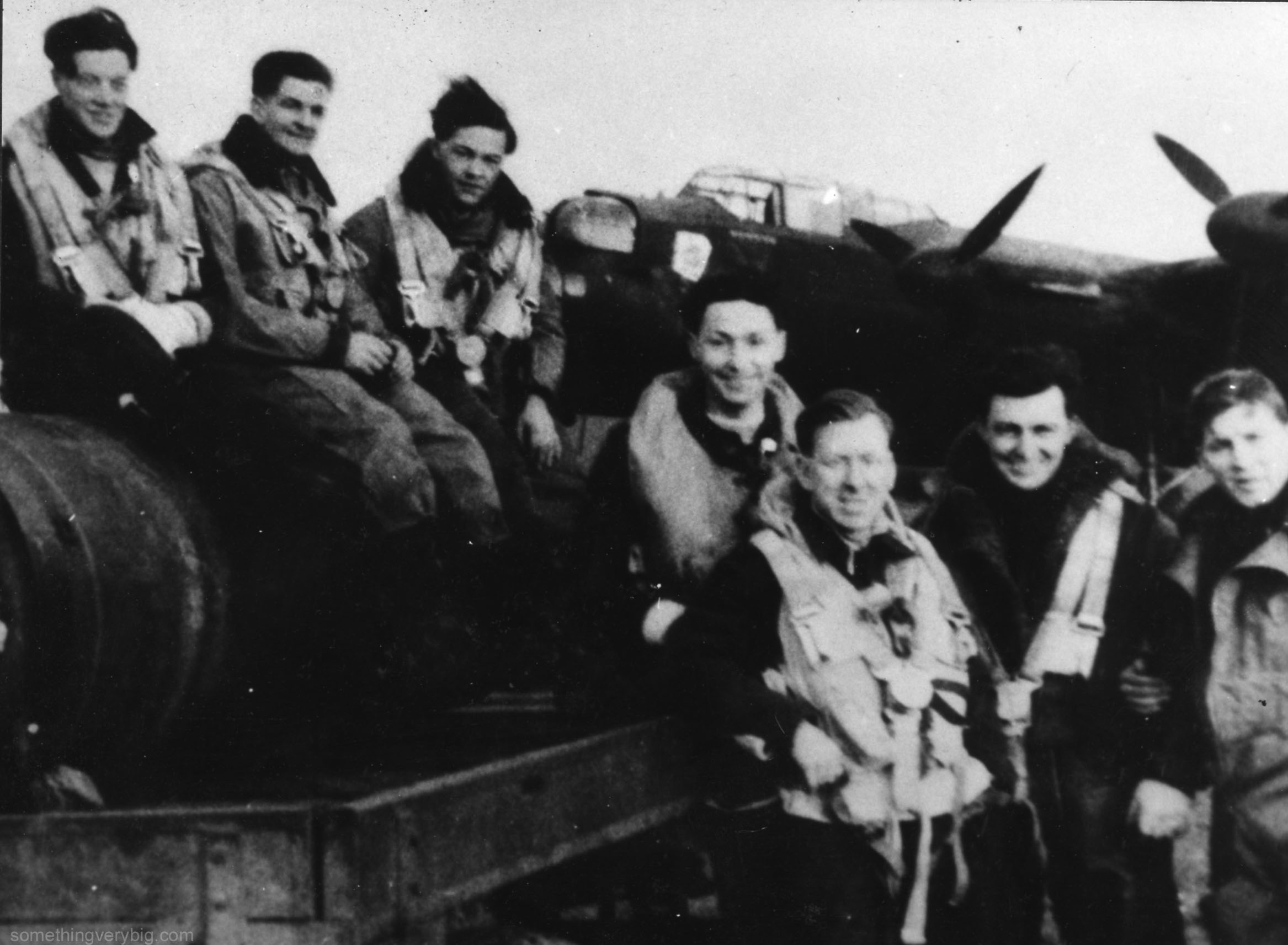
Schultz crew in front of ME580 JO-Q 'Queenie' of 463 Squadron. Photo from the Waddington Collection, RAF Waddington Heritage Centre
Keith Schultz and crew in front of ME580 JO-Q ‘Queenie’ of 463 Squadron. Photo from the Waddington Collection, RAF Waddington Heritage Centre

Having beaten the odds over Europe, the surviving Waddington aircraft were close to base when Mother Nature played one last trick on them. Fog began to form. “I can distinctly recall a sharp deterioration in the weather after return to base but this did not affect me personally,” said Squadron Leader Arthur Doubleday later,[13] who was the first pilot back. Most aircraft managed to beat the fog to the airfield, but B for Baker was among those which diverted, landing at Wittering, 35 miles to the south. They had been struggling with a supercharger fault and a brake fault for almost the entire trip, but the brakes cleared themselves on landing.[14]

The weather was more of a problem for those aircraft struggling home on less than their full complement of engines. Bill Brill, on three since being hit by bits of an exploding bomber near the target, had a little difficulty but eventually got in, the last aircraft to land at Waddington by a long shot. “He always caused me some anxiety,” wrote good friend Arthur Doubleday after the war.[15] On shutting down at their dispersal a belt of .303 ammunition was found embedded in the cowling of the busted engine.[16]

Dan Conway, however, had rather a more interesting time of it. Navigation had been difficult without an airspeed indicator and, crossing the French coast, it was discovered that their Gee set was also unserviceable. Shortly afterwards two fighters flew at them “aggressively”, but once they were recognised as Spitfires and the colours of the day had been fired off, the two aircraft formated on the struggling Lancaster and provided an escort until they reached the coast. Conway briefly thought about landing at the emergency airfield at Woodbridge which they passed, “FIDO equipment in full blaze,” but decided to leave it to “those aircraft worse off than ourselves.” He later admitted that “another consideration could have been that we were due to go on leave that day”! Navigating by dead reckoning, the relative volume on their otherwise unintelligible radio telephone and a lucky pinpoint, they found Waddington but it was not over yet.[17]

There was the usual problem with fog, as the Drem system was not visible in the denser patches. Having some trouble seeing and lining up on the runway, the approach must have looked spectacular. Just before passing the Control Van it was necessary to do a steep turn to regain alignment. We then landed smoothly and safely, well down the runway. I remember the startled faces of those assembled to welcome the boys home. Afterwards some of them claimed I had put my starboard wing tip outside the Control Van and was lucky not to have hit it. There was no choice, for going round again in those conditions was not on, with our fuel perilously low.

467 Squadron lost two aircraft on the Nuremberg raid, those captained by Bruce Simpson (on his thirtieth trip) and Roland Llewelyn (sixth). While all 463 Squadron crews got home safely, it was clear that it had been a disastrous night. The 5 Group Air Officer Commanding, Air Vice Marshal Ralph Cochrane, was visiting Waddington when the bombers came back and he asked Arthur Doubleday how the trip went. Doubleday replied, “I believe the Jerries scored a century before lunch today.”[18]

Doubleday was not far from the mark. In all, 94 bombers failed to return from Nuremberg, plus one special operations Halifax and an intruder Mosquito. The number eclipsed the 73 missing from Berlin a week ago and the 79 missing from the Leipzig raid in February 1944. As well as the 94 aircraft, of course, Bomber Command also lost 94 trained crews. 545 airmen were killed in action and 159 became prisoners of war. Amazingly, fifteen of those shot down evaded capture.[19]

616 aircraft reported attacking the target and while a large number undoubtedly dropped their bombs on the correct city, because of the cloud not one of them was plotted in the target area at the time of bombing. No post-raid reconnaissance was carried out either, so it’s unclear how much damage was actually done to Nuremberg. The Night Raid Report resorts to quoting a German communiqué, which said that some damage was caused and some casualties incurred among the population. Damage was scattered between Schweinfurt, Nuremberg and numerous small towns and villages outlying both cities. The civilian death toll as reported by Middlebrook was sixty Germans and fifteen foreign workers killed by the bombing in Nuremberg and just one child killed in Schweinfurt.[20]

After his eventful landing at Waddington, Flight Lieutenant Dan Conway walked to the Mess with the WAAF Station Officer:[21]

…a motherly and usually happy soul, who was most distressed […]. For myself, I was unhappy about the losses but glad to feel Old Mother Earth beneath my feet as the fog began to disperse.

The worst night in the history of Bomber Command was over.

This post is part of a series called 467 Postblog, posted in real time to mark the 70th anniversary of the crew of B for Baker while they were on operational service with 467 Squadron at RAF Waddington, Lincolnshire. See this link for an in-depth explanation of the series, and this one for full citations of sources used throughout it. © 2014 Adam Purcell

Sources:


[1] Middlebrook, p.181

[2] This was Pilot Officer Schultz in ME580 – 463 Squadron ORB, 30MAR44

[3] Easton, Arnold, Flying Log Book, 30MAR44

[4] Middlebrook, p.204

[5] Night Raid Report No. 567

[6] RAF Bomber Command Campaign Diary, March 1944

[7] Middlebrook, p.260

[8] Night Raid Report No. 567

[9] Middlebrook, p.189

[10] Conway, p.134 and Middlebrook, p.191

[11] 463 Squadron ORB, 31MAR44

[12] Night Raid Report No. 567

[13] Taylor, Geoff 1979 p.151

[14] Smith, Phil, Flying Log Book

[15] Quoted in Blundell 1975, p.18

[16] Blundell 1975, p.18, quoting Arthur Doubleday

[17] Quote, and story, from Conway, p.136

[18] Doubleday quoted in Blundell 1975, p.18

[19] Middlebrook, p.279

[20] Ibid., p.214 and p.259

[21] Conway, p.136

467 Postblog La: Thursday 30 March, 1944

There was not a little surprise at Bomber Command’s airfields when it was announced this morning that the squadrons would be operating tonight. It was quite late in the moon period with a bright half-moon expected so the surprise turned to dismay when they found out that the planned trip would be a long one.

The forecast was for cloud over Germany[1] which was expected to provide the Main Force with cover from the moonlight. The plan was that once the moon set the return journey could be made in darkness. The forecast was subsequently altered following two weather reconnaissance flights which showed the expected cloud was not present, but the operation proceeded. The target, in the south of Germany, was Nuremberg, and 795 aircraft were sent.

162 aircraft would be involved in operations designed to support the Main Force tonight[2]. 49 Halifaxes, simulating a large force perhaps bound for Hamburg or Berlin, were to lay mines in the Heligoland area, approaching the enemy coast at the same time as the Main Force. 13 Mosquitos were to attack nightfighter airfields. Three spoof raids, also using Mosquitos, were planned to Aachen, Cologne and Kassel. Sundry operations included small forces of Mosquitos to Oberhausen and Dortmund, Stirlings laying mines off Texel and Le Havre, a number of ‘special’ sorties and some OTU ‘Bullseyes.’[3]

The Nuremberg briefing was routine except there was some talk among the crews that this was the first major attack for a long time to penetrate deeply into Germany so late in the moon period. – Flight Lieutenant Dan Conway, writing after the war[4]

It was a maximum effort at Waddington with 35 aircraft dispatched, the most out of any one station.[5] It could have been even more but one pilot (Pilot Officer Anthony Tottenham) was ill just before take-off so he and his crew missed out. LM475 B for Baker was the third Lancaster to depart Waddington, taking off at 21.42. The normal crew were on board with the exception of bomb aimer Jerry Parker, who had been replaced on this trip by the Squadron’s Bombing Leader, Flight Lieutenant Patrick McCarthy (we last saw McCarthy when he flew to Frankfurt with Phil Smith a week and a half ago). There were two early returns to Waddington: Flying Officer Bruce Buckham returned just after midnight after the rear turret failed on ME701 and an hour later Pilot Officer Noel McDonald came back in LL792 when the electrically heated suits of the bomb aimer and both gunners failed.

The bombers passed their last positive visual fix in England, a vertical searchlight set up at Southwold, and crossed the North Sea. They made their landfall near Brugge in Belgium. The bombers were in bright moonlight and, ominously, there was no cloud.

The first bomber fell to flak guns near Namur, just after the bombers turned east for what Middlebrook called the ‘Long Leg’. A second was shot down by flak near Aachen (where red Target Indicators were to be dropped for the spoof raid on that city), two more at Bonn and another near Koblenz. But tonight would belong to the nightfighters. The German controllers decided early that the Heligoland Halifaxes were indeed a diversion. To cover an attack anywhere in the southern half of Germany they had ordered their aircraft to take off and assemble at two radio beacons: one called ‘Ida’, south-east of Cologne, or, for the later-arriving aircraft, another called ‘Otto’, north of Frankfurt. Unfortunately for the bombers, these beacons sat virtually astride their planned route.

The first bomber to fall to a nightfighter was a 467 Squadron machine: LM376 with Flight Lieutenant Bruce Simpson at the controls. Middlebrook quotes Unteroffizier Erich Handke, the radio operator on the aircraft that shot him down[6] near the German frontier:

Weather was marvellous – clear sky, half-moon, little cloud and no mist – it was simply ideal, almost too bright. It was a Lancaster flying nicely on a steady course so that, when we were comfortably positioned underneath and from about fifty metres, Drewes [his pilot] opened fire with the upward firing cannon at one wing which immediately caught fire. We followed the Lancaster for five minutes until it crashed below with a tremendous explosion.

The Lancaster had fallen to scräge Musik, or ‘jazz music’, a relatively new German innovation. At the time of the Nuremberg raid this weapon was still unsuspected by the Allies.[7]

Happily, Simpson and his entire crew were able to bale out more or less unhurt. The same, however, could not be said for many other crews over the next hour or so. The spoof raid on Cologne, intended to draw fighters away to the north, failed when the German controllers recognised the Main Force heading almost straight for the fighters waiting at the Ida beacon.  Low cloud developed shortly after the bombers crossed the Rhine, silhouetting them “like flies on a table-cloth”.[8] And nature had one more trick up its sleeve:

Due to some unusual and unforeseeable quirk of the weather, vapour or condensation trails, not normally found below 25,000 feet, had started to appear behind each bomber. The dead-straight streams of pure white cloud could not have given away more clearly the path the bombers were taking[9].

Everything was now in favour of the defenders. As Handke suggested, weather conditions were perfect: bright moonlight, low cloud, an unrecognised weakening of the expected wind that scattered the stream to the north a little,[10] and now the contrails. Add to this the mass of fighters lying in wait just ahead at Ida, and the stage was set for carnage.

The combats began in earnest south of Aachen. Sergeant Ray Tanfield, Flight Engineer in LM450 (Dan Conway’s aircraft), counted seven bombers going down in flames at one point. with another eleven wrecks burning on the ground.[11] Conway’s navigator, Sergeant Joe Wesley, would normally record on his navigation log any reports of aircraft going down, but not on this night. Conway had told the crew to stop mentioning them:[12]

We could not afford to have the intercom overloaded with reports when at any second, one of them might call up to report a fighter. Self preservation overruled statistics and I did not propose to become one.

“Now I know how those poor bastards in the Light Brigade felt”, Conway thought to himself. Earlier they had seen a Lancaster drifting across their path only 200 feet above them. “We could have shot it down ourselves with no trouble,” Conway said. Middlebrook records an instance of exactly this happening somewhere on the Long Leg when a 101 Squadron Lancaster fell victim to the itchy trigger finger of an unknown Halifax gunner whose aircraft had drifted across the top of it. Five of the crew of the Lancaster were killed.[13]

Pilot Officer Fred Smith, in LL788, counted thirty aircraft shot down between Aachen and the target. Interestingly he reported noticing on the last half-dozen trips that many aeroplanes had been seen going down in flames from their operational height for no particular reason. “I would suggest that [the] enemy are using [a] new type of ammunition,” he speculated in the Operational Record Book. In fact this was likely one of the earliest reported sightings of scräge Musik.

Just after crossing the Rhine, twenty Mosquitos left the bomber stream and headed for Kassel, “dropping German-type fighter flares to draw the enemy fighters and also Windowing furiously in an attempt to make themselves look like a large force of heavy bombers.” It was a perfectly executed ‘side-step’ but, apart from plotting it in their operations rooms, the Germans “ignored it completely.” Another spoof had failed to distract the defenders.[14]

The battle raged on. A small number of German fighters were shot down by either Serrate Mosquitos or by bombers, but the scoreboard was otherwise woefully lopsided. By the end of the Long Leg, fifty nine bombers lay blazing on the ground along the route. All had been shot down in the hour after midnight. “It is unlikely that a single hour, before or since, has seen a greater rate of aerial destruction,” wrote Middlebrook.[15] Some pilots – among them Rollo Kingsford-Smith – recognised that with the contrails came great danger and willingly disobeyed orders by flying higher than briefed to get above the zone. “From there I could see a mass of contrails below us; they were like a formation of American day bombers,” said a 76 Squadron pilot who did the same thing.[16]

Many Waddington crews were attacked. One – DV240 under the command of Pilot Officer Roland Llewelyn – was shot down by a fighter quite close to the Ida beacon. The bomb aimer, wireless operator and mid-upper gunner bailed out and became prisoners of war, but the other four were killed.[17]

Other crews were luckier. Pilot Officer Dave Gibbs of 467 Squadron, flying DV277, was threatened by a Messerschmitt ME210 soon after passing Cologne. The fighter was driven off by the mid-upper gunner after the guns in the rear turret failed. Dan Conway’s aircraft was attacked twice by a Junkers JU88 on the final leg to the target. His gunners both fired at it and saw smoke coming from one of its engines so they claimed it as damaged. “Gunners did a good job, saw JU88 first both times,” he later reported.[18]   But Conway’s port outer engine was damaged in the attack so it needed to be shut down. The Lancaster carried on on three. This was one of five JU88s claimed damaged on this night, amongst a small number of other fighters.

B for Baker itself had a close call when a nightfighter shot down another Lancaster five hundred yards behind and to one side of them, the bomber exploding in the air. “That night I thought my time was up,” wrote wireless operator Dale Johnston to his brother later, “and how I thought of you…”[19]

A 578 Squadron Halifax pilot named Pilot Officer Cyril Barton was also attacked on the way to the target. His aircraft was badly damaged and three crew members, including the navigator, bailed out after a miscommunication. With one engine knocked out and the aircraft badly damaged, he pressed on, bombed the target and attempted to fly home despite the absent navigator. Pushed off track by the wind, he made landfall near Sunderland, ran out of fuel and crash landed. The three remaining crew members were only slightly injured but Barton died in the crash. He was awarded a posthumous Victoria Cross for his heroism on this flight.[20]

The bombers turned south over a large forest called the Thuringer Wald, with no easily-recognisable features or towns nearby. Add to this the length of the leg they had just flown without a positive fix, the disruption to navigation from evasive action to escape fighters and the incorrect broadcast winds and it is clear how easy it was to miss the exact turning point. “The average bomber turned well to the north of the correct point and slightly short of it”, wrote Middlebrook.[21] This would prove critical in what was to come. The fighters, meanwhile, saw the turn and reported it to their control rooms – and now, for the first time, the nightfighters’ running commentary began mentioning Nuremberg. While fighter activity decreased slightly after the turn, they were still around in force and ten more bombers fell in the first half of this leg.[22]

With the target area looming ahead, Squadron Leader Bill Brill ran into the debris of an exploded Lancaster. Something hit his aircraft (ME614) and an engine stopped, but he flew on. Just after dropping his bombs a fighter attacked but he turned quickly and the fighter didn’t come back for a second go. A second engine failed and they were close to bailing out but when one of the engines came back to life he decided to fly home.[23]

Next: The bombers arrive at Nuremberg

This post is part of a series called 467 Postblog, posted in real time to mark the 70th anniversary of the crew of B for Baker while they were on operational service with 467 Squadron at RAF Waddington, Lincolnshire. See this link for an in-depth explanation of the series, and this one for full citations of sources used throughout it. © 2014 Adam Purcell

Sources:


[1] Night Raid Report No. 567

[2] Middlebrook, Martin (1973). The Nuremberg Raid. The definitive history of the Nuremberg operation, I have drawn heavily from this book for this post. See https://somethingverybig.wordpress.com/2014/01/01/467-postblog-citations-for-all-sources-used/ for full citation.

[3] Night Raid Report No. 567

[4] Conway p.132

[5] Middlebrook p.98

[6] Ibid., p.134

[7] Ibid., p.70

[8] Ibid., p.160

[9] Ibid., p.140

[10] Night Raid Report No. 567

[11] Conway, p.132

[12] Ibid., p.132

[13] Middlebrook, p.135

[14] Ibid., p.166

[15] Ibid., p.170

[16] Ibid., p.140

[17] Storr, Alan 2006

[18]467 Squadron ORB, 30MAR44

[19] Johnston, Dale, letter to brother Ian 20APR44. Transcript in Mollie Smith’s collection

[20] Bomber Command Campaign Diary, March 1944

[21] Middlebrook, p.176

[22] Ibid., p.176

[23] Story from Blundell, p.18 and Nelson, p.184

467 Postblog XLVIII: Sunday 26 March, 1944

The last couple of weeks of March 1944 were quite busy for the Waddington bomber crews. In the last ten days, they had flown four operations and had three scrubbed. Tonight they would be operating again, five of the crews involved being on their third consecutive raid in as many nights.[1]

The target was what the 467 Squadron Operational Record Book called “an old favourite:” Essen. It would be the first major attack on that “already half-devastated” city, home to a good portion of the German arms industry, in about eight months. The crew of B for Baker were on the Battle Order for this trip but for unknown reasons wireless operator Dale Johnston was not included. He was replaced by Pilot Officer Thomas Ronaldson, who appears to have been a ‘spare bod,’ completing operations with many different crews after his own pilot was posted tour-expired in December 1943. Curiously Phil Smith’s logbook does not mention Ronaldson by name, containing only ‘crew as above.’

Two aircraft were not ready in time for take-off and there was one early return but the groundcrews nevertheless managed to get a total of 31 aircraft away from the two Waddington squadrons. They were part of a total force of 705 Lancasters, Halifaxes and Mosquitos on their way to Essen. Other heavy bombers out tonight attacked railway facilities in Cortrai in Belgium and laid mines off the French Atlantic coast while Mosquitos flew Serrate patrols and attacked airfields in Belgium, Holland and Northern France.[2]

The Main Force flew east from their airfields heading towards Holland, passing close to the Dutch town of Julianadorp, which that night was subjected to a raid by three Mosquitos. The most recent few targets attacked by large forces of bombers had mostly been far inside Germany, and it’s likely that the German defenders were once again expecting a deep penetration. The Main Force flew a course that looked like it might have been headed for Hanover, and indeed a small force of Mosquitos made a harassing raid on that city, but just past the Ijsselmeer they suddenly turned south east and headed straight for the Ruhr. More Mosquitos raided Aachen but the bombers’ true target was now dead ahead.

Not that the crews could see it, looking at the ground. They had been flying over a solid layer of cloud since they had been half-way across the North Sea. This was not entirely unexpected but the forecast, reproduced in the Night Raid Report, had not been particularly confident and included the words “very uncertain conditions” for the north of the country:

Probably much strato-cumulus, but cloud may clear right away.

Or maybe it wouldn’t. The crews found that the cloud had not cleared at all. One pilot, albeit only on his second trip, was unnerved by the complete lack of anything to be seen: [3]

The navigator said to me, “Five minutes to the coast.” And then he said we were crossing the coast. And it was pitch black. There were no searchlights; there were no guns, nothing. And I thought, “Something queer here. I think we’re lost.” And on we went, and we were ten minutes from the target, and there was still nothing. Eventually, not long after that, I saw some flares go down ahead of me. So I realised then we weren’t lost.

Despite a small risk of some strato-cumulus cloud over the target itself, the met. boffins thought that at Essen it would “probably” be clear. On the strength of that, the attack was planned using ‘Musical Parramatta’ ground-marking tactics: Oboe-equipped Mosquitos would drop red Target Indicators that would be backed up visually with greens by Pathfinder crews following in Lancasters.

There was only one tiny flaw in the plan.

The forecast was entirely wrong.

The crews, trailing huge white contrails at high levels, arrived over the target to find it blanketed in 10/10ths thick cloud up to about 10000 feet. The Mosquitos dropped their target indicators but they quickly dropped out of sight in the murk. Consequently most crews could only bomb the estimated position of the target indicators via their glow coming through the clouds. At least two 463 Squadron crews saw no Pathfinder pyrotechnics at all and bombed on estimated time of arrival instead.

The cloud made it difficult to see any results of the raid while it was in progress, but there were signs that the bombing had been reasonably concentrated. The glow of fires was visible up to a hundred miles from the target and two distinct palls of thick black smoke were becoming evident as the crews left the target. Despite this, though, a number of crews were not certain if the raid had indeed been successful, and couldn’t understand why the Pathfinders had not carried skymarker flares to transition to an ‘Emergency Wanganui’ attack as soon as the solid cloud cover at the target was recognised. “An excellent Wanganui night”, lamented Wing Commander Arthur Doubleday. In fact the plan did include Wanganui flares, but they were dropped by Mosquitos as intended two miles east of the actual aiming point to distract the flak guns. In this they succeeded, with flak flashes seen nearby the falling parachute flares, and they also served to assist the Main Force in locating the general area of the target, but finding definite markers at which to aim the bombs proved more frustrating for the crews. “Wanganui backing up would have given [a] more definite aiming point than was possible with TI passing through cloud,” suggested Pilot Officer Laurence Hawes.

The cloud did, however, mean that searchlights were all but ineffective. While the heavy flak guns fired a loose barrage it was “not like old times.”[4] Some fighters had been led astray by the raid on Courtrai and the rest, probably distracted by the feint raid on Hanover, were held in reserve deeper in Germany in anticipation of an extended penetration by the bombers. There were reports of one or two combats on the way in to the target (there is some evidence that these were possibly attracted by the contrails[5]) but in general the fighters caught up with the stream late, claiming one bomber near Bonn just after leaving the target and four more on the way to Brussels. Flak got two bombers over the Ruhr and one when the stream turned for home near Charleroi. One more aircraft was seen to go down to unknown causes on the south-eastern run out of the target. These nine were the only aircraft that failed to return – a loss rate of just 1.2%. One returning bomber was damaged beyond repair by a fighter attack and two were written off in landing accidents.[6]

Every bombing photograph obtained by returning crews showed solid 10/10ths cloud, and the 463 Squadron diarist thought it was too early to assess results yet. As it turned out however, the Pathfinders, with the benefit of the highly accurate Oboe, dropped what the Night Raid Report called an “excellent concentration” of target indicators on the aiming point, and enough bombers aimed accurately at the correct glow to drop a “great weight” of bombs on the centre and south of the town. The Krupps munitions factories were seriously damaged.


This post is part of a series called 467 Postblog, posted in real time to mark the 70th anniversary of the crew of B for Baker while they were on operational service with 467 Squadron at RAF Waddington, Lincolnshire. See this link for an in-depth explanation of the series, and this one for full citations of sources used throughout it. © 2014 Adam Purcell

Sources:


[1] The five crews were those of Pilot Officers Victor Baggott, Laurence Hawes and Tony Tottenham, and Flying Officers Bruce Buckham and Dudley Ward – 463/467 Squadron ORBs, 24-26MAR44

[2] Details of tonight’s operations in Night Raid Report No. 564

[3] Rackley, Lionel 2003

[4] 467 Squadron ORB, 27MAR44

[5] As reported by Pilot Officer Milton Smith in the 467 Squadron ORB, 26MAR44

[6] Casualty data from Night Raid Report No. 564

467 Postblog XLVII: Saturday 25 March, 1944

As part of the developing strategy to disrupt the movement of German troops and equipment around the planned invasion areas, Bomber Command tonight turned its attention to the small town of Aulnoye, in northern France. In the north-eastern corner of the built-up area in that town was a large railway marshalling yard, and tonight depriving the occupying forces of the use of that facility would be the objective of almost two hundred aircraft. Ten of them – five from each squadron – were from RAF Waddington.

Being a French target, this was not expected to be defended with as much vigour as a normal German city might. “All crews on seeing the programme sensed an easy trip and all wanted to go,” says the Operational Record Book for 467 Squadron. But precisely because it was supposed to be an easy trip, the crews chosen to go from Waddington were all relatively inexperienced. The crew of B for Baker were among those who were given the night off.

And it turned out, indeed, to be a not particularly challenging operation. “Could do with more of these trips,” quipped Flying Officer Lindsay Giddings.[1] The forecast winds were slightly off, forcing some crews to orbit outbound at the English coast to lose time for the relatively short transit across the Channel, but otherwise no troubles were encountered. The route was quiet and the bombers arrived over the target to find a concentrated collection of target indicators burning in a thin layer of ground haze and almost all of the Waddington crews had the satisfaction of seeing their bombs bursting on or very close to the markers. Many also reported several large explosions in the target area up to an hour into the homeward journey. “If the markers were dropped correctly, the attack will be very successful,” said Flying Officer Dudley Ward.[2] The bombers flew home with a sense of a job well done. “Shouldn’t be much left of the target,” reads the 467 Squadron Operational Record Book the next day.

Unfortunately the ground haze reduced visual detail to the point where it concealed the real story. The marking aircraft had been a small force of Mosquitos and, while Oboe worked perfectly, the markers actually fell just a little wide of the target, perhaps pushed away by the wind. The haze made it difficult to visually identify the aiming point itself so the main force could only trust that the Pathfinders were on the money. They faithfully followed the markers and as a result their bombs mostly fell wide also. It wasn’t quite the ‘wizard prang’ that the crews believed it had been, though the marshalling yards still received numerous hits.[3]

Other operations that took place tonight included a small force of Lancasters that returned to the aircraft factory at Lyons, adding to the severe damage they caused there two nights ago. Mosquitos kept up the harassing raids on Berlin and made a precision attack on a railway bridge at Hamm in north-west Germany. The usual groups of aircraft dropped mines, scattered leaflets or made Serrate patrols. The only loss from the evening’s operations was one of the Serrate Mosquitos which failed to return.[4]

This post is part of a series called 467 Postblog, posted in real time to mark the 70th anniversary of the crew of B for Baker while they were on operational service with 467 Squadron at RAF Waddington, Lincolnshire. See this link for an in-depth explanation of the series, and this one for full citations of sources used throughout it. © 2014 Adam Purcell

Sources:


[1] 463 Squadron ORB, 25MAR44

[2] 463 Squadron ORB, 25MAR44

[3] Details of actual results from Night Raid Report No. 563

[4] Operations recorded in Night Raid Report No. 563

467 Postblog XLVIb: Friday 24 March, 1944

Just after 10pm on the night of 24 March 1944, more than 800 bombers were bearing down on Berlin. The first Waddington aircraft bombed at 22.27 and the last at 23.01. But much stronger winds than realised were playing havoc on navigation and timing. The crew of Flight Sergeant Ed Dearnaley, for example, first sighted Pathfinder flares behind their aircraft. They overshot the target, turned around and lost so much time flying back into the headwind that they bombed at 22.57, the second last aircraft from Waddington to do so.

Despite flying doglegs to try and waste some time on the final leg to Berlin, the tailwind was too strong for Dan Conway’s crew and they also overshot the aiming point. So they turned back and went around again:

This was quite an experience. Here we were chugging along at something like 120kmh groundspeed, taking about 15 minutes. Meanwhile other aircraft were flashing past us at over 600kmh. There was no way of avoiding them, so we just held on and prayed.[1]

They ended up bombing on a reciprocal heading to the rest of the stream. “We would not have been too popular,” Conway later admitted.

As always, the Germans defended their capital city fiercely. The fighters were still active, making many interceptions and shooting down four aircraft over the target itself and at least two more just south-west of the city.[2] There were many searchlights in the area and the heavy flak guns put up a fearsome barrage, claiming seven more bombers. With thin cloud below the bombers and explosions from bursting cookies all around, it was a “most dramatic spectacle”.[3]

In the end, even the Pathfinders were not immune to the effects of the wind. While their initial markers appear to have fallen close to the aiming point, later in the attack the concentration drifted some miles to the south-south-west. The Night Raid Report places the blame for this drift squarely at the feet of the wind, though it notes that German decoy flares may also have contributed. Either way, like on many Berlin trips the raid became rather scattered, despite the Master Bomber’s reported encouragement (“Keep it up, good show!”[4]).

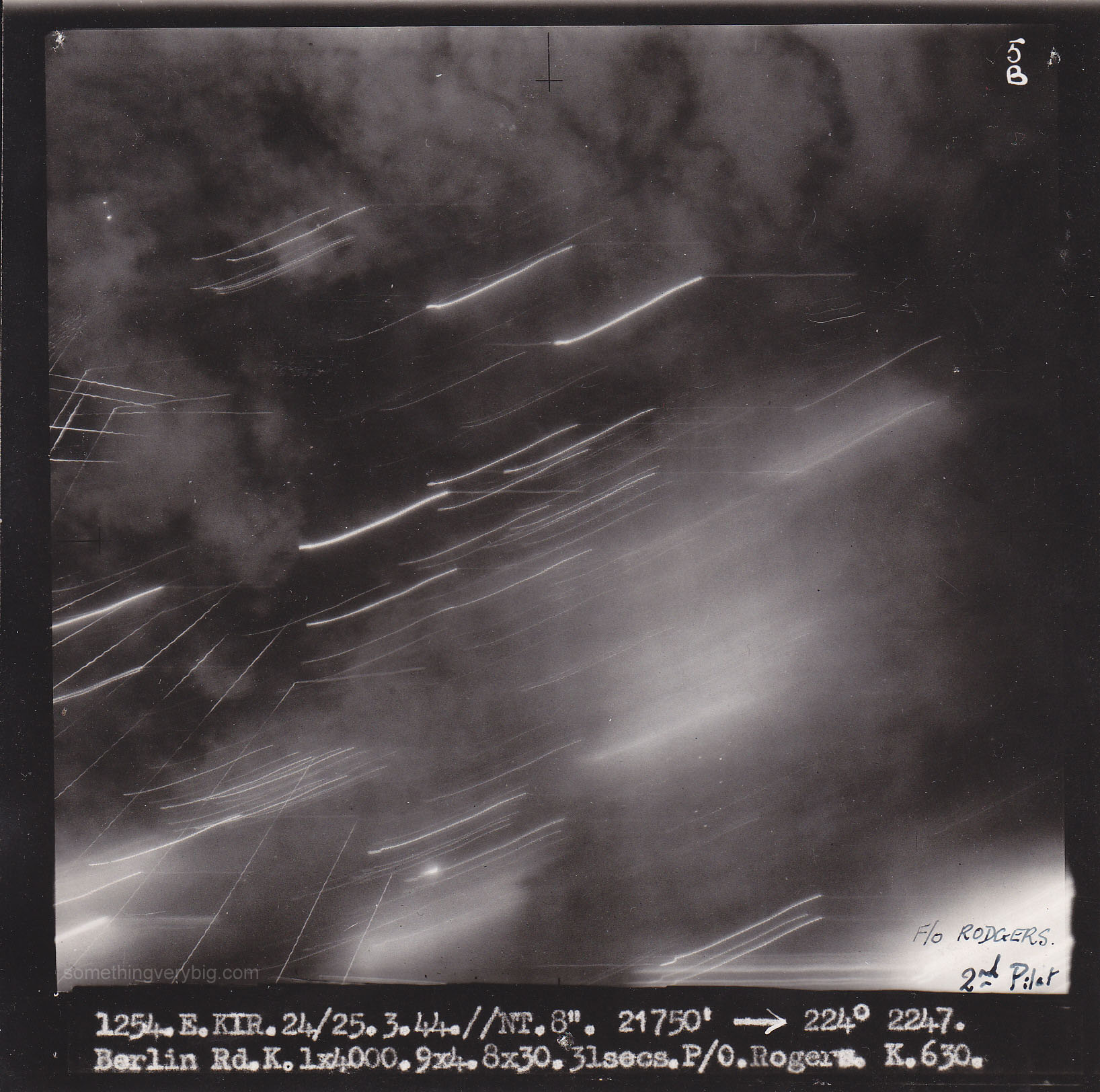
Squadron Leader Phil Smith and his crew bombed target indicators burning on the ground, visible through “thin filmy cloud.” Their bombing photo showed “fire and cloud.”[5] It probably looked something like this one, though this is from a different crew and was taken some eleven minutes later:

Berlin under attack. Photo from the Wade Rodgers Collection, courtesy Neale Wellman

After bombing, the plan was to continue on past Berlin for some 40 miles before turning to the west near Luckenwalde, to avoid known areas of heavy defences. But the wind was still making navigation difficult and many crews wandered. As a result, the Night Raid Report records that aircraft were engaged by defences at places significantly off the planned track: Leipzig, Münster and Kassel without apparent casualty, and Magdeburg, where four victims fell to flak and two to nightfighters, Nordhausen  where one bomber was shot down by a nightfighter, and Osnabrück (six to flak and one to a nightfighter).

But it was the Ruhr area that aircrews feared the most, and though a dogleg to the north had been designed into the route to avoid it, disbelieving crews found themselves flying into what at the time was probably one of the most heavily defended areas from air attack on the planet. The experience of Warrant Officer Clayton Moore’s crew was probably not unique: [6]

 An unusual and most heated argument blew up between our Captain (Bill Siddle) and the Navigator (Dick Lodge) concerning our position. Siddle insisted that we were heading for the heart of the dreaded Ruhr and the Navigator insisted this was far from being the case: he was using the latest wind speed and direction radioed from Bomber Command, anyway, we were in the centre of the bomber stream – we couldn’t all be wrong and off course! […] Finally, the argument ended with the Navigator being invited up to the flight deck to ‘see this bloody lot ahead for yourself’. There followed a brief pause in the dialogue after which the Navigator was heard to remark, ‘You’re dead right Skipper, that is the Ruhr – let’s get to hell out of it…’

No fewer than seven bombers fell to the Ruhr flak guns. It was, said Flight Sergeant Roland Cowan afterwards, “no fun.”

The extent of the navigational chaos became clear when crews got pinpoints upon crossing the enemy coast on the way home. The crew of B for Baker came out 20 to 30 miles south of track, and they were not unusual. At least six other 463/467 Squadron crews reported the same thing. But all the Waddington aircraft returned safely, two diverting to nearby Metheringham.[7]

This was the sixteenth and last of the mass raids on Berlin (though the Light Night Striking Force – Bennett’s Mosquitos – would continue to harass the city until the end of the war). It was also by far the most expensive. In all, 72 bombers failed to return, almost nine percent of the force sent. This operation was a good example of how things could go wrong for Bomber Command, even with mechanisms in place to impart some flexibility in case things changed after the bombers had taken off. The ‘floating’ zero hour concept and the Broadcast Winds system were good in theory but as seen on this raid Bomber Command was by this time a very large and complex organisation and just one error could cascade throughout the entire raid. In this case that error would appear to have been misjudging the true strength of the wind which then led directly to navigational difficulties. In an effort to reduce losses, Bomber Command’s tactics at the time involved an organised ‘stream’ flying a carefully designed route that would avoid known areas of heavy defences wherever possible. Accurate navigation to remain in the (relative) safety of the stream and to stay clear of those ‘hot’ zones was therefore critical. Navigating to the required standard of accuracy was very difficult without an accurate wind value and as seen particularly in the Ruhr area on this trip, wandering off track could have disastrous consequences. When the error was made by a single navigator, just one aircraft blundered over a defended area and could have been shot down. But when it was in the ‘official’ broadcast winds it became a systemic error and affected the entire bomber stream, causing loss rates like those seen on this Berlin raid.

There were two other interesting incidents that also occurred on this night. One of the aircraft that failed to return from Berlin was DS664 of 115 Squadron. Somewhere near Schmallenberg (east of Kassel and, unsurprisingly, well south of the planned homeward track), it was shot down by a nightfighter. Four members of the crew died and two made successful parachute jumps, but the rear gunner’s ‘chute had been damaged during the attack. Sergeant Nicholas Alkemade jumped anyway, apparently preferring death by impact than by fire. Incredibly, his fall was apparently broken by a fir tree and he landed in a deep snow drift, surviving with only a few superficial cuts and bruises. He was captured by the Germans (who naturally were reportedly suspicious of his story) and remained a prisoner for the remainder of the war.

The other episode is perhaps one of the most famous stories of all that came out of the Second World War. At a camp known as Stalag Luft III, seventy six prisoners of war escaped through a tunnel dug out under the wire. The Great Escape, as the episode became known, would turn to tragedy. Seventy three of the escapees were recaptured and fifty were executed as a result. Just three of the men made ‘home runs’. Stalag Luft III was near the town of Sagan (now Zagan in Poland), about 100 miles south east of Berlin. It’s not inconceivable that while they were breaking out, the escapees could hear the bombs as the attack on the German capital progressed.


This post is part of a series called 467 Postblog, posted in real time to mark the 70th anniversary of the crew of B for Baker while they were on operational service with 467 Squadron at RAF Waddington, Lincolnshire. See this link for an in-depth explanation of the series, and this one for full citations of sources used throughout it. © 2014 Adam Purcell

Sources:


[1] Conway 1995, p.130

[2] Night Raid Report No. 562

[3] Conway 1995, p.130

[4] Pilot Officer Dechastel of 463 Squadron in the ORB, 24MAR44

[5] 467 Squadron ORB and Smith, Phil, Flying Logbook, 24MAR44

[6] Quoted in Searby 1991, p.88. 

[7] Flying Officer Bill Felstead in DV372 and Anthony Tottenham in JA901

467 Postblog XLVIa: Friday 24 March, 1944

Since 18 November 1943, Bomber Command had made no fewer than fifteen major attacks, each of 380 aircraft or more, on Berlin. The last time the Main Force visited the German capital had been in mid February, more than a month ago, and there were some who believed that “we might well have finished with Berlin.”[1] But they were wrong.

It was a dull and hazy Friday morning at Waddington on 24 March and the two Australian Squadrons received word that an operation to the Big City was to be laid on for that evening. Some Pathfinder squadrons, looking at the prevailing poor visibility and chance of further fog in the evening, were expecting a cancellation about lunchtime. Indeed, John Searby writes that a planned American day raid to Berlin had been cancelled on the strength of a weather recce flight which found solid strato-cumulus from the German coast all the way to Nordhausen.[2]  But a mid-morning flight discovered that, as forecast, the cloud had begun to break up along the route for that night’s planned raid, so it was decided to go ahead. Also on the forecast was a strong north-westerly wind of up to 60 miles an hour. “For the assembled crews in the many briefing rooms throughout the Bomber Groups it was very much the mixture as before”, wrote Searby. “The navigators shrugged their shoulders – a strong headwind pulled back the groundspeed on the way home but it was nothing new.”[3]

As well as more than 800 aircraft in the Main Force, various other diversionary operations were planned for the evening. Eleven Mosquitos were to fly ahead of the Main Force across Denmark dropping Window as they went, then turn south and bomb Kiel. Nineteen more Mosquitos, led by two Pathfinders equipped with H2S, were to bomb Berlin ten minutes before the Main Force arrived, dropping Window and spoof fighter flares. 150 aircraft from Operational Training Units would make a sweep west of Paris, without dropping any bombs, as a distraction while the Main Force was on its way to Berlin. Meanwhile other Mosquitos were to attack Münster and Duisburg and airfields in Holland and Belgium, and carry out Serrate patrols.[4]

467 Squadron put nineteen crews on the battle order for tonight, and 463 mustered up fourteen. There appears to have been a delay taking off from Waddington, perhaps caused by a wait for bombs to be loaded. Many crews reported needing to try and make time up enroute and indeed one crew, ten minutes behind the last bombers in the stream at the first turning point on the route (near Hull), decided that was too much and, after jettisoning their bomb load half way over the North Sea, returned to base.[5] This was one of four crews to return early to Waddington.

The bomber stream headed north east over the North Sea towards Denmark. They were well out to sea when the first signs of trouble began to appear. Flight Lieutenant Dan Conway was the pilot of a wind-finder crew from 467 Squadron. While still in Gee range, his navigator Sergeant Joe Wesley calculated a wind from the north that was considerably stronger than that forecast. “He expressed his surprise to me”, wrote Conway after the war,[6] “and I told him that if that was his considered finding to report it back [to base].”

Wesley’s wind report was one of many received by the various squadrons and passed on to Command Headquarters. It would appear that the commanders decided that the wind could not possibly be as strong as the reports they were receiving, so the ‘Broadcast Winds’ were reduced to what they considered a more appropriate level.[7]

Calculating their courses using a broadcast wind value that was some twenty to thirty miles an hour less than reality meant that most crews in the Main Force were now being pushed south much faster than they expected. The result was that the stream began to scatter as aircraft wandered over the heavily defended areas that the route had been carefully designed to avoid. The Germans drew first blood at Sylt (twenty miles south of the nominal track) where six bombers fell to heavy flak. Four more were shot down at Flensburg[8] and some crews were crossing as far south as Kiel.[9] Up to seven more aircraft are believed to have been destroyed by flak on the outward journey at locations that are not recorded in the Night Raid Report.

It was also as the crews crossed the Danish coast (or German, depending on how far south they had drifted) that the enemy nightfighters arrived. Having quickly recognised the Paris sweep as the distraction it was, the fighter controllers sent their aircraft to the Hamburg-Heligoland area. The fighters got stuck into the bomber stream early, destroying two each at Sylt and Flensburg and one each at Rostock and Prenzlau. Searby quotes a Flight Lieutenant Moore of 83 Squadron: [10]

German night fighter activity was the fiercest I had ever known it to be and so many aircraft were being shot down in our vicinity that we stopped recording them and detailed all available crew members to maintain a sharp look-out.

Somewhere enroute, the half-hourly Group broadcast also included a change to the planned zero hour, bringing it forward by five minutes. This was a result of the stronger than forecast winds aloft and in recognition that the southerly run in to the target would be completed with a significant tailwind. The alteration, however, caused much confusion. The 463 and 467 Squadron Operational Record Books are full of comments like these:

We heard T.O.T. alteration but as we were late it made us even later. (Flight Lieutenant Jack Colpus)

Earlier T.O.T. unexpected and impossible to make up time already wasted. (Pilot Officer Leo Ainsworth)

Briefed for fixed T.O.T. and arranged timing for same but received W/T message z-5. No chance at all to catch up on this timing. (Flight Sergeant Roland Cowan)

Received zero hour correction, it made no difference to us as we were already late due to delay before take off. (Squadron Leader Phil Smith)

Perhaps these crews had not yet grasped the true wind situation. Other comments in the ORBs were much more positive, and Dan Conway even called the correction “very helpful as we were already running early.”

Next post: The bombers arrive over Berlin.

This post is part of a series called 467 Postblog, posted in real time to mark the 70th anniversary of the crew of B for Baker while they were on operational service with 467 Squadron at RAF Waddington, Lincolnshire. See this link for an in-depth explanation of the series, and this one for full citations of sources used throughout it. © 2014 Adam Purcell

Sources:


[1] Searby, John 1991, p.90

[2] Ibid., p.127

[3] Ibid., p. 124

[4] Night Raid Report No. 562

[5] Flight Lieutenant Walter Marshall and crew in ED953 – 467 Squadron ORB, 24MAR44

[6] Conway, Dan 1995, p.130

[7] Searby, 1991, p.141

[8] Night Raid Report No. 562

[9] Pilot Officer Milton Smith of 467 Squadron reported this in the ORB, 24MAR44

[10] Searby 1991, p.88