467 Postblog XLIV: Wednesday 22 March, 1944

Four nights ago, forty Waddington aircraft took part in a highly successful attack on the German city of Frankfurt. On each of the three days immediately after that raid, the crews were briefed for more operations but each time the trips were scrubbed. They were briefed again on 22 March and – finally – this time they went. The target again was Frankfurt, and it was to be another big raid with more than 800 aircraft sent.

The night’s ‘offering’ from 463 and 467 Squadrons was 36 aircraft. Among those on the battle order was Phil Smith and his entire crew: Ken Tabor, Jack Purcell, Jerry Parker, Dale Johnston, Eric Hill and Gilbert Pate. They took Lancaster R5485 to see if they could work out why multiple crews had complained that it would not take a full bomb load to a Lancaster’s normal operating height. Also flying tonight, on their first trip, was Flying Officer Dudley Ward and crew. It’s likely that they had been listed to fly on the last few scrubbed operations, and one suspects that they felt trepidation but also a certain degree of relief that their tour was finally underway when they took off at 19.03 in LL881, nineteen minutes behind the first aircraft from Waddington.

One Lancaster returned early. Pilot Officer Bill Mackay and crew encountered significant mechanical trouble in DV240: their starboard inner engine failed at 14,000 feet on their initial climb to cruising height, and along with it went the electrics and intercom in the mid-upper turret, the main compass, the autopilot compressor and the bomb sight. They turned around immediately, jettisoned their bombs and the Operational Record Book shows they were back at Waddington before half past eight.

Other Bomber Command operations tonight involved Mosquitos attacking Dortmund, Oberhausen and airfields in the Low Countries, radio counter-measure sorties, leafleting and Serrate patrols. There was also a large mining effort in Kiel Harbour and the Fehmarn Channel (off Denmark) and diversion raids on Berlin and Hanover.[1]

These last few operations, in particular, were a critical part of the plan, designed to draw attention away from the Main Force attacking Frankfurt. The chosen route for the bomber stream was a novel one. From their bases in England, the bombers flew towards Denmark. Further to the north, and also heading towards Scandinavia, were the 146 Halifaxes and Stirlings of the mining force, on German radar looking for all the world like a significant attack bound for Berlin. But half way across the North Sea, the Main Force suddenly turned south east. Now they looked like they might have been making for Hanover, Brunswick or even via a southerly route to Berlin.

Ahead of the main bomber stream flew a number of Mosquitos. They dropped target indicators, Window and spoof fighter flares near Hanover, then went on and did the same near Berlin. Following Mosquitos then bombed the markers.

The result was confusion on the part of the German fighter controllers. The Bomber Command Night Raid Report describes the “complex movements” undertaken by the nightfighters as they attempted to intercept the bomber stream. Those that took off from airfields in Holland were first sent out over the North Sea following a radio beam to find the bombers before they crossed the coast. Some combats occurred in the Emden area and the first bomber was shot down near Leeuwarden. The fighters next caught up with the stream near Osnabrück, where they accounted for five more. But then, probably deceived by the diversion raid, the fighter controllers announced over the running commentary that Hanover was the main target for the night and many fighters headed that way.

But before they got to Hanover the bombers turned sharply to the south. Many fighters saw this and followed, claiming a further five bombers along the way, and it was here that Pilot Officer Len Ainsworth of 467 Squadron reported seeing “considerable” fighter activity. But it took a full 17 minutes after the first markers had gone down at the real target – Frankfurt – before the controllers directed their forces there. Meanwhile at least two bombers fell to flak near the point where the stream turned. Interestingly some crews reported seeing rockets fired from either the ground or the air in the same area, though it is not known whether these accounted for any bombers.[2]

Not far ahead now was Frankfurt. The weather was clear on the final run in to the target with a little low cloud thickening in patches. Heavy predicted flak was being fired, which later loosened into a moderate barrage called by the Night Raid Report “rather more accurate than on the previous visit.” Numerous fighters were seen and many crews reported that the searchlights were highly active but, as Pilot Officer Clive Quartermaine described them, “a little clueless.” Three bombers were shot down by fighters and four by the ground defences over the target.

Early target marking was bang on. The first six salvoes of Newhaven ground markers, all falling as scheduled before zero hour (which was 21.50), were within a mile of the aiming point and spread on each side of the river running through the centre of the city. Three minutes after zero hour there was already a significant concentration of incendiaries burning in the middle of the city.

Later in the attack the bombing became a little scattered with smaller concentrations developing up to five and a half miles north and west of the aiming point. But it didn’t matter. It had, said Flying Officer Jack Dechastel, “every indication of a concentrated attack.” Flying Officer Jim Marshall described how the “whole of centre of target area” was “well alight.” Phil Smith said it “should be [a] very successful prang if PFF were on target.”[3]
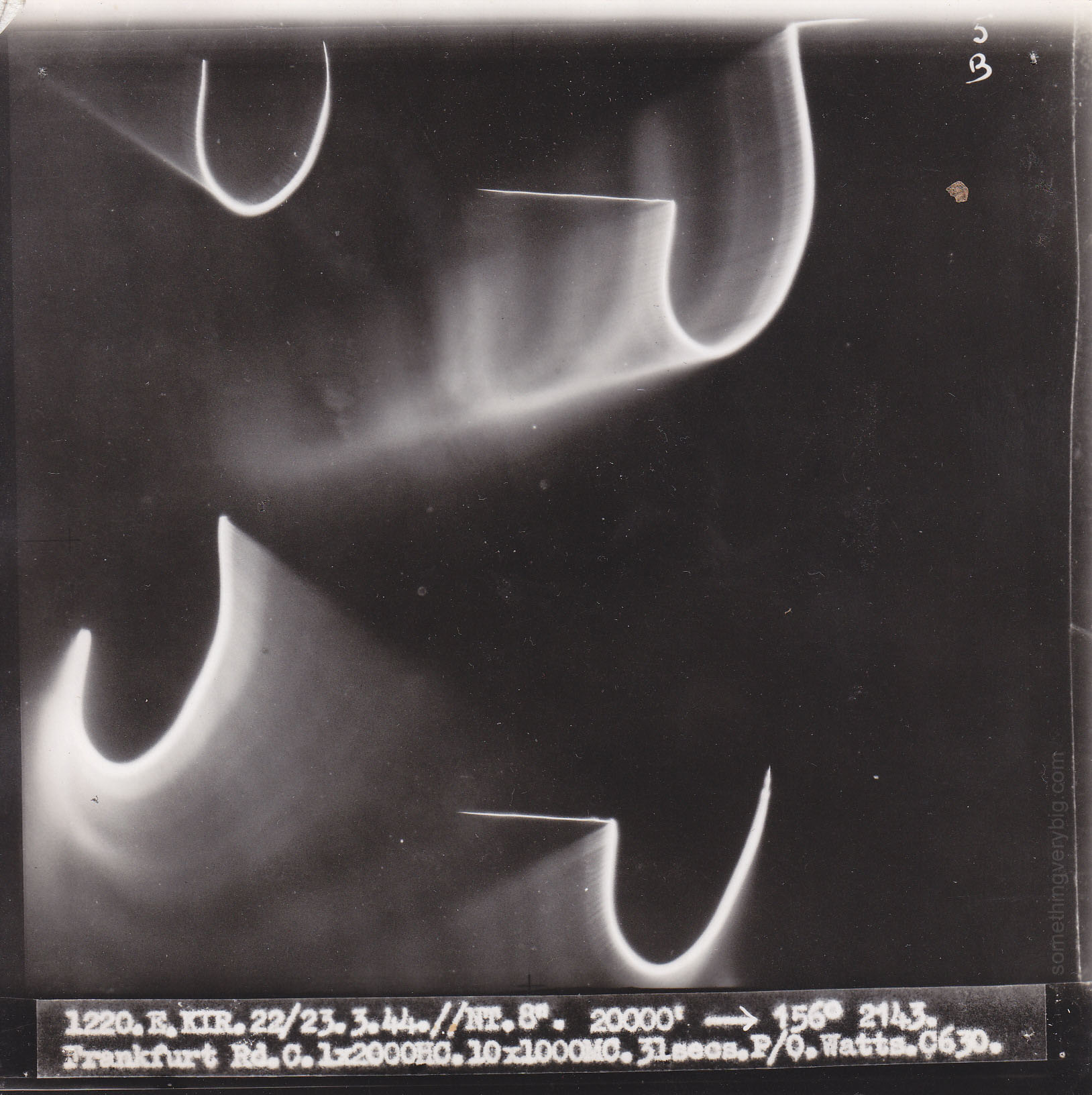
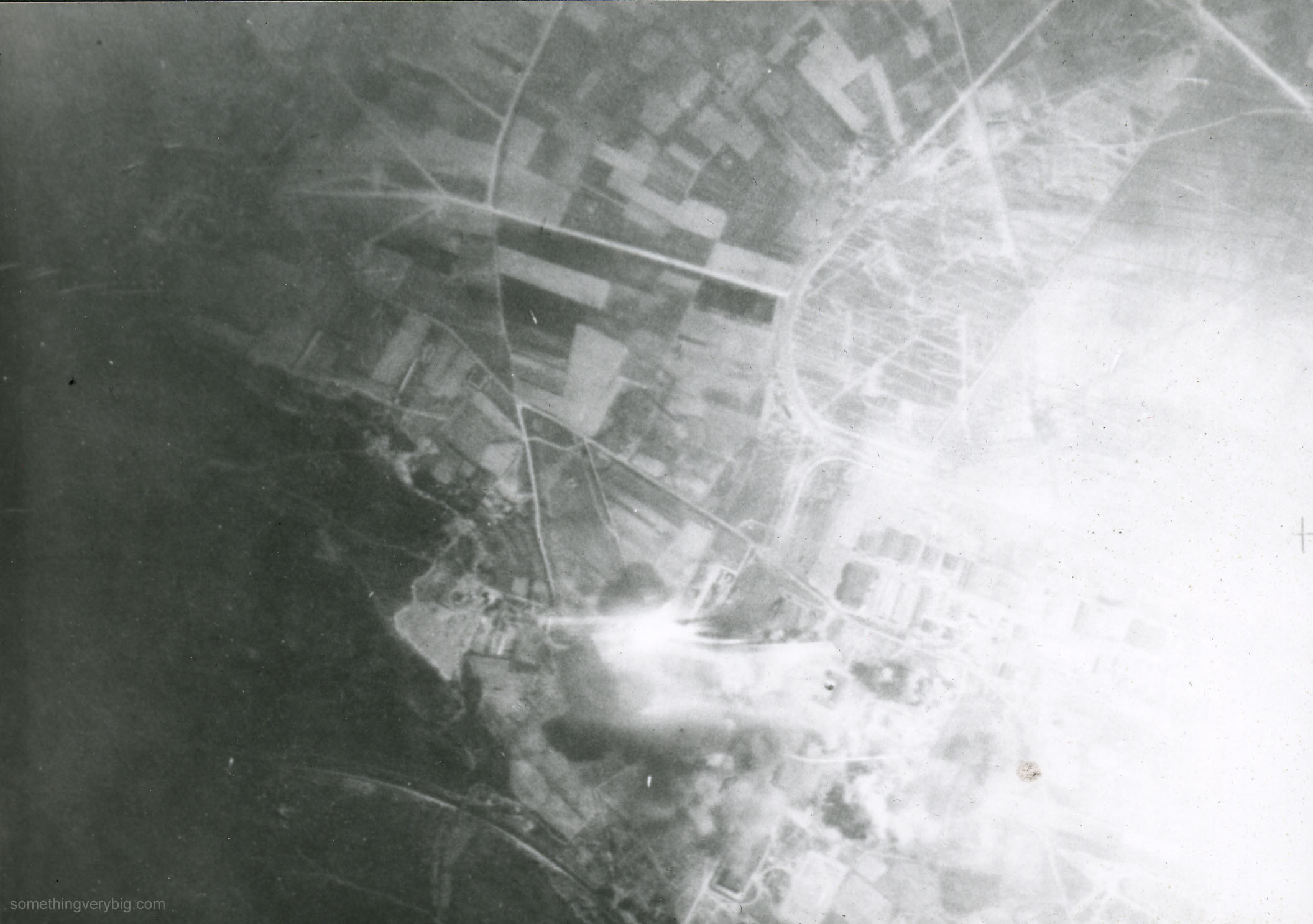
Bombing photo from 21.43. From the Wade Rodgers Collection, used courtesy Neale Wellman

After bombing, the stream carried on beyond the aiming point for a short distance south. On this leg searchlights were quite active and many crews were coned but only one bomber is known to have fallen here. Once again, though, crews were jettisoning incendiaries that had hung up along the route, and it wasn’t making the crews feel especially happy. “Why couldn’t these have been jettisoned in the sea as they light our bombers up?” complained Pilot Officer John McManus, captain of S for Sugar (R5868).

Near Mannheim the stream turned west for a short time (one more bomber being shot down from the ground near Trier), then northwest towards the coast. Over the middle of Belgium the last few casualties were incurred: one aircraft to flak and five to fighters.

All Waddington aircraft returned safely, but not without a couple of scares. In an incident worryingly reminiscent of the loss of ED606 with Pilot Officer Graham and crew on board a week ago, while the two Squadrons were arriving back at Waddington an unknown Lancaster “crossed across [the] centre of [the] aerodrome”, and nearly took out another aircraft. It was well and truly “too close for safety”, and Pilot Officer Victor Baggott, who was flying the second aeroplane, called it the “stickiest” incident of the trip. And Pilot Officer James McManus didn’t notice it at the time but at some stage during the flight it’s likely the tailwheel on the venerable S-Sugar collected a piece of flak. They found out when the tyre collapsed on landing, though no great damage was done. “It is hoped”, remarked the Operational Record Book drily, “that the rear gunner wasn’t in his turret or he would have had a rough ride.”

In all, 33 aircraft failed to return from this raid, a tick over four percent of the force sent. The effect on Frankfurt, however, was severe. German records[4] said the damage was worse than the earlier raid on the city, and gas, water and electricity services were cut in half the city “for a long period.” Industrial areas to the west of the city suffered badly. This was the second of what turned out to be three major raids on the city inside a week: as well as the two Bomber Command night raids, 162 American B-17s which had been sent to attack Schweinfurt on 24 March could not reach their primary target and used Frankfurt as a secondary instead, causing more damage. The three raids destroyed 90,000 homes, killed 1,870 people and made 180,000 more homeless.[5]

Phil Smith and his crew completed a relatively uneventful trip. They discovered that the old Lancaster – R5485 – did make it all the way to its normal operating height (indeed, they bombed from 21,000 feet, well inside the range of bombing heights recorded in the Operational Record Books), but “only by running the engines at above the recommended maximum temperatures.”[6] Less experienced crews, perhaps, had not been prepared to run the engines over temperature and so could not use full power – which explained the aircraft’s reluctance to climb when fully laden. Armed with this information, the Squadron’s engineers decided it was a cooling problem and replaced all of the machine’s radiators. Following the work there were no further complaints about the aircraft, and the mystery had been solved.

This post is part of a series called 467 Postblog, posted in real time to mark the 70th anniversary of the crew of B for Baker while they were on operational service with 467 Squadron at RAF Waddington, Lincolnshire. See this link for an in-depth explanation of the series, and this one for full citations of sources used throughout it. © 2014 Adam Purcell

Sources:


[1] Night Raid Report No. 560

[2] Flying Officers Graham Fryer and  Eric Scott were two crews who reported these – in 463 Squadron ORB, 22MAR44

[3] Quotes from both ORBs, 22MAR44

[4] Frankfurt city records, as quoted in the RAF Bomber Command Campaign Diary, March 1944

[5] Nordmeyer, Helmut 2006, p.3

[6] Smith, Phil (undated). Recollections of 1939-1945 War, p.22
467 Postblog XLI: Saturday 18 March, 1944

Operations, once again, were on for tonight. It was a big effort from the two Waddington squadrons: between them they got no fewer than forty aircraft airborne. Every crew from 467 Squadron were on the battle order, twenty two in all.[1] “Considering our establishment is 16+4 aircraft,” boasted the Operational Record Book, “tonight is certainly a good one and should be nearly a record for a two-flight Squadron.” The crew of B for Baker were among them, although on this trip bomb aimer Jerry Parker was replaced by the Squadron’s Bombing Leader, Flight Lieutenant Patrick McCarthy. They joined a total of 846 aircraft and crews sent to attack the city of Frankfurt.

As usual, there would be other Bomber Command aircraft out tonight. Almost a hundred of them were sent to lay mines in the Heligoland area, a trip also intended to look to German fighter controllers like a bomber stream possibly headed towards Berlin. A small force of eleven Mosquitos was to make a diversionary raid on Kassel, more Mosquitos attacked enemy airfields in Holland, Belgium and France or flew Serrate patrols to keep the nightfighters occupied and other aircraft flew radio counter-measure sorties. Meanwhile nineteen Lancasters bombed an explosives factory at Bergerac, near Bordeaux in France, with “devastating effect.” In all, more than one thousand sorties were despatched on this night.[2]

The first aircraft departed Waddington for Frankfurt at 18.45. There was one early return, Pilot Officer Jack Freeman and crew of 463 Squadron, though the ORB does not record the reason. Theirs was one of a total of 59 aircraft to abort the flight tonight. For the rest of the force the rendezvous point where the bombers began to form up into a recognisable stream was over the Channel, a position about 25 miles off Ramsgate. The bombers crossed the enemy coast between Dunkirk and Ostend, heading towards the south east.[3] They encountered stiff resistance from flak ships and the coastal defences in this area and it was here that the first casualty of the night fell, shot down from the ground.[4] “Do not recommend routeing in as flak quite active over coastal area,” said Pilot Officer Harold Coulson at interrogation later. Flak would claim one more victim south of Bonn after the stream crossed into Germany.

All across France and Belgium the route appeared free of nightfighters. The simultaneous arrival of two apparent bomber streams, one approaching on a northerly route and the second further south, seems to have induced the German fighter controllers to split their forces. Half were drawn towards the north by the minelaying force. Near the Belgian border with Luxemburg the Main Force turned east north east, onto a leg of some 100 miles that was aimed to appear to be threatening cities like Kassel or Leipzig. It was near this turning point that the first few nightfighters began to catch up with the bomber stream, shooting down four heavies before the target was reached. Most of the defenders, however, had been sidetracked for too long and were too late to make any appreciable impact on the bombers.

The diversionary Mosquitos went on ahead, Windowing furiously, to drop target indicators and high explosive bombs on Kassel and simulate the opening of a major attack on that city. But south east of Cologne the bomber stream altered course to the east before making a sharp right turn over the city of Giessen. Frankfurt – the real target – now lay almost directly to the south, about thirty miles or less than ten minutes flying time away.

One crew had a hair-raising experience at this point in the flight. It was gradually dawning on Pilot Officer Graham Fryer of 463 Squadron, flying in LM438, that his aircraft was behaving “erratically” and the controls were becoming heavier. With about twenty miles to run to the target, and climbing towards their bombing height of about 20,000 feet, the Lancaster very suddenly fell out of the sky in a violent stall. They lost considerable height before Fryer managed to bring the aircraft back under control. Their air speed indicator had been unserviceable for the entire trip and the artificial horizon and rate of climb indicator had both been “sluggish” so it was later realised that the upset had probably been due to severe icing.[5] They bombed from 18,000 feet, a little lower than most, but would return safely to Waddington.

Having failed to fall for the diversion to Kassel, the second force of nightfighters found the bombers as they approached the target. Heavy contrails were streaming in the wake of many aircraft and these were combining with haze and high level cloud, which might have reduced the effectiveness of the fighters.[6] Nineteen crews reported combats over the target but only one bomber was definitely seen to fall to fighters there, though it is likely that one more was also shot down.

The crews found only a thin layer of cloud below their bombing height, but there was much haze and visibility was poor. Even so, the first Pathfinder markers went down reasonably accurately, a minute early at 21.54. The initial markers were promptly backed up and “at no time during the attack”, wrote the scientists in the Night Raid Report, “were the main force without markers to aim at.” The flak guns put up a loose barrage and a large number of searchlights were active, but the haze meant that they were not as effective as usual. Consequently, though four fell to the target guns, the bombers were more or less unimpeded. The stream was so concentrated that Flying Officer Victor Trimble of 463 Squadron, flying ED611, expressed concern that perhaps there were too many aircraft there. They had other bombers on all sides during their bombing run and so could not manoeuvre, thus missing a chance at getting an aiming point photograph.[7] More seriously, they would also not have been able to evade a fighter, or for that matter another bomber: at least two aircraft are known to have been lost in a collision over the target.

A few other crews encountered difficulties over the target. While not many reported seeing any fighters, they were present and two Waddington aircraft were attacked. Flying Officer Arnold Easton, navigator in DV372, recorded in his logbook that his gunners fired at a fighter in the target area. Pilot Officer Noel McDonald in ED732 was attacked by a JU-88 but managed to dive and corkscrew away without a shot being fired. Flying Officer William Felstead was flying R5485, one of 467 Squadron’s ‘older’ Lancasters, on only his second trip as captain. All four engines overheated, necessitating use of a lower power setting which restricted the aircraft to 16,000ft until the bombs were dropped. They bombed from 15,000 and were among the last few aircraft to return to Waddington.[8]

The bombers hit the target hard. “PFF well concentrated,” said one 467 Squadron crew. “Good prang.”[9] At least two large explosions were reported by numerous crews during the attack. Bombing had strayed a little to the east of the centre of the city, but the docks received heavy damage and bombs had also fallen throughout the built-up area.[10] The last aircraft from Waddington to bomb was EE143 with Pilot Officer Ron Llewelyn at the controls. The aircraft (EE143, Phil Smith’s old one) would not fly faster than about 140mph indicated which made them late on target, bombing at the tail end of the attack at 22.19.

The bombers continued on their southerly track after bombing for another twenty or so miles, leaving the target with fires beginning to take hold. They were followed out by the nightfighters, which claimed three more victories over the first part of the homeward route. Two more bombers fell to flak near Darmstadt, just before the stream turned almost due west to point their noses towards home. Near the town of Morbach the bombers adjusted course slightly to the north west for the long journey to the coast.

At least seven crews complained bitterly that, once again, after leaving the target and for the rest of the way home some aircraft had jettisoned incendiaries that had hung up. “I wish blokes wouldn’t drop incs. all along track,” said Flight Sergeant Roland Cowan. Flying Officer Jim Marshall was more direct: “This lights up [the] track taken back by [the] Bomber Stream,” he said, “and causes much cursing.”[11]

Sadly, it probably caused more than cursing on this trip. It was on the long leg back to the coast that the first force of nightfighters – which had been kept to the north by the threat posed by the mining force earlier in the night – caught up with the stream. They are likely to have claimed two more bombers here. One more aircraft simply disappeared without trace.

The first aircraft arrived back at Waddington at 00.38. When Noel McDonald touched down in ED732 a little more than an hour later, one aircraft was still missing from the 463 Squadron dispersals. Pilot Officer James Gardner and crew, in EE191, were among the 22 aircraft which failed to return from Frankfurt, crashing just east of Frankfurt with the loss of all crew.[12] Their aircraft was on its 115th operation. The Night Raid Report also records that 34 bombers were damaged on the raid and two Lancasters got home but were wrecked in landing accidents. Two other aircraft collided in mid air but “luckily escaped without serious injury.”

For such a large target and force of bombers sent, this was a remarkably small loss rate. On the other side of the ledger, the bombers shot down three German nightfighters, and the Serrate Mosquitos accounted for three more near Frankfurt. No further Bomber Command losses – other than the 22 Main Force aircraft – were sustained during the night’s operations.

It had been one of the more successful operations of its type: while just 64 aircraft were definitively plotted as having bombed the target area, at least 180 and possibly as many as 626 were believed to have bombed within three miles of the aiming point. The exact damage caused to Frankfurt was unable to be determined because photographic reconnaissance was not available until after further attacks on the city by separate British and American forces, but all three raids together caused considerable damage, hitting industrial and transport facilities as well as commercial and residential premises throughout the city.

This post is part of a series called 467 Postblog, posted in real time to mark the 70th anniversary of the crew of B for Baker while they were on operational service with 467 Squadron at RAF Waddington, Lincolnshire. See this link for an in-depth explanation of the series, and this one for full citations of sources used throughout it. © 2014 Adam Purcell

Sources:


[1] Details of force sent from Waddington in 463 and 467 Squadron ORBs, 18MAR44

[2] Details of tonight’s operations come mainly from Night Raid Report No. 556, supported by the RAF Bomber Command Campaign Diary, March 1944

[3] Route details recorded in Arnold Easton’s logbook and plotted on Google Earth

[4] Locations of casualties throughout this post from Night Raid Report No. 556

[5] Episode described in 463 Squadron ORB, 18MAR44

[6] Several crews reported contrails; among them Wing Commander Sam Balmer and Flight Lieutenant Jack Colpus, both in 467 Squadron ORB 18MAR44

[7] Reported in 463 Squadron ORB, 18MAR44

[8] 467 Squadron ORB, 18MAR44

[9] F/L W.D. Marshall, in the ORB 18MAR44

[10] Night Raid Report No. 556

[11] Both quotes from 467 Squadron ORB, 18MAR44

[12] Storr, Alan 2006

467 Postblog XXXVI: Thursday 9 March, 1944

It was on.

Eleven crews from each Waddington squadron discovered at briefing that tonight they would use the special tactics that they had been learning over the last few days. The target was an aircraft factory at Marignane, near Marseilles – a long stooge south into France. Half of the 44 aircraft detailed for this raid came from Waddington. 9 Squadron at Bardney and 50 Squadron at Skellingthorpe made up the rest.[1]

For Phil Smith and his crew, this would be their first operational flight in B for Baker. Squadron Leader Bill Brill, flying LL790, led the two squadrons away at 20.19 hours. The bombers flew across France at fairly low level (10,000 feet), in good visibility and bright moonlight. They even went far enough to see the Swiss Alps from the air. “It has always been my ambition to see Switzerland though I should like to get a closer look”, Phil commented wryly when describing the incident in a letter written to his sister a few days later.[2]

It was a thoroughly uneventful trip. “It turned out a bore”, wrote Dan Conway.[3] “Everything was quiet, which possibly stretched our nerves more than usual.” The operation did not entirely go to plan however. A Gee coding failure made the use of that navigation aid difficult, and a number of pilots (including Phil Smith) later complained[4] that the incendiaries marking the rendezvous point – from which the timed bombing runs were planned to begin – were badly placed, leading to a delay in locating the target (one crew, who arrived at the rendezvous point with everyone else, would fail to find the target at all and ended up bringing their bombs home[5]).

But in the end it didn’t matter much. There was a little flak around but not much. Revelling in the complete lack of nightfighters, the bombers circled around the target area while waiting for the red spot fire target marker to be dropped.

And then they blew the factory out of existence. Most aircraft bombed between 8,000 and 10,000 feet, though Wing Commander Arthur Doubleday and Squadron Leader Bill Brill were right down at 6,000 feet when they dropped their cargo. While some incendiaries appeared a little scattered, many crews reported seeing their high explosives bursting on the target buildings and one (Flight Sergeant Eric Page in HK595) even claimed to have felt the blast of his own bombs. A large explosion, “orange-red in colour and lasting 2-3 secs”[6] was seen at 01.30, in the middle of the attack, followed by a thick pall of smoke reaching up to six or seven thousand feet. “Should be a complete wipe-out,” reported a very satisfied Pilot Officer Clive Quartermaine later.

There was a little excitement over the target for the crew of B for Baker. On the run-up to the target, Phil Smith heard an urgent call from Eric Hill in the mid-upper turret:

Weave, Skipper, weave – there’s a bloke right above us with his bomb doors open and I can see the eggs hanging there!

With all the aircraft milling around in the target area, however, evasive action was impossible. The crew nervously watched and waited, but eventually the other aircraft drifted off to one side and they carried on to drop their bombs “none the worse, apart from being frightened.”[7]

The bombers left the target well pranged with a mass of fires burning, and much smoke and dust rising. The Night Raid Report[8] lists a catalogue of damage:

All the buildings of the factory had been damaged, especially the assembly shops, the heat treatment shops, M/T. park, stores, and flight and repair hangars. The adjacent airfield also suffered heavily, many hangars and administration buildings being affected by fire and blast. Hits were scored on roads bounding the site and on the internal network of roads

It had been an extraordinarily accurate raid, with eight out of ten successful 467 Squadron crews scoring aiming point photographs. The only two to miss out were the leaders, Balmer and Doubleday, who both suffered photographic failure.[9] Despite circling the target for over half an hour, out of the total force of 44 Lancasters just three received minor flak damage and nightfighters were entirely absent.

Marignane, well and truly under attack. Photo: The Waddington Collection, RAF Waddington Heritage Centre

Flight Lieutenant Dan Conway’s crew encountered a little trouble on the homeward leg when their port outer engine apparently overheated and needed to be feathered.[10] As forecast, fog formed at Waddington overnight rendering the airfield unusable so the entire force was diverted to Cornwall. 463 Squadron were sent to Predannack, a nightfighter base in the south, where Wing Commander Rollo Kingsford-Smith complained they landed “in poor visibility without any flying control assistance of any kind.”[11] 467 Squadron went to St Eval, a Coastal Command base on the western coast. With the sudden influx of crews accommodation was at a premium. After nine hours and fifty minutes in the air Phil Smith in B for Baker was the last to land (at 06.30), so they would have had to make do with whatever they could scrounge.

Elsewhere, eight Mosquitos bombed Dusseldorf and two made Serrate patrols over the Continent. No aircraft were lost from the night’s operations.[12]

This post is part of a series called 467 Postblog, posted in real time to mark the 70th anniversary of the crew of B for Baker while they were on operational service with 467 Squadron at RAF Waddington, Lincolnshire. See this link for an in-depth explanation of the series, and this one for full citations of sources used throughout it. © 2014 Adam Purcell

Sources:


[1] This was a 53 Base only operation, notes the ORB. The other two stations under 53 Base, apart from Waddington, were Bardney and Skellingthorpe, each hosting one squadron (9 and 50).

[2] Smith, Phil, Letter to sister Wenda, 11MAR44

[3] Conway, Dan (1995), The Trenches in the Sky, p.128

[4] Reports are in both the 463 and 467 Squadrons ORBs, 09MAR44

[5] This was P/O H.W. Coulson in DV240 and the 467 Squadron ORB records that, despite almost getting there, he and his crew would not be awarded credit for this operation.

[6] F/O M.F. Smith in LL788, in 467 Squadron ORB, 09MAR44

[7] Smith, Phil, Phil’s Recollections of 1939-1945 War, p.21

[8] No. 547

[9] 467 Squadron ORB, 10MAR44

[10] Conway, 1995 p.128

[11] 463 Squadron ORB, 09MAR44

[12] Night Raid Report No. 547

467 Postblog XXXII: Thursday 2 March, 1944

Another one of those night jobs

– Gilbert Pate, annotation on a newspaper report about the Stuttgart trip that he sent to his family

More than 550 aircraft were in the bomber stream headed for Stuttgart in the very early hours of Thursday morning. They were over thick cloud for most of the way and this, combined with an apparent overall failure of the Gee navigation aid, made work difficult for the navigators.[1] As expected, the stream was in bright moonlight until about an hour before the target.[2] Nevertheless, the outbound trip was a reasonably quiet one, with only limited flak en-route. Though “the enemy controllers were obviously making real efforts to intercept the stream” and numerous fighters were seen, no attacks were reported and the bombers remained “almost unmolested.” The Munich diversion is likely to have distracted the fighters enough to delay their arrival at the target. [3]

Various crews were dealing with mechanical issues during the approach to the target. Pilot Officer Alan Finch reported intercom trouble, a broken mid-upper turret and a faulty oxygen system. Warrant Officer Jack Purcell, Phil Smith’s navigator in EE143, had to contend with a broken compass on top of the unserviceable Gee system right from the start of the trip. Pilot Officer Jim Marshall, on his first trip with his own crew, lost the use of the Monica early-warning radar an hour and a half before the target. The rear turret failed in Flight Lieutenant Jack Colpus’ aircraft an hour before the target. And five minutes before reaching the target area Flight Lieutenant F.D. Wilson’s flight engineer needed to go to the assistance of the rear gunner whose oxygen tube had split.[4]

The bombers found the target area eerily quiet. Flight Sergeant Ed Dearnaley, bombing towards the end of the attack at 03.16, reported that “all that could be seen was Wanganui flares, some flak bursts and a glow beneath cloud”. Stuttgart was covered in thick cloud with occasional small breaks. There was some heavy-calibre predicted flak but clouds severely restricted the effectiveness of searchlights and most crews considered the defences only slight. Indeed, only a single aircraft would fall to flak over the target. The first Pathfinder markers went down on time but it appears the subsequent marking never achieved the concentration that was hoped for. This was, according to the Night Raid Report, mainly due to poor serviceability of H2S radar among the backer-up Pathfinder crews.

What comes through from a reading of the 463 and 467 Squadron Operational Record Books is a feeling of being somewhat let down by the Pathfinders. Not many flares were actually dropped and those that were tended towards the scattered side.

A single Wanganui skymarker flare was visible when Phil Smith’s crew ran into the target in EE143. Bomb aimer Sergeant Jerry Parker directed his pilot:

Left… left… steady… right right… steeeaaaaady…

Then, with the flare squarely in his sight, he pressed the bomb release button. And…

Nothing happened.

All the bombs had ‘hung up’ and were still firmly in the bomb bay. They were forced to ‘go round again’, turning against the bomber stream to go back and make another run on the target, while Parker tried to work out what was wrong with the bomb release circuit. The second time everything worked and the bombs were dropped manually at 03.13.

Jim Marshall was on his bombing run when his aircraft was attacked suddenly by a FW190. A cannon shell put a large hole in the starboard wing and put the flaps out of action, and another destroyed the radio and set a fire under the wireless operator’s desk, which was put out using an extinguisher. They were the last Waddington aircraft to bomb, at 03.19, and then they turned into the wind and set course for home in their damaged aircraft.[5]

The fighters finally became organised as the bombers left the target. Seventeen combats were reported in the first 100 miles of the return route and three bombers were shot down near Strasbourg as a result. No combats were reported west of that city however, apart from one near Nancy.[6] The rest of the trip home was uneventful for the majority of the force.

The first Waddington aircraft, ED657 with Pilot Officer Bruce Simpson at the controls, touched down at exactly 07.00 on Thursday morning. Just under an hour later the last one arrived (HK536 with Flight Sergeant Eric Page and crew). All Waddington aircraft landed safely, but not all at their own base. Four aircraft had diverted. The headwinds caused Pilot Officer Victor Trimble to land at Tangmere, short of fuel. Flight Sergeant Roland Cowan in LM338 diverted to Dunsfold, presumably for the same reason.[7] Jim Marshall, who had been shot up over the target, nursed his damaged aircraft back to England but decided he had gone far enough and landed at Wittering with no flaps, no W/T radio and not much fuel.

Phil Smith also diverted. The ORB notes his TR1196 radio had failed so he would have had difficulty contacting the control tower at Waddington. Phil apparently decided it was too dangerous to try and ‘push in’ to the circuit without a radio and, with only 40 gallons of fuel left in each wing, he was unable to wait until the last aircraft landed. So he instead landed at Coleby Grange, an airfield just three miles from Waddington. “A bloody awful trip”, he wrote in his logbook afterwards, “with lots of small snags”.

The bombers left Stuttgart with a “deep red” [8] glow visible through the clouds from up to 150 miles away and later on Mosquitos reported several fires scattered throughout the city. Photographic reconnaissance from 9 March revealed “very considerable industrial damage,” although because the 20 February raid appeared to the crews to be much more concentrated than this one did it’s likely that most of the damage was attributable to the earlier operation.[9]

The Night Raid Report lists a number of factories and railway workshops that were severely hit, with some residential areas also damaged. There was no spread of fire.

Against this, Bomber Command lost just four aircraft missing, with two more Halifaxes being damaged beyond repair in landing and taxying accidents on return. “The loss rate is small for an operation of this penetration and strength”, wrote the scientists in the Night Raid Report.

With most aircrews still asleep from the effects of their night’s work, the only activity at Waddington during the day on Thursday was the continued clearance of snow under a sunny sky, five local flights and the arrival of three new aircraft for 463 Squadron, all collected from Coningsby.[10] There was some night flying in the evening, but no operations for the two Australian squadrons.

Other parts of Bomber Command, however, did not sleep. Halifaxes attacked an aircraft factory at Meulan les Meureaux, near Paris, with such a concentrated raid that the Germans abandoned it entirely afterwards. Lancasters from 5 Group attacked an aero engine factory near Albert with similar success. Mosquitos went to the Ruhr and the flying bomb site at Sottevast again, and other aircraft laid mines off France, dropped leaflets and attacked enemy airfields. ‘From the night’s operations”, said the Night Raid Report, “all our aircraft returned undamaged.”

This post is part of a series called 467 Postblog, posted in real time to mark the 70th anniversary of the crew of B for Baker while they were on operational service with 467 Squadron at RAF Waddington, Lincolnshire. See this link for an in-depth explanation of the series, and this one for full citations of sources used throughout it. © 2014 Adam Purcell

Sources:


[1] Three 463/467 Squadron crews – including Phil Smith’s – reported ‘Gee u/s from the start’ or words to that effect in the ORBs

[2] As reported by Pilot Officer H.S.A. Hemsworth of 467 Squadron in the ORB, 01MAR44

[3] Night Raid Report No. 540

[4] All accounts from the 463 and 467 Squadron ORBs, 01MAR44

[5] Account from 467 Squadron ORB, 01MAR44, and an entry in Arnold Easton’s logbook (navigator on this aircraft)

[6] Night Raid Report No. 540

[7] This is a hand-written amendment on the 467 Squadron ORB; no reason is given but Dunsfold is only about 20 miles north of Tangmere and close to the bombers’ route back from making landfall at Beachy Head.

[8] P/O J.W. McManus in R5868 in 467 Squadron ORB, 01MAR44

[9] Night Raid Report No. 540

[10] 463 and 467 Squadron ORBs, 02MAR44

467 Postblog XXXI: Wednesday 1 March, 1944

The snow of the past few days was beginning to thaw on Wednesday, though the work parties were still trying to shift it from the movement areas of the Waddington aerodrome.[1]

Snow at Waddington, 1 March 1944. From the Waddington Collection, RAF Waddington Hertiage Centre

Bomber Command’s Main Force had not operated since last Friday (the 25 February raid on Augsburg) and it was now time to resume their fight against the enemy. The target for tonight was Stuttgart, being attacked in force for the second time in a fortnight.

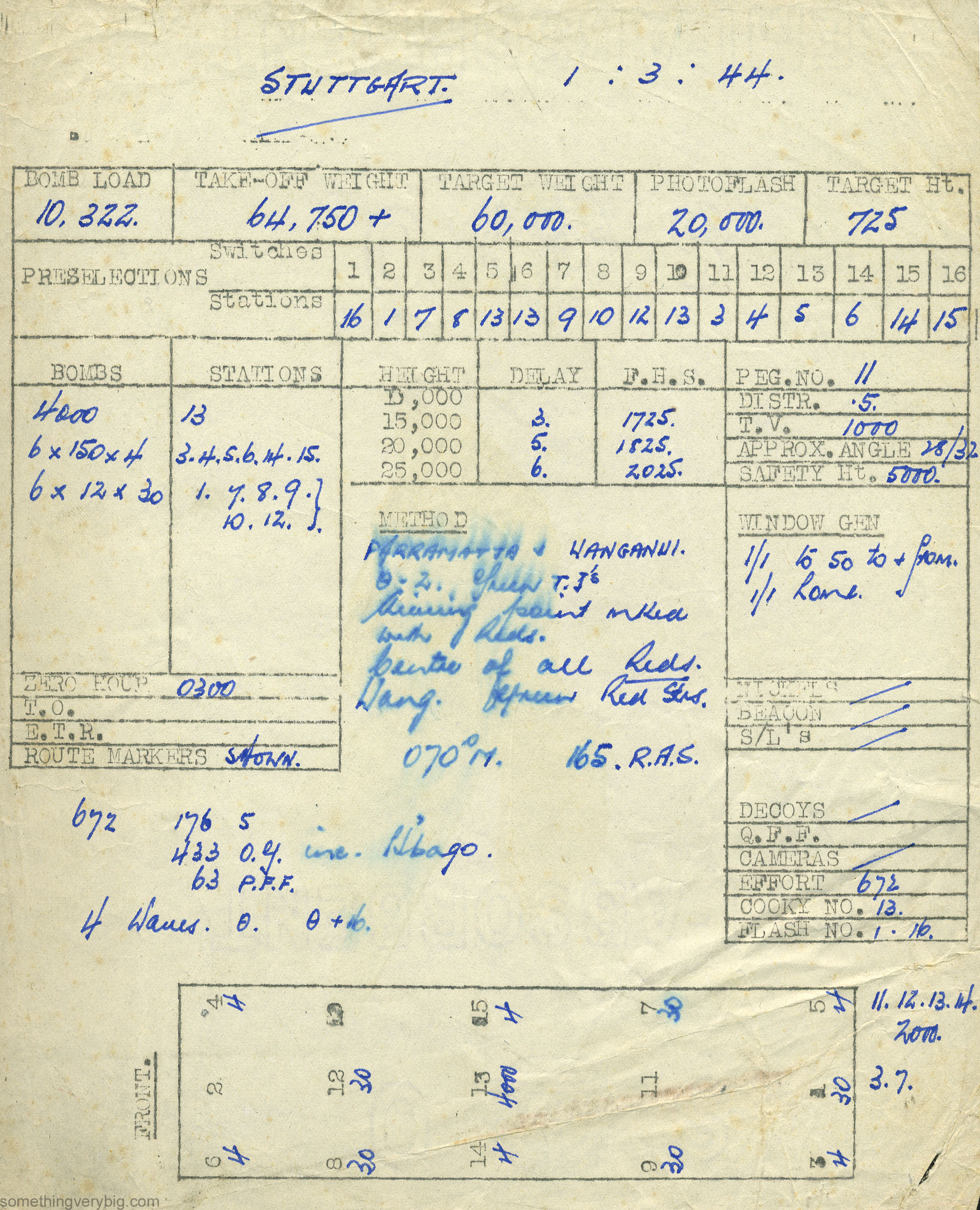
It was not considered practicable to use the ‘splitting’ tactics which had proven so useful in recent raids of this scale because a bright moon was expected to be above the horizon for the early part of the route to the target and strong winds were forecast for the return leg. Consequently the bomber stream was planned on a course keeping south of Strasbourg while the moon was up, and home on almost the shortest possible route.[2] Heavy cloud was forecast along most of the route and so a mixed Parramatta and Wanganui attack was planned using ground target indicators and airborne release-point flares, both dropped using H2S.

Bombing instructions as carried on the Stuttgart trip by Bill Kelleher, Fred Smith's bomb aimer. From the Waddington Collection, RAF Waddington Heritage Centre
Bombing instructions as carried on the Stuttgart trip by Flying Officer Bill Kelleher, Pilot Officer Fred Smith’s bomb aimer. From the Waddington Collection, RAF Waddington Heritage Centre

Supporting the Main Force tonight were small forces of Mosquitos on a diversion raid to Munich and attacking airfields in Holland, six Radio Counter-Measure sorties and ten Serrate patrols. Also planned were a number of Special Duties sorties, some OTU bullseyes and a single Mosquito attacking a flying bomb site.[3]

557 aircraft were sent on this operation. Among them were thirteen Lancasters from 463 Squadron and fifteen from 467 Squadron. Low, icing-type cloud hung over Waddington just before 11pm as the first aircraft, LM458 piloted by 463 Squadron Commanding Officer Rollo Kingsford-Smith, rolled down the runway. Phil Smith, with his normal crew plus the addition of Pilot Officer Bill Felstead, a newly-arrived pilot on a ‘second dickie’ observation flight, was the last to leave, lifting into the murk in EE143 a little more than an hour later.

All available aircraft from 467 Squadron had taken off for this raid (the remainder being ‘Cat A.C.,’ or requiring repair by the manufacturer, according to the Operational Record Book). Three however made early returns, all due to problems with their starboard engines.[4] The Operational Record Book later attributed the three engine failures to the heavy snowfall creating difficulties for the engine fitters working at exposed dispersals.

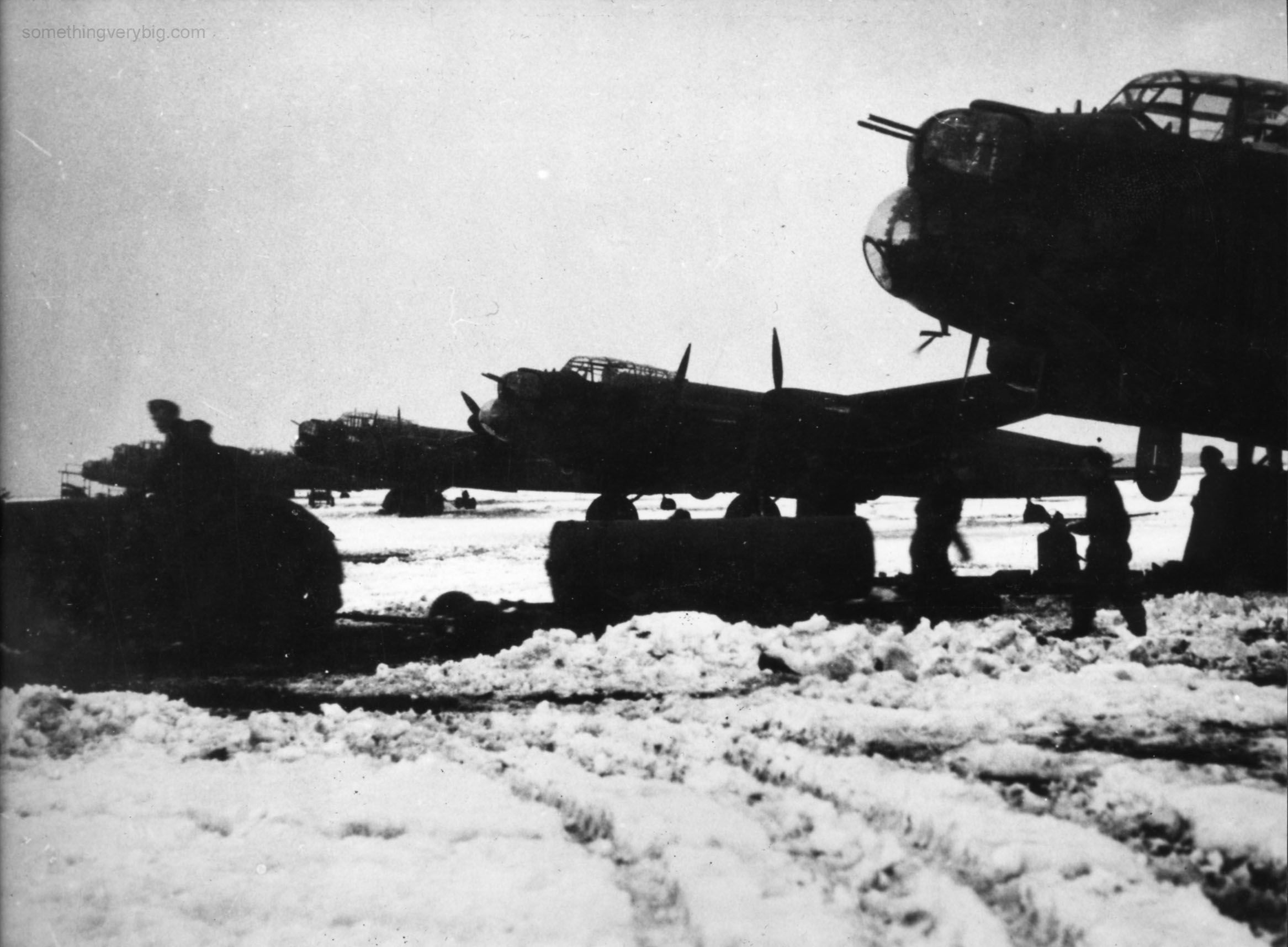
Bombing up for operations in March 1944. From the Waddington Collection, RAF Waddington Heritage Centre

463 Squadron didn’t get off entirely scot-free either with two aircraft making ‘boomerangs’ – one because of frozen guns in the rear turret (thought to have been caused by a faulty valve) and the second due to an oxygen failure in the mid-upper turret. “Being such a clear moonlight night”, reported the crew concerned, “it was too risky to carry on”.[5]

Meanwhile, the Main Force continued on towards Germany.

This post is part of a series called 467 Postblog, posted in real time to mark the 70th anniversary of the crew of B for Baker while they were on operational service with 467 Squadron at RAF Waddington, Lincolnshire. See this link for an in-depth explanation of the series, and this one for full citations of sources used throughout it. © 2014 Adam Purcell

Sources:


[1] 463 Squadron ORB, 01MAR44

[2] Night Raid Report No. 540

[3] RAF Bomber Command Campaign Diary, March 1944

[4] The pilots concerned were F/L W.D. Marshall in LM376, P/O N.R. McDonald in ED532 and P/O W. Mackay in DV240 – 467 Squadron ORB, 01MAR44

[5] P/O C.M. Schomberg was the pilot of ME614 with the rear turret issue (landed 02.03), and P/O A.R.S. Bowman was flying ME573 with the mid-upper issue. He landed at 02.29. 463 Squadron ORB, 01MAR44

467 Postblog XXIX: Friday 25 February, 1944

Despite returning at dawn this morning from Schweinfurt there was little rest for the Waddington crews, with a further operation on the cards tonight. In all, 23 crews were on the battle order to attack Augsburg, again in two waves, three hours apart. Twenty of them had operated last night – and no fewer than ten of those had been in the second wave last night but were scheduled for the first tonight. These unfortunates found themselves once again taking off for Germany a little more than fourteen hours after they had shut their engines down at their dispersals.[1]

A number of crews did not go on this raid. 463 Squadron detailed 13 crews but their Operational Record Book only lists eleven as having taken off. 467 Squadron detailed fourteen but had two crews miss out as their aircraft were unserviceable and not able to be fixed in time. Bruce Simpson, who had diverted to Tangmere after last night’s raid, returned to Waddington by lunchtime but was given the night off. And Squadron Leader Smith and his crew were also off. Though the reason for that is not recorded it was probably due to Phil’s position as Flight Commander. EE143, the Lancaster that they had flown in on their last three trips, was instead taken to Augsburg by Flight Sergeant Roland Cowan and crew. Cowan had been a ‘second dickie’ with Phil in the same aircraft last night.

Tactics used by Bomber Command for this raid were very similar to the Schweinfurt attack. The two waves of bombers (594 aircraft in all – 461 Lancasters, 123 Halifaxes and 10 Mosquitos)[2] were supported by diversionary attacks by Mosquitos on Saarbrucken, Mannheim, Aachen and Schweinfurt, continuing to harass the inhabitants of that town following last night’s large attack. There were also large mining operations in Kiel Harbour and the Bay of Biscay. Three Halifaxes and a Stirling from the mining force failed to return.

The route for the Main Force was once again across France and well into southern Germany – Flying Officer K. Schultz from 463 Squadron reported that “Switzerland looked attractive – like pre-war days” – before turning to the north towards the target. Combined with the diversions, this appears to have successfully deceived the fighters so the Night Raid Report[3] records few combats.

The bombers hit the city hard. The first wave found clear weather over the target and could easily identify the aiming point visually. The Pathfinder markers were extremely accurate. Searchlights and fighter flares were observed by a number of crews but the flak was not particularly strong. Pilot Officer Eric Smith’s gunners claimed a nightfighter destroyed over the target. Pilot Officer John McManus, in R5868 (S-Sugar), was coned over the target for some five minutes but managed to get away.[4] The Main Force left many fires burning and the glow from these was still visible up to 150 miles away.

Those fires made it very easy for the second wave to find the target. They simply added to the fires, though their attack spread a little further towards the south east of the town. Defences by this stage were less formidable: “Searchlights on target a little clueless”, said Pilot Officer Clive Quartermaine.

On the ground, the temperature was so low that fire hoses froze over.[5] The Night Raid Report estimated that 60% of Augsburg itself was devastated, with significant damage also caused in the industrial area between the town itself and the river.

21 aircraft were lost on this operation, twelve from the first wave (one to flak, six to fighters, four to collisions over the Channel and one unknown), and nine from the second (two to flak, three to fighters and four unknowns). Two Waddington aircraft, one from each squadron, were amongst those that failed to return. Pilot Officer Kevin McKnight and crew, in DV274, and Pilot Officer Herbert Stuchbury and crew, in LL746, were all in the first wave. McKnight’s aircraft crashed near Liesse in the Aisne region of France with the loss of all crew members. Stuchbury’s crew, only fairly recent additions to the squadron, had completed just three operations when they crashed near Denklingen in Germany. Again, all were killed.[6]

This post is part of a series called 467 Postblog, posted in real time to mark the 70th anniversary of the crew of B for Baker while they were on operational service with 467 Squadron at RAF Waddington, Lincolnshire. See this link for an in-depth explanation of the series, and this one for full citations of sources used throughout it. © 2014 Adam Purcell

Sources:


[1] Analysis based on details from 463 and 467 Squadron Operational Record Books, 25FEB44

[2] Bomber Command Campaign Diary, February 1944

[3] Night Raid Report No. 537

[4] Reported in the 463 and 467 Squadron ORBs, 25FEB44

[5] RAF Bomber Command Campaign Diary, February 1944

[6] Storr, Alan 2006 – Note this post originally stated that Stuchbury’s Lancaster was LL756 and that it crashed near a place called Deufringen. Subsequent research has revealed that these two facts were incorrect and the text of this post was corrected on 21NOV24, with thanks to Paul Jörg in Germany.

467 Postblog XXVIIIb: Thursday 24 February, 1944

The Second Wave attacks Schweinfurt. This post follows Part A.

Meanwhile, about two and a half hours before the first attack opened over Schweinfurt, crews of the second wave began taking off from their airfields in England. The first two aircraft, one of which was EE143 piloted by Phil Smith, left Waddington at 20.20 hours, part of a total group of 21 aircraft.[1] The bomber stream followed an identical route to that taken by the first wave over the Channel and across to the turning point south-west of Stuttgart, then north to Schweinfurt. Two bombers from the second wave were seen to be shot down by flak at Stuttgart on the way out, and two more at Frankfurt on the way back from the target.[2]

The Americans had badly damaged Schweinfurt during the day, and the first wave of Bomber Command’s attack had added to the fires. In clear weather, Phil Smith thought the glow from the target was visible from up to fifty miles away,[3] and many other crews reported that the whole town seemed ablaze on arrival. The fires were “glowing like a coal fire as we ran in on target,” according to one pilot’s report in the Operational Record Book.

The attack was scheduled to open at 01.05. The first Pathfinder blind marker crews managed to bracket the aiming point with their green target indicators. The visual markers dropped their red target indicators accurately and so the early bombing was also on the target. Once again however the backers-up bombed short and the bombing slowly drifted backwards (though the report notes this time it was only about half as far).[4] Phil Smith’s crew bombed red Pathfinder Target Indicators at 01.16, and Phil later recorded in his logbook that their target photo was plotted about 5,000 yards or nearly three miles south of the aiming point.

It was an eventful few minutes. Phil also noted that both gunners fired at a nightfighter while over the target, the only time that we have clear evidence of Gil Pate and Eric Hill using their guns in anger.[5] This was one of nine combats reported over Schweinfurt.[6] Another was experienced by Pilot Officer Noel McDonald: [7]

Overshot some red TIs by a few seconds owing to approach from stern of a fighter during bombing run, which necessitated corkscrew manoeuvre.

Schweinfurt was well alight by the time the bombers left. Many crews reported still seeing the fires from as far as 200 miles away on the homeward journey.[8] To fox the German defences further, the return route for the second wave differed to that of the first. After bombing, the aircraft overflew the target to the north-east before flying west for 20 miles. From there, instead of continuing roughly westwards towards home, they turned back towards the south and went out the same way they had come in, via Stuttgart and Dieppe.[9] Once again, many crews (including Phil Smith) complained of jettisoned incendiaries up and down the route. “It appears that this has been quite often the case of late”, lamented Flying Officer McDonald.[10]

33 bombers failed to return from Schweinfurt, a total that the Night Raid Report somewhat exultantly calls “a small proportion for so distant a target”.  While 22 of those (5.6% of the 392 sent) were lost from the first wave, just eleven (3.2% of 342) failed to return from the second. The German fighter controllers actually moved their fighters away from Schweinfurt, perhaps not believing that the British could be so bold as to attack the same target twice in one night. Consequently, though at least nine of the total losses could not be definitively accounted for, just four bombers were believed to have actually fallen to fighters during the second wave.[11] (Two Stirlings from the mining force and one Serrate Mosquito also failed to return.) On the other side of the balance sheet, two enemy twin-engined nightfighters were claimed as destroyed by the bombers over both waves.

The new tactics had, at least to some extent, worked.

Reconnaissance photographs were not obtained until 5 March, a week and a half after the raid. They revealed significant damage to the ball bearing factories in Schweinfurt, such that it was estimated that seven weeks’ production was lost by one factory and five weeks’ by the other. Some residential and commercial premises in the town itself were hit, and there was also damage caused in the outlying villages of Garstadt (five miles south-west of the city) and Grafenrheinfeld (two and a half miles).[12]

The initial marking was accurate during both waves, so the early bombing was also accurate and it’s likely that the twenty-two aircraft that got aiming-point photographs were in the initial waves of Pathfinders or Supporters during each phase. The plot of photographs in the Night Raid Report shows that very few aircraft overshot the target. It’s a reasonable assumption that the 260-odd aircraft that bombed within three miles were also in the early stages of the attack, and when the marking drifted outside three miles, so did the bombing (and photographs) of the rest of the force. With these inaccuracies it is however not possible to tell with any certainty which damage had been caused by Bomber Command or what was from the American daylight attack of earlier in the day.

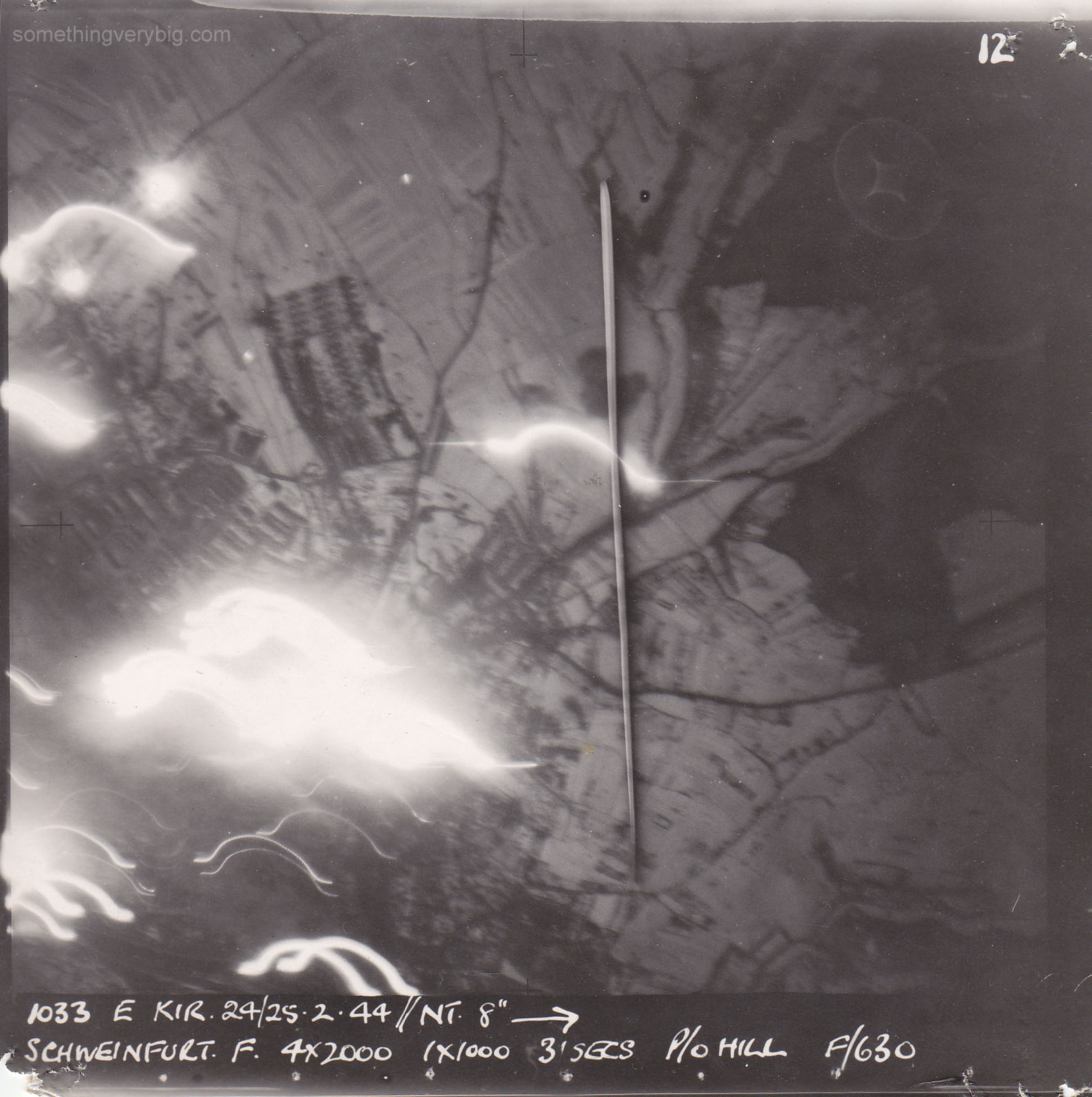
Bombing photo from 630 Squadron of the Schweinfurt attack. Image courtesy Neale Wellman

All 467 Squadron crews returned safely from Schweinfurt, though not entirely free of misadventure. Walter Marshall, in ED953 (with the photographers on board), was shot up by flak, damaging the main plane, tail planes, fuselage and pilot’s Perspex panel. Pilot Officer Bruce Simpson, in ED657, landed at Tangmere short of fuel.

But two bombers from 463 Squadron were still missing from their places on dispersal.

LM444, piloted by Flight Lieutenant Charles Martin, was hit by flak over the target, crashing near Edelshohe, five miles north west of Schweinfurt. The navigator got out and became a prisoner of war but the rest of the crew were killed.

Flight Lieutenant R.J. Mortimer, in LL740, was on his 30th trip. Passing Stuttgart on the way to the target, the aircraft was shot down by a nightfighter. Mortimer kept his blazing aircraft under control long enough to ensure that most of the other members of his crew could bale out, but he and his bomb aimer, Pilot Officer Ian Young, were both killed in the ensuing crash.[13]

This post is part of a series called 467 Postblog, posted in real time to mark the 70th anniversary of the crew of B for Baker while they were on operational service with 467 Squadron at RAF Waddington, Lincolnshire. See this link for an in-depth explanation of the series, and this one for full citations of sources used throughout it. © 2014 Adam Purcell

Sources:


[1] Or possibly 22; see note 9

[2] Night Raid Report No. 536, route plotted on Google Earth

[3] 467 Squadron ORB, 24FEB44

[4] Details from Night Raid Report No. 536. See [this post] for a more detailed explanation of the different sorts of Pathfinder techniques

[5] Interestingly there is no mention of any nightfighter contacts in the Operational Record Book

[6] Night Raid Report No. 536

[7] Night Raid Report No. 536

[8] As reported, among others, by P/O K.H. McKnight in LL790 – 463 Squadron ORB

[9] Route details from Night Raid Report No. 536, and plotted on Google Earth

[10] 467 Squadron ORB, 25FEB44

[11] Night Raid Report No. 536

[12] Night Raid Report No. 536

[13] Storr, Alan 2006

467 Postblog XXVIIIa: Thursday 24 February, 1944

Sat at his window in the Sergeant’s Mess at RAF Waddington, rear gunner Gilbert Pate was in a contemplative mood. The weather had improved from the snow and cold of the past few days, and the knowledge that this meant that operations would be scheduled for tonight made his thoughts turn to home. So as he sat he wrote a letter to his mother. “At present it is a lovely spring morning which makes everyone feel grand + miss home more than ever”, he wrote. “Hope everything at home is going along quite well… I can well imagine the pup is stretched out in the usual place by the back door.”[1]

It appears that Gilbert had some time to spare on this fine morning, for he also wrote to a distant cousin of his father’s. A digger from the First World War who had visited the Pates at home in Kogarah (Sydney) in 1934-5, Raymond Smith (no relation to Gilbert’s pilot) now lived in California. Gilbert had attempted to get in touch with Raymond while he passed through the US en route to England, but spent no appreciable time on the West Coast and so missed him. This letter[2] also shows signs of homesickness: “The sun is shining and it is like a lovely warm spring day in Sydney, just the kind of weather that makes Bondi Beach look an awfully long way off.” Gilbert then explained what he was doing in England:

 Our trips by night are right into the heart of Germany, as the coastal areas of occupied territory’s [sic] are done by the day bombers which as you know are mostly American forces. Between us we are hitting Jerry pretty hard and as you must have done in the last war, I am hoping that the end is just around the corner.

While Gilbert was busy writing his letters, the squadron’s groundstaff were already beginning to prepare the aircraft for the night’s operation. The target was Schweinfurt and was to be attacked by two distinct waves of bombers, two hours apart, a new tactic which Flying Officer McDonald, the compiler of the 467 Squadron Operational Record Book, considered a “grand idea and no doubt the target will be well marked for the last wave.”[3]

Well over 200 American bombers had raided Schweinfurt during the day today – part of their ‘Big Week’ campaign – but this was to be the first time that Bomber Command sent its own crews there.[4] Sir Arthur Harris had been reluctant to divert his forces from the strategy of area bombing but in early 1944 he had been, Martin Middlebrook wrote, “formally instructed” by the Air Ministry to attack the city,[5] which was the home of most of Germany’s ball-bearing industry and thus a vital target. In all, he despatched 734 aircraft to the city: 554 Lancasters, 169 Halifaxes and 11 Mosquitos.

Other aircraft were sent on various feints and diversions to draw German defences away from the main force. Mosquitos carried out intruder Serrate patrols. Mines were laid in Kiel Harbour, the Kattegat and the Bay of Biscay. More Mosquitos carried out precision raids on Aachen and a diversionary attack on Kiel itself.[6] And in a further distraction, almost 180 training aircraft carried out a “Combined Command Bullseye exercise”[7] over the North Sea to a position about 160 miles north east of the Lincolnshire coast, in an attempt to look like a large force headed for Berlin. It was hoped that these diversionary operations, combined with the new tactic of splitting the Main Force into two separate waves to the same target, would deceive the German fighter controllers and so reduce losses on such a deep penetration into Germany.

Phil Smith took a ‘second dickie’ pilot on this trip, Flight Sergeant Roland Cowan, and there were also two members of the RAF Film Unit in ED953 with Flight Lieutenant Walter Marshall. “Last trip they did the shots were shown in all newsreels and most of the daily papers”, boasted Flying Officer McDonald in the ORB.[8]

There were at least nine[9] Waddington aircraft in the first wave, taking off from 18.30. There was one early return: the port inner engine on Flight Lieutenant Jack Colpus’ Lancaster (JA901) caught fire and he was forced to drop his bombs in the middle of the North Sea before returning home on three.[10]

JA901 'Naughty Nan' and her crew at Waddington during the winter of 1943-44
JA901 ‘Naughty Nan’ and her crew at Waddington during the winter of 1943-44. Photo from the Waddington Collection, RAF Waddington Heritage Centre

Meanwhile the rest of the force crossed the Channel, making landfall just north of Dieppe. The bombers headed east-south-east until a point thirty miles south-west of Stuttgart. On this leg, two aircraft fell to flak, one each at Metz and Saarbrucken. The bomber stream then turned towards the north, on a direct track for Schweinfurt.

It appears that the Bullseye and mining forces did distract the nightfighters away from the bomber stream, for a while, anyway. The controllers held many of their aircraft towards the north, perhaps anticipating another heavy attack on Berlin. The fighters were moved progressively further south as the list of possible targets narrowed, and they finally caught up with the bombers about eighty miles before they turned north towards Schweinfurt. In the words of Pilot Officer Clive Quartermaine, it was “very lively” from this point to the target, with “numerous combats” seen. Five bombers went down near Saarbrucken and three between Saarbrucken and the target and two others had fallen earlier in the flight while the stream was still over France.[11]

According to the scientists who wrote the Night Raid Report, the first Pathfinder flares went down over Schweinfurt seven minutes before zero hour. Four minutes later the first of the visual marking crews dropped their red target indicators (one falling within half a mile of the exact aiming point). By zero hour (23.05) the target was well marked. Conditions were clear, with snow visible on the ground. Many crews reported smoke and fires when they arrived over the target, and they left it in an even worse condition:[12]

When aircraft left target area, many incendiary fires burning and several good orange fires – glow could be seen 40 minutes after leaving target area. – Pilot Officer Freddy Merrill in DV274, bombed at 23.11.

On arrival there were some fires and a good deal of smoke, but whether these were from day attack is difficult to say. – P/O John Roberts, in DV374, bombed at 23.12.

Fires well concentrated in one compact area. Streets distinguished by lines of fires. – P/O John McManus in R5868 (the famous S for Sugar), bombed at 23.15.

Some crews had a tough time over the target. During the first phase of this attack, two aircraft were shot down by nightfighters and two more fell to flak over the target itself. Pilot Officer Alan Finch, in DV373, almost joined them, being ‘coned’ in an estimated 24 searchlights for three or four minutes. “Target more formidable than briefed”, he nonchalantly reported on arrival back at base.

Finch bombed at 23.15 hours, just three minutes after Dan Conway, who had an altogether different experience:

Believed A.P. [Aiming Point] over block of warehouses in factory. […]Target defences slight.

Conway managed to sneak through the target entirely unmolested, and considered therefore that opposition had been negligible. Finch got coned and instead considered the defences stronger than expected. Yet they had been in the same general area within three minutes of each other. This is a good example of how big a part luck played in survival on operations.

Conway also believed that he was bang on the target. It would appear, however, based on his time of bombing and assuming he dropped his cargo on the target indicators as briefed, he was most likely actually a good deal south west of the planned aiming point. Though the initial marking had been accurate, as the raid progressed the subsequent Pathfinder backers-up began to suffer from ‘creep-back’ and the bombing fell back along the line of approach. “The main force”, wrote the scientists, “followed the backward drift of the backers-up only too faithfully”. The result was an undershoot of almost six-miles by the time Conway bombed at 23.13. In the end, photographs plotted only seven aircraft as definitively in the target area (though at least 110 more bombed within three miles of the aiming-point).[13]

After flying through and attacking the target, the bombers turned back to the west, to a point between Bonn and Koblenz. From there, they flew over Belgium before crossing the enemy coast near Dieppe again. Many crews reported jettisoned incendiaries along the route, both on the way out and on the way home, a dangerous practice that could attract nightfighters to the bomber stream.

In Part B: The Second Wave

This post is part of a series called 467 Postblog, posted in real time to mark the 70th anniversary of the crew of B for Baker while they were on operational service with 467 Squadron at RAF Waddington, Lincolnshire. See this link for an in-depth explanation of the series, and this one for full citations of sources used throughout it. © 2014 Adam Purcell

Sources:


[1] Pate, Gilbert, Letter to mother, 24FEB44

[2] Pate, Gilbert, Letter to Raymond Smith, 24FEB44

[3] 463 and 467 Squadron ORBs, 24FEB44

[4] RAF Bomber Command Campaign Diary, February 1944

[5] Middlebrook (1973), p.79

[6] Night Raid Report No. 536

[7] Bullseye numbers from RAF Bomber Command Campaign Diary, February 1944; all other details from Night Raid Report No. 536

[8] Smith, Phil, Flying log book and 467 Squadron ORB, 24FEB44

[9] Perhaps there was a tenth; one record in the 463 Sqn ORB has been pencilled in, with a note “Bill Brooker’s log”. No times or any further details are given so it is unclear whether this aircraft was in the first or the second wave.

[10] 467 Squadron ORB, 24FEB44

[11] Night Raid Report No. 536

[12] All in 463 and 467 Squadron ORBs, 24FEB44

[13] Night Raid Report No. 536

467 Postblog XXVI: Sunday 20 February, 1944

A “sticky” trip. Weather poor over base, bags of light over parts of the route and had microphone trouble. – Phil Smith’s logbook

In the very early hours of Sunday morning, thirty five Lancasters droned from Waddington eastwards across the North Sea, flying through light snow and low stratus cloud.[1] They were part of an overall force of 816 heavy bombers and seven Mosquitos en route to Leipzig.

The tactic, to keep the German fighter controllers guessing, was to approach the enemy coast at low level, climbing sharply just before the island of Texel.[2] But because of cloud conditions at the start of the outward route[3] and incorrect wind forecasts[4] many crews found themselves approaching the coast early. They needed to fly ‘doglegs’ to lose time, a dangerous practice in such crowded skies. At least one collision was seen and “it [was] wondered if the concentration [was] not becoming too heavy.”[5]

To further confuse the enemy fighter controllers, other aircraft were heading for a spoof attack on Berlin, a diversionary minelaying operation in Kiel Harbour and attacks on nightfighter airfields in Holland. While the Kiel operation attracted some of the fighters, the remainder were held in reserve probably as a result of the Mosquitos attacking the airfields – and so by what the Night Raid Report[6] called “unlucky chance” they were airborne and not very far away when the bomber stream crossed the coast. Consequently the bombers fought a running battle all the way to Leipzig and not less than twenty bombers were seen to be destroyed on the route out to the target.[7]

Many crews found themselves reaching turning points early, necessitating doglegs and orbits enroute (and even over the target) to try and lose time. This was a difficult trip for the navigators, and the Operational Record Books for both 463 Squadron and 467 Squadron are full of crews complaining about timing and flight planning for the raid:

Considerable inconvenience caused due to flight planning timing being too early. Numerous doglegs. – Flying Officer Dan Conway in LM450

Many aircraft seen doing doglegs up to Posn A, necessitating nav lights on. – Pilot Officer Milton Smith in LL788

Good trip spoilt by very bad timing over whole route, causing orbiting both en route and in target area. – Flying Officer Alan Finch in DV373

Bad trip. Timing all wrong. Had to orbit for 10 minutes to bomb in correct wave. – Flight Lieutenant Alex Vowels in HK356

Winds favourable but arrived 13 minutes too early. – Flight Lieutenant Ron Mortimer in LL740

Despite the best efforts of the navigators, many aircraft arrived over the target early and were forced to circle around the city until the first Pathfinder flares went down (themselves six minutes early, just before four o’clock in the morning), over solid cloud. The attack started in a fairly concentrated fashion but later on became scattered as subsequent marking accuracy reduced. When Phil Smith and crew arrived over the target area, it was quite a sight: there were “fighter flares of all types and TIs of all types spread over a large area” and a “red and white glow showed against [the] cloud.”[8] A heavy flak barrage was being fired at the bombers and though the searchlights themselves could not penetrate the cloud they illuminated its base to silhouette the bombers against it for the nightfighters, which claimed at least another three victims over the city.[9] There were several minutes during which no target indicator flares were burning (from 04.11 to 04.15). It was at the tail end of this period that Jerry Parker released the bombs from EE143.[10] Then they turned tail and dived out of the target area.

The return journey was just a little bit easier than the outbound one. Having initially been sent towards the diversionary mining force, the nightfighters had been in the air for a long time and were running short of fuel. Consequently they “pursued the bombers with less than their usual persistency,” and only four more bombers are known to have fallen victim to them on the way home.[11]

It had, however, been an expensive night. The nightfighters claimed at least 27 bombers and flak at least another twenty. The full toll was much higher. “When we heard 79 were missing we couldn’t believe it” wrote Flying Officer McDonald in the 467 Squadron Operational Record Book.

LONDON, Sunday.- The R.A.F. lost 79 bombers last night in massive air strikes at central and western Germany, France and Holland. The loss is the heaviest the Allies have suffered in any single day or night operation in the war. – The Daily Telegraph, 21FEB44

Though crews began arriving back at Waddington safely from about 06.40 on Sunday morning, there was to be a little bit more excitement before the raid was over. Pilot Officer Noel McDonald encountered difficulties while landing, when his flaps would not go all the way down – until the airspeed bled right back in the flare to land, whereupon they extended suddenly. The nose came up, the aircraft ‘pancaked’ violently, a tyre burst and the undercarriage collapsed. This pulled the Lancaster sideways and the aircraft (LM448) finished up off the runway with damage to its port wing, both port propellers and both fins. Pilot Officer Freddy Merrill, of 463 Squadron, diverted to Leconfield and was the last of the Waddington aircraft to land, at 08.15, perhaps as a result of this crash. Though all crews walked away, when combined with the ground collision before take-off 467 Squadron had badly damaged three aircraft in accidents in a single night. The news was worse for 463 Squadron, however, with one of their aircraft – DV338 with Flying Officer Ernie Fayle and crew – failing to return. It disappeared without trace.[12]

Despite the early morning arrival home from Leipzig today, there was little rest for most of the Waddington crews, with both Squadrons sending aircraft and crews on an operation to Stuttgart. In all 30 aircraft were detailed, though one was not serviceable in time and there were two early returns, both due to engine failures. Phil Smith and his crew were not on the battle order for this trip.

Visibility was excellent over the target (with individual blocks of buildings visible) and the crews considered this “quite a good prang.”[13] Later reconnaissance revealed that the bombing was somewhat scattered, perhaps caused by heavy cloud over much of the target area (except for the clear patch that the 467 Squadron crews reported) but considerable damage was caused to factories and suburbs in Stuttgart. Bomber Command sent almost 600 aircraft on this raid for a relatively light loss of just nine bombers, but the trip was not entirely without its dramas. One 467 Squadron crew (that of Flight Sergeant Ed Dearnaley) had an oxygen failure and needed to evacuate their rear gunner from his turret. Noel McDonald (who, you will remember, had crashed on landing on return from Leipzig earlier that day!) was attacked twice by nightfighters but successfully evaded, with the mid-upper gunner opening fire on the attacking aircraft (though without noticeable result). And Pilot Officer Clive Quartermaine was also chased by a Messerschmitt but corkscrewed immediately and the fighter disappeared into the blackness. All returned safely to Waddington.

Elsewhere tonight, 156 aircraft from both training units and operational squadrons made ‘Bullseye’ flights across the North Sea in a “preliminary feint” which likely distracted the German fighter controllers and contributed to the lower than usual casualty rate for the main Stuttgart stream. Mosquitos raided Munich and attacked Dutch airfields, several Serrate patrols were flown and other aircraft dropped mines in French waters for the loss of one Wellington.

And in welcome news, Phil Smith’s navigator, Jack Purcell, received a promotion to Warrant Officer effective today.[14]

This post is part of a series called 467 Postblog, posted in real time to mark the 70th anniversary of the crew of B for Baker while they were on operational service with 467 Squadron at RAF Waddington, Lincolnshire. See this link for an in-depth explanation of the series, and this one for full citations of sources used throughout it. © 2014 Adam Purcell

Sources:


[1] S/L Arthur Doubleday, quoted in Blundell 1975, p.19

[2] Ibid.

[3] Smith, Phil, reported in 467 Sqn ORB, 19FEB44

[4] Night Raid Report No. 531

[5] 467 Sqn ORB 20FEB44

[6] Night Raid Report No. 531

[7] Ibid.

[8] 467 Squadron ORB, 19FEB44

[9] Night Raid Report No. 531

[10] Ibid.; also 467 Squadron ORB 19FEB44

[11] Night Raid Report No. 531

[12] Storr, Alan 2006

[13]Most information for the Stuttgart raid comes from 467 Squadron ORB 21FEB44, with some details and other operations from Night Raid Report No. 532.

[14] Purcell, Royston William, Service Record

467 Postblog XXV: Saturday 19 February, 1944

On a cold, cloudy and slightly snowy day[1] both Waddington squadrons briefed for a maximum effort operation for the coming evening. And for once, it was not to Berlin. The main force was bound for Leipzig, Germany’s fifth-largest industrial city at the time,[2] situated some 100 miles south west of the capital. Every available aircraft and crew – eighteen in all from 463 Squadron and nineteen from 467 – geared up for a take-off scheduled for just before midnight.

It was not, however, an entirely uneventful preparation. The great hulking bombers started their engines and began trundling from their dispersals and onto the perimeter track some time after 23.00 hours. But then, in the words of the ORB, “one aircraft didn’t like the look of another and ran into it.” The two aircraft – both from 467 Squadron – were not severely damaged but it was enough to ground them for the night and both crews (those of Flying Officer Doug Harvey and Flight Lieutenant David Symonds) had to sit out the trip.

The first aircraft rolled down the runway at 23.25. Phil Smith, in EE143 (the same aircraft he had taken to Berlin four nights ago), took off at 23.47, and the last Lancaster disappeared into the cloud just under half an hour later.[3]


This post is part of a series called 467 Postblog, posted in real time to mark the 70th anniversary of the crew of B for Baker while they were on operational service with 467 Squadron at RAF Waddington, Lincolnshire. See this link for an in-depth explanation of the series, and this one for full citations of sources used throughout it. © 2014 Adam Purcell

Sources:


[1] Blundell, 1975 p.13

[2] Massive Attack on Leipzig, article from The Sydney Morning Herald, 21 February 1944. From Mollie Smith’s collection

[3] Timings from both 463 and 467 Squadron ORBs, 19FEB44