467 Postblog XXIII: Tuesday 15 February, 1944

The crews at Waddington awoke to find that operations were on, for the first time in sixteen days. This was particularly significant for two members of Phil Smith’s crew: navigator Jack Purcell and bomb aimer Jerry Parker would make their operational debuts on this night.

Not having flown in so long, Phil decided to take his aircraft on an air test during the day. He flew for 25 minutes in EE143, one of the veteran aircraft belonging to his flight, though it is not clear which of his crew came with him.[1]

Seventeen aircraft from 463 Squadron and eighteen from 467 were, once again, detailed for an attack on Berlin.[2] It would be the biggest attack of the war on the German capital in terms of numbers sent, with 891 aircraft despatched. At the same time, a small force of Lancasters “carried out a diversionary attack on the marshalling yards at Frankfurt-on-Oder, beyond Berlin, while Mosquitoes bombed Aachen and airfields in the Low Countries.”[3] Mine laying took place in Kiel Harbour and the Bay of Biscay and some Mosquitos carried out intruder patrols.

Squadron Leader Arthur Doubleday led the crews from Waddington off in LL746, at two minutes past five o’clock in the evening. The last Lancaster roared over the fence at 17.36. 35 aircraft had departed at a rate better than one a minute.

Phil Smith in EE143 opened the four throttles at 17.25.[4] But all was not well on the take-off roll. Well after the war, Phil wrote about what happened: [5]

When we were about two thirds way down the runway with a full load of petrol and bombs, I glanced down at the airspeed indicator to check that we were at about the right speed to float off the ground. I was horrified to find that the instrument was not working. I decided immediately that it would be impossible to stop before the end of the runway and that we would have to proceed with the take-off. I climbed away at a much smaller angle than usual. I remember wondering if anybody on the ground noticed our unusual take-off and wondered if we were in trouble.

They were able to climb away flying on recommended power settings, and decided to jettison their bomb load before returning. This required going well out to sea to avoid endangering lives on the ground. Once over the water though, and after attempts by both Phil and flight engineer Ken Tabor to fix the problem behind the instrument panel, they were well on their way towards Denmark and could feel the slipstreams of other aircraft around them.

“Clearly,” Phil wrote, “we were on track and with the mob going to the target.”

And having got that far, he thought, why not keep going?

I put it to the crew who came to agree with me, so we carried on and dropped our bombs somewhere in the Berlin area.

A long way in front of Phil Smith and his crew, the first Pathfinders arrived at Berlin and began marking the target, a little early, at 21.11. The planned ground-marking was once again foiled by cloud, but the skymarking attack that developed appeared to most crews to be well concentrated.

Jerry Parker, in the bomb aimer’s position in the nose of EE143, could see no skymarker flares in the early stages of the run-up to bomb,[6] but just in time some fresh ones were dropped by a preceding Pathfinder aircraft and he pressed the ‘tit’ that sent the bombs tumbling from their hangers at 21.31, twenty minutes after the first flares went down.[7] The attack was scheduled to finish four minutes later but there were some stragglers. The final aircraft from Waddington bombed at 21.45. Pilot Officer Freddy Merrill and crew, of 463 Squadron, would have felt quite lonely, having the defences of Berlin more or less to themselves by that time.

Having completed the entire operation without an airspeed indicator, Phil Smith was becoming a little concerned as he neared home about how a landing would go without such a vital instrument. But in the end it was a non-event.

Following the usual settings and techniques and with much help from the glide path indicators we landed reasonably with only a slight bump. What a tremendous relief it was to be safely on the ground and taxying back to our dispersal.

They landed at 00.40 hours having logged seven and a quarter hours in the air. Thirteen minutes behind them was Pilot Officer Clive Quartermaine and crew in LM338, who had arrived back overhead the airfield at the same time as a big bunch of other aircraft They were delayed in the air, and Quartermaine felt compelled to note his frustrations in his interrogation report:

Had to circle base for 40 minutes before landing. Quick Landing Scheme disappointing.

Though Quartermaine may have found it ‘disappointing’, it was still an impressive display of safely recovering many aircraft in a reasonably efficient manner. Between midnight and 1am, 30 aircraft landed at Waddington – including three in a single minute at 00.15.[8] All Waddington aircraft returned safely, though there had been a couple of early returns due to oxygen problems in one aircraft and an overheating engine on another.
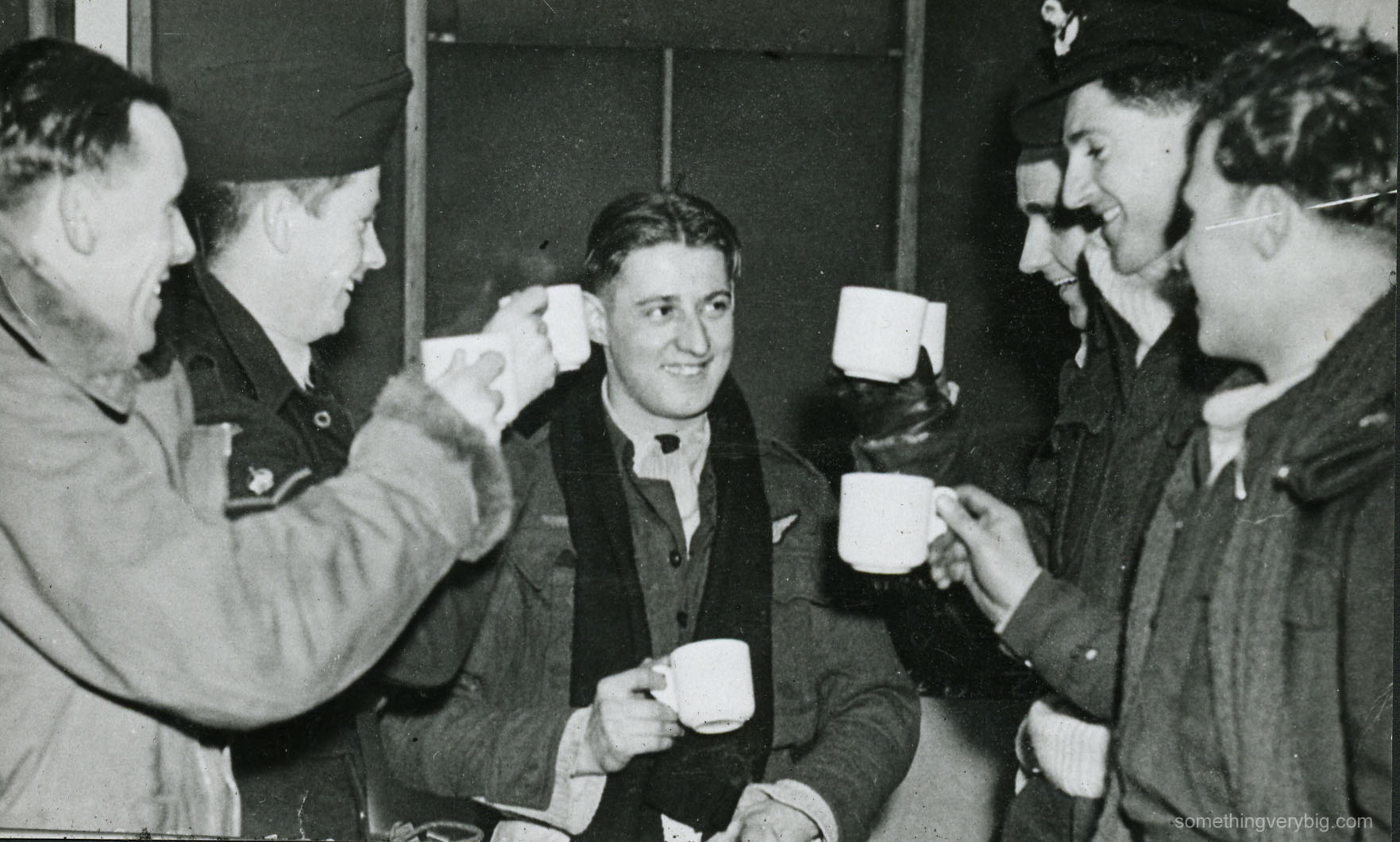
Raising a mug at Waddington to their rear gunner (Sgt Cliff Fudge) after the Berlin raid of 15 February 1944 is the crew of Pilot Officer John McManus (on right in hat). It was Fudge's 21st birthday. The Waddington Collection, RAF Waddington Heritage Centre
Raising a mug at Waddington to their rear gunner (Sgt Cliff Fudge) after the Berlin raid of 15 February 1944 is the crew of Pilot Officer John McManus (on right in hat). It was Fudge’s 21st birthday. The Waddington Collection, RAF Waddington Heritage Centre

It was not as successful a night elsewhere however. In all, 42 aircraft were missing. Of these, fourteen were observed to fall victim to flak (eight on the way out, two over the target and four on the way home), and seventeen were lost to fighters, the German controllers failing to fall for the spoof raid on Frankfurt-on-Oder. A further seven aircraft were destroyed in landing accidents.

Against this cost, German broadcasts reported some damage to “residential districts, cultural monuments and hospitals.” The bombers left the target burning steadily with a column of smoke later reported rising to 20,000 feet.[9]

This post is part of a series called 467 Postblog, posted in real time to mark the 70th anniversary of the crew of B for Baker while they were on operational service with 467 Squadron at RAF Waddington, Lincolnshire. See this link for an in-depth explanation of the series, and this one for full citations of sources used throughout it. © 2014 Adam Purcell

Sources:


[1] Phil’s logbook records “crew” as going along but this flight does not appear in Jack Purcell’s logbook.

[2] 463 and 467 Squadron ORBs, 15FEB44

[3] Night Raid Report No. 530

[4] 467 Squadron ORB, 15FEB44

[5] This and subsequent quotes on this story are from Smith, Phil, Phil’s Recollections of 1939-1945 War

[6] Night Raid Report No. 530 records no flares were burning between zero+12 and zero+14. Other details of this raid come from the same report, or from Smith, Phil, Flying Logbook 1940-1945

[7] Time of bombing is from 467 Squadron ORB, 15FEB44

[8] Figures from my own analysis of landing times as recorded in both 463 and 467 Squadron ORBs for 15FEB44.

[9] Casualty figures and extract of German broadcast in Night Raid Report No. 530
467 Postblog XVIII: Saturday 29 January, 1944

It was just after midnight last night that the Lancasters of 463 and 467 Squadron roared into the air, en route once more for the German capital, Berlin. There were three early returns. Pilot Officer Thomas Foster, in DV229, encountered icing that he couldn’t climb above, landing back at base just after 03.30 hours. Pilot Officer Lindsay Fairclough, in ED545, had the same problem, returning some two hours later. And an embarrassing navigational error saw Pilot Officer John McManus boomerang early in JA901, when he misinterpreted a new course passed to him by the navigator and inadvertently flew its reciprocal instead. By the time the error was realised, they had lost about half an hour and did not relish the prospect of having all of Berlin’s defences to themselves after the rest of the force had left the target area, so they set course for home, arriving a quarter of an hour before Fairclough.[1]

The outbound route took the bombers out over Denmark, before they turned south east towards the target. Defences were fairly active, with six bombers shot down by flak on the outbound route and at least twelve by nightfighters before the target was reached.[2]

Once again Berlin was covered in broken cloud, and though some groundmarking was possible the attack eventually required the less accurate ‘Wanganui’ skymarking technique. Despite this, most crews thought that this appeared to be one of the best attacks on Berlin yet. Phil Smith reported “three distinct areas of fire glow on clouds; good fires must have been below.”[3] The defences, he wrote in his logbook, “seemed weak”. His impression was later confirmed when it was determined that flak probably destroyed only one aircraft over the target itself. There was a moderate barrage of heavy flak and some intense light flak near the marker flares, but the searchlights were much hampered by the heavy cloud cover.

Fighters were however very active. Over the target at least 150 were sighted – including one which followed DV372, with Gil Pate and Eric Hill keeping a very close eye on it from their turrets until it sidled off into the darkness once more.[4] “Altho’ the place was lit up by the fires like the worlds fair”, wrote Dale Johnston,[5] “we never saw another kite. Bar a Jerry, but we gave him the slip and he disappeared in the clouds.” Some 27 combats were reported over Berlin and six more heavies were shot down there.

In all, 43 aircraft were reported missing, or some 6.3% of the attacking force. Seven were known to have been lost to flak and 21 to fighters. The rest, thought the scientists of Bomber Command’s Operational Research Service, were “almost certainly due to fighters”.[6]

Despite Phil’s later recollection of this as a “straightforward”[7] trip, it was not entirely without trouble. After dropping their load of 4000lb high explosives and 5000lb incendiaries towards the end of the attack at 03.30hrs (only one of Waddington’s aircraft bombed after them, at 03.32), they were on the homeward journey when Gilbert Pate’s oxygen failed in the rear turret. Wireless operator Dale Johnston went back to give some help, but his portable oxygen also failed. When flight engineer Ken Tabor went to help and suffered the same fate, Phil needed to descend to about 15,000 feet to bring everyone around again.[8] They eventually arrived back at Waddington  at 08.30 on the morning of the 29th – the third last aircraft to return.

Sadly each Waddington squadron lost a crew on this operation. Flight Lieutenant Norm Cooper, flying HK537, and Ivan Durston, in ED867, both disappeared without message or signal being received. Post-war it was discovered that Cooper’s aircraft had collided with an 83 Squadron bomber, crashing on the Danish island of Als. All on board died. Durston, who had been the last to depart Waddington last night and was “one of our most popular pilots and an excellent crew,”[9] had been on his 27th trip. His aircraft crashed at Schmachtenhagen, three miles east of Oranienberg and approximately 25 miles north of Berlin. All seven members of the crew are buried in the Berlin 1939-1945 War Cemetery.[10]

Because of the very late return this morning from the Berlin operation, there was much sleeping during the day and the squadrons were stood down for the afternoon. There was “the usual Saturday night dance” but very little else happened.

Elsewhere, Bomber Command sent small forces of Mosquitos to attack a steelworks on Duisburg and a flying bomb site at Herbouville in France tonight, and a small group of Whitleys dropped leaflets over Northern France.[11] A force of enemy aircraft was seen on radar heading towards the English coast during the night. Bombs were dropped across Hampshire, the Thames Estuary and Suffolk. It’s thought that one of the raiders was shot down by a Beaufighter of 68 Squadron.[12]

This post is part of a series called 467 Postblog, posted in real time to mark the 70th anniversary of the crew of B for Baker while they were on operational service with 467 Squadron at RAF Waddington, Lincolnshire. See this link for an in-depth explanation of the series, and this one for full citations of sources used throughout it. © 2014 Adam Purcell

Sources:


[1] Details on arrival times from 463 and 467 Squadron ORBs, 28JAN44

[2] Route details and losses are detailed in Night Raid Report No. 516

[3] 467 Squadron ORB, 28JAN44

[4] This fighter is mentioned in Smith, Phil 1940-1945, Flying Logbook

[5] Johnston, Fannie, Letter to Don Smith 24AUG44 – transcribes part of one of Dale’s letters.

[6] Night Raid Report No. 516

[7] Smith, Phil, Phil’s Recollections of 1939-1945 War, p.20

[8] Incident described in a letter Dale Johnston wrote to his brother Ian, 20APR44. Transcript (probably by Don Smith) in Mollie Smith’s collection.

[9] 467 Squadron ORB 28JAN44

[10] Amended following comment by Prue Worthington (see below), 28APR18

[11] Night Raid Report No. 517

[12] Bowman, Martin W., p.129

467 Postblog XVII: Friday 28 January, 1944

For the first time since joining 467 Squadron, Phil Smith’s name was on the Battle Order tonight as captain of his own aircraft. The target – as if anyone expected anything different – was, once again, Berlin, now being attacked for the thirteenth time this winter. Two members of Phil’s normal crew did not take part in this raid. Navigator Jack Purcell, who was still off sick, and bomb aimer Jerry Parker were replaced by Flight Sergeants Leonard Connolly and F.G. Craven respectively.[1] In any case, twelve aircraft were detailed from 463 Squadron, and fourteen from 467. They joined a total of 679 heavies and four Mosquitos sent to the German capital.

In an effort to support the force attacking Berlin, Bomber Command also sent a mining force to Kiel Harbour and several Mosquitos to harass Hannover and to bomb Berlin a full four hours before the main attack was due.[2] On the other side, sixteen Messerschmitt Me410s and ten Focke-Wulf Fw190s made a small incursion into East Anglia, Kent and Sussex. A Mosquito nightfighter accounted for one of the raiders but a defending fighter was also shot down.[3]

At Waddington, take off was scheduled for midnight. The first Lancaster – ED949 of 463 Squadron, under the command of Flying Officer Doug Dunn – roared down the runway at two minutes past the hour, and most were away by 00.36. Flight Lieutenant Ivan Durston was somewhat delayed, departing in ED867 thirteen minutes after the previous aircraft, and Pilot Officer Noel McDonald encountered engine trouble on the takeoff roll and aborted the mission on the runway. Phil Smith and his crew, meanwhile, were in Lancaster DV372, the nineteenth aircraft to depart. They left the ground at 00.28, climbed away and set course eastwards.[4]


This post is part of a series called 467 Postblog, posted in real time to mark the 70th anniversary of the crew of B for Baker while they were on operational service with 467 Squadron at RAF Waddington, Lincolnshire. See this link for an in-depth explanation of the series, and this one for full citations of sources used throughout it. © 2014 Adam Purcell

Sources:


[1] Smith, Phil 1940-1945; Flying Logbook. Craven was RAF and as such does not appear on the Australian Nominal Roll so his name is unknown at this time

[2] Night Raid Report No. 516

[3] Bowman, Martin W., p.128

[4] Details of departure order from 463 and 467 Squadron ORBs, 28JAN44

467 Postblog XVI: Thursday 27 January, 1944

A week after the last big raid on the city, Berlin was once again the target for operations for tonight. This would be the twelfth major operation against the German capital since the so-called Battle of Berlin began in November last year. Each squadron at Waddington briefed sixteen crews. Once again Phil Smith’s was not one of them. Though Jack Purcell was still in the Station Sick Quarters it is unknown why the others did not go either. Flight Lieutenant Ivan Durston began the mass take-off at 17.18 hours. All were away a little over 40 minutes later – with an average of less than a minute and a half between each heavily-laden aircraft. One aircraft was “unable to take off,” possibly due to an engine failure on the runway, and there was one early return – Pilot Officer Bruce Simpson in ED657, who ‘boomeranged’ due to compass trouble three and a bit hours after take-off. [1]

In all Bomber Command sent 530 aircraft on this trip to Berlin. In a good example of how the entire Command was coordinated to support the main force, significant diversionary and harassing operations were carried out across a wide front. Halifaxes laid mines in the Heligoland Bight and Wellingtons and Stirlings did the same off the Dutch coast (one Stirling was lost); Mosquitos dropped imitation fighter flares well away from the bombers’ route to and from the target and other aircraft flew radio counter-measure and intruder sorties targeting nightfighters. Though the fighters did intercept the bomber stream early, it appears that the spoof operations had the desired effect and “half the German fighters were lured north by the Heligoland mining diversion”.[2] Consequently fewer fighters attacked the bombers enroute to the target than usual. Even so, fighters were known to have claimed at least seventeen of the 32 aircraft that were lost on this trip.

The Main Force arrived over Berlin to find it once more blanketed in thick cloud, necessitating the use of less-accurate skymarkers. Crews reported a fair concentration of markers from the Pathfinders but there was no way to determine whether the markers themselves where anywhere near the target, so actual results of this raid remain uncertain.

The first successful aircraft arrived back at Waddington just after 01.30 in the morning. The last crew back, at 02.48, was that of Squadron Leader Bill Brill of 463 Squadron in DV274. They had been struck by incendiaries falling from higher-flying aircraft over the target and were close to baling out until Brill regained control and they set course for the long and uncomfortable trip home.

When word was received that two aircraft had landed away (Flight Lieutenant Geoff Baker in ED545 landed at a Coastal Command base at Thorney Island, near the Isle of Wight, and Pilot Officer John McManus diverted to Coleby Grange in JA901), there were still three aircraft outstanding from Waddington. Flying Officer Alan Leslie in ME563 from 463 Squadron crashed near Teltow, 16km south west of the centre of Berlin. 467 Squadron’s Pilot Officer Cec O’Brien, in ED539, crashed in the Berlin suburb of Kopenwick, 8km south east of the city. And Pilot Officer Stephen Grugeon (who had flown Phil Smith and crew to Little Snoring a few days ago) crashed east-north-east of Kassel in Germany.[3] All members of the three crews were killed.

This post is part of a series called 467 Postblog, posted in real time to mark the 70th anniversary of the crew of B for Baker while they were on operational service with 467 Squadron at RAF Waddington, Lincolnshire. See this link for an in-depth explanation of the series, and this one for full citations of sources used throughout it. © 2014 Adam Purcell

Sources:


[1] 463 and 467 Squadron ORBs, 27JAN44

[2] Details of all operations from Night Raid Report No. 515. Further details and quote from RAF Bomber Command 60th Anniversary Campaign Diary, January 1944

[3] Storr, Alan 2006

467 Postblog XIV: Friday 21 January, 1944

A clear day dawned at RAF Waddington to the news that operations, once more, were on for tonight. Phil Smith and his crew completed a half-hour air test in Lancaster EE143[1] but they again found themselves off the battle order for the evening’s raid.

Fourteen 463 Squadron aircraft were detailed for tonight, with most headed for the night’s main force attack on Magdeburg. Two however went on a diversionary 5 and 8 Group raid to Berlin and one of the Magdeburg force made an early return. 467 Squadron sent thirteen aircraft to Magdeburg and two to Berlin, with take-off commencing at 19.50 hours.[2] Interestingly another crew (captained by Pilot Officer Ross Stanford) took EE143, the aircraft that Phil Smith had air tested earlier in the day.

Elsewhere, Bomber Command also attacked military targets in the Pas de Calais and Cherbourg areas, Mosquitoes bombed targets in the Ruhr. Other aircraft scattered leaflets over France, laid mines off St Nazaire and carried out intruder patrols.

This was the first big raid to Magdeburg, with a total of 648 aircraft despatched. The Pathfinders initially marked the target accurately but decoy markers set by the Germans successfully distracted the Main Force and the raid became scattered. The diversionary raid to Berlin may have contributed to a delay in the defenders identifying the main target, but in any case it appears that German nightfighters had infiltrated the stream before it had even crossed the enemy coast. Consequently it was believed that a large proportion of the 55 aircraft lost fell to the fighters.[3]

One of those missing was ED803, piloted by Pilot Officer Jack Mitchell, of 467 Squadron. It departed Waddington at 20.20 but crashed near Eikendorf, south of Magdeburg. There were no survivors.[4]

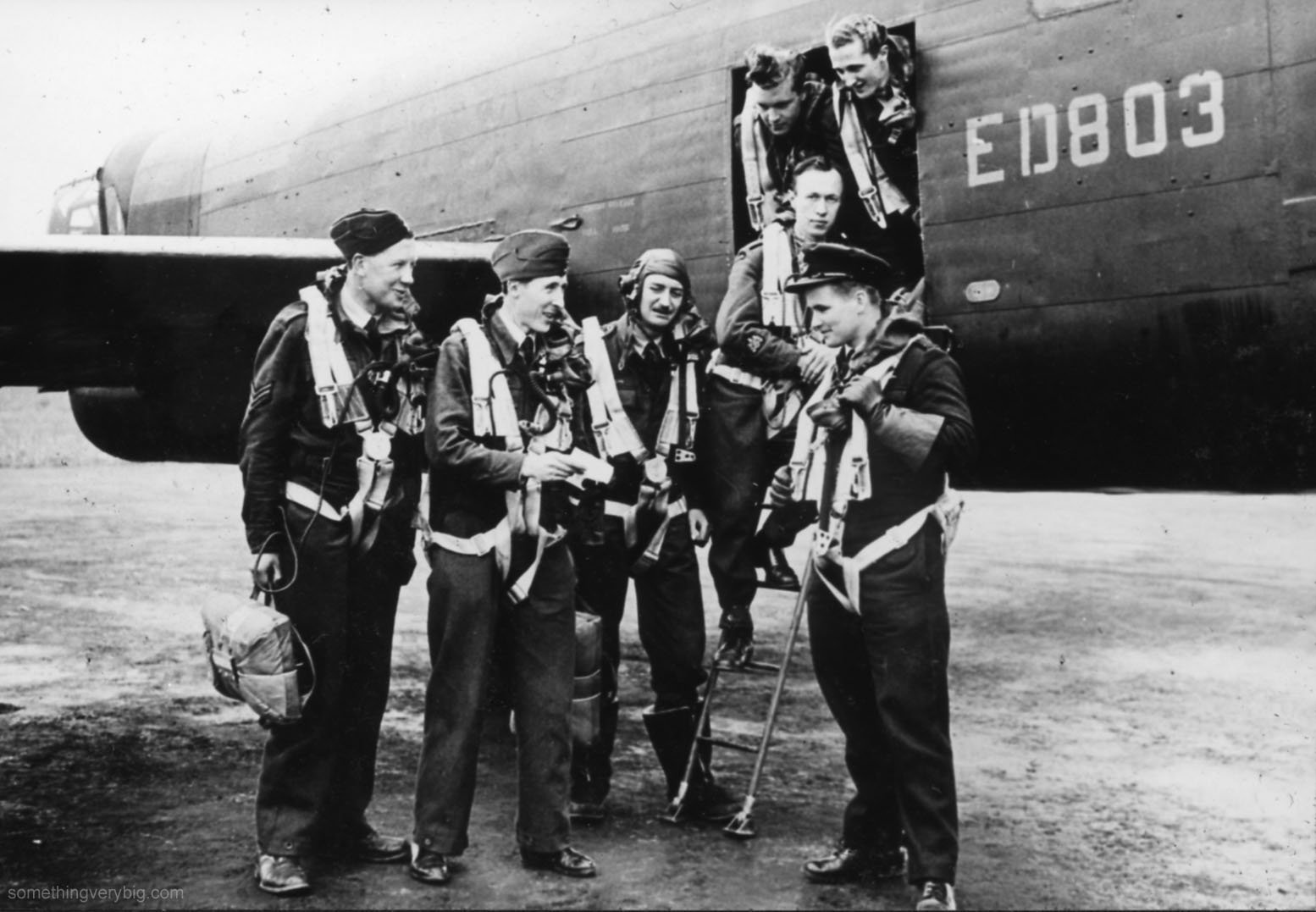
ED803, the aircraft lost tonight, is shown with a different crew in this photograph from some time in 1943. The crew depicted was lost on a raid to Milan on 15 August 1943. From the Waddington Collection, RAF Waddington Heritage Centre
ED803, the aircraft lost tonight, is shown with a different crew in this photograph from some time in 1943. The crew depicted was that of Flying Officer John Sullivan, lost on a raid to Milan on 15 August 1943. From the Waddington Collection, RAF Waddington Heritage Centre

Tonight the Germans launched what they called a ‘Steinbock’ (Capricorn) raid on London. Among the attackers were fifteen Heinkel He177s, the first time that aircraft was used on operations. 21 of the raiders failed to return.[5]

This post is part of a series called 467 Postblog, posted in real time to mark the 70th anniversary of the crew of B for Baker while they were on operational service with 467 Squadron at RAF Waddington, Lincolnshire. See this link for an in-depth explanation of the series, and this one for full citations of sources used throughout it. © 2014 Adam Purcell

Sources:


[1] Flight is recorded in both Jack Purcell’s and Phil Smth’s logbooks; intriguingly the 467 Squadron ORB entry for this day states “there was no local flying for today”.

[2] 463 and 467 Squadron ORBs, 21JAN44

[3] Raid details from Night Raid Report No. 512, and RAF Bomber Command Campaign Diary, January 1944

[4] Storr, Alan 2006

[5] Bowman, Martin 2003 p.128

467 Postblog XIII: Thursday 20 January, 1944

Early fog cleared at Waddington by the mid morning, so the flag was run up over the 463 Squadron ‘A’ Flight office[1] to signify that war was on for tonight. The target, once again, was Berlin.

463 Squadron had eleven crews detailed for the night’s operation, including Wing Commander Kingsford-Smith, who arrived back from Acklington just in time for briefing. 467 Squadron named sixteen crews, but one aircraft broke down before take-off so fifteen got away in the end. For unknown reasons Phil Smith and his crew were once again not on the battle order, so it’s likely that at least some of them were beside the runway with the usual crowd of WAAFs and ground crews watching the take-off.[2] The first aircraft, ED532 with Flying Officer Stuart Crouch at the controls, got away at 16.16, with each successive aircraft following an average of about 90 seconds thereafter.[3]

Apart from one early return (Flying Officer Jack Colpus in JA901 ‘boomeranged’ with an unserviceable rear turret and icing inside the fuselage), all aircraft from Waddington got away OK.

They bombed through thick cloud and returned safely. “The consensus”, wrote Flying Officer McDonald, “was that it was an easy night’s work”. Sadly, however, tragedy struck on board DV274, a 463 Squadron machine piloted by Pilot Officer Freddy Merrill. The crew encountered trouble with their oxygen system, and all were in some way or other affected by it. The mid-upper gunner was affected worst of all and was unconscious by the time the crew left the target area. “All efforts were made to disentangle [him] from his turret, and every effort was made to revive him for fully two hours, but this was of no avail”, and Sergeant Bertie Turner was dead on arrival at Waddington.

Unfortunately for the bombers, it also turned out to have been an easy night’s work for the German nightfighters. There was some attempt to confuse the defending fighter controllers with a route swinging towards the north of the direct line to Berlin, and feint attacks were sent to Kiel, Hannover and Dusseldorf, but “the diversions were not large enough to deceive” and nightfighters got stuck into the stream early. They accounted for at least sixteen of the 35 heavy bombers that failed to return, out of a total of 769 sent against the German capital.[4]

This post is part of a series called 467 Postblog, posted in real time to mark the 70th anniversary of the crew of B for Baker while they were on operational service with 467 Squadron at RAF Waddington, Lincolnshire. See this link for an in-depth explanation of the series, and this one for full citations of sources used throughout it. © 2014 Adam Purcell

Sources:


[1] Fallon, p.126

[2] Among other sources, described in Hannaford, 2000 p.4

[3] 463 and 467 Squadron ORBs, 20JAN44

[4] Night Raid Report No. 511and RAF Bomber Command Campaign Diary, January 1944

467 Postblog XI: Friday, 14 January 1944

After more than a week with no operations, the two Waddington squadrons were tonight going to war once more. And for the first time since arriving at the squadron, some members of Phil Smith’s crew found themselves on the battle order for the night’s trip. Phil himself “elected to follow custom”[1] and went as second pilot with Pilot Officer Doug Harvey and crew, in Lancaster LM440. Eric Hill joined Pilot Officer Hugh Hemsworth in LM376, filling in for Hemsworth’s own mid-upper gunner. The rest of the crew, though, were still waiting to make their operational debuts.

In all, 467 Squadron sent sixteen aircraft on the operation and 463 got thirteen away, out of a total force of 498 Lancasters. The target was Brunswick in central northern Germany, and take-off from Waddington commenced from 16.15hrs.

Elsewhere, military targets in Northern France received attention from Bomber Command, and diversionary raids were made to Berlin and Magdeburg. Other aircraft “laid mines off the Frisians and in the Bay of Biscay, dispersed leaflets over France and completed intruder patrols” for no loss.[2]

Unfortunately Pilot Officer Clive Quartermaine returned to Waddington in DV372 a little over an hour and a half after take-off with multiple aircraft defects[3] and one 463 Squadron aircraft came back with compass trouble,[4] but for the rest of the crews it was a good trip, and everyone from Waddington was safe (though Pilot Officer Bill Mackay, in DV240, landed away at Little Snoring). Menacingly, no fewer than three 467 Squadron machines showed evidence of damage from incendiaries and bombs dropped from higher-flying aircraft – they were declared ‘Cat. A/C’, to await the attentions of Avro for repair.

The Pathfinders achieved a good concentration of skymarker flares at the beginning of the raid[5] and a good fire glow was seen by Harvey’s crew (including, of course, Phil Smith), but thick cloud over the target would prove decisive and later reconnaissance revealed only minor damage in the town itself, with many groups of craters well to the south of the aiming point. German defences were very active. Harvey reported no less than eight aircraft seen going down in flames near or over the target area, and Eric Hill received a worrying introduction to ops when his aircraft was hit by flak over Brunswick itself. In the end it would be determined that at least 23 aircraft were lost to fighters and six to flak. Another nine were lost to unknown causes, for a total of 38 bombers missing – including eleven Pathfinders. In return, five enemy aircraft are known to have been destroyed by the attacking Lancasters.

This post is part of a series called 467 Postblog, posted in real time to mark the 70th anniversary of the crew of B for Baker while they were on operational service with 467 Squadron at RAF Waddington, Lincolnshire. See this link for an in-depth explanation of the series, and this one for full citations of sources used throughout it. © 2014 Adam Purcell

Sources:


[1] Phil’s Recollections of 1939-1945 War, p. 20

[2] Night Raid Report No. 510

[3] 467 Squadron ORB

[4] ED606 of 463 Squadron, captained by P/O ARS Bowan – 463 Squadron ORB

[5] Description of raid comes from Night Raid Report No. 510 and 467 Squadron ORB, 14JAN44

467 Postblog VI: Thursday 6 January, 1944

Waddington’s Lancasters arrived back from Stettin between 08.27 and 09.37 this morning.

Except for three.

One diverted to Wigsley (and was “outstanding for a while” until it was reported that he was safe on the ground there[1]) but two remained missing. Pilot Officer Frank Connolly and crew, in ED547, disappeared without trace. Flying Officer Colin Reynolds and crew, in ED994, crashed north of Stettin. Only the flight engineer, Sergeant W King, survived.[2]

The feint attack on Berlin worked as planned, successfully drawing defenders away from the main force, but even so the missing Waddington aircraft were two out of a total of 27 bombers lost in last night’s trip. 467 Squadron crews reported “one very big explosion” over the target and “all considered this the best effort for months”, with fires visible 200 miles away. Heavy damage was caused in the central part of Stettin, though the phenomenon of ‘creepback’ led to undershooting and scattered the bombing a little to the west of the aiming point.[3]

Aiming Point Certificate aarded to Pilot Officer Fred Smith and crew from the Stettin trip, from the Waddington Collection, RAF Waddington Heritage Centre

At Waddington itself, it was a clear day, but both Squadrons were stood down and nothing much happened during the day. After the very late return this morning from the operation, there were “very few aircrews who were on last night in evidence”.[4]

One of the few not needing to sleep off the operation, Phil Smith wrote to his mother[5] with his first impressions of his new posting: “As I expected I am now on an Australian squadron – my new station is a prewar one and very comfortable. I have not seen enough of the squadron to be able to pass any real comments but so far as I can see I think life will be very much the same as with an ordinary RAF unit over here.”

This post is part of a series called 467 Postblog, posted in real time to mark the 70th anniversary of the crew of B for Baker while they were on operational service with 467 Squadron at RAF Waddington, Lincolnshire. See this link for an in-depth explanation of the series, and this one for full citations of sources used throughout it. © 2014 Adam Purcell

Sources:


[1] 467 Squadron Operational Record Book, 06JAN44

[2] Storr, Alan 2006. King was not RAAF so his full name is unknown.

[3] Night Raid Report No. 504

[4] 463 Sqn Operational Record Book, 06JAN44

[5] Smith, Phil. Letter to his Mother, 06JAN44

467 Postblog III: Monday 3 January, 1944

An eerie silence hung over Waddington around the time the crews were due back from Berlin this morning. A quick look outside confirmed that thick fog had settled on the aerodrome and it was soon established that all aircraft returning from Berlin had been diverted to other bases. After two long trips on consecutive nights, and with the weather looking like staying duff all day, a stand-down was declared.

Which explained the silence.

The ‘Big City’ had become such a common target in recent months that some ground crew were now beginning to call it the Battle of Berlin.[1] Last night’s raid followed a now familiar pattern: the large force of aircraft found heavy cloud over the target and bombed skymarker flares with unknown success – the only evidence of note being an intercepted German wireless broadcast which referred to ‘attacks against various residential districts of the Reich capital’.[2]

What was certain, however, was that fighters were very active last night and consequently losses were high. The BBC news at midday reported 28 missing aircraft.[3] By midday all but two of the diverted aircraft, had returned to Waddington, but there was one from each Squadron still outstanding. Flight Sergeant Jack Weatherill and crew, in 463’s JA902, wouldn’t come back. They went down over the Ijsselmeer in Holland (five would be taken POW, with the other two killed in action[4]).

But Flying Officer Alex Riley, in ME575, had not been heard of yet either. As the fog cleared, the aircraft began to trickle back in from their diversion airfields. But it was now nearly four and a half hours after Riley had been due to land. The Committee of Adjustment had already collected his crew’s kit and the casualty signals had been made up and were juuuuuuust about to be despatched…. when in the Waddington Watch Office, the radio crackled with a familiar voice and a Lancaster landed. It was Riley, safe and sound with his crew. He’d landed at Lakenheath this morning, but someone forgot to pass the message on to Waddington.

By the time the B.B.C announcer read the six o’clock news, the number of missing had been revised to 27.[5]

This post is part of a series called 467 Postblog, posted in real time to mark the 70th anniversary of the crew of B for Baker while they were on operational service with 467 Squadron at RAF Waddington, Lincolnshire. See this link for an in-depth explanation of the series, and this one for full citations of sources used throughout it. © 2014 Adam Purcell

Sources:

[1] Blundell, HM 1975, p. 12

[2] Night Raid Report No. 501

[3] 467 Squadron ORB, 03JAN44

[4] Blundell, H.M.  1975, p.12

[5] F/O Riley’s story is recounted in the 467 Squadron ORB, 03JAN44.

A Pathfinder Glossary

The Pathfinders of Bomber Command used a variety of techniques and tactics when marking targets for the Main Force. These were all referred to by codewords. Here is an alphabetical glossary of some of the many Pathfinder terms I’ve come across in the course of my research:

  • Backers-Up: Pathfinder crews scattered through the Main Force who dropped secondary target indicators (usually green) visually on the red primary target indicators. This was aimed at ensuring that the target remained marked for the entire attack, even after the primary markers had burnt themselves out.
  • Blind Marking: Aiming bombs or target markers by means other than visually – usually referring to the use of an electronic aid like H2S, Oboe or Gee.
  • Blind Marker-Illuminators: First Pathfinder aircraft on the scene during a NEWHAVEN attack who used H2S to drop illuminating flares and target indicators (usually green or yellow). The light provided by the flares could then be used by the Visual Markers.
  • Controller: Officer who is in R/T contact with the Pathfinder Markers and Illuminators, and W/T contact with the rest of the Main Force. The Controller decides which markers are accurate and instructs the Main Force crews accordingly.
  • Emergency Parramatta: Used where the Visual Markers could not see the aiming point due to cloud or haze. They would hold on to their markers and the Backers-Up would instead aim their secondary target indicators on the markers dropped by the Blind Marker-Illuminators.
  • Emergency Wanganui: Pathfinder aircraft carried a single WANGANUI flare for use where unexpected heavy cloud precluded the use of ground markers.
  • H2S: Airborne ground-mapping radar carried by bombers. Could distinguish built-up areas and most effective where a clearly-defined feature – such as a coastline – existed.
  • Illumination: Dropping of parachute flares to light up the target area, enabling the aiming point to be identified visually by Pathfinders or by the Main Force. Carried out by the Flare Force.
  • Main Force: ‘Ordinary’ rank-and-file Bomber Command crews.
  • Markers: Generic term for Target Indicators or Wanganui makers. Confusingly, could also refer to the crews actually doing the marking.
  • MUSICAL: Prefix codeword for raids marked by crews (usually in Mosquitos) using OBOE. Distributing marking Mosquitos throughout the bomber stream aimed to ensure that the target was always marked by primaries. Eg MUSICAL NEWHAVEN, MUSICAL PARRAMATTA or MUSICAL WANGANUI.
  • MPI: Mean Point of Impact. The estimated ‘centre’ of a cluster or target indicators, sky markers or bombs.
  • NEWHAVEN: A method of ground-marking whereby the target was first located by Blind Marker-Illuminators, then backed up by Visual Markers dropping Target Indicators. Since the markers were aimed visually this could only be used with clear weather prevailing over the target. If a Newhaven attack was impossible an Emergency Parramatta would be used instead.
  • OBOE: Navigation/blind-bombing aid using beams from two base stations in England. Extremely accurate but could be used by only a small number of aircraft at a time, so was used primarily to drop target markers.
  • PARRAMATTA: Classic area bombing technique where the primary markers (red or yellow) were dropped on the target by H2S-equipped Blind Markers. Backers-Up would then aim their (usually green) Target Indicators at the MPI of those primary markers for the benefit of the Main Force.
  • Primary Markers: Target Indicators or flares aimed at the Aiming Point itself. As opposed to Secondary Markers.
  • Release-point flares: Parachute flares, usually red with green stars or green with red stars, used in WANGANUI attacks. Also called skymarkers.
  • Secondary markers: Target Indicators or flares aimed at Primary markers. Dropped by Backers-Up to keep the target marked before the primaries burned out.
  • SUPPORTERS: Experienced Main Force crews briefed to go over the target and bomb at the same time as the leading Pathfinders, to ‘swamp’ the defences and make it difficult for radar-predicted flak to lock onto one individual aircraft.
  • Target Indicators: Ground markers consisting of a small bomb case which was set to burst at a certain height above the ground (3,000, 6,000 or 10,000ft), scattering up to 60 small ‘candles.’ The candles then ignited and cascaded slowly to the ground. Once on the ground they continued burning with a distinctive colour – red, green or yellow. Most burned for about three minutes but some burned, less brilliantly, for up to seven. Called ‘Christmas trees’ by the Germans.
  • Visual Markers: Pathfinder crews that identified the aiming point visually, and dropped their own markers (usually red) on it. Usually the most experienced crews in the Pathfinders.
  • WANGANUI: Blind bombing skymarking technique used when aiming point is covered in cloud. H2S-equipped aircraft dropped parachute flares and the Main Force aimed at the flares themselves (or the MPI of the flares if they were being scattered by the wind), bombing on a pre-arranged heading. Not terribly accurate and very susceptible to the wind. Flares used could variously be referred to as ‘skymarkers’, ‘release point flares’ or, simply, ‘Wanganuis’.

© 2013 Adam Purcell

Sources:

NAA: A11343, 77/AIR. [No 467 Squadron] Pathfinder Force – Technique. Barcode 304281

Middlebrook, Martin (1973). The Nuremburg Raid