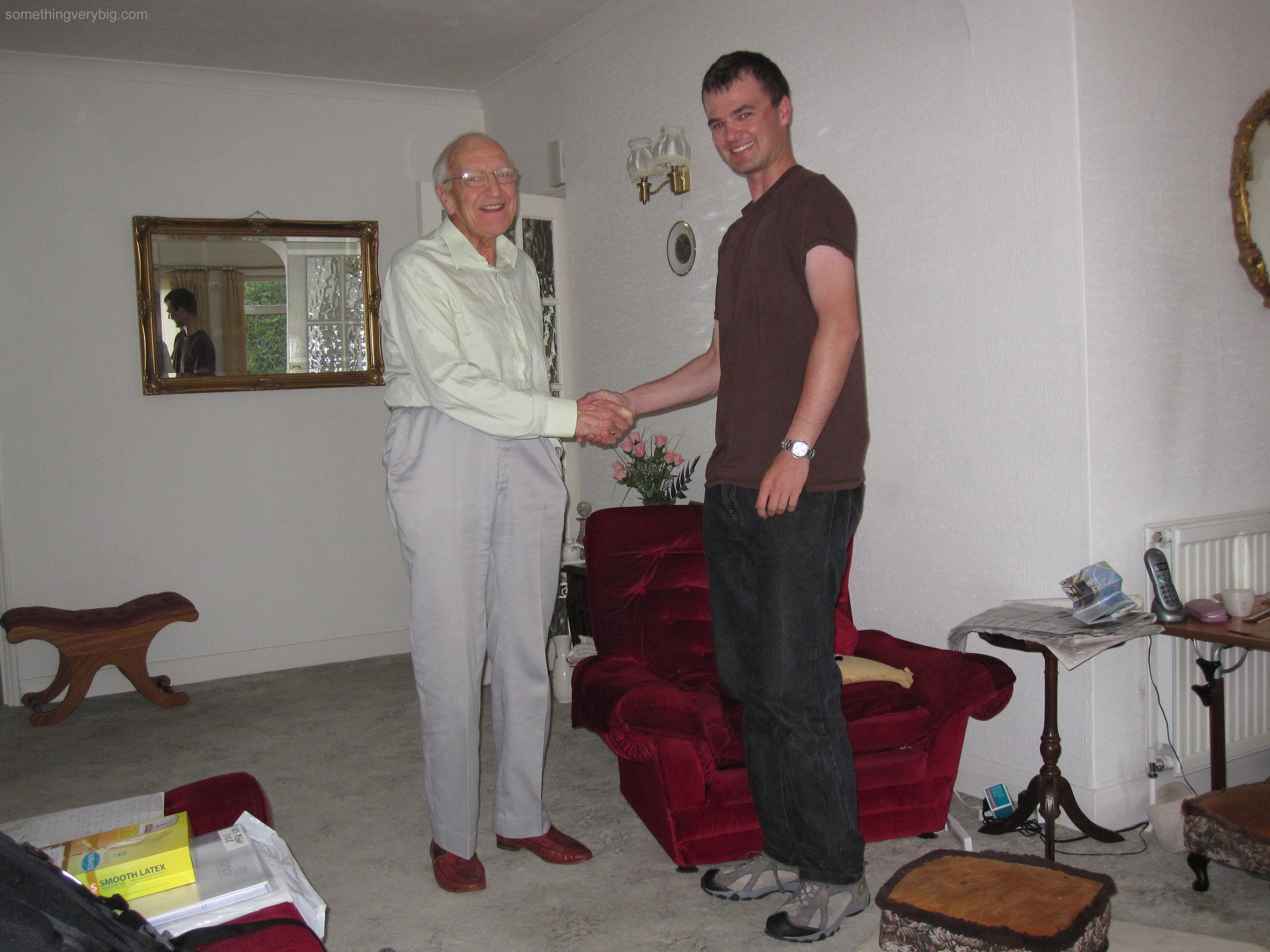
Vale Pat Kerrins

Bomber Command attracted, and got, the best men of a generation. They were (in general) more highly educated than many of their time, they were carefully selected and they were highly trained. Many achieved great things during their time with the Air Force. A significant proportion – those who didn’t come back – never got the chance to follow that achievement up with similar success in post-war life. For some who did survive, their few short months on an operational squadron would come to define the rest of their lives. But there were also others who went to war, flew a tour of operations, returned to Australia – and, putting all thoughts of the war behind them, simply got on with life. One of those was Pat Kerrins, who died on Easter Sunday.

Pat was a Lancaster pilot. He grew up on a farm just outside the northern Victorian town of Tatura and, after leaving home, worked for the Postmaster General’s department in Melbourne and Sale. It was while he was at Sale that war broke out and, perhaps having caught the flying bug from the close proximity to the RAAF base nearby, as soon as he was old enough he joined up, first as a transport driver but eventually as a trainee pilot.

Pat trained in Australia and was selected as a fighter pilot. He travelled via the US to England, but on arrival found a long wait to get onto a fighter squadron. Bomber pilots, on the other hand, were needed immediately – so he swapped over, and would eventually fly 32 operations with 115 Squadron. He ended the war as a Flying Officer.

I first met Pat at the Bomber Command Commemorative Day weekend in Canberra  in June 2011. He was engaged at the time in a lively conversation with another veteran (Tommy Knox, a 149 Squadron Stirling flight engineer) about a mutual acquaintance both had known during the war, and I took a photo of them both in the midst of it:
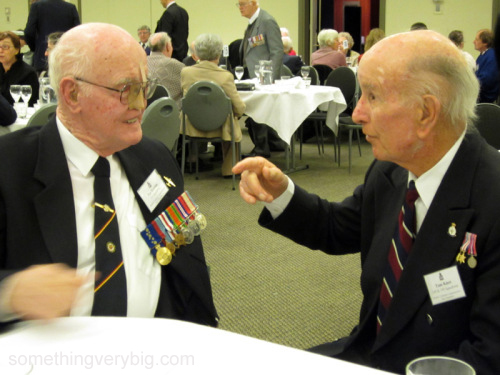
11jun-bombercommandcanberra-067s copy

I sent Pat a copy of this photo (he’s on the left), and after exchanging a few letters I even drove up to Tatura to visit him for lunch one day. We pored over his logbook and a few photos and he shared a story or two of his service. It turned out that, along with his mid-upper gunner Nobby Clarke, he had been interviewed by writer and broadcaster Michael Veitch for a book called Fly, published in 2008. It’s worth quoting a passage from this book (p.83) which I think reveals much about Pat’s character and cheeky sense of humour:

“You’re writing a story about us old blokes, are you?’ asked Pat. ‘Why didn’t you get onto us fifty years ago when we could remember something?’

‘Sorry about that, Pat,’ I replied. ‘So when did you join up?’

’26 June 1942,’ he rattled off in a flash. Somehow I didn’t think his memory would present too much of a problem.

I think it was Pat’s favourite self-deprecating joke; he asked me the same thing the day that I visited him!

But talking about his wartime experiences was only a fairly recent development. After the war, Pat never flew an aeroplane again. He returned to Tatura and settled down on the family farm. He raised a family (eventually becoming a grandfather and then a ‘2-Pa’), played an important role in the developing Tatura dairy industry and was generally involved in the life of the town, volunteering with groups like Legacy, the local AFL club and horseracing club. He was awarded the Order of Australia Medal in 2001 for his services to the local community. Pat was such a legend in and around Tatura that about one thousand people attended his funeral there last week, and a large crowd of those who couldn’t fit inside the church spilled over into the driveway outside. He had been baptised and married in the same church.

I spotted perhaps my most favourite tribute to a real character of the local area as I was driving out of Tatura after the funeral on Saturday. Pat had a lifelong love of horses and was heavily involved in the Tatura horseracing club, officiating as a steward for many years at race meetings. I happened to glance to my left as I was passing the racecourse, just in time to flash past a sign proudly proclaiming the name of a large expanse of dirt. It was, the sign said, the Pat Kerrins Carpark.

I only knew Pat because he was a Bomber Command veteran. But while his two or three years in the Air Force were an important part of his life, they did not come to define it, and arguably his greatest successes came after he returned to Australia. His impish grin and cheeky sense of humour will be much missed.

© 2013 Adam Purcell

Remembering Scredington

In June 1943, a seven year old lad named Neil Trotter was in the playground at school in a tiny English village called Scredington when he saw a big black bomber flying very low overhead. After walking home that afternoon, he was told by his mother that the aircraft had crashed in the fields behind the house (about two miles from the school). Neil later learnt that his mother had approached the aircraft intending to render what assistance she could, but because of exploding ammunition was unable to get anywhere near the wreck. All on board perished in the crash.

The aircraft was Lancaster I ED439, of 83 Squadron. It had taken off from Wyton at around 11.00am on 18 June 1943 with a crew of seven, plus two passengers believed to have been wireless technicians:

Pilot: AUS409804 F/Sgt M.K. Cummings

Flight Engineer: AUS6756 Sgt H.W. Luker

Navigator: 537936 Sgt F.W. Wilcox

Bomb Aimer: 1431821 Sgt J. Roughley

Wireless Operator: 1396788 Sgt Cheshire

Mid Upper Gunner: 1588938 Sgt N. Woodcock

Rear Gunner: Can. R113958 Sgt R. Taylor

Passengers: 1024724 Cpl Bond and 1544915 Cpl. Sloss

The ‘Report on Flying Accident or Forced Landing Not Attributable to Enemy Action’ in Max Cummings’ casualty file at the National Archives of Australia shows that the aircraft was on a practice bombing flight “but did not carry out [its] detail”. It was seen to dive out of cloud near Highgate Farm, Scredington, about 45 minutes after take-off. The aircraft burnt on impact. While the Commanding Officer, 83 Squadron, recommended a Court of Enquiry be held as “this was a fully capable crew”, he appears to have been overruled by the Station Commander, RAF Wyton, Group Captain H.R. Graham, who wrote that “pending [the] report of Accident Investigation branch, I doubt that any useful purpose can be gained by holding [a] Court of Enquiry”. A report by the Engineer Officer, 83 Squadron, written after examination of the accident scene, states that “the starboard wing hit a farm building, and demolished one end wall, the fuselage and probably undercarriage nacelle tore off the roof of an unoccupied house close to the Barn.” The aircraft was identified by means of a number plate attached to one of the four engines. Because of the lack of a formal Court of Enquiry, the exact cause of the crash remains unknown to this day.

The idea to properly commemorate the men who died in this crash has been percolating around in Neil Trotter’s mind for some years and, now he’s retired after a long career in the post-war RAF, he’s had the time to do something about it. With the assistance of the RAF Association (Lincolnshire Branch), he has been working on organising for an appropriate memorial plaque to be placed in the village church in memory of the crew. He has managed to contact the families of six of the nine men who were on board the Lancaster when it crashed, and representatives of some of these families will be attending the unveiling ceremony in June this year. Other parties involved in the ceremony will be a large crowd of Scredington villagers, the Mayor of the local area, a considerable current RAF presence from the stations at Waddington, Coningsby and Wyton, and the local Air Training Corps, who will become custodians of the memorial after the ceremony. All in all, it’s a significant undertaking and it all comes, primarily, from Neil Trotter’s desire to find out more about that fleeting childhood glimpse of a Lancaster.

Ultimately stories like these are about the airmen themselves. They deserve to be remembered, and it’s heartening to see the work that people like Neil have done in the UK to ensure the stories live on.


© 2013 Adam Purcell


Sources:

Emails between Neil Trotter, Ian Milnes, Bill Hauxwell, Gerrit Kuijper and myself, November 2012- March 2013

Research into P/O Max Cummings, carried out by Victor Harbour RSL Sub Branch, South Australia

NAA: A705, 166/8/141; CUMMINGS, Max Keiran – (Pilot Officer); Service Number – 408904; File type – Casualty – Repatriation; Aircraft – Lancaster ED 439; Place – Lincolnshire; Date – 18 June 1943

I became involved in this story through a very small part that I played in the search for the family of P/O Cummings.

Another Satisfied Customer

In July last year I wrote here about a 463 Squadron Flight Engineer named Sergeant Peter Taylor, and his sister-in-law, Joni, who has been trying to find relatives of Sgt Taylor’s crew. I published the names of the rest of the crew on the blog, in the hope that it might attract a passing Google search.

And it did.

At the end of January I received a blog comment from a lady named Susan Little, the niece and God-daughter of the only survivor from the crew, bomb aimer Flight Sergeant Tom Malcolm. It’s taken a little bit of too-ing and fro-ing but Joni and Susan are now in touch with each other. Susan’s sent copies of a photo of Tom and his crew:

tom-malcolm-007 copy

The men wearing the white lifejackets are Sgt taylor and his crew (the others are their ground crew). Aircrew in the back row, left to right are pilot P/O J.F. Martin, wireless operator F/S G.W. Bateman and bomb aimer F/S Tom Malcolm. In the front row, left to right, airmen are flight engineer Sgt Peter Taylor, navigator W/O Bernard Kelly, mid-upper gunner F/S L.G.L. Hunter and F/S Bramwell Barber.

There’s also this photo from Susan, showing some of the crew outside a pub:

tom-malcolm-008 copy

Bramwell Barber is on the far left, Tom Malcolm is next to him. The airman in the middle is unidentified. Next along is Peter Taylor, and on the far right is skipper J.F. Martin.

Once again, the power of the internet is demonstrated. Two people, on opposite sides of the planet, brought together simply through a little bit of curiosity, a blog post and the wonders of the Google search algorithm. I’m happy I was able to help. And finding Susan has inspired Joni to continue her search for the rest of her brother in law’s crew.

I’d call that another satisfied customer!

© 2013 Adam Purcell

(Edited 13MAR13 with identification of Peter Taylor in photos following correspondence from Joni)

For King and Country?

There appear to have been as many reasons for joining the wartime Air Force as there were aircrew. The chance to learn to fly was of course a key motivation. Dennis Over gave me some of his reasons on the phone in June 2011: “Until the war, we were all going to be train drivers”, he said. But the Battle of Britain happened, and “then we were all going to be fighter pilots!” Too young to join up immediately, Dennis worked in a shipyard fitting out Air-Sea Rescue boats. Many of the crews of these boats were ex aircrew and he was also inspired by their tales of derring-do so when he became old enough he joined up, eventually serving as a rear gunner on 227 Squadron.

For some, it was more personal. Cliff Leach, a 150 Squadron Pilot/Flight Engineer, wrote that “our main aim… was to stop our relatives being killed and our homes being wrecked”. To back it up, he had a newspaper photograph of what was left of his mother’s house after a German air raid on Liverpool in 1941.

It’s easy to see how motivation to enlist in the Air Force could be stirred by seeing the effects of war first-hand – but until the Japanese entered the war Australia was not under direct threat of attack. So what might have attracted so many Australians to join the ranks of aircrew in those first few years of the war?

Hank Nelson collected a few ideas from different aircrew in Chased by the Sun:

Those who volunteered for aircrew were, Don Charlwood said, ‘children of the empire’. Nearly all had relatives in the British Isles. Most were also strongly conscious of their Australianness, but saw no contradiction in being both British and Australian […] Charlwood said that his swearing-in was the culmination of his upbringing, acceptance of authority and the ‘Call of the Homeland’. Wade Rogers’ mother said to him before he sailed, ‘Don’t miss seeing Scotland for me, son’ […] Although David Leicester’s father was born in Australia, he was ‘very pro-English’, and David grew up in a home where ‘fighting for England was really the thing to do’. (C07-039-009)

One of the most matter-of-fact descriptions that I’ve seen, and one that covers most of the key motivations for enlisting, was written by 467 Squadron skipper Phil Smith in an unpublished manuscript, some decades after the war (C03-004-004):

My motives for joining the forces were mixed:

  • a) The call of adventure
  • b) A feeling of duty
  • c) The need to be ‘in it’ with the mob
  • d) A question of patriotism
  • e) At 22 years I was the right age, and had no responsibilities.

The call of ‘King and Country’ managed to reach all the way to Australia much like it had a generation before, and it was heard by thousands of young men. The chance of adventure and the need to be ‘in it’ certainly played a big part – in many ways similar to that which attracted so many of the previous generation to arms in the First World War. It is clear that patriotism was perhaps the overriding reason for men to enlist in the armed forces in general – but there were other reasons for choosing the Air Force specifically, over the other two branches of the military. Stories of the horrors of that earlier conflict were well-known and so many were conscious of the need to stay out of the infantry. Frank Dixon was a 467 Squadron skipper, and picked the Air Force out of a desire to avoid what he called a “man to man, face to face, knee deep in mud confrontation with cold steel”, the thought of which horrified him (C06-070-005).  The Air Force offered what Danny O’Leary, a Vultee Vengeance pilot, called “a way out: accept the risk of death for yourself, but volunteer for a technical arm like the Air Force or the Navy, where you will kill clinically, at a distance, where you won’t see ” the whites of his eyes”.

Phil Smith’s reason was perhaps more practical than many; he wrote that he decided on the Air Force because he thought that a pilot’s licence could be “a useful qualification” to have after the war (C03-004-004). As it happened after he was demobbed he never flew in command of an aeroplane again, but the sentiment remains.

But there was also a higher sense of duty. Danny O’Leary put it eloquently:

Deep down we all knew that this was a job which had to be done, and we young men of our generation, who had the fitness and schooling to do it, must step forward, for there was no one else […]It was our duty to stop this.

And stop it, they did.

© 2012 Adam Purcell

The Scroll of Honour

A few weeks ago I took some days off work and my girlfriend and I drove a rented campervan up to Echuca, on the Murray River which borders New South Wales and Victoria. While exploring the surrounding area we stopped at a small winery in neighbouring Moama (on the NSW side of the river) to escape the stinking heat of the day. The winery also happened to have attached to it a small military museum, so we went in to have a look.

In the museum – which, alas, was not air-conditioned – was a quite remarkable gathering of old vehicles on the ground floor, some restored and some not so restored. Upstairs, arranged in a collection of dusty display cabinets, were uniforms, rifles, medals, badges and other assorted items of militaria. What caught my eye was this:

12nov-britzingthemurray-023 copy

It is a scroll as presented to the families of Australian servicemen who died as a result of their military service in World War II. A similar scroll hangs on a wall at my parents’ place, bearing the name of my grandfather’s uncle, RW Purcell. The scroll in Moama commemorates one Flight Sergeant I H Smead – but apart from the name on the scroll itself, there were no details on who he might have been or what might have happened to him. I thought it looked quite sad sitting there all but forgotten in a display case in a roasting tin shed next to the Murray River, so I decided to see what I could find out about him when I got home.

The first place to look, as with any Australian casualty from either of the World Wars, was the Commonwealth War Graves website. This gave me a few further details to work with:

SMEAD, IRWIN HAROLD

Rank: Flight Sergeant

Service No: 419228

Date of Death: 21/04/1944

Age: 20

Regiment/Service: Royal Australian Air Force

Grave Reference Plot A. Row D. Grave 14.

Cemetery BUNDABERG GENERAL CEMETERY

I now had a name, service number and date of death – and, most interestingly, information that he is buried in Bundaberg, Queensland. Bundaberg was the site of No. 8 Service Flying Training School at that time. Being a training unit, this suggested an accident rather than enemy action.

Going out on a limb, I tried a quick Google search – and came up with Peter Dunn’s Oz At War website which revealed what happened. Irwin Smead was a navigator. He was flying in a Bristol Beaufort on a formation flying exercise on 21 April 1944 when it collided with another Beaufort of the same formation about 15 miles west of Bundaberg. All eight airmen – four in each aircraft – were killed.

I also found a copy of the “Preliminary Report Internal External of Flying Accident or Forced Landing” for this accident in the Casualty or Repatriation File of F/Sgt Hardy, the pilot of the other aircraft*, which is digitised at the National Archives of Australia website (A705, 166/17/544). It gives the probable cause of the collision as ‘UNKNOWN’.

It’s not much, but finding even this small amount of information adds that little bit more to Irwin Smead’s story. It reminds us that he was more than just a name on a page.

*Interestingly there appears to be a disagreement between this source and Peter Dunn’s information about which aircraft were involved in this accident. Both agree on Hardy’s aircraft, A9-476 – but the NAA file shows Smead’s as A9-426. This shows the value of going back to the original documents wherever possible!  

This will be the last post on SomethingVeryBig for 2012. Thanks to all for your support and comments throughout the year. Have a great Christmas, and I’ll be back in mid-January.

© 2012 Adam Purcell

Happy First Solo Day!

On 28 November 1940 – exactly seventy-two years ago today – Phil Smith flew solo for the first time. Like many (if not all) Australian pilots under the Empire Air Training Scheme, it was in a little yellow Tiger Moth, serial A17-58, at No. 6 Elementary Flying Training School, Tamworth, NSW. Phil didn’t seem too excited about it when he wrote to his parents later that day (A01-132-001), reporting simply that “[…] altogether I made three solo flights and landed satisfactorily each time.”

But there is no doubt that the first solo is a significant milestone for any pilot. Witness the following small collection of thoughts and memories from various pilots, taken from the excellent Australians at War Film Archive:

Barry Finch, eventually of 3 Squadron, quoted his instructor:

“Well you might want to kill yourself but I’m precious and I’m getting out. That’s all I can say. Be careful. I’m going to let you go off on your own.” The bloody thing leapt into the air like a young buck, it was incredible what a difference it made without his weight in the front, and to actually find myself going up into the air without any head in front of me, it was unbelievable. And I thought, “Well, I’m here, all I’ve got to do is to get down again.”[After landing] I went over to where he was and he said, “That’s alright, I’m coming with you next time. I reckon you’re safe […] Unforgettable!” (C06-072-013)

John Boland, 61 Squadron:

“So when I had 5 hours instruction up, I got in the aircraft and did a circuit and the instructor got out of the front seat, took the pilot stick out and said, “Righto, take it around again” and I got the shock of my life. I got that big a shock, that when I come around to land, I was that nervous, the instructor had confidence that I could land it, and as I come in to touch down the tail hit the ground first and it bounced.” (C06-073-005)

Colin Morton, 450 Squadron:

“Scared bloody hell out of me. […] I flew an aeroplane before I drove a motor car. It’s – the impact was enormous and I loved it” (C06-081-003)

Alf Read, 463 Squadron:

“I can still remember it because it’s marked with a tree, which you see as you drive past the old airport at Narromine. My instructor said, “Just a minute and I’ll get out, and I’ll sit under this tree while you take your first solo,” and I can assure you it was a wonderful feeling just to be able to take that plane off and bring it back in one piece. And it’s a little incident in your life that you never forget.” (C06-086-006)

Noel Sanders, 463 Squadron:

“I went solo at about nine hours, I think it was. It should have been seven, but they took me up for a check, and by the time I finished the check and got back, the wind had strengthened up so strong that they wouldn’t let a learner pilot go out. So he said, “Well, you’ll have to do it tomorrow.” Tomorrow came and it was still blustery and rough and nobody flew that day. And the following day he said, “You’ve got to have another check.” So I had another check, then he said, “Right, off you go. Just do one circuit and down again and that’s your baptism on your own.” (C06-090-011)

Lionel Rackley, 630 Squadron

“Eventually I went solo, on the 1st of April, 1942. […] Every instructor said it, “Now, okay Rackley. Be careful, because we’re very short of aeroplanes. We don’t care if you get back or not, because we can always replace you. But we’re short of aeroplanes.” So you go around, and I came in and I stood too close to the field, and I had to go around again. And of course the second time I got in. You know then, okay, “I’ve done it. I’m going to get through this course now. I’m not going to get scrubbed. The worst of it is over.” […] And I remember sending a telegram to my mother. I’ve still got the telegram in my album there: ‘Went solo today’”. (C06-075-004)

As it turns out, today is also the tenth anniversary of my own first solo. It was in a Cessna 152, registered VH-WFI, from runway 16 at Wollongong, south of Sydney. After an hour or so of flying circuits, my instructor got out and I proceeded to fly one by myself. It was a slightly wobbly but passable exercise and I logged a princely 0.1 hours solo time in the process.

Some years later, by this time a fully qualified private pilot, I would also experience solo flight in a Tiger Moth, in my own small way experiencing something of what these young men had been doing seven decades ago. And while that flight remains one of the most memorable ones in my logbook, I still remember the tremendous sense of achievement that followed my first solo.

© 2012 Adam Purcell

Motivations

Daily life at a Bomber Command airfield could not exactly be described as ‘calming’.

I learned what the target was about midday, and for the whole afternoon I wandered around with a feeling of having half a pound of cold lead in the pit of my stomach. – Bill Brill, 467 Sqn skipper and later CO – C07-036-142

In an effort to explain their feelings about what they were to do, some airmen turned to thoughts of sport – as Hank Nelson wrote in his excellent book Chased by the Sun, for many airmen “sport was one place where their capacity to perform at their best under stress had been tested”. Nelson quotes Arthur Doubleday comparing the lead up to an operation to waiting to go into bat in cricket: “You know, the fast bowler looked a lot faster from the fence, but when you get in there it’s not too bad” (C07-036-142).

But as tours dragged on, as airmen witnessed more and more empty places at the Mess tables, it would have been only natural to begin to feel the cumulative tension of one operation after another. On his eleventh operation, Bill Brill was ‘getting a little accustomed to being scared’ (C07-036-159). And there is no doubt that airmen knew very well exactly how low their chances of surviving a tour were. Gil Pate wrote to his mother in November 1943 (A01-409-001): “It seems an age since I last saw you all + I guess I’ll need a lot of luck to do so again, the way things happen.”

So why did they go on?

Much has been made of the ‘stigma’ of being branded ‘LMF’ (Lacking Moral Fibre), a fate seemingly worse than death. And certainly there were instances of aircrew who had gone beyond their breaking point being publicly stripped of their ranks and their aircrew brevets, and given humiliating menial duties for the rest of the war. The loose stitching and unfaded spots left on their uniforms were a cruel reminder of what they once were. Certainly the threat of being branded LMF was a big motivator for some aircrew to carry on. But despite how much it was feared by the aircrew, a very low number of verdicts of LMF were ever officially handed down – Leo McKinstry quotes about 1200 in all, or less than 1% of all airmen in Bomber Command (C07-048-225).  There were also instances of compassionate squadron Commanding Officers recognising an airman at his limit and quietly moving him off flying duties, without the humiliation of accusations of cowardice. One veteran I know told me of the case of a mid-upper gunner who had been so traumatised by discovering the mutilated remains of his rear gunner comrade after an attack by nightfighters that he was clearly not in a state to continue flying. He was given a month’s compassionate leave on return to base, and on his return from leave was transferred to the Parachute Section of the same Squadron where he worked for the rest of the war (C03-021-051).

One of the most significant motivators, in my view, was the bonds shared by the crews themselves. Dennis Over – a 227 Sqn rear gunner, writing on the Lancaster Archive Forum in December 2010 – says “our greatest fears may well have been not wanting to let our crew down”. When I visited Dennis in June 2010 he said that he could not remember feeling fear while actually on an operation. That, he said, came later.  He had instead, he told me, “a sense of complete concentration on my duties, for the benefit of my entire crew”. No matter what the enemy could throw at them, no matter the hazards of weather or mechanical failure, their crew came first. That bond carries on today with many veteran aircrew still very close to surviving members of their crews. It’s one of the unique aspects of the Bomber Command experience and goes a long way to explaining why, in the face of dreadful odds, they pressed on regardless.

© 2012 Adam Purcell

Captain Over

I first got in touch with Dennis Over through the Lancaster Archive Forum a few years ago, on which he is a much-loved and highly prolific member. Dennis began the war, too young to join the forces, working on fitting out air-sea rescue launches. Once old enough he joined the RAF as aircrew, serving on 106 and 227 Squadrons as a rear gunner. Following the war he was station manager at Heathrow for first BOAC and later for British Airways. Consequently Dennis has a wealth of stories. I therefore couldn’t miss the opportunity when I was in the UK in 2010 to meet him and his wife of 66 years, Peggy, at their home in London.

We talked for hours and hours and hours. We spoke about Concordes. We spoke about Queen’s Tours, L1011s and B707s. We discussed Dennis’ unconfirmed but more or less definite claim for a nightfighter. We talked about air-sea rescue launches, Comets (exploding or otherwise), Constellations, RAF dinghies, Irish jokes, 5th pods, cheese and rocket-powered sailplanes. And of course, we told stories about Tiger Moths.

As a rear gunner, Dennis told me that he felt a real sense of isolation. He was physically removed from the rest of the crew and, of course, was the only one flying backwards. He said he never felt any panic or fear while on operations. That came either before or after. While actually flying he felt only a sense of complete concentration on his duties, for the mutual benefit of his entire crew. He did mention a feeling of unreality, almost of detachment, as if he had been viewing the events he was describing from the position of a third party. Partly at least, I imagine this was a means of dealing with the enormity of the situations he found himself in.

The conversation was wide-ranging and ever changing. At one point I used his telephone to ring the family I was staying with in London and tell them I wouldn’t be home for dinner. This discussion was far too good to cut short!

I always love talking to veteran aircrew. They are a living link to the past. While I can learn facts from official documents and get a personal picture from reading letters and diaries, oral history is far more interactive. It is subject to the limitations of memory, but when supported by other sources a witness account can add much colour to a history. Dennis has some fantastic memories and it was a real pleasure to drag the hangar doors open and listen in some awe for a few hours.

29jun10-045 copy

© 2012 Adam Purcell

Enlisting

I went for an interview with the Air Force people this afternoon

– Phil Smith writing to his father, 27MAR40 (A01-118-001)

In 1940, said Don Charlwood, some 60,000 young men applied for the first 4,000 training places in the Royal Australian Air Force (C06-063-001). At that early stage of the war, competition for places was intense and the selection panels could afford to be a little choosy in the potential airmen they accepted. The process was quite involved.

In March 1940, Phil Smith was one of the 60,000. He wrote a detailed account of his first experiences in a letter to his father later that day (A01-118-001). The interview panel consisted of three officers who asked general questions about aeroplanes, about Phil’s motives for joining up, and some technical questions about centrifugal force and specific gravity (“the first I explained only fairly and the second exactly,” he told his father).  And that, he wrote, was about the limit of it. Then it was time for the medical exam.

There was, he said, a long form to fill in. Then a general physical examination, including a colour blindness check, height and weight (while stripped), measurements of “buttocks to toes” and a check of the pulse. The eye exam appears to have been quite complicated, though in his matter-of-fact way Phil declined to describe the details as “I do not know what each was for”.

The next three doctors came equipped with a battery of weird and wonderful tests. Ears were checked first with tuning forks and then with the aid of a little light. The same light was then used on the nose and throat. Phil was spun around ten times on a swivel chair and told to stand up straight afterwards. A dentist carefully checked his teeth. Blood pressure was measured. And then it was time for ‘the torture machine’. With a clip on his nose, Phil had to take a deep breath and then support an inch-high column of mercury for as long as possible. “I kept it up for over two minutes”, he wrote to his father, “but my ears are still singing”. Finally his reflexes were tested by scraping his instep with a sharp piece of iron. Recruit Dennis Over, who would eventually become a 227 Sqn rear gunner, concurred with the general contents of the medical, adding that he was also subjected to a hemorrhoids test (“bend over & let me see if your hat’s on straight”…) and a test for “rupture” (“Just cough for me, will you?”). He also encountered the ‘torture machine’, actually a test for diseases of the lungs.

At the end of an exhausting day of being grilled, poked and prodded, Phil was told he would be accepted for the Air Force Reserve but that he would be required to have his tonsils removed and six teeth filled at his own expense first. After some indecision he had the required work done and was duly enlisted in the Royal Australian Air Force Reserve, to await call-up. He was given a badge to wear to say that he had enlisted and continued to work at the Yarraville Sugar Refinery for another six months.

Though Phil doesn’t mention it, it appears that recruits would be given a course of study in mathematics, physics and navigation to do while they were awaiting call-up, to improve their chances of coping with the early, theoretical stages of their training. This is what Don Charlwood called the ‘twenty-one lessons’. In his memoir ‘Journeys into Night’ he describes the course as ‘extraordinarily well-arranged’. Recruits living in towns could attend night schools to complete the course; others living further out (like Charlwood himself) needed to work by correspondence, helping mates out as they went. Morse code was taught by local postmasters (C07-034-xiii).

Reservists were on the Reserve for differing periods of time. Don Charlwood’s mates Jim Riddoch and Claude Austin were called up after seven months; Charlwood himself had to wait eleven (C07-034-xiv). In fact Riddoch would be in Canada beginning his training before Charlwood received his call-up papers. Phil Smith was waiting for ‘only’ about six months. But the letter arrived, and on 14 September 1940 Phil found himself on a train from Melbourne to his Initial Training School at Bradfield Park, Sydney. Life would never again be the same.

© 2012 Adam Purcell   


Leo’s Letter

It started, as many of these things do, with a simple Google search. In mid May, I saw in my site stats that someone had run a search for “222 squadron leo mcauliffe’. A day or so later a comment appeared in my inbox. It was from a man named William Rusbridge. Cleaning out his late mother’s papers, he had found a letter written by a young Australian airman whose squadron had been based for a time at the Selsey Advanced Landing Ground in southern England.

William’s parents owned a farm that had been requisitioned by the RAF for the landing ground in the lead-up to D-Day. They managed to convince the Air Force to allow them to stay living in their house, as William says more or less in the middle of the air base. They subsequently got to know many of the airmen posted to the base and, as the letter shows, remained in touch with at least one young Australian – Leo McAuliffe. Deciding to find out more about who might have written the letter so long ago, William tried an internet search… and so found this blog.

William very kindly typed out and sent me a transcript of the letter. It is, in every way, a typical letter as written by aircrew during the war. There’s a bit of news about Leo’s rest period when he was “flying an Anson backwards and forward from the continent to England”, some talk about other airmen the recipients would have known (“You remember the C.O. S/L Rigby the chap who was going around with that girl you know from Chichester well both he and Ernie Broad got a bar to their DFC’s before going on rest which they both deserved”), and a story of how he celebrated Christmas. “What a time it turned out to be”, he wrote, “drunk for two days without remembering a thing”. Leo wrote this letter on 2 February 1945, just six weeks before he was killed.

Just reading the transcript was amazing enough. But then, having no further use for it himself, and in an extraordinarily generous move, William mailed me the original letter.

It’s written on four pages of blue paper with an Air Force letterhead, in fountain pen ink and with a flowing old-fashioned script. Leo McAuliffe wrote this letter with his own fountain pen and in his own hand. And though the words he used themselves add something to what I know about him, the letter also represents something more. It is a real, tangible connection to the man whose grave we first stumbled upon in the east of The Netherlands in 1995. Suddenly the story has a human element to it. The man is more than a face in a photograph, and more than a name on a white stone.

I’m extremely grateful to William Rusbridge for his generosity – and ever hopeful that more people who look through dusty boxes of papers are curious enough to try to find out more about the people they belonged to.

 © 2012 Adam Purcell