Sergeant Taylor

On 10 May 1944, the crew of B for Baker failed to return from an operation to Lille in France. As the next day dawned at Waddington and the survivors of the raid began to come to terms with what had been the worst night of the war for the station, a new crew was posted in to 463 Squadron. Led by 16203 P/O J.F. Martin, it was made up mainly by Australians. The Flight Engineer, one 1324017 Sgt P.D. Taylor, was the sole Englishman. This crew, flying Lancaster LM571 JO-E, would make eleven un-eventful trips, mainly to targets supporting the invasion in France, but would be lost on their twelfth, to Prouville on 24/25 June 1944. The bomb aimer would be the only survivor, and his six crewmates today lie in Bussuss-Bussuel Communal Cemetery in France. They were one of three 463 Sqn crews to be lost that night, while 467 Sqn lost two. Only the 10 May Lille raid was more costly.

I received an email last night from Phil Bonner, who was the Squadron Leader who showed me around RAF Waddington when I visited in 2009. Now retired from the RAF, he runs Aviation Heritage Lincolnshire and remains a key contact for me in the area. Phil passed on a query from the sister-in-law of Sgt Taylor, a Mrs Joni Taylor, who is searching for relatives of the Australians in this crew. He wondered if I might be able to help.

The full crew list is as follows:

Pilot: 16203 P/O J.F. Martin

Flight Engineer: 1324017 Sgt P.D. Taylor

Navigator: 415430 W/O B.E. Kelly

Bomb Aimer: F/S T.A. Malcolm

Wireless Operator: 417327 F/S G.W. Bateman

Mid-Upper Gunner: 424761 F/S L.G.L. Hunter

Rear Gunner: 408433 F/S B.R. Barber

The National Archives of Australia has digitised records for W/O Kelly and F/S Barber. Before enlistment Kelly was a ‘Junior Clerk’ with the Chief Secretary’s Department of the Government of Western Australia. His next-of-kin was listed as an aunt, Mary O’Grady of 70 Lindsay St, Perth, WA. Also to be informed of any news was Miss Valerie O’Sullivan, 45 London St, Mt.   Hawthorn, WA. Barber was a bank clerk from Ulverstone in Tasmania. His next of kin was recorded as his father, Fletcher Bramwell Barber, 12 Richards Ave, Launceston, TAS.

I’ve pointed Phil towards the secretaries of the Queensland and the NSW Branches of the 463-467 Squadron Association, and in the meantime thought I’d try to publicise Mrs Taylor’s search online. If anyone has any leads that may be of assistance, please leave a comment below or drop me an email – details through this link.

© 2012 Adam Purcell

Caterpillar Club

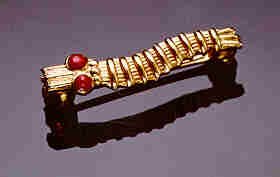
One night in September 2008 I was at a formal dinner put on by the Royal Aeronautical Society’s Sydney branch. Sitting at my table was a very interesting man. On his lapel was a tiny golden caterpillar, with bright ruby red eyes, not unlike this one:

That suggested he had a story to tell!

Peter Batten was his name, and indeed he did have a story. In March 1987 he became the last Australian to eject from a Mirage jet fighter, after his engine flamed out off the coast near Newcastle, NSW. He was rescued by a fishing boat with only minor injuries. I had recognised the golden badge on his lapel as the emblem of the Caterpillar Club, a loose association of airmen united by one common thread (ahem): taking to the silk to escape from a disabled aeroplane. Started by Irvin Aerospace in 1926, the Club recognises aircrew regardless of their nationality.

The first member of the Caterpillar Club that I met was Phil Smith, pilot of Lancaster LM475 B for Baker. He once showed me his caterpillar badge, which is how I recognised Peter’s some years later. In 2003 I wrote to Irvin to see what information they held on Phil’s escape but due to British privacy laws they could not release anything. Lucky, then, that I now have a copy of an unpublished manuscript that Phil originally wrote for his grandson, in which he relates exactly what he could remember:

We were just about to drop our bombs when everything went hot and dry and red. When the flame had gone out, I was still in my seat but could feel no aeroplane around me. I immediately released my seatbelts and then my parachute. It seemed to open immediately. There was sufficient light for me to see that one of the two straps supporting me had been half cut through. I floated to the ground holding with both hands the damaged strap above the cut. This helped soften my landing which was on what appeared to be a flat grassy field. […] I seemed to be all in one piece but my flying helmet and one flying boot had gone. (C03-004-024)

As we now know, Phil sheltered with a French family until the invasion forces passed his position in September 1944. There is a letter in Mollie Smith’s collection from the great Leslie Irvine himself, written to Phil in October congratulating him for his escape – it took a little longer for the badge to reach him, “owing to supply restrictions” (A01-042-001).

And when I visited Phil in the late 1990s, hanging on his wall was a frame enclosing the tiny golden caterpillar with the ruby red eyes.

Text © 2012 Adam Purcell

Image from http://www.merkki.com/images/ccpin.jpg

Leader

Every Monday in my postbox I receive a copy of the local newspaper. The Moonee Valley Leader usually shrinks to less than half its thickness once the advertising flyers are removed, but every now and then it reports on interesting stories with local connections. Just after ANZAC Day this year it ran this story  about a 100 Squadron airman, P/O Jack Wilson, killed in action over Holland in January 1945. He and his wife were living in Essendon when he enlisted, and the story was about how his daughter – two years old at the time of her father’s death – made contact with a British researcher after by chance finding an earlier article in the Leader seeking information about P/O Wilson.

The British man is Paul Kurn, whose father was a ground mechanic with 100 Squadron, responsible for Lancaster JB603, the aircraft on which P/O Wilson had died. Mr Kurn’s search for the story of his father’s war began in 1998 and was originally centred around the operations carried out by this aircraft, before shifting into looking for the airmen who had flown it. He contacted the newspaper using P/O Wilson’s wartime address. It took a year, but eventually the right person saw the article and made contact.

Writing to local newspapers is a tactic that can, as this story demonstrates, be very effective. People of that era tended not to move around nearly as much as we might do today and so if they are still alive there is a good chance of their being in the same area six or seven decades later, if not in the same house. Articles also being published online these days greatly strengthens the chances of finding the right person by bringing them within the reach of a simple Google search. All it takes is one curious relative to look for something as straightforward as a name. Patience – and a good deal of luck – can certainly pay off in this research caper.

Paul Kurn set out on his journey with similar intentions to my own. Finding descendants of the crew, he said, gives him “…a chance to maybe tell them of what happened to their relative and […] to shed light on something that they may have wondered about for 60 years without any idea what happened in those final moments and where it happened… The story has grown beyond anything I could have imagined”.

Telling the crews’ stories, and remembering. That’s why we do it.

© 2012 Adam Purcell


Bomber Command in Canberra 2012

The 2012 Bomber Command Commemoration Weekend has just wrapped up in Canberra. There were slightly fewer people present, to my eye, than on previous years but I think it was still a fair turnout. Perhaps the forecast rain kept some away – it certainly was a wet welcome to Canberra when my Virgin E-Jet broke clear of the thick cloud that we’d been descending through just before landing.

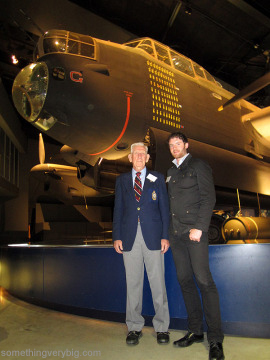
This was the fifth such commemoration to be held in the nation’s capital and the event has settled down into a familiar but effective pattern. G for George provided the setting for the now traditional ‘Meet & Greet’ function. There were indeed many people to meet and greet. Tommy Knox and Pat Kerrins, who I’d met here last year, were both there again. Don Browning and Ross Pearson traded their usual good-natured banter about which between the Halifax and the Lancaster was the ‘proper’ aircraft to have flown in (at least we all thought it was good-natured…). And I met a few new people too.

12-jun-bomber-command-in-canberra-007 copy

Early in the evening as I was wandering around to see who else I recognised, out of the shadows of the Lancaster’s nose came a man named Don McDonald, a 466 Sqn Halifax skipper from Melbourne, a veteran I had not yet met. He was a lovely bloke and we chatted about all sorts of things for a good while – and upon learning that I now also live in the southern capital he and his wife Ailsa promptly invited me to visit them for dinner sometime. You never do know who you will meet at these events! I also spoke with the former Commanding Officer of the reformed 462 Squadron, which was previously a Halifax squadron of Bomber Command and is now an electronic intelligence unit based at RAAF Edinburgh in Adelaide. The superb Striking by Night sound and light show was again played at the end of the event. The final moments of the production feature a WAAF speaking about the Australian airmen she worked with. “They were young… handsome…” she says, “…and full of life.” At which point Don Huxtable was heard to mutter “well two out of three ain’t bad…”12-jun-bomber-command-in-canberra-012 copy
Many of us repaired to the hotel bar at the Rydges after returning from the AWM. It was a memorable night, sharing beers with the two Toms Knox sitting on one side and Hux on the other as a great variety of stories, of both tall and short varieties, were told.

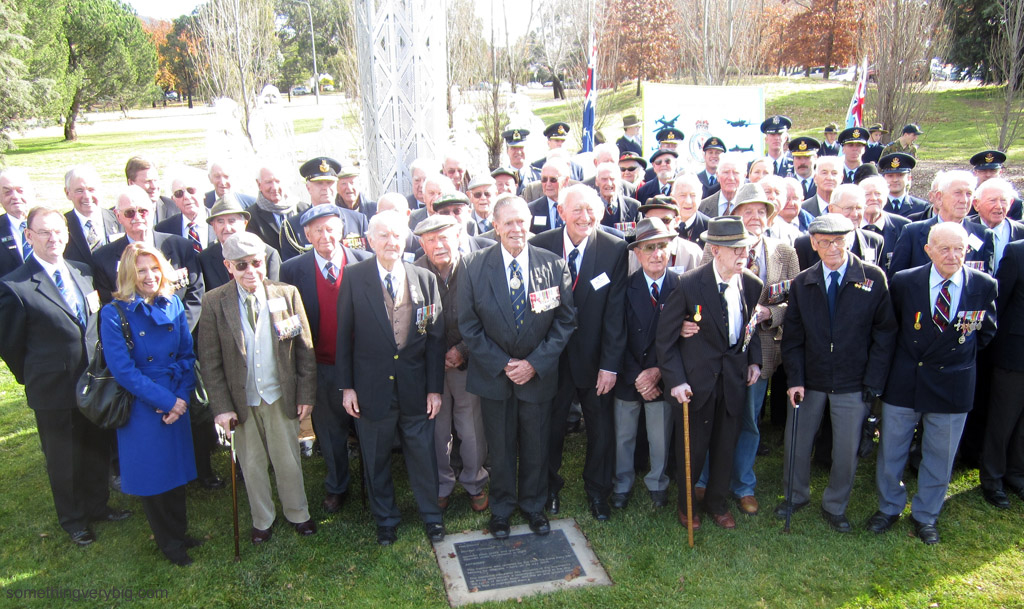
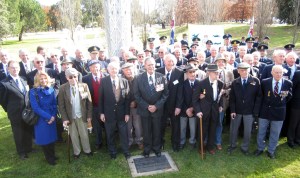
Canberra received almost an inch of rain on Saturday and it looked very much like it had set in for a week. But upon peering out of my hotel room window in the morning I saw a scene that was wet, but not actually raining. The clouds gradually cleared as the morning went on and in fact it turned out into a delightfully mild Canberra morning. The Commemorative Address was given by Air Marshal Mark Binskin, Deputy Chief of  Defence Force (and a former Chief of Air Force), who spoke about the legacy of teamwork from the men of Bomber Command, and how the Air Force has reformed two Bomber Command squadrons as a tribute. Fittingly a large group of 460 Squadron personnel were present standing in three neat rows at the back of the crowd. There was an attempt to get an official photo of all the veterans who were present but it was not as organised as last year’s effort:
12-jun-bomber-command-in-canberra-032 copy

Back to the Rydges, then, for the luncheon, always for me the highlight of the weekend. Despite the slightly lower numbers present this year, it is still one of the largest gatherings of Bomber Command veterans, families and other interested people in this country. Once again there were many extremely interesting people to talk to. I finally met Diane Strub of the Queensland Branch of the 463-467 Squadrons Association, and Fred Murray-Walker, whose father was killed in the crash of 463 Squadron Lancaster JO-G on the Scottish hillside in 1944. Peter Rees, a Canberra-based author who is currently finalising a book focusing on Australians in Bomber Command, was also there, and brought with him a magnificent folio of target photographs cheekily entitled “The Collected Works of 463 Squadron, as told to the Third Reich, September 1944 to May 1945”.

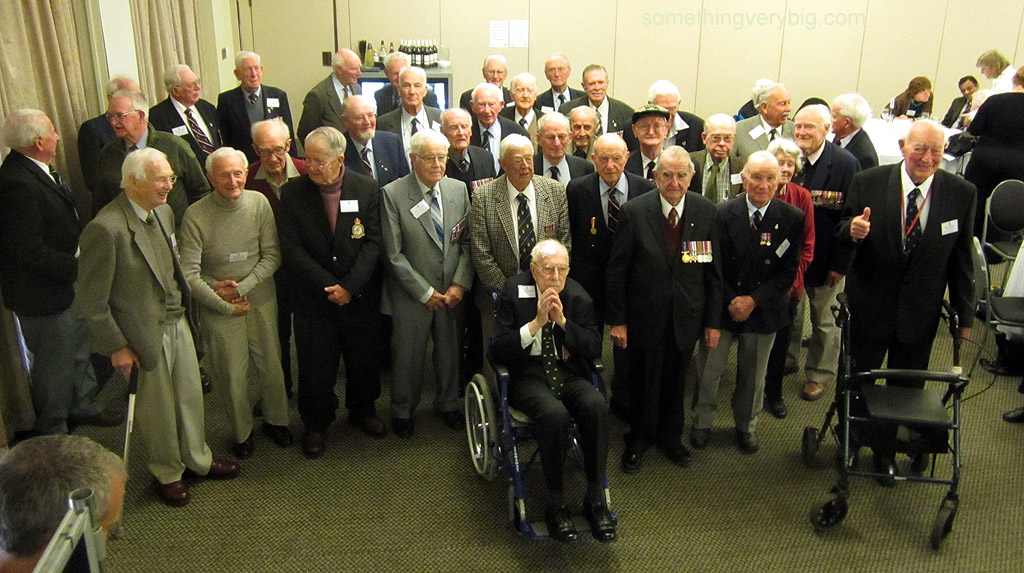
Perhaps the most remarkable person I met was sitting at a table at the back of the function room with her son and daughter in law. An Englishwoman, her name was Maude and, as it turned out, she had been on the staff at Bomber Command Headquarters – she was Deputy Commander in Chief Sir Robert Saundby’s secretary from 1943 until the end of the war. I asked her what the atmosphere was like at Bomber Command HQ. She said it was always busy – she was at work whenever her boss was and might – might – get the occasional half-day off on a Sunday if she was lucky. It was only a short conversation but it was an absolute pleasure to meet and talk to a unique lady. I even managed to convince her to get up for the group photo of all present who had served in Bomber Command (she is front right here, wearing red, behind Tommy Knox):
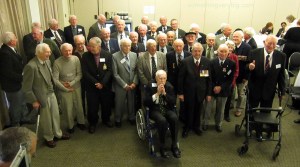
12-jun-bomber-command-in-canberra-066 copy

Some more photographs from the weekend:

Some of the crowd at the Meet & Greet function in the shadow of Lancaster G for George:

12-jun-bomber-command-in-canberra-010 copy

The Ceremony, in front of the AWM’s Bomber Command memorial:
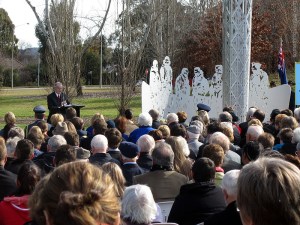
12-jun-bomber-command-in-canberra-015 copy

The Three Dons: Don Southwell reading a copy of a ‘Tribute to Mr Don Huxtable’ as tabled in NSW State Parliament recently, while Don Browning and Don Huxtable himself look on:

12-jun-bomber-command-in-canberra-041 copy

Bryan Cook, Don Huxtable, Don Browning and Adam Purcell in Canberra, 03JUN12:

12-jun-bomber-command-in-canberra-048 copy

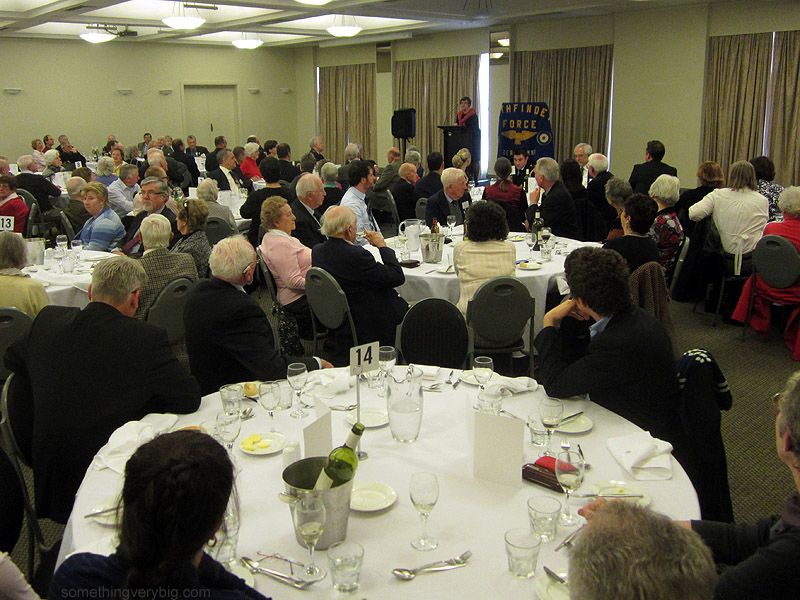
Part of the 220-strong crowd at the Lunch that followed the Ceremony on Sunday:

12-jun-bomber-command-in-canberra-052 copy

In all, then, another fine weekend of commemoration and friendship. Another pile of things to follow up on. Another piece of proof that, even after almost seventy decades, the deeds of Bomber Command live on. I’ll leave the closing words to Don Southwell, who delivered the Reflections address during the Ceremony on Sunday.

“I will always be proud”, he said, “that I flew with Bomber Command”.

Text and images (c) 2012 Adam Purcell

Vale Cliff Leach

I’m very sad to report that Clifford Leach, a 150 Squadron Pilot/Flight Engineer, died last week after a short illness. Cliff, perhaps unusually for his generation, plunged right in to the world of computers and forums in his later years, posting on a number of forums about his wartime experiences as ‘cliffnemo’. His magnum opus, however, was a thread that he started on PPRuNe in June 2008 called ‘Gaining an RAF Pilot’s Brevet in WWII’. Cliff posted about his experiences while in training, backed up with original notes and drawings. This drew a number of other contributors into the open, among them the much-missed Reg Levy, a 51 Sqn Halifax skipper who later  (among other things in a very long and varied career) flew Boeing 707s with Sabena. Four years and close to 2,500 posts later, that thread is still more than going strong, with a former Vultee Vengeance pilot named Danny now holding court.

On another forum, one of Cliff’s first posts was typical of the modesty of his generation:

I didn’t do much only three opps

Well, you might not have thought so, Cliff, but what a legacy you leave behind. The PPRuNe thread likely would not have come into existence without Cliff’s input. And it’s the interactive nature of those kinds of threads that makes them so valuable – being able to read experiences written first-hand, then asking questions either about those stories or on anything else even remotely related to the topic at hand. That little post in June 2008 brought into the open many fascinating stories and the thread now contains a goldmine of information for researchers like me – adding colour to the dry facts and figures.

His son Bill has posted on the thread following the death of his father, saying how proud Cliff was of the thread and how he had arranged for a printed copy of it to be left for his grandson. He also related the story of Cliff’s final flight, just a week before he died. A friend arranged for a local flying school to take him up, and he was, says Bill, “astounded that he was ordered straight into the pilots seat and took the controls for the whole flight. He was told that if it wasn’t for a strong cross wind he would have been allowed to land the plane.”

I never had the chance to meet Cliff, though we corresponded through the thread and through email over the last few years. His input assisted greatly in my earlier post on Flight Engineer training, and his recollections about the Lancaster contributed to th final look of the painting of B for Baker that I commissioned a couple of years ago. “On final check before switching off engines [the] engineers final check included raise flaps”, he wrote. “I think that if we had arrived at ‘dispersal’ and found the flaps down, we would have informed ‘Chiefy’.” And that settled it, so I asked Steve to depict B for Baker with her flaps up!

Another remarkable man has, in the words of the late Neptunus Lex, ‘stepped into the clearing at the end of the path’. Blue skies and tailwinds, Cliff. Blue skies and tailwinds.

Edit 25APR12: Link to a story in the local newspaper of Cliff’s final flight, published only a few days before he died.

(c) 2012 Adam Purcell

More Connections

The internet has made it a lot easier in recent years to make connections between people sharing common interests. One comment I received on this blog in recent times led to me linking up two people with an association with the same aircraft (ME739 of 630 Sqn): one whose great uncle flew it at the beginning of its career in April 1944 and one whose neighbour was shot down in it on its last operation exactly a year later. I’ve also had a comment from an artist preparing an entry for the 2012 RAAF Heritage Prize. And I received a comment a few months back from James Hollinworth, who has been researching Tamworth’s aviation history for some time. He was able to add significantly to what I now know about Andrew MacArthur-Onslow, the man with whom Gilbert Pate first tasted flight in the last few days of peace in 1939.

Given MacArthur-Onslow had held a pilot’s licence before the war (he had to have one if he had taken Gilbert with him!) I knew he already had some sort of flying experience. But I had no idea of just how much. James says he was an aerial surveyor prior to his enlistment, and as early as 1936 had visited Tamworth for the Diamond Jubilee Air Pageant that was held there, flying one of six machines from the Royal Aero Club. He enlisted in the RAAF in January 1937. But for me, the most staggering fact that James has revealed is that, in 1938, Andrew MacArthur-Onslow, along with his brother Denzil, flew their own aircraft from England to Australia. Even today this is no mean feat, let alone in the 1930s.

So it is evident that MacArthur-Onslow was a well-experienced airman, and the Air Force was not going to allow that expertise to go begging. In September 1940 (when Phil Smith was preparing for call-up for his posting to Initial Training School), MacArthur-Onslow was already an instructor at 6 Elementary Flying Training School atTamworth, NSW. The Air Force used his experience as part of a Board of Inquiry into 6 EFTS’s first accident in early October, when Tiger Moth A17-59 crashed, killing the student LAC WM Aspinall. Incidentally I suspect Phil Smith was alluding to this accident when he wrote to his mother shortly after arriving atTamworth in November 1940:

“The discipline up here appears unpleasantly severe, partly, we are told, because there was a fatal accident not long ago due to lack of flying discipline.” (A01-126-001)

I did have a look through Phil’s logbook for his time at Tamworth (November and December 1940) but MacArthur-Onslow’s name does not appear in it so the two did not fly together.

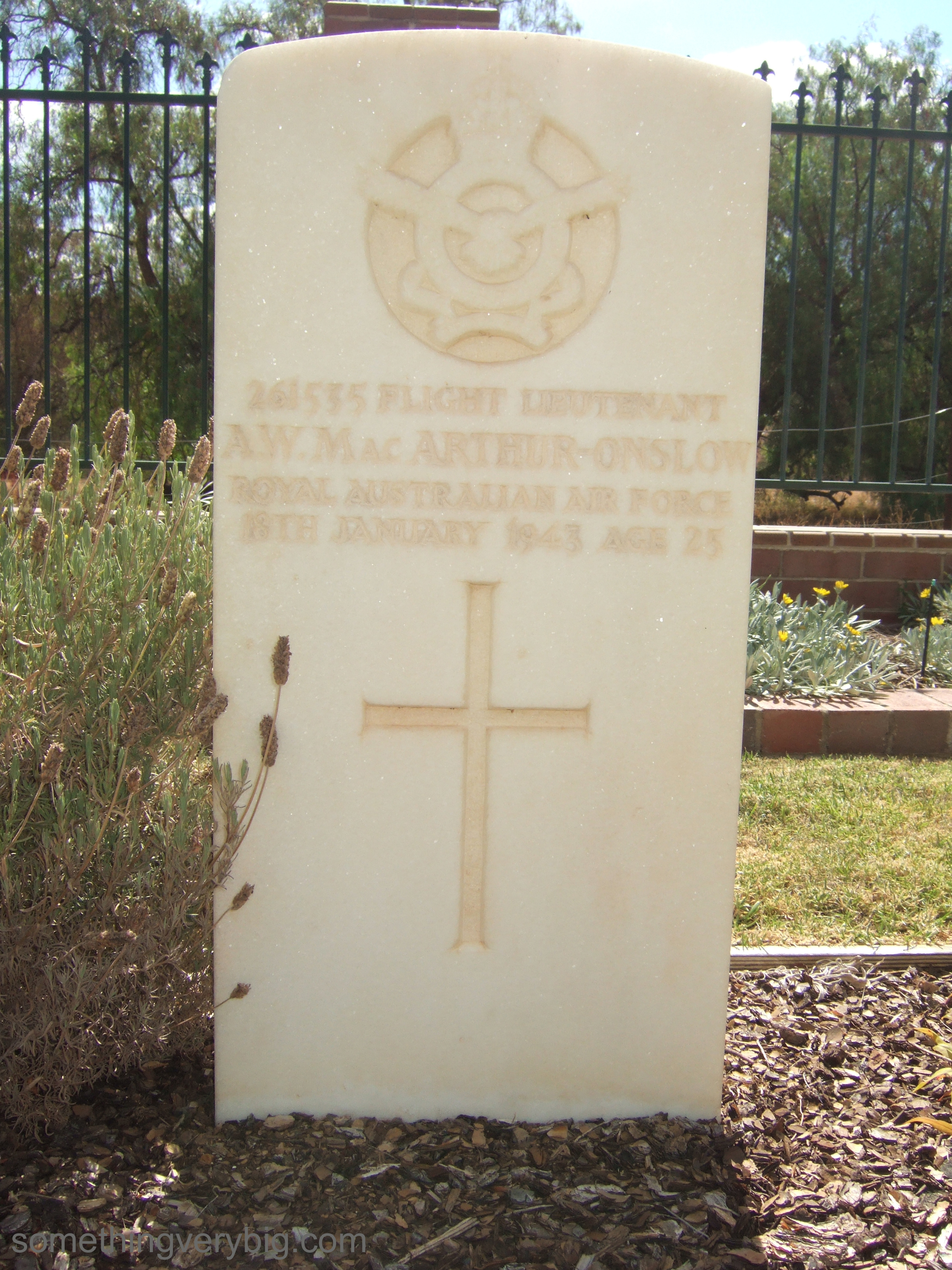
MacArthur-Onslow, James tells me, remained at Tamworth when 6 EFTS was disbanded in March 1942. The unit was replaced by the Central Flying School, which had the task of training the Air Force’s future instructor pilots. It was in this capacity that Flight Lieutenant Andrew William MacArthur-Onslow was flying with Sgt Thomas Myles Dawson on 18 January 1943 when, two and a half miles south west of Currabubula – about thirty kilometres south west of Tamworth– the Wirraway they were flying crashed while on a low flying exercise. Along with his unfortunate student, MacArthur-Onslow was killed and is buried in Tamworth War Cemetery.

c05-234-001 copy

© 2012 Adam Purcell


Thanks to James Hollinworth for the information that went into this post and the photograph of the grave.

Leo

There are fifteen Commonwealth War Graves in the cemetery belonging to the small village of Hellendoorn, in the east of The Netherlands. My family and I lived in Nijverdal – the next town along – throughout the year 1995 and when we discovered that there was one Australian among the graves we decided to see what we could discover about him.

Flight Lieutenant Leo McAuliffe was a fighter pilot attached to No. 222 Squadron, RAF. He was killed on 17 March 1945, a matter of weeks before that part of the Netherlands was liberated. He was 24 years old and came from Bexley, NSW. While still overseas, we wrote to the Commonwealth War Graves Commission to see what they could tell us about Leo. He had been killed in a ‘flying battle’, they said, and another letter to the Air Force after we returned to Australia in 1996 revealed he crashed while leading a section of two aircraft on a patrol and weather reconnaissance mission over enemy occupied territory.

Late last year I decided to obtain copies of Leo’s service record and A705 files from the National Archives of Australia. This was not intended to be as in-depth a study as I am doing on my great uncle Jack and his Lancaster crew. It was just a side-line interest, more for general interest of our family than anything overly complicated. I had vague plans of reading through the files and writing a short ‘interpretation’ of them so I could then bind the whole lot up and give it to Dad for Christmas. Unfortunately the National Archives are experiencing ‘high demand’ for copies at the moment, and the month turnaround that I was expecting turned into two – too late for Christmas. Dad got a packet of liquorice instead.

But I now have the files, and have spent the last couple of weeks reading through them and beginning to write my little story. And guess what? It’s turned out into something far bigger than I was intending it to. I’m not under the deadline of ‘Christmas’, so I have time to delve into the story a little deeper, following leads that I would have otherwise left alone. So questions raised in the NAA files have led to posts on the RAFCommands forum, which in turn led to the discovery that Leo served in Northern France following the invasion… meaning that my friend Joss le Clercq is also interested in Leo’s story and has been in touch.

The account of Leo’s final flight, from his wingman, suggests to me that he simply became disoriented and lost control in thick cloud – more accident than ‘flying battle’. And the story of how a young Dutch woman witnessed the crash and recovered a dog tag but was later killed in an air attack on Nijverdal caused me to contact a friend who volunteers at the small World War II museum that is now in that town. This, in turn, resulted in numerous emails from her contacts at the museum, and much information about the crash and the attack on Nijverdal.

All quite amazing. I’ve spent the last few hours translating those emails from Dutch and using Google Earth to try and pinpoint a crash location. But a line needs to be drawn somewhere. There is a lot of information out there – the tough part is deciding when you have enough, when you can stop researching and start writing. Leo’s story is well on its way to becoming known now. A couple more questions to my new Dutch contacts, and the writing can begin.

© 2012 Adam Purcell

Why the Japanese really threw in the towel

I’ve recently discovered the Australians at War Film Archive,  a massive resource made up of more than 2000 oral histories from people ‘who were there’ in various conflicts ranging from World War One to the current operations in Afghanistan. Included in the collection are transcripts of interviews of a large number of Australian Bomber Command aircrew, and it was in one of these that I found this little gem.

Rod Allcot, DFM, was a bomb aimer with 460 Squadron. After VE Day, Rod was on his way back to Australia to join the rumoured Tiger Force, flying Avro Lincolns against the Japanese. But events turned out somewhat differently:

“[…] When we were half way across the Atlantic, they [the Japanese] must have heard the news that a great team of Aussies was back on its way home to form a Lincoln squadron and fight against [them]. And that’s when they decided to toss it in… some people think it’s because of the atom bomb!”

Always modest, the airmen of Bomber Command.

This will be the last post on SomethingVeryBig for 2011. Best wishes to everyone for Christmas and the New Year, and I’ll be back in mid January. 

Flight Engineer

In the early days of the bomber offensive, British aircraft like the Wellington would typically fly with a ‘second pilot’ in a support role to operate flaps and throttles or to take over for a while in the cruise. Phil Smith was operating on his first tour with 103 Sqn at this time, and his logbook records that he completed ten operations as second pilot before being given his own crew. The second pilot would be a fully-trained and qualified pilot who was usually less experienced than the ‘first pilot’ who commanded the aeroplane. But this meant, of course, that to lose one aircraft would mean losing two pilots – and pilots were perhaps the hardest (and most expensive) out of the aircrew categories to train and replace.

The Stirlings, Lancasters and Halifaxes that began coming on line around then had more complex systems than those on, for example, the Wellington, so a more specialised member of the crew was required. Around the beginning of 1942 the second pilot was starting to be replaced by a dedicated member of the crew whose job it was to know where every single switch and dial and gauge on their aeroplane was (and in the dark), and what they did: the flight engineer.

Initially, flight engineers were taken from the ranks of the ground crew already serving at RAF bases: the engine fitters and mechanics whose technical knowledge was already of a high standard. But when the demand for heavy bomber crews really ramped up the supply of suitable ground crew available to take conversion training began to slow. So the RAF began training ‘direct entry’ flight engineers from scratch.

One of these direct entry flight engineers was Tom Knox, a Glaswegian who moved to Australia after the war and still retains his beautiful accent. I had the distinct pleasure of meeting Tom in Canberra in June, and recently spent an afternoon visiting him at home onSydney’s northern beaches.

Tom had begun an engineering apprenticeship when he was 16. Being a reserved occupation, the only way he could get out of it was to join up as aircrew. “So I did it!”, he wrote to me in a letter in June 2011. He reported to Lords Cricket Ground just after his 18th birthday, did his ‘square bashing’ in Devon and went to No. 4 School of Technical Training, St Athan.

It was here where young men learnt everything there was to know about their aeroplanes. The training was remarkably solid. Cliff Leach (a pilot who retrained as a flight engineer late in the war) remembers copying diagrams of the various systems from a blackboard and being asked to reproduce from memory some of them in exams. Cliff, aided by his classroom notes which he still has, remembers a lot of the systems of the Lancaster more than six decades later.

During their course the trainee flight engineers covered fuel systems, instrument panels, flight controls, engines, electricals, hydraulics and pneumatics. They learnt how to do the pre-flight inspection. They experienced hypoxia in a decompression chamber, to be able to recognise it if it arose on operations. They spent a week on a ‘Maker’s Course’, visiting Avro or Short Brothers or Handley-Page to gain an insider’s view of their specific aircraft. The final assessment consisted of written tests on each of the subjects they had studied followed by a face-to-face test.

But perhaps the most remarkable thing about their training is that, even after receiving the half-wing brevet with an E – the mark of a fully qualified flight engineer – most of them had in fact never been up in the air. And when they got to the next stage, a Heavy Conversion Unit, the men that they would join had already been a crew for some months.

In Tom’s case, crewing up was very simple. He was approached by a young Australian Flight Sergeant who asked if he wanted to join the crew – and that was that. His first experience of flight was in the rear turret of a Stirling shortly afterwards. “It was scary”, he says, but he handled it ok and went on to fly operationally with 149 and 199 Squadrons.

The flight engineer on B for Baker was a young man named Ken Tabor. He joined the RAF on his 18th birthday and was at St Athan between February and August 1943. In this photograph he is standing with his parents, wearing his Flight Engineer’s brevet:

a05-226-001-orig copy

The brevet shows that the photo was taken after he graduated from St Athan, which happened in August 1943 – perhaps the snap was taken while Ken was visiting his family on leave in Dorset before he went to an operational squadron.

Ken Tabor was the youngest man on board B for Baker when it went missing over Lille in May 1944. He had not yet reached his 20th birthday.

(c) 2011 Adam Purcell

Image: Steve Butson

Thanks also to Tom Knox and Cliff Leach for their input to this post.

Training

I was talking to 463 Squadron veteran Don Southwell on ANZAC Day in April about his training to become a navigator in WWII. Among other things he spoke about life at Initial Training School at Bradfield Park. He said that days started with physical training and drill, and were then full of theory classes – and when the trainee aircrew had time off from formal classes, they were expected to study. He remembers some particularly challenging subjects keeping him working at his desk until one or two in the morning. “The blokes in my hut”, he told me on the phone recently, “used to say that they didn’t have to go to classes because they’d hear everything from me… while I was talking in my sleep!”

This got me thinking (as happens every so often). In some ways, I can draw some parallels with what I understand of Air Force training and what I’m currently experiencing as a trainee air traffic controller. For example, the eleven other lads in my group and I are known by the simple name ‘Course 44’. We are timetabled as a course and subsequently we do everything together. We’ve become a reasonably close-knit group, with friendships forged in the furnace of shared challenges. We’re all (mostly) young men. Many have travelled from all over the country, and some from overseas, to do this training. We are learning a highly technical discipline, and we’re under considerable time pressure. We work hard, and we have to. There is the ever-present threat of being ‘scrubbed’ and washout rates are not insignificant. In short, this course is by far the most intense thing that I’ve ever attempted.

But there are a few key differences. Most of us are in our late 20s or early 30s, which is older than an average Australian airman in training during WWII (Don celebrated his 21st birthday on a bombing raid over a German city). There’s no mandated physical exercise or drill to worry about. We don’t live on site. But most importantly, the end result of our training – if we actually get through it – is a high-pressure but ultimately civil job. Sure, we’ll be on shift at all hours of the day and night, we’ll be working some pretty tough days and nights and there is no ‘pause’ button in air traffic control. But we won’t be going into combat. We are not facing the prospect of half of our number going missing in action. We can be pretty sure that at the end of our shift we will get home safely.

Which is a lot more than could be said for the airmen of Bomber Command.

© 2011 Adam Purcell