Bomber Command in Canberra

There was an old man sitting patiently in the departure lounge in Melbourne when I boarded a QantasLink Dash 8 to fly to Canberra last weekend. Sat next to him was his middle-aged son. When we boarded the aircraft they sat across the aisle and a few rows in front of me. I overheard a snippet of half a conversation that the younger man was having on his phone: “meeting in Canberra… taking him to… you know, Air Force stuff…” I watched his father as we powered down Runway 34 and took off. He was gazing out of the window, and his thoughts looked like they were miles away: across the seas, and across the decades.

They were going to Canberra for the same reason I was: the fourth annual Bomber Command Commemorative Day. I next saw Ian and his son Phillip underneath the nose of Lancaster G for George at the Meet & Greet cocktail party later that evening and went across and said g’day. Ian had been a 460 Squadron pilot so it was fitting that G for George, a 460 Squadron machine, was the centerpiece of the function.

11jun-bombercommandcanberra-007s copy

It was an outstanding evening. There were perhaps 150 people present, a fair proportion of those being veterans. Talking about flying Lancasters with people like Don Huxtable, a 463 Sqn skipper, was a unique experience as he casually threw a thumb over his shoulder at the old bomber to emphasize a point. The function ended with the magnificent ‘Striking by Night’ sound and light show recreating a bombing raid around the Lancaster. We retired to the hotel bar for a nightcap, ensconced in a warm corner while Don Southwell held court.

It was a cold and misty Canberra winter’s morning when we awoke. But the sky soon cleared and the sun was nicely warming as we took our seats for the ceremony at the Australian War Memorial.

As is customary the AWM Ceremonies division put on a good show. It ran smoothly and Don Browning’s ‘Reflections’ presentation was particularly good. As the first notes of The Last Post rang out into a brilliant blue sky the line of young RAAF officers in the row in front of us snapped into a salute. It was a moving moment.

After the ceremony all the veterans moved up towards the War Memorial buildings for an extraordinary group photo. I counted 50 veterans, surely one of the largest gatherings of Bomber Command airmen (and at least one WAAF) anywhere in the world these days.

11jun-bombercommandcanberra-045s copy

The final part of the weekend was the luncheon. This was, I reckon, the highlight of an already highlight-heavy weekend. Some 200 people showed up, with at least one veteran at each table.

The best part of this event is the ability to float around between tables talking to all sorts of interesting people. Until today, I’d never met a real live Bomber Command flight engineer. Tom Knox, a Glaswegian flight engineer from 149 and 199 Squadrons, is on the right here:
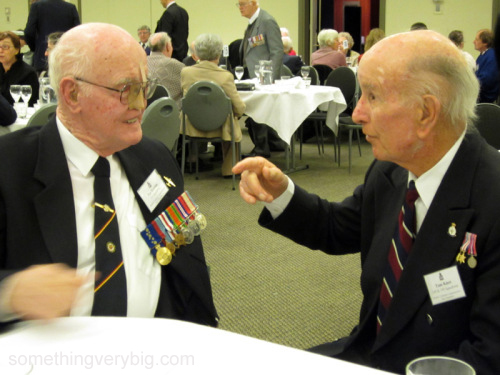
11jun-bombercommandcanberra-067s copyThe other man is Pat Kerrins, a pilot from 115 Squadron. They were in animated conversation regarding a mutual friend and just being a fly on the wall while they chatted away was fascinating. A copy of this photo will be winging its way to each of these men shortly. I also met Jean Smith, who served in the WAAF at 27 OTU, RAF Lichfield, and a couple of likely suspects involved with the 463-467 Squadron Association in Melbourne. All very interesting people to know.

This has become an extremely significant event in the Bomber Command calendar in Australia. The Bomber Command Commemoration Day Foundation was set up to organise events like these to ensure that the men and women of Bomber Command get some long-deserved recognition. Behind ANZAC Day and Remembrance Day, this is now the third largest single event held by the Australian War Memorial each year.

Given the level of interest in this year’s event, the men and women of Bomber Command can rest assured that it will continue into perpetuity.

11jun-bombercommandcanberra-004-copys copy

(c) 2011 Adam Purcell

Logbook

A logbook is a legal requirement for any pilot. In Australia, it must record at a minimum the dates of any flights made by the pilot, crew details, aircraft type and registration, route details and flight times. It allows a pilot to calculate his or her experience in terms of flying hours, and records the results of any exams or licence flight tests carried out.

But logbooks are something more than simply a dry record of dates, aeroplanes and times. They can also be intensely personal documents. Reading through my own one, I find my mind can very easily wander to remember a particular flight, and the circumstances surrounding it. “Bankstown-Three Sisters-Bankstown. Bumpy”, reads one entry. A simple enough description. But it’s one that belies the intensity of that flight, on which I and my passengers flew unwittingly into some pretty severe turbulence. Or ‘Circuits Camden – First Tiger Solo’, recording the first time I flew a Tiger Moth by myself, possibly my proudest yet moment in an aeroplane.

Unless one kept a diary there were very few ways that people could accurately recall where they were at a certain time, let alone what they were doing. This is where all pilots score. Your log book, which it was mandatory to keep and have regularly certified as being a true record, will instantly tell you that and, hopefully, jog the memory especially as the long forgotten names of the people that flew with you are very often there as well.

-The late Reg Levy, 51 Sqn Halifax skipper and later pilot for Sabena, writing on PPRuNe 

I think Reg nailed it. The terse notations in a logbook, taken in isolation, give fairly dry information about where someone was and what they were doing at particular dates in history. This in itself is interesting stuff for a study of the men of Bomber Command. But they can also trigger memories far beyond the short statements themselves.

It’s easier, of course, when the airmen are still around, because you can ask them questions about it. This is one reason why Reg Levy, in the last year or so of his life, contributed to a fantastic thread on the Professional Pilots Rumour Network (which by the way is well worth a look if you have a few hours to spare*). He used his logbooks as the basis of a superb running story about his experiences in training, then while operating in Bomber Command, and his rather incredible adventures after the war. The logbooks provided the spark, the interaction with other contributors around the world were the fuel and his sharp memory filled in the details.

It’s a little harder to ‘reconstruct’ what an airman was doing through his logbook alone if he is no longer with us. But it’s a good starting point. Other historical records and personal letters can go a long way to filling in the details. Maybe the end result won’t be quite so personal – but it’s a worthwhile challenge.

jacklog-last-page copy

*Reg’s pseudonym on the thread was ‘regle’

© 2011 Adam Purcell

Bradfield Park

After a period on the Volunteer Reserve, a newly-enlisted airman in the RAAF in WWII would find himself posted to an Initial Training School (ITS) to learn about the basics of military life. Each state of Australia had its own ITS. Airmen from NSW would normally pass through No. 2 ITS at Bradfield Park in Sydney. Many thousands of airmen (and women, for there was also a WAAAF school on site) would experience their first taste of the Air Force at this station.

Don Southwell remembers “miles and miles” of parade grounds near the gatehouse of the station. Don was a 463 Squadron navigator in the latter part of the war. Like so many of his era, his Air Force career started at Bradfield Park. Don took me on a drive around the site of the old station shortly before I left Sydney in October 2010. “The WAAAFs could out-drill anyone”, he said.

Don on occasion would need to guard the Station’s boat house, which was down on the banks of the nearby Lane Cove River. He would carry his straw mattress and rifle down a track through thick bush and stay overnight in the boat house. On one occasion he fired his rifle at the water to see what would happen, then spent the walk back to the main base worrying about how he would account for that one cartridge… history and memory do not record how he got away with that one!

Don related stories of airmen crawling through a hole in the fence and removing the white ‘trainee’ flash from their caps to appear to be ground crew and thus less suspicious, to be able to walk up Lady Game Drive to Chatswood Railway Station. Being a Croydon boy, Don says he did the same while officially on guard at the boat house. He simply waited until it was dark, then made his escape to catch a train home. He slept at home that night, returning just as the sun came up the next day.

There is now virtually none of the station left. The CSIRO moved to the area in 1979 when their National Measurement Laboratories were built. In recent years they sold off some of the Commonwealth land on which the RAAF station once stood. But reminders are still there. The main road past the CSIRO’s compound is called Bradfield Rd. Other streets close by are Squadron Circuit and Brevet Ave. And in the corner of Queen Elizabeth Reserve, a short distance from tennis courts where Don says some of the parade grounds were, is this memorial:

 bradfieldparkmemorial1 copy

Partly funded by the CSIRO and Kuringai Council, it was built in 2006 and forms a fitting reminder to the activities that took place there.

 bradfieldparkmemorial2 copy

© 2010 Adam Purcell

First Solo

“I’ll always remember my first solo”

-463 Sqn navigator Don Southwell in conversation, October 2010

There is a certain mystique about a pilot’s first solo. It is one of those moments that separate them from the common ground-dweller. Quite simply, there are those who have flown solo, and there are those who have not.

I remember my own first solo well. It was 28 November 2002, in a Cessna 152. It didn’t take long – just one circuit, taking off from Runway 16 at Wollongong in NSW. Flying downwind, I distinctly recall the euphoric feeling as I looked at the empty seat to my right, where my instructor had been sitting just a few minutes before, and realised that I was flying the aeroplane – all by myself. I ballooned slightly in the landing flare, but at least it was a reasonably soft touchdown.

World War Two provided many aircrew with the opportunity to join that elite ‘solo’ club. Phil Smith flew alone for the first time on 28 November 1940 (exactly 62 years to the day before I did so myself). He flew a Tiger Moth from No. 6 Elementary Flying Training School, Tamworth, NSW. Despite the achievement, Phil’s letter to his father written later that day is in the same measured, almost formal language as all the rest of his correspondence:

“I still don’t make good landings but they say I am fairly safe. So, this morning I did my first solo flight. Altogether I made three solo flights and landed satisfactorily each time” (A01-132-001)

Don Southwell was originally chosen for pilot training. He was posted to 8 EFTS in Narrandera, NSW, and before he was scrubbed and re-mustered as a navigator, he managed to go solo in the Tiger Moth. His solo flight was not entirely uneventful however. He told me the story when I visited him in October 2010. Don was at one of Narrandera’s four satellite fields, which he described as ‘a paddock with a hut’. Shortly after he took off the wind changed. His instructor came up beside him in another Tiger Moth, gesticulating wildly and pointing to the windsock, but Don couldn’t work out what he was trying to tell him. So he simply landed in the same direction that he had taken off in, in a significant crosswind – and made a ‘pearler of a crosswind landing’. I commented on this because I know from experience how much Tiger Moths do not like crosswinds – Don admitted it had been a ‘bit of a fluke’!

Amusing anecdotes aside, however, some aircrew did see their early solo flying as special. In his memoirs published posthumously in 2009, 467 Sqn mid-upper gunner Brian Fallon described his first solo cross country flight in slightly more descriptive terms:

“On 17 June 1943 I flew my first solo cross-country. It was magic. The thrill of sitting alone in an open cockpit with the wind in your hair floating above the earth is something to be experienced.”

I can only say that the first time I flew a Tiger Moth by myself – in April 2010 – I knew exactly what Brian had been getting at. To look forward and not see the back of the instructor’s head in the front cockpit, to hear the wind through the wires and to feel its force on your face is to experience in a small way something of what it was like for so many aircrew of the Commonwealth air forces of World War Two.

Brian’s writing encapsulates a lot of how much it means for pilots to join a very special club:

“They say that flying is as close to heaven as you can get in this life. I think it is so, for you could not help wondering at God’s greatness as you flew around flirting in and out of the clouds with the earth stretched out below, its cultivated squares looking like a quilt. Up there I had a feeling of detachment from all the petty squabbling in society and could not bring myself to believe that all was not right with the world below.”

If there was one good thing to come out of World War Two, it was the opportunity for so many to experience that joy of flight that Brian writes about.

© 2011 Adam Purcell

So Far from Home

A recent article in Sydney’s Sun-Herald, 02JAN11:

http://www.smh.com.au/national/where-the-streets-will-have-his-name-20110101-19cjd.html

Flying Officer Lindsay Page Bacon, a couple of months before the end of the war in Europe, returning from a bombing operation in a 7 Sqn Lancaster which is damaged in combat and struggling to keep height. He manages to avoid crashing into a small town, but in the process destroys what little control he has over the aircraft. All on board perish in the crash.

65 years later, digging at a construction site in Nieuwdorp, the Netherlands, uncovers remnants of F/O Bacon’s aircraft. The town goes on a search for information about the crew, with an aim to build a memorial near the crash site. With the help of the newspaper they eventually find F/O Bacon’s sole surviving brother in Ulladulla, NSW.

People have many motivations for becoming involved in this sort of research. For myself, like many others, it’s about that dusty photograph or logbook, and wanting to know more about someone who shared your name. For others, it’s the technical aspects of the aircraft, or the tactics, or the strategies.

But for people like Hans van Dam, the Dutchman who contacted the newspaper in Sydney, it’s about remembering the men who came from the other side of the world to fight in the defence of his little village – and who never got the chance to go back home.

Rollo

While sorting through some of my old files recently I found a few sheets of notepaper stapled together and covered in the messy scrawl of my own handwriting from some years earlier. It was a description of some of my early flying lessons from late 2003. As I read through it I chuckled to myself as I remembered the events I had described. On one page however, the flying story came to an abrupt stop. The handwriting became bigger, messier, more hurried. At the top of the page was scrawled,

“PHONE CALL FROM ROLLO KINGSFORD—SMITH, 6.30pm 13/12/03”

Rollo was the nephew of perhaps the most famous of all Australian aviators, Sir Charles Kingsford-Smith. Far from hiding in the shadow of his famous uncle, Rollo had a distinguished career of his own in the Royal Australian Air Force. He was, in fact, the first Commanding Officer of 463 Squadron, which had been formed in November 1943 from ‘C Flight’ of 467 Squadron and was also based at Waddington. In 2003 Rollo lived in the village of Exeter, in the far south of the Southern Highlands of NSW, not too far away from where I grew up. I had discovered that he had flown – and in fact had a narrow escape – on the Lille raid of 10 May 1944 on which Jack Purcell and his crew were shot down, so I sent him an email.

A few weeks later I was writing out my flying account, having completely forgotten about the email, when my telephone rang. It was Rollo, calling for a chat. The notes I found recently had been scribbled during this phone call. Rollo remembered Phil Smith as a man who “kept much to himself but seemed a pleasant chap”. This certainly bears out with Phil’s letters and with Dan Conway’s description of him as a “fine example of quiet efficiency” (C07-014-143). Phil Smith had passed away some nine months previously and, while I had been lucky enough to meet Phil a few years before his death, it was quite something to hear about him from someone who had known and served with him at Waddington.

Given his close shave on the Lille trip it is not surprising that Rollo could remember it well. My notes from the conversation tell me that it was very important that they “only bomb the railway” on the night – I’m guessing that this was to avoid French civilian casualties. The Pathfinders marked the target, Rollo said. Then:

“we milled around for five minutes or so and that gave the German defences time to get organised”.

As we now know, it was this delay – actually lasting 21 minutes (A04-056-002) and caused because the first markers on the target were quickly obscured by smoke – which contributed to the surprisingly high casualties on the Lille operation (C07-018-185). Rollo said that the bombing height for this raid was very low – only about 6,000 feet – which would also have raised the risks for the bombers by bringing them into the range of light flak. There was, he remembered, “intense” flak about though he could not remember seeing any fighters about. Given the target’s close proximity to a nightfighter airfield and the delay in marking the target this, with the background knowledge I now have, I find curious. I can only conclude that Rollo and his crew were lucky – certainly the possibility of a nightfighter attack rates fairly highly on my list of theories to explain what caused the loss of LM475.

I never spoke directly to Rollo again. I had seen him at a Bomber Command Commemoration at the Australian War Memorial in Canberra, but never got the chance to have another chat. He died in 2009, but I consider myself honoured to have spoken even so briefly with such an amazing man.

© 2010 Adam Purcell