Just far enough removed

My sister Jennifer, when visiting Uncle Jack’s grave in Lille, once described the man as the ‘Shadow in the Corner’: someone we were always aware of while growing up. We were told stories about him, we leafed through his little blue felt-covered logbook, we looked at fading black and white photographs of a young man in uniform and on Anzac Day, we pinned medals on the right-hand side of our chest and we marched in our village’s parade. During the minute of silence, Jack was the person we thought about.

We felt, and I think still feel, a personal connection to this man, despite never having met him and despite being, really, only distant relatives of his. Through this blog, I’ve been contacted by people who are more closely related to Jack than I am; he was one of nine children and there are many branches of the family tree. I’ve learned that there are many other people who think of him during their minute of silence, too.

That is no bad thing, and it’s partly why almost thirty years ago I dove into finding out more about Jack: so I can help to tell his story. But I’m not a direct descendent of his – to our knowledge, he never had any – and he was my grandfather’s uncle, not my grandfather. I didn’t grow up with him around, like the sons and daughters of the veterans I once knew. I didn’t see the effect that war had on him; I didn’t have to live with the person he might have become as a result. And I was far enough removed, in time and in family connection, that I didn’t experience how news of his death affected those he did live with. For those people, the shadow isn’t just in the corner on Anzac Day, the ‘one day of the year’, but it’s always there.

In my case, though, the extra level of removal from the story helps, I think. It allows me to look at things a bit dispassionately, and so perhaps more honestly. 2024 will see the 80th anniversary of the Lille operation from which Jack and his crew failed to return. That makes it a very very long time ago: it’s now almost (but not quite) outside of living memory. For me, that helps the thrill of the hunt for more information to outweigh the sheer horror of what might be found next. The official records, for example, contain some quite gruesome details of what happened to the bodies of the crew, for example. The distance in time makes it a lot easier to be pragmatic about that: this really happened, this is what war does to people.   

That makes me lucky in a way. I’m a close-enough relation to a member of Bomber Command – to the point that I share a surname – to feel a personal connection to that person and his story. But at the same time I’m far enough away that any emotional response to it can be tempered somewhat. And perhaps that allows me to get a little closer to the real story.

© 2024 Adam Purcell  

Vale Laurie Larmer

Late last year I dropped in to visit Laurie Larmer at his home in Melbourne’s north-western suburbs. Though we’d had the occasional phone call, it was the first time I’d actually seen him since the pandemic started. It was a lovely visit, we had a chat and a cup of coffee, and then Laurie graciously kicked me out so he could have an afternoon nap. As I left, he wagged a finger at me:

“Don’t leave it so long next time!”

Sadly, I now can’t comply with his instruction. On 14 April, five months before his one hundredth birthday, my friend, 51 Squadron skipper Lawrence O’Hara Larmer, OAM Ld’H, departed on his final flight.

I have written about Laurie before, of course. He was one of 28 veterans who I interviewed for the International Bomber Command Centre’s Digital Archive – you can listen to his interview here – and I wrote up details of his wartime story in a blog post shortly afterwards.

Up until we recorded the interview, I’d known of Laurie but beyond a few short conversations at lunches or other Bomber Command events we hadn’t really got to know each other. But once I’d spent several hours in his company, listening to his story, we became friends. After that, if there was a Bomber Command or aircrew-related event, I’d ring Laurie to see if he was planning to come, and then on the day I’d drive him there and back. And it was on those car trips that we got to talk about all sorts of things: about his service, sure, but also about life after the war, or the chances of one of his horses in its latest race meeting, or about politics and current affairs. I’m a bit sad I was born too late to experience Laurie’s hospitality in one of the pubs he ran after the war.

Laurie had a great friendship with Jim Cahir, another veteran who lived close by, and my partner Rachel and I will always remember a hilarious car trip home from the Bomber Command commemoration ceremony at the Shrine one year, with Laurie comfortably riding shotgun and Jim’s long legs squeezed into the back seat of my little Golf.   

Laurie in 2018

Laurie flew nine trips with 51 Squadron out of Snaith in the UK in the last weeks of the Second World War. He was, thus, proudly a Halifax man. At his funeral last week, they played the video clip for Grant Luhrs’ 2013 song ‘Full Moon Tonight.’ You might recognise a lot of the footage from the wartime colour film ‘Night Bombers’ which was filmed in 1943 on the airfield of a 1 Group Lancaster squadron. I could almost hear Laurie making indignant comments about the lack of Halifaxes in the film.

As the film played though, I realised something. Over the last couple of decades I’ve been privileged to know several dozen Bomber Command veterans. I’ve had in my address book many of their names and phone numbers, and I’ve always been able to pick up the phone to one of them for a chat or to arrange to drive them to a luncheon, or just a visit for a cup of coffee.

With Laurie goes the last of those men that I knew in Melbourne. No more can I ring a phone number and hear a familiar old voice on the other end. No more can I go and visit someone to hear about life in Bomber Command, from someone who was there.

That makes Laurie’s passing all the more poignant.

A page from Laurie’s logbook, with his pilot’s wings and lucky-charm Guinness pin

© 2023 Adam Purcell

Where, exactly, was the target? A Google Earth story

“[O]ur boys joined in the attack on the Marshalling Yards at LILLE” – 463 Squadron Operational Record Book, 10 May 1944

The concept of a marshalling yard in Lille has long formed part of my understanding of what happened to the man known in our family as ‘Uncle Jack’. It’s been part of Purcell family folklore, I suppose, for as long as I can remember: that the target of Jack’s Lancaster on that fateful night was a set of railway lines in northern France.

But which set of railway yards, exactly?

The thing about Lille, you see, is that it’s a pretty important railway junction. It’s now a key stop on the Eurostar cross-Channel tunnel route between Brussels and London, an hour from Paris on the TGV and about 40 minutes from Brussels. There’s also a significant local railway network. There are two key stations in the centre of the city; Lille-Flandres, which hosts local and regional trains and some high-speed TGVs, into which I arrived when I visited Lille in 2009, and Lille-Europe, serving the Eurostar cross-Channel trains and international TGV services, from which I departed three days later. While a lot of these train lines and services have been built since the Second World War, their slower fore-runners also ran through the city: Lille sat on the route from the ports of Calais to Berlin and on to Warsaw, for example, and one of the first railroads in France, the line between Lille and Paris, opened as early as 1846. Locomotive building and repair workshops were also located in the city. 

It’s pretty clear, then, why the city’s railways were targeted as part of Bomber Command’s pre-invasion Transportation Plan. But which part of them, specifically, was the target on 10 May 1944?

In the International Bomber Command Centre’s superb Digital Archive I thought I found the answer: a bombing photograph from the night in question, which shows a distinctive set of marshalling yards amongst the smoke – just above the white bomb burst in the photo:

[

Extremely helpfully, the IBCC’s volunteers have geolocated this photograph over a modern-day map. I fired up Google Earth, bearing in mind that this is a modern-day image and a lot of this infrastructure wouldn’t have been present in 1944, and immediately found the relevant spot. The facility in the bombing photo is pretty clearly the Hellemmes workshops, circled in blue:
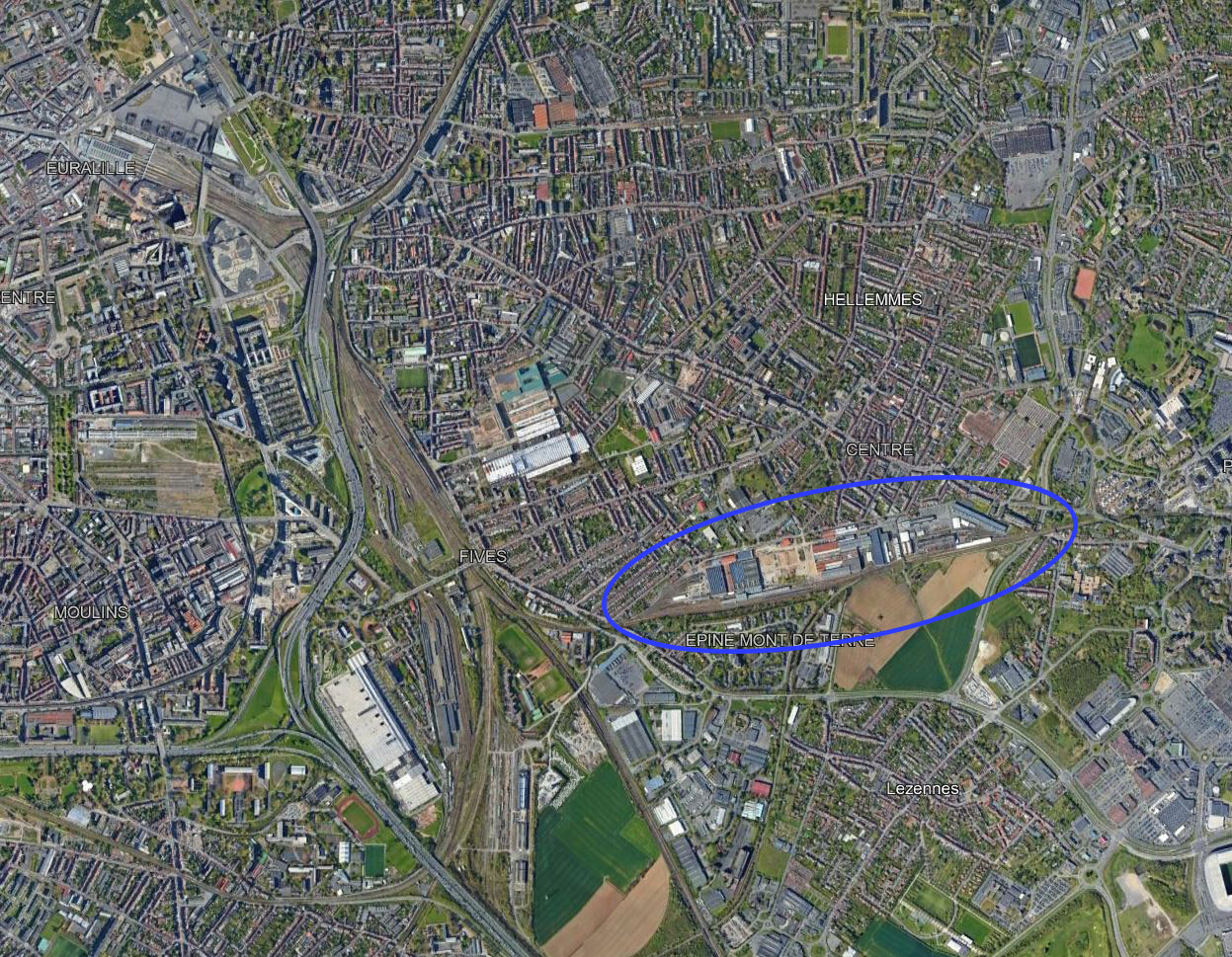
And it looks like the 50 Squadron crew who obtained the bombing photograph just missed the target – the centre of the photo, the point where the bombs themselves would have theoretically fallen, being plotted a little way south of the marshalling yards. In this view, which I’ve geolocated onto the Google Earth screenshot, the red ‘X’ marks the crosshairs:

If I remove the bombing photo overlay, you can see the red ‘X’ just above that little white building – not very far away from the marshalling yards at all:

Or so I thought… until I saw the other side of the bombing photo, which has also been scanned in the IBCC’s Archive:
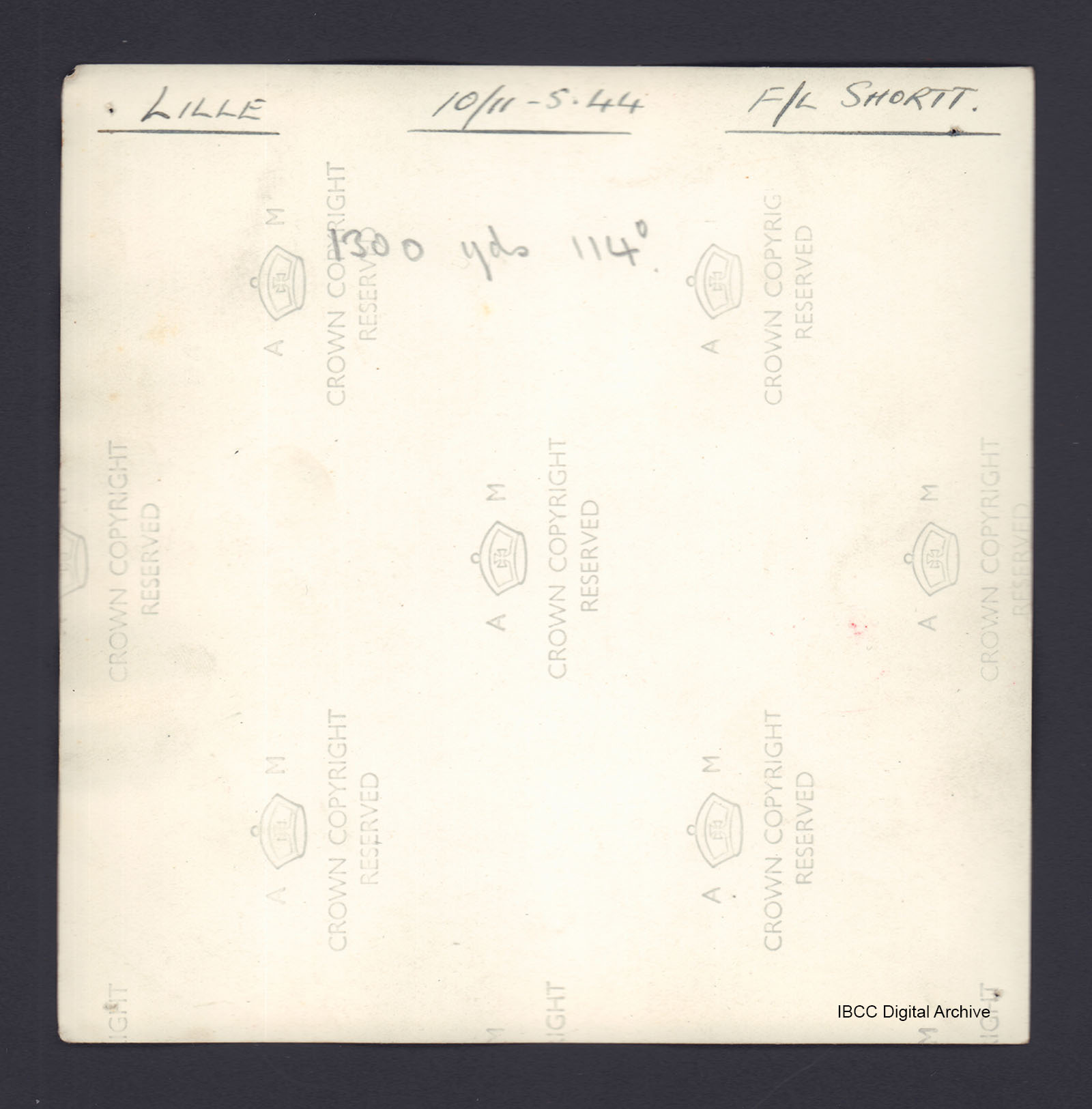
Hmm. “1300 yds 114°” – that looks to me to be a bearing and distance. I wonder if it’s a location referencing the actual aiming point, or in other words, how far away from it this crew’s bombs landed?

If 114° is the bearing of the photo from the aiming point, as I suspect, its reciprocal (114 + 180 = 294) is the bearing of the photo to the aiming point. So here’s a Google Earth ‘ruler’ showing where that point is. The bottom right of the yellow line is located on the position of the red ‘X’ in the earlier screenshot. If I’m right, the other end of it shows where the actual aiming point was:

Looking promising – that’s clearly one of the other marshalling yards. But can I find any other evidence to corroborate this theory?

I wouldn’t be writing about it if I couldn’t. In the Night Raid Report[1] from this night’s operation, there’s a description of damage as shown by later photo-reconnaissance:

A great concentration of bombs fell on and around the railways and sidings 200yds S.W. of the steel and engineering works of the Fives Lille company. 2 locomotive sheds and a repair shop were destroyed, together with numerous smaller buildings, and many hits were scored on lines and rolling stock. The Fives Lille factory and several other industries were damaged.  

Where is or was the Lille-Fives company? It’s that white-roofed industrial area to the right – east – of the marshalling yard in the following screenshot. You might just be able to see the label above it that says ‘Fives Cail’; this is a new redevelopment project that aims to turn the old factories of the ‘Lille-Fives Company’, which later became known as ‘Fives-Lille-Cail’ and, now, simply ‘Fives’, into an urban project with housing, public areas and creative industries. But it’s where the Lille-Fives company was located during the Second World War, and its edge is clearly 200 yards north-east of the same marshalling yard identified by my yellow line earlier. In other words, the marshalling yard is 200 miles south-west of the factory, as noted by the Night Raid Report:

So it looks to me like the marshalling yards near Fives were the actual target for the bombers on the night of 10 May 1944. While the bombing was mostly accurate, some landed closer to the railway yards and workshops south of Hellemmes – and all of the six bombers that crashed within two miles of the target area, including B for Baker, fell east of the aiming point. That, however, is a story for another day.

Screenshots from Google Earth. IBCC material used under the CC BY-NC 4.0 Attribution-NonCommercial 4.0 International Creative Commons licence. Analysis, additional geolocation and text © 2021 Adam Purcell


[1] The National Archives of the UK (TNA): Public Record Office (PRO), AIR 14/3411, B.C. (O.R.S.) Final Reports on operations, Night Raids Nos. 416-620, September 1943 to May 1944, vol. 4: Night Raid Report No. 602

Anzac Day 2021

Everyone looked up when the jet screamed over the city.

It was Anzac Day 2021, and once again I’d returned to Sydney to mark the occasion. First order of business was the march – and for once, first order of the march was the Air Force.

The Bomber Command contingent, made up of four veterans with banner bearers and assorted supporters, made their way down the route slowly and somewhat unsteadily. While it appeared that the WWII veterans in preceding groups had been pushed along the march in wheelchairs – these fellows aren’t old any more, they’re now ancient – two of the Bomber Boys made the journey on foot. Consequently they weren’t moving particularly fast, and a fair gap opened up between them and the group in front. You could be forgiven for thinking that they were leading the entire march.

Ron Houghton waving to the crowd

It was at that moment that the jet appeared. Flying north to south over the parade, the sound of its engines growled, roared and boomed off the surrounding buildings as it whistled overhead. It was an F-35 fighter-bomber – in the long lineage of Royal Australian Air Force bombers, it’s the current holder of the role once held by the Lancasters and Halifaxes of WWII – and for just a moment it looked like it was giving Bomber Command its very own flypast.

Travelling interstate in the midst of a global pandemic, however under control it might appear in Australia at the moment, is always a somewhat fraught business. And there were certainly signs that things aren’t ‘normal’ yet. Masks on planes and trains. Helpful people dotted around the city holding QR codes for contact tracing check-ins. Overall spectator numbers looked to be a long way down on usual. But the skirl of bagpipes, the smell of horse poo and that little chinking sound made by bemedaled chests made it feel like an almost-normal Anzac Day. There was more than one moment where I felt how lucky we are to live here, when compared with the rest of the world.

It’s been a year and a half since I’ve seen most of the veterans who were present this year, and I can say most of them have aged in that time. But they were there, still pressing on regardless – like Ron Houghton who, determined not to be pushed in a wheelchair, had the assistance of two of his adult grandchildren. Matt, on the right of shot here, is an RAAF Reservist, and flew down from Brisbane to march in uniform.

Then there’s the one who, in the words of one of my lunch companions, “always looks like he’s just stepped out of the gym”: Tony Adams. A 149 Sqn wireless operator (Stirlings! Lancasters! Oh my!), Tony’s one of the more switched-on veterans you’ll find these days. He’s also a bit of a film star: just the night before Anzac Day, A Current Affair featured him (and two others who were on the march, the previously-mentioned Ron Houghton and the rather incredible Frank Dell) in a short report (see here). That’s just the latest in a long string of recent TV appearances. Tony had no trouble completing the march and, yes, looked like he’d just stepped out of the gym at the end.

Off to lunch, after all that, with the Bomber Command Association of Australia. On the way, I ducked into the Anzac Memorial with Fiona Campbell for a quick look at the new RAAF Centenary exhibition they have there, which includes a silk ‘escape map’ that belonged to Fiona’s late father Keith.

Fiona Campbell with her father’s silk map (in the display case)

Then to the Royal Automobile Club for a lunch that was up to their usual high standards. There was good food and good conversation throughout. Speeches were short and to the point and the surroundings were comfortable and classy. Five Bomber Command veterans were present: Tony Adams (complete with what seemed like the entire, er, Adams Family), Rodney Higgs, Ron Houghton, Bill Geoghegan and Bill Purdy.

In front, Rodney Higgs. Behind, L-R: Tony Adams, Bill Geoghegan, Ron Houghton. Bill Purdy managed to escape my camera for this one.

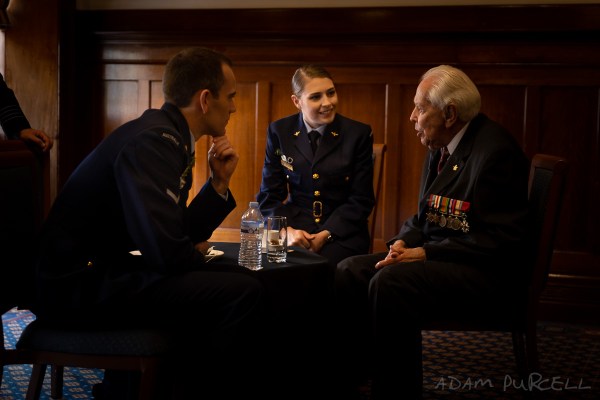
Also present was a good-sized contingent of current serving RAAF personnel, from 37 Squadron at RAAF Richmond. This was a wonderful way for members of the current Air Force to get to know some of their predecessors, and it certainly seemed like the passing on of wisdom was well underway:

As I left the lunch to catch the train to the airport and fly back to Melbourne, I saw perhaps the best example of this. Bill Geoghegan – at 101, said some wag, Bill is older than the Air Force himself – was deep in conversation with a young 37 Squadron pilot, with plenty of ‘Top Gun’ hands in evidence from both sides.

Bill Geoghegan with a 37 Squadron pilot

It would appear that Bomber Command’s legacy in Australia is in safe hands.

See my full gallery of photos from Anzac Day at Melbourne Ceili Camera.

Tony Adams before the march
Bill Purdy – a 463 Squadron skipper who is the only man I know who was flying from Waddington at the same time as the crew of B for Baker.
Bill Geoghegan after lunch. The little pin on his lapel is a ‘Lincoln Imp’, the mascot of 61 Squadron in which he served.

Text and images © 2021 Adam Purcell

In which Adam ‘flies’ a Link Trainer

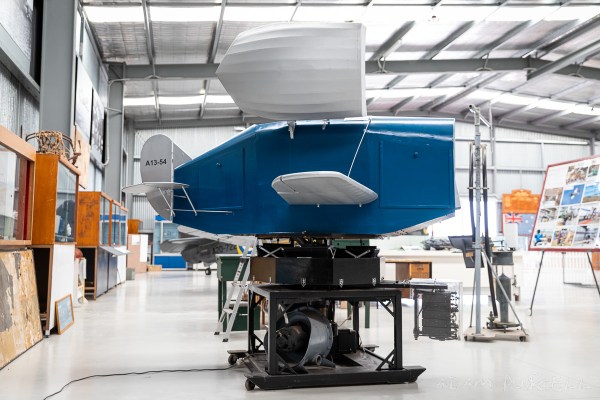
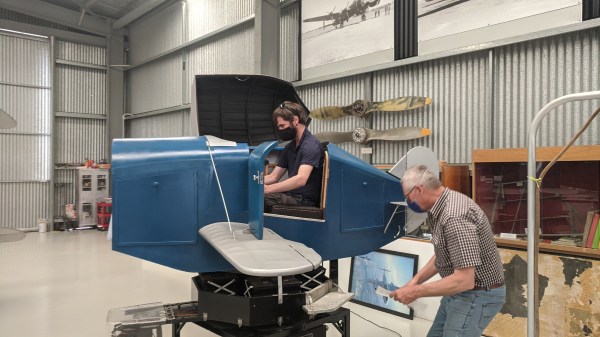
It’s shaped like a stubby little aeroplane, with comically short wings and a tail. It’s not very big: inside is seating accommodation for a single occupant only. When in use, it rotates and pitches and rolls on air-operated bellows and if you’re unfamiliar with this machine you’d be forgiven for mistaking it for one of those coin-operated children’s rides you find in dreary suburban shopping centres.

Though for a while a coin-operated amusement is exactly what it was, this 90-year-old piece of technology is actually a highly sophisticated simulator. It is, of course, a Link Trainer, and last weekend, I got the chance to try one.

Edwin Link – the man who designed the machine – did so using expertise gained from his previous career as an organ builder. Hence the bellows. In 1931, the world wasn’t quite ready for the leap in sophistication that the simulator represented. That’s why for several years the only models that Link managed to sell were the aforementioned coin-operated varieties for amusement parks. But when a number of pilots were killed flying air mail in the US in the mid 1930s, the Link Trainer’s potential as an instrument flight trainer became clear. When the Second World War erupted, the little simulator truly came into its own. More than 10,000 were built; apparently at its peak one rolled off the production line every 45 minutes.

Open the logbook of any World War II pilot and you will almost certainly find that they spent considerable time in a contraption just like this one. It seems to have been the custom at Australian training schools to add an extra column in one’s logbook to record time in the Trainer on the same pages as real-life flying, but once pilots got to the UK they transitioned to what was evidently the RAF way of doing things, dedicating entire pages in the back of the book to time in the simulator and leaving the main section of the book to the real aeroplanes. But relegating time in the simulator to a forgotten section at the back of a logbook seems rather like selling it short. This little box-on-bellows played a crucial role in pilot training, allowing the realistic simulation of instrument flying and procedures, at a much cheaper cost than flying in a real aeroplane, and at virtually no risk to life and limb.   

The operating Link Trainer that I had a go in is part of the excellent Nhill Aviation Heritage Centre in western Victoria. NAHC volunteers Wes and Trevor explained things as we moved around the hangar, and after looking at the Anson they have under restoration, the exquisite Wirraway parked in a corner and an airworthy Tiger Moth, eventually we ended up standing next to the trainer. We chatted here for several minutes before Trevor casually asked me if I had any flying experience.

NAHC volunteer Trevor with the Link Trainer

Well, yes, I admitted. But it was a looong time ago now.

That didn’t seem to matter. “Would you like a go in the Link?” he asked me.

I didn’t have to be asked twice.

Adam in the Link (Photo: Rachel McIntosh)

Trevor flicked a few switches on the outside of the machine while I climbed in. It took a little while for the valves to warm up – there’s nothing digital about this thing, everything’s electro-mechanical or pneumatic. I looked around the cockpit while I waited. The pilot’s seat is padded leather and the control stick is a big piece of turned wood that falls naturally to hand. My feet rested on flimsy-looking rudder pedals on the floor. In front of me was a wooden instrument panel with a standard ‘six pack’ of dials like you’d find in any aeroplane of the era, with a big artificial horizon in the middle. There was a throttle lever on the left wall of the cockpit and a compass between my knees, in the manner of a Tiger Moth or a Spitfire. There was even a Morse key mounted on the right-hand side. It was a reasonably comfortable little cockpit.

Link Trainer cockpit (Photo: Rachel McIntosh)

Once the instruments started indicating things, Trevor turned on the compressor that powers the simulator’s motion, released two stabilising metal strips, and I was away. The whole machine wobbled immediately, like it was floating on air – which, I suppose, on those bellows, it pretty well was. I started off carefully, with the hood open, getting a feel for how the controls moved and how the simulator responded. Before too long, though, I started pushing the envelope a bit, pitching the nose up and down as far as it would go and, somewhat more tentatively, rolling from one side to the other. I’m slightly ashamed to admit that it took me a while to realise that if I pushed the rudder pedals far enough, the Link would spin around – I later discovered that if I’d tried it, I’d have been able to rotate through a full 360 degrees.

As you will see if you watch this video, I had a grin from ear to ear. It was great fun! But it also wasn’t the point. The Link Trainer wasn’t for fun. It was a trainer, designed to allow pilots to learn and practice instrument flying so they could go flying in cloud without killing themselves. I wanted to get the full effect, so I asked Trevor if I could close up the hood. He nodded. So I did.

It was very dark under the hood (he says, obviously). The only illumination, apart from a tiny bit of light that leaked around the base of the hood, came from a pair of lights mounted on either side of the cockpit, bathing the instrument panel in a dim orange light. It was consequently not much of a challenge to concentrate on the instruments: there was nothing else to look at. With the vacuum pump running it almost sounded like a jet inside; the air flowing through the pipes made a reasonable approximation of a slipstream flowing past the fuselage. There was some ungainly wobbling, but I managed to fly something resembling straight and level for a little while, and even made some more-or-less coordinated turns. I was concentrating so hard I started sweating, but I was still grinning widely. It really did feel like flying.

Though Jack Purcell did start out on a pilot’s course, he was fairly rapidly scrubbed from that and remustered as a navigator. Presumably there was a Pilot’s Logbook that recorded his flying training but it hasn’t survived so I don’t know if he ever got into a Link Trainer. But his pilot Phil Smith certainly did, and it was towards him that my thoughts turned as I bounced around in the Link cockpit. It wasn’t much, but I could feel a distinct connection reaching back through the decades to him. For a moment, I could feel just a tiny bit of what these people experienced.

Then I opened the hood and got out again.

Thanks to my partner Rachel for the video and some of the photos in this post. She had a go in the Link too. Let’s just say I’m not a very good flying instructor and leave it at that, eh?!

The Nhill Aviation Heritage Centre is open on weekends or by appointment. See their Facebook page for the most up to date information.

© 2020 Adam Purcell

IBCC Digital Archive Interview Wrap

I collected my first oral history for the International Bomber Command Centre’s Digital Archive in October 2015. Interview Number One was with a man named Ern Cutts, a 466 Squadron Halifax rear gunner, and at the time I was one of just two volunteer interviewers for the project in Australia, and the only one in Melbourne.

A little over two years later, the Archive is close to being launched. It is well on the way to being an extremely significant collection of original Bomber Command stories, containing over 700 interviews and tens of thousands of scanned documents. These come from a wide variety of participants: both aircrew and ground crew, civilians who were in some way affected by Bomber Command or its legacy, and even a sizeable collection of material from German and Italian sources.

I’ve now taken a step back from actively seeking out further people to interview, partly to give some attention to other somewhat neglected projects and partly to give someone else a go, but I thought I’d share something of my experiences from the 27 interviews I contributed to the project.

My collection of subjects included nine pilots, seven navigators, four wireless operators, two bomb aimers, one mid-upper gunner, three rear gunners and a single WAAF. To my eternal disappointment, I wasn’t able to find a flight engineer to interview, otherwise I’d have collected an entire crew. In their ‘main’ postings, these 27 individuals represented three Heavy Conversion Units, one Operational Training Unit, and 18 Squadrons. Four of them held a Distinguished Flying Cross. One held a DFC and Bar. There were three members of the Caterpillar Club, four prisoners of war and one evader. 15 flew in Lancasters and eight in Halifaxes. One man flew both. Two flew in Liberators, one in Mosquitos and one poor soul flew in, and was shot down in, something called a Bristol Bombay.

I interviewed four people who were at Heavy Conversion Units when the war ended (two of them on the same crew). At the other end of the experience scale, one man completed 68 operational trips, ending up as a Pathfinder Master Bomber. At the time of interview, they ranged in age from a few months past 90 to more than one hundred. At least five of them have died since I interviewed them.

I interviewed two people in Sydney, one in Canberra and three on a single particularly intense weekend in Adelaide. The rest have all been in and around Melbourne (if, that is, you count as Melbourne the Mornington Peninsula in the south, Warragul in the east and Ballarat in the north-west). I’ve calculated that I have spent almost 250 hours directly working on this project, resulting in about 40 hours of actual taped interviews and more than 50 hours of travel time. I’ve travelled by car, motorbike, train, plane, bus, taxi and on my own two feet. The furthest I travelled for an interview was more than 800km to Sydney, and the shortest a walk of less than two kilometres from my home.

I’ve met some lovely people through this project. The vast majority have been extremely generous with their time, their tea and their stories. I knew seven before I interviewed them – indeed, I could even claim three or four as close friends – but for the vast majority of the rest, the first time I met them was when I turned up on their doorstep carrying my laptop, microphones and camera. I’ve found it quite amazing how open some of these people have been, how willing they’ve been to dive straight into some pretty personal stories within minutes of meeting me.

And some of those stories are genuinely astonishing. Like the navigator who went through all the training only to be shot down on his first trip—by another Lancaster. Or the pilot who went to the UK expecting to go to Bomber Command, but was instead posted to India where he flew a distinguished tour on Liberators. Then there was the pilot who flew for a Special Duties squadron whose operations were so secret he still doesn’t know exactly what he was doing. The Mosquito nightfighter navigator who chased doodlebugs through the skies of south-eastern England. The man who went from Flight Sergeant to Squadron Leader in six weeks, such was the rate of casualties in his squadron, then flew two full tours – all before his 21st birthday. The wireless operator who was shot down over France and spent three months with the Resistance before being rescued by Patton’s tanks. The bomb aimer who was the only survivor from both crews involved in a mid-air collision over Stuttgart. The gunner who still thinks – every day – about his pilot, who was the only member of his crew who died when they were shot down over Germany.

Time, certainly, has dulled some of the memories. But as we’ve gone deeper into the interviews, memories have been unlocked and some long-forgotten details have been pulled to the surface. It was not uncommon to be told afterwards that I’d just heard things that even their closest family members didn’t know. That, in itself, has made this an extremely worthwhile project to be a part of, and the archive is developing into a very valuable collection of original Bomber Command stories.

But I’ve found another happy effect from collecting all of these interviews. I’ve been able to talk with some very interesting people, and several friendships have developed as a result. And in many cases, I’ve been able to ring them up again and even go back to visit them – for nothing so formal as a follow-up interview, simply for a social chat.

I reckon that’s one of the best things that we can do to show our respect for these people: just be friendly, show interest in them as people, not only in their stories. To listen to them, give them some of our time.  They deserve that much from us all.

(c) 2017 Adam Purcell


Metheringham

There were an awful lot of wartime airfields in Lincolnshire: almost 50, in fact, with 16 of them within ten miles of Lincoln itself. Most of the old airfields have reverted to the farmland from whence they came. But even today, if you take a flight over the county you’ll see unmistakable signs of the classic ‘A’ shape of wartime runways, marked by a line of trees, remnants of concrete or even a bunch of chook sheds.

Metheringham is one of the airfields in the close ring around Lincoln, situated ten miles to the south east. It was a wartime ‘temporary’ airfield and was built in a hurry, with all the privations that implied, and it was only operational for about two and a half years. 106 Squadron was based there and, among other honours, the Victoria Cross awarded to Norman Jackson, for his crawl-onto-the-wing-and-put-a-fire-out heroics, was earned while on a sortie from Metheringham.

There’s a book called Lincolnshire Airfields in the Second World War by Patrick Otter (1996), that says 106 Squadron were the “first and only” occupants of RAF Metheringham. This isn’t quite correct. In June 1945 – after the war in Europe ended – 467 Squadron was moved to Metheringham from Waddington. Here they began training for the ‘Tiger Force’ that was to begin bombing Japan. When the atom bomb rendered that force redundant, in September 1945 the squadron was disbanded with a ceremony held at Metheringham (“Vale 467”, says the Operational Record Book. “And so to Civvy Street.”)

Consequently, Metheringham is of some significance for me. Several veterans I know or knew served there, like Harry Brown and Ern Cutts. And it was one of the places I visited while on my Bomber Command pilgrimage in 2009. I well remember clambering up into the ruins of the old control tower in the late afternoon, and looking out over the old airfield:

Metheringham Pano.jpg

I also visited the small but active visitors centre and museum, set in the old ration store for the station. I was recently contacted by Jacquie Marson, who is the centre’s volunteer Education Officer, asking me to spread the word, particularly for any 106 Squadron veterans or their families. The centre is a registered charity and an accredited museum, with “an ever growing archive and genuine wartime buildings which are of great interest to family members who visit us,” Jacquie says.

They’re a friendly and knowledgeable bunch, and can be contacted at www.metheringhamairfield.co.uk, on Twitter, or on Facebook.


(c) 2017 Adam Purcell

Bomber Command Commemorative Day Speech by AWM Director Dr Brendan Nelson

One of the highlights of the Bomber Command weekend in Canberra in June was the rolling masterpiece of a speech delivered during the lunch by AWM Director, Dr Brendan Nelson.

The War Memorial has posted a transcript of the speech on their website – you can find it here.

1706 BCCDF CBR-367

I’ll even claim a little bit of credit for one section: I was the IBCC “Oral Historian” he mentioned, who collected Denis Kelly’s story (if you haven’t read that rather astonishing tale yet, it’s here).

The transcript isn’t quite word for word – it omits some perhaps less-relevant anecdotes – but the main thrust comes through loud and clear. Well worth a read.


Going to the Archives

Primary records are the foundation of any good history. And there’s nothing quite like going directly to the source to find them. I travelled to Canberra last month to plough through files at the National Archives of Australia and, as it turned out, also at the Australian War Memorial.

The National Archives are housed in a squat white building located behind Old Parliament House. While most files are stored off-site, the building houses offices, exhibition spaces and, in the back, the Reading Room where researchers can access original documents. I had previously ordered a number of files and they were waiting there for me when I arrived.

This visit was primarily looking for general 467 and 463 Squadrons stuff, and I wasn’t disappointed. Among other things, I found an internal signal to the Squadrons, explaining what went wrong during the disastrous Mailly-le-Camp raid on 3 May 1944, and the original order detailing the special training sortie to be carried out prior to the Marignane trip of 9 March 1944. I know that the crew of B for Baker were involved in both operations so these documents add considerable detail to the story. Another file allowed me to solve the mystery of why Jack Purcell waited until the middle of February to do his first operation, despite having arrived on the squadron in early January: he spent a week and a half in the Station Sick Quarters in the latter part of January and missed the Berlin trip (28 January) on which most of the rest of his crew made their operational debuts.

Some other files that I’m interested in, with intriguing titles like “Flight Planning Conferences”, “5 Group Tactical Summaries” and “Ideas and Inventions”, are marked “not yet examined” – offering the tantalising prospect of looking at files that no-one has ever seen before at the Archives – but these were not yet ready in time for this visit. Guess I’m coming back another time.

There are a few other files listed on the NAA database under a search for “467 Squadron” that are part of a series called ‘AWM64’. As it turned out these are actually held at the Australian War Memorial Research Centre. Conveniently, after spending most of the morning shuffling and photographing old papers at the Archives, this was to be my next stop.

As part of plans for the Centenary of ANZAC commemorations, the War Memorial is undergoing significant refurbishment works at the moment. Consequently the usual entrance to the Research Centre is unavailable and you need to be escorted through ‘back of house’ to access it. That minor inconvenience aside, the staff are exceedingly helpful and the collection, of course, is world-class. I was able to examine an original navigation log and chart for an operation to Konigsberg in August 1944 (the overwhelming impression is that navigators worked like cut snakes, with fixes every six minutes), a number of logbooks (including one for a navigator who completed a tour on Lancasters, then another one on Mosquitos and after the war flew extensively for Qantas Empire Airways) and diaries and, eventually, the relevant AWM64 files. Included among these are large-size notebooks which appear to be the Orderly Room’s master list of sorties carried out by each member of aircrew. They are incomplete and contain frequent blank pages but it was interesting to see evidence that French targets only counted for a ‘third’ of a raid up until Mailly-le-Camp. The crew of B for Baker were not among the names on the pages but others who occasionally flew with Phil Smith are there. I’m not sure that the full records have survived but even so, this could be a valuable resource for deciphering some of the more badly faded pages of the Operational Record Books.

A certain amount of ‘pot-luck’ is needed when ordering records at libraries and archives – sometimes the entries in the catalogues are less than descriptive – but that’s all part of the fun. Many times the files are not entirely relevant to the task at hand but, every so often, you find something unexpected in amongst the files. It was a useful couple of days work.

© 2013 Adam Purcell

Grisly

War is a terrible business. The violent nature of the tools used in combat – guns, bombs, explosions, fire – can do dreadful things to human bodies. In the course of this sort of research, you sometimes come across some shocking stories. A P-47 Thunderbolt pilot, for example, was killed in a crash in eastern Holland in November 1943. A young girl found a loose boot belonging to the pilot near the wreck of the aeroplane… with a foot still inside. Or the unfortunate Charlie Nash, a 467 Sqn mid-upper gunner who was killed on the 10 May 1944 Lille raid. Such was the force of the explosion that brought his Lancaster down that Nash was dismembered. He was initially buried in two distinct graves, one in Hellemmes and one in Forest sur Marque.

Many of these sorts of stories are revealed in the files of the Missing Research and Enquiry Service, a team of RAF investigators who combed what had been occupied Europe to establish the fate of as many missing airmen as possible after the liberation of each area. The reports can sometimes make for disturbing reading. So much so, in fact, that full MRES reports are not released to the public in the UK if authorities believe they will be too distressing for next-of-kin or other researchers to read.

There is no doubt that these reports can contain some very grisly details. But factual reports of this nature are just that – factual. The details contained within them are very real. The events they deal with really happened – to real people. How much should modern-day sensibilities take precedence over knowing the truth?

This is an extremely difficult question to answer, and it’s one that every researcher must give serious thought to. There are two conflicting priorities here: the natural desire of the historian to tell the truth, the whole truth, and nothing but the truth, versus the need to protect families from some pretty disturbing feelings about what might have happened to their relative. It is sometimes easier for the researcher to deal with these sorts of unpleasant revelations if they have no direct family connection to their subject. What they need to be careful of, however, is the sensitivities of those who do have that direct connection. I’ve been guilty of this myself, once or twice blithely telling a story to a relative of one of my great uncle’s crew without first considering how they might take the news. It’s only after I’d finished, when I saw their reaction that I realised, whoops, perhaps I could have dealt with that one with a little more sensitivity.

Ultimately, it is the researchers themselves who are responsible for making this very difficult decision. I disagree with the authorities determining what will and will not be released because I think it should be the duty of the researcher to decide what they do and don’t tell their audience. Researchers must be sensitive about how they communicate these sorts of stories.

Personally, I tend to prefer the truth, warts and all. After all, this is what actually happened. But I need to be very careful about how I get the message across.

 © 2012 Adam Purcell