Eureka!

Janet Hurst has been busy in Goring. She wrote a small article about my search for Eric Hill, and it has just been published in the village newsletter. And guess what?

It worked!

She was contacted by a local lady whose daughter married Eric Hill’s nephew. Janet sent me an email last night to tell me this good news… and half an hour later I received an email that started with this:

Hello Adam,

I am Barry Hill son of Frederick Roland Hill who was the brother of Eric Reginald Hill.

Bingo!

This is the same tactic that I successfully used in the search for relatives of Jerry Parker. I’m extremely grateful to Janet for her hard work over the last couple of weeks.

Barry says that his father died a few years ago but he does have a couple of stories that have been passed down through the family about Eric. Apparently he was something of a dare-devil. Those sorts of things will go a long way towards giving a story to the blurry photos I have of the man.

So Barry Hill makes it six families out of seven of the crew of B for Baker who I am now in touch with. Only flight engineer Ken Tabor remains outstanding. I’ve been working on that one as well recently, but not getting very far with it as yet. But getting this welcome news from Goring is very encouraging and keeps the spark alive.

I’ll keep searching.

(c) 2011 Adam Purcell

Stationmaster

An intriguing email popped into my inbox the other day. I had written to Janet Hurst, of the Goring and Streatley Local History Society in England, seeking assistance in the search for living relatives of Eric Hill, the mid-upper gunner on B for Baker. She replied with these details on E R Hill, from a book published a decade or so ago on the war casualties of that area:

Eric Rowland Hill

Rank: Leading Aircraftsman (LAC)

Service No: 1295905

Unit: Royal Air Force Volunteer Reserve, served as clerk, special duties, 250 Wing, Middle East Command

Died: 21 September 1942 of enteric fever (typhoid)

Memorial: Ismailia War Memorial, Egypt 7C9

Next of kin: Mr & Mrs F. Hill (parents) of Goring

Home address: Station House,Wallingford Road, Goring

Educated: Goring School, 1928-1935

Personal details: He was employed in the office of Smallbones, builders. His father was stationmaster at Goring 1917 1947 and assistant organist at Goring Parish Church

Comparing this with my information raises a few conflictions. Most notably, the ER Hill buried in Lezennes – and therefore not in Egypt – was named Eric Reginald Hill, not Rowland. The service numbers and ranks do not match. Either do the dates of death (1942 vs 1944).

But his parents’ names and address do support what I have for Sgt Hill. I had a suspicion that the local historian who researched the book in Goring might have muddled up his details with another entry in the Commonwealth War Graves database. But how could I be sure?

The first thing was to establish beyond reasonable doubt that the man I was looking for was indeed Eric Reginald Hill. This might seem a reasonably obvious fact, but I decided to go back to primary sources to be sure. I have a copy of a ‘Circumstantial Report’ from 467 Sqn to the Air Ministry in London, dated 11 May 1944, that confirms “1352851 Sgt Hill ER, MU/AG” as a member of the crew posted missing the previous night. This service number matches that on the Commonwealth War Graves Commission database in the record for Eric Reginald Hill. It (unsurprisingly) also matches the service number on the gravestone in Lezennes. Phil Smith’s logbook has many entries including a “Sgt Hill”, and of course these entries are dated 1944, well after LAC Hill died in Egypt. This is to me fairly solid evidence that we have the right man – barring an extremely serious error by CWGC.

Next, I needed to find some sort of connection between Eric Reginald and his parents. CWGC records his next of kin as “Frederick and Fanny Rebecca Hill, of North Weald, Essex”. The names match Janet’s information, but the address does not. Wanting to discount the possibility of an error on the part of CWGC, I went back to some primary sources.

I found a letter written by Gilbert Pate’s father Sydney to Don Smith, the father of the pilot of B for Baker, dated 12NOV44:

“Your mention of Mr F Hill of Goring (Berks) completes the “tally” of 7 names, and we are obliged for this.”

Also in my files was a letter from W/Cdr Bill Brill, CO of 467 Sqn, dated 01SEP44 and again written to Don Smith:

“The addresses of the English members are:-

Mr F Hill (Father)

Station House

Goring

Reading

Berks.”

Janet then sent confirmation of an entry in the Goring Parish registers showing the baptism of Eric Reginald Hill at Goring on 26 June 1921. Critically, she says, he is recorded there as the son of “Frederick and Fanny Rebecca Hill, stationmaster of Goring”.

So I now had a name and address match for Eric Reginald Hill’s parents. But it still did not tally exactly with what is on the CWGC database. There was the remote possibility of another Fred Hill existing, one who also had a son named Eric R Hill. I needed a link between Goring and North Weald. And as it happened, I found something that, while not absolutely incontrovertible, is fairly strong evidence. It is a note on a scrap of paper found amongst Gilbert Pate’s box of letters. Scrawled on it, in an unknown hand, is this:

“Mr Fred Hill, 18 Bassett Gardens, North Weald,Essex. Father of Eric Hill”

This appears to match what is in the CWGC database. But can I explain the reason for the two addresses?

I can’t, at least not from what primary sources I have found to date. But I do have a possible scenario. I do not know when the unknown note was written, but perhaps the Hills initially lived in Goring and after the war moved to North Weald. According to Janet’s email Fred Hill was stationmaster until 1947 so a move around then is certainly within the bounds of possibility. Certainly it is plausible that, as it took CWGC some years to sort out all of their casualties following the war, their records were updated with a new address. The note may have been a record of that new address for the family of Gilbert Pate.

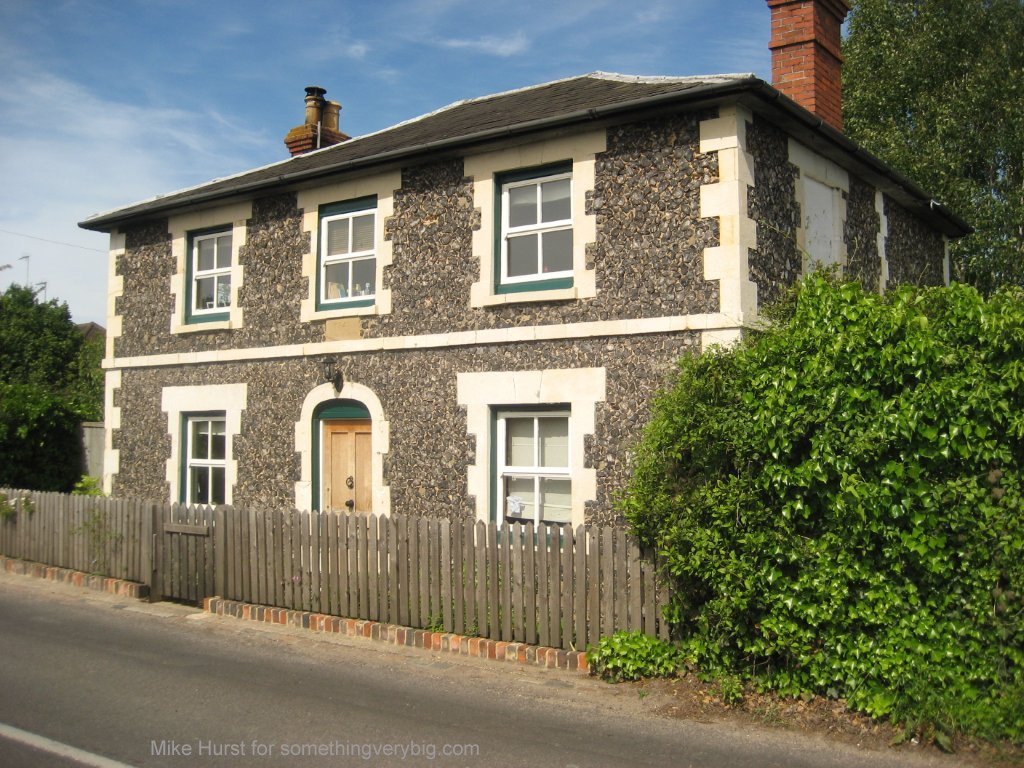
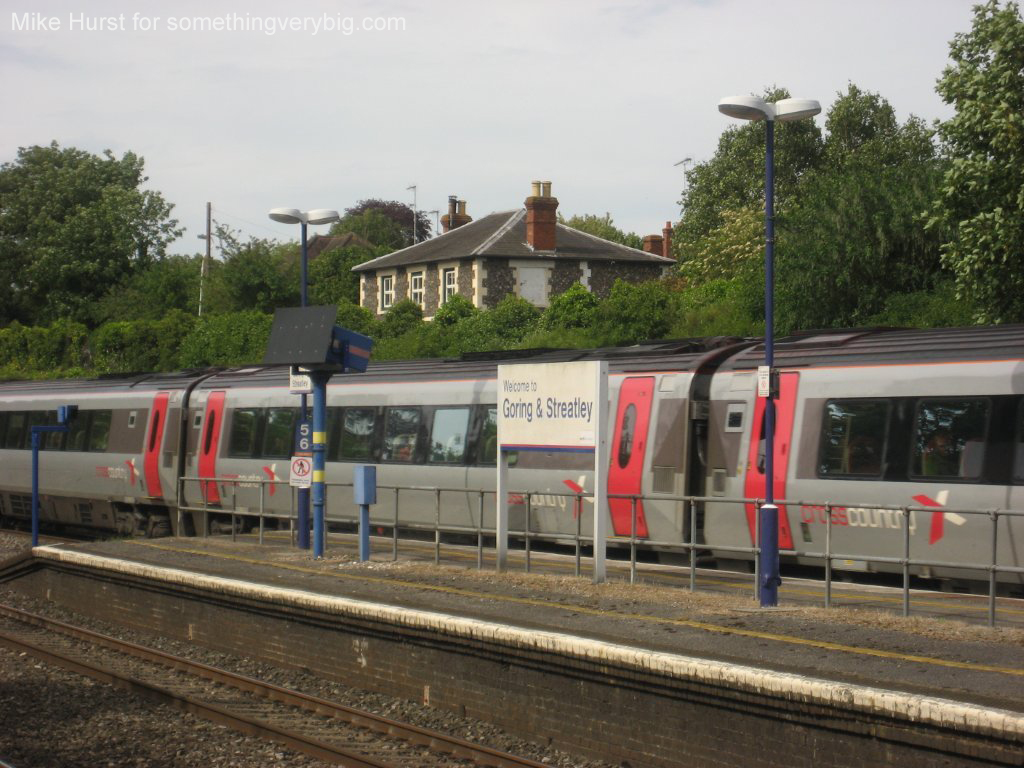
Having established, in any case, that Eric Hill’s father Frederick was the stationmaster at Goring, Janet sent me some photos of a rather pretty stone house in Goring Village.

It is called the Station House – and it is where Eric Hill once lived.

c05-215-003 copy

c05-215-004 copy

Janet tells me she will ask around the village in the next little while to see if anyone remembers or knows what happened to the Hills. She also suspects that the family tree on Ancestry.com that gave some information on Eric’s siblings may not be entirely accurate, so will have a dig through some primary sources for me.

The search goes on.

Image credit: Mike Hurst

Other sources: Janet Hurst, Mollie Smith, Gil and Peggy Thew

© 2011 Adam Purcell

Bomber Command in Canberra

There was an old man sitting patiently in the departure lounge in Melbourne when I boarded a QantasLink Dash 8 to fly to Canberra last weekend. Sat next to him was his middle-aged son. When we boarded the aircraft they sat across the aisle and a few rows in front of me. I overheard a snippet of half a conversation that the younger man was having on his phone: “meeting in Canberra… taking him to… you know, Air Force stuff…” I watched his father as we powered down Runway 34 and took off. He was gazing out of the window, and his thoughts looked like they were miles away: across the seas, and across the decades.

They were going to Canberra for the same reason I was: the fourth annual Bomber Command Commemorative Day. I next saw Ian and his son Phillip underneath the nose of Lancaster G for George at the Meet & Greet cocktail party later that evening and went across and said g’day. Ian had been a 460 Squadron pilot so it was fitting that G for George, a 460 Squadron machine, was the centerpiece of the function.

11jun-bombercommandcanberra-007s copy

It was an outstanding evening. There were perhaps 150 people present, a fair proportion of those being veterans. Talking about flying Lancasters with people like Don Huxtable, a 463 Sqn skipper, was a unique experience as he casually threw a thumb over his shoulder at the old bomber to emphasize a point. The function ended with the magnificent ‘Striking by Night’ sound and light show recreating a bombing raid around the Lancaster. We retired to the hotel bar for a nightcap, ensconced in a warm corner while Don Southwell held court.

It was a cold and misty Canberra winter’s morning when we awoke. But the sky soon cleared and the sun was nicely warming as we took our seats for the ceremony at the Australian War Memorial.

As is customary the AWM Ceremonies division put on a good show. It ran smoothly and Don Browning’s ‘Reflections’ presentation was particularly good. As the first notes of The Last Post rang out into a brilliant blue sky the line of young RAAF officers in the row in front of us snapped into a salute. It was a moving moment.

After the ceremony all the veterans moved up towards the War Memorial buildings for an extraordinary group photo. I counted 50 veterans, surely one of the largest gatherings of Bomber Command airmen (and at least one WAAF) anywhere in the world these days.

11jun-bombercommandcanberra-045s copy

The final part of the weekend was the luncheon. This was, I reckon, the highlight of an already highlight-heavy weekend. Some 200 people showed up, with at least one veteran at each table.

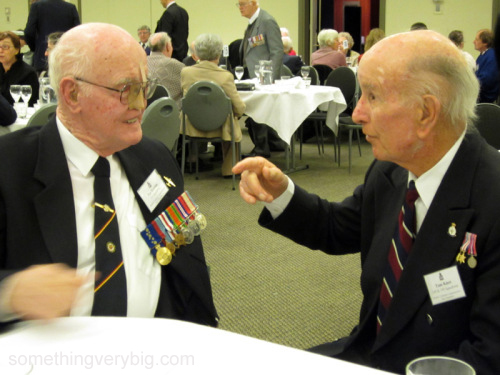
The best part of this event is the ability to float around between tables talking to all sorts of interesting people. Until today, I’d never met a real live Bomber Command flight engineer. Tom Knox, a Glaswegian flight engineer from 149 and 199 Squadrons, is on the right here:

11jun-bombercommandcanberra-067s copyThe other man is Pat Kerrins, a pilot from 115 Squadron. They were in animated conversation regarding a mutual friend and just being a fly on the wall while they chatted away was fascinating. A copy of this photo will be winging its way to each of these men shortly. I also met Jean Smith, who served in the WAAF at 27 OTU, RAF Lichfield, and a couple of likely suspects involved with the 463-467 Squadron Association in Melbourne. All very interesting people to know.

This has become an extremely significant event in the Bomber Command calendar in Australia. The Bomber Command Commemoration Day Foundation was set up to organise events like these to ensure that the men and women of Bomber Command get some long-deserved recognition. Behind ANZAC Day and Remembrance Day, this is now the third largest single event held by the Australian War Memorial each year.

Given the level of interest in this year’s event, the men and women of Bomber Command can rest assured that it will continue into perpetuity.

11jun-bombercommandcanberra-004-copys copy

(c) 2011 Adam Purcell

Nightingales and Bombers

19 May 1942.

As they had done each May 19th since 1924, the BBC recorded nightingales singing in the late evening in a place called Foyle Riding in Surrey.

The nightingales were not all that they recorded:

Click Here.

105 Wellingtons, 31 Stirlings, 29 Halifaxes, 15 Hampdens, 13 Lancasters and 4 Manchesters of RAF Bomber Command were on their way to attack Mannheim in Germany. The drone as they flew overhead was also captured by the BBC.

Of the 197 aircraft that flew over Foyle Riding that night, 11 failed to return. Only light damage resulted from the raid. Most of the target photographs from those that did make it to Mannheim showed forests or open fields.

(Hat tip to Chris Wild of ‘How to be a Retronaut’)

This is why we do it.

”It’s unbelievable. After 95 years, we finally found him.”

-John Andrews, great nephew of Matthew Hepple, one of the Australians missing at Fromelles

In July 1916 the 5th Division of the Australian Army launched an attack on German positions near the French town of Fromelles. It remains one of the costliest attacks ever mounted by Australian military forces. In one night more than five and a half thousand men became casualties. Almost two thousand of those had been killed.

In 2002 retired Australian schoolteacher Lambis Englezos, following a visit to the Western Front, realised that the number of known Australians buried after the Fromelles battle did not match the number of the recorded missing. He suspected he had evidence of the existence of mass graves dug by the Germans after the battle at a place called Pheasant Wood. He believed that this might have been where the missing Australians lay. This kicked off a remarkably dogged and determined investigation that would eventually find enough information to convince Australian and British authorities to mount an exploratory archaeological dig at the site. British historian Peter Barton was the man, as part of that first dig, who uncovered two buttons showing the Rising Sun of the Australian Army, unequivocally proving that Australians had been there and that Lambis had in fact been right.

In 2009, I was in France to visit the graves of the crew of B for Baker in Lille. I was staying with Joss le Clercq, who by chance lives just outside the village of Fromelles. The week that I was there, a full archaeological dig began on what became known as ‘the Fromelles Project’ at Pheasant Wood. This work resulted in some 250 bodies being recovered and reinterred in the first completely new cemetery to be built by the Commonwealth War Graves Commission in more than 50 years, just across the road from Pheasant Wood.

Up to the beginning of 2011, some 96 of those 250 had been identified. Last month, a further 14 names were released, as reported in the Sydney Morning Herald.

We are now seeing the vindication of the project begun by Lambis Englezos. 110 families have now received news that had been delayed almost a century. 110 soldiers have permanent, dignified resting places that can become a focus for their families’ remembrance of them. Most importantly, 110 soldiers now have names and stories.

And it all came about through one bloke’s enthusiasm, determination and sheer hard work.

Remembering the men in the faded photographs. This is why we
do it.

© 2011 Adam Purcell

ANZAC Day 2011

ANZAC Day lives on.

Despite age taking its toll, and in defiance of the rather wet weather, eight 463-467 Sqn veterans took part in the Sydney march on Monday with a group of ten or fifteen descendents and family members following behind. The rain, threatening all morning, held off for the most part while we were marching.

While the rain did fall at times, it failed to keep the crowds away. George St was lined four or five people deep for most of its length as we marched past. I think this fact alone is proof that ANZAC Day remains relevant and keeps its place in the hearts of many Australians.

Ten veterans were at the lunch that followed the march. Left to right, they were: David Skinner, Alan Buxton, Hugh McLeod, Don Southwell, Bill Purdy, Albert Wallace, Harry Brown, Don Browning, George Douglass, Don Huxtable.

11apr-anzac-day-007 copy

But the nature of the commemoration of ANZAC Day will and must change. The men who fought in WWI are no more. And the men who fought WWII are getting on a bit. Before too many more years have gone by, there will be noone left who ‘was there’. So it will fall to the younger generation to ensure that these men – in the main, ordinary lads living in extraordinary times – and what they did is not forgotten. I’m always touched by the sentiments of the veterans I speak with on ANZAC Day. They are pleased as punch that there are younger people present, at both the march and the lunch. I think they are happy to know that someone will carry the banner down George St, long after they have gone. For me, as one of those younger people, hearing this is rather humbling.

Want further proof that there is a new generation of people remembering? Half way through lunch on ANZAC Day, a group of 20 young musicians entered. 11apr-anzac-day-017 copy

They were the Australian Army Cadets Band and had been playing a few numbers at some of the other ANZAC Day lunches that were taking place around the city. They had a mighty sound and were a wonderful surprise for all present. Lest we forget, indeed!

© 2011 Adam Purcell

Must be the time of year

There are a few articles like the one that appeared in the Sun-Herald today that tend to appear around this time of year. This one tells the story of a man named Fred Reeves, a Digger killed at Gallipoli in 1915. Or rather it tells the story of how an interested descendant – a great niece in this case – pieced together Fred’s story.

More power to Judy McLeod’s elbow, I say. She started with a name in a family Bible and a hunch that the date given with the name – 1915 – could have been connected with the First World War. She was right. He had been killed in Gallipoli and has no known grave.

“I am glad I looked into this otherwise he would just be another statistic. There is nobody to even say he existed and fought and died for his country.” – Judy McLeod, great niece of Australian infantryman Fred Reeve

This quote for me is the most important part of the article. Through the curiosity of one interested individual, almost a century later, the name scribbled into the Bible has come to life.

There has been a real resurgence in interest in this sort of family research in recent years. Indeed, my own work could be said to be part of it as well. I put it down to a couple of happy coincidences. Perhaps the salient one from a practical point of view has been the information and speed of communications that comes from the internet. It’s become much more accessible to the average person and so it’s easier to turn an idle curiosity into a keen family history interest. We can find records online that previously would have involved letters to archives overseas, if not an actual trip overseas. Investigations that previously would have taken months can now find answers from the other side of the world in literally minutes. In short, people can work in the comfort of their own homes, without having to pore through musty files in some record depository somewhere (though some (like me) might say that doing that is what it’s all about anyway!).

The other factor, more relevant in this case than in my own work into the crew of B for Baker, is the upcoming centenary of the Gallipoli landings in four years time. It means that ANZAC Day is receiving more and more media coverage each year. There are no WWI veterans alive in Australia anymore, but there are more and more people investigating family connections to the conflict – giving names and stories to their own ‘man in the photograph’. For remembering men like Fred Reeves, who would otherwise as Judy McLeod said be just another statistic, this can only be a good thing.

© 2011 Adam Purcell

The Crew of B for Baker

lancaster_7-little1 copy

The crew of LM475 B for Baker, an Avro Lancaster Mk III of 467 Squadron, Royal Australian Air Force, arrive on dispersal at RAF Waddington on the evening of 11 April 1944. Their target is Aachen in Germany.

The crew is made up of seven men: Pilot S/L DPS Smith, Navigator W/O RW Purcell, Flight Engineer Sgt KH Tabor, Bomb Aimer Sgt J Parker, Wireless Operator F/Sgt AD Johnston, Mid-Upper Gunner Sgt ER Hill and Rear Gunner F/Sgt GF Pate. One month after the Aachen raid, B for Baker failed to return from an operation to Lille, France. Of these seven men, only the pilot would survive.

This painting, by aviation artist Steve Leadenham, was specially commissioned by Adam Purcell, the great nephew of the navigator. It serves as a tribute to these seven men – but also to the 125,000 who also served in Bomber Command during WWII. The story of how this project developed can be read in the archives of SomethingVeryBig. Click here.

High-quality 80x40cm archival reproductions of this painting are now available for purchase direct from the artist at the rate of AUD45.00, plus postage to anywhere in the world.

For details on how you can obtain your own copy of this very special image, contact Steve directly through his website: http://leadenham.com/contact.html.

mg_8215_1 copy

See more of Steve’s work at www.leadenham.com.

You never know what lies up the garden path

Joss le Clercq alerted me to a thread on the RAFCommands forum late last year. It concerned a researcher who was trying to work out the fate of Sgt Leslie Edwards, who died of wounds or injuries in July 1943. It was discovered that Edwards had been on board a 27OTU Wellington that crashed at Church Broughton on the 6th of that month.

So why did Joss think it was of particular interest to me? Henk Welting posted on that RAFCommands thread that Bill Chorley’s Bomber Command Losses vol 7 revealed a Sgt Purcell had been in the crew of the Wellington. Joss thought it could have been my great uncle Jack.

This was an intriguing find. Because we have no letters or diaries from Jack, we know little about what happened to him directly while he was in England. Could Joss have uncovered a story about Jack surviving a Wellington crash that my family didn’t know about?

I quickly checked my records. Initially it looked possible. Jack was posted to 27OTU at Lichfield on 22 June 1943 and did not leave until September, so he was certainly there at the right time. But a few other details did not check out. Jack’s service record shows that he was promoted to Flight Sergeant on 20 February 1943 – before this accident – so his rank did not match. And perhaps more crucially, we do have Jack’s logbook. The first flying recorded at Lichfield in my copy of it is not until 14 July, or after this crash happened.

So it was not looking good. I rechecked the original logbook when next I returned to my parents place near Sydney to make sure that I hadn’t missed any pages in the copying process.

I hadn’t.

The next step was to ask Chris Pointon of the RAF Lichfield Association, who had guided me around what was left of the old station when I visited in 2009.

Chris settled the matter. It turns out that AUS410379 Sgt David Purcell was posted to 27OTU in May 1943. So there was a second Australian navigator called Purcell at RAF Lichfield at the same time that Jack was. It seems likely that this Purcell is our man.

David Purcell’s service record is online at the National Archives of Australia. It reveals that he was from Melbourne and enlisted on the same day that Japan bombed Pearl Harbour. He trained at Cootamundra, East Sale and Nhill before going to the UK via Canada. Eventually he ended up on Halifaxes with 466 Squadron at Leconfield. Chris’ email told me that David Purcell was shot down on 23 April 1944 on an operation to Dusseldorf. He survived and spent the rest of the war as a POW, eventually returning to Australia.

So while somehow disappointed that I didn’t uncover something else about Jack Purcell, I did find another interesting story – and potentially another branch of the Purcell family to look at. I’ve passed the details about David’s family to Therese Findlay, one of my regular correspondents on this blog. Therese says she’s found a Purcell somewhere who is working on the family tree. Perhaps they might have more information for me.

©2011 Adam Purcell