Before it’s too late

Tony Wright, National Affairs editor at The Age newspaper here in Melbourne, usually writes about the goings-on in and around Parliament House in Canberra. His series of Sketch columns usually throw an interesting light on the events of the day (and, if you’ve been following Australian politics, he’s had a not inconsiderable amount of material for inspiration recently).

But every Saturday, Wright gets the opportunity to write about something other than politics. One week last year it was about Mike Druce, the man who made a modern-day escape from Colditz Castle in September, then walked unsupported to Switzerland. Wright wrote another interesting one early in February.

“They are disappearing fast now”, he wrote, “the generation who experienced a world war.”

It seems not so long ago that those who had lived through World War I and had seen horses step aside for internal combustion engines and a lot more were being put in the ground, but memory plays tricks – it’s 100 years since that war began.

Those who knew it, even those who lived to astonishing ages, breathed the last of this earth’s air a long time ago.

Now it is the turn of the last of the survivors of World War II.

Some of those shuffling off into the sunset in recent times, of course, were well-known in life and widely mourned in death. Giants of politics like Gough Whitlam (an RAAF navigator) and Tom Uren (a survivor of the Burma-Thai Railway). Journalist and Korean War correspondent Harry Gordon. “These are, of course, big and extraordinary lives”, Wright says:

…generous spirits well documented, celebrated on a broad stage, their stories teaching us something that transcends the experiences that will go into books about their achievements: call it wisdom.

But while these were some of the better-known men whose lives intersected with some of the biggest conflicts in the history of mankind, so many others were there too. In Wright’s words:

…each day others whose lives were not destined to be celebrated so publicly or granted obituaries pass beyond this existence. Every one of them has a story, and in those stories we can often find ourselves enriched, because wisdom often resides there.

He’s dead right.

This is more or less why I flew to Sydney last month to have lunch with a Bomber Command veteran who also happens to be a good friend of mine. Hugh is a former rear gunner and we arranged to meet at one of those very old and very exclusive clubs in the city, all cedar panelling and leather Chesterfield armchairs. Hugh has been a member for a quarter-century.

He’s clearly well-known here. As we entered the bar the bartender poured my beer but gave Hugh the bottle and an empty mug. “I like to pour it myself”, he explained. Somehow, I imagine, with its sharply-dressed, exclusively male clientele, beer in pewter mugs and discreet murmur of conversation, the atmosphere in the bar at a wartime Officer’s Mess (in one of its quieter moments) might have been something similar. And perhaps for Hugh that’s at least part of where the attraction lies.

With that thought in my head, it’s not surprising that our conversation very quickly turned to flying. As we drank our beers we shared experiences flying the Tiger Moth and I mentioned my recent visit to Nhill and the Anson that is under restoration there. “I loved the old Aggie”, he said simply. We continued talking in the dining room as we waited for and then enjoyed a scrumptious meal while looking out over the State Library across the street.

Hugh is a little unique. He actually trained as a pilot but when he arrived at his squadron, he was one of twelve who were asked/chosen to re-train as gunners to operate a special ‘secret weapon’. It turned out to be ‘Village Inn’, an automatic radar-guided gun system. Despite what you might read on that link, Hugh’s opinion of the equipment is not very high. It was unserviceable half the time, he said, and the rear turret was not a nice place to be. Nor was it safe. On his first trip – to Bremen, in October 1944 – two of the twelve Village Inn men failed to return.

Hugh flew on his last operation – his 32nd – a matter of weeks before the end of the war. There followed the traditional fortnight’s end-of-tour leave, part of which coincided with the regular 12-days-every-six-weeks leave of a good friend at the squadron called Johnny Garrett. Hugh had arranged to meet up with Johnny in Cardiff but was a bit surprised when he did not show up. On return to the squadron he found out why.

On 22 April 1945, 49 Squadron was moving from Fulbeck to Syerston. As happened frequently on these occasions, on departure each bomber “beat up” the control tower before setting course for their new home. One aircraft flew past at extremely low level. Johnny, like Hugh a pilot/rear gunner, was in the rear turret.

The pilot pulled the Lancaster up into the air.

Too late.

The tail of the aircraft hit the MT shed. The Lancaster fell to the ground, killing all six on board. Fifteen more people – part of the works party which were about to begin runway extentions at Fulbeck –  were killed on the ground.(1)

It was a sobering story to hear over an otherwise very civilised lunch. But that’s just the point. Such was life, and death, in Bomber Command. Tragic as they are, stories like these actually happened. While official records like the squadron Operational Record Book reveal something of what happened to the aircraft, they won’t include the personal details – like the friends of those killed who wondered why they did not show up for an arranged meet-up while on leave.

These are the sorts of details and stories that can only come direct from those who were there at the time. So I see part of my role, as a Bomber Command researcher, but also as a member of the human race, to collect those stories while I still can. Hugh is one of the younger Bomber Command veterans I know, but he turned 90 last year. He’s no spring chicken. And one day I’m going to want to ask him something… but he won’t be there anymore. So in the meantime, says Tony Wright as he finishes his piece:

…the rest of us could do worse than sit with those close to us and explore what they might have to share and teach before they are gone and we find ourselves turning, bereft, to their shadow.

Amen to that.


Hugh McLeod, 49 Squadron rear gunner and my good friend, died on 7 July 2015.


(1) The ‘Fulbeck Tragedy’, as it is known, is described in Ward, J 1997: Beware of the Dog at War: Operational Diary of 49 Squadron Spanning Forty Nine Years, 1916-1965, pp. 542-5. Thanks to Colin Cripps for the steer.


© 2015 Adam Purcell

A Cocktail Party in Melbourne

I love collecting veterans.

Though their numbers are undeniably dwindling, it seems that every time I go to a Bomber Command-related event I come away having met a new veteran or two. And last Saturday night, a fundraising cocktail party for the Bomber Command Commemorative Day Foundation (Vic) in Melbourne, was no different.

Because of my own history of living in Sydney most of the events I go to are still in the Harbour City, and so despite living in Melbourne for four and a half years now I regularly travel there for ANZAC Days or other events. Consequently I’m still getting to know the Melbourne-based Bomber Command community. So it was great to see that among the fifty or so guests who gathered on Saturday night at the Nurses’ Memorial Centre on St Kilda Road were five Bomber Command veterans, three of whom I had not properly met yet. Rest assured that was remedied by the end of the evening!

The other two I know well. 578 and 466 Squadron Halifax skipper Don McDonald brought his wife Ailsa, and was working the room as he always does. Though he was wearing a badge with joined Australian and French flags I didn’t get the chance, unfortunately, to ask him about his recent award of the Legion d’Honneur, but that story will have to wait until the next time we meet. 463 Squadron navigator Don Southwell came down from Sydney as a representative of the national Bomber Command Commemorative Day Foundation committee. Don, as well as being a friend of mine is very active on numerous Bomber Command committees and it was nice to have the chance to talk to him at an event which, for once, he did not organise.

Gerald McPherson and Don Southwell

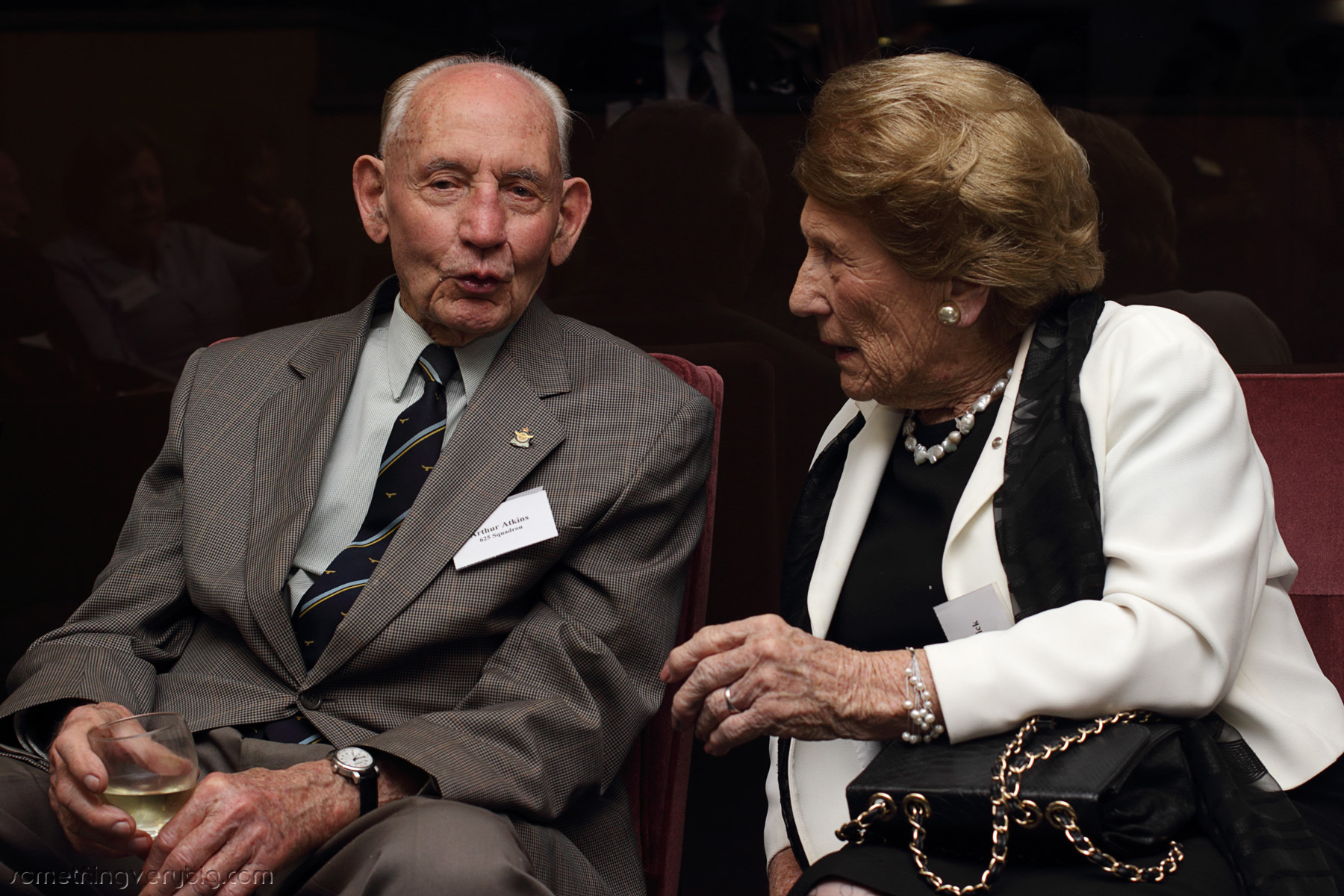
The other three are all Melbourne veterans. “Poor old Wally McCulloch”, as he introduced himself, was a 460 Squadron bomb aimer. He and his wife had braved a long and difficult journey to get to the function… from their apartment upstairs in the same building! And Arthur Atkins was a 625 Squadron pilot, with a DFC. He approached me after Don Southwell pointed me out as someone with a 463-467 Squadron connection, saying he had a mate who was lost flying from Waddington.

I’d briefly met the third Melbourne veteran, Gerald McPherson, at the panel discussion at the Shrine of Remembrance in 2013 but, until now, had not had a chance to talk to him. He was a rear gunner in 186 Squadron and related the story of his first ever trip in a Lancaster. Up to that point, he told me, flying Wellingtons and Stirlings, he’d always said a small prayer to himself at the top of the runway to help the aeroplanes take off safely. “I never needed to do that in the Lanc”, he said. “You could feel the power as it took off.” He was wearing a Bomber Command clasp so we talked about that for a little while. Coincidentally I had dropped the application for my great uncle Jack’s clasp into the postbox as I was walking to the tram to travel into the city for this event.

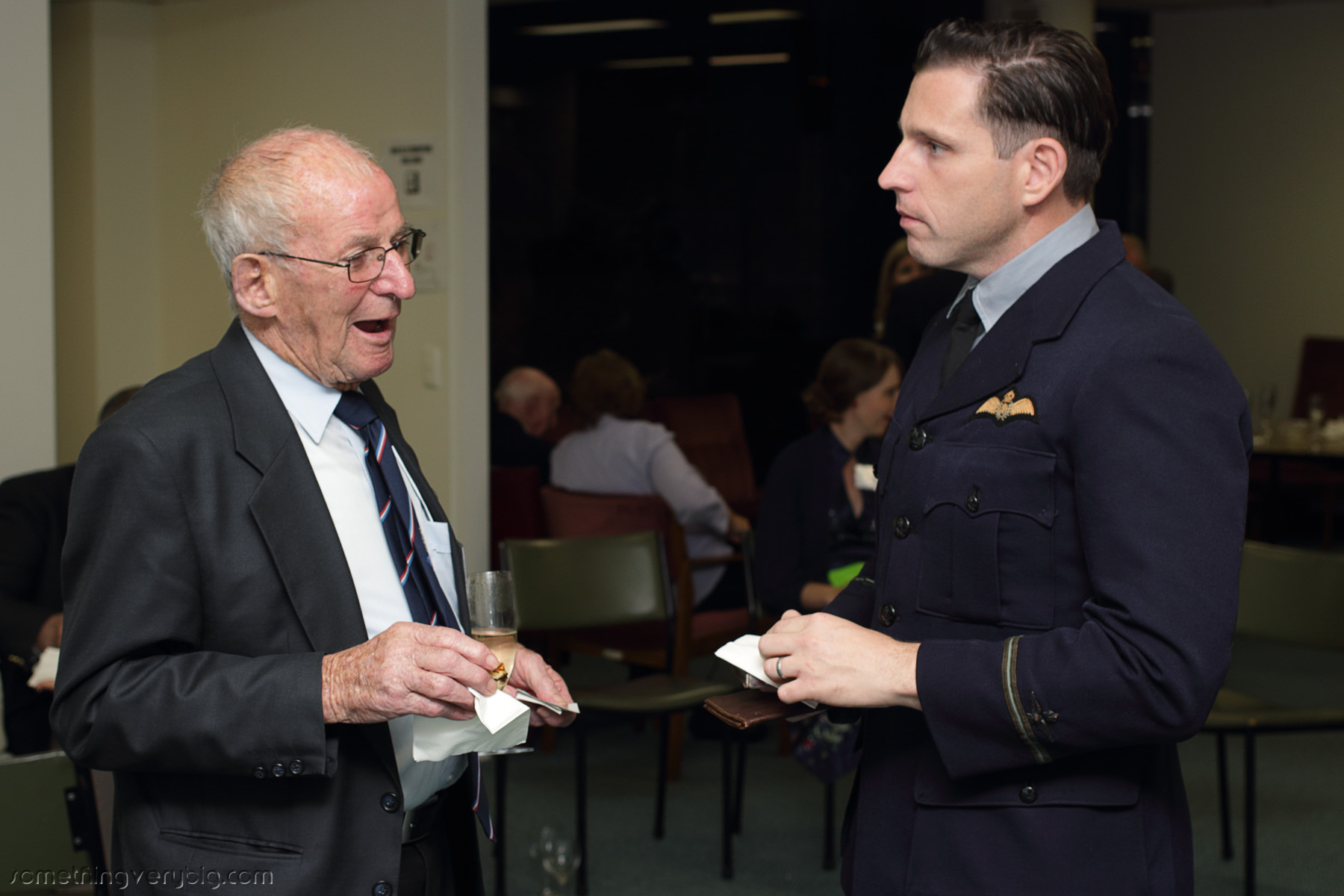
It’s not just the veterans, of course. I came away with some other useful contacts too. David Howell works at the Shrine as a Development Officer and is their resident Kokoda expert. In fact he even leads tours along the Kokoda Track (see www.kokodahistorical.com). David is clearly a military history nut – he turned up to the function wearing a WWII RAAF uniform, along with a mate:

1503-BCPartyMEL 065

I also, finally, met Andy Wright of Aircrew Book Review. We’ve corresponded before, mostly about blogging and book-ish issues, and we’ve been trying to arrange a time to catch up since he moved to Melbourne from central NSW with his young family a few months ago. This cocktail party offered a good chance to meet. Very generously, Andy had used some of his publishing contacts to source for us some very nice books for our raffle.

The raffle had been my main contribution to the running of the event. It turned out to be very successful with everyone getting involved, and Andy’s efforts, along with a couple more books and an Easter basket or two from Jan Dimmick (one of my fellow committee members), really made it worthwhile. Here are a couple of the winners:

Andy Wright with David Howell, the winner of the 'main prize' - a complete set of Chris Ward's Bomber Command Groups books, donated by Pen and Sword in the UK
Andy Wright with David Howell, the winner of the ‘main prize’ – a complete set of Chris Ward’s Bomber Command Groups books, donated by Pen and Sword in the UK
Ian Gibson with his prize, a Fighting High book donated by Capricorn Link (Australia)

Thanks to Capricorn Link (Australia) and Pen and Sword Books (UK) for their very generous donations. And I must also mention the Royal Australian Air Force Association (Victoria), whose treasurer Richard Orr announced a significant donation of funds to the group on the night.

And at the end of the day, fundraising was what it was all about. The Bomber Command Commemorative Day ceremony gets bigger in Melbourne each year, and it is beginning to cost a fair amount to put on. The aim of the cocktail party, as well as being a good chance to bring together people with an interest in Bomber Command in the city, was to raise money to ensure that the ceremony – set down for June 7 this year – can continue to be held. In this it was a success, and I think a good night was had by all.

One last thing, before I get stuck into some more photos. I wrote back in January about a programme run by the Shrine of Remembrance to connect veterans’ groups with schools, to pass the legacies of some of these groups on to a new generation. I’ve been holding this news back for a while now but, as it was effectively announced publicly on Saturday night, it’s time it got a run on SomethingVeryBig.

The Bomber Command Commemorative Day Foundation (Vic) is now part of this important Shrine initiative.

Present at the cocktail party was Scott Bramley, who is the Middle School Chaplain at Carey Baptist Grammar School, in Kew, Melbourne. (His seven-year-old son Hamish was also there and won the final prize in the raffle – a great big Easter basket – but no one believes me when I say it was emphatically not a set-up!!)

Scott Bramley
Scott Bramley

Carey was the school attended by Frank Dimmick, who was a 460 Squadron navigator and the husband of Jan Dimmick, one of my fellow committee members. Though Frank died in 2013 Jan has maintained contact with Carey’s Old Grammarians network and it is through this association that the school was approached and agreed to become part of the ceremony each June. Scott has been the main point of contact, and his enthusiasm for the project is infectious. He’s effectively thrown the resources of the school at our disposal. Year 9 students will learn about Bomber Command as part of their history studies and Carey students are expected to take an active role at the ceremony in June. Let’s hope it’s the beginning of a long and mutually beneficial association between the two groups.

RAAAFA (Vic) Treasurer Richard Orr
Don McDonald with David Howell
Arthur Atkins wih Jan Dimmick

1503-BCPartyMEL 037

Vic Leigh of the Royal Air Forces Association (Melbourne Branch). He is a veteran from an RAF Mosquito squadron but served in Australia and the Pacific, and so very modestly refused to appear in the group photograph. Lovely bloke though!
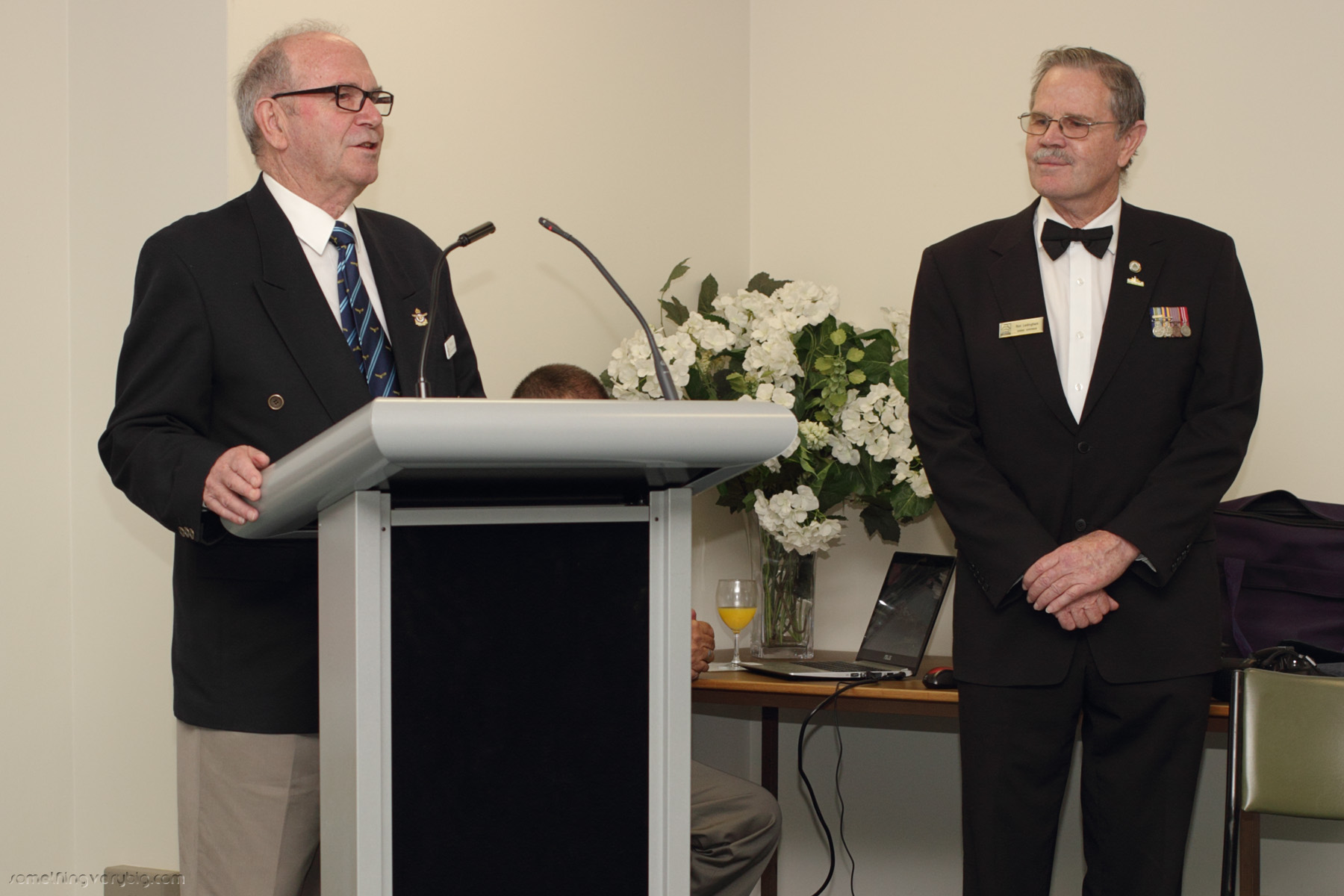
Don Southwell. Ron ledingham looking on.
Don Southwell. Ron Ledingham looking on.
1503-BCPartyMEL 052
Back, L-R: Robyn Bell (Organiser), Don Southwell, Don McDonald, Elaine McCulloch, Wal McCulloch. Front, L-R: Ailsa McDonald, Fay McPherson, Gerald McPherson, Arthur Atkins


Photos and text (c) 2015 Adam Purcell


A Diamond in Emerald

In the central Queensland town of Emerald recently, a lady named Margaret Rawsthorne, a researcher at the Emerald RSL, heard a story about a box of papers belonging to a local man whose grandfather had served at Gallipoli in WWI. Mark Murray, a surveyor, had no idea of what was in the box – and the discovery was so interesting that it led to a small story on ABC’s 7.30 programme in January this year.

Murray’s grandfather, James Nicholas Murray, was a soldier in the infantry when he was sent to Gallipoli in 1915. But when his commanding officer discovered that he was also a licenced surveyor, he was asked to apply his trade to mapping the network of trenches and tunnels at a particularly significant strategic point of the peninsula, a place called Russell’s Top.

The diary entries of the adventures he had while carrying out this work are interesting enough. But along with the diary were notes and maps which have provided the most detailed information yet about exactly what was at Russell’s Top. “The Russell’s Top handover report […] basically says that Russell’s Top is one of the most important lines of defence. It said […] it doesn’t have any second line, and if that line is lost, then ANZAC is lost,” said Rawsthorne.

How often do we hear of this sort of story? A long-forgotten box of papers gathers dust in someone’s shed or attic. Simple curiosity or a chance remark somewhere leads to someone opening the box and discovering a veritable gold mine. Probably the most famous discovery of recent years was the glass plate photographs of Australian and British soldiers discovered in a French attic in 2011. I’d suggest that this discovery in Emerald is of a similar significance. And while not necessarily of national importance, smaller finds can be just as useful for family or researchers interested in a particular time period, unit or even individual. The boxes lie undisturbed until the elderly relatives die and their house is cleared by the family (which is where the McAuliffe Letter came from), or until a chance remark reminds someone of their existence (or a letter arrives from someone like me – as happened to Gil Thew).

Happily, as in each of the cases above, much of the time when boxes like these come to light the discoverer contacts the Australian War Memorial or their local RSL (or even gets straight onto Mr Google if they are interested themselves to find out something about what they’ve found). But sometimes people do not realise what they have found and the documents are thrown out or destroyed. This is likely why we have so little documentation relating to my great uncle Jack Purcell.

This year being the Centenary of ANZAC, I suspect a few more dusty boxes will be coming out of the woodwork before too long. I can only hope that whoever discovers a box of papers like these realises the significance of their find.


(c) 2015 Adam Purcell

Straight to the Pool Room!

Or are you a stranger, without even a name?

Forever enshrined, behind some glass pane?

In an old photograph, torn and tattered and stained,

And fading to yellow, in a brown leather frame?

-Eric Bogle, No Man’s Land

Perhaps because so little has survived, the few photos and original documents that I have of my great uncle Jack are treasured possessions for my family. They help to make real the legend that I grew up with. They are, literally, all that is left of the man. And for this reason, it’s critically important that I keep them safe.

When Dad was given the photos from his grandfather they lived in a shallow foolscap box. But by the time I saw them in the early 1990s the box was falling apart. Given my developing interest in the photos and the story they represented, something more practical needed to be found to allow them to be easily accessed. They spent the next few years in plastic sleeves in a green display folder, along with all the other material we’d gathered.

A few years later Dad found an old leather briefcase in an antique shop somewhere, and thought it would make an appropriate home for Jack’s memorabilia. He arranged the photos around Jack’ logbook in the briefcase, which sat open in a display cabinet at my parents’ place in Goulburn until he gave them to me earlier this year.

An antique cabinet at home serves as my ‘Pool Room’. I was keen to display Jack’s memorabilia there, along with other meaningful objects like the forage cap and my Lancaster model. (Not entirely coincidentally, the original oil painting of B for Baker hangs on the wall above). But some of the photos are fading and curling a little. Wanting to display them but not wanting to run the risk of further degradation, I needed another solution.

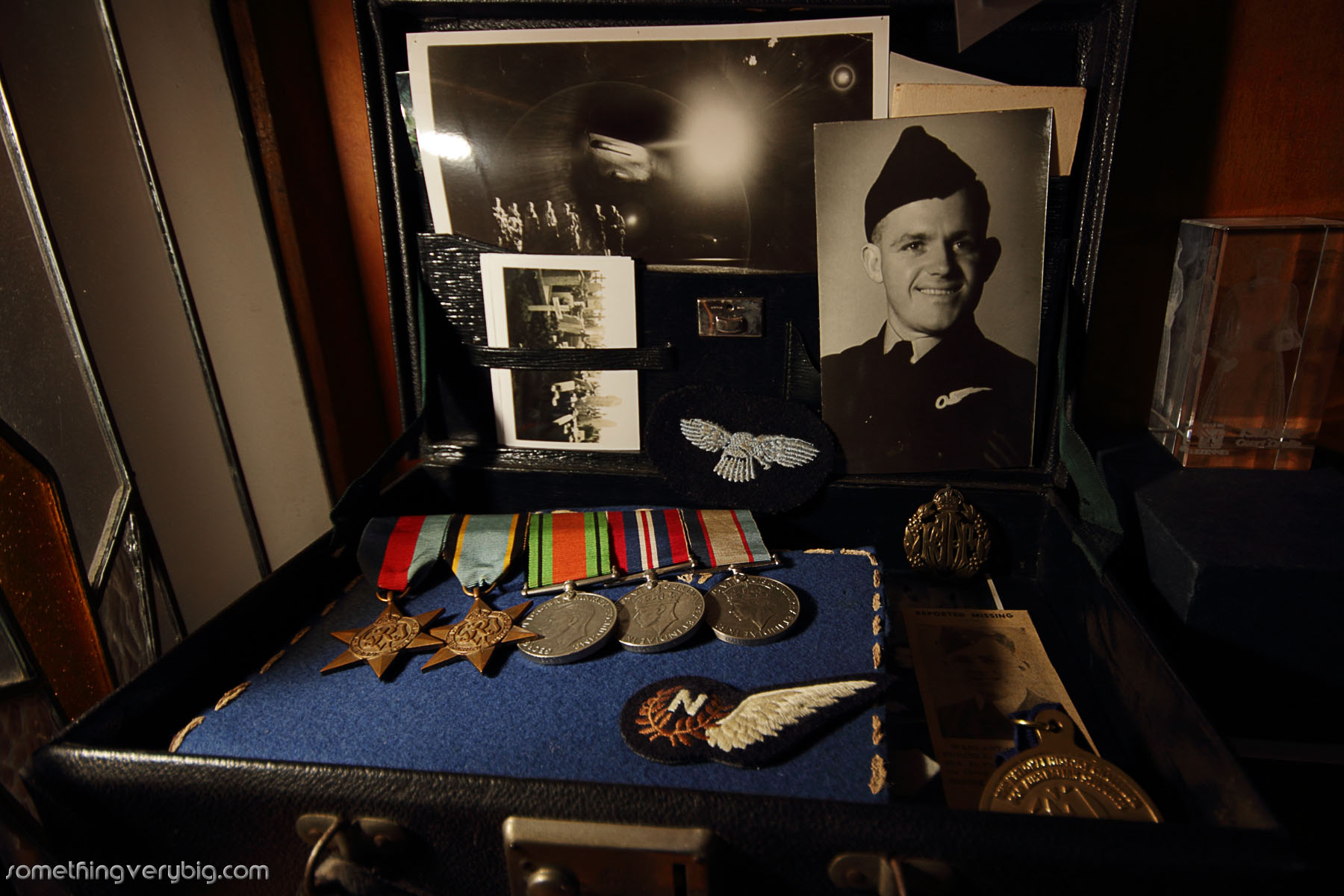
The first thing I did was get copies of the photos. I scanned them many years ago for a CD-ROM (remember those??) I put together in 2003 so I already had digital copies, but imaging technology has improved immeasurably in the decade since then so I recently had digital prints made at my local friendly photo retailer. The new copies I arranged in the briefcase that Dad had given me, along with Jack’s original logbook and service medals:

14Sep-Medals 026 copy

So I now have copies on display in my cabinet. Digital copies are available for study as part of my research if I need to, or for posting on this blog. But the originals have an atmosphere to them that the copies can never replicate. In part it is those imperfections collected over seven decades – the fading, the creases and the pin holes in some – that give the originals their character. Phil Smith’s handwriting on the back of one or two adds to their authenticity.

But while those imperfections add to the character of the originals and help make them ‘real’, there’s not much point if the photo degrades to such an extent that the original can no longer be viewed. To prevent further deterioration I have now mounted the original prints – seventeen of them in all – in a loose-leaf archival quality album, using photo corners. The album is now stored in a closet in my house where the temperature will, hopefully, remain reasonably constant. That way the photos are still easily available for closer examination if I want to get them out, but they are also stored as best I can in conditions that will not accelerate the aging process and the deterioration that comes from it.

They should last another couple of generations at least.

(c) 2014 Adam Purcell

Three Brothers

November 2014 saw the 73rd anniversary of the sinking of HMAS Sydney, a light cruiser of the Royal Australian Navy. Following a successful tour of duty in the Mediterranean, Sydney was escorting troopships through the Indian Ocean to South-East Asia when she was engaged in battle by a German raider called HSK Kormoran. On paper it was a lop-sided encounter but, disguised as a merchant ship until the last moment, the Kormoran managed to surprise the bigger vessel and Sydney was sunk without a trace and with no survivors. Just one body from Sydney washed ashore, three months after the battle, at Christmas Island (north-west of Australia). The unknown remains were buried in an unmarked grave on the island.

One of the 645 men lost with HMAS Sydney was Donald Erskine Johnston, a 21-year-old, and he has a direct connection with the crew of B for Baker. Indeed, it was the Sydney connection that led me directly to contacting Don Webster, a nephew of the lads, in 2010. Following the Mediterranean action, Don Johnston was at home in Kingaroy on leave for a couple of weeks in February 1941. While there, this photo was taken:

Ian, Don and Dale Johnston - Kingaroy, February 1941. Photo courtesy Dale Higgins
Ian, Don and Dale Johnston – Kingaroy, February 1941. Photo courtesy Dale Higgins

Don is in the centre, flanked by his two brothers. On the left is Ian. And on the right is Ian’s twin – Dale Johnston, who of course would eventually become the wireless operator on B for Baker. This would be the last time that all three of the brothers were in the same place at the same time. Only Ian would survive the war.

The wrecks of HMAS Sydney and HSK Kormoran were discovered about 100 miles off the coast of Western Australia in 2008. But about a year ago an article was published in The Age, about how the Navy had exhumed the unidentified body on Christmas Island, and was trying to work out who the man had been. Forensic analysis, the article said, had established that the man was of European ancestry with red hair, blue eyes and pale skin. He was quite tall, between 168 and 188cm, and limestone traces found in his teeth suggested he came from northern NSW or Queensland and probably grew up reasonably close to the coast. Using this information, the article continued, researchers had narrowed the field, as it were, from 645 to about 50.

Red hair, you say?

Tall?

From Northern NSW or Queensland?

I’d seen that combination of features somewhere before – in Dale Johnston’s service record (NAA:A9301, 425413).

Dale was 5’10 in the old money, or about 178cm – smack in the middle of the range of our mystery sailor. He had red hair and blue eyes. The family moved to Kingaroy – in southern Queensland – when Don was nine years old. Could it be…? I sent Don Webster an email the day after the article was published and he duly contacted Navy.

Nine months later, Don had provided a DNA sample which had been tested and, in the middle of November, the results were in.

And…?

The sailor buried on Christmas Island is not Don Johnston.

While that result is a little disappointing for Don’s family, it is of course not an entirely wasted effort. Don Johnston can now be crossed off the list of 50 potential identities for the unknown sailor. At this stage in the investigation, ruling someone out is almost as valuable as a positive identification.

One more down, only 49 to go.

(c) 2015 Adam Purcell

Medals lost and medals found

Digging in his garden in the Victorian Goldfields town of Creswick late last year, a man named Neville Holmes unearthed something unexpected. Under the flower bed was a sort of trench. And in the trench was what was left of an old medicine cabinet. “I could see bits of bottles and broken glass so I kept digging deeper and deeper to see what was under there,” he told journalist Melissa Cunningham of the Ballarat Courier newspaper in January. “There were tubes and tubes of toothpaste, combs, toothbrushes, a pair of dentures and medicine bottles.”

My sister has a degree in archaeology, and to celebrate her graduation a few years ago my father created an ‘archaeological dig’ in the back yard, smashing old plates and mixing in a rusty spoon or two for her to excavate with her brand new trowel (because, as everyone knows, every archaeologist needs a trowel). So finding a real-life pile of old stuff buried under your wife’s irises would, I’d imagine, be pretty exciting. But Mr Holmes found something else hiding away in the old medicine cabinet. Something with even more of a story.

They looked like coins at first. But when he pulled them out, Mr Holmes realised he had found a pair of war service medals. He took them to the secretary of the local RSL club, a man named Phil Carter. Mr Carter was able to identify who the medals belonged to because the soldier’s name is engraved around the rim: a WWI soldier named Private George Bailey. Cunningham writes that Bailey enlisted in Ballarat in April 1916, served with the 39th Battalion and was killed in a gas attack in Messines, Belgium, in June 1917. His brother – Frederick – lived for many years in the house now occupied by Mr Holmes and his wife.

At the time the article was written the search was on for Private Bailey’s family, led by the Creswick RSL. “We knew nothing about George but now we know so much”, said Phil Carter. “It’s like he’s a member of our RSL.”

I can certainly relate to this feeling. After seriously studying the story of my great uncle Jack and the rest of his crew over the last six or seven years, I genuinely do feel as if I know the lads, even though six of them were killed forty years before I was born. The feeling is all the stronger for those members of the crew for whom I have letters or diaries written in their own words, in their own hand. But to find those, of course, I first needed to find their families, and, well, that took a while.

Amazingly, though, less than a week after Melissa Cunningham’s first article was published in the Ballarat Courier and The Age, the search for Private George Bailey’s family came to a successful conclusion when Frederick Bailey’s grandson came forward. If only it were that easy when I was searching for families of the crew of B for Baker three or four years ago!

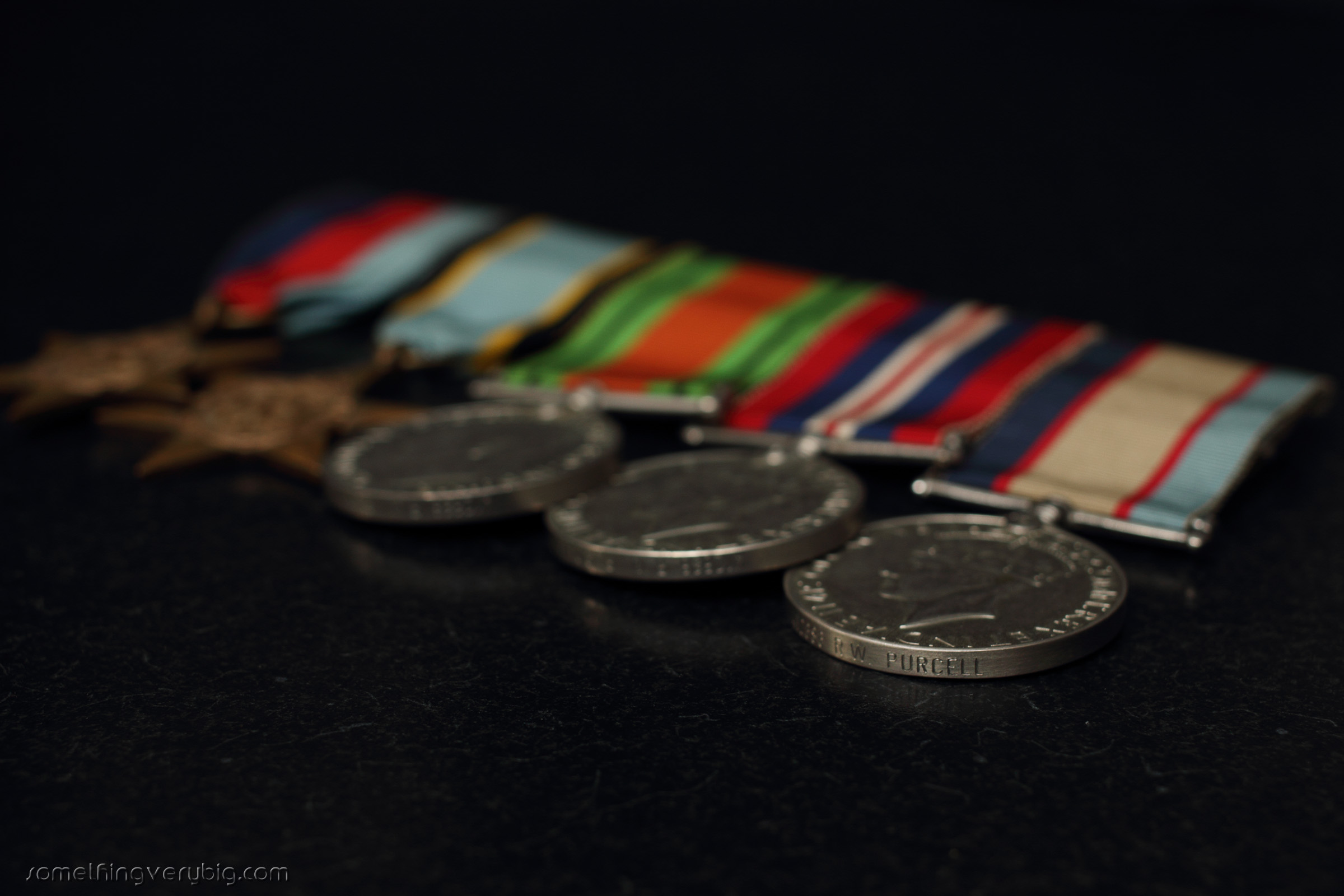
We initially thought that Jack Purcell’s service medals had been lost in the years since the war and so almost 20 years ago my father enquired about the possibility of acquiring replicas. Imagine our surprise, then, when we discovered that in actual fact they had never officially been issued. Dad duly jumped through the multiple bureaucratic hoops that were required to prove that we were entitled to claim them and one day in 1996 a small box arrived by registered post. Inside were five medals – three circles and two stars – and their associated ribbons.

And, yes. Stamped around the edges are Jack’s name and service number.

1501-JackMedals 042Words and photo (c) 2015 Adam Purcell

Hangars, Ansons and Aeradio: A visit to Nhill

Most of the 40 or so locations around Australia that hosted aircrew training units during WWII are still in use today as aerodromes, both civil and military. Some are better-known than others. Mascot, for example, where the current Sydney International Airport is located, was No. 4 Elementary Flying Training School. Essendon – No. 3 EFTS – was, for a time, Melbourne’s main airport and remains in use by corporate aircraft, emergency services, freighters and trainers. Amberley and Pearce are still RAAF bases. While some were abandoned post-war (Cressy in Victoria, for example, or Uranquinty in NSW), a large number of the others are in use in regional and metro areas of Australia. Forest Hill – No. 2 Service Flying Training School – became Wagga Wagga Airport, now a reasonably busy training, maintenance and RPT hub for regional airline Rex. Many navigators trained at No. 1 Air Navigation School in Parkes, NSW, which remains active as a regional airport. And about five years ago I landed my last aeroplane, appropriately enough a Tiger Moth, on the grass runway at Camden, outside Sydney, which hosted for a time the RAAF’s Central Flying School where flying instructors were taught their trade.

Jack Purcell trained at four airfields in Australia, and all remain active. After he was scrubbed from pilot training at 8 EFTS, Narranderra (which today receives multiple scheduled air services each day to and from Sydney), he re-mustered and began his navigator training at No. 2 Air Observers’ School, Mount Gambier (hosting air services to Adelaide and Melbourne). Then he was posted to 2 Bombing and Air Gunnery School at Port Pirie, South Australia (a regional town on the eastern side of the Spencer Gulf). And finally, before being awarded the half-wing that denoted a qualified navigator in July 1942, he spent almost a month at No. 2 Air Navigation School, just outside the western Victorian wheatbelt town of Nhill, on the highway half-way between Adelaide and Melbourne.

Rachel and I happened to spend a night camped in the caravan park at Nhill on the way home from a holiday to Kangaroo Island late last year. Knowing that the name crops up in Jack’s logbook, I thought we might be able to have a quick look at the airfield to see if we could find interesting remnants of its wartime history. I was completely unprepared for what we actually found.

The first sign that something good is going on at Nhill was, quite literally, just that: a new-looking brown road sign. It was pointing, it said, to the “Historic RAAF Base”. Excellent, I thought, we’ll follow that in the morning. We arrived at the caravan park where a westerly wind was howling as we set up the tent. The roar of trucks passing on the highway was almost drowned out by the squawking and screaming of hundreds of white and pink corellas as they wheeled and soared and swung overhead.

Walking around the town looking for somewhere to have breakfast the next morning, we found a display in an otherwise empty shop window for the Nhill Aviation Heritage Centre. I rang the telephone number and was put on to a lady named Joan Bennett, who is the Secretary of the group. She readily agreed to open up the hangar at the aerodrome for us to visit.

And so an hour later after breakfast in a local café, that’s exactly where we headed. Unexpectedly, and despite the almost constant truck traffic, Nhill is a rather pretty little town. Heritage buildings line the main street and a long park, with bandstand and war memorials, sits between the two carriageways as the highway passes through the town itself.

The smaller of the two memorials looked, to me, to be quite new. And so it proved, being a memorial set up by the Nhill Aviation Heritage Centre in 2011:RAAF Nhill memorial in the town The northern end of the town is dominated by the concrete silos of the former Noske Flour Mills. When it was built in 1919 this was apparently the largest concrete silo in Australia. No doubt it was a significant landmark for trainee navigators during wartime. About two kilometres northwest of the town is the airfield.

In 1938 an Aeradio station began operating at Nhill. This was part of a national network of air/ground communications stations set up to give comms and navigation support to civil aircraft flying around Australia. It was, in effect, the forerunner of the Flight Service network which eventually developed into the enroute air traffic control system we now use. The first building we passed, right next to the road along the western boundary of the aerodrome, is the former Aeradio site. It looks to be in some disrepair but out of the seventeen original sites around the country this is, it seems, the most original and the best preserved, and so moves are afoot, in cooperation with the Civil Aviation Heritage Society based at Essendon Airport here in Melbourne, to restore it and turn it into part of the Nhill Aviation Heritage Centre.

There are two hangars at Nhill Airport. One is the last of five Bellman hangars built at Nhill during the war. It currently hosts the Wimmera Aero Club: The Bellman Hangar at Nhill Airfield; now the home of the Wimmera Aeroclub The other is virtually brand new. It was built in 2013 and officially opened in May 2014. Designed and built at cost by Ahrens, a steel and industrial supply company based in Adelaide but which owns a local Nhill business, the hangar now houses the beginnings of an air museum.

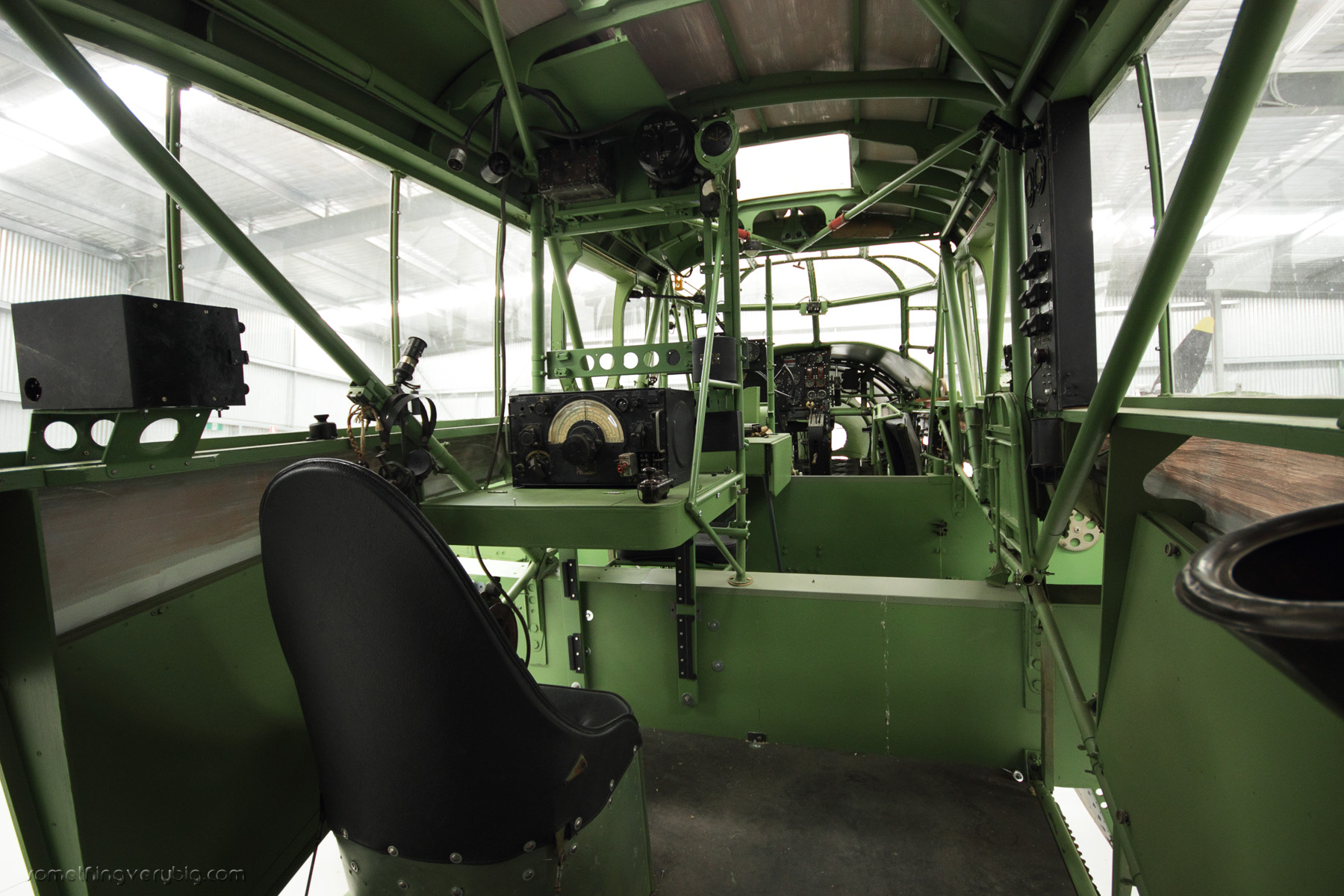
Joan was already there when we pulled up in front of the hangar. We paid our $5 each for admission (genuine 1972 prices!) and Joan showed us around. Pride of place in the middle is this: The Nhill Aviation Heritage Centre Avro Anson, undergoing restoration in their brand new hangar It’s the bones of an Avro Anson, serial W2364 to be specific. While this particular airframe was not itself based at Nhill during the war, most of the flying that took place from the airfield would have been in aircraft very much like it. Jack Purcell’s logbook records a total of 25 hours of flying from Nhill by both day and night, over seven flights in July and August 1942. All of it was in Ansons. Page from RW Purcell's logbook In recognition of Nhill’s association with Ansons, then, this one is undergoing a slow but steady and beautifully detailed restoration. Joan says the aim is to get it to taxying status and they have already got one of the engines running, evidenced by the drip trays catching oil from said engine. Over along one side of the hangar is the workshop area, where members of the group have been cleaning, repairing or fabricating components as they go. It’s taken five years and over 2,000 man-hours of work to get it to this stage and while there’s undoubtedly a very long way to go, the day in February 2014 when the work-in-progress was towed from Anson Restoration Project Manager Mick Kingwell’s shed to the new hangar was a significant one for the group and for Nhill – the first time an Anson had been on the airfield in some sixty years.

While none of the original wooden parts have been suitable for re-use on the restoration, they have been used as templates for copies to be made and the level of detail already in place inside the fuselage is quite stunning: Inside the Nhill Anson Joan emphasised the spirit of cooperation and assistance that has come out of the aviation heritage community around Australia. A good illustration of this is the pair of Link Trainers which sit in a corner of the hangar. They both come from the same South Australian-based family. One is more complete than the other. This has been loaned to the Nhill group to restore to operating status and then to use as a template while they work on restoring the second one. Once restoration is complete the first trainer is to go back to its owners – but the second is to be retained in Nhill.

Also around the airfield itself is a Heritage Trail, with sealed pathways and signage, that takes the visitor around and explains the significance of the remains of the airfield’s time as a RAAF base. While we didn’t have time to walk around it ourselves it’s another sign that good things are afoot at Nhill. There are even plans to hold a fundraising airshow at the airfield on October 10 this year (stay tuned for details – I intend to be there if I can).

It’s wonderful to see such a passionate group at work in Nhill. Their plans are ambitious but the work to date is, really, most impressive. They appear to have the support of the local council and the town itself and they are breathing new life into what would otherwise be just another quiet, dying little country airfield in a quiet, dying little country town. We certainly need more of that sort of enthusiasm, and that there is a direct connection to Jack Purcell’s wartime story is, for me, an added bonus. Joan and Adam in front of the Nhill Anson You can find the Nhill Aviation Heritage Centre’s website at http://nhillaviationheritagecentre.com.au/. Visits to the Ahrens Hangar can be arranged by phoning Joan Bennett on 0438 265 579. Tell her I sent you! © 2015 Adam Purcell
EVENT: Cocktail Party for the Bomber Command Commemorative Day Foundation (VIC)

Also just to hand is notofication from the Bomber Command Commemorative Day Foundation (Vic) of a cocktail party planned to raise funds to support the annual commemoration service. Details below…

WHEN: 18:00-21:00, Saturday 14 March 2015

WHERE: Nurses’ Memorial Centre, 431 St Kilda Road, Melbourne (entrance off Slater St)

WHO: All welcome – Veterans, Family, Friends

WHAT: Cost includes bubbly, beer, red and whit wine and soft drinks with finger food also provided

HOW MUCH: $40 per head

RSVP: Robyn Bell: brucebell (at) netspace.net.au or 0439 385 104, by 28 February

Details for payment can be found on the official flyer, here.


EVENT: Bomber Command Commemorations in Melbourne, 7 June 2015

An announcement just to hand from the organisers of the Melbourne edition of the Bomber Command Commemorative Day about this year’s ceremony:

The Bomber Command Commemorative Day Foundation (Vic) is pleased to announce the 4th year of commemorating the service and sacrifice of the men and women who served and those who paid the ultimate sacrifice in WWII.

In Conjunction with the Shrine of Remembrance we will be conducting the 2015 service at the Shrine at 12.00 noon on Sunday June 7th

Concurrent observances are held in Canberra, Queensland, South Australia and Western Australia together with overseas observances in New Zealand, Canada and the United Kingdom.

Enquiries:

Robyn Bell

03 9890 3107

0439 385 104

brucebell (at) netspace.net.au

Similar events are expected to be held around the country on the same day, including of course the flagship weekend in Canberra. Further details to be released in due course.

What happens when those that are left grow too old?

It has long been the case that, following their return from war or warlike service, many veterans will become involved in ex-service groups. These organisations – many set up and run by the veterans themselves – provide support and comradeship for the years immediately following return from war. Regular reunions, typically based around ANZAC Day or other significant dates on the calendar, helped keep alive the close friendships that develop out of shared combat or other adversities. And of course they would also allow time for reflection and remembrance of those who did not come back. As Laurence Binyon wrote, “They shall not grow old.”

But of course there are more words that follow that line from Binyon’s famous poem, For the Fallen:

“..as we that are left grow old.”

Time, inevitably, marches on, and those that are left from WWII are now very, very old indeed. The last Australian to serve overseas in WWI died in 2005. It won’t be many more years before WWII veterans go the same way. Once they are no more, will the ex-service organisations carry on? Who will run them? Who will carry the banners? Who will remember them, at the going down of the sun, and in the morning?

Enter Melbourne’s Shrine of Remembrance. Reasoning that the earlier you get ‘em, the greater the impact, the Shrine runs a programme that as far as I know is unique in Australia. They match ex-service organisations with primary and secondary schools, usually with either a geographical or a historical connection. The Shrine facilitates and hosts initial meetings between the interested parties. It provides guidance on how to proceed. And then it steps discreetly out of the way, leaving the two bodies to continue and develop the relationship that has been cultivated.

Usually targeting a particular year group at the school, the history of the adopted unit is integrated into the school’s curriculum. As the Shrine notes on its website, this works nicely with the Civics and Citizenship part of the Victorian Essential Learning Standards (AusVELS) curriculum. Just this in itself is a good reason for becoming involved. But then they go further.

Many different ex-service organisations hold annual commemorative services at the Shrine (that for Bomber Command, of course, is in June each year). But as the veterans age, it becomes harder for them to organise, run or even attend the ceremonies themselves. For units that have been adopted under the Shrine’s programme, the solution is obvious. The school students, who have been learning about the unit at school, meet the veterans, become part of organising the ceremony and then play a role in actually running it. Because the programme is targeted at a specific year group (say, Year 9), different students are involved every year – and thus the unit’s legacy becomes, hopefully, self-perpetuating.

It’s a great idea and one that has already borne fruit. Some 33 schools are already taking part and there are a number of others in the pipeline.

Just imagine learning at school about a particular aspect of WWII, and then meeting people who were actually there. What a fantastic way to inspire an interest and bring the history alive. Wish they’d have thought of it when I was at school!


(c) 2015 Adam Purcell