EVENT: Bomber Command Commemorations in Melbourne, 7 June 2015

An announcement just to hand from the organisers of the Melbourne edition of the Bomber Command Commemorative Day about this year’s ceremony:

The Bomber Command Commemorative Day Foundation (Vic) is pleased to announce the 4th year of commemorating the service and sacrifice of the men and women who served and those who paid the ultimate sacrifice in WWII.

In Conjunction with the Shrine of Remembrance we will be conducting the 2015 service at the Shrine at 12.00 noon on Sunday June 7th

Concurrent observances are held in Canberra, Queensland, South Australia and Western Australia together with overseas observances in New Zealand, Canada and the United Kingdom.

Enquiries:

Robyn Bell

03 9890 3107

0439 385 104

brucebell (at) netspace.net.au

Similar events are expected to be held around the country on the same day, including of course the flagship weekend in Canberra. Further details to be released in due course.

Ladies’ Day with the 463-467 Squadrons Association in Sydney, 16 November 2014

Some three decades ago, the 463-467 Squadrons Association (NSW) (Inc) needed to find a new venue for their Annual General Meeting. One of the squadron veterans was a member of the Killara Golf Club in what’s usually described as Sydney’s ‘leafy’ North Shore, and suggested that the salubrious surrounds of the art deco clubhouse there might be suitable. So they tried it, and it was. After a few years the meeting would be followed by lunch at the club and eventually wives and partners were invited along too. The gents had their meeting in the Billiards Room while the ladies got stuck into drinks in the Dining Room. And then they would all share lunch together.

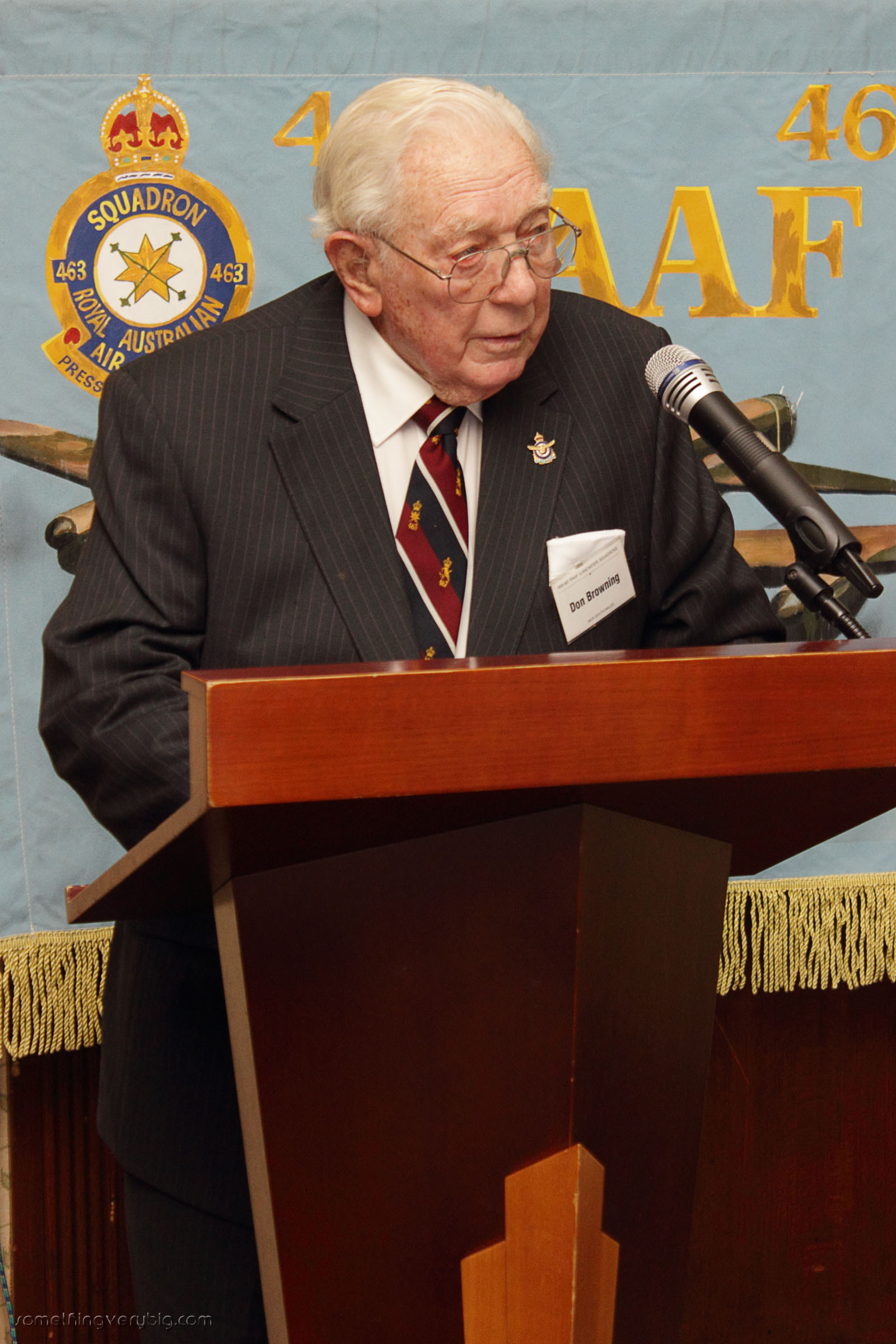
Such were the origins, says veteran 463 Squadron wireless operator Don Browning, of the now-annual ‘Ladies’ Day’ luncheon. AGMs are no longer required following the winding up of the official body some years ago but the loose association continues to hold the lunches on the Sunday nearest Remembrance Day each November. This year’s edition took place yesterday. And I was there, one of about 55 people in the crowd.

There was a little shuffling of the seats happening at Table 3 when I arrived to stake my claim. No fewer than three Bomber Command veterans were at the table so I cunningly found a spot in between two of them. Don Southwell apologised as he took his seat on my left. “Sorry you got me,” he said. “I thought you’d want to sit next to someone interesting!” I raised an eyebrow. Sitting next to me on my right, was Ron Houghton, who flew a full tour as a Halifax pilot on 102 Squadron and after the war had a long career flying Constellations and B707s with Qantas. To his right, Keith Campbell, a bomb aimer who was the only survivor when his 466 Squadron Halifax was shot down over Stuttgart in June 1944. Keith wore the little gold caterpillar badge that denotes a member of the Caterpillar Club. Don Southwell himself, of course, flew nine operations as a 463 Squadron navigator.

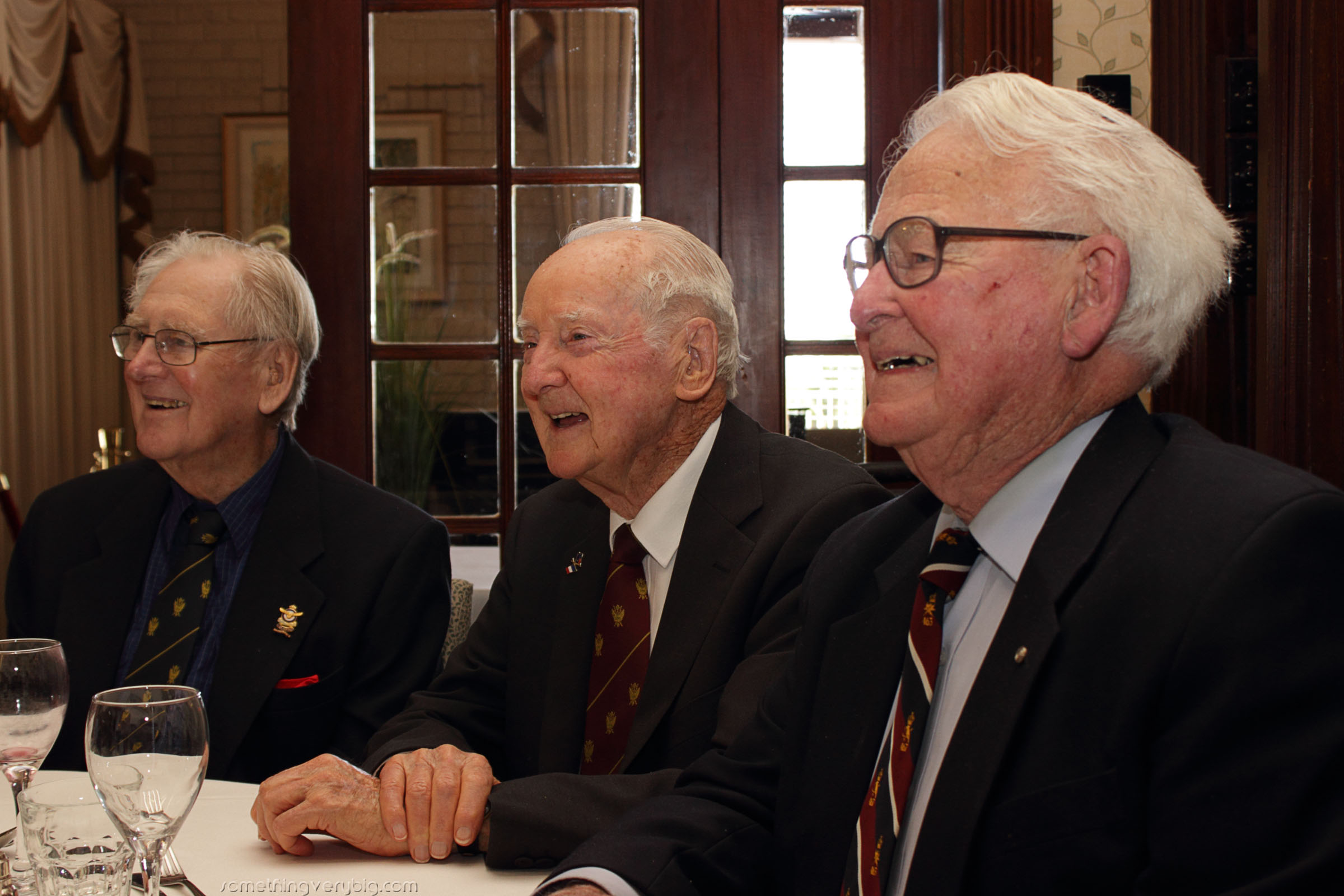
Don Southwell (right), Ron Houghton and Keith Campbell

I reckon I’d have a hard time finding anyone more interesting than this trio.

I was, in reality, extraordinarily lucky to have three veterans at my table. In all there were nine present, down three on last year, mostly through illness both short and long-term. Most obviously missing for me were Tom Hopkinson, who had to cancel at short notice, and Harry Brown, who is still recovering from complications after breaking a hip a few months ago. Even some of those who were there have been a little in the wars lately. Keith Campbell got the most points for effort though. He’s had a hip operation recently but managed to wrangle a leave pass from hospital for the afternoon.

After a superb meal at which, as you’d expect in this company, the conversation was free-flowing, it was time for some speeches. Don Southwell welcomed the reasonably significant number of visitors, and proposed the traditional Toast to the Ladies:

SOLD! To the man in the blue suit!

Annette Guterres responded on behalf of the Ladies, both present and not:

14Nov-LadiesDay 031
Annette Guterres

The day’s main speaker was Bill Purdy. Before he spoke, however, Don Browning shared a story about him:

Don Browning
Don Browning

Following his tour of operations, Bill was posted to a Heavy Conversion Unit at Wigsley as an instructor. Returning from a training sortie one day Bill found himself close to Waddington and decided it would be fun to buzz the control tower there. So he did. Word of his indiscretion, of course, made its way back to Wigsley, where the Commanding Officer there happened to be the former CO from 463 Squadron, Rollo Kingsford-Smith. Kingsford-Smith gave Bill a good dressing-down and told him that Group Captain Bonham-Carter had demanded an apology in person.
“You are to go to Waddington”, Rollo said.

No problem, Bill thought. It’s only about nine miles away as the crow flies, a short hop in a Lancaster. No sweat.

But Rollo wasn’t finished yet.

“…by bicycle!”

Bill says he hasn’t forgotten that bike ride.

Apart from Phil Smith, of course, Bill was the first Bomber Command veteran I had met who actually flew on the Lille raid of 10 May 1944 from which the crew of B for Baker failed to return. He’s also the only Bomber Command airman I know who still has a pilot licence, flying around in a Tiger Moth from Luskintyre, north of Sydney. But this talk was about his experiences in June of this year, when a delegation of seven Australian veterans went to France to take part in the official 70th anniversary commemorations of the Normandy landings.

14Nov-LadiesDay 044

Bill had been on the raid on the morning of the invasion against Pointe du Hoc, a very large German gun emplacement, and it was in this capacity as a veteran of D-Day that he was selected. Interestingly another one of the seven was present at Killara: my lunch companion Ron Houghton.

In any case, Bill gave a good talk. Security on the French trip was tight, he said, with multiple checkpoints to negotiate on the way to the official ceremonies, and traffic was a nightmare with half a million people in the area. But it was one of the best-organised events he had ever been part of and a most memorable occasion, particularly seeing first-hand the damage their 1,000-pounders had done to Pointe du Hoc. Having been there myself a few years ago, he’s right – there are craters everywhere.

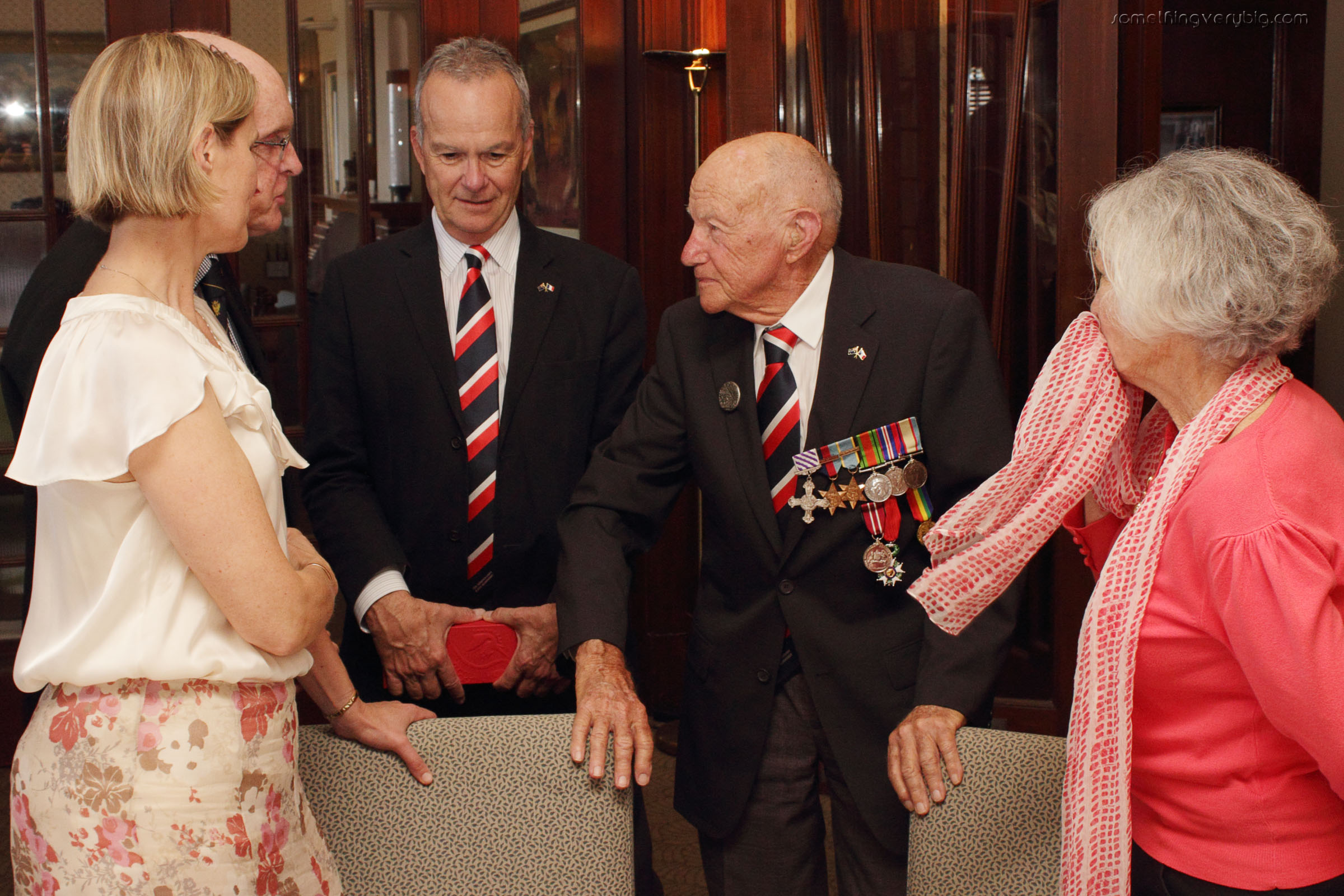
Bill was wearing his medals, and they included a particularly impressive-looking one hanging from a red ribbon. While the veterans were overseas the French presented each of them with the Légion d’Honneur, one of the country’s highest honours. It’s the one hanging from his left thumb in this photo:

14Nov-LadiesDay 045

Following the talk there was one more bit of official business to take care of: the group photo. Once again, all we were missing was a flight engineer… and a Lancaster, otherwise I would have suggested they all took us for a fly.

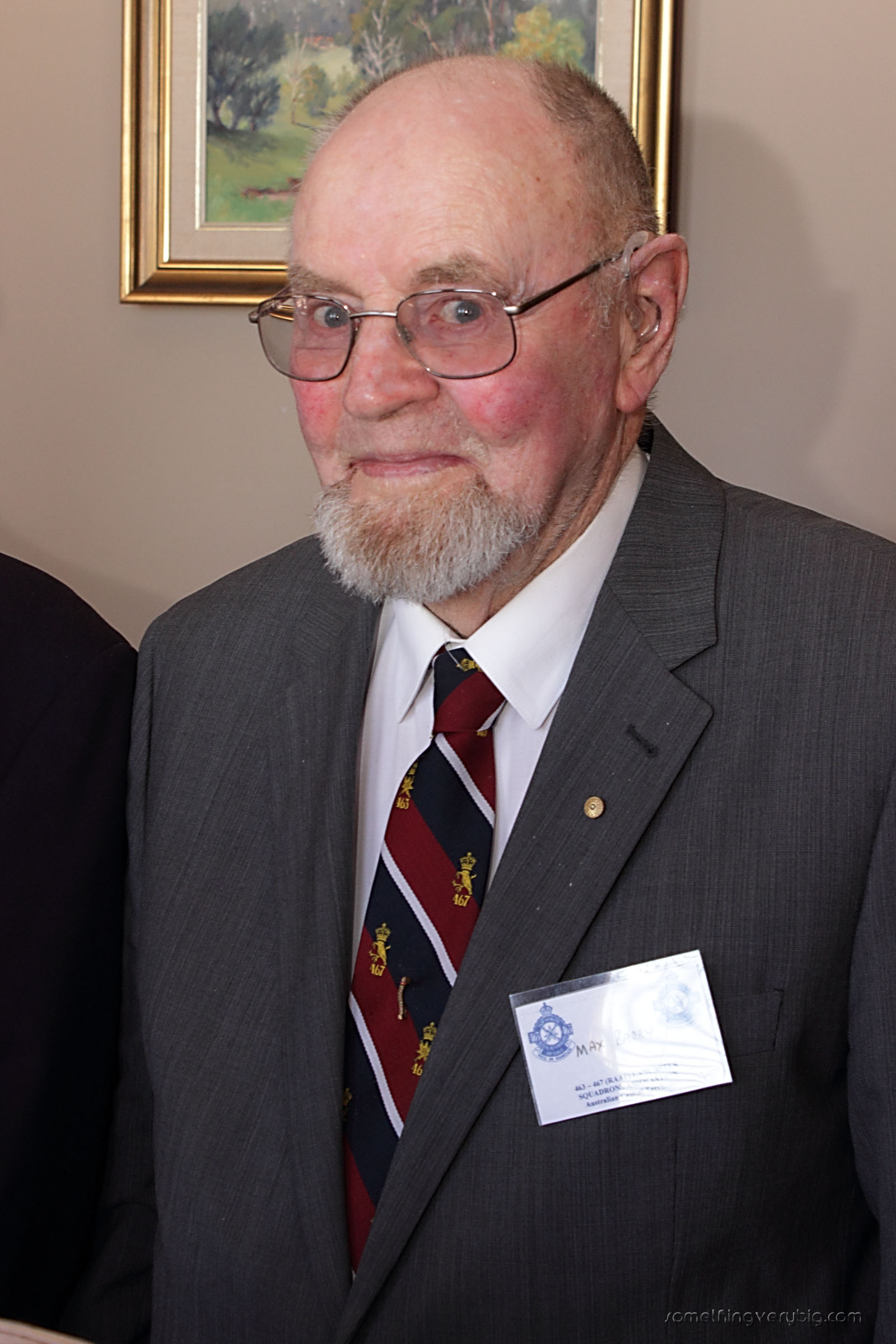
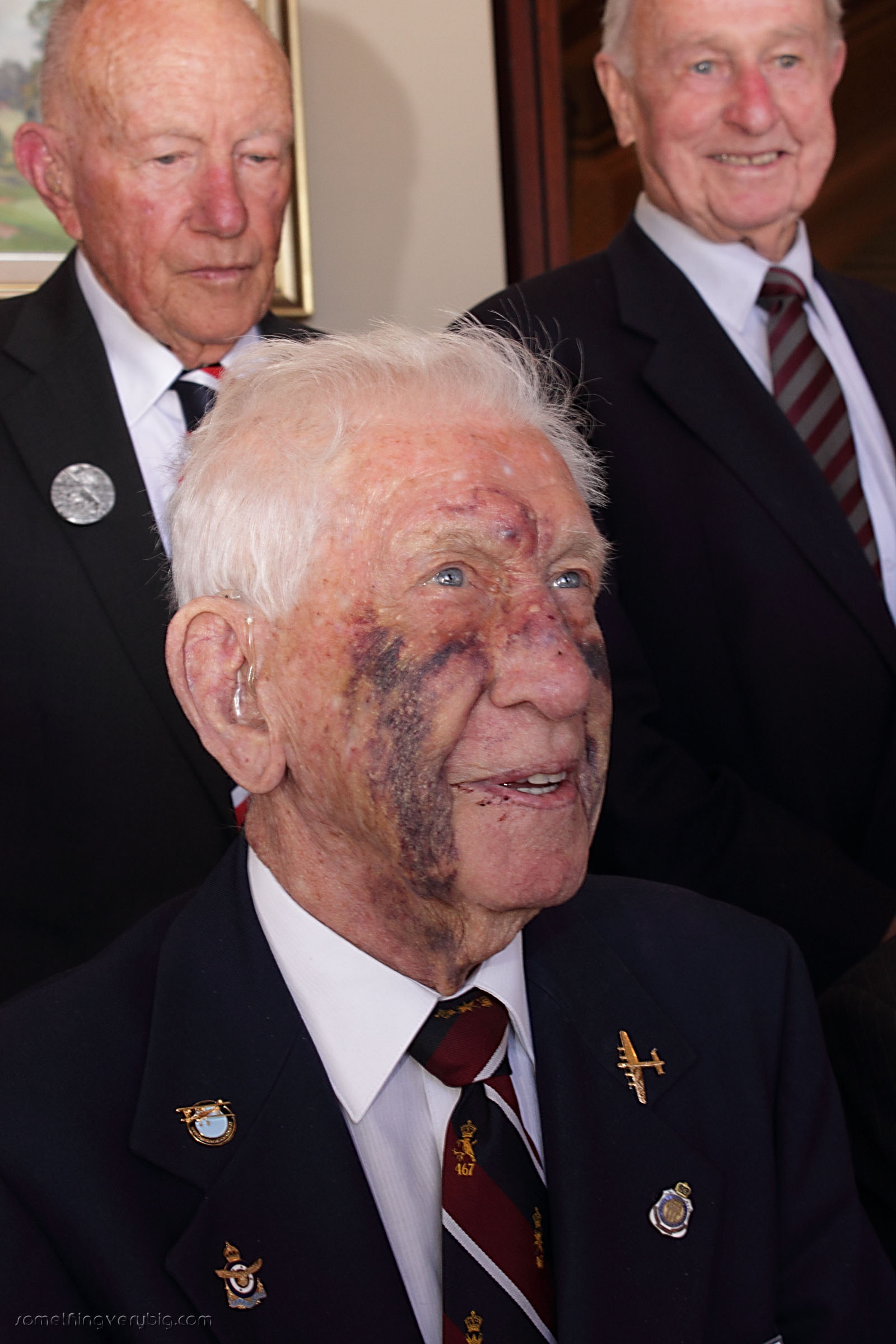
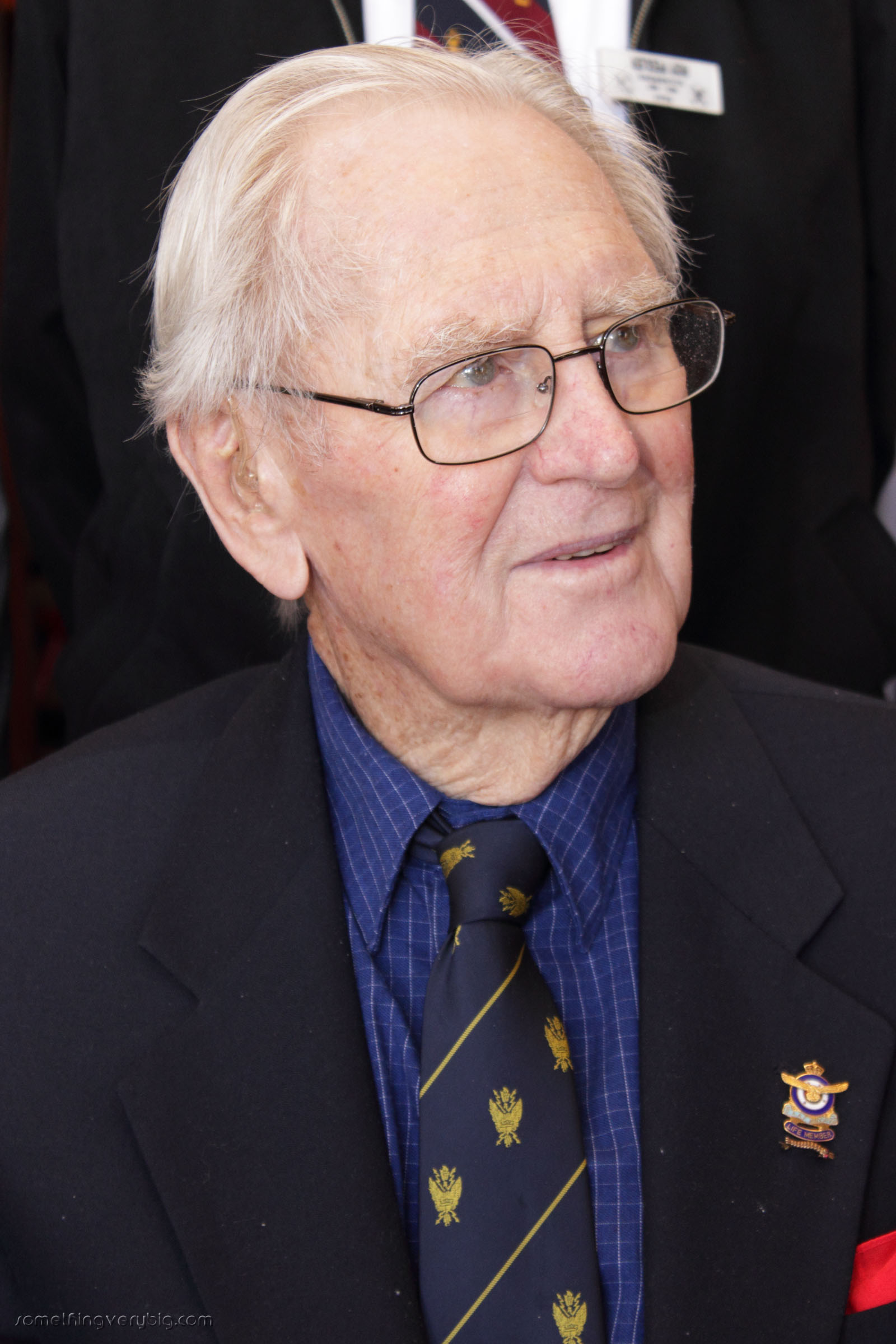
Back row L-R: Don Southwell (463 Sqn Navigator), Bill Purdy (463 Sqn Pilot), Hugh McLeod (49 Sqn Rear Gunner), Max Barry (463 Sqn Mid Upper Gunner), Roy Pegler (467 Sqn Bomb Aimer). Front Row L-R: Don Huxtable (463 Sqn Pilot), Don Browning (463 Sqn Wireless Operator), Ron Houghton (102 Sqn Pilot) and Keith Campbell (466 Sqn Bomb Aimer).

I really enjoy the company of these ‘old lags’ and I feel very lucky that I’ve been able to make the trip up from Melbourne to catch up with them a couple of times a year. May it continue for a good few years yet.

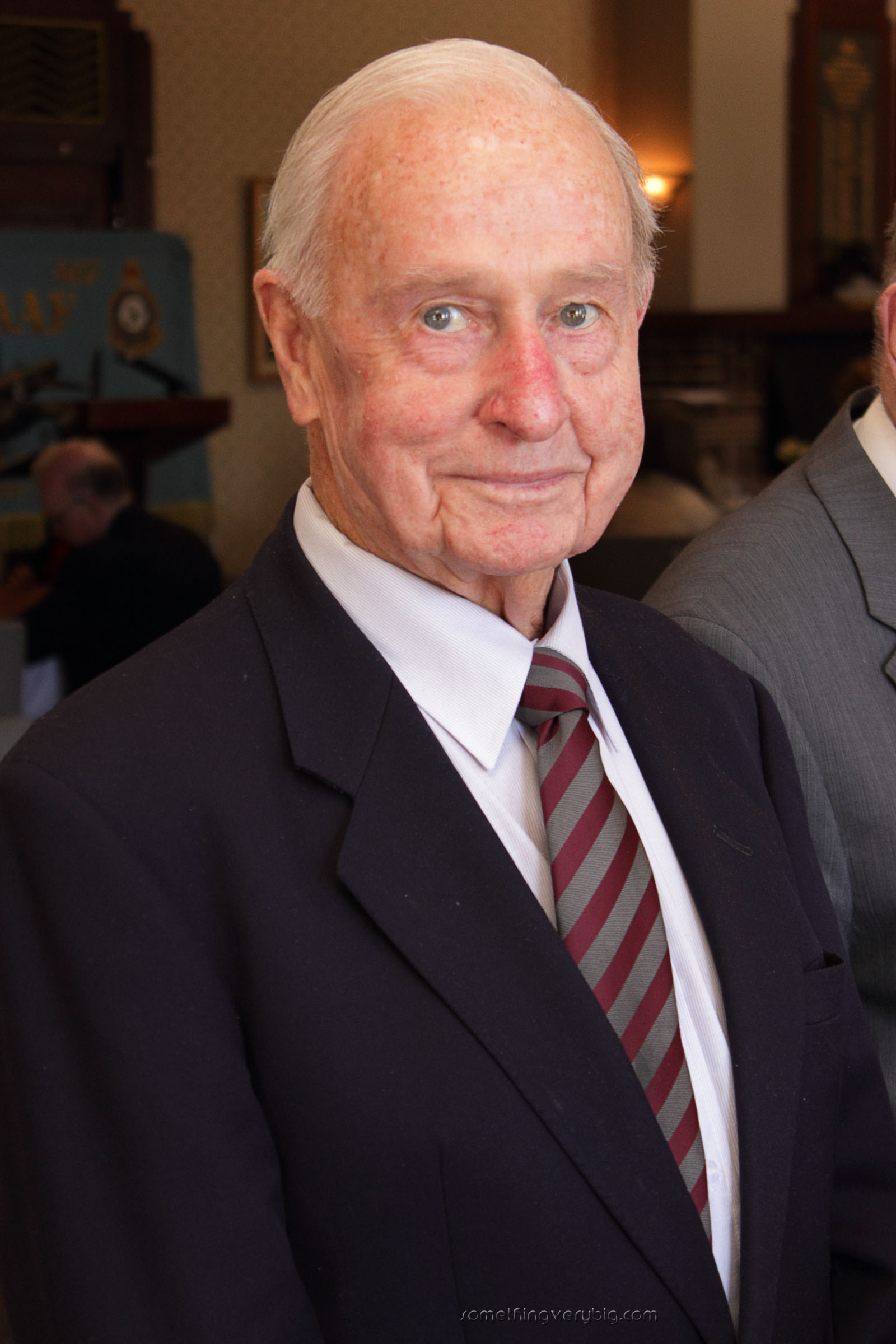
Max Barry
Max Barry
Roy Pegler
Roy Pegler
Don Huxtable
Don Huxtable
Ron Houghton
Ron Houghton
14Nov-LadiesDay 051
Keith Campbell
Hugh McLeod
Hugh McLeod
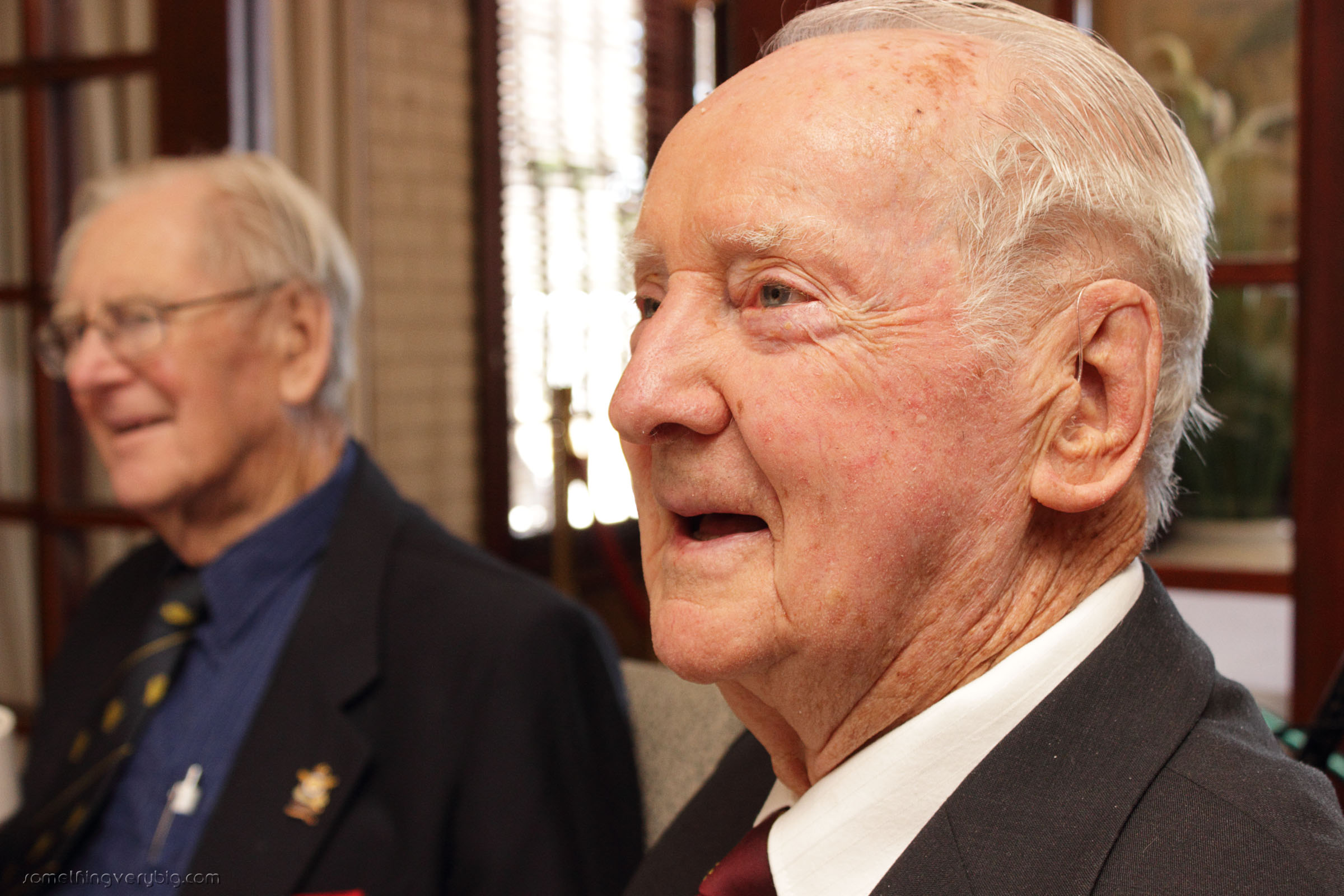
Keith Campbell and Ron Houghton
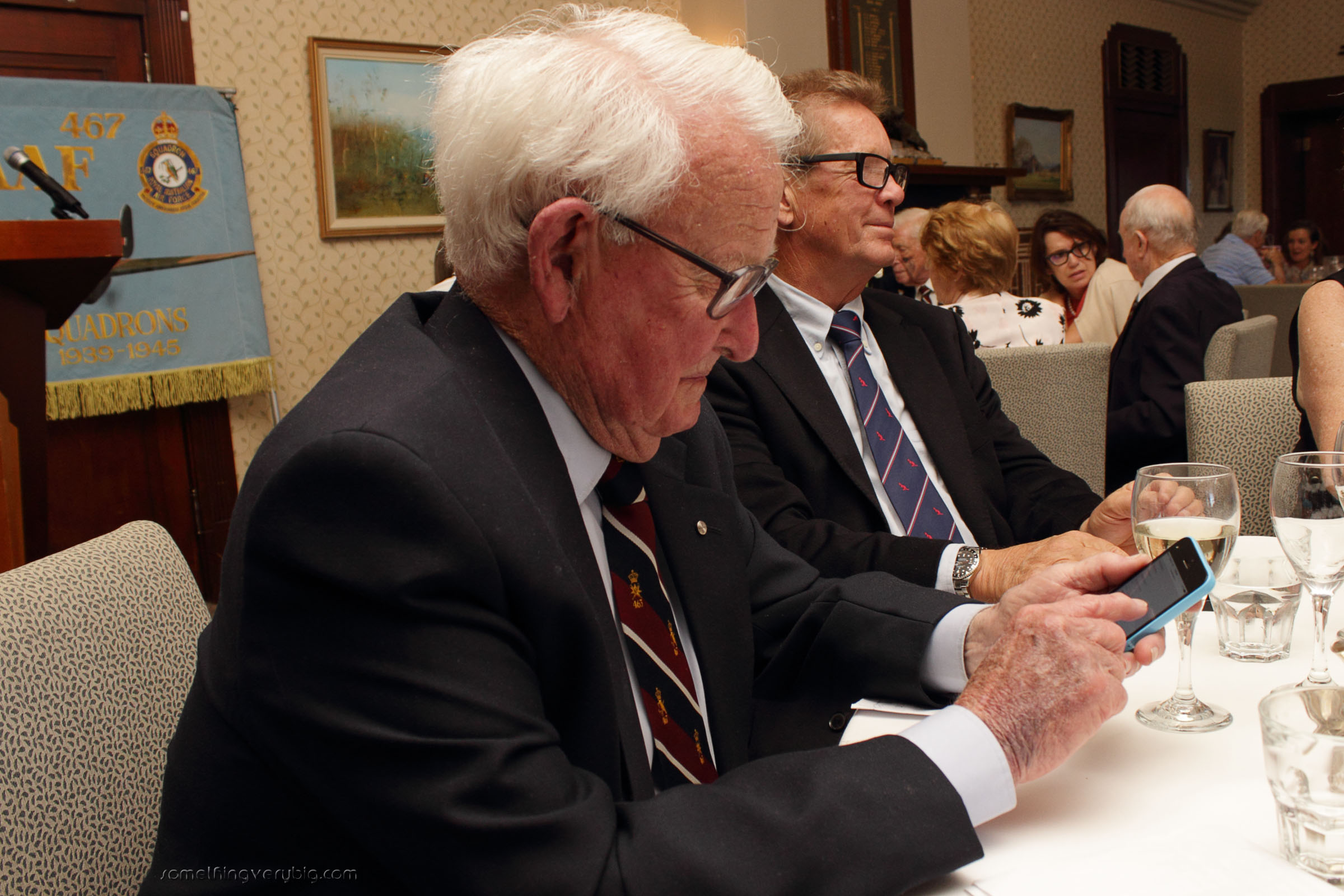
"How do you work this thing anyway?"
“How do you work this thing anyway?”
Hux and his 'Top Gun Hands". Once a pilot, always a pilot...
“There I was, nothing on the clock but the maker’s name…” Once a pilot, always a pilot…
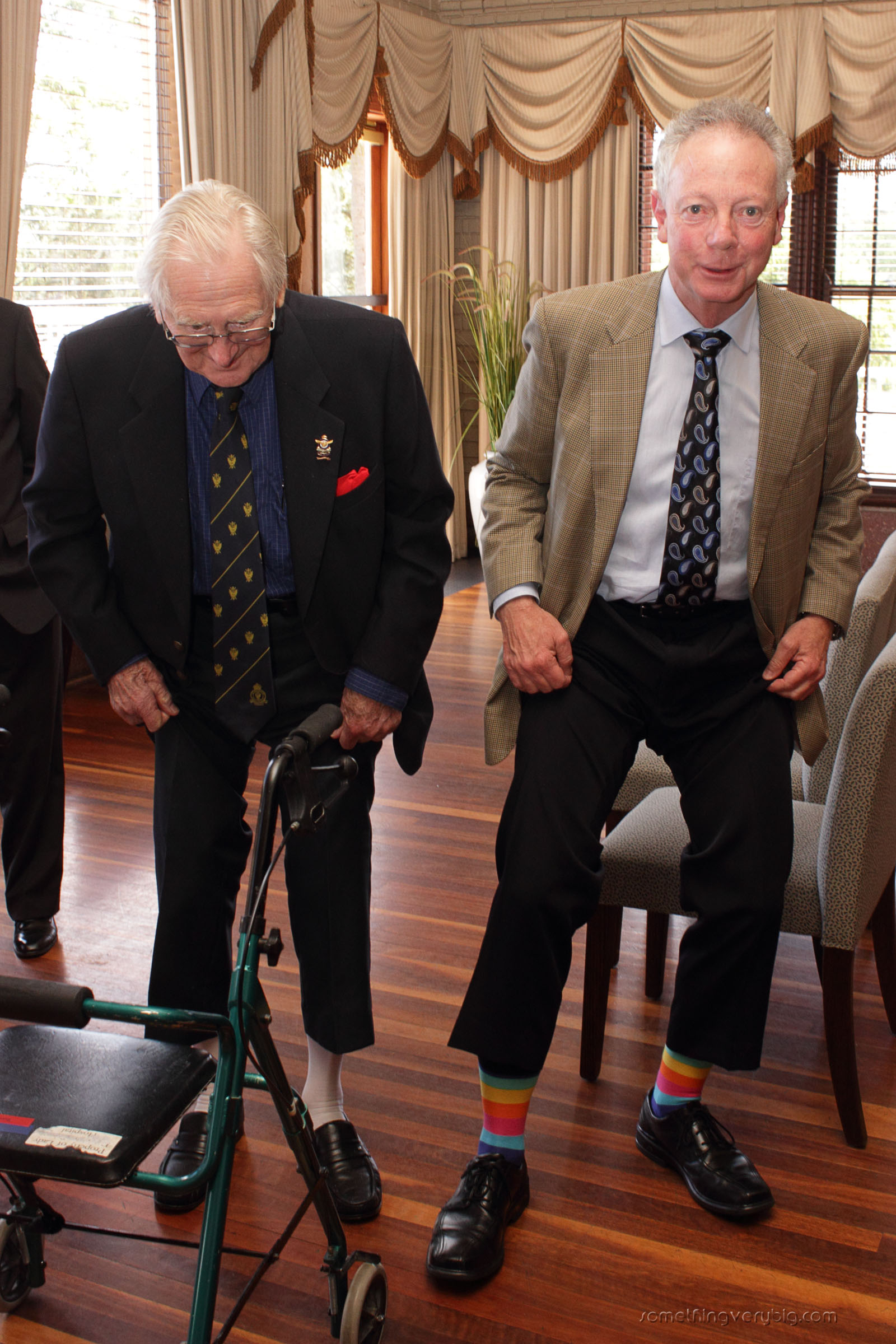
Keith Campbell, Ross Browning and Ross' socks
Keith Campbell, Ross Browning and Ross’ socks

14Nov-LadiesDay 070

Text and images (c) 2014 Adam Purcell


Google Earth

The internet is full of tools to make the life of a Bomber Command researcher easier. There are forums to connect like-minded folk from across the globe. There is the National Archives of Australia website to view digital copies of original personnel and casualty files (among many many thousands of others). And there is Google Earth, which has for me proven invaluable in giving some sort of an appreciation of the geographical setting of the events I’m investigating from the other side of the world.

I made heavy use of the program while I was researching and writing my 467 Postblog series over the last couple of years. I pulled the approximate routes flown by the bomber streams on various operations from either logbooks or the Night Raid Reports, then stuck those ubiquitous virtual yellow pins into the map. Then I could plot the locations of casualties, nightfighter attacks or other interesting events in relation to the nominal track flown by the bombers. I could even, in some cases, locate the exact aiming point and trace the unfolding bombing operation in close detail.

As an example, take the Tours raid of 10 April 1944 (on which the crew of B for Baker did not take part). I wanted to find potential reasons for why the second wave of the attack was not as accurate as the first had been. I started with the Night Raid Report[1], which says that “the first red spot fires fell near the roundhouse and the bottleneck between the two yards”.

Off to Google Earth I went, where it was easy to find railway yards at Tours with a bottleneck between them and (though this image is quite low-resolution) a roundhouse visible just under the ’o’ in ‘Approx’. Excellent, I thought, and inserted a fire icon.

tours

What next? “The Master Bomber therefore ordered crews to bomb 500 yards to the E”, continued the Night Raid Report. So I picked an appropriate icon (a bullseye), and placed it some 500 yards east of the spot fire icon. It’s pretty close to the bottleneck – smash that and the entire marshalling yard complex will struggle to function effectively. So things are beginning to make sense.

The bombers approached the target roughly along the line from bottom right to the target pin (which is probably slightly displaced from the actual aiming point because of limits in the resolution of the coordinate system used by the aircrews). This image has been rotated slightly towards the east to fit the text in comfortably so the line of approach should actually be only slightly north of west.

While most crews were carrying high explosives only, the 463 and 467 Squadron Operational Record Books reveal that a number of crews also dropped incendiaries, the fires from which caused a lot of smoke to rise over the target. The ground wind, according to Wing Commander Willie Tait’s report on the 467 Squadron ORB, was coming from the west. One look at the target area on Google Earth reveals that the smoke would have been blown back along the path of the second wave of approaching bombers. It’s easy to see why the second wave had trouble identifying the target and thus, one reason for why their attack was not as accurate as the first had been.

This analysis came from a careful study of the data found in the Night Raid Reports and the 463 and 467 Squadrons Operational Record Books, combined with a Google Earth satellite view of the target area as it was in 2010. Perhaps a map of the area may have afforded a similar conclusion but it’s unlikely that the detail of the bottleneck and the roundhouse, which stick out clearly on the satellite photo, would have been on a map. I used a similar technique throughout the Postblog series, including tracing Phil Smith’s evasion as he walked south through France – I could even pinpoint the farmhouse where he spent a couple of nights in Orchies two days after his aeroplane crashed.

I visited the UK in 2009 on what was essentially a pilgrimage around various sites associated with the crew of B for Baker and with Bomber Command in general. However much they have changed in the intervening decades, there is nothing quite like seeing first-hand places I had, to that point, only read about in logbooks and diaries. But, when trying to trace these events from the other side of the world, if you can’t be there in person Google Earth comes closest for giving an impression of how everything fitted together.


[1] No. 576 – see here for full citation

One Mystery Solved

Operational Record Books are fantastic historical sources. They are extensive chronological records of everything that happened, day by day, to a squadron in an operational sense. They cover information like targets, aircraft and crews, and usually describe details of any operational flying carried out. Very useful, then, if you’re trying to trace the lives and times of a particular Lancaster crew.

But they do not yield all the answers. The documents are seven decades old. They are faded, smudged, illegible and fragile, either on paper or (shudder) a microfiche machine. The information that was once there can sometimes disappear.

And sometimes the information was left out, mistyped or never even there in the first place.

The Monthly Summary (the so-called ‘Form 540’) in the 463 Squadron ORB records that Pilot Officer ‘Dud’ Ward received word on 9 May 1944 that he had been awarded an immediate Distinguished Flying Cross. The summary shows that the decoration was for a “grand effort” during an operation, but the date of that operation is smudged. It could be 6/7 April, or it could be 26/27 April. It’s unlikely that it was the earlier date because on that night nothing happened. The Form 540 entry for 26 April does however relate a story which is a possible candidate for the action that resulted in Ward’s DFC.

After losing two engines on return from a raid on Schweinfurt and ordering his crew to man ditching stations, Dud Ward managed to coax his aircraft across the Channel and land at Tangmere. The problem is, however, that the sortie list (or Form 541) has no record of Ward or his crew having flown that night. So while it appears most likely that it was indeed the Schweinfurt trip on which Ward won his DFC, there is contradictory evidence and thus some doubt remains.

I came across this quandary while I was writing my 467 Postblog series. Being early May at the time, I was pushing the deadline to publish the post so I had no time to find other sources to swing the balance one way or the other. I had to make do with a short description of the problem, and moved on.

And there the not-quite-satisfactorily-resolved issue remained, largely forgotten. Until I recently started to dig into the large pile of stuff that has been accumulating on my desk (and on my hard drive), waiting patiently for me to find time to go through it properly.

A not insignificant part of this pile is made up by one of the better collections of wartime letters I’ve seen. It’s from Arnold Easton, a 467 Squadron navigator who was at Waddington from mid February 1944. His letters, provided by his very proud son Geoff, are in places extremely detailed and I have been finding interesting little nuggets all through them. Including this, from a letter written on 9 May, 1944:

By the way George Jones’ pilot was notified today that he has won the D.F.C. for a very good show he put up on the return trip from Schweinfurt on 26.4.44.

Jones was a good friend of Arnold’s, and his name appears frequently in his letters. Reading this line set off a small bell in my memory. Could George Jones’ pilot have been ‘Dud’ Ward?

He most certainly was. The crew list is in the ORBs (though not for the Schweinfurt raid!). And, sadly, both Jones and Ward are buried at Forest-sur-Marque in France, just a few miles east of Lille, the city they were attacking when they were killed two nights after Easton wrote his letter home. “George Jones – best pal gone”, wrote Arnold in his logbook the next day.

So, satisfyingly, the ambiguity in the ORB was solved by another primary source, one that came from an entirely different place. I still have almost a hundred of Arnold’s letters to read – what else might I find?


© 2014 Adam Purcell


Flying over Lezennes

Five miles south-east of the centre of Lille is an airport. With an instrument landing system, VOR/DME and a main runway 2825m long it is now more than capable of handling aircraft up to about Boeing B767 size, and indeed today you can catch a flight direct from Lille to some 70 destinations around France, Europe and northern Africa.

But in 1944 it was the Luftwaffe air base known as Flugplatz Vendeville. Based there between April and September of that year was Fliegerhorst-Kommandatur E (v) 220/XI. On the north-west of the base was a battery of three heavy 88mm flak gun positions and it was this battery which probably shot down a 97 Squadron Lancaster, JB708, during the raid on the marshalling yards to the north on 10 May. [1]And after his own aircraft, B for Baker, was hit attacking the same target, Phil Smith landed nearby:

Not long after [being shot down and landing safely], I came to a heavy barbed wire fence, which I took to be the boundary of the fighter aerodrome to the SE of our target. Basis the guarding of English aerodromes, I reckoned that it would be better to walk across the aerodrome rather than make a long detour around it. Accordingly I started to look for a way under the wire but as soon as I did this, shots rang out. I had not been challenged but felt sure that they were meant for me. I changed my mind immediately and crept off as quietly as possible in a North-Easterly direction…        -Phil Smith, ‘Recollections of 1939-1945 War’

About ten hours short of exactly sixty five years after Phil Smith stumbled onto the boundary fence of an airfield near Lille, I was in a car being driven by my friend Olivier Mahieu across the boundary of the same airfield. We had spent the morning at the graves of the crew of B for Baker and Olivier had organised for me to go flying in a light aeroplane with a local instructor. His sister Sylvie came along in the aircraft to act as translator.

The aircraft was F-GKVV, a TB-9 (a French design, unsurprisingly), a type I had never been in before so I enjoyed the chance to fly something a little different.

F-GKVV, the TB-9 we flew over Lille

Though English is the international language of aviation, the local air traffic controllers use French if you’re flying in a French-registered aeroplane. Which is fair enough, but can present some problems if you don’t speak French. The instructor pilot – whose name was Frank – had English as non-existent as my French and I could barely hear Sylvie’s translation over the headset, but with much gesturing going in both directions between Frank and myself we managed reasonably well.

Flying, particularly in a weird aeroplane in a foreign country, is always good fun. But this flight was memorable for more than just this. Because this was the same area where, sixty five years before, the crew of B for Baker had been flying in a Lancaster.

Not long after taking off we were already over Lezennes. The cemetery where we had spent the morning was clearly visible down below.

Lezennes Communal Cemetery from the air

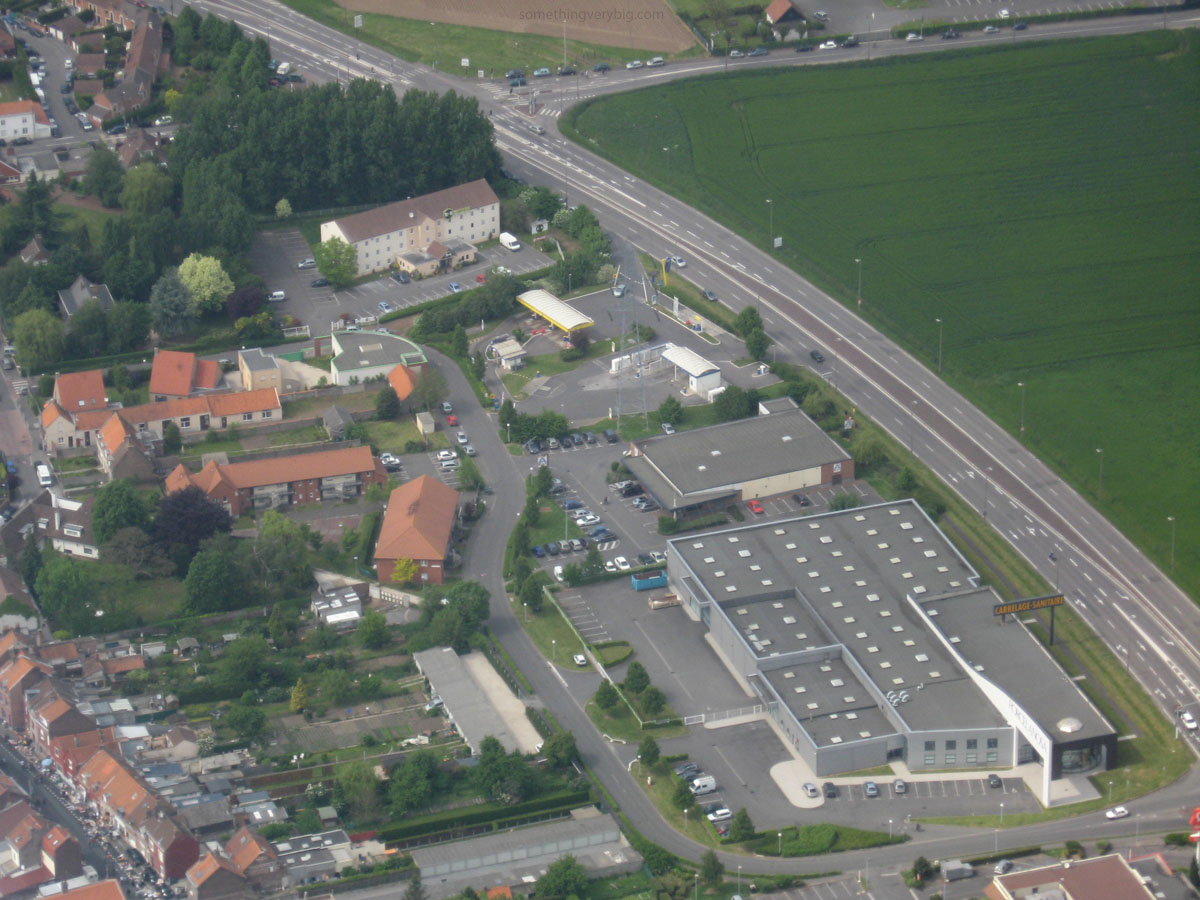
And not all that far away I could see the petrol station and hotel that are now built on the site where B for Baker crashed.

The crash site of LM475 B for Baker - between the motel and service station at top centre.
The crash site of LM475 B for Baker – between the motel and service station at top centre.

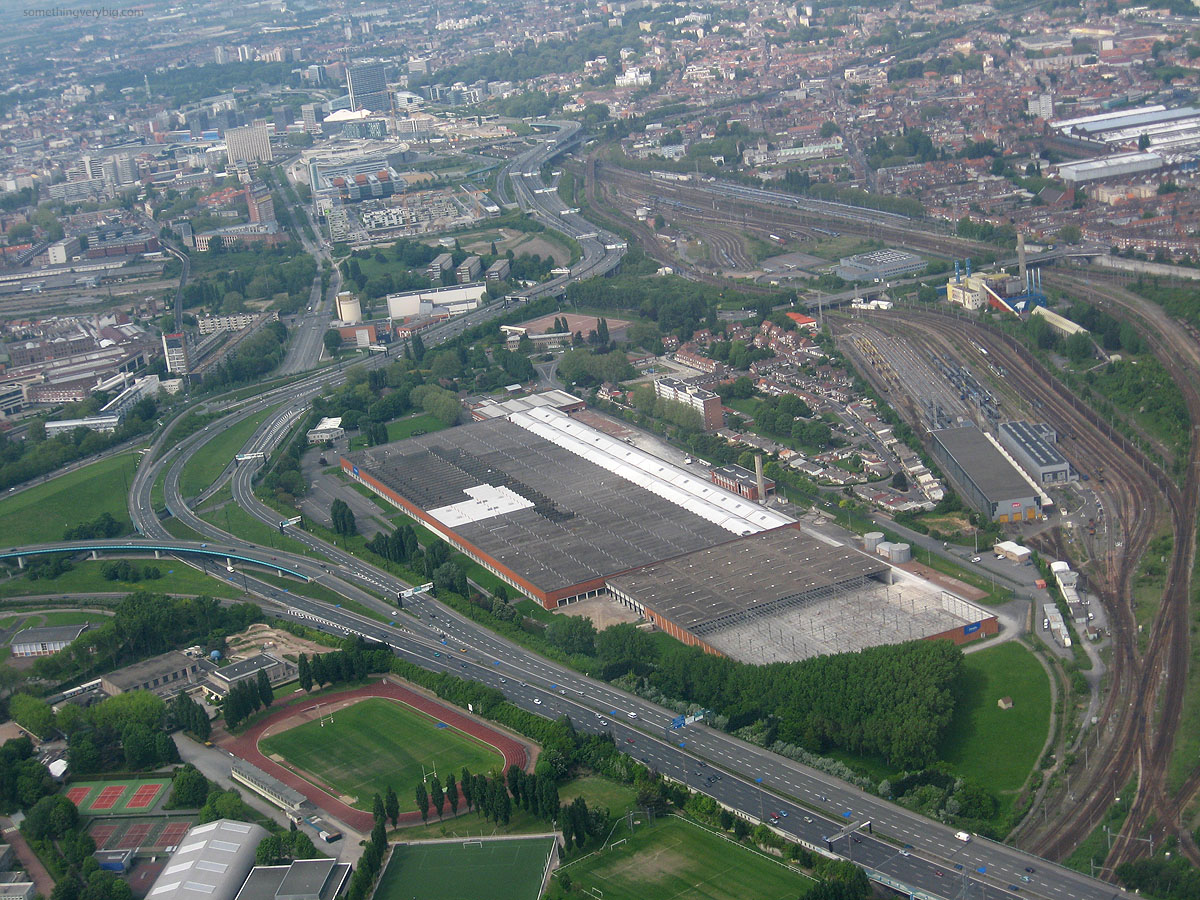
And also visible, a mile west of the crash site, were some of the big sheds and railway yards that formed part of the target that night. The Fives marshalling yards are the further set in this photo, just above centre.

Part of the Lille marshalling yards

Though the passage of time has unavoidably altered the landscape as more areas have been developed and the suburbs have sprawled, from the air the relationship between the target, the airfield and the place where the aeroplane crashed stands out clearly. They really did crash very close to the target area.

Flying over the same area where my great uncle Jack and his crew were lost was for me a profoundly moving experience. It can never come close, of course, to exactly what it was like that May night in 1944. The weather was good, we were flying in daylight and, critically, no one was shooting at us. At 1,500 feet we were also considerably lower than where the Lancasters would have been flying. But to be in the air, over the same railway yards, was to feel for a moment just a little closer to the crew of B for Baker.

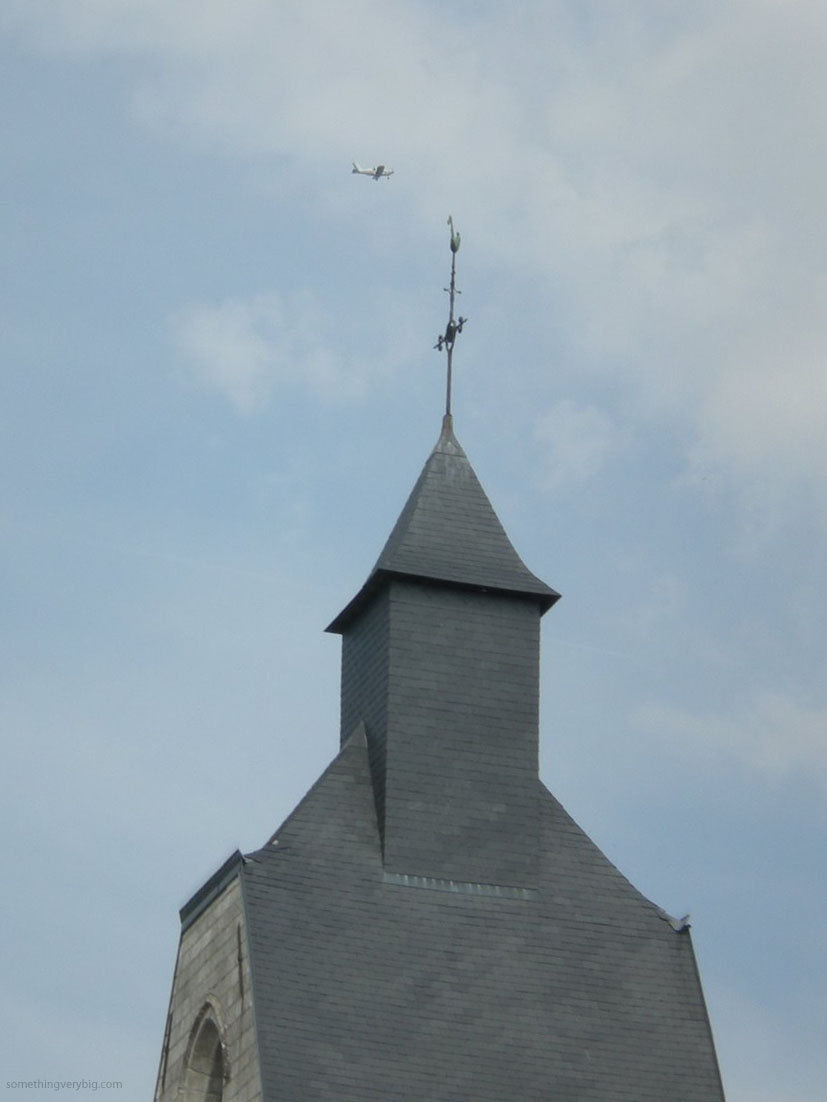
F-GKVV passing a church in Hellemmes - snapped by a friend while we were flying
F-GKVV passing a church in Hellemmes – snapped by a friend of Olivier’s while we were flying


(c) 2014 Adam Purcell


[1] Jozefiak, Richard 1995. Crash of a RAF bomber occurred on the airfield Vendeville (Lesquin) during the Second World War. Unpublished typescript translated by Peter Harvey

Childhood Memories

Given I’ve recently bought a house, my parents decided that, now I have space of my own, the time had come to go back and pick up the boxes of my old stuff which they had been keeping in their shed. So instead of flying to Canberra for the Bomber Command Commemorations in June I drove my car the seven hours up the Hume Highway. After the lunch concluded on the Sunday afternoon, I continued north to Goulburn where Mum and Dad now live.

It turned out that most of the boxes in the shed contained stuff belonging to my two sisters rather than me, but I still came away with a couple of those big plastic tubs full of old trophies, documents and childhood memories. Included amongst it were two very interesting artefacts.

I well remember the morning when, as a very young lad, I came out of my bedroom to get ready for school to find a long, tattered cardboard box at my place on the kitchen table. I lifted the lid in the early morning gloom to find some curling, yellowing black and white photos of a young man in uniform, an impressive certificate bearing a large, colourful royal seal and a little blue notebook, carefully inserted into a hand-made blue felt cover. The collection, my father told me later that day, all related to a man who had been my grandfather’s uncle. ‘Uncle Jack’, as Dad called him, had been killed during the Second World War.

The long and the short of it is that this was a critical moment in my growing up. For my next birthday, I was given an Airfix model of a Lancaster. I built it and for the next seven or eight years it was suspended by fishing line from the ceiling in my bedroom, in eternal combat with a model I later built of a Messerschmitt. While the German aircraft seems to have disappeared at some point in the intervening years, in one of the boxes I collected from Goulburn in early June, there was the Lancaster:

14Jun-Melbourne 116 copy

14Jun-Melbourne 106 copy

It’s far from perfect – after all it was built by a not-quite-ten-year-old boy. The decals were never square and the paint line is nowhere near straight but, apart from a couple of missing propeller blades, it’s survived its years packed away reasonably well.

While Jack’s logbook is obviously the most important single source of my Bomber Command interest, the Lancaster model is also significant. When I was a little boy I wanted to be a train driver. But then I saw the logbook. Imagine if my reaction had been one of resounding indifference. But, happily, I clearly showed some sort of curiosity, so my parents decided to give me the model. And that only stoked the fires.

Also in one of the big plastic tubs I retrieved from Goulburn, hidden in a big folder of mass-produced pre-school paintings of green trains (and one blue signalbox, done after my teacher confiscated the green paint and told me I wasn’t allowed to paint a train) was a drawing of the top view of an aeroplane.

14Jun-Melbourne 140 copy

It’s shaky and childlike but it’s unmistakeably a Lancaster. And written underneath (in my mother’s schoolteacher handwriting) is the date: November 1993. Probably not entirely coincidentally, the drawing is very close to the same size as a 1:72 scale model of a Lancaster, suggesting it was completed after I finished the model. That would imply that I probably got the model for my ninth birthday which was in August that year. Dad must have left the logbook at my place at the kitchen table some time before that. So it turns out that I’ve been interested, in one way or another, in Lancasters and the men who flew them for more than two decades.

Dad gave me one more very special box to take home when I drove back to Melbourne. It’s a very small black leather briefcase that he found at an antique shop somewhere.

Inside?

Uncle Jack’s service medals, logbook and those yellowing photos.


© 2014 Adam Purcell

Norm Kobelke and the mystery of the man in the suit

Earlier this year I was sent a fantastic photo of a bomber crew standing in front of their Lancaster. It came about because of a comment I received on this post in my 467 Postblog series. Richard Kobelke, who sent me the photo, is the son of the man on the far left in this highly distinguished crew:

The Kingsford-Smith/Kobelke crew at Waddington. Photo courtesy Richard Kobelke

Because it is so unusual Richard’s surname rang a bell instantly: I’d come across it a lot while transcribing sections of the 463 Squadron Operational Record Book. His father, Norman Kobelke, was a navigator who flew in the winter-spring of 1943-44 with Wing Commander Rollo Kingsford-Smith. The entire crew in the photo, left to right, are as follows:

  • Navigator: Flying Officer N.H Kobelke
  • Wireless Operator: Flying Officer M.J. McLeod
  • Bomb Aimer: Flight Sergeant B.W. Webb
  • Pilot: Wing Commander R Kingsford-Smith
  • Flight Engineer: Sergeant A Fairburn
  • Rear Gunner: Flying Officer D Proctor
  • Mid-Upper Gunner: Flying Officer J.K.R. Rees

Norm Kobelke’s first tour of operations was with 458 Squadron, flying in the Middle East. In October 1943 however, he joined 467 Squadron as part of Kingsford-Smith’s crew, then went across with “C” Flight when it was split off to form half of the new 463 Squadron. Norm completed 55 operations in total, the last 20 with Rollo. His final trip was 24 May 1944 to Duisberg (“Last of 2nd tour,” he wrote in his log book. “You beaut!”) and about the same time he was awarded a Distinguished Flying Cross. After the war Norm stayed in the Air Force but sadly, in February 1948 he was killed in the crash of a Lincoln bomber at Amberley, Queensland.

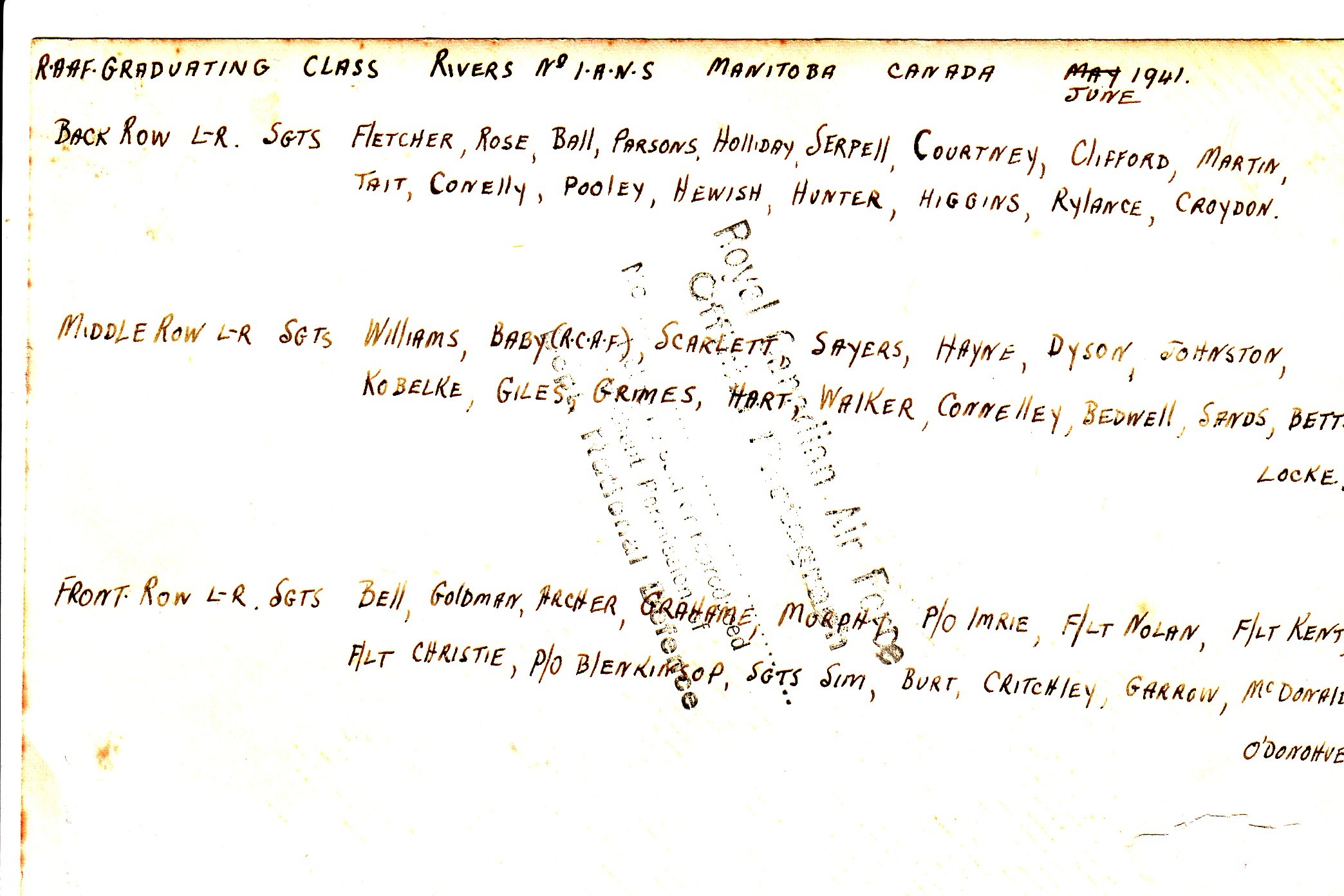
Richard has sent me a few really interesting photos including his father. Norm trained in Canada; here is his graduating class from No. 1 Air Navigation School in Rivers, Manitoba, Canada, in June 1941. Norm is eighth from the left (almost under the Anson’s nose) in the middle row:

RAAF Graduating Class Rivers No. 1 ANS, Manitoba, Canada, June 1941. Photo courtesy Richard Kobelke

Jul06251

Richard thinks the next photo may have been taken at Amberley. If that is the case it is almost certainly in the immediate post-war period: Norm is far right in the front row and he is wearing two rows of rank braid on his sleeves showing he was a Flight Lieutenant and the ribbon of the DFC:

Photo courtesy Richard Kobelke. His father Norm is seated on the far right.

This is probably the most interesting out of the photos in the small collection that Richard sent me.

Who is the man in the civilian suit? Photo courtesy Richard Kobelke

In amongst a big group of airmen (Norm is there too, in the top right of the photo) is a man in a civilian suit. Clearly he is someone important, but we have not yet been able to pin down a definite identification. The best guess so far is Lester B Pearson, a Canadian politician who would go on to become Prime Minister two decades after the war. Certainly we know Norm trained in Canada and the rest of the airmen in the photo appear to be all Australian, and the man bears something of a resemblance to the two photos in this link, but for the moment his identity remains a guess at best.

Richard also sent me some extracts of his father’s wartime diary, covering the period when he was at Waddington. It’s a brilliant source. He describes some of his operations in the sort of detail you don’t normally read in letters:

And now a Berlin in the log book. […] A real bind of a trip. Met winds from all over the place – early at target and well north of track crossing French coast home… (19NOV43)

He describes his leaves:

Had a 48 [hour leave] last week whilst Smithy [Rollo Kingsford-Smith] was on leave. Went on car with rear gunner Proctor, spent night at dam-buster squadron + rest of time at the ‘White Horse’ in Braton. Spent all my money. (21DEC43)

There is some serious personal reflection as well:

Have practically decided to marry Biddy – will have to look around for money for rings. Future very unsafe financially, but have a grand pal in Biddy & I’ve told her my exact position. Here’s hoping. (05APR44)

The pair would marry a month later, with Kingsford-Smith attending and rear gunner Proctor the best man.

Norm even notes how the wider war was progressing:

Russians still winning. Stalemate in Italy due to bad, wintry weather… (19NOV43)

What is really interesting for me, however, is the talk of various rumours around the squadrons:

Many rumours flying about re Aussies flying home in Liberators before XMAS. Will believe it when it happens. (20MAR44)

Staying on squadron for a while but now a strong rumour about all tours extended to another 3. So I’d better get out quick. (29MAY44, after last operation of 2nd tour)

Diaries are really the only source of this sort of information. It is certainly never something you find in official records (because they were rumours) and is unlikely to make it to letters sent home, but it’s very much part of the life and times for Bomber Command aircrew. I can well imagine aircrew discussing the latest rumour in the crew room or over a pint or two at the pub.

A diary was the one place where aircrew could put down their thoughts and feelings if they wanted to. They are in many cases a great little uncensored snapshot of what was going on at the time. (Well, almost uncensored – Norm’s diary shows evidence of some parts being cut out, apparently cleaning up when he married Biddy!).

In all, it’s a great little collection of photos and documents and I’m grateful that Richard has allowed me to see and share them.


© 2014 Adam Purcell

Bill and the demons of Dresden

When I arrange to meet a Bomber Command veteran I typically try to find out beforehand some basic details of his service, to put the visit in some sort of context. It was no different when I recently met a former bomb aimer who had served on an Australian squadron in the closing months of the war.

The veteran – who I’ll call ‘Bill’ – flew his first operation on 13 February, 1945.

In hindsight, I probably should have realised the significance of that date much earlier than I did.

Dresden.

Even though in recent years there has been a re-assessment of the causes and consequences of the firestorm (most notably in Frederick Taylor’s excellent 2004 book Dresden: Tuesday 13 February 1945), the name of the city still induces a sharp, involuntary intake of breath. It would come to haunt Bill for the next seven decades.

On 9 February 1995, The Age newspaper published two articles marking the 50th anniversary of the raid. “Dresden put to fire and the sword”, said the headline on one of them, an article by Simon Jenkins. “The war was almost over and military installations round Dresden were not attacked,” Jenkins wrote. “Harris used incendiaries on Dresden to create a firestorm where in other cities he used high explosive.” And in dealing with the reaction after the raid, he wrote, even the Americans “distanced themselves from avowedly “terrorist” air attacks, after their own planes had gunned down people fleeing the burning city the morning after the British raid.”

The second article, titled “Unease lingers 50 years after a city’s ruin” by John Lahey, quotes a 463 Squadron navigator, Brian Luscombe. “Mr Luscombe says he become uneasy about 20 years after the war ‘when people would ask where you had been and what you had done. It was only then we realised the enormity of it. It was a holocaust.’” Bill underlined that paragraph in red ink. As the bomb aimer, he had been the man on board his Lancaster who pressed the button to send his munitions into the maelstrom below. Ashamed at the personal responsibility he felt for what happened to Dresden, he threw away his service medals and declared himself a pacifist.

But the irony is the two articles which apparently affected him so much demonstrate a view of the Dresden raid which is now well out of date. As 227 Squadron rear gunner Dennis Over – who also flew to Dresden – suggested to me a few years ago, how did anybody at the time know that the war was almost over? Squadron Operational Record Books confirm that bomb loads used at Dresden were no different to other raids on urban targets around the same time. And Frederick Taylor, in an appendix to his book, effectively blows the theory of post-raid strafing of civilians out of the water (see p.440 for a summary and explanation). The theory was raised in David Irving’s now-discredited 1963 book The Destruction of Dresden, but there is precisely no reliable documentary evidence that anything of the sort actually happened.

This is not the first time that I’ve met a veteran of Dresden. Indeed, given that it happened at the end of the war, I’d say most veterans still alive today would have been operating at the time. But Bill is one of the first I have met who has been affected by it this much. It wasn’t the only part of his wartime service which appears to have scarred him however.

Bill is well over 90 now and quite frail, and was sitting in an armchair reading a newspaper when his wife showed me in. She introduced us and his first comment was that “it was a very very very long time ago and my memory isn’t very good anymore.” Nevertheless we were able to have a conversation, however rambling and confused it might have been.

Prompted by a photo of his crew sitting on the engine of a Lancaster, Bill shared with me one of the more shocking events of his operational career. Just a couple of weeks from the end of the war in Europe, his crew was on the final leg to a target in Germany when they were attacked by an unidentified aircraft, badly damaging their Lancaster. As was standard practice, once the immediate emergency was over the pilot checked on the intercom to make sure everyone was ok. He managed to raise everyone but ‘Jock’, the flight engineer. He asked Bill to check on him.

Bill was within arm’s reach of his comrade. He reached across and placed a hand on his wrist and felt – nothing.

I don’t think Jock’s with us anymore.

Jock was dead. The crew later got permission to fly to Scotland for the funeral – but after that life (and the war) went on. They got a replacement flight engineer and continued flying on operations.

Having experiences like this can badly affect people, especially young people. Bill was not quite 24 when this happened. Five or so years ago he became ill. His memory began to fail him and consequently when I visited the story was difficult for him to find in his mind. As he finished his story I began to feel like maybe he had shared enough, that the memories, as difficult as they were physically to find, were now beginning to get too much. He suddenly realised the time. “Oh, the football will be on,” he said, and shuffled out with his walking frame to watch it on a television out the back.

His wife came back in around that point, and over a cup of tea I found out a little more about him. “He was very difficult to live with,” she told me. It got to the point where their daughter would refuse to be in the house without her mother. It’s only been in recent years – since Bill became ill and, ironically, since his memory began to fail – that he began opening up just a little bit about his experiences. To try and better understand the sorts of things he would have gone through, she has begun to seek out more about his story. There’s an impressive collection of Bomber Command books on her shelf and, though Bill himself is now unable to travel she regularly attends Squadron reunions and Bomber Command events. Their daughter went to the UK for the opening of the Bomber Command memorial in 2012 (with replacement medals arranged through the Australian Department of Defence and her local Member of Parliament). His wife even went to the UK as well a few years ago to visit some of the sites associated with Bill’s service, including what’s left of the airfield his unit flew from. One day she had lunch at the Petwood Hotel in Woodhall Spa, most famous as being the one-time 617 Squadron Officers’ Mess. Hanging on a wall in the Squadron Bar inside the hotel, she found a framed print showing a Lancaster flying low over a Dutch windmill. It’s a painting called ‘And They Called It Manna’, done in 1989 by an artist called Howard Bourne, and try as she might, she has been unable to find a copy of it.

For Bill also took part in some of the food drops carried out by Bomber Command to starving Dutch civilians in the very final days of the war in Europe. They counted as full operations and were flown fully crewed and armed because no-one could be certain that the Germans, who still occupied western parts of the Netherlands, would not fire on the aircraft. And then there were two flights for Operation Exodus, the repatriation of Allied prisoners of war, following the German surrender. On one of these, one of the 24 or so passengers who had been picked up in Antwerp became so emotional when he sighted the White Cliffs of Dover that he gave Bill a German SS dagger he had souvenired. Bill still has it. It’s an evil-looking weapon, with a swastika in a red and white diamond-shaped enamel badge set in the hilt, and will soon find a home in an appropriate museum.

The football match had developed into a very one-sided contest but despite that Bill had regained his spark by the time I went into the back room to say goodbye. I left in a very thoughtful mood. For many in Bomber Command, the food drops and prisoner repatriations were some of the most satisfying trips they took part in, giving them the chance to be part of something constructive rather than destructive. Perhaps the joy at having survived the war (though an offensive against Japan still looked possible) had something to do with it.

But it is clear that for some, even seven decades on there are still some demons hanging around. It was not Manna or Exodus which Bill remembered. It was instead one particularly infamous raid on which he took part which would come to define his wartime service and, subsequently, his life. It’s a desperately sad story and very much one of the forgotten but longest-lasting effects of the war.

Super Special Bonus Post: Bomber Command in Brisbane, Part II

My sleuths in Brisbane have uncovered three more photos from the Bomber Command Commemorations held there on 1 June 2014. These images were taken by Vicki Gray, used here by permission via Diane Strub. As you can see the weather was more co-operative than what we ‘enjoyed’ in Canberra!

Ethel Braun - widow of 467 Sqn wireless operator William Braun - on her way to lay a wreath
Ethel Braun – widow of 467 Sqn wireless operator William Braun – on her way to lay a wreath
Ethel Braun and Bryan McGill (463 Squadron gunner) right of centre, with Allan Vial of the Pathfinders left of centre, amongst the crowd at Amberley
The Australian Squadrons memorial following the service

Thanks to Vicki Gray – Ethel’s daughter – for taking and giving me permission to post these photos, and to Diane Strub for chasing them down for me.

Bomber Command in Brisbane, 1 June 2014

On Sunday 1 June 2014, Bomber Command commemorations took place all around Australia. In Queensland, the ceremony was held at the Memorial Gardens, near the front gate of RAAF Amberley. Tiana Walker-Adair, whose father was a Halifax navigator, sent me these photos:

Ron Hickey DFC, a pilot with 462 and 466 Squadrons, giving his address
Ron Hickey DFC with his son David
Ron Hickey with his son David
Her Excellency The Honourable Ms Penelope Wensley AC, Governor of Queensland, with Ron Hickey
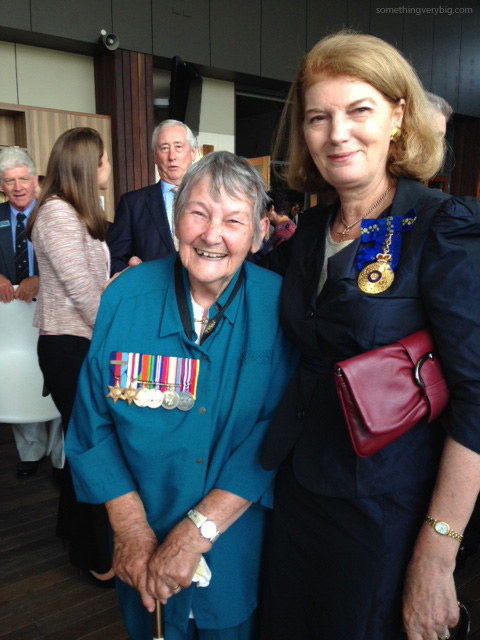
Joanne Adair (who was a former Secretary for Winston Churchill) with Her Excellency The Honourable Ms Penelope Wensley AC, Governor of Queensland
Joanne Adair (who was a former Secretary for Winston Churchill – and is Tiana’s mother) with Her Excellency The Honourable Ms Penelope Wensley AC, Governor of Queensland
Group photo of Bomber Command veterans at Amberley


Thanks to Tiana for these photos. Only Perth to go now, and I’ve collected the whole set!