Chapter Two, Part One: The Stamp

The first place I went in my journey to follow Jack Purcell was less a place and more an experience. It traced its beginnings to something in Jack’s logbook that I thought was pretty special. It took up fully one-third of an otherwise blank page, stamped in slightly smudged, dirty purple ink.

CERTIFIED THAT I UNDERSTAND THE PETROL, OIL AND IGNITION SYSTEMS OF THE TIGER MOTH,

it read,

…AND THAT I HAVE BEEN INSTRUCTED IN PROPELLOR SWINGING IN ACCORDANCE WITH FLYING STANDING ORDERS.

Then there was a line for the date – 23 March 1943 – and next to it, Jack’s signature, in uncertain running writing, inked in with a wide-nibbed fountain pen.

In light of what comes later, the story that the stamp told wasn’t the most dramatic or tragic or emotional one in the logbook. It was just a straightforward record of the fact that Jack was once qualified to swing the propeller – yes, the stamp spelt it differently – on a Tiger Moth. But for me, this simple stamp was one of the most significant parts of Jack’s logbook. And it was all because of where it led me.

Three weeks after I finished high school, many years ago, I was at Wollongong Airport, south of Sydney. It was a Thursday morning, a light southerly breeze blowing straight down the runway, and I was sitting in the left-hand seat of a little Cessna 152 training aeroplane. I looked over the top of the instrument panel, through the bug-splattered Perspex of the windscreen. Looked past the spinning disc of the propeller. Along the dashed white line marking the centre of the runway. To my right, for the first time ever, was an empty seat. My instructor Marty, only a few years older than me and later to fly big jets with Qantas, had just unbuckled his seatbelt, slipped out and closed the door and walked around the back of the aeroplane, waggling the elevators as he passed. The control yoke correspondingly bucked forward and aft in my hand in encouragement. I was a few months past eighteen years of age, and I was about to fly an aeroplane all by myself.

It was, I discovered, true what they said about your first solo. Without the weight of your instructor the aeroplane really did leap into the air. And you really were so busy in those first few moments that it was not until you climbed to height and turned to fly the circuit back to the top of the runway that you settled down enough to look at the empty seat next to you, and savoured what it meant. And then, after allowing yourself a brief moment of exhilaration, you got right back to business, working through the mental checklists you’d been taught as you slowed the aeroplane and turned to start the gradual descent back to the runway. A tiny float, maybe a gentle bounce, and then with a thump you were on the ground again.

Afterwards, back at the flying school, I proudly wrote into my logbook my first six minutes of solo time. Then I watched Marty as, with reverence, he placed a stamp on an ink pad and then pushed it firmly onto the page.

It was only a small stamp, but there it was, in slightly smudged, dirty purple ink:

I CONSIDER ADAM PURCELL COMPETENT TO FLY SOLO BY DAY IN C152 TYPE AEROPLANES.

  It was only when I got home that afternoon that I realised the connection. I went to the cupboard where Jack’s logbook was stored, opened the tattered cardboard box and pulled out the little blue book. I turned straight to the page with the Tiger Moth stamp, then laid my own logbook open next to it. Now I’ve got a stamp in my own logbook, I thought.

This post is part of a series, publishing writing originally completed as part of my now-discontinued book project. Find an explanation of the series and an evolving table of contents here.

(c)2025 Adam Purcell
Chapter One, Part Two: A Logbook By The Fire

At the time, it was one of those moments that did not seem all that significant.

In mid 1993, I was a not-quite-ten-year-old boy who was interested in things like astronomy, science and space travel. I lived with my parents and two sisters in a big brick veneer house in a semi-rural village in the Southern Highlands region of New South Wales.

On this day, the sun was not yet above the horizon when, for once the first in the family to wake up, I opened my bedroom door and walked out to begin getting ready for school. Outside it was cold, the kind of cold where when it’s raining the freezing drizzle sticks to your face, and when it’s not raining, thick white frost  covers the lawn and crunches underfoot. In the corner of the family room was our old wood-burning fireplace, which was lit around Easter each year and which we usually kept burning all the way until my mother’s birthday in October. It was normal in our household for Mum and Dad – who were both teachers – to leave important things at our respective places on the dining table, for us to find the next day. Normally they were boring but necessary things like lunch money or signed permission slips for school excursions, but this time I found something different. On that morning, by the glow of the fire’s smouldering embers, I first saw the box.

 Of the old-fashioned foolscap size, the box was made out of rather tattered green and black cardboard. It might once have held overhead transparencies or some other tool of the teachers’ trade, but on this chilly morning, as I curiously opened it I found it now held very old photographs.

There was one of a man in uniform who, I thought, if I squinted a bit and looked at it from just the right angle, bore a startling resemblance to my dad.

There was one of several dark and indistinct figures, dramatically backlit, standing in front of a big aeroplane.

There were several photos that showed what looked like graves, marked with white crosses and covered in flowers.

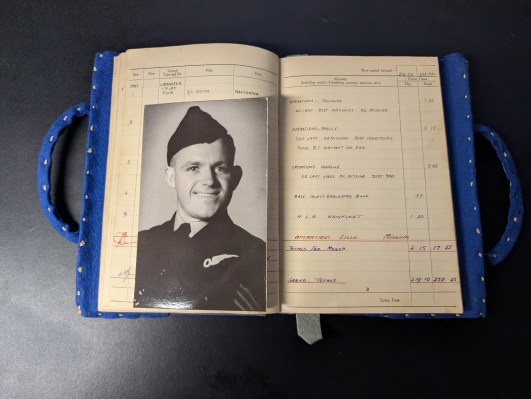
I found a small blue notebook in the box, too. Tucked into a hand-made cover of blue felt, the book was clearly old, its pages yellowed and brittle. It was filled with columns of numbers, times and unfamiliar place names, all inked in with a wide-nibbed fountain pen.

Nhill. Llandwrog. Lichfield.

Munich. Nuremberg. Berlin.

And on the final line, in red ink and different handwriting:

“OPERATIONS. Lille,” I read.

“MISSING.”

I had many questions for my father when he emerged from bed a short time later. Who was the man in the photograph? Why was he missing? And why did he look sort-of like Dad?

The man, it turned out, was “Uncle Jack”, and he had been a relative of ours. Dad told me that he had been in the Air Force , and that he’d been killed during the Second World War. The photos, and the logbook, were all that were left of him.

This post is part of a series, publishing writing originally completed as part of my now-discontinued book project. Find an explanation of the series and an evolving table of contents here.

(c) 2025 Adam Purcell

What happened to Jack’s letters?

Something that intrigues, and slightly frustrates, me on this journey into the story of my great uncle Jack is that we have very little original personal material about him. Being in possession of his wartime logbook, I concede, is more than many people have (and indeed was significant in capturing my interest in the first place), and there are official records available at the National Australian Archives and other places, but beyond a couple of official portraits I have nothing in the way of personal photographs, diaries or correspondence. What is most frustrating is that I know that such material once existed. What has happened to it since is a mystery.

There are a number of sources where correspondence to or from Jack is mentioned. His ‘last letter’, as his brother Edward wrote to Don Smith in July 1944 (A01-344-001), spoke of his “hope of being home for next Xmas and, as he phrased it, in a place where he could count on seeing the sun every day”. A note in his Casualty File reports that a letter to his late mother was discovered amongst his personal effects following his being posted missing, which was forwarded to RAAF Headquarters in Melbourne ‘for appropriate action’ (A04-071-061). There’s also talk in another of Edward’s letters to Don Smith of two letters from “Jack’s English sweetheart’ (which is a story in itself), and the intriguing suggestion that she might have sent some ‘snaps of all the boys [of the crew of B for Baker]’ to Edward (A01-111-001). So there was definitely correspondence that came from England to Australia, either written by Jack or by his mysterious girlfriend. And presumably his relatives in Australia would have replied to those letters – which could account for a bundle of “correspondence and photographs” that was included in the list of personal effects in his Casualty File (A04-071-024).

Unfortunately, somewhere between England and Australia, the bundle (along with a pillowcase) went missing. Its listing is marked with an asterisk on the list in the Casualty File, showing it never arrived at RAAF Central Depositories in Melbourne. And sometime in the ensuing decades, everything else apart from his logbook , a small collection of photographs and two unsent postcards went missing too. What happened to it is unknown. I have vague recollections of being told that a great aunt (one of Jack’s sisters) might have destroyed anything that she could find to do with her late brother in a fit of pique sometime in the 1960s. Or less menacingly, perhaps it was all simply thrown out in a big clean-up, just a bunch of papers found in a file somewhere that surely couldn’t be of any use to anyone any more. Whatever happened, it is clear that what was once a valuable archive (at least for someone like me) has simply disappeared.

I live in hope that one of my long-lost relatives will one day clear out their shed and stumble upon a bundle of ‘old papers’, thus solving a decades-old family mystery. But I suspect the history might have been lost forever.

© 2012 Adam Purcell

Logbook

A logbook is a legal requirement for any pilot. In Australia, it must record at a minimum the dates of any flights made by the pilot, crew details, aircraft type and registration, route details and flight times. It allows a pilot to calculate his or her experience in terms of flying hours, and records the results of any exams or licence flight tests carried out.

But logbooks are something more than simply a dry record of dates, aeroplanes and times. They can also be intensely personal documents. Reading through my own one, I find my mind can very easily wander to remember a particular flight, and the circumstances surrounding it. “Bankstown-Three Sisters-Bankstown. Bumpy”, reads one entry. A simple enough description. But it’s one that belies the intensity of that flight, on which I and my passengers flew unwittingly into some pretty severe turbulence. Or ‘Circuits Camden – First Tiger Solo’, recording the first time I flew a Tiger Moth by myself, possibly my proudest yet moment in an aeroplane.

Unless one kept a diary there were very few ways that people could accurately recall where they were at a certain time, let alone what they were doing. This is where all pilots score. Your log book, which it was mandatory to keep and have regularly certified as being a true record, will instantly tell you that and, hopefully, jog the memory especially as the long forgotten names of the people that flew with you are very often there as well.

-The late Reg Levy, 51 Sqn Halifax skipper and later pilot for Sabena, writing on PPRuNe 

I think Reg nailed it. The terse notations in a logbook, taken in isolation, give fairly dry information about where someone was and what they were doing at particular dates in history. This in itself is interesting stuff for a study of the men of Bomber Command. But they can also trigger memories far beyond the short statements themselves.

It’s easier, of course, when the airmen are still around, because you can ask them questions about it. This is one reason why Reg Levy, in the last year or so of his life, contributed to a fantastic thread on the Professional Pilots Rumour Network (which by the way is well worth a look if you have a few hours to spare*). He used his logbooks as the basis of a superb running story about his experiences in training, then while operating in Bomber Command, and his rather incredible adventures after the war. The logbooks provided the spark, the interaction with other contributors around the world were the fuel and his sharp memory filled in the details.

It’s a little harder to ‘reconstruct’ what an airman was doing through his logbook alone if he is no longer with us. But it’s a good starting point. Other historical records and personal letters can go a long way to filling in the details. Maybe the end result won’t be quite so personal – but it’s a worthwhile challenge.

jacklog-last-page copy

*Reg’s pseudonym on the thread was ‘regle’

© 2011 Adam Purcell