Event: Bomber Command Commemorative Day, Canberra, 2-3 June 2012

The Bomber Command Commemorative Day Foundation, with the support of the Australian War Memorial, will hold their 5th annual Commemorative Day in Canberra on the weekend of 2-3 June 2012. Three events are planned: a ‘Meet and Greet’ function on the Saturday night, then a Memorial Service and Luncheon on Sunday.

The Meet and Greet function takes place in the shadow of G for George, the AWM’s Lancaster, in the ANZAC Hall from 6 to 8pm on Saturday 2 June. Cost is $50, hot and cold canapes will be served with beer, wine, soft drink and juice also provided.

The Luncheon takes place at the Rydges Lakeside, Canberra, 12.30 for 1pm to 4pm. $55 covers a sit-down two-course meal with tea and coffee, with a cash bar operating.

To attend the Lunch and/or the Meet and Greet, contact Keith Campbell by 18 May: 142 Coonanbarra Road Wahroonga NSW 2076. Cheques to be made out to Bomber Command Commemoration Day Foundation.

The focus of the weekend, however, is the Memorial Service. This is held outdoors in the Sculpture Garden of the Australian War Memorial, by the Bomber Command Memorial. To allow the organisers to anticipate numbers, please RSVP to the AWM by 11 May: rsvp@awm.gov.au or 02 6243 4363.

In the group photo taken at this event last year, I counted 50 veterans. This is one of the largest gatherings of Bomber Command aircrew (and at least one WAAF) in Australia and for that reason alone it is well worth attending. Talking to so many veterans in the one place at the one time is an opportunity that doesn’t come around too often. I’ve been to three of the last four of these events (though at this stage it is looking unlikely that I’ll be able to make it to this one) and they never fail to impress. More information can be found at http://commemorativedayfoundation.com/.

Update 21APR12: I’ve managed to organise the weekend off so I’ve booked my flights to Canberra for this event. There are also events on in other parts of Australia, for those who can’t make it to Canberra:

VICTORIA: Hastings RSL, 11am Sunday 3rd June

QUEENSLAND: Memorial Gardens at RAAF Amberley, 11am Sunday 3rd June

I think there are also plans for NSW and SA, but I haven’t got details yet.

Bomber Command in Canberra

There was an old man sitting patiently in the departure lounge in Melbourne when I boarded a QantasLink Dash 8 to fly to Canberra last weekend. Sat next to him was his middle-aged son. When we boarded the aircraft they sat across the aisle and a few rows in front of me. I overheard a snippet of half a conversation that the younger man was having on his phone: “meeting in Canberra… taking him to… you know, Air Force stuff…” I watched his father as we powered down Runway 34 and took off. He was gazing out of the window, and his thoughts looked like they were miles away: across the seas, and across the decades.

They were going to Canberra for the same reason I was: the fourth annual Bomber Command Commemorative Day. I next saw Ian and his son Phillip underneath the nose of Lancaster G for George at the Meet & Greet cocktail party later that evening and went across and said g’day. Ian had been a 460 Squadron pilot so it was fitting that G for George, a 460 Squadron machine, was the centerpiece of the function.

11jun-bombercommandcanberra-007s copy

It was an outstanding evening. There were perhaps 150 people present, a fair proportion of those being veterans. Talking about flying Lancasters with people like Don Huxtable, a 463 Sqn skipper, was a unique experience as he casually threw a thumb over his shoulder at the old bomber to emphasize a point. The function ended with the magnificent ‘Striking by Night’ sound and light show recreating a bombing raid around the Lancaster. We retired to the hotel bar for a nightcap, ensconced in a warm corner while Don Southwell held court.

It was a cold and misty Canberra winter’s morning when we awoke. But the sky soon cleared and the sun was nicely warming as we took our seats for the ceremony at the Australian War Memorial.

As is customary the AWM Ceremonies division put on a good show. It ran smoothly and Don Browning’s ‘Reflections’ presentation was particularly good. As the first notes of The Last Post rang out into a brilliant blue sky the line of young RAAF officers in the row in front of us snapped into a salute. It was a moving moment.

After the ceremony all the veterans moved up towards the War Memorial buildings for an extraordinary group photo. I counted 50 veterans, surely one of the largest gatherings of Bomber Command airmen (and at least one WAAF) anywhere in the world these days.

11jun-bombercommandcanberra-045s copy

The final part of the weekend was the luncheon. This was, I reckon, the highlight of an already highlight-heavy weekend. Some 200 people showed up, with at least one veteran at each table.

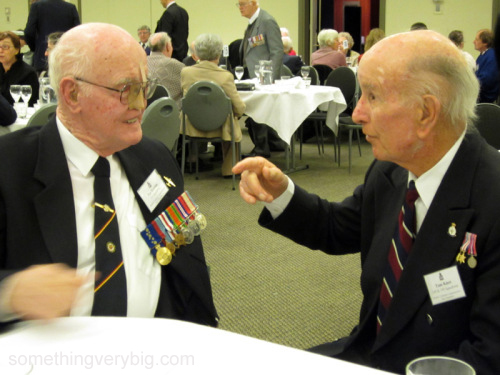
The best part of this event is the ability to float around between tables talking to all sorts of interesting people. Until today, I’d never met a real live Bomber Command flight engineer. Tom Knox, a Glaswegian flight engineer from 149 and 199 Squadrons, is on the right here:

11jun-bombercommandcanberra-067s copyThe other man is Pat Kerrins, a pilot from 115 Squadron. They were in animated conversation regarding a mutual friend and just being a fly on the wall while they chatted away was fascinating. A copy of this photo will be winging its way to each of these men shortly. I also met Jean Smith, who served in the WAAF at 27 OTU, RAF Lichfield, and a couple of likely suspects involved with the 463-467 Squadron Association in Melbourne. All very interesting people to know.

This has become an extremely significant event in the Bomber Command calendar in Australia. The Bomber Command Commemoration Day Foundation was set up to organise events like these to ensure that the men and women of Bomber Command get some long-deserved recognition. Behind ANZAC Day and Remembrance Day, this is now the third largest single event held by the Australian War Memorial each year.

Given the level of interest in this year’s event, the men and women of Bomber Command can rest assured that it will continue into perpetuity.

11jun-bombercommandcanberra-004-copys copy

(c) 2011 Adam Purcell

ANZAC Day 2011

ANZAC Day lives on.

Despite age taking its toll, and in defiance of the rather wet weather, eight 463-467 Sqn veterans took part in the Sydney march on Monday with a group of ten or fifteen descendents and family members following behind. The rain, threatening all morning, held off for the most part while we were marching.

While the rain did fall at times, it failed to keep the crowds away. George St was lined four or five people deep for most of its length as we marched past. I think this fact alone is proof that ANZAC Day remains relevant and keeps its place in the hearts of many Australians.

Ten veterans were at the lunch that followed the march. Left to right, they were: David Skinner, Alan Buxton, Hugh McLeod, Don Southwell, Bill Purdy, Albert Wallace, Harry Brown, Don Browning, George Douglass, Don Huxtable.

11apr-anzac-day-007 copy

But the nature of the commemoration of ANZAC Day will and must change. The men who fought in WWI are no more. And the men who fought WWII are getting on a bit. Before too many more years have gone by, there will be noone left who ‘was there’. So it will fall to the younger generation to ensure that these men – in the main, ordinary lads living in extraordinary times – and what they did is not forgotten. I’m always touched by the sentiments of the veterans I speak with on ANZAC Day. They are pleased as punch that there are younger people present, at both the march and the lunch. I think they are happy to know that someone will carry the banner down George St, long after they have gone. For me, as one of those younger people, hearing this is rather humbling.

Want further proof that there is a new generation of people remembering? Half way through lunch on ANZAC Day, a group of 20 young musicians entered. 11apr-anzac-day-017 copy

They were the Australian Army Cadets Band and had been playing a few numbers at some of the other ANZAC Day lunches that were taking place around the city. They had a mighty sound and were a wonderful surprise for all present. Lest we forget, indeed!

© 2011 Adam Purcell

Finding Phil Smith

It was a very significant letter.

A single page of A4, written in a steady but flowing hand, it was this correspondence of November 1996 which turned a passing interest in Uncle Jack’s story into something much bigger. The letter was from Doug Wheeler, himself a former Bomber Command navigator and, at the time, the secretary of the NSW branch of the 463-467 RAAF Lancaster Squadrons Association. Doug lived a couple of towns from where I grew up. I’d done quite well earlier in the year in a national history competition with an entry based around what I knew then about Jack. Doug saw an article about my entry in the local paper and contacted me through my school.

It was, in fact, this letter which led us directly to the sole surviving member of the crew of Lancaster LM475.

“Squadron Leader D.P. Smith survived and evaded capture […] I have been in touch with him a couple of times in recent years. I am sure that if you wished to contact him at any point he would be happy to help.”

Happy to help, he was. We made contact and, early in 1997, visited the old pilot and his wife Mollie in Sydney:

Donald Philip Smeed Smith – better known as Phil – was an industrial chemist working in the sugar industry when he joined the RAAF in 1940. By November of that year he had made his first solo in a Tiger Moth at Tamworth. He arrived in the UK in July 1941 and flew the first operation of his tour in October of that year with 103 Squadron, Elsham Wolds. That tour was completed in June 1942 and Phil became an instructor pilot for a spell. In late 1943 he returned to operations via 1668 Conversion Unit at Syerston – which is where, as a Squadron Leader, he was joined by the rest of the crew that he would lead to 467 Squadron.

The Lille raid was Phil’s 51st operational flight. Not even he could remember exactly what brought the aeroplane down. He simply found himself being ejected from the aircraft, by whatever means, and descended by parachute. After a short-lived attempt to walk to neutral territory in Spain, Phil was sheltered by a French family until the invasion forces caught up in September 1944.

Phil returned to Australia shortly thereafter. He was hospitalised in early 1945 with peritonitis. Mollie tells me that he was saved by a massive dose of penicillin. Phil wasn’t demobbed until late 1945, spending the remaining time of his five years in the Air Force as Commanding Officer of 88 Operational Base Unit, Bundaberg. He met and married Mollie after the war, had a family and returned to the sugar industry.

Phil Smith died in 2003. I remain in touch with Mollie who still lives in Sydney.

Receiving the letter from Doug Wheeler in 1996 and making contact with Phil Smith turned out to be a substantial factor in turning my interest in my great uncle into, well, Something Very Big. Here was someone who had actually known my great uncle Jack. Here was a living connection to the Man in the Photograph. In more recent years Mollie has allowed me to borrow and study Phil’s archive of letters and photographs, which has added immeasurably to my understanding of his experiences. I think this archive inspired me to start looking to see if there was anything else like it still out there, waiting to be found.

There have indeed been other collections like it that I have found. The search goes on for more.

C05-043-002med(c) 2010 Adam Purcell

This will be the last entry on SomethingVeryBig for 2010. The out-of-hours workload in the new job is significant, and I’ve discovered that I don’t at this stage have sufficient time to devote to properly researching and writing new posts. I’ve therefore decided to take a break from it for a month or so. 

I should be back by mid January.  

Adam