The Scroll of Honour

A few weeks ago I took some days off work and my girlfriend and I drove a rented campervan up to Echuca, on the Murray River which borders New South Wales and Victoria. While exploring the surrounding area we stopped at a small winery in neighbouring Moama (on the NSW side of the river) to escape the stinking heat of the day. The winery also happened to have attached to it a small military museum, so we went in to have a look.

In the museum – which, alas, was not air-conditioned – was a quite remarkable gathering of old vehicles on the ground floor, some restored and some not so restored. Upstairs, arranged in a collection of dusty display cabinets, were uniforms, rifles, medals, badges and other assorted items of militaria. What caught my eye was this:

12nov-britzingthemurray-023 copy

It is a scroll as presented to the families of Australian servicemen who died as a result of their military service in World War II. A similar scroll hangs on a wall at my parents’ place, bearing the name of my grandfather’s uncle, RW Purcell. The scroll in Moama commemorates one Flight Sergeant I H Smead – but apart from the name on the scroll itself, there were no details on who he might have been or what might have happened to him. I thought it looked quite sad sitting there all but forgotten in a display case in a roasting tin shed next to the Murray River, so I decided to see what I could find out about him when I got home.

The first place to look, as with any Australian casualty from either of the World Wars, was the Commonwealth War Graves website. This gave me a few further details to work with:

SMEAD, IRWIN HAROLD

Rank: Flight Sergeant

Service No: 419228

Date of Death: 21/04/1944

Age: 20

Regiment/Service: Royal Australian Air Force

Grave Reference Plot A. Row D. Grave 14.

Cemetery BUNDABERG GENERAL CEMETERY

I now had a name, service number and date of death – and, most interestingly, information that he is buried in Bundaberg, Queensland. Bundaberg was the site of No. 8 Service Flying Training School at that time. Being a training unit, this suggested an accident rather than enemy action.

Going out on a limb, I tried a quick Google search – and came up with Peter Dunn’s Oz At War website which revealed what happened. Irwin Smead was a navigator. He was flying in a Bristol Beaufort on a formation flying exercise on 21 April 1944 when it collided with another Beaufort of the same formation about 15 miles west of Bundaberg. All eight airmen – four in each aircraft – were killed.

I also found a copy of the “Preliminary Report Internal External of Flying Accident or Forced Landing” for this accident in the Casualty or Repatriation File of F/Sgt Hardy, the pilot of the other aircraft*, which is digitised at the National Archives of Australia website (A705, 166/17/544). It gives the probable cause of the collision as ‘UNKNOWN’.

It’s not much, but finding even this small amount of information adds that little bit more to Irwin Smead’s story. It reminds us that he was more than just a name on a page.

*Interestingly there appears to be a disagreement between this source and Peter Dunn’s information about which aircraft were involved in this accident. Both agree on Hardy’s aircraft, A9-476 – but the NAA file shows Smead’s as A9-426. This shows the value of going back to the original documents wherever possible!  

This will be the last post on SomethingVeryBig for 2012. Thanks to all for your support and comments throughout the year. Have a great Christmas, and I’ll be back in mid-January.

© 2012 Adam Purcell

Happy First Solo Day!

On 28 November 1940 – exactly seventy-two years ago today – Phil Smith flew solo for the first time. Like many (if not all) Australian pilots under the Empire Air Training Scheme, it was in a little yellow Tiger Moth, serial A17-58, at No. 6 Elementary Flying Training School, Tamworth, NSW. Phil didn’t seem too excited about it when he wrote to his parents later that day (A01-132-001), reporting simply that “[…] altogether I made three solo flights and landed satisfactorily each time.”

But there is no doubt that the first solo is a significant milestone for any pilot. Witness the following small collection of thoughts and memories from various pilots, taken from the excellent Australians at War Film Archive:

Barry Finch, eventually of 3 Squadron, quoted his instructor:

“Well you might want to kill yourself but I’m precious and I’m getting out. That’s all I can say. Be careful. I’m going to let you go off on your own.” The bloody thing leapt into the air like a young buck, it was incredible what a difference it made without his weight in the front, and to actually find myself going up into the air without any head in front of me, it was unbelievable. And I thought, “Well, I’m here, all I’ve got to do is to get down again.”[After landing] I went over to where he was and he said, “That’s alright, I’m coming with you next time. I reckon you’re safe […] Unforgettable!” (C06-072-013)

John Boland, 61 Squadron:

“So when I had 5 hours instruction up, I got in the aircraft and did a circuit and the instructor got out of the front seat, took the pilot stick out and said, “Righto, take it around again” and I got the shock of my life. I got that big a shock, that when I come around to land, I was that nervous, the instructor had confidence that I could land it, and as I come in to touch down the tail hit the ground first and it bounced.” (C06-073-005)

Colin Morton, 450 Squadron:

“Scared bloody hell out of me. […] I flew an aeroplane before I drove a motor car. It’s – the impact was enormous and I loved it” (C06-081-003)

Alf Read, 463 Squadron:

“I can still remember it because it’s marked with a tree, which you see as you drive past the old airport at Narromine. My instructor said, “Just a minute and I’ll get out, and I’ll sit under this tree while you take your first solo,” and I can assure you it was a wonderful feeling just to be able to take that plane off and bring it back in one piece. And it’s a little incident in your life that you never forget.” (C06-086-006)

Noel Sanders, 463 Squadron:

“I went solo at about nine hours, I think it was. It should have been seven, but they took me up for a check, and by the time I finished the check and got back, the wind had strengthened up so strong that they wouldn’t let a learner pilot go out. So he said, “Well, you’ll have to do it tomorrow.” Tomorrow came and it was still blustery and rough and nobody flew that day. And the following day he said, “You’ve got to have another check.” So I had another check, then he said, “Right, off you go. Just do one circuit and down again and that’s your baptism on your own.” (C06-090-011)

Lionel Rackley, 630 Squadron

“Eventually I went solo, on the 1st of April, 1942. […] Every instructor said it, “Now, okay Rackley. Be careful, because we’re very short of aeroplanes. We don’t care if you get back or not, because we can always replace you. But we’re short of aeroplanes.” So you go around, and I came in and I stood too close to the field, and I had to go around again. And of course the second time I got in. You know then, okay, “I’ve done it. I’m going to get through this course now. I’m not going to get scrubbed. The worst of it is over.” […] And I remember sending a telegram to my mother. I’ve still got the telegram in my album there: ‘Went solo today’”. (C06-075-004)

As it turns out, today is also the tenth anniversary of my own first solo. It was in a Cessna 152, registered VH-WFI, from runway 16 at Wollongong, south of Sydney. After an hour or so of flying circuits, my instructor got out and I proceeded to fly one by myself. It was a slightly wobbly but passable exercise and I logged a princely 0.1 hours solo time in the process.

Some years later, by this time a fully qualified private pilot, I would also experience solo flight in a Tiger Moth, in my own small way experiencing something of what these young men had been doing seven decades ago. And while that flight remains one of the most memorable ones in my logbook, I still remember the tremendous sense of achievement that followed my first solo.

© 2012 Adam Purcell

Motivations

Daily life at a Bomber Command airfield could not exactly be described as ‘calming’.

I learned what the target was about midday, and for the whole afternoon I wandered around with a feeling of having half a pound of cold lead in the pit of my stomach. – Bill Brill, 467 Sqn skipper and later CO – C07-036-142

In an effort to explain their feelings about what they were to do, some airmen turned to thoughts of sport – as Hank Nelson wrote in his excellent book Chased by the Sun, for many airmen “sport was one place where their capacity to perform at their best under stress had been tested”. Nelson quotes Arthur Doubleday comparing the lead up to an operation to waiting to go into bat in cricket: “You know, the fast bowler looked a lot faster from the fence, but when you get in there it’s not too bad” (C07-036-142).

But as tours dragged on, as airmen witnessed more and more empty places at the Mess tables, it would have been only natural to begin to feel the cumulative tension of one operation after another. On his eleventh operation, Bill Brill was ‘getting a little accustomed to being scared’ (C07-036-159). And there is no doubt that airmen knew very well exactly how low their chances of surviving a tour were. Gil Pate wrote to his mother in November 1943 (A01-409-001): “It seems an age since I last saw you all + I guess I’ll need a lot of luck to do so again, the way things happen.”

So why did they go on?

Much has been made of the ‘stigma’ of being branded ‘LMF’ (Lacking Moral Fibre), a fate seemingly worse than death. And certainly there were instances of aircrew who had gone beyond their breaking point being publicly stripped of their ranks and their aircrew brevets, and given humiliating menial duties for the rest of the war. The loose stitching and unfaded spots left on their uniforms were a cruel reminder of what they once were. Certainly the threat of being branded LMF was a big motivator for some aircrew to carry on. But despite how much it was feared by the aircrew, a very low number of verdicts of LMF were ever officially handed down – Leo McKinstry quotes about 1200 in all, or less than 1% of all airmen in Bomber Command (C07-048-225).  There were also instances of compassionate squadron Commanding Officers recognising an airman at his limit and quietly moving him off flying duties, without the humiliation of accusations of cowardice. One veteran I know told me of the case of a mid-upper gunner who had been so traumatised by discovering the mutilated remains of his rear gunner comrade after an attack by nightfighters that he was clearly not in a state to continue flying. He was given a month’s compassionate leave on return to base, and on his return from leave was transferred to the Parachute Section of the same Squadron where he worked for the rest of the war (C03-021-051).

One of the most significant motivators, in my view, was the bonds shared by the crews themselves. Dennis Over – a 227 Sqn rear gunner, writing on the Lancaster Archive Forum in December 2010 – says “our greatest fears may well have been not wanting to let our crew down”. When I visited Dennis in June 2010 he said that he could not remember feeling fear while actually on an operation. That, he said, came later.  He had instead, he told me, “a sense of complete concentration on my duties, for the benefit of my entire crew”. No matter what the enemy could throw at them, no matter the hazards of weather or mechanical failure, their crew came first. That bond carries on today with many veteran aircrew still very close to surviving members of their crews. It’s one of the unique aspects of the Bomber Command experience and goes a long way to explaining why, in the face of dreadful odds, they pressed on regardless.

© 2012 Adam Purcell

Does a blog count?

When Bomber Command: Failed to Return was in its final stages of preparation before printing, Steve Darlow, the publisher, asked all the contributing authors to write a short bio for the front flap. “This is your chance to crow unabashed about your work to date”, he wrote.

With precisely no published work to date, for me this was going to be a challenge. My first attempt was pretty lame. But then Steve wondered, what about my blog? Surely that’s a significant piece of work?

That was an interesting point. A blog by definition is something quite personal, where literally anything that I want can be published for all to read without requiring the rigorous editing and reviewing that goes into a traditional book. There are thousands, if not millions, of blogs out there, all of varying quality and accuracy. I hadn’t considered my own to be worthy of much ‘crowing’, and I suppose it’s telling of my mindset at the time that I was excited about Bomber Command: Failed to Return being my first piece of ‘proper’ in-print writing. But then I thought about it. The button I will click on to send this post spinning into cyberspace is marked ‘Publish’. And once I have clicked that button, my words can be read by anyone with an internet connection – just like a book can be read by anyone who happens to pick it up. I’ve tried to note sources as I go along and, though no-one else ever sees my posts before they go live I make sure I edit them for spelling or grammar before I hit ‘Publish’. So why can’t a blog be published work?

I’ve decided that it can indeed count as ‘work to date’, and so my bio on the front flap of Bomber Command: Failed to Return includes the web address for this blog. With the decline of the printed word on paper in society (one just needs to see the long and growing list of failed ‘traditional’ bookshops in Australia to see this), the telling of history needs to evolve. This is not at all incompatible with the idea of a traditional book. I still want to eventually write a real book, made of real paper and ink, on the tale of the crew of B for Baker and where they fit into the overall Bomber Command story. But in the meantime, this blog can help spread the word.

James Daly, an English historian specialising in the military history of Portsmouth, wrote on his Daly History blog: “Just like the internet has broken down doors for music artists, it’s done the same for historians”. Blogs give a vehicle for making history accessible, on sometimes a very local level. The stories get told – which is, of course, the most important thing – to people who want to read them.

© 2012 Adam Purcell

Enlisting

I went for an interview with the Air Force people this afternoon

– Phil Smith writing to his father, 27MAR40 (A01-118-001)

In 1940, said Don Charlwood, some 60,000 young men applied for the first 4,000 training places in the Royal Australian Air Force (C06-063-001). At that early stage of the war, competition for places was intense and the selection panels could afford to be a little choosy in the potential airmen they accepted. The process was quite involved.

In March 1940, Phil Smith was one of the 60,000. He wrote a detailed account of his first experiences in a letter to his father later that day (A01-118-001). The interview panel consisted of three officers who asked general questions about aeroplanes, about Phil’s motives for joining up, and some technical questions about centrifugal force and specific gravity (“the first I explained only fairly and the second exactly,” he told his father).  And that, he wrote, was about the limit of it. Then it was time for the medical exam.

There was, he said, a long form to fill in. Then a general physical examination, including a colour blindness check, height and weight (while stripped), measurements of “buttocks to toes” and a check of the pulse. The eye exam appears to have been quite complicated, though in his matter-of-fact way Phil declined to describe the details as “I do not know what each was for”.

The next three doctors came equipped with a battery of weird and wonderful tests. Ears were checked first with tuning forks and then with the aid of a little light. The same light was then used on the nose and throat. Phil was spun around ten times on a swivel chair and told to stand up straight afterwards. A dentist carefully checked his teeth. Blood pressure was measured. And then it was time for ‘the torture machine’. With a clip on his nose, Phil had to take a deep breath and then support an inch-high column of mercury for as long as possible. “I kept it up for over two minutes”, he wrote to his father, “but my ears are still singing”. Finally his reflexes were tested by scraping his instep with a sharp piece of iron. Recruit Dennis Over, who would eventually become a 227 Sqn rear gunner, concurred with the general contents of the medical, adding that he was also subjected to a hemorrhoids test (“bend over & let me see if your hat’s on straight”…) and a test for “rupture” (“Just cough for me, will you?”). He also encountered the ‘torture machine’, actually a test for diseases of the lungs.

At the end of an exhausting day of being grilled, poked and prodded, Phil was told he would be accepted for the Air Force Reserve but that he would be required to have his tonsils removed and six teeth filled at his own expense first. After some indecision he had the required work done and was duly enlisted in the Royal Australian Air Force Reserve, to await call-up. He was given a badge to wear to say that he had enlisted and continued to work at the Yarraville Sugar Refinery for another six months.

Though Phil doesn’t mention it, it appears that recruits would be given a course of study in mathematics, physics and navigation to do while they were awaiting call-up, to improve their chances of coping with the early, theoretical stages of their training. This is what Don Charlwood called the ‘twenty-one lessons’. In his memoir ‘Journeys into Night’ he describes the course as ‘extraordinarily well-arranged’. Recruits living in towns could attend night schools to complete the course; others living further out (like Charlwood himself) needed to work by correspondence, helping mates out as they went. Morse code was taught by local postmasters (C07-034-xiii).

Reservists were on the Reserve for differing periods of time. Don Charlwood’s mates Jim Riddoch and Claude Austin were called up after seven months; Charlwood himself had to wait eleven (C07-034-xiv). In fact Riddoch would be in Canada beginning his training before Charlwood received his call-up papers. Phil Smith was waiting for ‘only’ about six months. But the letter arrived, and on 14 September 1940 Phil found himself on a train from Melbourne to his Initial Training School at Bradfield Park, Sydney. Life would never again be the same.

© 2012 Adam Purcell   


Leo’s Letter

It started, as many of these things do, with a simple Google search. In mid May, I saw in my site stats that someone had run a search for “222 squadron leo mcauliffe’. A day or so later a comment appeared in my inbox. It was from a man named William Rusbridge. Cleaning out his late mother’s papers, he had found a letter written by a young Australian airman whose squadron had been based for a time at the Selsey Advanced Landing Ground in southern England.

William’s parents owned a farm that had been requisitioned by the RAF for the landing ground in the lead-up to D-Day. They managed to convince the Air Force to allow them to stay living in their house, as William says more or less in the middle of the air base. They subsequently got to know many of the airmen posted to the base and, as the letter shows, remained in touch with at least one young Australian – Leo McAuliffe. Deciding to find out more about who might have written the letter so long ago, William tried an internet search… and so found this blog.

William very kindly typed out and sent me a transcript of the letter. It is, in every way, a typical letter as written by aircrew during the war. There’s a bit of news about Leo’s rest period when he was “flying an Anson backwards and forward from the continent to England”, some talk about other airmen the recipients would have known (“You remember the C.O. S/L Rigby the chap who was going around with that girl you know from Chichester well both he and Ernie Broad got a bar to their DFC’s before going on rest which they both deserved”), and a story of how he celebrated Christmas. “What a time it turned out to be”, he wrote, “drunk for two days without remembering a thing”. Leo wrote this letter on 2 February 1945, just six weeks before he was killed.

Just reading the transcript was amazing enough. But then, having no further use for it himself, and in an extraordinarily generous move, William mailed me the original letter.

It’s written on four pages of blue paper with an Air Force letterhead, in fountain pen ink and with a flowing old-fashioned script. Leo McAuliffe wrote this letter with his own fountain pen and in his own hand. And though the words he used themselves add something to what I know about him, the letter also represents something more. It is a real, tangible connection to the man whose grave we first stumbled upon in the east of The Netherlands in 1995. Suddenly the story has a human element to it. The man is more than a face in a photograph, and more than a name on a white stone.

I’m extremely grateful to William Rusbridge for his generosity – and ever hopeful that more people who look through dusty boxes of papers are curious enough to try to find out more about the people they belonged to.

 © 2012 Adam Purcell

Bomber Command in Canberra 2012

The 2012 Bomber Command Commemoration Weekend has just wrapped up in Canberra. There were slightly fewer people present, to my eye, than on previous years but I think it was still a fair turnout. Perhaps the forecast rain kept some away – it certainly was a wet welcome to Canberra when my Virgin E-Jet broke clear of the thick cloud that we’d been descending through just before landing.

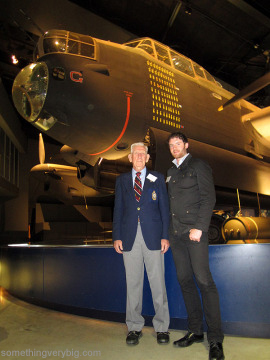
This was the fifth such commemoration to be held in the nation’s capital and the event has settled down into a familiar but effective pattern. G for George provided the setting for the now traditional ‘Meet & Greet’ function. There were indeed many people to meet and greet. Tommy Knox and Pat Kerrins, who I’d met here last year, were both there again. Don Browning and Ross Pearson traded their usual good-natured banter about which between the Halifax and the Lancaster was the ‘proper’ aircraft to have flown in (at least we all thought it was good-natured…). And I met a few new people too.

12-jun-bomber-command-in-canberra-007 copy

Early in the evening as I was wandering around to see who else I recognised, out of the shadows of the Lancaster’s nose came a man named Don McDonald, a 466 Sqn Halifax skipper from Melbourne, a veteran I had not yet met. He was a lovely bloke and we chatted about all sorts of things for a good while – and upon learning that I now also live in the southern capital he and his wife Ailsa promptly invited me to visit them for dinner sometime. You never do know who you will meet at these events! I also spoke with the former Commanding Officer of the reformed 462 Squadron, which was previously a Halifax squadron of Bomber Command and is now an electronic intelligence unit based at RAAF Edinburgh in Adelaide. The superb Striking by Night sound and light show was again played at the end of the event. The final moments of the production feature a WAAF speaking about the Australian airmen she worked with. “They were young… handsome…” she says, “…and full of life.” At which point Don Huxtable was heard to mutter “well two out of three ain’t bad…”12-jun-bomber-command-in-canberra-012 copy

Many of us repaired to the hotel bar at the Rydges after returning from the AWM. It was a memorable night, sharing beers with the two Toms Knox sitting on one side and Hux on the other as a great variety of stories, of both tall and short varieties, were told.

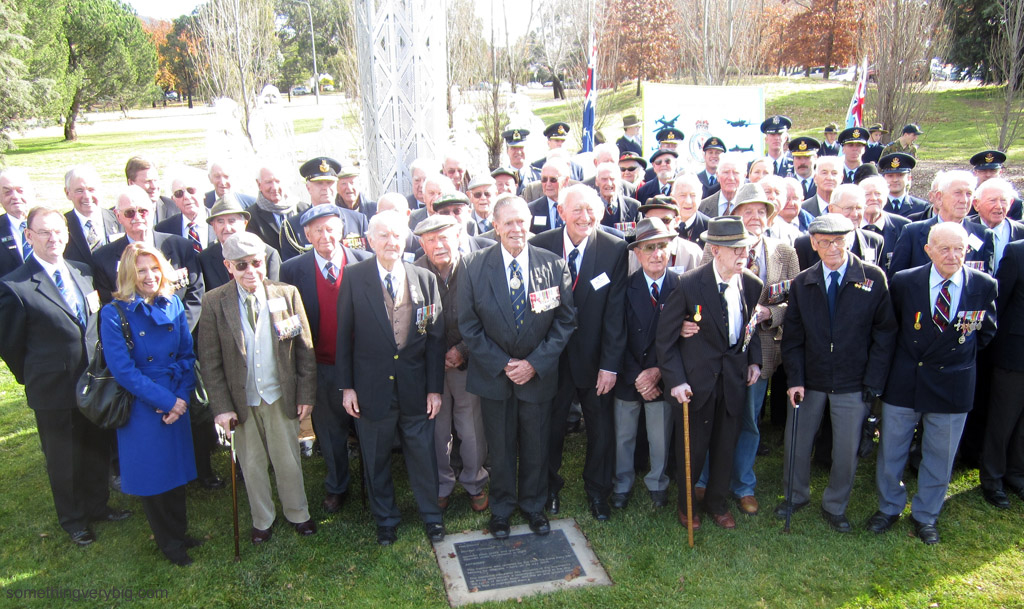
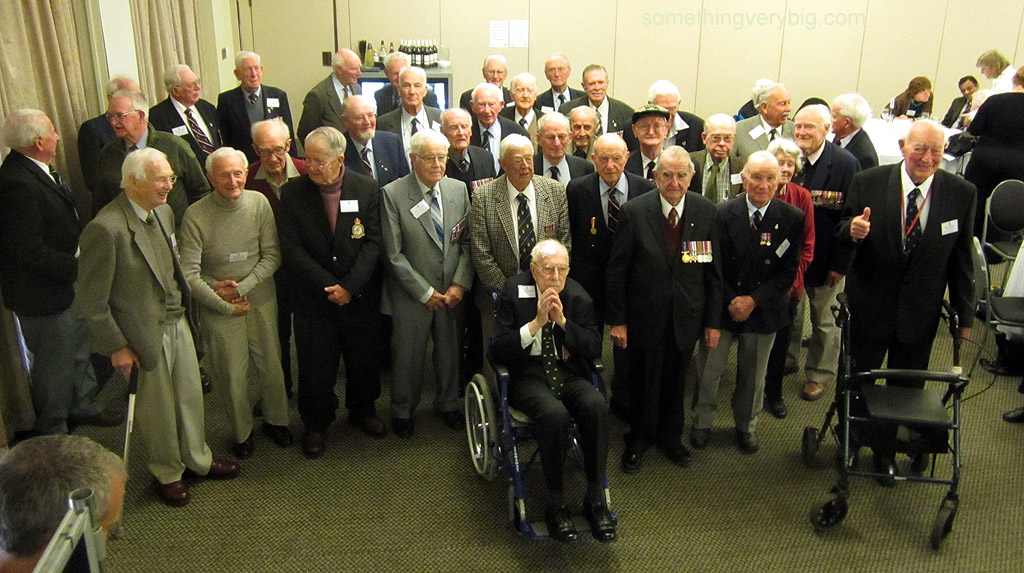
Canberra received almost an inch of rain on Saturday and it looked very much like it had set in for a week. But upon peering out of my hotel room window in the morning I saw a scene that was wet, but not actually raining. The clouds gradually cleared as the morning went on and in fact it turned out into a delightfully mild Canberra morning. The Commemorative Address was given by Air Marshal Mark Binskin, Deputy Chief of  Defence Force (and a former Chief of Air Force), who spoke about the legacy of teamwork from the men of Bomber Command, and how the Air Force has reformed two Bomber Command squadrons as a tribute. Fittingly a large group of 460 Squadron personnel were present standing in three neat rows at the back of the crowd. There was an attempt to get an official photo of all the veterans who were present but it was not as organised as last year’s effort:

12-jun-bomber-command-in-canberra-032 copy

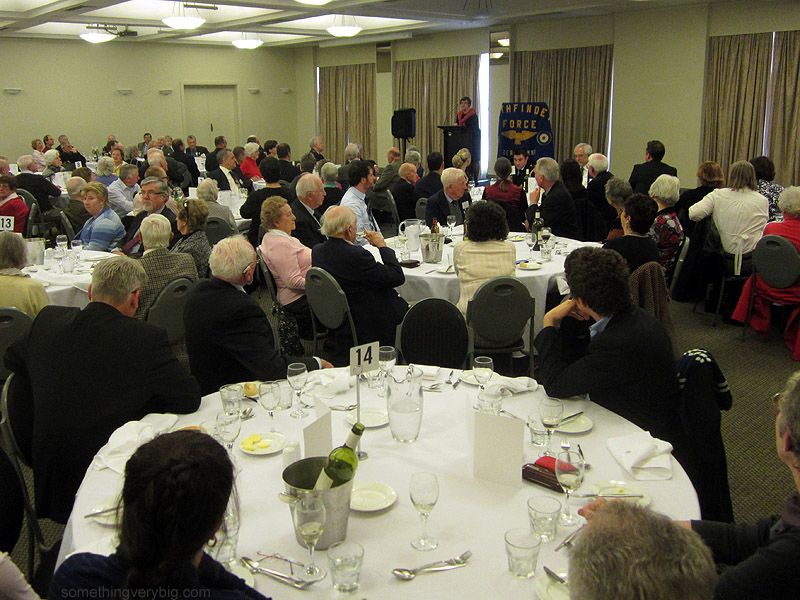
Back to the Rydges, then, for the luncheon, always for me the highlight of the weekend. Despite the slightly lower numbers present this year, it is still one of the largest gatherings of Bomber Command veterans, families and other interested people in this country. Once again there were many extremely interesting people to talk to. I finally met Diane Strub of the Queensland Branch of the 463-467 Squadrons Association, and Fred Murray-Walker, whose father was killed in the crash of 463 Squadron Lancaster JO-G on the Scottish hillside in 1944. Peter Rees, a Canberra-based author who is currently finalising a book focusing on Australians in Bomber Command, was also there, and brought with him a magnificent folio of target photographs cheekily entitled “The Collected Works of 463 Squadron, as told to the Third Reich, September 1944 to May 1945”.

Perhaps the most remarkable person I met was sitting at a table at the back of the function room with her son and daughter in law. An Englishwoman, her name was Maude and, as it turned out, she had been on the staff at Bomber Command Headquarters – she was Deputy Commander in Chief Sir Robert Saundby’s secretary from 1943 until the end of the war. I asked her what the atmosphere was like at Bomber Command HQ. She said it was always busy – she was at work whenever her boss was and might – might – get the occasional half-day off on a Sunday if she was lucky. It was only a short conversation but it was an absolute pleasure to meet and talk to a unique lady. I even managed to convince her to get up for the group photo of all present who had served in Bomber Command (she is front right here, wearing red, behind Tommy Knox):

12-jun-bomber-command-in-canberra-066 copy

Some more photographs from the weekend:

Some of the crowd at the Meet & Greet function in the shadow of Lancaster G for George:

12-jun-bomber-command-in-canberra-010 copy

The Ceremony, in front of the AWM’s Bomber Command memorial:

12-jun-bomber-command-in-canberra-015 copy

The Three Dons: Don Southwell reading a copy of a ‘Tribute to Mr Don Huxtable’ as tabled in NSW State Parliament recently, while Don Browning and Don Huxtable himself look on:

12-jun-bomber-command-in-canberra-041 copy

Bryan Cook, Don Huxtable, Don Browning and Adam Purcell in Canberra, 03JUN12:

12-jun-bomber-command-in-canberra-048 copy

Part of the 220-strong crowd at the Lunch that followed the Ceremony on Sunday:

12-jun-bomber-command-in-canberra-052 copy

In all, then, another fine weekend of commemoration and friendship. Another pile of things to follow up on. Another piece of proof that, even after almost seventy decades, the deeds of Bomber Command live on. I’ll leave the closing words to Don Southwell, who delivered the Reflections address during the Ceremony on Sunday.

“I will always be proud”, he said, “that I flew with Bomber Command”.

Text and images (c) 2012 Adam Purcell

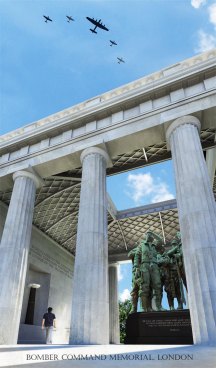
Bomber Command Memorial London

On 28 June 2012, the Bomber Command Memorial will be officially dedicated and opened in London by the Queen. The Memorial will be a lasting tribute to more than 125,000 Commonwealth aircrew who served with Bomber Command during World War II.

The bomber offensive was perhaps the longest, most sustained single campaign of the war – crews were in action from almost the first day of the conflict and the final sorties were flown at the very end of hostilities in Europe. Their contribution to the final victory was immense – as, sadly, was the cost. Out of those 125,000 airmen, more than 55,000 were killed in action. As an overall group, only the German U-Boat crews suffered a higher casualty rate.

Some 10,000 Australians served with Bomber Command. Almost three and a half thousand of them died while on active service. Bomber Command represented some 2% of total Australian enlistments in WWII but suffered 20% of Australian casualties. One Australian unit, 460 Squadron, lost more than 1,000 men over the course of the conflict – the equivalent of being completely wiped out five times.

Yet despite their terrible sacrifice, despite their enormous contribution to the war effort, the men of Bomber Command have never received the recognition that they deserve. A campaign medal was never awarded. And it has taken until now – nearly seven decades after the cessation of hostilities – for an official Memorial to be built. It’s been estimated that some 150 Bomber Command veterans remain alive in Australia. The youngest of these are fast approaching their 90th birthdays. Naturally our surviving veterans are very keen to travel to London to take part in the dedication ceremony. Due to the ravages of age not all 150 are well enough to attend, but at least 80 have registered interest with the Bomber Command Association of Australia.

The Australian Government initially announced a Commemorative Mission of five veterans would be fully sponsored and supported to go to the Ceremony. No family members or carers were included. A further forty grants of up to $3,000 each were to be available to assist other veterans in defraying their travel costs. In contrast, the New Zealand Government announced in a media release (through Veteran’s Affairs New Zealand) that they will be sending an RNZAF Boeing 757 to London with any veterans who are willing and able to make the trip, plus carers. Veterans’ Affairs New Zealand will cover all accommodation, transport, travel and medical expenses. This is a superb effort and shows how much the New Zealand Government respects and appreciates the efforts of their veterans.

So the Bomber Command Commemorative Day Foundation started a campaign for proper recognition of our veterans. And it was successful, sort of. The Government announced on May 12 that they will now be taking 30 veterans, with $5,000 grants available to those who miss out on being part of the official delegation. This is a good improvement, but more is still needed. There are practical difficulties associated with travelling at such an advanced age and having a family member or carer travelling alongside is almost a necessity. The Australian Government was quite happy to send these brave men all-expenses-paid to England seventy years ago. The least they deserve is help so that they have the chance to see that their efforts – and the memories of the 3,486 Australian airmen who never came home – are properly recognised in London.

I’ve written letters supporting this cause to my local Member of Parliament, the Minister for Veterans Affairs, the Prime Minister and the Opposition Leader. So far (a week and a half later) the only response has come from the Office of the Opposition Leader, in a phone call this afternoon. The staffer who rang me suggested I also contact the Shadow Minister for Veterans Affairs, so a new letter will be on the way shortly. I’ll be very interested to hear the responses of the others and will post here with any updates.

In the meantime, for those who wish to give practical support, please see details for making donations to the Bomber Command Commemorative Day Foundation’s London Visit Appeal here.


Edit 03JUN12:

An article in the Hornsby Advocate featuring a great photo of two of our 463-467 Sqn veterans.

I’ve also received a reply from Warren Snowdon’s office advising that the official mission is now 32 men – 44 applications were received and all those assessed as medically fit to join the mission were accepted.  The number of $5,000 grants is uncapped. This, to me, appears a reasonable response – it is certainly an improvement over the initial proposal. I’m still awaiting a response from my local member.

Picture: http://www.hydro.com/pagefiles/846261563/BCM-Poster_800x1365.jpg

Text (c) 2012 Adam Purcell 

Briefing Room

While the photograph that is now finding a wider audience as the cover shot of Bomber Command: Failed to Return is the only known image showing the entire crew of B for Baker, there is one more photo that shows at least four of them. It is from the small collection that was with my great uncle Jack’s logbook and it shows a large group of airmen in a briefing room. The three men furthest back in the photograph are, left to right, Ken Tabor, Eric Hill and Gil Pate. In the middle of the second row, next to the man wearing the round officer’s cap, is Phil Smith:

Briefing - Still 1

It has been thought that the man in the middle of the row immediately behind Phil Smith was Jack Purcell, on the basis of an arrow that my father says used to be attached to the photo. Certainly Edward Purcell, Jack’s brother and recorded next-of-kin, thought initially that this man was the one who looked most like Jack, writing to Don Smith in November 1944 that:

“The actual features are, as you will notice, very vague, but the general head conformation is identical with that of the boy.” (A01-110-001)

But a month later, after Don had provided another enlarged photo, Edward reconsidered:

“It was most kind of you to send the photos but, I am sorry to say, the enlarged view establishes that the boy marked is definitely not Jack.” (A01-111-001)

The photo has an interesting history. When we first met Phil Smith in 1997, we showed him the print. He turned it over – and immediately recognised his own handwriting on the reverse, naming the three members of his crew sitting at the back of the group. But there is an intriguing inconsistency in the photo. At close inspection, the date on the blackboard at top left reads 11 March. The target is given as Berlin. But in neither Jack’s nor Phil’s logbooks is there an operation recorded on that date – to anywhere, let alone to the ‘Big City’. In fact, neither logbook records any flying of any kind on that day. Perhaps, we thought, the briefing had been for an operation that was subsequently scrubbed.

As it turns out, the real answer is even better. Also appearing in the photo – the man in the centre wearing the officer’s hat – is Dan Conway, an A Flight skipper. After the war he wrote a superb book called The Trenches in the Sky, in which he explained the situation. A film unit was visiting Waddington to take shots for a short feature called The RAAF in Europe. The briefing was staged for the benefit of the cameras and, according to Conway, included “references to tracking at low level over the Ruhr etc. Maybe because we were laughing [the CO] was made to go through the procedure again and then again…” (C07-014-160). The photo is in fact a still taken from that film. Our copy has a purple stamp on the back saying “RAF Photographic Section”.

So how did this official photo end up in Jack’s collection? Phil Smith had much extended family in England and his letters reveal that he visited them often while on leave. One uncle was Jack Smeed, who worked for a film studio in London… and it was this studio that produced the film from which the photograph was pulled. It appears that Jack Smeed arranged for copies to go to Phil, who captioned them and then forwarded them to his parents. After the crew went missing, Edward Purcell’s letters from late 1944 show that Don Smith spread them around to the families of some of the rest of the crew.

A few years before he died, Phil Smith was visiting the Australian War Memorial with his wife Mollie. In a corner of the Second World War gallery at the time was a small Bomber Command display, which included a short film. It was a grab from The RAAF in Europe, and Phil recognised himself as one of the reluctant film stars in it. I remember seeing the same display myself some years later (edit September 2013: it’s still there!), and the footage still crops up occasionally in documentaries and the like.

© 2012 Adam Purcell

ANZAC Day 2012

ANZAC Day dawned cold and wet in Melbourne. The conditions didn’t stop 35,000 people attending the Dawn Service at the Shrine of Remembrance. I wasn’t one of them, though – instead, I got on board a Virgin jet and headed towards the north.

Descending into Sydney, the city looked an absolute picture. It was one of those sparkling autumn days that I don’t think you really get anywhere else in the world. Only the whitecaps on the rolling seas hinted at the presence of some wind.

I caught the train into the city. Emerging from the pedestrian tunnels out of St James station, I smelt rosemary and heard marching drums somewhere in the depths of the city. Yes, the March was well and truly underway.

The Air Force veterans traditionally hit the circuit around 11am so I had a bit of time to spare. A marching band moved past, its mighty horns echoing off the skyscrapers. Walking out of the tunnels I spied a familiar figure. It was Tommy Knox, a Stirling flight engineer from 149 Squadron who I had met in Canberra last year. He was clutching a free cup of tea that he’d been given by Legacy volunteers at the train station. I’d received a letter from Tommy just a couple of days before. We had a quick chat before he hurried off to find the rest of the ‘Odd Bods’, the group he marches with.

Returning to Elizabeth Street, I patrolled up and down the assembling throng, looking for people I knew. The first veteran I recognised was Hugh McLeod, a 49 Sqn rear gunner who, at “eighty seven and a half” says he is one of the youngest in the group. Hugh was adopted by the 463-467 Sqn Association some years ago and now joins them for the march and lunch each year. Once the banner arrived, safe in the care of Bryan Cook whose grandfather was a 463 Sqn mid upper gunner, it became the focal point and more familiar faces detached themselves from the growing crowd. In recent years it has become something of a tradition for Bryan and I to carry the banner for the Squadrons and we were again honoured to do so this year.

Only six veterans actually marched this year. Even the indefatigable Don Southwell was absent, having pulled a hamstring recently. He rode in an RSL-provided Land Rover instead. The rest of the bunch was made up by numerous families and friends of veterans, numbering perhaps a couple of dozen in all.

Some photos of the march:

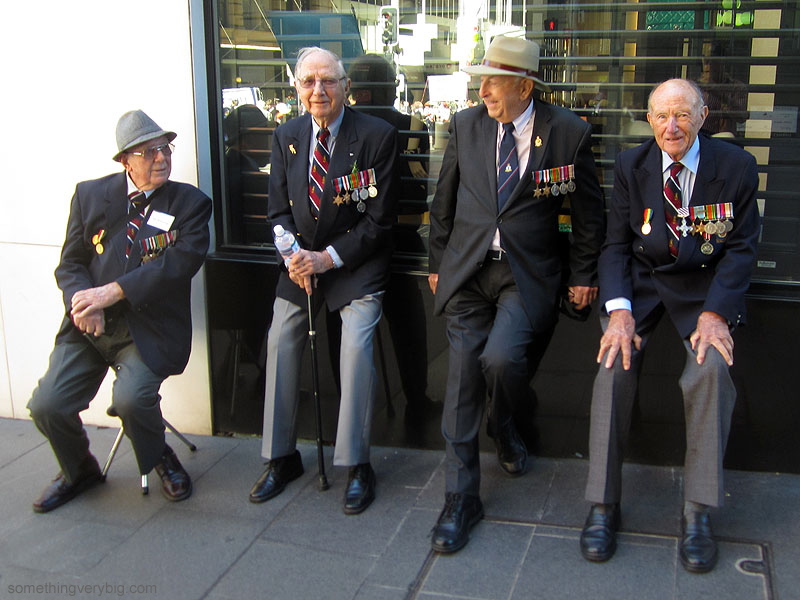
After setting off up Elizabeth Street, we turned down Market Street– where, as has become normal each year, we halted for perhaps half an hour to avoid congestion further down the route. President of the Association Don Browning came prepared, wielding one of those walking sticks with a built-in stool. The other three in this photo took advantage of a handy window sill:

12apr-anzac-day-009 copy

Meanwhile the wind had picked up. While we were waiting to continue Bryan and I had a good chat with Hugh, our 49 Sqn rear gunner, while he clung gamely to one of the banner’s guy ropes to keep it under control in the breeze:

12apr-anzac-day-010 copy

Following the march, lunch was at the Sydney Marriott hotel, on the other side of Hyde Park. Once again it was a superb meal. 48 people were present, including the same ten veterans who we had last year. Again a group photograph was organised (ignore the two young blokes holding the banner up in the background!):

12apr-anzac-day-008 copy

Left to right, they are Don Southwell, David Skinner, Bill Purdy, Alan Buxton, Hugh McLeod, George Douglass, Don Huxtable, Don Browning, Albert Wallace and Harry Brown.

Five of these distinguished gentlemen will be travelling to London in late June for the dedication of the new Bomber Command Memorial in Hyde Park.

During lunch I sat next to Alan Buxton, a navigator. Alan never flew operationally with 467 Sqn – he actually flew his tour with 617 Sqn, the famed Dambusters. In late 1944 he baled out of his crippled Lancaster over Norwich after a harrowing return trip across the Channel with all four engines ablaze, a story hinted at by the tiny golden caterpillar badge with ruby red eyes that he was wearing on his tie. He proudly showed me his Caterpillar Club membership card, which he still carries in his wallet. After VE Day Alan was posted to 467 Sqn at Metheringham, in preparation for the planned Tiger Force operations against Japan. Thankfully the war ended before they were required to fight in that theatre. Alan appears in this photo on the left:

12apr-anzac-day-017 copy

And so another ANZAC Day passes. It is always wonderful to see these blokes each year, and long may it continue. President Don Browning made a toast to absent friends during the lunch – but added that, as long as there was someone to carry the banner, there would be someone to march with it, and so the spirit of the two Squadrons will live on.

© 2012 Adam Purcell