The search for the story of Lancaster B for Baker (and other things)
Author: Adam Purcell
When I was young my father showed me a small blue felt-covered notebook. It was the flying logbook of my great uncle Jack, a Lancaster navigator in WWII.
That simple act kicked off a fascination with all things aeronautical. That fascination has now become Something Very Big for me. Here were seven young men, from vastly different backgrounds, all by immense forces well beyond their control or understanding brought together to the one place at the one time - inside that Lancaster as it flew over Northern France in May 1944. They were normal, everyday lads caught up in extraordinary circumstances. I've realised that it's a fascinating story and it's one that deserves to be told.
This is the story of That Thing Very Big and where it is leading me. I'm endeavouring to add a new post roughly once every ten or twelve days or so.
With many crews on leave and the moon period current, it was with some surprise that the Waddington squadrons were told this morning that operations would be on tonight. The target was Stettin. 463 Squadron put up seven aircraft and 467 detailed eleven for the trip,[1] among a total force of 333 heavies. Other Bomber Command units were also in action, sending Mosquitoes on a feint attack to Berlin and other targets in Western Germany, more Mosquitoes to the Cherbourg Peninsula, Lancasters to lay mines and a Beaufighter on a Serrate radio counter-measures patrol[2]– the last Beaufighter to carry out one of these before Mosquitoes took over the duty full-time.
Meanwhile, Phil Smith’s crew were still on leave. Gil Pate was living it up in London. By this time he’d been there a few times and was starting to find his way around like a local.[3] Today he decided to get a formal portrait taken:
Gilbert Pate in London. Photograph courtesy Gil and Peggy Thew
He signed it ‘Love, Gil’, gave it today’s date and decided to post it to his mother when he got back to Waddington.
As the weather was still poor and the moon period was beginning, no operations were expected for the Waddington squadrons over the next few nights so many crews were sent off for a short period of leave. Phil Smith’s crew were no exception. Rear gunner Gilbert Pate in particular got straight onto a train and headed for London.
There was no leave for Phil himself however. He had much work to do to get up to speed in his soon to be new role as Flight Commander, so he consoled himself by opening a tin of goodies that his mother had sent him for Christmas. Fudge… milk chocolate… caramels… all the things he was ‘particularly fond of’.[1] It made the foggy winter’s day go by that much quicker.
But just because there was a bright moon rising didn’t mean that Bomber Command stopped entirely. 80 aircraft – predominantly Stirlings with small numbers of Mosquitoes and Lancasters – headed off to attack a pair of flying bomb sites in France.[2] Mosquitoes raided Cologne and Krefeld. The usual ‘gardening’ (minelaying) and ‘nickelling’ (leaflet dropping) sorties were carried out over France. And Berlin, having been given a rest last night, was harassed once again, this time by a small force of Mosquitoes.
In all, 148 aircraft were involved in the night’s operations, for no losses (though one Stirling crashed on landing).[3]
An eerie silence hung over Waddington around the time the crews were due back from Berlin this morning. A quick look outside confirmed that thick fog had settled on the aerodrome and it was soon established that all aircraft returning from Berlin had been diverted to other bases. After two long trips on consecutive nights, and with the weather looking like staying duff all day, a stand-down was declared.
Which explained the silence.
The ‘Big City’ had become such a common target in recent months that some ground crew were now beginning to call it the Battle of Berlin.[1] Last night’s raid followed a now familiar pattern: the large force of aircraft found heavy cloud over the target and bombed skymarker flares with unknown success – the only evidence of note being an intercepted German wireless broadcast which referred to ‘attacks against various residential districts of the Reich capital’.[2]
What was certain, however, was that fighters were very active last night and consequently losses were high. The BBC news at midday reported 28 missing aircraft.[3] By midday all but two of the diverted aircraft, had returned to Waddington, but there was one from each Squadron still outstanding. Flight Sergeant Jack Weatherill and crew, in 463’s JA902, wouldn’t come back. They went down over the Ijsselmeer in Holland (five would be taken POW, with the other two killed in action[4]).
But Flying Officer Alex Riley, in ME575, had not been heard of yet either. As the fog cleared, the aircraft began to trickle back in from their diversion airfields. But it was now nearly four and a half hours after Riley had been due to land. The Committee of Adjustment had already collected his crew’s kit and the casualty signals had been made up and were juuuuuuust about to be despatched…. when in the Waddington Watch Office, the radio crackled with a familiar voice and a Lancaster landed. It was Riley, safe and sound with his crew. He’d landed at Lakenheath this morning, but someone forgot to pass the message on to Waddington.
By the time the B.B.C announcer read the six o’clock news, the number of missing had been revised to 27.[5]
The Berlin trip last night was of mixed success. Thick cloud covered the target so the force instead bombed cascading skymarker flares dropped by the Pathfinder Force. The diversionary raid to Hamburg failed to have the desired effect. German fighter controllers were “never in doubt as to the identity of the main objective”, said the Night Raid report,[1] and the fighters had a field day. 28 bombers were lost.
Twenty aircraft left Waddington last night, but only eighteen came back. Both absent crews were from 467 Squadron. One finally arrived at Waddington late today, that of Pilot Officer Ross Stanford, who had run short of fuel and diverted to Ford. But Leo Patkin never returned. His aircraft crashed and exploded in a field near Hanover in Germany. There were no survivors.[2] The second dickie on Patkin’s aircraft was James Mudie, who it will be remembered arrived at Waddington just yesterday. His crew were now ‘headless’ and would be posted back to a Heavy Conversion Unit a week later.
But despite having arrived back at Waddington very early this morning, there was no rest for the crews. They were briefed, once again, for Berlin. Some air tests were flown during the day to check the aircraft over, but only eight from each Squadron were ready for take off in time.[3]
Elsewhere, aircraft of Bomber Command were being prepared for more precision attacks to Duisberg and Bristillerie. They would also lay mines off the Frisian Islands and complete intruder patrols over France and Germany, and a small force went to France to drop leaflets.[4] By far the largest force, however – 383 aircraft in all – were off to the German capital.
Phil Smith and his crew, still settling in, were not on the battle order tonight. They watched as the first aircraft took off into the darkness at two minutes past eleven o’clock.
[3] 463 and 467 Squadron ORBs. Note the 463 Squadron ORB Form 540 for this day clearly states 6 aircraft on, but the list in the back (Form 541) lists eight aircraft taking part. Of these, two made early returns so perhaps the implication was that they got six aircraft away to the target.
The first day of the New Year began as a very quiet winter’s Saturday morning at RAF Station Waddington. This, after the previous night’s fancy dress dance in the Mess, was probably just as well.[1] Despite all that, though, there was still a war to be fought, and ops were on tonight for the airmen of 463 and 467 Squadrons.
Various aircraft across Bomber Command were given a variety of taskings for the evening. Mosquitoes were sent on precision raids against Witten, Duisberg, Bristellerie and Cologne. Eleven Wellingtons scattered propaganda leaflets over France. A diversionary force of fifteen more Mosquitoes harassed Hamburg, to try and draw defenders away from the main target – which, for the ninth time this winter, was Berlin.[2] In all, the two Waddington Squadrons offered ten aircraft each. They were part of a force of 421 Lancasters destined for the Big City.
Two new crews arrived at Waddington during the day, both to join 467 Squadron. The captain of the first crew was a Flight Sergeant by the name of James Mudie. He got cracking quickly, joining Flight Sergeant Leo Patkin’s crew as a ‘second dickie’ on the Berlin trip[3] while his own crew settled in to their new surroundings. The other crew was led by a quiet but highly experienced Australian Flight Lieutenant. Donald Philip Smeed Smith, better known as Phil, completed his first tour of operations flying Wellingtons from Elsham Wolds with 103 Squadron, followed by almost a year and a half instructing at an Operational Training Unit in the Cotswolds. There were three more Australians in his new crew: the Navigator, Flight Sergeant Jack Purcell, Wireless Operator Flight Sergeant Dale Johnston and Rear Gunner Sergeant Gilbert Pate. The balance of the crew was made up by Englishmen: the Flight Engineer, Sergeant Ken Tabor, the Bomb Aimer Sergeant Jerry Parker and the Mid-Upper Gunner, Sergeant Eric Hill.
While Mudie wasted no time in getting into action, Phil Smith had some additional administration to attend to, having been selected to replace the outgoing Flight Lieutenant Bill Forbes as Officer Commanding, A Flight, 467 Squadron, and he and his crew wouldn’t be flying tonight.
For the crews who were, take-off was set for midnight.[4]
The crew of B for Baker were posted to 467 Squadron on the last day of 1943. They arrived at RAF Waddington, Lincolnshire, on the first day of 1944. It follows therefore that 2014 marks seventy years since the crew were operational. To mark this anniversary, I’ve planned a special project to be published on SomethingVeryBig over the next few months: 467 Postblog.
Drawing from a range of sources I’ve compiled a timeline, or a daily diary if you will, looking at events in Bomber Command as a whole and RAF Waddington and the crew of B for Baker in particular during the time that they were on the squadron. From tomorrow I’ll be publishing a post almost every day, following their story from the time they arrived in January 1944 until the fateful Lille operation some four and a half months later.
This period encompasses a good cross-section of Bomber Command operations, and includes some very significant raids. In the first couple of months we will see the crescendo of the Battle of Berlin, with the last mass raid on that city taking place on 23 March amongst a larger campaign of mass city-busting attacks. A week after the final Berlin raid comes the infamous Nuremberg operation. As we move into April, we will see how Bomber Command’s strategies change, in line with the Transportation Plan and other operations aimed at preparing the way for the planned invasion of occupied Europe. While the occasional large raid still happens on a big city like Munich in the latter part of April, for most of that month and the early part of May attacking forces become smaller, trips become shorter and marking techniques become increasingly more accurate. The changing tactics make this a particularly useful and interesting period to look at in some detail.
There were significant periods early on – in early February in particular – where the weather badly affected the bomber offensive. And it was a very long war so there were also days when, simply, nothing much of note happened. So there will be a few days for which I will summarise events into a single post – but all the important ones, particularly the operations in which any member of the crew was involved, will have their own entry to be published seventy years to the day after the events it covers. There will be descriptions of the big events of the time, but also some discussion of everyday life on the squadron and, where the information is available, what the crew themselves got up to.
Almost a year in the making, this is a type of project well-suited to digital publication. Sections will be added in close to real time and the whole project will grow as time goes by.
While the Imperial War Museum undergoes significant redevelopment in preparation for the centenary of the First World War, some of its bigger and most well-known exhibits have been removed from its main site on Lambeth Road in London and temporarily installed at Duxford. Among them is the forward section of a rather significant Lancaster.
Avro Lancaster Mk I DV372 of 467 Squadron flew its first operation on 18 November 1943. The target was Berlin. Over the next seven months the aircraft would fly on 50 raids, [1] including the entire Battle of Berlin period, the infamous Nuremberg Raid and the Transportation Plan operations on French railway targets in the lead-up to D-Day. Old Fred, as it was known on account of its squadron code letters PO-F, was on the strength of 467 Squadron at the same time as the crew of B for Baker, and indeed Phil Smith and most of his crew took it on its 16th trip, to Berlin on 28 January 1944. But the man with whom Old Fred is probably most associated is Flight Lieutenant Arnold Easton, a 467 Squadron navigator who flew 20 trips in the aircraft from March until May 1944. I was lucky enough to get a copy of Arnold’s logbook a few years ago. Befitting his civilian career as a civil engineer, it is one of the most detailed and comprehensive wartime logbooks I’ve seen and forms the basis of a book, We Flew Old Fred – The Fox, compiled by Arnold after the war.
After its front-line service it appears that the aircraft was damaged in an accident, requiring repairs that took several months to complete. It was sent to 1651 Conversion Unit where it saw out the war before being broken up in October 1945. Happily someone thought to save the nose section which eventually is how it became part of the collection of the Imperial War Museum. It was one of three Lancasters I ‘visited’ while in the UK in 2009.
Among the people I met at the recent Bomber Command Panel Discussion event held at the Shrine of Remembrance in Melbourne was Arnold’s son Geoff. As well as discussing the intriguing possibility of reissuing his father’s book (now out of print and extremely difficult to get hold of), Geoff told me a lovely story of what happened when he was in the UK in June 2013.
Like many surviving Bomber Command aircrew, Arnold kept some bits and pieces relating to his wartime service when he returned to Australia. Geoff used to play with his flying helmet, putting it on and pretending to connect the intercom cable, with its distinctive bell-shaped Bakelite plug, into an imaginary ‘aeroplane’. Somehow it never stayed plugged in.
Since his father’s death some years ago, Geoff and his wife decided to donate his leather flying helmet and metal circular navigational computer to the Imperial War Museum, unique relics with a direct connection to Old Fred. They arranged to take the artefacts to Duxford where the IWM’s Andy Marriott is taking the opportunity, while it is out of London, to clean and conserve the remains of the aeroplane. Indeed, Andy asked Geoff at one stage whether his father had chewed gum. While ferreting around in various locations under the navigator’s position he had found some lolly wrappers, a chewed-up wad of gum and a NAAFI form with aerodrome weather written on it:
NAAFI sheet found in Old Fred – photo courtesy Geoff Easton
Andy allowed Geoff and his wife to crawl into the aeroplane through the bomb aimer’s escape hatch in the nose. They then used the yellow handrails on the side of the fuselage to move up underneath the flight engineer’s position into the cockpit proper. There, just behind the pilot’s seat, was the navigator’s bench and, tucked in underneath it, attached to a swinging arm, the unpadded metal bucket chair in which Geoff’s father sat for twenty operations over enemy territory. Pulling the chair out, Geoff sat down and placed the helmet on the desk. He looked around, soaking up the atmosphere. Among the instruments and equipment remaining in the cramped compartment, hanging from the bulkhead to his left was a rather familiar-looking bell-shaped Bakelite plug. Could it be?
It was.
Geoff picked up the end of the intercom cable on the helmet. He pushed the two bell-shaped plugs together.
There was a snug click.
For the first time in nearly 70 years, the flying helmet was reunited with Old Fred.
Geoff stood up, stooping somewhat under the low roof of the fuselage. He exited the aeroplane the same way he came in, leaving his father’s flying helmet on the desk.
Arnold’s flying helmet reunited with Old Fred. Photo courtesy Geoff Easton
[1] While most sources list 49 trips, Geoff Easton believes he has found a 50th, to Berlin on 28JAN44. The 467 Squadron ORBs certainly appear to support this.
The Pathfinders of Bomber Command used a variety of techniques and tactics when marking targets for the Main Force. These were all referred to by codewords. Here is an alphabetical glossary of some of the many Pathfinder terms I’ve come across in the course of my research:
Backers-Up: Pathfinder crews scattered through the Main Force who dropped secondary target indicators (usually green) visually on the red primary target indicators. This was aimed at ensuring that the target remained marked for the entire attack, even after the primary markers had burnt themselves out.
Blind Marking: Aiming bombs or target markers by means other than visually – usually referring to the use of an electronic aid like H2S, Oboe or Gee.
Blind Marker-Illuminators: First Pathfinder aircraft on the scene during a NEWHAVEN attack who used H2S to drop illuminating flares and target indicators (usually green or yellow). The light provided by the flares could then be used by the Visual Markers.
Controller: Officer who is in R/T contact with the Pathfinder Markers and Illuminators, and W/T contact with the rest of the Main Force. The Controller decides which markers are accurate and instructs the Main Force crews accordingly.
Emergency Parramatta: Used where the Visual Markers could not see the aiming point due to cloud or haze. They would hold on to their markers and the Backers-Up would instead aim their secondary target indicators on the markers dropped by the Blind Marker-Illuminators.
Emergency Wanganui: Pathfinder aircraft carried a single WANGANUI flare for use where unexpected heavy cloud precluded the use of ground markers.
H2S: Airborne ground-mapping radar carried by bombers. Could distinguish built-up areas and most effective where a clearly-defined feature – such as a coastline – existed.
Illumination: Dropping of parachute flares to light up the target area, enabling the aiming point to be identified visually by Pathfinders or by the Main Force. Carried out by the Flare Force.
Main Force: ‘Ordinary’ rank-and-file Bomber Command crews.
Markers: Generic term for Target Indicators or Wanganui makers. Confusingly, could also refer to the crews actually doing the marking.
MUSICAL: Prefix codeword for raids marked by crews (usually in Mosquitos) using OBOE. Distributing marking Mosquitos throughout the bomber stream aimed to ensure that the target was always marked by primaries. Eg MUSICAL NEWHAVEN, MUSICAL PARRAMATTA or MUSICAL WANGANUI.
MPI: Mean Point of Impact. The estimated ‘centre’ of a cluster or target indicators, sky markers or bombs.
NEWHAVEN: A method of ground-marking whereby the target was first located by Blind Marker-Illuminators, then backed up by Visual Markers dropping Target Indicators. Since the markers were aimed visually this could only be used with clear weather prevailing over the target. If a Newhaven attack was impossible an Emergency Parramatta would be used instead.
OBOE: Navigation/blind-bombing aid using beams from two base stations in England. Extremely accurate but could be used by only a small number of aircraft at a time, so was used primarily to drop target markers.
PARRAMATTA: Classic area bombing technique where the primary markers (red or yellow) were dropped on the target by H2S-equipped Blind Markers. Backers-Up would then aim their (usually green) Target Indicators at the MPI of those primary markers for the benefit of the Main Force.
Primary Markers: Target Indicators or flares aimed at the Aiming Point itself. As opposed to Secondary Markers.
Release-point flares: Parachute flares, usually red with green stars or green with red stars, used in WANGANUI attacks. Also called skymarkers.
Secondary markers: Target Indicators or flares aimed at Primary markers. Dropped by Backers-Up to keep the target marked before the primaries burned out.
SUPPORTERS: Experienced Main Force crews briefed to go over the target and bomb at the same time as the leading Pathfinders, to ‘swamp’ the defences and make it difficult for radar-predicted flak to lock onto one individual aircraft.
Target Indicators: Ground markers consisting of a small bomb case which was set to burst at a certain height above the ground (3,000, 6,000 or 10,000ft), scattering up to 60 small ‘candles.’ The candles then ignited and cascaded slowly to the ground. Once on the ground they continued burning with a distinctive colour – red, green or yellow. Most burned for about three minutes but some burned, less brilliantly, for up to seven. Called ‘Christmas trees’ by the Germans.
Visual Markers: Pathfinder crews that identified the aiming point visually, and dropped their own markers (usually red) on it. Usually the most experienced crews in the Pathfinders.
WANGANUI: Blind bombing skymarking technique used when aiming point is covered in cloud. H2S-equipped aircraft dropped parachute flares and the Main Force aimed at the flares themselves (or the MPI of the flares if they were being scattered by the wind), bombing on a pre-arranged heading. Not terribly accurate and very susceptible to the wind. Flares used could variously be referred to as ‘skymarkers’, ‘release point flares’ or, simply, ‘Wanganuis’.
On Tuesday a large crowd of at least 150 people gathered at the Shrine of Remembrance here in Melbourne to take part in perhaps the largest of the events to be held in conjunction with the Bomber Command exhibition currently showing at the Shrine. I was particularly looking forward to this one, and it didn’t disappoint.
The occasion was a Panel Discussion about Bomber Command, chaired by Air Vice Marshal Chris Spence (Retd), Chairman of the Shrine Trustees. The panel was made up of three veterans, covering the entire period from the beginning of the war to the end. Jack Bell was a Wireless/Air Gunner who served in the Middle East early in the conflict before being shot down in a Bristol Bombay and becoming a prisoner of war in Italy and then in Germany. Peter Isaacson was a Pilot with 460 and 156 Squadrons, later famous as the man who flew Lancaster Q for Queenie to Australia (and under the Sydney Harbour Bridge) on a War Bonds tour in 1943. And Maurie O’Keefe was a Wireless/Air Gunner who served with 460 Squadron at the tail end of the war.
Left to Right: Jack Bell, Peter Isaacson, Maurie O’Keefe and Chris Spence
With Air Vice Marshal Spence asking questions and gently prodding the veterans along, over the next fifty minutes or so the discussion covered the entire war: from enlistment to training to operations and beyond. Peter joined up, he said, after seeing a mannequin wearing an Air Force uniform in a recruitment display in the window of Myer in Bourke St, Melbourne. It was a very smart blue suit, he said, and he decided that he would like one of those. So he enlisted. Maurie concurred. “You used to go to dances,” he said, “and the girls made a bit of a fuss of you if you’d joined up… so that was the main attraction, really!”
The theme continued. Peter related a story of landing a Tiger Moth in a farmer’s field so he could sneak an illicit smoke while at 8 Elementary Flying Training School. Unfortunately he was seen by an overflying aircraft and was as a result confined to barracks, the indiscretion, he said slightly wistfully, “rather spoiling a little romance I had going with a girl in Narrandera…” Once aircrew, always aircrew.
But there were also some desperately sad stories. Jack was shot down after his aircraft stumbled over the German 15th Panzer Division in Libya. The navigator was killed in the ensuing crash and, after he returned to Australia following three years, three months and three days as a prisoner of war Jack went to visit his dead crewman’s family. He could see in the mother’s eyes the unasked question, ‘why my son and not you?’ It was, he said, the hardest thing he ever had to do.
Following the formal part of the discussion, the microphone was opened to questions from the floor. And there were some very good questions, too. One was relating to Schräge Musik, the fixed upward-firing guns fitted to nightfighters which were so devastatingly effective and utterly unsuspected by Bomber Command until quite late in 1944. What was it like, the questioner asked, to encounter Schräge Musik? Incredibly enough, a first-hand answer was available. In the audience were at least ten other veterans, and one of these – Jim Cahir – was actually in Stalag Luft III with Jack Bell. Jim’s aircraft was shot down by Schräge Musik over Germany one night. He first became aware of it – “too late, of course” – when shells started hitting his aircraft. Having someone there who, well, was there, gave the answer a real meaning and brought the subject home in a very personal and tangible way.
Inevitably at a public event of this nature the discussion eventually turned to Dresden and, as Peter Rees emphasised both in his book and in his talk last week, there were some passionate defences of the rationale and of the attack itself, both from the floor and the panel.
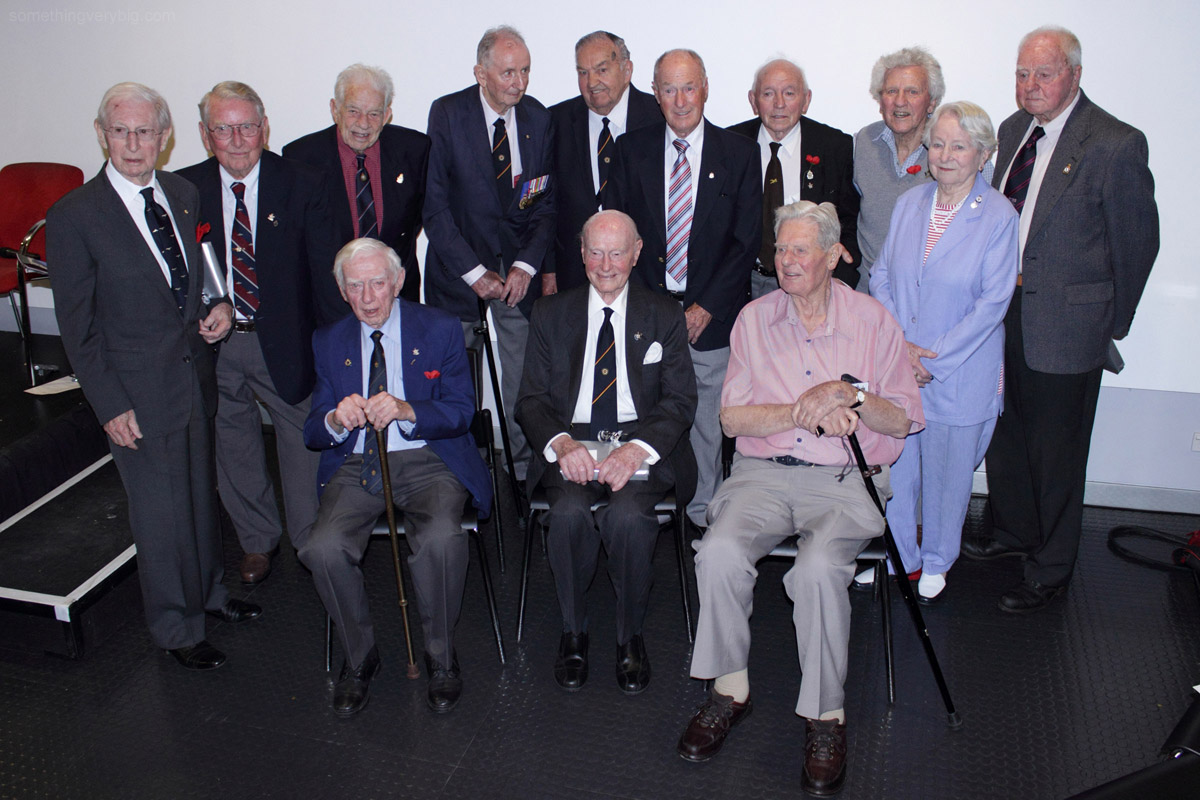
Following the discussion someone suggested organising a group photograph of all of the veterans present. In all there were thirteen in the photo, though I suspect one or two others may have slipped off before we had a chance to get everyone gathered near the front of the room. Unfortunately I was unable to get everyone’s names so only the following are identified in the photograph below: Back row, L-R: Peter Isaacson, Bruce Clifton, Wal McCulloch, [unknown], Gerald McPherson, Allan Beavis, John Wyke, Gordon Laidlaw, Jean Smith, Maurie O’Keefe. Front row, L-R: Bill Wilkie, Jack Bell, Jim Cahir Other veterans who were present but for whom I cannot match a name with a face were Jim Carr, Col Fraser and Ron Fitch. (If you are able to identify any of the unknowns in this photo, please get in touch)
The opportunity then arose to mix a little bit over a cup of tea. I knew a few veterans (among them Allan Beavis, a Mosquito navigator who I visited at home in Geelong earlier this year) but most were new to me. Most notably, I recognised a tiny golden caterpillar with ruby red eyes on Bill Wilkie’s tie. When I asked him about it he immediately opened his wallet and pulled out his Caterpillar Club membership card, which he carries around with him everywhere even today. He had been a 15 Squadron rear gunner flying out of Mildenhall when his Lancaster was shot down over Germany in January 1945.
There were of course other people to see as well. Robyn Bell was there and I finally got to meet Neil Sharkey, the curator at the Shrine responsible for the current Bomber Command exhibition. Happily I was also able meet a man named Geoff Easton. His father was Arnold Easton, a 467 Squadron navigator who was operating at much the same time that my great uncle Jack and his crew were at Waddington. Arnold’s logbook, which I have a copy of, is one of the most precise examples I’ve ever seen and has been a great help in my research so far. But apart from a few emails about five years ago I’d never actually met Geoff. We had a good chat and he offered to send me copies of his late father’s wartime correspondence and a few photos of a very special visit he made recently to what’s left of ‘Old Fred’, Lancaster DV372 in which Arnold completed 20 sorties (and Phil Smith flew at least once), at the Imperial War Museum’s Duxford site. That will be the subject of a future post (it’s a wonderful story). Geoff has since sent me the files and I’m going to enjoy diving into them to see what nuggets come to the surface.
On my way out, I saw Gordon Laidlaw, the 50 Squadron pilot who I first met when visiting the exhibition a few weeks ago. He was waiting for his lift to arrive and I couldn’t resist one last photo of him: In all, a fantastic event. The Shrine of Remembrance has embraced the Bomber Command theme in the last few months and the interest from the public has been obvious, with big crowds turning out to the two events which I’ve been able to attend in the last week. Peter Rees said to me in an email after his talk last week, “It really feels like the book has tapped into something out there. Maybe people have long sensed [the airmen] were given a bum deal; if I’ve made it accessible for them to understand, then that’s a good outcome.”
The same could be said of the Shrine’s efforts over the last few months. It’s quite strange – but also very encouraging – to see big banners around the city of Melbourne emblazoned with the legend ‘BOMBER COMMAND’ with a photo of a crew in front of a Lancaster. It’s far too late for the vast majority of those who were there, of course, but while we still have some left, events and exhibitions like these allow the stories to be told and the memories to live on.
Download a podcast of the discussion from the Shrine websitehere.
Despite the shocking weather there was a good-sized audience of perhaps 100 people present, all of whom listened in some awe to a very thorough presentation which covered the main themes of the book and told some good stories. Peter made certain to mention that Lancaster Men was his publisher’s choice for a title, not his – there were, as he rightly points out, other aircraft flown by Australians in Bomber Command! He told some stories from ‘behind the scenes’ of researching and writing the book, like Ted Pickerd, a 463 Squadron veteran who who greatly assisted Peter’s research before he died last year. They would meet weekly at the Australian War Memorial to pore through documents and archives together, Ted still being in possession of his navigator’s eye for detail and accuracy coming to the fore. He also said that since publication the book has received strong support, so much so that it’s now on its third print run (and indeed the Shrine shop ran out of copies of the book tonight, like the Australian War Memorial did during the Bomber Command weekend in Canberra in June), and as a direct result of writing it he has received so many further stories from people who have read the book that he is planning a follow-up volume in a couple of years time.
A lively discussion followed the talk, with Dresden getting much of the attention – and, incredibly, adding their input from the audience were four Bomber Command veterans, three of whom had in fact been on the Dresden trip and who could add recollections of what they were told at briefing for that raid. That added a very personal, and quite immediate, touch to the discussion at hand.
Someone mistook me for an official photographer and asked me to organise a group photo of Peter with, yes, the Lancaster Men.
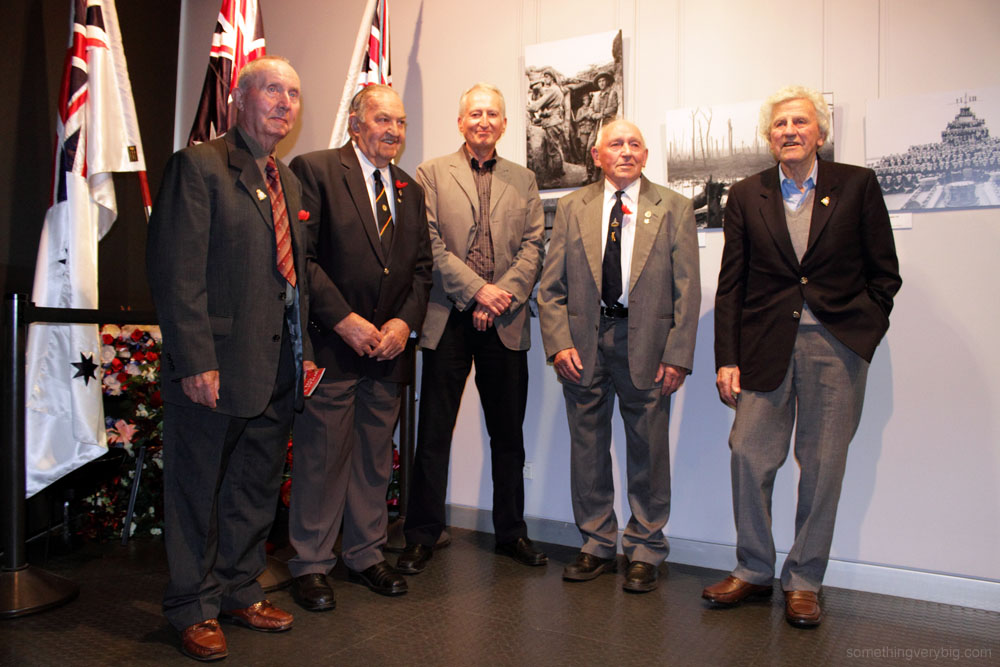
Left to right, we have Len Swettnam (a bomb aimer), Gerald McPherson (rear gunner), Peter Rees (author), John Wyke (another rear gunner), and Gordon Laidlaw (pilot).
Peter cites the lack of recognition given to Bomber Command and especially its returning veterans at the end of the war as one of the reasons he wrote his book. This event, of course, tied in with the Bomber Command exhibition which is now showing at the Shrine. And next week at the Shrine will be a panel discussion with, among others, Peter Isaacson, perhaps one of Australia’s most well-known Bomber Command airmen. It’s all evidence of the increase in awareness of Bomber Command in recent times.
At least a little bit of the credit for that should go to Peter himself. His very readable book has made some of the extraordinary stories of the ordinary airmen of Bomber Command accessible to a mass audience. That can only be a good thing, if the stories are to live on.
Bring on Volume Two!
The Shrine has placed a podcast of Peter’s talk on their website. The download is here.




 Something Very Big