Similarities

Henry wanted to be a pilot.

He learnt to fly gliders before the war and, when asked which branch of the Services he wanted to join, said simply that “I would like to fly aeroplanes because I already have a glider pilot’s licence”. Initially rejected for being too short, he served for a while on an anti-aircraft unit. But after a few months someone at headquarters evidently had a change of heart, and Henry found himself posted to pilot training school. Once he got there, so keen was he to learn everything he could about his new job that he would continue to study by torchlight, under the blankets, after lights out. After qualifying Henry flew many operational flights on a dozen or so different types of aircraft, ranging from twin-engined fighters and medium bombers to his country’s largest four-engined aeroplanes. Henry’s story is similar to those of so many World War II aircrew, and is included in Michael Veitch’s excellent book Fly (Penguin, 2008). But there is one key difference.

Henry’s real name is Heinz Hampel, and he was a pilot in Germany’s Luftwaffe.

What is eerily noticeable is how much Henry’s story parallels those of many Commonwealth airmen. Gil Pate, for example, served as a sapper in an anti-aircraft searchlight unit before enlisting as aircrew. Don Southwell told me of staying awake until one or two in the morning to study while at ITS. And a key motivation for many aircrew – for example David Mattingley (C07-052-015) – was the desire to learn to fly. The fighter pilots that the bomber aircrew would come up against in the skies over Germany were, in so many ways, just like themselves: ordinary young men who wanted to fly caught up in decidedly extraordinary circumstances. As Veitch writes in the same book about Peter Mehrtens, another German pilot, “sadly, it was the similarities rather than the differences with the people he was fighting that stood out for me the most”.

My friend Bryan, on a trip to Oktoberfest in Munich a couple of years ago, started chatting with a local lad of about the same age. Somehow the topic of the war came up. The young German had recently discovered a stash of his grandfather’s wartime memorabilia, including photos, medals and a Luger pistol. He had, as it transpired, been an anti-aircraft gunner in Dortmund. Bryan could relate a similar experience – his own grandfather, after whom he was named, was a man named Brian Fallon, a mid-upper gunner with 463 Squadron, and Bryan has his medals at home. “Brian had been on bombing trips to Dortmund so often”, he told me a few weeks ago, “that they called it the Milk Run.” He was staggered to realise that his grandfather and his new German friend’s grandfather had quite possibly been shooting at each other over the city. And now the two young men were sitting in a large tent, in the middle of a huge crowd of people, having a friendly conversation while drinking enormous steins of beer.

Seven decades earlier they might have met in very different circumstances.

© 2013 Adam Purcell

10 Really Useful Bomber Command Websites

The internet has revolutionised how people research and share information about just about anything you can think of (and, probably, lots more you can’t). The history of Bomber Command, and particularly where the individual story of a relative or friend is included, is certainly no different. Here, then, in no particular order, is a list of ten of what I consider the most useful websites about Bomber Command, all essential bookmarks.

  1. World War Two Nominal Roll – www.ww2roll.gov.au

If the airman you are interested in is Australian, this is always the first place to go. It contains a database of around one million individual records, covering all who served in Australia’s armed forces (and the Merchant Marine) during the Second World War, and a nifty search engine to allow you to extract it. You can search by name, service number or place of birth or enlistment, or even by any honours or awards won. The information returned for each individual is fairly basic but offers a good starting point for further research from other sources. It will show the last unit with which the individual served, which is most useful if they were killed but can be a little misleading if they were discharged at the end of the war.

  1. National Archives of Australia – www.naa.gov.au

The National Archives are the repository for all official Australian Government records. A powerful search engine allows easy access to the collection and many records have been digitised and are available to view on the website for free. If not yet digitised, the website allows you to pay a small fee for the service to be carried out for you – records will then be online for anyone to see. You can also order records for viewing in one of the NAA’s offices. As well as the obvious service records, the NAA  holds Casualty Files for any airman who was posted missing at any stage, and other Air Force records such as Squadron papers, orders and memoranda. There’s so much stuff here that it would take a very long time to sift through everything – but every now and then you find the little golden nuggets that make it all worthwhile.

  1. Commonwealth War Graves Commission – www.cwgc.org

If the airman you are interested in died during service, you will find a record about him at the Commonwealth War Graves. Like the Nominal Roll, the information is limited but it can provide a basis for further research, with details like parents’ names and occasionally addresses usually recorded. The advantage is that it covers any Commonwealth military death, so it will include information on the non-Australian airmen in a crew. You can even search by cemetery which can be a useful first step in deducing who else was in a particular crew, for example.

  1. Australian War Memorial – www.awm.gov.au

The Australian War Memorial, based in Canberra, holds significant material relating to Bomber Command. As well as information about planning a visit to the Memorial, you can find the history of Australia at war, browse the AWM Shop and, most usefully, search the catalogue of their entire collection, which contains much of interest to the Bomber Command researcher. Items held at the AWM are generally of a more personal nature than the official records you will find at the NAA, including diaries, photographs and other memorabilia.

  1. RAF Commands Forum – http://www.rafcommands.com/forum/

This is the go-to forum for those tricky questions about individual airmen or aircraft. It’s home to a large bunch of very good researchers who are usually more than happy to dig through their records on polite request. A large cross-section of RAF interests are covered and, if someone actually on the forum doesn’t have the documents they are looking for, there’s a good chance they know someone who does.

  1. Stirling Aircraft Society Forums – http://sas.raf38group.org/forum/index.php, and the Bomber Command History Forum – http://www.lancasterbombers.net/BomberCommandHistoryForum/index.php

These two forums both moved to fill the space left following the demise of the Lancaster Archive Forum. The Stirling Aircraft Society’s forum expanded its focus to include all of Bomber Command, and the Bomber Command History Forum is a new site run by one of the stalwarts of the original LAF. Both are very similar in scope, and indeed there is a significant overlap in membership between the two. You’ll find general Bomber Command discussion on aircraft, individuals or tactics, aircraft modelling (with a bomber focus) and general chat. While not as ‘scholarly’ as RAF Commands, there are still some quality researchers on both these forums and even a veteran or two.

  1. Gaining an RAF Pilot’s Brevet in WWII – http://www.pprune.org/military-aircrew/329990-gaining-r-f-pilots-brevet-ww11.html

This is a long-running thread started on an aviation forum by a Bomber Command veteran called Cliff Leach in June 2008 to describe his wartime experiences. To an avid audience of military and civilian aircrew, veterans, researchers and sundry others Cliff wrote about his enlistment and training as a Lancaster pilot and also as a flight engineer, which is how he ended up flying operationally. Various other veterans joined in – like pilot Reg Levy who flew Halifaxes in 51 Squadron, took part in the Berlin Airlift, was an air traffic controller for a short while and ended his flying career on Boeing 707s – and, while both Cliff and Reg have sadly since died, now holding court in the ‘virtual crew room’ is a Vultee Vengeance pilot named Danny who continued a long post-war career in the RAF. The best part about the thread remains its interactive nature, as people ask questions and contribute to the discussion. It is a very long thread (up to 215 pages at the time of writing) but a read of the full length will, while time-consuming, give a good idea of ‘what it was like’, as written by those who were there.

  1. The Australians at War Film Archive – http://www.australiansatwarfilmarchive.gov.au/aawfa/

Growing out of a landmark Australian television series in the year 2000 and commissioned by the Australian Government Department of Veterans Affairs, the Australians at War Film Archive website holds transcripts of more than 2,000 interviews with veterans of every conflict that Australia has been involved in from the First World War all the way up to the War on Terror. The veterans were asked about their entire lives – from growing up to their service and afterwards – and as such each interview is of significant length. Documentary makers can request footage for use in their own productions but for our purposes the transcripts are sufficient. There are at least 120 of them relating to Bomber Command and they are all worthwhile reading.

  1. Lancaster Bombers of 49 Squadron – http://lancasterbombers.net/lancasterbombers_v1_004.htm

A website set up by Dom Howard, the title is a little misleading as he has recently expanded to cover more than just 49 Squadron, with which he has a family connection. Dom now maintains a large collection of documents such as aircraft Loss Cards and Night Raid Reports, operational documentation like aircrew manuals and even some newspapers, all available to view online. The Loss Cards and Night Raid Reports are particularly useful for researchers looking at an individual crew and this is a convenient way of accessing them.

  1. An Ordinary Crew – www.ordinarycrew.co.uk

Another personal website, this one is run by Max Williams to showcase his work on the crew of Lancaster ME453, PO-L of 467 Squadron, lost over the Dortmund-Ems Canal in March 1945. As the title suggests, it’s about ‘just another ordinary crew’ and as such provides a very detailed and well-written account of typical experiences of a bomber crew at that time. It’s a moving tribute to the crew and a testament to Max’s efforts in uncovering their story. I’m told a book is in the works.

So, there are my ten essential Bomber Command websites. Leave me suggestions for ones I missed and I’ll add them to my link list.

© 2013 Adam Purcell

Two Railway Attacks: Tours and Lille, April-May 1944

By the beginning of April 1944, the crew of B for Baker had completed their first dozen or so operations. They had been members of 467 Squadron at Waddington for three months and their last time off had been in February. Consequently all seven spent the first week and a half of April away on leave.

But while they were away the war continued. I’ve been having a close look recently at the operations that were carried out during the period that the crew were at Waddington. On 10 April 1944 – the day that they were due back from leave – the rest of the squadron were part of a force of 166 aircraft that were sent to attack the marshalling yards at Tours in southern France. When I first saw the Tours raid in the Operational Record Books, I wasn’t intending to take too much time to study it closely because the crew of B for Baker were not themselves involved in it. But the Tours operation nevertheless shows some interesting parallels when compared with the operation a month later from which they failed to return, an attack on Lille on 10 May 1944.

Both operations were part of the so-called ‘Transportation Plan’, a series of attacks designed to cripple the Germans’ ability to move troops and equipment around France in preparation for the coming invasion of the continent. As such, each was one of a number of attacks made on railway targets on the same nights. 180 aircraft went to Tours, but only 89 went to Lille.

Interestingly, both were a little ‘different’ tactically when compared with the other raids they accompanied. While the four other raids carried out on 10 April (Aulnoye, Ghent, Laon and Tergnier) used Mosquitos to lay ground markers on the aiming point using the Oboe blind bombing aid, at Tours the marking was done visually by Lancasters under the light of white parachute flares, similar to the Pathfinders’ Newhaven tactics. Three other railway targets were attacked on 10 May 1944, each also using Oboe-equipped Mosquitos backed up by visual flares and using a Master Bomber to control the raid (Lens, Ghent and Courtrai). At Lille the same night, however, the marking was carried out entirely by visual means. At this stage in my research I can’t establish why Oboe was used for the other raids but not at Tours or Lille – perhaps it was a capacity issue, and the expected clear conditions and bright moonlight on each night meant that a visual technique was considered sufficient.

At both Tours and Lille, the first markers went down accurately. But on each operation problems arose after the first few bombs had fallen. At Tours, this was because the markers were laid on the actual aiming point itself, and smoke from the resulting bombing obscured the markers for later aircraft. The resulting delay before the target could be remarked caused some aircraft to circle in the target area for up to an hour. A new tactic was developed between the two operations so that markers were laid a short distance away from the actual aiming point, and bomb sights were adjusted accordingly so that bombs still fell onto the actual target, and Lille was the second time that this technique had been attempted. Unfortunately it failed when the first few bombs fell onto the target indicator anyway (perhaps because some early bomb aimers had not made the necessary adjustments to their sights) and it was extinguished or obscured by blast and smoke. A delay ensued, like at Tours, while the target was remarked and the appropriate wind correction was calculated for the bomb sights.

The biggest difference between the two raids, however, was that while the defences of Tours failed to take advantage of 180 bombers circling for up to an hour, at Lille it was rather a different story. Few fighters and little flak was encountered on the Tours trip and only one bomber was lost. But at Lille, while the delay was ‘only’ about 20 minutes and there was slight to moderate flak over the target, the fighters put up stiff opposition and twelve aircraft out of 89 failed to return.

————

Sources:

467 and 463 Squadron Operational Record Books for the Tours operation, 10APR44, and for the Lille operation, 10MAY44

Night Raid Reports Nos. 576 and 602

Lawrence, W.J. 1951. No. 5 Bomber Group, R.A.F. 1939-1945, Faber and Faber Limited, 24 Russell Square, London W.C.1, p. 185

© 2013 Adam Purcell

The First Flight in B for Baker

On Friday 3 March 1944, LM475, the aircraft that would become B for Baker, appears in Phil Smith’s logbook for the first time. Two flights are recorded on this day, and while on the face of it they appear perfectly normal – two sessions of High Level Bombing, one during the day and one by night – the entries would lead to much head-scratching on my part, some seven decades later.

Phil’s logbook records this for the first flight:

Lancaster LM475. Pilot: Self, Crew: W/Cdr Balmer, F/L McCarthy, Crew. HLB. Landed at Hunsdon. 2.05hrs Day.

There are a few curiosities in this entry. Wing Commander Balmer was the 467 Squadron Commanding Officer. It appears most likely that the other passenger was Flight Lieutenant Patrick Ernest McCarthy, who was probably the 467 Squadron Bombing Leader at the time. It is unclear whether Phil’s ‘normal’ bomb aimer Jerry Parker came along or not as Phil had a habit of not recording full crew names for non-operational flights. The reason for the trip to Hunsdon (a nightfighter airfield 20 miles north of London, or some 100 miles from Waddington) is unknown. There is a possibility that this could have been a check flight for either Phil Smith or for the new aircraft, though I don’t know if Squadron Commanders carried out this sort of activity. More likely, perhaps, is that Balmer needed to get to London and so Phil took the opportunity to take his new aeroplane for a spin to get him there.

The mystery deepens however when we throw the entry in Jack Purcell’s logbook into the mix:

Lancaster. Pilot S/Ldr Smith. Duty: Navigator. Remarks: Owethorpe – H.L.B. 1.25hrs Day.

Owethorpe is most likely a spelling error – there was a practice bombing range at Owthorpe (without the ‘e’), just east of Nottingham, and this was probably the destination for the bombing exercise. The High Level Bombing part agrees with what is in Phil’s logbook, but there is an alarming inconsistency here: Phil records the flight as having been 40 minutes longer than Jack did. My initial theory was that Balmer went along first for a 40-minute check flight in the Waddington circuit with Phil Smith only, and then the remainder of the crew with F/L McCarthy joined them for a flight to Hunsdon via the practice range at Owthorpe. But I’m not sure that 1.25 hours is enough time to get from Waddington to Hunsdon via Owthorpe, particularly when the later flight to another range close to Nottingham took 1.30 hours on its own.

This second flight appears to be recorded correctly in both logbooks. Phil says this:

Lancaster LM475. Pilot: Self. Crew: Crew, F/Lt McCarthy. HLB (5). 145yds bombing error. 1.30hrs Night with 0.45hrs Instrument.

And Jack says this:

Lancaster. Pilot: S/Ldr Smith. Duty: Navigator. Remarks: Eppistone – HLB. 1.30hrs Night.

These entries both clearly relate to the same flight (1.30 hours at night with S/L Smith), which was for more practice bombing. Once again F/L McCarthy went along (no mention if Jerry Parker was also on board though), and Jack has misspelt the destination (which come to think of it is a somewhat startling trait for a navigator!) which should probably be ‘Epperstone,’ the site of another practice bombing range seven miles north east of Nottingham. This also tallies with the entry in the 467 Squadron Operational Record Book:

No ops again today – instead we had 2 Bulls Eyes and plenty of Bombing Practice at night. With the moonlight conditions were ideal.

So this second flight is fairly easy to explain. But it’s hard to think of a scenario which could explain a flight on which practice bombing was carried out at Owthorpe AND a landing made at Hunsdon, with the Squadron Commander AND the Bombing Leader along for the ride, on a trip on which the pilot logged 2.05 hours but the navigator logged just 1.25 hours. The simplest explanation would be that Jack Purcell made a mistake. If we assume this was the case, it would be quite reasonable to fly from Waddington to Hunsdon, either to drop off W/C Balmer or simply as an exercise on which Balmer came along to observe, via a few practice bombing runs at Owthorpe range, and then back to Waddington again inside 2.05 hours. Judging on other parts of his logbook Jack’s record keeping was never particularly fantastic so a mistake is a distinct possibility. It does not sit well with the fastidious nature of his job as a navigator though.

There is insufficient information in the sources currently available to me to explain what might have happened in a definitive sense. The ORBs do not record non-operational flights in adequate detail and Phil did not write of this trip in his post-war manuscript so the only way of being sure would be to compare the logbooks of all those involved. But as far as I know out of the crew of B for Baker only Jack’s and Phil’s logbooks have survived, and they disagree with each other. This one will probably remain a mystery.

(c) 2013 Adam Purcell


Point Cook and the RAAF Museum

A little over twenty kilometres south west of Melbourne city, on the shores of Port Philip Bay, lies the birthplace of military aviation in Australia. RAAF Williams Base Point Cook is where land was purchased in 1912 for the newly-formed Australian Flying Corps, and where nine years later that fledgling organisation became the Royal Australian Air Force. In fact, until Richmond and Laverton were built in 1925 Point Cook remained the only military air base in Australia. Point Cook played an important role in training of pilots and officers and many other Air Force trades and disciplines over the next seventy or so years, and while military flight training ceased in 1992 the airfield remains operational with the Royal Melbourne Institute of Technology operating a flying school from it (though little military traffic uses it these days and the control tower has been empty for many years).
It is, therefore, a fitting location for the RAAF Museum. Housed in four Bellman hangars, the museum follows the story of Australia’s military aviation history – from the very first days of the Australian Flying Corps right through to current operations in the Middle East. There is a large collection of significant aircraft and artefacts and some intensive restoration work underway, including of a Mosquito which is the only known surviving airframe of that type with a WWII combat record.
Three times a week, on Tuesdays, Thursdays and Sundays at 1pm, one of the collection of airworthy aircraft will be parked in front of a purpose-built grandstand. An MC delivers a short introduction, then the pilot adds a few words and climbs in, fires up whatever old machine it is and takes off for a short 10-15 minute flying display. During the flight the radio calls from the aircraft are patched over the PA system. After landing, with the aircraft once again shut down in front of the grandstand, the floor is opened up for questions. The whole thing is carried out without fuss in about half an hour. It’s a great opportunity to see some flying action at close range and then have a chat with those responsible for flying and maintaining the aircraft. When I visited in May, the star of the show was a Harvard:

12-anzac-day-will-pt-cook-051 copy

Other days it might be a Tiger Moth, or a CT-4, or perhaps a Mustang. And it’s all done free of charge. The Museum reckons it’s the only place in the world where these sorts of aircraft are displayed regularly like this.
Point Cook was the site of No. 1 Service Flying Training School during the Second World War. As such an entire hangar is dedicated to training – with displays of some of the aircraft and devices used for training a very wide variety of Air Force personnel throughout the 20th Century and beyond. Most relevant to my interests (apart from a brief look at air traffic control) was a Tiger Moth, in the ubiquitous bright yellow colours typical of Elementary Flying Training Schools:

12-anzac-day-will-pt-cook-054 copy

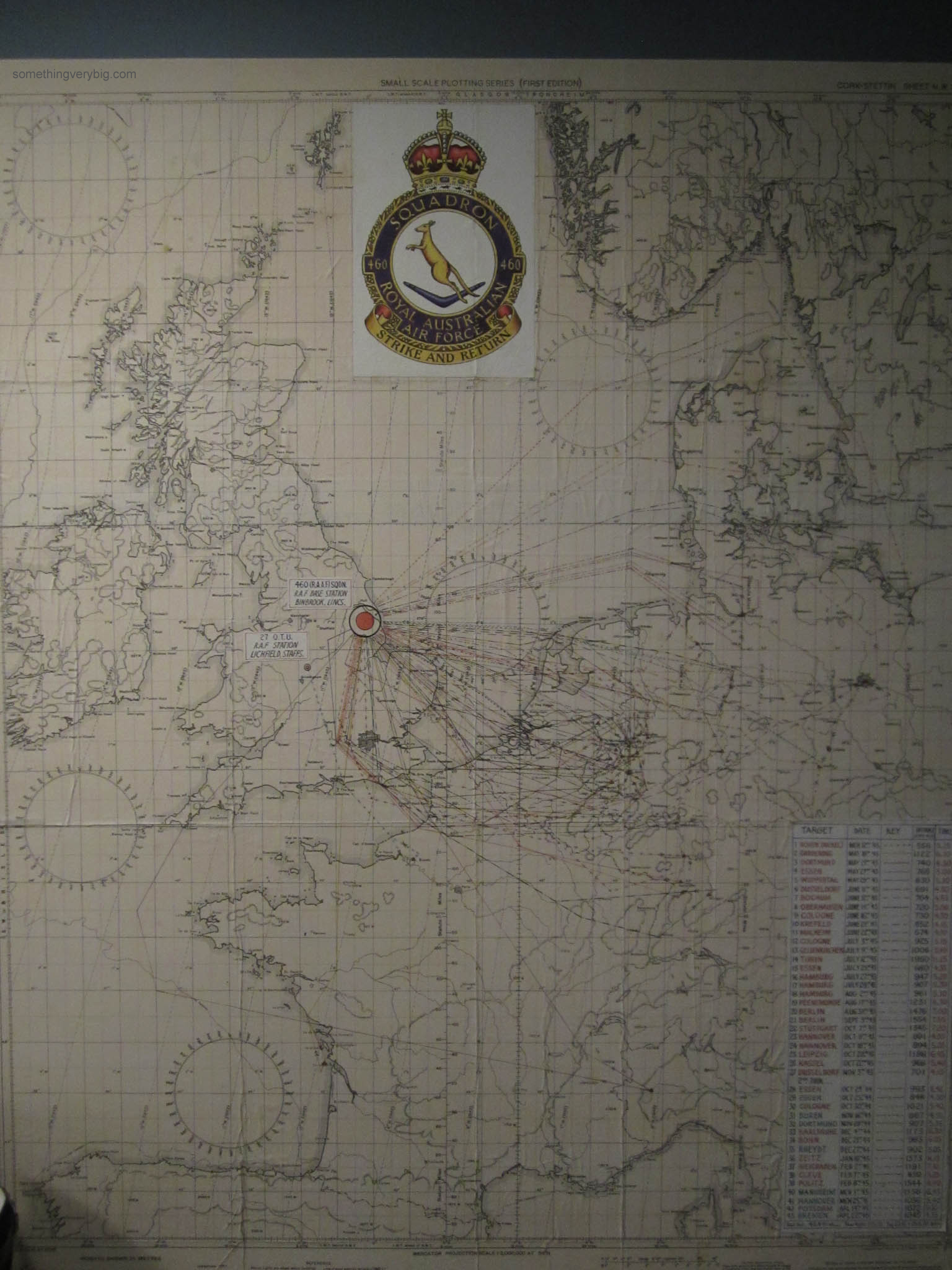
There was also an intriguing item on exhibition in the WWII Heritage Gallery:

12-anzac-day-will-pt-cook-045 copy

It’s a map of Europe, with the operations carried out by a 460 Squadron crew member marked on it. I couldn’t find a name to go along with it but in the bottom right corner is a list of all 43 operations along with dates. They span two tours, the first between 12 March – 03 November 1943 and the second from 24 October 1944 – 22 April 1945. Whoever the unknown crew member was, he was extraordinarily lucky. The particularly deadly Battle of Berlin period fell in the time that he was (presumably) instructing between his tours of operations.

Point Cook is steeped in history. Suburbia is fast encroaching (its sister base, just up the road at Laverton, has already been sold off for housing) but for the moment it is still an active airfield. The Government has announced a planned redevelopment with an “ongoing commitment to maintain the base” as an operating military airfield and continuing to “recognise the significant heritage of the site” which is very encouraging. Much work appears to have been carried out already – there is an excellent (but very large – around 75mb) presentation of ‘before and after’ photos from the end of 2012 available here on the Defence website – but I found many buildings that still look unloved as I wandered around the Museum precinct.
The difficulty is the trade-off between maintaining the base as an active RAAF station and retaining the heritage fabric of the physical environment. Remaining an active military base gives Point Cook an economic reason for continued existence and makes it more likely that future governments will continue to consider it a useful part of the Air Force’s infrastructure. But with that comes the security and access restrictions that the modern military demands, which seriously reduces easy access for the public. Opening the base to the public as a heritage site will necessarily reduce its utility as a pure military facility, and Defence will naturally be reluctant to take the required funding from its already stretched budget.
At the very least, though, the recent work will see the most significant physical parts of Point Cook’s heritage survive for some decades to come.

© 2013 Adam Purcell

Going to the Archives

Primary records are the foundation of any good history. And there’s nothing quite like going directly to the source to find them. I travelled to Canberra last month to plough through files at the National Archives of Australia and, as it turned out, also at the Australian War Memorial.

The National Archives are housed in a squat white building located behind Old Parliament House. While most files are stored off-site, the building houses offices, exhibition spaces and, in the back, the Reading Room where researchers can access original documents. I had previously ordered a number of files and they were waiting there for me when I arrived.

This visit was primarily looking for general 467 and 463 Squadrons stuff, and I wasn’t disappointed. Among other things, I found an internal signal to the Squadrons, explaining what went wrong during the disastrous Mailly-le-Camp raid on 3 May 1944, and the original order detailing the special training sortie to be carried out prior to the Marignane trip of 9 March 1944. I know that the crew of B for Baker were involved in both operations so these documents add considerable detail to the story. Another file allowed me to solve the mystery of why Jack Purcell waited until the middle of February to do his first operation, despite having arrived on the squadron in early January: he spent a week and a half in the Station Sick Quarters in the latter part of January and missed the Berlin trip (28 January) on which most of the rest of his crew made their operational debuts.

Some other files that I’m interested in, with intriguing titles like “Flight Planning Conferences”, “5 Group Tactical Summaries” and “Ideas and Inventions”, are marked “not yet examined” – offering the tantalising prospect of looking at files that no-one has ever seen before at the Archives – but these were not yet ready in time for this visit. Guess I’m coming back another time.

There are a few other files listed on the NAA database under a search for “467 Squadron” that are part of a series called ‘AWM64’. As it turned out these are actually held at the Australian War Memorial Research Centre. Conveniently, after spending most of the morning shuffling and photographing old papers at the Archives, this was to be my next stop.

As part of plans for the Centenary of ANZAC commemorations, the War Memorial is undergoing significant refurbishment works at the moment. Consequently the usual entrance to the Research Centre is unavailable and you need to be escorted through ‘back of house’ to access it. That minor inconvenience aside, the staff are exceedingly helpful and the collection, of course, is world-class. I was able to examine an original navigation log and chart for an operation to Konigsberg in August 1944 (the overwhelming impression is that navigators worked like cut snakes, with fixes every six minutes), a number of logbooks (including one for a navigator who completed a tour on Lancasters, then another one on Mosquitos and after the war flew extensively for Qantas Empire Airways) and diaries and, eventually, the relevant AWM64 files. Included among these are large-size notebooks which appear to be the Orderly Room’s master list of sorties carried out by each member of aircrew. They are incomplete and contain frequent blank pages but it was interesting to see evidence that French targets only counted for a ‘third’ of a raid up until Mailly-le-Camp. The crew of B for Baker were not among the names on the pages but others who occasionally flew with Phil Smith are there. I’m not sure that the full records have survived but even so, this could be a valuable resource for deciphering some of the more badly faded pages of the Operational Record Books.

A certain amount of ‘pot-luck’ is needed when ordering records at libraries and archives – sometimes the entries in the catalogues are less than descriptive – but that’s all part of the fun. Many times the files are not entirely relevant to the task at hand but, every so often, you find something unexpected in amongst the files. It was a useful couple of days work.

© 2013 Adam Purcell

Information Management Part II: The Database

Though I’ve been looking at the story of my great uncle Jack and the crew of B for Baker since about 1996, my work has really become serious over the last five or so years. In that time I’ve amassed and created a great deal of information: facts, documents, books, photographs, sound recordings, emails, letters and yes, even blog posts. Keeping track of all of that data is a significant task. In my last post I explained how I catalogue my sources. How to easily access the information contained within those sources forms the second part of my information management system.

The files from the first research I completed on my great uncle, which was for a competition called the National History Challenge when I was still in primary school, all fitted into a single A4 display folder. The second phase of work I did, in the year I took off between high school and university, filled a small portable filing box. I graduated to a two-drawer filing cabinet for paper notes and documents when I decided to start my current (and somewhat obsessive) work about five years ago, but by then digital storage was becoming predominant. While it’s still important to have access to the paper files in that cabinet (and I’ve filled another box with them too), most of my work (including this blog post as I write it) is now saved onto a portable hard drive on my computer and catalogued as I explained in my last post. And having stored and catalogued all of this information, the next step is the ability to easily search the whole lot to find the parts I’m looking for at any particular time. That is where a solid digital database comes in handy.

The one I eventually settled on is a self-contained piece of software called Personal Knowbase. It’s a simple, easy-to-use program that allows me to save my information in text-based articles and attach any number of relevant keywords to each article. Each article has a date stamp which can be set to any date – like the date of the letter or document under study, for example. I can then easily pull up any articles tagged with a particular keyword, or combination of keywords. Some examples of tags I’ve used might be general themes (‘training’, ‘flying’, ‘operations’, ‘England’ etc), individuals’ names, book titles, aircraft types, targets, airfields and so on and so on. I’ve also used my catalogue numbers as keywords which makes it easy to locate the source of any specific quote. I can easily run a more customised search using a combination of keywords, basic text searches and date ranges, across the entire database or a selected subset of it. Searches can then be exported in various formats for printing or review.

The point is it is very easy to access information when it is needed, and to be able to tell where that particular piece of information came from. And if I’ve used my keywords effectively, I can also pull up related articles – very helpful when looking for everything I have on a particular raid that happened on 10 May 1944, for example…

It’s not a perfect system. Simple things like typographical errors can make word searches difficult, and care needs to be taken to use appropriate keywords to avoid burying an important fact under a pile of other stuff. And like anything computer-related, the file is susceptible to a hardware failure or a file corruption, for example – the latter of which happened to me late last year. Happily, a solid backup regime provides a certain degree of redundancy and I was able to recover my file without losing too much work (the cause was eventually traced to a dodgy portable hard drive). My database is now automatically backed up in two separate locations, one of which is ‘off-site’, and I make an occasional manual copy too ‘just in case’.

Overall, it’s a useful bit of gear. I have the database window open on one side of my screen whenever I’m working on my research. Together with the catalogue spreadsheet, the database makes it easy to store, search and find virtually anything in my collection of sources.

© 2013 Adam Purcell


Information Management Part I: The Catalogue

I have something in the order of 13,000 individual pages in the sources listed in my catalogue for this project. Dealing with the sheer volume of stuff that I’ve gathered remains one of the big challenges of the work. Making interesting discoveries won’t do much good if I then forget where the discoveries came from, how I made them and where they fit into the story when it eventually comes time to write my planned book. There are two keys to my information management system: the catalogue, for knowing which source information comes from, and the database, for knowing what information is in those sources. This post will look at how I catalogue my sources.

If you’ve been reading this blog closely over the last few years, you may have noticed the occasional strange group of letters and numbers popping up in the posts themselves. The codes are in fact references to my catalogue of sources, and are the way I keep track of where my information comes from. The codes look like this, for example, from my ‘Accidents’ post of September 2010:

The second engine faltered shortly after crossing into England so they sought out an emergency aerodrome and, in Phil’s memorable understatement… (B03-001-016)

“…we crash landed rather unsuccessfully…”

Or these two, in ‘Motivations’ (November 2012):

Bill Brill was ‘getting a little accustomed to being scared’ (C07-036-159). And there is no doubt that airmen knew very well exactly how low their chances of surviving a tour were. Gil Pate wrote to his mother in November 1943 (A01-409-001): “It seems an age since I last saw you all + I guess I’ll need a lot of luck to do so again, the way things happen.”

The catalogue was one of the first things I set up when I got seriously stuck into this work in about mid 2008 and though it’s not an incredibly sophisticated system it is quite effective in keeping track of all the sources I’ve gathered over the last few years. It lives on a (well backed-up) multiple-tabbed Excel spreadsheet that I continually add to whenever I obtain a new source. Broadly, the code is split into four groups:

Designator-Series-Item Number-Page Number

The Designator tells me what type of source I’m looking at. It is the first letter in the group, and translates as follows:

A: Original (ie Primary) Documents, Scans or Copies – a document that originated during the war or the immediate period thereafter

B: Transcripts of original documents (used when I have not seen the original – ie someone else has transcribed it)

C: Post-war (ie Secondary) material

The types are broadly defined and can sometimes be a little ambiguous – at this stage it is not critical to define each type precisely. A general idea is sufficient.

The Series indicator defines the broad category under which the source fits. It decodes like this:

01: Letters and Telegrams (including letters I’ve personally sent and received)

02: Flying Logbooks

03: Diaries and Operational Record Books

04: Official Documents and Service Records – typically these documents come from archival collections such as the National Archives of Australia [www.naa.gov.au]

05: Photographs

06: Articles, Newspaper Clippings and Media Reports – including magazines

07: Books, Memoirs and Video

08: Databases

09: [Currently spare]

The Item Number is simply an increasing three-digit number for each individual document in each series (disregarding the designator), allocated in order of cataloguing. I haven’t yet reached greater than 999 items in any category, but if I do I’ll simply transition to a four-digit number for subsequent items.

The three-digit Page Number is the page of the document on which the actual quote or information can be found. Obviously for single-page documents or photos this would remain 001. If it’s a really long book with more than 999 pages, there is nothing stopping me using a four-digit page number.

So putting it all together, using as the first example the reference from my ‘Accidents’ post quoted above:

B03-001-006

This refers to a transcript (B) of a diary (03), which was the first diary I catalogued (001). The quote can be found on page 6 (006).

I then take those details over to my Excel spread sheet, where I find…catalogue

Which tells me that it’s a quote from Phil Smith’s diary. I originally got the document from Mollie Smith, and my copy of it resides in my filing cabinet in the folder ‘Smith, Phil’.

The quote from Bill Brill, in my second example above, has the catalogue number C07-063-159. So it comes from page 159 of the 36th book I catalogued, and the book was written post-war. Referring to my handy spreadsheet, I can see its source is Hank Nelson’s book Chased by the Sun, and that there’s a copy of it on my shelf should I feel the need to check the quote.

I’ve used this cataloguing system throughout this blog mainly for my own benefit, so that when I start writing the book I keep telling myself I want to write I can easily find where I found all of my information when I was writing the blog. Obviously the final book will be properly referenced rather than being interrupted by my own strange system of code groups of letters and numbers – but behind the scenes, when I’m doing the research and the actual writing of the story, it’s a quick and easy short-hand method of accurately keeping track of exactly where my information comes from and ensuring that I can easily check my sources for accuracy where required.

I have also incorporated the referencing numbers into the second part of my information management system – the database. Conveniently, that will be the subject of my next post.

© 2013 Adam Purcell

Air Traffic Control, Bomber Command-style

Around the time that Jack Purcell and his crew were on active service with 467 Squadron (January – May 1944), Bomber Command was routinely sending forces numbering six or eight hundred aircraft on large-scale raids against German cities. Even the ‘smaller’ raids on French targets still involved a couple of hundred aircraft each. Landing everyone safely at their airfields after the operation, in the dark, with no lights or radar, and contending with fatigued aircrew, battle damage and the odd German intruder attack, required the development of some remarkably sophisticated and highly efficient systems, and thus laid the foundations for what we now know as air traffic control.

There were a number of local variations depending on which Group the airfield fell under, but the basic procedure was that incoming aircraft would call up the control tower as they approached their home airfield to identify themselves. Flying Control would respond with instructions to either land immediately if there was no-one in front of them, or to circle the airfield, stacked above earlier arrivals at 1,000’ intervals. As No. 1 was in the circuit at 1,000’ and preparing to land, No. 2 would be circling at 2,000’, No. 3 would be at 3,000’ and so on. No. 1 flew around the circuit, following the ‘Drem’ lights located around the airfield, and the pilot would report on the radio as he passed each position: ‘crosswind’ as he passed over the upwind end of the runway, perpendicular to it; ‘downwind’ as he passed the mid-point of the runway, flying parallel to it (which is also where he would begin a slow descent from 1,000’ to land), and ‘funnels’ as he made the final turn to line up with the runway, facing into wind. Then he would wait for the green light from the aerodrome controller (who was located in a caravan parked next to the landing end of the runway) before landing and taxying off the runway to dispersal. Meanwhile, No. 2 became No. 1 and would leave the stack. He would adjust his circuit spacing and speed to position himself one reporting position behind the aircraft in front. As each aircraft left the bottom of the stack, everyone else still circling above them could be stepped down a level until, in turn, they were at the bottom and next to land.

Arrival over base could be inside 10/10ths cloud. In this case, according to 49 Squadron veteran rear gunner Hugh McLeod, the navigator would use the ‘Gee’ navigation aid to home in to the airfield. He would be calling instructions to the pilot in much the same manner as the bomb aimer would while over the target: “Starboard a bit, Skipper… hold it there… should be coming into view now”. Hugh says it was accurate enough to take the aircraft all the way to ‘funnels’ – quite astounding accuracy for the time. In the event of an intruder alert (“this happened to me on three occasions,” Hugh said), an emergency call would come over the radio, lights everywhere would be turned off and the arriving bombers would all scatter until the all-clear sounded or they diverted to other ‘dromes.

It’s interesting to study how the ‘Quick Landing Scheme’ worked in practice on a typical operation. My interest was piqued by an entry in the 467 Squadron Operational Record Book, following a Berlin raid on 15/16 February 1944. Pilot Officer Clive Quartermaine, flying in Lancaster LM338, said this in his interrogation report:

Had to circle base for 40 minutes before landing. Quick Landing Scheme disappointing.

This was an intriguing comment, I thought, and warranted further investigation. Happily, the ORBs for both 463 and 467 Squadrons record landing times for each aircraft at Waddington. I plotted reported landing times in five-minute blocks, for all aircraft landing between midnight and 1 a.m. LM338 landed at 00.53 (in red). The resulting table looks like this:

Time Aircraft   Landing Times
0000-0004 0001 0001 0003 0004
0005-0009 0008
0010-0014 0010 0011 0012 0014
0015-0019 0015 0015 0015 0017 0019
0020-0024 0022 0023
0025-0029 0025 0029 0029
0030-0034 0032
0035-0039 0036 0039
0040-0044 0040 0041 0043
0045-0049 0045 0047 0048
0050-0054 0053
0055-0059 0056

During this hour, thirty aircraft landed at Waddington. The longest gap between arrivals is five minutes (it comes immediately before Quartermaine landed). Without a modern-day radar controller judging approach paths and in darkness, the odd ‘blow out’ of a few extra minutes in the landing sequence is quite understandable. Shorter intervals are far more common and, assuming the times recorded in the ORB are indeed accurate, there were an amazing three arrivals in a single minute at 00.15. Tellingly, this was about 40 minutes before Quartermaine landed, so was quite possibly about the time that LM338 arrived overhead – to find a large stack of aircraft already awaiting their turn to land.

In the next 40 minutes, as Quartermaine and his crew circled overhead the field, a total of 21 aircraft landed. At a rate better than one aircraft every two minutes, this is actually a reasonably efficient use of the runway given wartime conditions (blackout, no lights, no radar control, fatigued crews etc). There is insufficient evidence about the timing of when other aircraft arrived over the field, but there is a good chance that other captains faced similar waiting times.

So while P/O Quartermaine may well have felt a little hard-done-by having needed to wait for so long, it was a simple case of too many aircraft arriving at once and not enough runways for them to use. This basic cause of airborne delays is still a common occurrence in modern-day air traffic control. Nothing ever changes… someone still has to wait!


Descriptions of aerodrome control come from C07-014-123, The Trenches in the Sky by Dan Conway, and C07-050-023 Takeoff to Touchdown by Don Charlwood. Hugh’s recollections were related in a phone call in May 2013.

© 2013 Adam Purcell

Flying around the bases

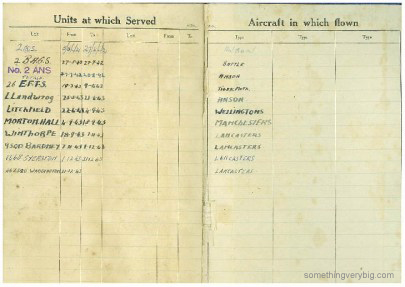
In the very back of my great uncle Jack’s wartime logbook is a list of places and dates. It records the places at which he served, from Air Observer School right through to the Squadron. Jack evidently wasn’t the world’s most fastidious record keeper because the list is missing some places that are shown on his service record, but it does list all of the airfields he was stationed at.

jacklog-postings copyThe last eight names on the list are in the UK. When I was over that side of the world in 2009 I hired a light aeroplane and a local instructor from Tatenhill Aviation and flew over four of them, plus a number of others.

Tatenhill was a satellite airfield for 27 Operational Training Unit, RAF Lichfield. As it turns out, Lichfield itself is not very far away. Just after we took off we turned left – and there it was, less than seven miles to the south.

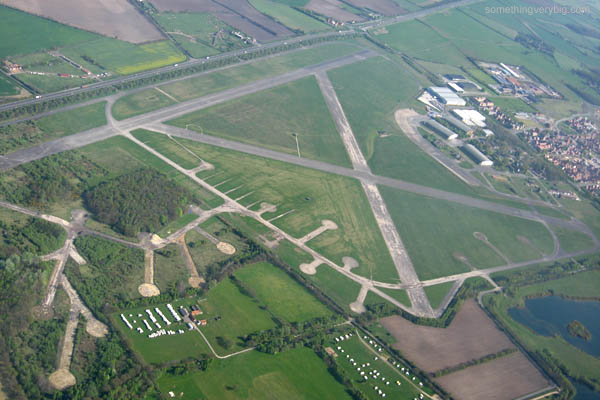
22APR09 064 copy

At first it took me a moment to recognise it as an airfield. Parts of a runway and a number of hangars are still extant, but on top of what used to be a runway is now a great big Tesco warehouse. The northern corner, with half a runway, some taxiways and a couple of blister hangars, is the best-preserved section of the old airfield, though now in considerable disrepair.

Morton Hall was not an airfield, though it is very close to the remains of RAF Swinderby. It became No. 5 Group Headquarters a few months later but it appears that it was a venue for lectures about security and significant physical training at the time that Jack was there (C07-014-067). It was a prison when I drove by in 2009 and is now an immigration detention centre, so no photos. On my flight however we did see Swinderby.

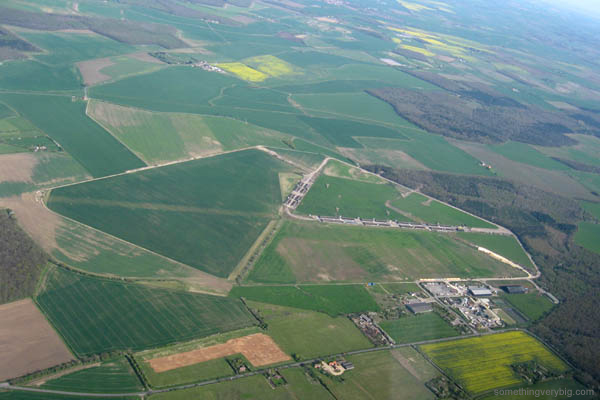
22APR09 013

I was quite pleased to discover what appeared to be a relatively well-preserved RAF airfield when I visited on the ground a day or so later – but just a few months later the whole site was flattened for development.

But enough of that. Onwards with the aerial tour through Jack’s logbook. Winthorpe was a Heavy Conversion Unit, where Jack and his crew got to grips with the Lancaster for the first time.

22APR09 047

One corner of the airfield is now the Newark Showgrounds, and across from those is the fantastic Newark Air Museum.  There’s very little remaining of the original airfield, and the runways, which were used for gliding until recently, are no longer fit for use. But at least one corner of the old airfield still has some sort of aviation activity taking place on it.

Bardney is only a few miles from Lincoln. From the air, the triangle of the runway layout is still visible, though most of the hard surface has been removed.

22APR09 029

The old airfield has reverted to the farmland it one was, with thousands of chickens now occupying sheds on what used to be the runways. Jack was only here for a few months serving on 9 Squadron, losing his pilot in a ‘second dickey trip before flying operationally himself. The crew did record some training flights from here however.

After losing their pilot Jack and (most of) his crew were posted to another Heavy Conversion Unit, this time at Syerston, where they joined up with Phil Smith. We skirted around Syerston on my flight but didn’t actually go over the top so I have no aerial photos of it – though I did visit the RAF Gliding squadron that now occupies the site on weekends.

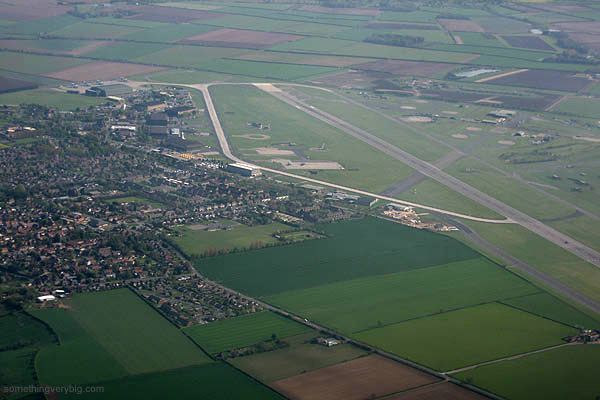
The last unit in Jack’s logbook is of course 467 Squadron at RAF Waddington. This is where, on 10 May 1944, he and his crew climbed aboard B for Baker and took off in the direction of Lille on their final flight. Waddington remains an active RAF station and retains very little of its wartime ‘feel’, though remnants of the original triangle runway layout are still used as taxiways.

22APR09 016

There were a number of other airfields that we also flew over on this trip, with names like East Kirkby, Conningsby, Metheringham, Bottesford and Tollerton. What was perhaps most telling for me, used to the wide open spaces you get flying in Australia, was how close by everything is. I logged 1.5 hours for this trip, out and back, and we flew over at least ten separate wartime airfields that I could recognise, with a good few others nearby that I couldn’t identify. It’s not hard to imagine how crews could get lost and land at the wrong airfield, particularly during the wartime blackout, and the proximity of the bases would have considerably heightened the collision risk.

Most poignant, however, was at the most easterly point of our flight, near East Kirkby. From there, the coast is about fifteen miles away. That coast line was extraordinarily significant to the aircrew of Bomber Command. On the way out, it marked the end of friendly territory – beyond it was the enemy. And on the way home some hours later, it meant they were back among friends.

© 2013 Adam Purcell