Searching for Ken Tabor

1850279 SERGEANT

K.H. TABOR

FLIGHT ENGINEER

ROYAL AIR FORCE

10TH MAY 1944

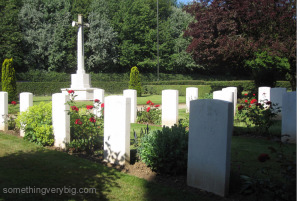
So reads the inscription on one of the nine Commonwealth War Graves in the Lezennes Communal Cemetery, near Lille in France. It commemorates the flight engineer of LM475, one Kenneth Harold Tabor.

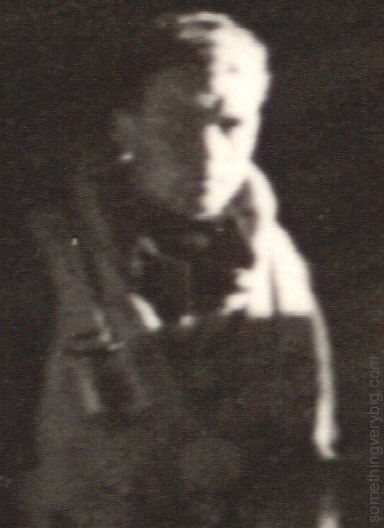
This was quite literally all the information that I had when I began this search. The only known photo showing the entire crew includes Tabor:a05-019-001-med copy
Ken is third from the left:

a05-019-001-large copy

But it was Mollie Smith’s superb archive of letters which revealed the first clue. Wing Commander Bill Brill – the 467 Sqn Commanding Officer at the time of the Lille operation – wrote to Don Smith in September 1944 to advise contact details for the next-of-kin of the rest of Phil’s crew. A Mr J Tabor lived at 104 Castle Rd, Winton, Bournemouth, Brill wrote (A01-074-001).

My first step, then, was suggested by my good friend Max Williams . He provided the addresses of four Tabors listed in the Oxford/Bournemouth phone book. I wrote letters to each… but of the four, one was no relation and the other three were all related to each other, but not to the Tabors I was searching. Call that a dead end.

Steve on the Lancaster Archive Forum suggested doing a search on the FreeBMD website. This turned up a K H Tabor, born in 1924 in Christchurch, Bournemouth. His mother’s maiden name, the record said, was Lanham. This would have made Ken 20 at the time of his death – young, but certainly plausible. The trick, though, would be to try and match that record to the ‘right’ K H Tabor. I needed to go overseas to find the next clue.

I had a few days at the end of my UK travels in June 2010 to spend at the British Library, intending to try and find what I could on the two remaining members of the crew. Sadly most of their electoral records were ‘in transit’ to another storage location when I visited so only selected records were available on microfilm. Luckily for me, this included parts of the Bournemouth rolls. I spent perhaps half an hour grappling with the microfilm machine before I came across what I was looking for. There, at 104 Castle Rd, Winton, were listed John Albert and Dorothy Violet Tabor.

Ancestry.com was my next stop – which revealed a marriage record for a John A Tabor to a Dorothy Violet Lanham-Smith in 1919 in Christchurch.

I had a match.

Further searching revealed more tidbits. John Tabor was born in 1894 in Poole, Dorset. He died in 1956 in Bournemouth. Dorothy was born in 1899, and died in 1978 in Poole, Dorset. A letter from Sydney Pate to Don Smith in November 1944 suggests that they also had a daughter.

At the time of writing I have not yet managed to find the final link to living next of kin. The next step I think will be to obtain copies of the death certificates for Ken’s parents from the Bournemouth record office – which I’m hoping will allow me to find a newspaper death notice. My hope is that I can use that to find names for surviving next-of-kin… and the process then starts again.

In 2004, Freda Hamer visited the cemetery in Lezennes. In front of Ken’s headstone when Freda arrived was a small bouquet of flowers. This is encouraging. To me, it seems certain that someone, somewhere, still remembers Ken Tabor.

All I need to do is find that someone.

© 2010 Adam Purcell

Canvas

It’s happening.

Steve has started sketching the basic outline for the painting onto the canvas. Here’s a preliminary photo:

lancaster_1-blog1 copy

You can see the general arrangement of the Lancaster (with H2S bulge) and the crew bus. The squiggles in the middle will, I’m told, eventually turn into the crew themselves…

Actually introducing paint to the canvas will happen, Steve says, in the next week or so. In the meantime, we now need to start thinking about where the bike and a few other details will fit in…

Rollo

While sorting through some of my old files recently I found a few sheets of notepaper stapled together and covered in the messy scrawl of my own handwriting from some years earlier. It was a description of some of my early flying lessons from late 2003. As I read through it I chuckled to myself as I remembered the events I had described. On one page however, the flying story came to an abrupt stop. The handwriting became bigger, messier, more hurried. At the top of the page was scrawled,

“PHONE CALL FROM ROLLO KINGSFORD—SMITH, 6.30pm 13/12/03”

Rollo was the nephew of perhaps the most famous of all Australian aviators, Sir Charles Kingsford-Smith. Far from hiding in the shadow of his famous uncle, Rollo had a distinguished career of his own in the Royal Australian Air Force. He was, in fact, the first Commanding Officer of 463 Squadron, which had been formed in November 1943 from ‘C Flight’ of 467 Squadron and was also based at Waddington. In 2003 Rollo lived in the village of Exeter, in the far south of the Southern Highlands of NSW, not too far away from where I grew up. I had discovered that he had flown – and in fact had a narrow escape – on the Lille raid of 10 May 1944 on which Jack Purcell and his crew were shot down, so I sent him an email.

A few weeks later I was writing out my flying account, having completely forgotten about the email, when my telephone rang. It was Rollo, calling for a chat. The notes I found recently had been scribbled during this phone call. Rollo remembered Phil Smith as a man who “kept much to himself but seemed a pleasant chap”. This certainly bears out with Phil’s letters and with Dan Conway’s description of him as a “fine example of quiet efficiency” (C07-014-143). Phil Smith had passed away some nine months previously and, while I had been lucky enough to meet Phil a few years before his death, it was quite something to hear about him from someone who had known and served with him at Waddington.

Given his close shave on the Lille trip it is not surprising that Rollo could remember it well. My notes from the conversation tell me that it was very important that they “only bomb the railway” on the night – I’m guessing that this was to avoid French civilian casualties. The Pathfinders marked the target, Rollo said. Then:

“we milled around for five minutes or so and that gave the German defences time to get organised”.

As we now know, it was this delay – actually lasting 21 minutes (A04-056-002) and caused because the first markers on the target were quickly obscured by smoke – which contributed to the surprisingly high casualties on the Lille operation (C07-018-185). Rollo said that the bombing height for this raid was very low – only about 6,000 feet – which would also have raised the risks for the bombers by bringing them into the range of light flak. There was, he remembered, “intense” flak about though he could not remember seeing any fighters about. Given the target’s close proximity to a nightfighter airfield and the delay in marking the target this, with the background knowledge I now have, I find curious. I can only conclude that Rollo and his crew were lucky – certainly the possibility of a nightfighter attack rates fairly highly on my list of theories to explain what caused the loss of LM475.

I never spoke directly to Rollo again. I had seen him at a Bomber Command Commemoration at the Australian War Memorial in Canberra, but never got the chance to have another chat. He died in 2009, but I consider myself honoured to have spoken even so briefly with such an amazing man.

© 2010 Adam Purcell

Concepts

As explained in this post, I’ve engaged the services of a good friend of mine to paint me a picture of Lancaster LM475. I’ve decided to start an occasional series of posts dealing with ‘the process’ of how the painting develops over the next couple of months.

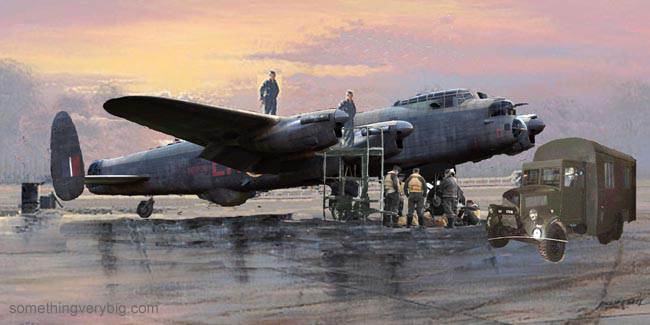
Steve and I have been throwing ideas around for the last few weeks, and now we are starting to see some concepts ‘on screen’, if not exactly on canvas yet. The traditional method for deciding on a composition, Steve says, is to actually sketch out ideas on paper. Those days are no more, thanks to Photoshop. Steve mocked up a proposed composition using a CGI image that I’d found on the Lancaster Archive Forum (thanks Peter) and a few other bits and pieces:

lanc20copy1-blog copy

Already the feel of the scene is coming through…

The beauty of Photoshop, of course, is that even those like myself, suffering a severe lack of skills in the drawing department, can have a fiddle with some things. So I found our lonely ‘erk’ a work stand…draft1-copy-blog1 copy


…then decided the stand (and ‘erk’ – who had, Steve tells me, been rudely snatched from a USAAF Lightning and suddenly transported into the RAF) would work better on the other wing…draft2-copy-blog copy


So I bounced both of my ‘amendments’ to Steve to throw in to the mix.

These were always intended to be very crude representations of an overall concept for the painting. Details like the bicycles and any other bits of the flotsam usually found near a dispersal haven’t arrived on-scene yet. But they can come later.

Next step: the canvas.

Visit Steve’s website for more of his work…

Accidents

Life in Bomber Command was a hazardous affair. Apart from the obvious – anything the Germans could throw at them – aircrew faced many other dangers in the long road to an operational squadron. Out of more than 55,000 aircrew killed serving in Bomber Command, some 8,000 died in accidents.

In the early 1940s, the aeroplane had existed for just four decades. Equipment was still primitive – especially compared with modern aircraft. Engine and other system failures were common, particularly when pushed beyond their design limits by the realities of wartime all-weather flying. Aircraft used at Operational Training Unit level – the unit at which airmen would ‘crew up’ and learn to fight – were often older, tired-out aircraft because the priority for the best equipment understandably lay with the operational squadrons themselves.

The aircraft on which most of the eventual crew of LM475 completed their OTUs in late 1943 was the Vickers Wellington. This was the type of aircraft on which Phil Smith flew his first tour of operations with 103 Squadron from Elsham Wolds from October 1941-June 1942. Phil’s first operation was as a second pilot on 16 October 1941 to Duisberg. Due to an oil problem they shut down one engine crossing the Dutch coast on the return flight. The second engine faltered shortly after crossing into England so they sought out an emergency aerodrome and, in Phil’s memorable understatement… (B03-001-016)

“…we crash landed rather unsuccessfully…”

All got out with only cuts and bruises.

But while Phil’s first crash in a Wellington was caused by mechanical failure, accidents could also come about from somewhat more mundane problems. Chief amongst these was human error. “I have come to the conclusion since I have been flying”, wrote Phil Smith to his mother in 1941, “that the machines are much more reliable than the humans that fly them.” (A01-147-001)

While the truly unsuitable were theoretically weeded out at the elementary flying training stage, even the best could occasionally make mistakes. On first arrival at Elementary Flying Training School in Tamworth in November 1940, Phil Smith wrote to his mother: (A01-126-001)

“The discipline up here appears unpleasantly severe, partly, we are told, because there was a fatal accident not long ago due to lack of flying discipline.”

An accident in a Tiger Moth witnessed by Phil at Elementary Flying Training School at Tamworth, NSW, in January 1941 was, according to the RAAF Preliminary Report of Flying Accident, put down to (A04-072-001)

“Poor technique and lack of anticipation on the part of the instructor”.

What happened to the instructor’s career subsequently is not recorded.

Inexperience played a big role in air accidents. The pilot of the Tamworth accident that Phil saw was lucky enough to walk away – but sometimes aircrew were not that lucky. During Phil’s time at 21 OTU, Moreton-in-Marsh, between August and October 1941, he witnessed or heard about many incidents. At least four are recorded in his diary – ranging from less-serious accidents like a burst tyre in August to an aeroplane flying into a hill and killing all seven on board in early October. The cemetery on the road between the airfield and the town of Moreton-in-Marsh bears witness to the appalling loss of life both from this accident and, sadly, from many more just like it. In all 46 airmen from the OTU are buried there. In a similar way, just outside the site of the old RAF Lichfield airfield is Fradley Church. 35 airmen rest here – which, according to Chris Pointon (RAF Lichfield Association historian) are only casualties from the period prior to August 1943. To avoid taking over the church yard, he says, following that date burials took place at Chester Blacon, almost 100km to the north west of RAF Lichfield. – there are 35 more there. A further six casualties were buried at Oxford Botley, 100km south.

Even then, that is not all of Lichfield’s victims. One of the men to die at Lichfield was Sgt AH Ashwood. He was killed on 27 September 1941 after sustaining serious burns in a Wellington crash which Phil Smith witnessed while out on a training flight himself (B03-001-013):

“We went first to Lichfield which is north of Birmingham.” […] We landed and no sooner had we got out of the plane than we saw a Wimpy start to burn on the runway. A very nasty memory, these planes are certainly death traps if they catch alight.”

Sgt Ashwood was buried in Margate, Kent – which was where his parents lived during the war.

Phil, of course, was not entirely immune himself. On squadron at Elsham, he was flying night time practice circuits with another pilot in January 1942. Bad visibility hampered their efforts but all went well until Phil’s last landing. They touched down nicely, but then (B03-001-015):

“the wheels collapsed and we settled down on our belly in the middle of the runway. It looks as though I selected the wheels up instead of flaps.”

Phil received a negative endorsement in his logbook following this incident, the cause being called “faulty cockpit drill”, put down to “inexperience”.

Perhaps the saddest epitaph of them all, however, is carved into one of the headstones in Moreton-in-Marsh and has nothing to do with aeroplanes.

“Killed in a road accident”, it reads. “Thy will be done.”

25jun10-056 copy

(c) 2010 Adam Purcell

Halifax

The Halifax – that ‘other’ aeroplane in Bomber Command’s arsenal – was badly maligned for much of WWII. Leo McKinstry, for example, in his recent book Lancaster: The Second World War’s Greatest Bomber, records Sir Arthur Harris trying to close down Halifax production lines in favour of the Lancaster.

The earlier Halifaxes – Mk IIs in particular – were indeed pretty poor aeroplanes. Ron Houghton, a 102 Sqn Halifax skipper, spoke at the Royal Aeronautical Society’s Sydney Branch meeting in late August 2010. He described his first flight in a Halifax at a Heavy Conversion Unit in mid 1944. It was a B MkII series I, and was seriously underpowered and too slow for its purpose. The nose design, with a front turret, meant lots of drag. Half way down the 1100 yard runway on its take-off roll, with full power selected, the aircraft had barely reached 65 miles per hour.

“I don’t like this”, Ron said to his instructor.

“Keep going”, was the reply.

900 yards down and speed still barely above stall.

“I really don’t like this”.

“Keep going”.

They dragged the aeroplane reluctantly off the ground, just clearing the trees at the end of the runway. Climb rate was negligible. Wide-eyed, Ron asked the instructor, “How does this thing handle with a full bomb load?!?”

“DON’T ASK!!!”

Ron told us that the Mk IIs had a 99-foot wingspan and squared-off wingtips, designed like the unfortunate Short Stirling to fit inside the standard 100-foot-wide RAF hangar. This combined with the high drag from the front turret and the lack of enough power gave them a service ceiling of only around 12,000 feet – well inside range of German flak guns. They also had a nasty reputation of entering an unrecoverable spin if stalled with one engine out, caused by a faulty rudder design. No wonder, then, that Ron spoke of his delight at arriving at 102 Squadron at Pocklington to discover that the squadron had on that day received the first of their much-improved Halifax Mk IIIs. With no front turret, redesigned rudders, new slightly wider wings and vastly more powerful Bristol Hercules engines, the new generation ‘Hallybag’ had a 24,000’ ceiling and held much better survival prospects.

They were still complicated machines however. Ron related the requirement for pilots who were converting onto the Halifax to be able to draw a diagram of its fuel system from memory – all 17 tanks and many, many taps and lines and switches. There was, Ron said, “an awful lot of juggling of fuel”. The fuel tanks themselves had an ingenious system by which nitrogen was added to each one as it emptied, thus vastly reducing the risk of an explosion should a bullet or shell pierce it. There was just one piece of armour plating that Ron could remember, placed like the Lancaster on the rear of the pilot’s seat.

Ron mentioned crashed Halifaxes in Germany being recovered, restored and then flown into the bomber stream, crewed by Luftwaffe airmen, to follow and attack other bombers. This was I thought an interesting idea that I must admit I have not seen any documentary evidence of – if anyone is aware of this please get in touch!

The most important question, however, concerned the relative merits of the Halifax vs the Lancaster. The Halifax reputation suffered considerably from the faults of the earlier variants, but by war’s end the Mk III was close to the Lancaster in performance, if not in bomb-carrying capacity. Having flown both Ron was in a good position to compare ‘which one was the better’, but ever the gentleman he is he would not be drawn into judging one way or the other, saying only that the two were “pretty equal”.

So there we have it – a potted history of the Halifax, by someone who was there. Ron’s talk was fascinating. At its conclusion I got the chance to speak to him briefly and I will make sure to get in touch in the next little while to talk about it in more detail. Ron spent 35 years after the war flying for Qantas… and I’ll bet he has some stories to tell about that as well!


(c) 2010 Adam Purcell

Read and post comments | Send to a friend

Finding Dale Johnston

Alastair Dale Johnston – known as Dale – was the wireless operator on LM475. A tall redheaded Queenslander, Dale was 24 when killed over Lille.

As he was a member of the Royal Australian Air Force, Dale’s service record was easily obtained from the National Archives of Australia. In fact I had a copy of this document as far back as 2003. So I knew from an early stage Dale’s path to 467 Squadron, via 14 OTU Cottesmore, 1661 HCU Winthorpe (where he would have met Jack Purcell and Jerry Parker) and 9 Sqn at Bardney. There is a photo believed to show Dale with Jerry Parker and two as-yet unidentified airmen that was probably taken at either Winthorpe or Bardney. When their pilot was lost over Berlin on a ‘second dickey’ trip, Dale and his mates ended up at 1668 CU, Syerston – which is where they joined with Phil Smith and Gil Pate before their posting to 467 Squadron, Waddington, 30 December 1943.

The search for Dale’s family took me down a couple of dead-end streets but in the end success came unexpectedly easily. I felt I knew the family before I found them because I had read many letters from them. Dale’s mother Fannie was, like many of her time, a prolific writer. Many letters from her survive in Mollie Smith’s superb archive. Sadly, her handwriting – not fantastically clear to begin with – noticeably deteriorates as time goes on. There were also a couple of letters from a mysterious ‘Mollie Webster’, which appeared to be from someone in this family as well.

The key lead in this search came from a letter written by Edward Purcell – my great grandfather – to Don Smith, Phil’s father:

“My chief grief at the moment is for my… now old and very valued… friend, Mrs Johnston. She has, as you already know, lost one boy on the Sydney, and, as her other son, Dales twin, is now on active service” (A01-086-001)

The relative openness of Australian authorities (when compared to their British counterparts – perhaps a subject for a future blog post) meant that it was straightforward to find the names of Dale’s two brothers.  The HMAS Sydney connection was particularly valuable, given publicity in the last couple of years surrounding the discovery of the wreck of that particularly unfortunate ship. A search on the Commonwealth War Graves Commission’s website for Johnstons killed on the date the Sydney was sunk yielded a couple of possibilities – but I knew Dale’s father’s name was Charles Erskine so there was a very good chance that one Donald Erskine Johnston was the man I was after. CWGC confirmed Donald’s parents matched those of Dale – so one brother was uncovered.

I could then plug Dale’s date of birth into the Department of Veteran’s Affairs WWII Nominal Roll to search for Brother # 2. Two options came to light – Aubrey Thomas or Ian Rennie. Aubrey was according to the Nominal Roll in the Merchant Navy but Ian was in the Air Force, which seemed to me to be more likely to match the ‘active service’ description from Edward Purcell.

I tried tracing Ian on the Ryerson Index which had proven so useful in the search for Gil Pate. This revealed an entry for a local Queensland newspaper from 1992 but without a copy of the actual death notice following this one up was going to be tough.

Don Johnston seemed to be the best way forward. I searched for an HMAS Sydney crew list, and found the HMAS Sydney II Virtual Memorial. Some crew on the list have short histories attached that have been submitted by families. Crucially, Ian’s history was available in a scanned PDF document – which included this:

“Donald Erskine Johnston the youngest son of Charles Erskine and Francis Emma Johnston, was born on the 17th January 1921 in Oaklands (Southern Riverina) NSW. He had a sister, Mary Rothney, who is still alive today at age 92, and twin brothers Alastair Dale and Ian Rennie. The twins joined the RAAF during WWII. Alastair was a member of 467 Sqn when he was shot down and killed over Lille in France on the 10th or 11th May 1944. Ian survived the war, and died in 1992.” (C06-049-006)

In one paragraph it confirmed I’d found the right Johnston, showed that someone, somewhere remembered the boys – and raised the intriguing possibility that their sister was still around.

I contacted the Naval Association who runs the Virtual Memorial website. Their President, Les Dwyer, did the rest. He passed my request to the people who had submitted the history – and a few days later, Don Webster contacted me. He was Mary’s son. Sadly he told me that she had died a couple of years ago – but he did clear up that she was known as Mollie (which, of course, explained the letters from Mollie Webster).

Finding Don Webster completed the tally of four Australian crew members. With Freda Hamer the first of the British group to be traced, this leaves two more – the families of Ken Tabor, flight engineer, and Eric Hill, mid-upper gunner. I’m still working on these ones…

(c) 2010 Adam Purcell

BUMP – My site stats shows that someone today (15APR11)  found this blog through a search engine, searching for Charles Erskine Johnston. As you can read above, Dale’s father was a man of the same name. If this looks like being the same bloke, please drop me a message through the comments box below.

Read and post comments | Send to a friend

Tiger Moth

How I imagine Phil Smith’s solo might have happened…

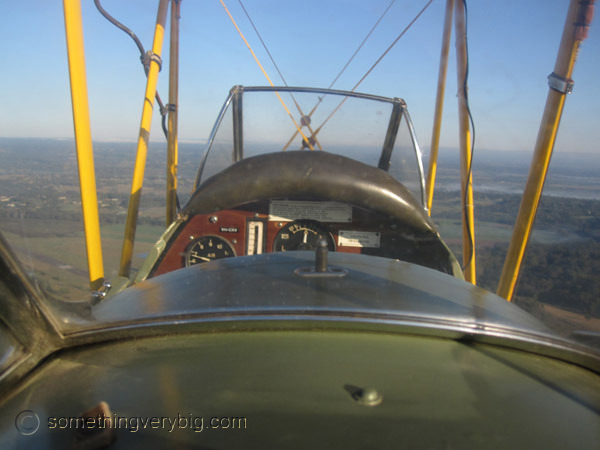
“It’s all yours, Smith – just do what Maguire told you to”, the senior instructor yelled into Phil’s ear, as he dropped off the wing and walked away from the Tiger Moth. It was early on one of those mornings that had the promise of turning into a real stinker in Tamworth. “And don’t bend it!” He waggled the elevator up and down – oh yes, keep that stick back, Phil, you twit – as he left. Phil blipped the throttle to get her moving, pushing the rudder pedals one way and then the other to keep the Tiger Moth weaving but heading, on average at least, in the direction he wanted it to. As the nose moved to each side, he peeked down the other side of the fuselage to make sure they would not taxi into anything.

Still rolling, Phil pushed the throttle forward to carry out his run-up checks – reaching outside the cockpit to flick the magneto switches off and on one at a time while  listening for a faint drop in RPM, closing the throttle and checking it idled smoothly, ‘stirring the pot’ with the control stick and rudder pedals – then released the trim. Nearing the far end of the field now, he checked the windsock, satisfied that from here he could take off directly into the light breeze that was blowing. He checked for any approaching aeroplanes, then turned into the wind and opened the throttle.

As the Tiger started to accelerate, he added progressively more left rudder to counteract the swing to starboard – the tail came up and suddenly he could (after a fashion) see ahead. Like the graceful creature she was, the Tiger Moth lifted from the grass, seemingly all by itself. Wow, he wasn’t kidding, they do climb better empty. Phil pushed forward slightly on the stick to place the horizon just below the edge of senior instructor F/O Maddocks’ windscreen (speaking of Maddocks, where was he?), adjusted the throttle back to 2150 rpm and checked the airspeed indicator. Good, he thought, it’s reading about 55 knots, just where it should be. Gee, it’s chilly up here. Keep those b—-d wings level – still got the power on, still got the left boot jammed into the rudder pedal. Sneak a glance at the airfield behind, the slipstream clawing at the top of his leather cap. Flying straight, that’s good.

Approaching 500’ on the altimeter now – lead the turn with a little rudder, then ease into the bank. Stop the turn. Still climbing. Nearing 1000’, circuit altitude. Turn downwind, lower the nose a little and reduce the power to about 1900 rpm – there, that sounds about right. Trim out the control forces – airfield off to the left, its far boundary just outside the wingtip. There goes another Tiger, he thought, as a little yellow biplane lifted off. With the power back it’s marginally warmer, but it’s still jolly cold in here. Wow, I’m actually flying – by myself! He looked all around, but it was true – he was the only one in the aeroplane. Solo!

“Wings level”, growled Maddocks through the Gosport.  Or he would have, had he been there. Whoops. Phil came back to reality. His touchdown point slipped past the left wingtip and it was time to think about the approach. I thought I’d be more nervous than this. Pull the throttle back to idle now – the engine coughed a bit, must have moved the throttle a bit too fast. It settled, and Phil kept the nose up as the aeroplane decelerated. Rolling into the base turn – don’t forget that rudder – he looked through the wires at the touchdown point. Looks a little high, he thought. Wait… don’t fall for that one again. Maguire had always told him it was easier to lose height than try and find it again. With the power at idle, all went comparitively quiet and he listened to the sound of the wind through the wires. Whoops. The singing wires turned higher in pitch. Too fast. Nose up a bit – the noise fell away and the aeroplane slowed down. There. That’s better. He shifted his backside on his parachute – the aeroplane wobbling from the inadvertant rudder movement. Aiming point – that rough patch of grass – stayed framed by the wings, just where it should be.

He started rolling into the final turn – added a bit of right rudder to sideslip neatly towards the ground. Too high – watch that airspeed – more aileron and more rudder to steepen the sideslip, then the aiming point disappeared below the nose and it was time to straighten up. Kicked her straight, brought the wings level – put on a trickle of power for the extra control authority. Transitioning into the flare, Phil brought the stick back a little bit. Feeling for the runway – lots of little, almost imperceptible jerks on the controls – then he felt the wheels kiss the grass. Power off – a tiny bounce – then she settled. Stick forward a tiny bit to pin the wheels onto the deck. Keep her straight! The Tiger Moth slowed down and Phil’s view forward disappeared as the tailskid dropped neatly onto the ground. Keep her straight! At walking pace now. Phil turned off the runway. There’s Maddocks, out to the side – how curious, he almost looks pleased. Taxied to the flight line, weaving back and forth – there’s that erk again, waving him in. There now – throw the switches, the engine stopped, the Tiger Moth rolled tidily to a halt, perfectly lined up with all the others. Helmet off, harness unbuckled, stand up – on shaking legs – climb out of the aeroplane (don’t forget to turn off the front switches). It’s only then that he realises what he’s just achieved.

Big silly grin.

Solo.

First Solo in a Tiger Moth

(c) 2010 Adam Purcell

Read and post comments | Send to a friend

Visiting George

This was originally posted by me on the Lancaster Archive Forum, 28APR10. I thought it appropriate for a cross-post.

After spending most of a Wednesday morning and a fair proportion of the afternoon at the National Archives of Australia in Canberra making copies of the Casualty Files belonging to three of the Australians on my great uncle Jack’s crew, I drove across Lake Burley Griffin to the Australian War Memorial. The purpose, ostensibly, was to make a recce of the Research Room for the upcoming meeting of the Lancaster Archive Forum brigade. But something else happened while I was there.

I found myself being drawn towards the ANZAC Hall, the impressive display space at the back of the Memorial where the large-technology objects live. The largest of these, of course, is Lancaster bomber W4783 G-George, a 'high-scoring' Lanc from 460 Squadron – and it was this aircraft that was drawing me in.

The first thing that you notice whenever you stand in close proximity to one of these aeroplanes is just how big it is. I moved to the floor underneath the bomber – just walking around it in circles, looking up.

Every hour, on the hour, the lights around George dim. You begin to hear the sound of Merlin engines being run up. It’s the start of the AWM’s impressive Striking by Night exhibition, a sound and light show representing one of George’s many operations. A few years ago I was standing next to a Bomber Command veteran watching the show. He said it was pretty realistic – “but much louder than I remember it!” The show started as I was standing under one of the engines. I stayed there and watched and listened. When it ended the small crowd that had gathered to watch it dispersed – but I found myself frozen to the spot.

Just looking up.

I visited RAF Waddington for ANZAC Day 2009. This was expected to be one of the highlights of my time in Europe. It was, after all, the place at which Jack and five of his comrades set their last foot upon the Earth. And though it was a fantastic experience, there was something that I was missing. After Phil Bonner dropped me off at the Horse and Jockey to pick up my hire car, I tried to drive back into Lincoln. But something wasn’t letting me drive away. Something was keeping me there. I drove again around the outside of the perimeter of the station, but I left feeling very unsettled. There seemed to be unfinished business at Waddington.

As I tried to leave George, I felt that same unsettled feeling. Like something was calling me back. I can't explain for sure what it was. But the aeroplane – a collection of metal, shaped and bolted together in just the right way – had something else to it. Something I could sense. I walked slowly up the stairs nearby, lingering for a time at the top, just gazing at the Lancaster. Even as I turned and walked away, I felt the need to look back over my shoulder. The unsettled feeling stayed.

Each day as the Memorial closes there is a simple ceremony as the sun sets. Still feeling troubled, I stayed to watch. A lone piper stood under the Roll of Honour. He began to play an old Scottish lament, took perhaps a dozen steps forward, then turned to face the silent crowd. His haunting notes echoed around the courtyard. The piper was nearing the end of the piece as I watched him turn about face and slow-march up the steps leading to the Hall of Memory, which houses the Tomb of the Unknown Soldier.

He crossed into the Hall.

The doors swung silently shut behind him as the last notes rang out.

I looked up at my great uncle’s name, forever engraved on the Roll of Honour.

I smiled, nodded, turned on my heel – and walked away.


Original location: http://lancaster-archive.com/forum/viewtopic.php?f=11&t=2522&p=25043 

(c) 2010 Adam Purcell

Read and post comments | Send to a friend

The Shadow in the Corner

My father first showed me my great uncle’s logbook and a few faded photos when I was perhaps eight or nine years old. Since that time, I have always been aware of the family legend that tells the story of the Man in the Photograph. I think my sister Jen said it better than I can when she visited the grave in Lezennes in September 2007:

“Jack has always been an intangible legend. A god. The man of the medals and he blue felt covered notebook. The man of the faded photo and the tragic love story. Larger than life. The sudden realisation that this legend was human came when I read out aloud his age of 22…the age I will be in less than six months. So I sat in front of a war grave of a man I was so utterly disconnected from, but so inextricably connected to, and cried”.

There has always been this ‘idea’ of Jack in the back of the collective Purcell family mind. The idea is of a young man who sailed to far-off places to fly in a war from which he never returned, leaving only a handful of photos and that much-prized blue logbook to survive through the decades. Jude Findlay – a great nephew of Jack’s from the other side of the family – called him “the Shadow in the Corner”. While growing up Jude was always aware of the legend. In fact Jack’s death affected Jude’s father so much that he went and joined the RAAF himself.

Consequently Jen is right when she calls Jack a ‘legend’. Certainly he has been turned into a legend, being the focus of much of the family lore that originally got me hooked on the story. But along with the ‘legend’ tag has come some mythology, or at the very least some stories of debatable or unconfirmed authenticity. Like the story that says Jack was to be married the Saturday following his death. Or the claim that his mother only signed his enlistment papers in the belief that a knee injury picked up as a young child would disqualify him from active flying. Both these stories I heard originally from my grandfather (Jack’s nephew). They may well be true – but they may also be somewhat ’embellished’. The Purcell family, of course, is far from alone when it comes to these family stories. One example is the tale Gil Thew tells of his uncle Gil Pate who, he says, was recalled off end-of-tour leave for ‘one last’ operation to Lille from which – of course – he never returned.

The problem is that, unlike the hard facts like dates and places that can be found in service records and logbooks, for the somewhat ‘romantic’ stories like these ones there is generally no definitive primary evidence – especially where the serviceman concerned never returned from the war. In these cases grieving families, desperate for any clue as to what might have happened to their loved ones, could perhaps grab hold of any information that might possibly relate to the bomber war and ‘extrapolate’ it into a theory relating to their missing man. It could also be a comfort or a defence mechanism, as a way of dealing with what happened – believing, for example, that the aeroplane was brought down by flak rather than a more mundane and somehow less acceptable accident like a collision. Over time, the theory becomes ‘fact’ in the minds of the successive generations of the family. This is the danger of relying solely on ‘oral histories’ from members of the various families.

But while dry facts like dates and places and timelines can come from official documents, it’s these stories that add a ‘human’ element to the history. It is, after all, a ‘family’ history – as much the story of the families as it is of the airmen themselves. How the families dealt with the loss is a legitimate part of the history – even if the stories they used to cope are slightly stretched versions of the truth.

This post took well over a week to write. I started off going in one direction but in the writing it took a few unexpected turns. I’m not entirely sure what it became – which is why I left it for a few days. I’d especially appreciate your comments on this one please!


Current task: Editing and cataloguing Dale Johnston’s A705


(c) 2010 Adam Purcell

Read and post comments | Send to a friend