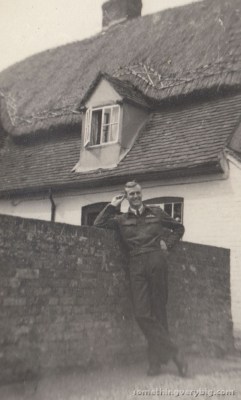
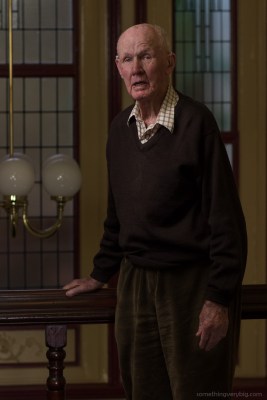
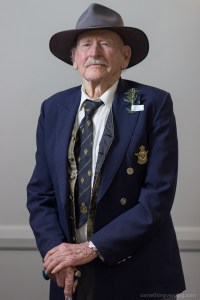
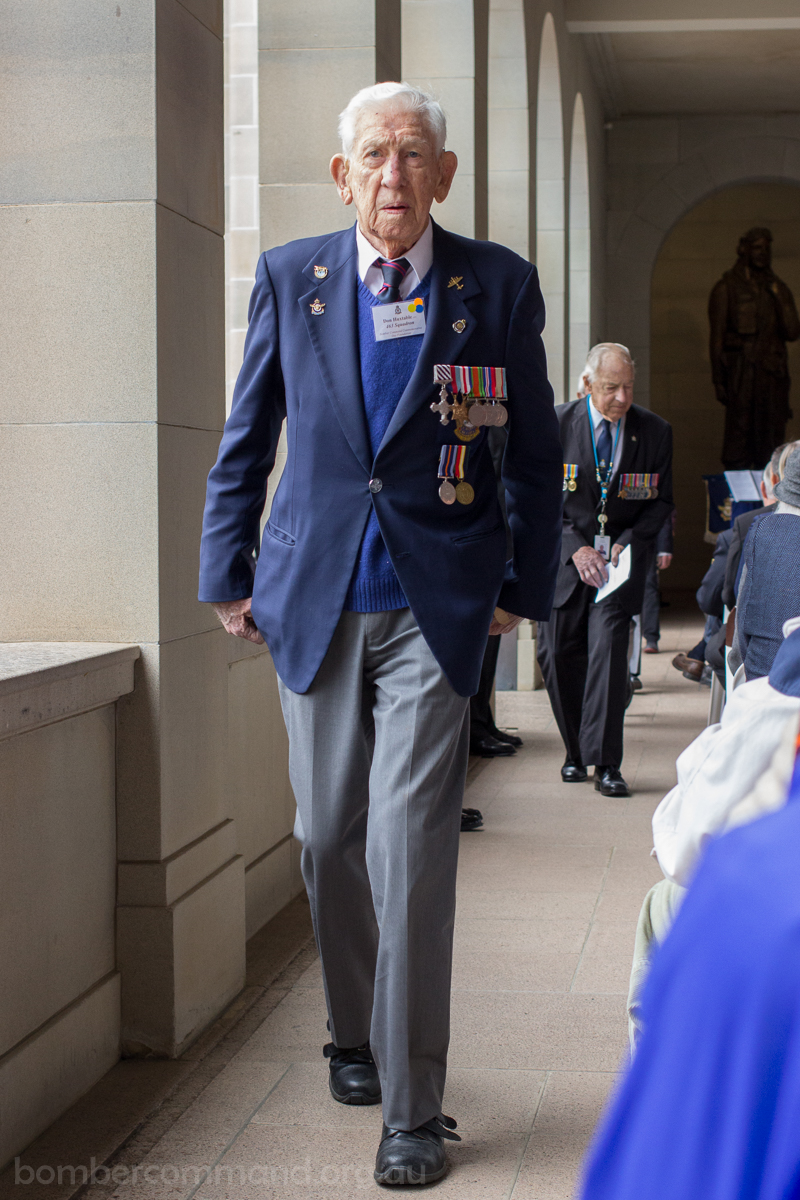
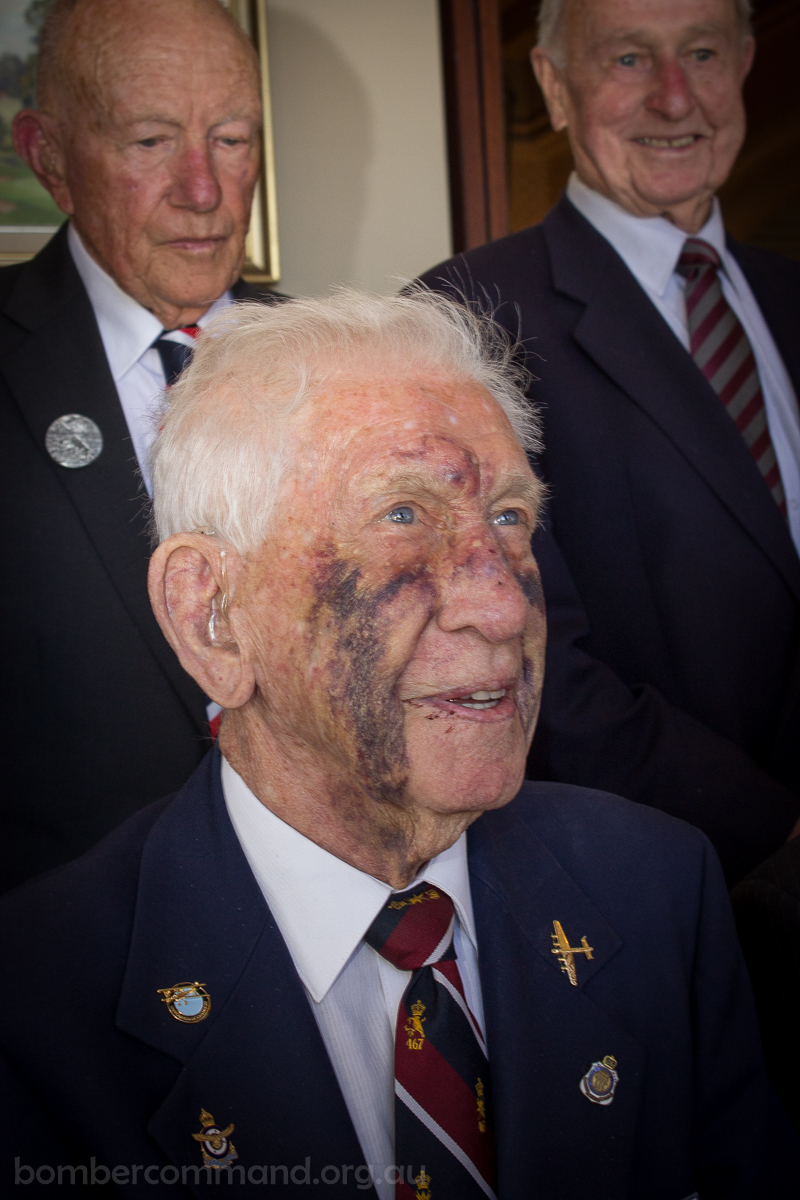
IBCC Interview #9: Denis Kelly – 467 Squadron Wireless Operator and Evader

denis-kelly-copy

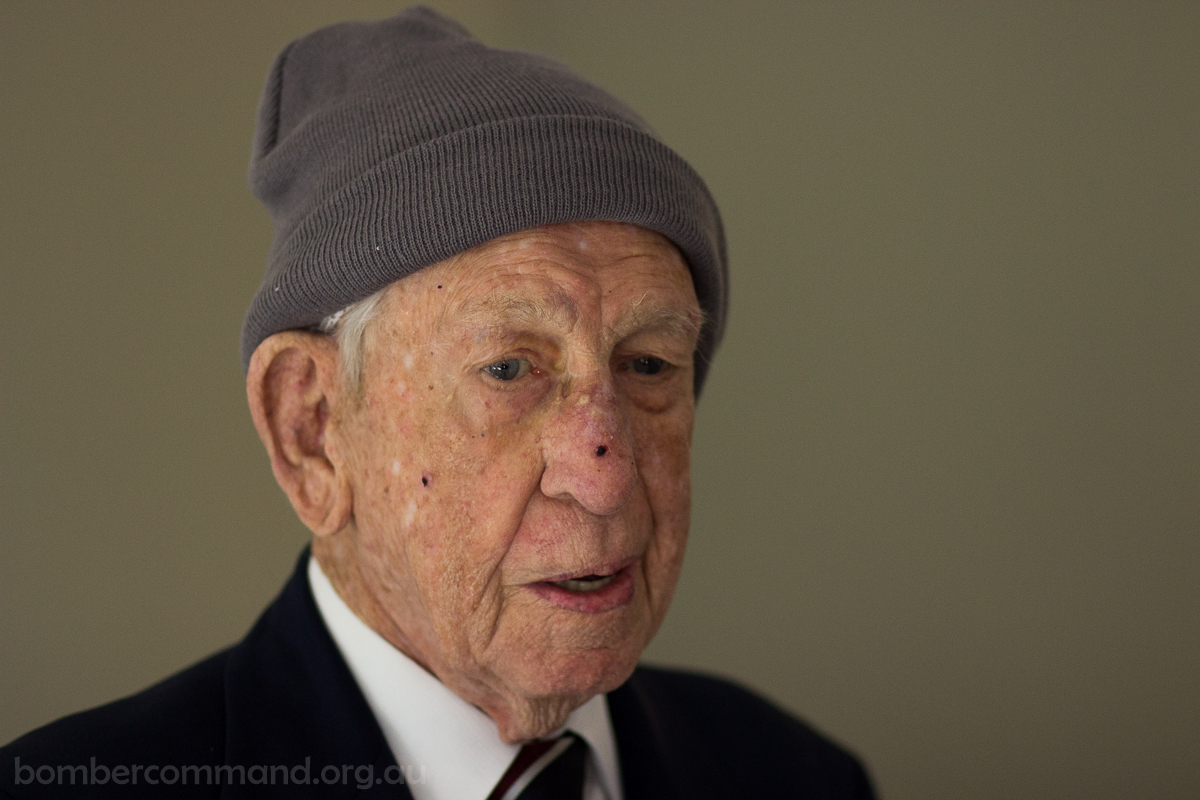
“I thought, I’m done, I can’t get out of this ditch, I’m gunna die here. And that was frightening.”

When I rang 467 Squadron wireless operator Denis Kelly to arrange an interview for the International Bomber Command Centre’s Digital Archive, he told me that he’d almost completed his tour of operations when he was shot down over France in July 1944. I was excited when I hung up the phone: no doubt this would be a good story for me to capture for the Archive.

But when I set up my microphones in his little retirement unit in Melbourne’s far south-east on one warm December morning, what he told me was more than just a good story. It turned out, without exception and without exaggeration, to be the most astonishing tale I have ever had the privilege of hearing first-hand.

And it goes something like this.

Denis Kelly was already married with an infant son when he joined the Air Force at 19, wanting to be a fighter pilot. A lack of depth perception discovered at Initial Training School in Victor Harbour saw him chosen instead for wireless training, which he completed at Ballarat. He sailed to war via the USA (including an unauthorised couple of days in New York), did some more flying at Llandwrog in north-west Wales and crewed up at RAF Lichfield with an Australian pilot named Tom Davis.

Posted to 467 Squadron at Waddington, Denis and his crew began flying operations in late April 1944. They were on many of the same trips as the crew of B for Baker, including Mailly-le-Camp on 3 May (though not the fateful Lille raid a week later). Life on operations was a continual strain, broken only by wild parties in the Mess or short periods of leave. Denis was convinced that with each trip, his supply of luck was steadily being used up. “Every op you completed brought you one closer to the one that would get you.”

On 18 July 1944 the crew attacked Revigny, in France. Close to the end of their tour, this one would indeed turn out to be the one that got them. “We had dropped our bombs,” Denis recalled, “and we’d just turned round and [were] making for home and then BANG, we were hit.” His radios exploded as the aircraft started to burn. The pilot yelled to bale out. Denis immediately clipped on his parachute and went down to the door at the back of the aircraft, pulling on the mid-upper gunner’s legs as he went past to signal that he was about to go. He opened the doors to the rear turret to help the 19-year-old gunner inside to escape, to be confronted by a shocking sight.

“His head was… well, he was dead.”

Denis’ parachute pack and battledress was beginning to smoulder by this time, and the pilot was still yelling to get out.

“So I went to step out – and then I remembered, never step out of a Lanc, you gotta dive.”

Denis dived.

“Next thing I know, I was falling, I was smoking, so I pulled the ripcord at the exact second I hit the ground.”

The impact caused him severe injuries: he later discovered that it had compacted his legs and spine so much that he was a full three inches shorter afterwards. “I thought I broke my spine,” he said. More immediately, his legs simply refused to work.

Denis dragged himself painfully over to a nearby tree. “I thought, ‘my wife’s not going to know I’m here, she’ll think I’m dead. She’ll get the telegram, I can’t do anything about it…’”

Two other members of his crew had landed nearby, and all three held a council of war to decide what to do next. Unable to walk, Denis decided he would be a liability and convinced the others to go on without him. They left – and Denis began a courageous attempt to crawl his way across France. “It was marshy ground, fortunately,” he said.

For the next two days, Denis dragged himself laboriously along on his elbows, moving about “50 yards every three hours.” At one point he slithered into a canal and swam, until he came to a bridge that had German guards on it. In the water he beat a cautious retreat. Getting out of the canal was difficult without the use of his legs, but after several attempts he managed and continued on his slow, determined but excruciating way. He came to a road, started crawling across it – and mercifully passed out.

Evidently deciding he was safe enough, Denis’ mind simply shut his body down. “The Harley St people said it was mind over matter, [my] mind said ‘you’re safe there,’ so…” The next thing he knew, he was being prodded by the boot of a curious French civilian. Lying there, Denis croaked the only French he knew: “Je suis Anglais parachutist – soif.” – “I am an English parachutist – thirsty.” The Frenchman produced a full bottle of beer, and Denis gulped the lot. Then the Frenchman rolled Denis into the ditch at the side of the road – and left him there.

“I thought, I’m done, I can’t get out of this ditch, I’m gunna die here. And that was frightening.”

After Denis spent a terrible day in the ditch thinking the worst, that night the Frenchman returned. He brought with him two others, some spare civilian clothes and a bicycle. Dressing Denis in the clothes, they propped him up on the bicycle, legs hanging below, and took him just a little further downstream from where Denis had scrabbled out of the canal to the house of a lock-keeper named Victor.

Denis stayed here for several weeks while his immediate injuries healed and while he figured out how to walk again. At one point he was taken to see two other members of his crew, in another safe house nearby. This happened to be on Denis’ 21st birthday. Unbelievably, when Denis informed one of the Frenchmen of that fact he produced a bottle of Moet champagne, and all present enjoyed a glass.

After leaving Victor’s care, Denis was hidden, guarded by a gigantic and fierce dog, in the locked room of an unknown house, and later in the attic of a hospital. A little later Denis was picked up again, by a pair of Resistance fighters driving a car fuelled by a charcoal-burning contraption bolted to the back of it. They informed him that a British aeroplane was coming to pick him up that night, and that they were taking him to the landing ground. But on the way there, they saw an identical little car being towed by some German soldiers. The Frenchmen, recognising the car as belonging to one of their comrades, panicked. Clearly the operation had been compromised. The car stopped, the Frenchmen jumped out and urgently knocked on the door of the nearest house, and Denis was unceremoniously pushed inside. (Denis was later told that a British aircraft did indeed land to pick up a whole bunch of evaders, and that the Germans waited until it was loaded and had taken off before shooting it down in cold blood.)

Denis’ new host was not enamoured with the idea of involuntarily sheltering an Allied airman, and by the third day, despite not sharing a common language, he made it clear that he was not welcome. So Denis left.

He was now alone in occupied France.

For the next little while (he isn’t certain how long), Denis wandered between farmhouses scrounging for food. It was at one of these places that he met an American airman, a Thunderbolt pilot who he knew only as ‘Tex’ who had been shot down some nine months previously. They decided to join forces. For a while all was ok, but scrounging sufficient food for two was even harder than it had been when they were on their own. As they got hungrier they started to take more risks, and one day it all came unstuck.

They were in a café and the plan was for Tex to cause a distraction at the counter while Denis pinched a loaf of bread. Unfortunately, two German soldiers walked in at the exact moment that Tex began talking, in his broad Texan accent, to the girl behind the counter. The game was up. The two unfortunate airmen were handcuffed and taken away.

Interrogated half-heartedly by an elderly German soldier who reminded him of a nice old school teacher, Denis was informed that as they had been caught in civilian clothes it was being presumed that they were spies. They were to be taken to Berlin for further interrogation by the Gestapo. “I’d visions of my fingernails being pulled out,” Denis said with a shudder. Sure enough, the next night Denis and Tex were taken to the station, handcuffed together, and were on the point of being bundled onto the train when one of their two guards ducked around the corner to answer a call of nature.

“Tex looked at me,” Denis recalled. “He didn’t say anything but I knew he was going to [do something].” Denis watched wide-eyed as Tex kicked the remaining guard in the groin, stole his gun and shot him in the head. Predictably the other guard then stuck his head around the corner to see what the fuss was about, and Tex shot him too. And then, still handcuffed together, the two airmen ran. Amazingly they were not chased. They spent the next few nights in several barns until they managed to convince one of the farmers to remove their handcuffs with a cold chisel.

Despite their shared perils, however, Denis and Tex went their separate ways shortly afterwards. And here’s where Denis’ story gets truly bizarre. He was just outside a forest one day, foraging for food, when he heard some tanks approaching. So he high-tailed it into the forest and up a tree – then watched in horror as the tanks, which were German, stopped and proceeded to set up their own camp directly underneath his tree.

They stayed there for four days.

FOUR DAYS.

For all of that time, Denis remained in the tree, having used a piece of his parachute which he had been carrying to tie himself to the branch so he could sleep. He sucked the dew off the leaves to survive. The hardest part, he told me, was smelling the aromas when the troops were cooking their rations. The tanks eventually packed up camp and left – and not once had anyone looked up.

Denis crawled down from his tree, very stiff, very sore, very hungry and very thirsty. He had a drink from a nearby stream and, stumbling across a calf, hacked a piece of flesh out of the unfortunate beast’s side. Suddenly beset by terrible stomach cramps from the unaccustomed nutrition, he drifted into an uneasy sleep just outside the forest. He awoke the next night to the sound of a big aeroplane circling very low nearby.

It was a lone Shorts Stirling bomber, and it dropped something big on the end of a parachute. Denis watched as the parachute descended and was making his way over to investigate when suddenly he heard a deep, threatening and unmistakably British voice. “You German bastard,” it growled, “you stop where you are!” Denis turned around, very slowly, to find a mean-looking soldier levelling an equally mean-looking submachine gun in his direction.

“I’m not a German,” Denis squeaked. “I’m an Aussie!”

It turned out that he had blundered into a small platoon of SAS commandos, operating from a well-hidden base behind the lines. The Stirling had been dropping them a Jeep. Denis would stay with the commandos for several days. At one point while they were out on an operation he snuck into their camp, found their radio and tapped out a desperate message to England. “They never answered and I never knew if it had been received,” he told me, “but I found out later from my wife that the federal police came to her [at home] and told her that I was safe at that time, but still behind enemy lines.”

Some time afterwards the commandos handed Denis back to the Resistance who placed him in yet another safe house – where he found Tex and several of his own crew waiting. Knowing that the fighting front was getting closer, the French were collecting their fugitive airmen in one place to wait for liberation.

It was not long coming. “We heard guns,” Denis recalled, “and thought, that’s real firing. So we went up the road, and it was General Patton’s mob, so we waved them down.”

Once they had convinced the Americans that they were Allied airmen who had been in hiding, the Yanks invited them into their tanks, and Denis had the surreal experience of standing in the gun turret, being handed bottles of wine from the grateful inhabitants of several villages as they were liberated.

Denis was sent back to Paris and eventually flown back to England in early September 1944. He had been on the run behind enemy lines for nearly three months. He eventually returned to Australia and his family.

Perhaps unsurprisingly after his experiences, Denis is still coping with the effects of his war. He still occasionally suffers nightmares – “it’s horrifying how realistic it is” – and he said he’d told me things during the interview that he never told his wife (who died about fifteen years ago). It’s clearly hard for him to talk about. But a decade or so ago, his son sat him down and said, “look Dad, you’ve got grandchildren and great grandchildren now – you should leave your story.”

And so Denis wrote. Only ten copies of the resulting manuscript were ever printed. The book includes his whole story, from enlistment to demob and beyond, and it’s uncompromising in its detail. It’s in need of a good edit but its raw honesty, and the astonishing story it tells, makes it one of the more remarkable aircrew memoirs that I’ve read.

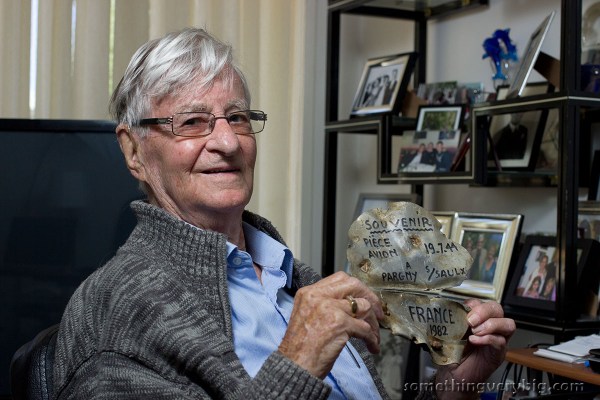
As well as setting the incredible tale onto paper, the act of writing the book, I suspect, helped Denis to in some way cope with the demons he’s carried for so long. But something else helped too. There’s a photo on Denis’ wall of him with his son at the Bomber Command memorial in London. It was taken in 2014 when they went on a pilgrimage to Europe.

As well as England, they went across the Channel to France. They visited the lock keeper’s house where Denis had been hidden. They attended receptions in town halls with ceremonies and local dignitaries. They even found a woman who, as a young girl, had been present at the impromptu party when Denis celebrated his 21st birthday behind enemy lines. But most important of all, they visited two lone war graves in two separate churchyards: those of rear gunner Sgt Col Allen and pilot P/O Tom Davis, the two members of Denis’ crew who did not survive the crash.

Standing next to the grave of his brave pilot, Denis broke down in tears. “I bless all of you for coming here today in memory of my comrade,” he told the gathering of local townsfolk. “But also a very important agenda on my plate today is to say thank you, thank you, thank you.”
1512-denis-kelly-004

See a video of Denis’ trip to Europe on the ABC 7.30 website

Denis died in September 2019.

© 2016 Adam Purcell


Published!

The August issue of Flightpath magazine (Vol 28 No. 1 – in newsagents now) includes a feature article that I wrote on Leo McAuliffe, an Australian fighter pilot who was killed over Holland in a Tempest in March 1945.

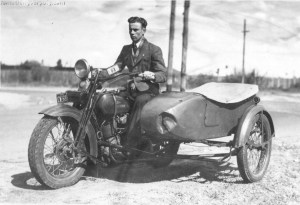
Leo,Harley & sidecar copy
Leo on a sidecar, pre-enlistment. Photo from Craig Bennett

I wrote a little about Leo here and here, and since I did that new letters, photos and even Leo’s logbook has come to light, shared by Craig Bennett, Leo’s nephew who lives in Cootamundra. I had put together a piece about Leo for my family several years ago, and Craig’s generously-shared collection gave me enough new material to update it – and that’s what you can now find in Flightpath.

Quite an exciting moment to see the new issue in the newsagent and open it to find my article inside! My grateful thanks to Craig Bennett, Chris Thomas and Andy Wright for making it happen.

416385832_lg

You can find Flightpath in most newsagents in Australia – or a digital version is available to purchase here

IBCC Interview #8: Arthur Atkins, 625 Squadron Lancaster Pilot

Arthur Atkins had a fascination with flight that started very early. He built and flew model planes. He was a member of the Cub Scouts. He was lucky enough to take his first flight aged 8 or 9, when two Cubs at a time squeezed in together in the open cockpit of an Avro Avian flying from the old Coote Island aerodrome just west of Melbourne. Arthur really wanted to be a pilot. But in the early 1930s, how on Earth could a lad from Surrey Hills in Melbourne ever afford flying lessons?

By winning them, of course. So Arthur entered a competition run by the Sun News Pictorial newspaper. The prize was enough flying tuition to get a pilot licence. “But I didn’t win!”

Maybe the Air Force would pay instead, he thought, and tried to enlist in his final year at school. But the inter-war Air Force was not very big, and there were lots of other people who also dreamed about becoming a pilot. 2,000 people applied for just 20 positions.

“So I didn’t get that one either.”

Putting his dreams aside for a moment, Arthur qualified and found work as an accountant.

And then the Second World War broke out, and he got his chance.

Two photos of Arthur Atkins as trainee aircrew copy

When I arrived at Arthur’s house for our interview, the gates were closed and I was initially not sure that I had found the right place. But any doubts were dispelled, after I’d parked the motorbike and walked up to the door, as soon as I saw the nameplate on the wall.

‘KELSTERN’

I’d seen that name before. RAF Kelstern, in the Lincolnshire Wolds, was the wartime home of 625 Squadron, Royal Air Force, with which Arthur had flown 31 operations. He earned a Distinguished Flying Cross in the process. I was definitely at the right house.

Arthur came out of the front door, a fit and distinguished-looking gentleman, and immediately wanted to talk about my bike. “Oof” he said, giving it a curious push. “It’s a bit heavier than mine was.” He was referring to a 350cc Calthorpe motorcycle that he used to hoon around on in the years immediately before the war.

Arthur Atkins and his 350cc Calthorpe motorcycle copy

This was my first clue that Arthur was quite a technical person. The next one followed soon after, as we walked into his old-fashioned study, with an Anglepoise lamp and one of those big green banker’s desk lights over the desk. As I set up my laptop among the model planes and boats and piles of motorbike and aviation magazines, I remarked on a big picture of a Wellington that was hanging among dozens of photos of cars, boats and aeroplanes on the walls. Arthur immediately launched into a highly detailed explanation of why sleeve valves in the Wellington’s engines made them so complex and therefore unreliable, especially as they got older. This set the tone for the next couple of hours.

Interviewing Arthur was easy. I kicked off with my standard opener about what he was doing before the war, and he was off. He used his meticulous logbook as a memory prompt. Moving through it, he would announce the name of a place or a unit (“then we went to Mallala”) and then he’d lean back, take off his reading glasses, and proceed to tell me a story about that place.

At the end of the story, the glasses went back on and he picked up the logbook to read the next place name. And off we went again.

Ansons over Mallala, early 1943 copy
A very rare air-to-air photo, taken by Arthur, of another Anson as he flew over Mallala

The stories he told were sometimes serious, sometimes funny and sometimes gory. But they were always interesting. He told me of his first solo at Benalla, and of the desert heat at Mallala. He told me about a weekend spent on leave in New York on his way to war. Of arriving at an Advanced Flying Unit at Greening Common in the UK and going for a walk onto the airfield with a few mates. They found a big black patch, about 50 or 60 feet across, the scene of an Oxford crash the night before. “They hadn’t scraped everything off the runway,” Arthur said of the ghastly scene. The next day he was chosen to be one of the pallbearers for the dead pilot. “We carried the coffin to the local train station,” he said, “where we shoved it into the guard’s van and said ‘goodbye sport’ – and that was it…”

He told me of landing a Wellington at his Operational Training Unit at Church Broughton on one engine, and of a Nickel leafletting raid on Chartres in France that was almost comedic. First, the bomb aimer pressed the wrong button over the target, so instead of opening to scatter leaflets in the slipstream, one of the two six-foot-long canisters in the bomb bay was jettisoned entirely. It disappeared from the aircraft with all the leaflets still tightly packed inside. Then, when they were approaching the French coast, someone in the crew said “there’s a searchlight on us!”

“Well, that of course rattled everyone… and after a while we found that the searchlight was following us!”

It was actually their own landing light, which when not in use was supposed to be retracted flush against the wing and pointing straight down, that had been mysteriously switched on.

“We were flying over German-occupied France with this bright light shining straight down…”

Of his time at Blyton, a Heavy Conversion Unit, Arthur told me how, rolling out after his first landing in command of a Halifax, he relaxed a tiny bit too early and the big bomber swung violently. They ended up on the grass facing the way they’d come. But the control tower frequency stayed silent. No-one had seen the grassy excursion. So Arthur innocently taxied back to his dispersal. “I never did it again – you couldn’t relax until the thing had stopped rolling at your parking spot!”

Most of his stories, though, come from the seven months that he was at 625 Squadron, Kelstern, from June 1944. Like the time they were coned over Mannheim, on the way to Russelsheim to attack the Opel works there. They got picked up by a blue “master” searchlight:

“I could hardly see the instruments because I was blinded… I remember thinking, ‘Geezus, I’ve done all this training and now I’m gunna be killed’… I pushed the stick forward and immediately lost the searchlight…”

(While he was telling me this he grabbed an imaginary control column and shoved it forward to illustrate. It might be decades since Arthur flew an aeroplane, but the instinct has never left him.)

Then there were a pair of low-level daylight operations on consecutive days over the Bay of Biscay to attack the Gironde Estuary in France. The first trip happened to be on Arthur’s birthday. “Beautiful day,” he recalled, “no wind, blue skies, not a cloud in the sky. A delightful day… so I got a nice birthday present, a nice trip to southern France, at 50 feet across the Bay of Biscay – and we dropped bombs on it.” He remembers roaring over an old horse and cart in the dunes on the way in to the target.

On the second one, they were all hurtling “hell for leather” over the water when Arthur’s rear gunner called up.

“Someone’s gone in!”

Two other Lancasters had collided. Arthur looked around in his seat, and:

“There’s this great splash of water still hanging in the air…”

One aircraft survived the collision. The second did not.

Another trip that stuck in Arthur’s mind was a night raid on Frankfurt in September 1944. “That was a good one,” he said. “I liked Frankfurt.” From 17,800 feet in the cockpit of his Lancaster, Arthur looked down on the great city. “It looked just like Melbourne would from the air at night, with the streets all lit up… but it wasn’t lights, it was the burning buildings on each side of the street.” Arthur lost a close friend on the same night, a Flight Lieutenant named Dave Browne who died attacking Stuttgart with 467 Squadron.

Dave Browne, Chieveley copy
418804 F/L David Dorey Browne

Incidentally, in the early 1990s Arthur went to Germany with a group of old bomber aircrew organised by the Royal Australian Air Force Association. Among the places they visited, in a bus driven by two German Air Force pilots, was Frankfurt. “They’ve got a big new wide boulevard through the centre,” Arthur said “Well they can thank me for putting that there – I removed a whole heap of scruffy old houses from a great strip in the middle of Frankfurt!” The bomber boys were subsequently guests of honour at a dinner held by the German Ex-Fighter Pilots Association, where the Germans perhaps got a little of their own back. “They had these long tables in the room, with the big pots of beer, and they were singing songs… stamping their feet and banging their pots on the table… I spoke to the bloke next to me (they speak a lot of English in Germany), and said “what are they singing now?”

It was the old battle song: “Wir fahren gegen Engeland!”

“I said, oh, that’s interesting!”

Arthur reckons he flew over about eight European countries in his Lancaster, including Sweden and Switzerland, Norway and Denmark. “I’ve been around in that Lancaster. It was a beautiful thing to fly.”

More than two hours had passed from the time Arthur first picked up his logbook to the time I asked my final question. How will Bomber Command be remembered, I wanted to know?

“I think it’ll be remembered by the people that were in it, alright,” he said. “It was the best job I ever had in my life.”

And he has left his own little piece of remembrance too. Several years ago Arthur sponsored a racing boat for his rowing club. As sponsor he was allowed to choose the name of the vessel.

After his much-missed good mate, he called it “David Browne”.

Arthur Atkins

Text (c) 2016 Adam Purcell

Wartime photos courtesy Arthur Atkins. Colour photo by Adam Purcell

IBCC Interview #7: Col Fraser, 460 Squadron Lancaster Navigator

Things didn’t get off to a promising start when I met Col Fraser. It was October last year, and I was fishing for IBCC interviewees at the Empire Air Training Scheme luncheon in Melbourne.

“I was”, Col said when I asked if he had been in Bomber Command. A navigator, in fact, with 460 Squadron. But he politely declined my request for an interview, saying “I gave most of my stuff to the people in Canberra a few years ago and I think I’ve told my story enough. Besides, I didn’t do much anyway.” Disappointed but respectful of his decision, I thanked him for his time and moved on to see who I could find at the next table.

But about fifteen minutes later, when I was talking to another veteran in another corner of the room, Col came lurching up to me out of the shadows. “Adam!” he announced. “I’ve changed my mind.”

“That’s great”, I said.

“Yeah, I got shot down on Anzac Day 1945 so I thought I should say something.”

I’ll say. Anzac Day, 1945. The day of Bomber Command’s final raids of the war. And the day of Bomber Command’s final losses. Col Fraser, as it turned out, was in the second last Lancaster to be lost during WWII. And one clear spring day a few weeks later, he told me about it.

25 April 1945 was, as Col remembers it, a lovely day:

“Beautiful blue sky, no clouds, green fields and lakes and rivers down below, and on the right was the majestic Alps with snow shining on their tops. Absolute picture-book.”

Under the command of Flying Officer HG ‘Lofty’ Payne, Col and his crew were off on a daylight trip to visit ‘Hitler’s hangout’ near Berchtesgaden in the Bavarian Alps.

On a mountain overlooking the town of Berchtesgaden were mountain retreats and chalets belonging to elite members of the Nazi Party like Herman Göring, Martin Bormann and Albert Speer. Hitler’s own alpine lodge known as the Berghof was also there, and an SS barracks was nearby. While it is now known that Hitler himself was in Berlin at the time of the raid, there were very real fears that fanatical Germans would set up a mountain redoubt for a bitter and bloody last stand centred around the Berghof. So more than 300 bombers were sent to destroy it.

Approaching the target, Col got up from his navigator’s position and moved into the cockpit to have a look at the view. The flak looked light to moderate; “no worries,” he said. Then the bomb aimer took over:

“He said, ‘left, left’ and then ‘bombs gone, bomb doors closed’ – and as he finished that word we were hit.”

Something flew up past Col’s face and out over the roof, and when he looked down there was a jagged hole in the bundle of Window which was stashed under his navigator’s desk. The decision to come out of his little ‘office’ saved his life, at least for the moment – but they were not safe yet. The “light to moderate” flak had scored a direct hit, and though none of the crew were injured three of the Lancaster’s engines were destroyed. The pilot told everyone to get out.

“But we can’t do that Lofty,” said the flight engineer, “we’re over Germany!” Nobody wanted to jump while they still had a chance of making it back to the Allied lines. But then that last engine also gave up the ghost. “We were gliding”, said Col, “and we had to go.” And so out Col went.

Col Fraser always wanted to be a navigator. He reckons he’s not very good with his hands but was skilled with figures and calculations. And while actually flying an aeroplane could be “deadly” boring, as a navigator he’d be working steadily all flight. He got his wish, was selected for navigator training and earned his N brevet in Australia in February 1944. Then he went to war.

Like so many Australians Col crewed up at 27 Operational Training Unit, Lichfield. He’d run into a mate named Dan Lynch, a Tasmanian bomb aimer with whom he had been training in Australia, and they decided to fly together. “We discussed having a pilot and decided we wanted one who was big and strong, and he had to be mature – about 23 or 24 years old!” The man they chose was West Australian Harry ‘Lofty’ Payne, so-called because he was 6’3 tall. The wireless operator Bill Stanley was from Melbourne and both gunners, ‘Shorty’ Connochie and ‘Buck’ Bennett, were Sydney lads.Col Fraser and crew

After their very first flight in a Wellington, the instructor got out and told ‘Lofty’ to take it up for three more circuits. “Well we took off and landed twice,” Col recalled, “and the third time as we reached height the port engine failed.” This, I’ve learned, was not an uncommon occurrence with the battered old Wellingtons then found on OTUs. And they were in a particularly old one: when Col operated the emergency landing gear extension system it also disabled the aircraft’s hydraulics, a quirk that had been engineered out of later versions of the aeroplane. So having struggled around the circuit, when the pilot tried to lower the flaps for landing nothing happened.

“He finished up banging the aircraft down halfway down the strip, and we ran through the fence, across a road, through the fence on the other side and a bush or two, and finished up in a ditch with the [aircraft’s] back broken and up in the air.”

They all managed to walk away virtually uninjured, and the following day they were flying again. This experience left Col confident that he had made a good choice: “We’ve got a bloody good pilot who didn’t panic!”

Col learned an important lesson on another night at OTU when the heating failed in his Wellington, forcing him to work with frozen hands. As a result his navigation log was not up to the usual standard, a judgement communicated to Col in no uncertain terms by the chief navigation instructor. Col protested that given the circumstances it wasn’t too bad. But the instructor disagreed:

“In Bomber Command there are no excuses.”

Col says this lesson stayed with him for the rest of the war.

Col enjoyed England. It was “comforting”, he said (and of course they spoke his language!). One of the great things about being an Australian airman in England was that “there were no Australian army troops to stuff it up… by and large the Australians over there were middle class and educated, and were very popular with the local girls…”, he added with a twinkle in his eye. On leave, he and a small group of friends would obtain railway warrants to either Lands End or John O’Groats, which are at the extreme opposite ends of Britain. This would enable them to get off the train, unplanned, anywhere they wished to explore.

Col flew his first operation in March 1945, attacking a place near Cologne called Brück. The flak was fairly heavy over the target, and Col gave me an impression of his bomb aimer’s reaction after his first run into a target: “Left left”, he said, “steady… steaaaady… bombs gone, bomb doors closed (and here his voice rose an octave)… LET’S GET THE HELL OUT OF HERE!!!”

“I must admit that the rest of the crew, including me, was feeling the same way that he was,” Col said. “This is no place to be, for us nice blokes!”

On the way home, over France, an ack-ack shell went straight through one wing, leaving a jagged hole but failing to explode. They returned home shaken but unharmed, feeling “a bit guilty at bringing back an aircraft with a hole in the wing… as if we’d been a bit careless about the whole thing!”

Over the next few weeks Col and his crew would fly another five operations, during which they would be coned over Potsdam and recalled while over the target but before they could drop their bombs on a trip to Bremen, necessitating a hazardous landing back at base with a full load on board. And then came Berchtesgaden – Col’s seventh trip.

After parachuting from his aircraft Col landed on a field near a couple of houses. He unbuckled his harness and left it there, attempting to hightail it into a nearby clump of trees. But the occupants of the houses had watched him come down, and pointed him out to the Volksturm. Col was arrested and taken to an Army camp, and over the next few hours the rest of the crew trickled in (except for the bomb aimer who – the first one out of the aircraft – landed in the foothills of the Alps and was captured by mountain troops).

The most amazing story, however, belongs to ‘Lofty’ Payne. After everyone else had jumped, Payne was about to leave the cockpit himself when the rear gunner appeared behind the pilot, carrying his open parachute. He had caught the ripcord on something as he came forward, and the parachute was now useless. Deciding he couldn’t leave the gunner to his fate, ‘Lofty’ made the risky decision to try to land his crippled aircraft. Fuel was sloshing over the floor as they glided down towards a cornfield. A powerline clipped the top off the rudders but they managed to crash in a more or less controlled fashion, exited smartly and ran, expecting an explosion at any moment. None came – it seems the ploughed earth had put out the flames. They were arrested shortly afterwards.

Col and his crew were taken to Stalag VIIa at Moosburg, where after perhaps the shortest time as Prisoners of War ever, on 29 April 1945 elements of the American 14th Division arrived and liberated the camp. General Patton himself arrived on the front of a truck on 1 May, where with a hundred photographers and correspondents surrounding him he promised that all the prisoners would be back in England in two or three days. In the end it took closer to a week (Col was in the camp under the Americans for longer than he was under the Germans), but eventually they were transported to the great airfield at Juvencourt to be flown home in a DC-3. Col sat up the front with the pilot – a New Zealander with whom he had trained at an Advanced Flying Unit in the UK six months before. “All the debris of war was still spread out across the countryside,” he said. “You could see what war had done…”

Col was one of the more organised of the veterans I’ve interviewed. When I’d turned on the microphones in a small sitting room in the great big old nursing home where he lives, he pulled out a thick sheaf of papers – and began reading from a prepared speech. I suppose he wanted to make sure he didn’t forget anything. It worked, because he told his remarkable story in detail and in an entertaining way.

But as happens in these sort of interviews, it’s the unscripted answers that are sometimes more revealing. “The thing that hurt most of all,” Col said when I asked him about the legacy of Bomber Command, “was Churchill deserting Bomber Command.”

“…not one word, one way or the other, was [mentioned] in Churchill’s speech of the Victory over Germany. That hurt most of all… When the war was close to finishing, all of a sudden all the … bishops were saying ‘oh we shouldn’t have bombed… bombing’s not supposed to be that, it’s only supposed to be drop a little bit in their garden or something – look at all the houses you’ve knocked down!’”

“The point is that it should always be remembered,” Col said.

And who can disagree with that?

1511 Col Fraser 08
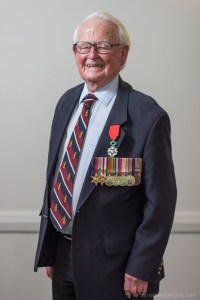
Col Fraser

Col Fraser died in December 2022 – the second-last, to my knowledge, Bomber Command veteran left in Melbourne.

(c) 2016 Adam Purcell

Bomber Command Commemoration Day 2016: Melbourne

It was raining steadily while I waited at Canberra Airport for my flight to Melbourne last Sunday morning. As we boarded our aeroplane a Qantas International B747 – an unusual visitor to Canberra – not so much landed as splashed down, unheralded but spectacularly, on the main runway.  It turns out it was a flight from Hong Kong that had missed out in the atrocious weather conditions prevailing in Sydney and diverted. The weather – caused by a pair of big fat low pressure systems sitting just off the south eastern coast of Australia – had already forced the Canberra Bomber Command Commemorative Day ceremony to move into the cloisters of the Australian War Memorial, away from the sodden lawn. It was just as wet in Melbourne.

One could be forgiven for thinking that the appalling conditions might have kept people away from the fifth annual Bomber Command Commemorative Day service at the Shrine of Remembrance.

One would be wrong. This year saw the biggest turnout yet in the southern capital. Twelve veterans of Bomber Command were among more than 160 people who attended. There were veterans and their wives and families – one veteran headed a party of no less than ten of his extended family. There were politicians and serving members of the Royal Australian Air Force. There were members of the Australian Air Cadets and there were staff and students of BCCAV’s partner school, Carey Baptist Grammar. And there were members of the general public, with or without a direct connection to Bomber Command. In the Auditorium it was standing room only. At least it was dry.

1606 BCCAV MEL-040

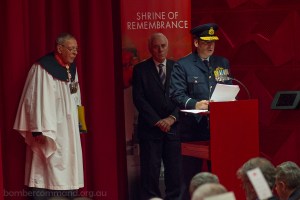
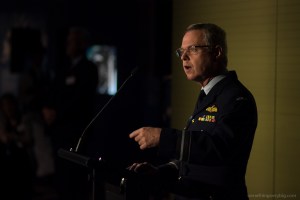
There were speeches from Shrine Governor Major Maggie More and Chaplain John Brownbill. But the keynote address was from the Royal Australian Air Force’s Air Commodore Geoff Harland, Commander of the Air Force Training Group. In an excellent address (available for download here), Air Commodore Harland highlighted some of the statistics of life in Bomber Command: 125,000 aircrew served, of which 55,573 were killed:38,462 Britons, 9,980 Canadians, 4,050 Australians, 1,703 New Zealanders and 1300 from Poland, Free France, the USA, Norway and India.

1606 BCCAV MEL-023

“It is crucial that we remember the sacrifice these numbers represent,” Air Commodore Harland said. “As a modern aviator I marvel at the bravery of these young men… the example they set for is in terms of commitment, valour and sacrifice is instructive to us all and, I would argue, sets an unmoveable foundation for the values we hold so dear in our modern Air Force.”

“To forget is not an option.”

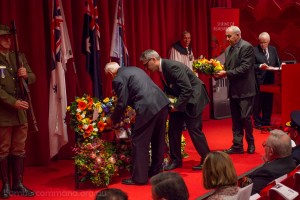
The wreath-laying ceremony followed the Air Commodore’s address.

1606 BCCAV MEL-038

1606 BCCAV MEL-057
Bomber Command veteran Laurie Williams
1606 BCCAV MEL-050
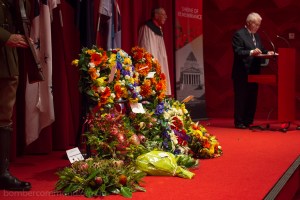
Students from Carey Baptist Grammar lay their wreath.

1606 BCCAV MEL-044

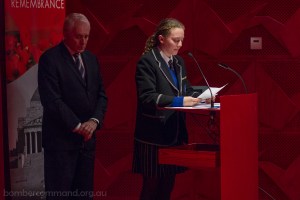
For the formal commemorative part of the ceremony, Carey Baptist Grammar Middle School Co-Captain Sophie Westcott read the Ode. It was the first time that a student from Bomber Command Commemorative Association Victoria’s Partner School has carried out an official role at this service and it was well-received.

1606 BCCAV MEL-060
Sophie Westcott of Carey Baptist Grammar recites the Ode

By the time it was over we came outside to discover that the weather had closed in even more. The top half of nearby Eureka Tower (975’) had disappeared completely into the murk. We knew that the Royal Victorian Aero Club contingent were grounded at Moorabbin, but there was some hope that a lone Mustang, flying from Tyabb, might yet be able to get through. There were a lot of people squeezed into the foyer enjoying a chat with some light refreshments, and as one of the organisers I was in some demand, talking to people I already knew, some I’d been corresponding with and several I’d not met before. Then I got tapped on the shoulder.

“There are two TV crews set up in the forecourt!”

Oh boy. As the Media Officer for the Bomber Command Commemorative Association Victoria, I’ve been busy drafting and distributing press releases and emails to various media organisations over several months, hoping for a bit of coverage. And someone had actually turned up! So I trekked around to the front of the Shrine where there were, indeed, two camera crews, one from the ABC and one from Channel 7. I was able to brief them about the flypast.

Sadly, at the appointed hour, nothing happened except that, if it were possible, the cloud base seemed to lower even more. The Mustang did actually get airborne at Tyabb but, restricted to VFR flight only, could not find a safe way through the clouds. The pilot made a very prudent decision to return to base, and the skies over Melbourne remained quiet. It was disappointing that we had some media interest but they were unable to get the shots that they wanted. But there’s nothing we can do about the weather, and I was thankful enough that it had been sufficient to get a) out of Canberra and b) into Melbourne on time earlier in the day.

We did get some other media coverage though, and this led directly to one of my favourite stories about this year’s ceremony. A few weeks ago, I got a phone call from a reporter from the Mornington News who had heard about this ceremony but was looking for a local angle. I subsequently facilitated contact with Jean Smith, a 94-year-old veteran of the Womens’ Auxiliary Air Force who lives on the Peninsula (who I interviewed for the IBCC in March). The resulting coverage in the News was pretty good (link here).

The best bit? Jean told me after the ceremony that she had told the reporter she was so keen to attend the ceremony that she was saving her pennies to pay for a taxi to the city, a journey of an hour and a half each way. “It was a throwaway line really,” she said – but the reporter printed it. Within days, no fewer than three members of the public had separately contacted the newspaper offering to drive Jean to Melbourne for the ceremony.

And so on Sunday morning, Jean arrived at the Shrine of Remembrance, driven by a friendly member of the general public. It was the embodiment of Air Commodore Harland’s words:

We must take pause to remember the collective sacrifice of this group, we must remember those who perished and cherish those who survived and those who are still with us and say ‘thank you’ and know that that will never be enough.

1606 BCCAV MEL-011
The Australian Air Cadets provided an honour guard
1606 BCCAV MEL-008
Shrine Governor Major Maggie More

1606 BCCAV MEL-017

1606 BCCAV MEL-014
Chaplain John Brownbill
1606 BCCAV MEL-027
A veteran comforts his wife

1606 BCCAV MEL-064

© 2016 Adam Purcell


Bomber Command Commemoration Day 2016: Canberra

It was an unfortunate fact that the Bomber Command Commemorative Day ceremonies were on the same day this year in both Canberra and Melbourne. While in previous years I have prioritised travelling to the nation’s capital, in part because it has tended to attract Sydney-based Bomber Command types who I count as friends, with the recent incorporation of the Bomber Command Commemorative Association Victoria and my deeper involvement with that group in Melbourne, I needed to be in the southern capital on Sunday. But neither that nor the big rain band that’s been chucking it down at the entire east coast of Australia all weekend stopped me making a flying visit to Canberra last Saturday.

While it was only a short visit, I made sure it would be well and truly worthwhile by arranging an early flight on Saturday morning and doing a sneaky IBCC interview with 466 Squadron bomb aimer and prisoner of war Keith Campbell. I’ll get around to writing about Keith’s story in more detail one of these days (I’m afraid there’s a six-month backlog on that series of posts at the moment!), but at this point I must acknowledge the superb support cheerfully given by the staff of the Australian War Memorial in arranging a suitable venue for the recording. We’d hoped to be able to get an early check-in at the hotel but as this could not be confirmed until very late in the piece I thought I’d ask a contact at the AWM about the possibility of finding an appropriate spot somewhere in the building.

To AWM Events and Ceremonies Coordinator Pam Tapia, Media Relations Manager Greg Kimball, Duty Manager Richard Cruise and the staff at the front desk go my grateful thanks. We had the use of the Memorial’s BAE Systems Theatre for a couple of hours and it made for a very comfortable and appropriate location. Keith was the only survivor of a mid-air collision over Stuttgart in July 1944 – he still doesn’t know how his parachute was clipped on or how it opened – and it was wonderful to listen to him telling his story in detail, and get it on tape.

The prize for ingenuity goes to Adam, the AWM’s Theatre Manager who, noticing my struggles with the low light in the room, suggested, supplied and operated a theatre spotlight for the traditional photo:

1606 BCCDF CBR-013
Keith Campbell OAM LdH in the BAE Systems Theatre, Australian War Memorial

After all that excitement we had a brief respite at the hotel (back at the QT again after last year’s experiment further down Northbourne Ave), and then it was back to the War Memorial for the evening’s cocktail party. This has always been my favourite part of this weekend: the atmosphere provided by Lancaster G for George is second to none. There was a reasonable crowd, though veteran numbers were somewhat lower than we have seen in recent years with eight present.

1606 BCCDF CBR-050

A notable absence was Don Southwell, who had been taken to hospital on Friday with a mild infection. Long a stalwart of the organising committee of this weekend, Don was devastated at missing the event, and he was certainly missed both at the AWM and at the post-function drinks back at the hotel. Apparently he’d been on the phone to his son David every three hours to make sure everything was going smoothly in Canberra, so we hope to see him back on his feet soon.

Geoff Ingram provided MC services on the night and the guest speaker was Air Vice Marshal Kim Osley. He hit precisely the right note with a short address that was informal enough for the social nature of the occasion yet thoughtful enough to touch on some important issues. He started on a humorous note, telling the crowd that his father had been German. “So I’d like to thank those of you who attacked Stuttgart,” he said, pausing for effect, “…and missed!”

1606 BCCDF CBR-038

The airmen of Bomber Command, Air Vice Marshal Osley said, were to the modern Royal Australian Air Force role models, leaving a legacy of moral courage in adversity and professional mastery. “Bomber Command shortened the war – end of story,” he declared, and no-one in the crowd could possibly argue with that.

I was happy to renew acquaintances with some veterans I know well: Tommy Knox, Bill Purdy, Tom Hopkinson, Ray Merrill and Jim Clayton (who claimed after AVM Osley’s Stuttgart quip that “we didn’t [miss]!”). And I managed to meet a new one too: Les Davies, a 466 Squadron mid-upper gunner, a lovely bloke who I found sitting under G for George.

1606 BCCDF CBR-052

The night ended with the return of the Striking by Night sound and light show, which finished things off with a nice little punctuation mark.

1606 BCCDF CBR-063

1606 BCCDF CBR-072
Jim Clayton, Ray Merrill and some plane called George

There were a small band of people in the QT hotel bar when we got back to the hotel for a nightcap or three. That distinctly Huxtable-shaped hole in proceedings again made its presence felt, but there were some passionate and very useful conversations in progress as the night wore on.

And then the next morning I got up early, Geoff Ingram drove me to the airport and I flew, in cloud the whole way, back to Melbourne. The next part of the Bomber Command Commemoration Day events was about to begin.


(c) 2016 Adam Purcell


Anzac Day in Sydney 2016

Something a bit different for Anzac Day this year: I had my photo light gear with me at the 463-467 Squadron Association lunch in Sydney, so I thought it a good opportunity to get some proper portraits of the six veterans we had with us.

Bill Purdy DFC LdH - 463 Squadron pilot
Bill Purdy DFC LdH: 463 Squadron pilot
Don Browning LdH: 463 Squadron wireless operator
Keith Campbell OAM LdH: 466 Squadron bomb aimer and PoW
Don Southwell, 463 Squadron navigator
Don Southwell LdH: 463 Squadron navigator
David Skinner, 467 Squadron pilot
David Skinner: 467 Squadron pilot
Alan Buxton: 617 and 467 Squadron navigator

It was a good day, with three veterans marching on the amended route along Elizabeth St. There was a particularly Huxtable-shaped hole in proceedings however. Very sadly, for the first time in many, many years, when someone in the crowd yelled out “Hey, Don!”, the answer was not “which one??”

But while numbers were down for the march (and as I wrote last week I’m not sure how much longer this group will continue to take part), the following lunch had more than 50 people in attendance. And this was what led to probably my favourite moment of the day. At my table were a young couple who I’d not met before. Luke is a relation of the Southwells and he’d brought his partner Sharna along. I mentioned to them in conversation the significance of the little golden caterpillar badge worn by some aircrew, and suggested that if they find someone wearing one they should ask them about it. “Like him,”, I said, pointing to Alan Buxton who was sitting at the other end of the table. “Ooh,” said Sharna, “do you know his story?” I do, I said (he bailed out over the UK returning from a raid when all four engines in his Lancaster caught on fire), but as Alan was right there I encouraged her to ask him herself.

Shortly afterwards Sharna did so. This was the result:

1604 Anzac Day-159

As I left the lunch about 45 minutes later they were still there: Sharna and Luke listening intently as Alan told them why he has a golden caterpillar.

One more story shared to a new generation. Two more people who have heard first-hand something about life in Bomber Command. This is what it’s all about.

It was a lovely way to end the day.


(c) 2016 Adam Purcell


Anzackery

Last Friday night I went to see the local Super Rugby team, the Melbourne Rebels, play South Africa’s Cheetahs at the imaginatively named “Melbourne Rectangular Stadium“. While it was great to see a sadly-not-too-common Rebels victory, something odd happened just before the game.

An Anzac Day ceremony.

At the rugby.

Huh?

It’s not even Anzac Day until tomorrow!

Call me unAustralian, but that ceremony made me feel a little uneasy. It did not feel like it belonged there, in that place, in that context. Sport is not war without guns, as David Stephens wrote in the Sydney Morning Herald last year.

Stephens is the secretary of the Honest History coalition of historians and others “supporting the balanced and honest presentation and use of Australian history”. There’s a very long but illuminating transcript of a speech he gave in Kogarah in June 2015 on the Honest History website, and it’s a very useful read at this time of year. Among other things, he argues that Anzac should be “about the private, within-family, remembrance of – and caring about – people who have suffered in war, both those who have been killed and not come home and those who have come home but who are injured in body or mind – and those who live with the memory of the dead and the reality of the presence of the living.” In other words, Stephens sees Anzac as a primarily personal thing that is connected with those affected by war: both the effects on those who were actually there and the effects on the direct families who lived with them. “For families who are directly affected by war,” Stephens writes, “commemoration isn’t parades and wreaths and speeches by politicians; it is something they live every day and every week.”

As we move further and further away from the events being remembered, though, those private, individual stories seem to become lost in the mass. The Great War is now beyond living memory, and in a few short years WWII will go the same way. Meanwhile, Anzac Day continues to increase in popularity, at least if the crowds at the big marches are anything to go by. “The obsession about remembrance has grown stronger the further away we get from the reality,” Stephens writes. “It has grown stronger as the number of people who actually remember the reality of total war has got fewer and fewer.”

Why? Perhaps because Anzac has become almost a secular religion in Australia. We’re in danger of losing the quiet remembrance of individuals and of the terrible things war did to them – and continues to do to them – lost amidst all the cheers, the flag-waving and tears.

This is a part of what the Honest History crowd likes to call “Anzackery.” Stephens again:

Anzackery… is public, very public. It’s marches and flags and hymns and speeches. Nowadays it’s also projections of pictures of Diggers onto buildings, it’s battlefield tours and Gallipoli cruises […] it’s ministers and prime ministers and war memorial directors making emotional speeches to nostalgic audiences about the Anzac legend, it’s Anzac football matches in whatever code you fancy… Anzackery is sentiment and it’s nostalgia and it’s nationalism – which people think is patriotism but which is really jingoism.

I was struggling to articulate ideas like these when I wrote this post last week. That remains an important piece of writing for me because it attempts to deal with the future of my own personal remembrance, both of the great uncle I never knew, and the Bomber Command veterans I did (and still do) know, and all their family members who had to cope with the effects the war had on them. But if I’m being truly honest with myself, it does not say completely what I think I wanted to say. That out-of-place Anzac observance at the rugby last Friday night, though, made me realise how uncomfortable I’ve become with many of the things that go along with Anzac Day these days. The problem is that I’m not quite sure how I can reconcile that realisation with the act of taking up the banner and marching down Elizabeth Street in Sydney tomorrow morning.

I maintain my desire to continue doing so while we still have 463-467 Squadron veterans capable of marching because supporting them, particularly as they get older and older, is an important thing, and many of them have become friends. But once they’re done, so am I. It’s time to find a quieter, more personal form of commemoration.

John Coyne – a veteran of Bougainville and East Timor – describes his own private tradition of remembrance in a beautifully-written piece in The Age last Friday:

These days I choose to head out into the Australian bush surrounding Canberra. Well before dawn’s first light I make my way to a piece of high ground overlooking a valley floor. I stand too with dawn’s first light, sitting silently and generally shivering in the pre-dawn chill.

To the cacophony of bush noises, I reflect on those who made the ultimate sacrifice while on operations, or after they’d returned home. I think about the cost of our service: both the physical and psychological. I remember our stories, good and bad.

After the sun’s rays warm me up I make my way back to my car and return to my family.

This, clearly, would resonate most with ex-service personnel, which I am not. But it’s a lovely concept, and it’s perhaps something to think about as you watch the Anzac Day march on television tomorrow morning.


(c) 2016 Adam Purcell
What happens when the last veteran dies?

And the band plays Waltzing Matilda,

And the old men still answer the call,

But as year follows year, more old men disappear.

Someday no-one will march there at all.

– Eric Bogle, And the Band Played Waltzing Matilda

Once again Anzac Day approaches. Once again I will board an aeroplane and fly to Sydney. Once again I will pin my great uncle Jack’s medals to the right side of my chest. Once again I will hoist the 463-467 Squadron banner high, and once again I will march.

But for how much longer?

I’ve been struggling to write about the future of the Anzac Day march – or specifically the future of my part in it – for several years now. At around this time each year I’ve grappled with it, starting something but failing to come up with a coherent argument. So I’ve put it off. Chickened out. Relegated it to the ‘too hard’ basket. But sure as eggs, once again here I am. And the question has become more urgent. So this year I’m going to finish it.

I’ve been involved with the 463-467 Squadrons Association in Sydney for about a decade now. Long enough that I now consider friends many of the veterans, friends and family that make up the group. This is why, despite living in Melbourne for the last five or so years, I still prefer to go to Sydney for Anzac Day: it’s one of only a handful of chances I have each year to catch up with them.

As time has passed, so too has a fair number of veterans I knew. Men like Reg Boys, Rollo Kingsford-Smith and David Walter, among several others, have all gone to the Great Crew-Room in the Sky. In the last year or two however, as those who are left have grown very very old indeed and as age wearied them more and more, the trickle has turned into a flood: George Douglass. Harry Brown. Hugh McLeod. Albert Wallace. And now Don Huxtable. And these are just Sydney-based 463-467 Squadron Association veterans I knew personally.

As year follows year, more old men disappear.

In 2014 just three veterans started the Anzac Day march with the 463-467 Squadron banner. That was the first point at which I began actively wondering about the future of the Squadron banner in the march. One of the three that year was unable to complete the course – and the other two have since died. Improbably in 2015 numbers actually grew to eight, including two riding in trucks and two in wheelchairs, but given the numbers who have died in the intervening year that is likely to have been an aberration. Don Huxtable’s recent passing has further focused minds on a difficult but inevitable truth.

There are now very few 463-467 Squadron veterans left who remain capable of marching behind the banner on Anzac Day. One day, sooner than we all would like, they too will pass.

Someday no-one will march there at all.

And what then?

There’s been a fair bit of controversy in recent years about marching on Anzac Day, and specifically how descendants of veterans, such as myself, fit into it. Originally, of course, it was only the veterans themselves who were allowed to march – and that was highly appropriate. But those were the days when there were a significant proportion of veterans of conflicts like WWI still alive. Those first Diggers are long gone now, and descendants have begun marching in their place. But as the WWII Diggers now slowly fade away, the few who remain sometimes seem in danger of being swamped by the ever-increasing crowds of descendants.

In 2008 it all got too much for the RSL in Sydney. They began politely suggesting that descendants go to the back of the parade instead of marching with their ancestors’ units. In more recent years that polite suggestion has become more assertive, and changes have been made to the traditional format so that WWII veterans are given more prominence at the front of the march (with a strict limit of one carer each allowed with them). Instead of the WWI banners leading the march, they now bring up the rear. This year it’s spread to Melbourne, with similar adjustments on the cards for the southern capital’s march.

Far be it, of course, for me to criticise the involvement of descendants in the Anzac Day march. I have, after all, been one of them for several years now. There’s no doubt that it’s been a special experience. The noise made by the crowds that lined George St during last year’s march during the Centenary of Anzac was, genuinely, quite exhilarating. But at the same time I’ve felt a little uneasy. The applause and the cheering from the crowd is for those original veterans we have marching with us. Once they can no longer march, then what?

The answer, I think, is that once we no longer have any originals capable or willing to march, the time has come to bring down the curtain. The fellowship evident at the 463-467 Squadrons Association luncheon each year – and indeed the increasing numbers seen at that and other functions in the last few years – shows that there remains a place for events of that type. And of course other Anzac Day traditions such as the Dawn Service must also continue. But the March should be for the veterans themselves. While we still have veterans marching with us, I’m very happy to carry the banner for them.

But on the day the last 463-467 Squadron veteran in Sydney dies, it’s time to retire the banner.

And the band plays Waltzing Matilda,

And the old men still answer the call,

But as year follows year, more old men disappear.

Someday no-one will march there at all.

(c) 2016 Adam Purcell


Vale Don Huxtable

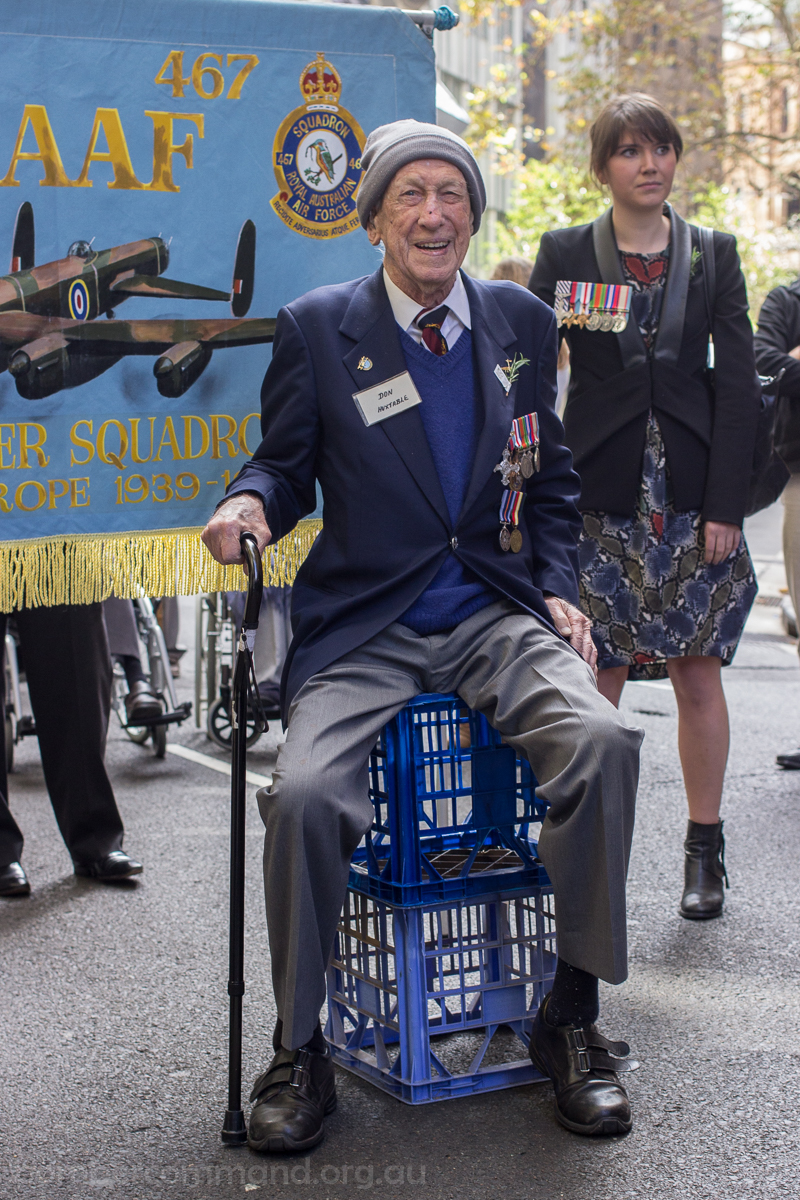
I’m terribly sad to report that 463 Squadron veteran Lancaster pilot, Hornsby legend, knockabout old bloke and all-round nice guy Don Huxtable died in a Sydney hospital in the early hours of this morning. He’d been unwell for several months but the end was, I’m told, rather swift.
I’ve written about Hux before, when I went to visit him in Sydney eighteen months or so ago. He was one of the first veterans I befriended amongst the Sydney-based 463-467 Squadrons crowd. For many many years he was a stalwart of Anzac Day commemorations, marching in front of the squadron banner with medals, among them the silver insignia of the Distinguished Flying Cross, proudly clinking on his chest. Probably my favourite memory of Hux is that most years he would be the first to reach the bar for a beer before the traditional post-march lunch.

14Jun-BomberCommandinCanberra 116

Hux had many, many stories, and a bar was probably his favourite place in which to tell them. I especially remember a night in the hotel bar in Canberra after the Saturday night Meet & Greet during the Bomber Command Commemorative weekend in 2014. Numbers dropped off steadily as the night wore on, but still there, scotch and soda in hand, when the bar staff finally kicked us out at 1am was, you guessed it, Hux and his entranced audience of young people. Some of the stories he told us may have even been true… like the one about flying solo in a Tiger Moth one day, with a princely 14 hours in his logbook, when he decided to fly his aeroplane between two trees at very low level. (As Hux told it he got 28 days in the Holsworthy military detention centre as a result.) He also spoke of flying circles around a tree in a paddock “like I was tied to it”, and of herding (with the aeroplane) all the sheep into the middle of a paddock… and then dropping empty bottles onto them.
1504 AnzacDay064

He was most distressed a few years ago when I told him that the Horse and Jockey, which during the war was the pub most frequented by aircrew in Waddington village, had closed down. “You hadn’t started until you’d had 16 pints, the beer was so weak”, he reminisced. “It couldn’t go flat ‘cos it was flat already… and it couldn’t go warm ‘cos it was warm already too!” Happily I was able to report the next time I saw him that my contact in Waddington had told me that the pub had new owners and was back in business.

1504 AnzacDay016
Hux on Anzac Day 2015 – as it turned out, the last time I would see him

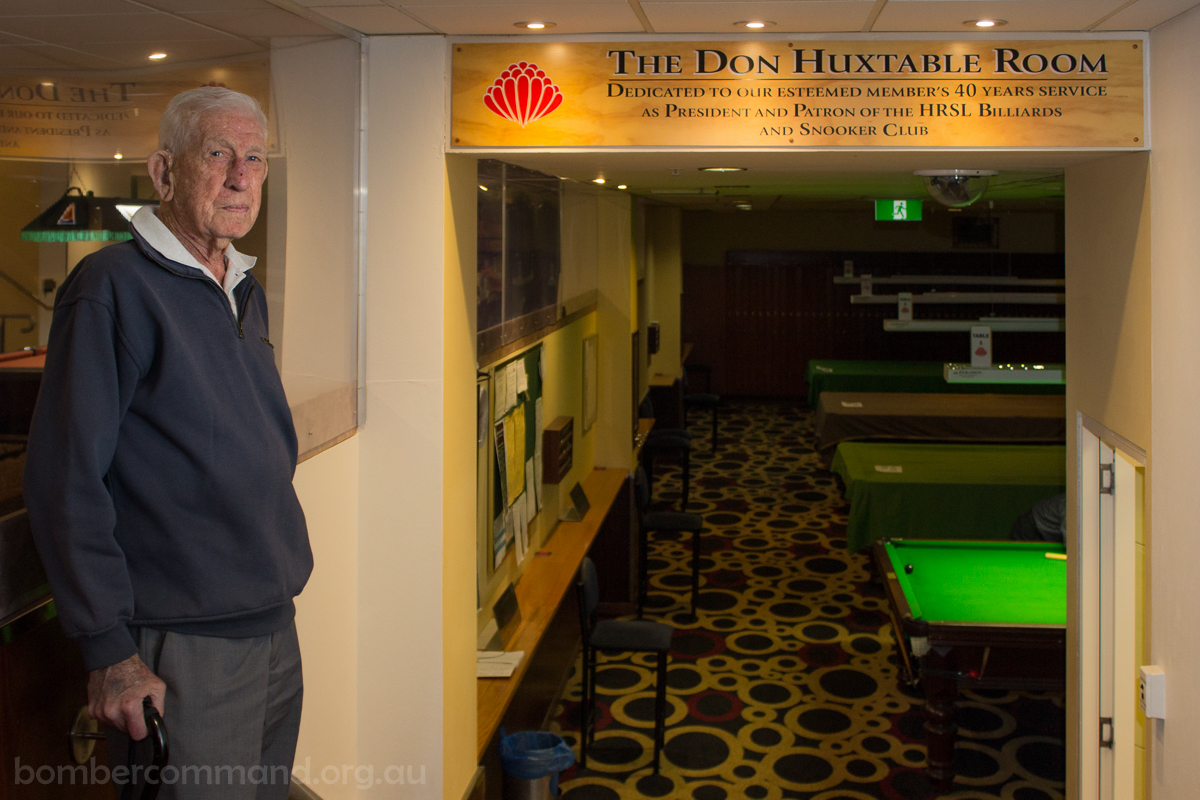
He was very proud of his crew, four of whom after the war bought adjacent blocks of land in Hornsby and then helped each other build their houses on them. In later years Hux, perhaps always feeling the captain’s sense of responsibility for his crew, was always looking out for Mary Fallon, wife of his late mid-upper gunner Brian, and was very close to Mary’s grandson Bryan. After the war Hux worked in the meat trade and became such a respected member of his beloved Hornsby RSL that they went and named a room after him.

14Oct-Sydney 102
Hornsby RSL

The tales Hux told were mostly about the lighter side of life in Bomber Command. Every now and then, though, something happened that reminded you that for all the humour and good times, it was a war that Hux had been involved in, and war isn’t all beer and skittles.

At the night-time function at the Australian War Memorial in Canberra one year, I was talking to Hux after the speeches when the lights dimmed and the sound and light show centred around Lancaster G for George began. At the end of the presentation I noticed that Hux had uncharacteristically gone quiet for a moment.

“I don’t know how the hell I flew straight and level through all that,” he whispered.

Blue skies and tailwinds, Hux. Anzac Day will never be the same without you.

14Oct-Sydney 097

1504 AnzacDay007

14Apr-ANZACDay 071

14Jun-BomberCommandinCanberra 078

14Nov-LadiesDay 058

(c) 2016 Adam Purcell