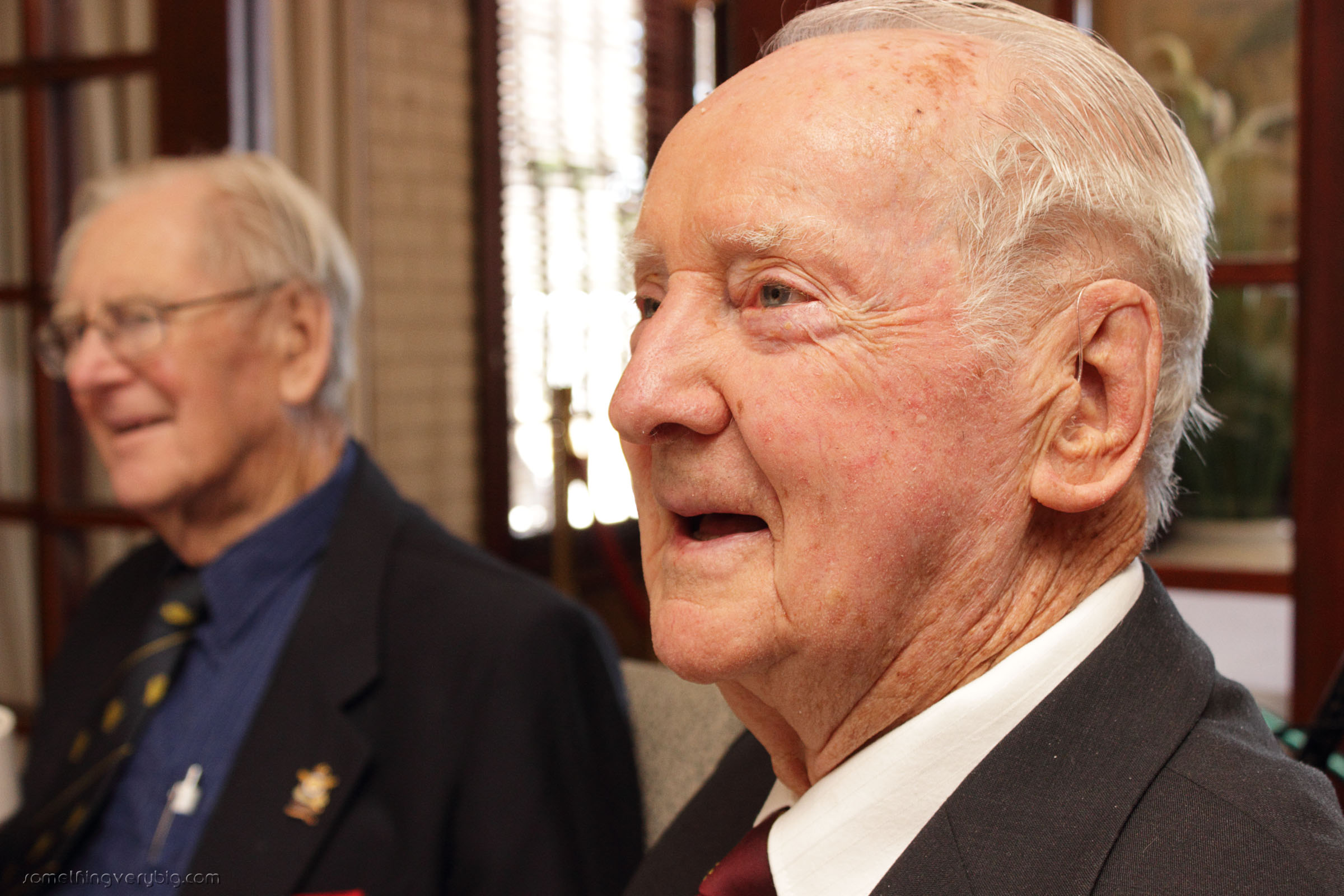
Before it’s too late

Tony Wright, National Affairs editor at The Age newspaper here in Melbourne, usually writes about the goings-on in and around Parliament House in Canberra. His series of Sketch columns usually throw an interesting light on the events of the day (and, if you’ve been following Australian politics, he’s had a not inconsiderable amount of material for inspiration recently).

But every Saturday, Wright gets the opportunity to write about something other than politics. One week last year it was about Mike Druce, the man who made a modern-day escape from Colditz Castle in September, then walked unsupported to Switzerland. Wright wrote another interesting one early in February.

“They are disappearing fast now”, he wrote, “the generation who experienced a world war.”

It seems not so long ago that those who had lived through World War I and had seen horses step aside for internal combustion engines and a lot more were being put in the ground, but memory plays tricks – it’s 100 years since that war began.

Those who knew it, even those who lived to astonishing ages, breathed the last of this earth’s air a long time ago.

Now it is the turn of the last of the survivors of World War II.

Some of those shuffling off into the sunset in recent times, of course, were well-known in life and widely mourned in death. Giants of politics like Gough Whitlam (an RAAF navigator) and Tom Uren (a survivor of the Burma-Thai Railway). Journalist and Korean War correspondent Harry Gordon. “These are, of course, big and extraordinary lives”, Wright says:

…generous spirits well documented, celebrated on a broad stage, their stories teaching us something that transcends the experiences that will go into books about their achievements: call it wisdom.

But while these were some of the better-known men whose lives intersected with some of the biggest conflicts in the history of mankind, so many others were there too. In Wright’s words:

…each day others whose lives were not destined to be celebrated so publicly or granted obituaries pass beyond this existence. Every one of them has a story, and in those stories we can often find ourselves enriched, because wisdom often resides there.

He’s dead right.

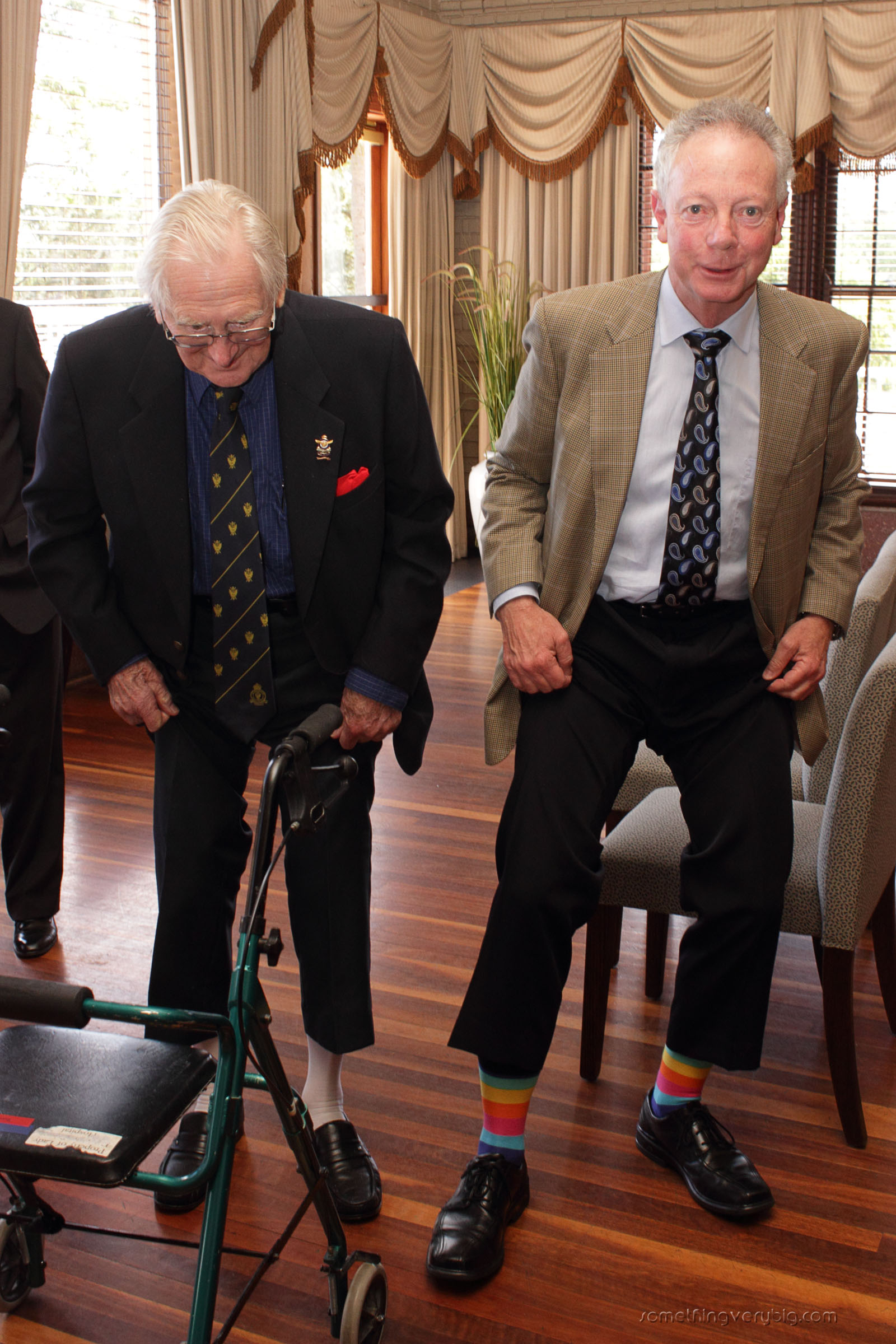
This is more or less why I flew to Sydney last month to have lunch with a Bomber Command veteran who also happens to be a good friend of mine. Hugh is a former rear gunner and we arranged to meet at one of those very old and very exclusive clubs in the city, all cedar panelling and leather Chesterfield armchairs. Hugh has been a member for a quarter-century.

He’s clearly well-known here. As we entered the bar the bartender poured my beer but gave Hugh the bottle and an empty mug. “I like to pour it myself”, he explained. Somehow, I imagine, with its sharply-dressed, exclusively male clientele, beer in pewter mugs and discreet murmur of conversation, the atmosphere in the bar at a wartime Officer’s Mess (in one of its quieter moments) might have been something similar. And perhaps for Hugh that’s at least part of where the attraction lies.

With that thought in my head, it’s not surprising that our conversation very quickly turned to flying. As we drank our beers we shared experiences flying the Tiger Moth and I mentioned my recent visit to Nhill and the Anson that is under restoration there. “I loved the old Aggie”, he said simply. We continued talking in the dining room as we waited for and then enjoyed a scrumptious meal while looking out over the State Library across the street.

Hugh is a little unique. He actually trained as a pilot but when he arrived at his squadron, he was one of twelve who were asked/chosen to re-train as gunners to operate a special ‘secret weapon’. It turned out to be ‘Village Inn’, an automatic radar-guided gun system. Despite what you might read on that link, Hugh’s opinion of the equipment is not very high. It was unserviceable half the time, he said, and the rear turret was not a nice place to be. Nor was it safe. On his first trip – to Bremen, in October 1944 – two of the twelve Village Inn men failed to return.

Hugh flew on his last operation – his 32nd – a matter of weeks before the end of the war. There followed the traditional fortnight’s end-of-tour leave, part of which coincided with the regular 12-days-every-six-weeks leave of a good friend at the squadron called Johnny Garrett. Hugh had arranged to meet up with Johnny in Cardiff but was a bit surprised when he did not show up. On return to the squadron he found out why.

On 22 April 1945, 49 Squadron was moving from Fulbeck to Syerston. As happened frequently on these occasions, on departure each bomber “beat up” the control tower before setting course for their new home. One aircraft flew past at extremely low level. Johnny, like Hugh a pilot/rear gunner, was in the rear turret.

The pilot pulled the Lancaster up into the air.

Too late.

The tail of the aircraft hit the MT shed. The Lancaster fell to the ground, killing all six on board. Fifteen more people – part of the works party which were about to begin runway extentions at Fulbeck –  were killed on the ground.(1)

It was a sobering story to hear over an otherwise very civilised lunch. But that’s just the point. Such was life, and death, in Bomber Command. Tragic as they are, stories like these actually happened. While official records like the squadron Operational Record Book reveal something of what happened to the aircraft, they won’t include the personal details – like the friends of those killed who wondered why they did not show up for an arranged meet-up while on leave.

These are the sorts of details and stories that can only come direct from those who were there at the time. So I see part of my role, as a Bomber Command researcher, but also as a member of the human race, to collect those stories while I still can. Hugh is one of the younger Bomber Command veterans I know, but he turned 90 last year. He’s no spring chicken. And one day I’m going to want to ask him something… but he won’t be there anymore. So in the meantime, says Tony Wright as he finishes his piece:

…the rest of us could do worse than sit with those close to us and explore what they might have to share and teach before they are gone and we find ourselves turning, bereft, to their shadow.

Amen to that.


Hugh McLeod, 49 Squadron rear gunner and my good friend, died on 7 July 2015.


(1) The ‘Fulbeck Tragedy’, as it is known, is described in Ward, J 1997: Beware of the Dog at War: Operational Diary of 49 Squadron Spanning Forty Nine Years, 1916-1965, pp. 542-5. Thanks to Colin Cripps for the steer.


© 2015 Adam Purcell

A Cocktail Party in Melbourne

I love collecting veterans.

Though their numbers are undeniably dwindling, it seems that every time I go to a Bomber Command-related event I come away having met a new veteran or two. And last Saturday night, a fundraising cocktail party for the Bomber Command Commemorative Day Foundation (Vic) in Melbourne, was no different.

Because of my own history of living in Sydney most of the events I go to are still in the Harbour City, and so despite living in Melbourne for four and a half years now I regularly travel there for ANZAC Days or other events. Consequently I’m still getting to know the Melbourne-based Bomber Command community. So it was great to see that among the fifty or so guests who gathered on Saturday night at the Nurses’ Memorial Centre on St Kilda Road were five Bomber Command veterans, three of whom I had not properly met yet. Rest assured that was remedied by the end of the evening!

The other two I know well. 578 and 466 Squadron Halifax skipper Don McDonald brought his wife Ailsa, and was working the room as he always does. Though he was wearing a badge with joined Australian and French flags I didn’t get the chance, unfortunately, to ask him about his recent award of the Legion d’Honneur, but that story will have to wait until the next time we meet. 463 Squadron navigator Don Southwell came down from Sydney as a representative of the national Bomber Command Commemorative Day Foundation committee. Don, as well as being a friend of mine is very active on numerous Bomber Command committees and it was nice to have the chance to talk to him at an event which, for once, he did not organise.

Gerald McPherson and Don Southwell

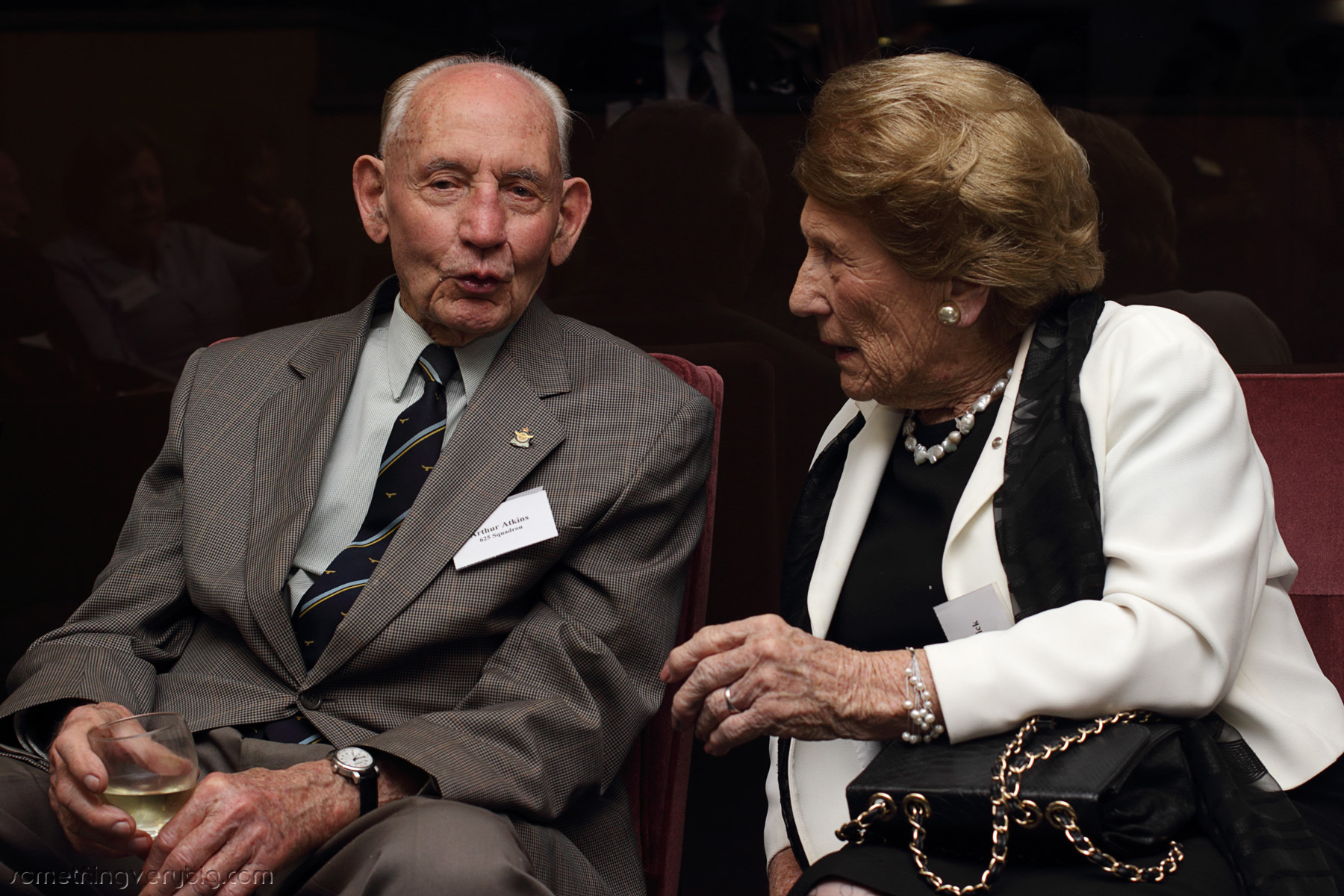
The other three are all Melbourne veterans. “Poor old Wally McCulloch”, as he introduced himself, was a 460 Squadron bomb aimer. He and his wife had braved a long and difficult journey to get to the function… from their apartment upstairs in the same building! And Arthur Atkins was a 625 Squadron pilot, with a DFC. He approached me after Don Southwell pointed me out as someone with a 463-467 Squadron connection, saying he had a mate who was lost flying from Waddington.

I’d briefly met the third Melbourne veteran, Gerald McPherson, at the panel discussion at the Shrine of Remembrance in 2013 but, until now, had not had a chance to talk to him. He was a rear gunner in 186 Squadron and related the story of his first ever trip in a Lancaster. Up to that point, he told me, flying Wellingtons and Stirlings, he’d always said a small prayer to himself at the top of the runway to help the aeroplanes take off safely. “I never needed to do that in the Lanc”, he said. “You could feel the power as it took off.” He was wearing a Bomber Command clasp so we talked about that for a little while. Coincidentally I had dropped the application for my great uncle Jack’s clasp into the postbox as I was walking to the tram to travel into the city for this event.

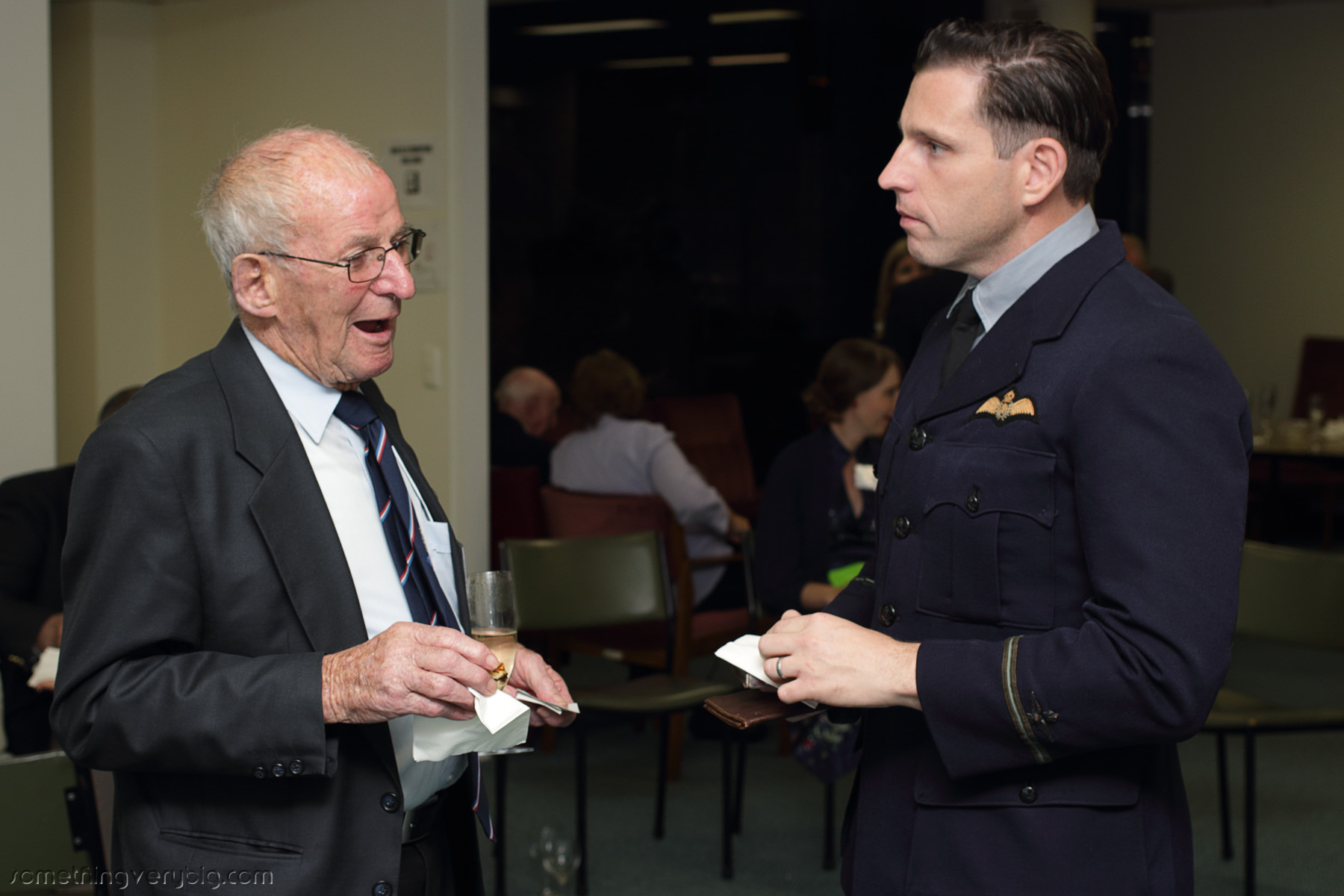
It’s not just the veterans, of course. I came away with some other useful contacts too. David Howell works at the Shrine as a Development Officer and is their resident Kokoda expert. In fact he even leads tours along the Kokoda Track (see www.kokodahistorical.com). David is clearly a military history nut – he turned up to the function wearing a WWII RAAF uniform, along with a mate:

1503-BCPartyMEL 065

I also, finally, met Andy Wright of Aircrew Book Review. We’ve corresponded before, mostly about blogging and book-ish issues, and we’ve been trying to arrange a time to catch up since he moved to Melbourne from central NSW with his young family a few months ago. This cocktail party offered a good chance to meet. Very generously, Andy had used some of his publishing contacts to source for us some very nice books for our raffle.

The raffle had been my main contribution to the running of the event. It turned out to be very successful with everyone getting involved, and Andy’s efforts, along with a couple more books and an Easter basket or two from Jan Dimmick (one of my fellow committee members), really made it worthwhile. Here are a couple of the winners:

Andy Wright with David Howell, the winner of the 'main prize' - a complete set of Chris Ward's Bomber Command Groups books, donated by Pen and Sword in the UK
Andy Wright with David Howell, the winner of the ‘main prize’ – a complete set of Chris Ward’s Bomber Command Groups books, donated by Pen and Sword in the UK
Ian Gibson with his prize, a Fighting High book donated by Capricorn Link (Australia)

Thanks to Capricorn Link (Australia) and Pen and Sword Books (UK) for their very generous donations. And I must also mention the Royal Australian Air Force Association (Victoria), whose treasurer Richard Orr announced a significant donation of funds to the group on the night.

And at the end of the day, fundraising was what it was all about. The Bomber Command Commemorative Day ceremony gets bigger in Melbourne each year, and it is beginning to cost a fair amount to put on. The aim of the cocktail party, as well as being a good chance to bring together people with an interest in Bomber Command in the city, was to raise money to ensure that the ceremony – set down for June 7 this year – can continue to be held. In this it was a success, and I think a good night was had by all.

One last thing, before I get stuck into some more photos. I wrote back in January about a programme run by the Shrine of Remembrance to connect veterans’ groups with schools, to pass the legacies of some of these groups on to a new generation. I’ve been holding this news back for a while now but, as it was effectively announced publicly on Saturday night, it’s time it got a run on SomethingVeryBig.

The Bomber Command Commemorative Day Foundation (Vic) is now part of this important Shrine initiative.

Present at the cocktail party was Scott Bramley, who is the Middle School Chaplain at Carey Baptist Grammar School, in Kew, Melbourne. (His seven-year-old son Hamish was also there and won the final prize in the raffle – a great big Easter basket – but no one believes me when I say it was emphatically not a set-up!!)

Scott Bramley
Scott Bramley

Carey was the school attended by Frank Dimmick, who was a 460 Squadron navigator and the husband of Jan Dimmick, one of my fellow committee members. Though Frank died in 2013 Jan has maintained contact with Carey’s Old Grammarians network and it is through this association that the school was approached and agreed to become part of the ceremony each June. Scott has been the main point of contact, and his enthusiasm for the project is infectious. He’s effectively thrown the resources of the school at our disposal. Year 9 students will learn about Bomber Command as part of their history studies and Carey students are expected to take an active role at the ceremony in June. Let’s hope it’s the beginning of a long and mutually beneficial association between the two groups.

RAAAFA (Vic) Treasurer Richard Orr
Don McDonald with David Howell
Arthur Atkins wih Jan Dimmick

1503-BCPartyMEL 037

Vic Leigh of the Royal Air Forces Association (Melbourne Branch). He is a veteran from an RAF Mosquito squadron but served in Australia and the Pacific, and so very modestly refused to appear in the group photograph. Lovely bloke though!
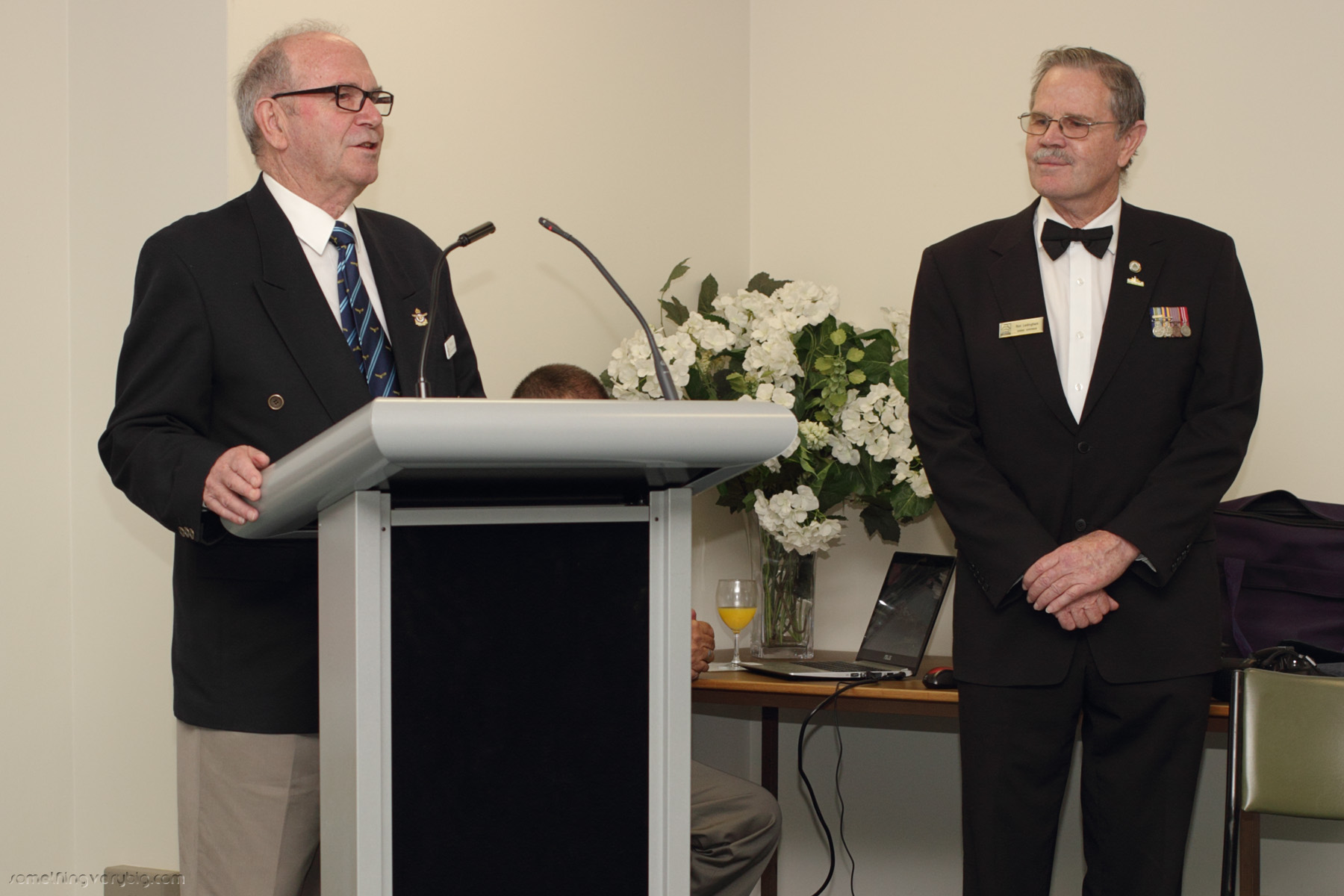
Don Southwell. Ron ledingham looking on.
Don Southwell. Ron Ledingham looking on.
1503-BCPartyMEL 052
Back, L-R: Robyn Bell (Organiser), Don Southwell, Don McDonald, Elaine McCulloch, Wal McCulloch. Front, L-R: Ailsa McDonald, Fay McPherson, Gerald McPherson, Arthur Atkins


Photos and text (c) 2015 Adam Purcell


Appeal for Information: Prouville, 24 June 1944

As regular readers of this blog (yes, both of you) would know, the most expensive operation of WWII, in terms of crews lost, for 463 and 467 Squadrons was the Lille raid of 10 May 1944 from which six aircraft failed to return.

There were three occasions – all in 1944 – which were almost as expensive, when the Squadrons lost five aircraft in single nights. On 30 January, five failed to return from Berlin. On 29 August, another five were lost attacking Konigsberg. And on 24 June, five aircraft didn’t come back from a raid on Prouville in France.

I’ve posted about the Prouville raid before. Back in July 2012 I was contacted by Phil Bonner in the UK, who passed on an enquiry from Joni Taylor, the sister-in-law of one of the men who was lost on this raid. Joni was looking for information about other members of the crew, so I posted about it here in the hope it would attract a passing Google search… and it did. It took nine months but in January the following year I received a comment from Susan Hird-Little, niece of the only survivor of Sgt PD Taylor’s crew. I was able to put the two ladies in touch with each other, which I thought was a nice little story.

Meanwhile, the wonders of Google have struck again. A few months ago I had a message from a Frenchman named Mathieu Lecul, who lives in Brucamps, near Amiens in the Somme area, and about 10km south of the night’s target at Prouville. LM571 – Taylor’s aircraft – crashed in nearby Bussus-Bussuel. In fact, four of the five 463/467 Squadron machines lost that night came down within 20km of Mathieu’s house.The fifth (the ORB says LM587 but it appears more likely to have been LM597*) also crashed somewhere near the target, but all on board survived. Four of the crew became prisoners of war but amazingly the other three evaded capture and made it home.

I was able to put Mathieu in contact with Joni and Susan, but he has now asked for help to find information or – even better – family members of each of the other crews who crashed nearby.

So, set out below, are the names and where possible a little more detail about 28 airmen who were in the aircraft shot down around the Somme area on the night of 24 June 1944. If anyone does have any useful leads for Mathieu, please drop me a line and I’ll put you in touch.

LM450 PO-K, 467 Squadron:

Crashed near Neuilly-L’Hospital

  • 415495 P/O Albert Arthur William Berryman – Died. Neuilly-Hospital – Son of Frederick and Gertrude Annie Langley Berryman Berryman; husband of Agnes Elizabeth Berryman, Victoria Park, Western Australia.
  • Sgt J.W.P. Carey Escaped
  • 418086 F/Sgt John William Berry Down – Escaped. Born on 29/01/1922 at Epson UK
  • 418418 F/Sgt John Murray Hughes – Prisoner. Born 26/02/1923 in Sydney, NSW, Australia – 305 POW Stalag Luft7
  • 427323 F/Sgt Peter Padbury Hardwick – Prisoner. Born 10/01/1922 in Perth, WA, Australia
  • 424978 F/Sgt William John Conway – Prisoner. Born 03/05/1922 in Surry Hills, NSW, Australia – 293 POW Stalag Luft7
  • F/Sgt F.H. Pagett – Prisoner

ND729 PO-L, 467 Squadron

Crashed near Mareuil Caubert

  • 425278 F/L Roland Reginald Cowan – Died – Commemorated at Runnymede. 24 years – Born 21/8/1919 – DFC – Son of Reginald Herbert and Lucy Agnes Cowan, Caloundra, Queensland, Australia.
  • 1540769 Sgt Harry Kitchener Feltham – Died – Mareuil-Caubert
  • 422779 F/Sgt Andrew Leslie West – Died – Mareuil-Caubert. 20 years – Born 30/9/1923 – Son of William Thomas and West Dorris West, Randwick, New South Wales, Australia.
  • 426377 F/Sgt Paul Francis O’Connell  – Died – Poix de Picardie. 22 years – Born 17/12/1921 – Son of Michael Francis and Annie Maria O’Connell, Toowoomba, Queensland, Australia. Pharmaceutical Chemist.
  • 423639 F/Sgt Herbert Kenith Brown – Died – Mareuil-Caubert. 21 years – Born 10/6/1923 – Son of William Herbert and Elsie May Brown, of Tocumwal, New South Wales, Australia.
  • 1578397 Sgt Jack Sheffield – Died – Mareuil-Caubert. 28 years – Son H. Lawrence, Raunds, Northamptonshire UK
  • 429503 F/Sgt Arthur Albert Summers – Died – Mareuil-Caubert. 30 years – Born 28/1/1914 – Son of James Arthur Joseph and Margaret Mary Summers; husband of Beatrice Erin Summers, of Annerley, Queensland, Australia.

LM571 JO-E, 463 Squadron:

Crashed near Bussus-Bussuel.

  • 16203 P/O John Francis Martin – Died – Bussus-Bussuel. 23 ​​years – Born 14/12/1920 in Fremantle, WA, Aust – Son of Francis William and Veronica Rechinda Martin; husband of Doreen Madge Martin, Subiaco, Western Australia.
  • 1324017 Sgt Peter Donald Taylor – Died – Bussus-Bussuel. 24 years – Son of John Ernest and Elizabeth Taylor, of Slough, Buckinghamshire.
  • 415430 W/O Bernard Edward Kelly – Died – Bussus-Bussuel. 23 years – Born 02/03/1921 in Perth, WA, Aust – Son of Edward Joseph and Bridget Kelly, Perth, Western Australia.
  • 418755 F/Sgt Thomas Alexander Malcolm – Prisoner. 418755 – Born 13/07/1921 in Morwell, VIC, Australia – Arrested in Paris on 19/07/1944 and deported to Buchenwald – Pow 8929?
  • 417327 F/Sgt George William Bateman – Died – Bussus-Bussuel. 32 years – Born 28/04/1912 in Unley, SA, Aust – Son of Sidney Davies Bateman and Florence Ethel Christina Bateman; husband of Marjorie Jean Bateman, Magill, South Australia.
  • 424761 F/Sgt Lionel Gregory Leslie Hunter – Died – Bussus-Bussuel. 20 years – Born 23/08/1923 in Canowindra, NSW, Aust – Son of Arthur and Grace Agnes Hunter, of Balgowlah, New South Wales, Australia.
  • 408433 F/Sgt Bramwell Rockliff Barber – Died – Bussus-Bussuel. 20 years – Born 28/02/1924 in Ulverstone, TAS, Aust – Son of Bramwell Fletcher Barber Florence and Myrtle Barber, Launceston, Tasmania, Australia.

LM574 JO-J, 463 Squadron:

Crashed near Longuevillette.

  • 417248 P/O Jeoffrey Maxwell Tilbrook – Died – Amiens St-Pierre. 21 years – Son of Robert and Esther Forrester Tilbrook, of Brinkworth, South Australia.
  • 1725436 Sgt David Jesse Dowe – Died – Amiens St-Pierre. 19 years – Son of David N. Dowe and Alice E. Dowe, Thorpe St Andrew, Norfolk.
  • 416651 W/O Hubert George Carlyle – Died – Amiens St-Pierre. 30 years – Son of Leslie and Amy Morton Carlyle Carlyle, Flinders Park, South Australia.
  • 412469 W/O Alexis Charles Mineeff – Died – Amiens St-Pierre. 23 years – Son of John and Annie Emily Mineeff, Glenbrook, New South Wales, Australia.
  • 1251477 Sgt Frederick Charles Penn – Died – Amiens St-Pierre. 23 years
  • 419126 F/Sgt Maxwell MacDonald Lack – Died – Amiens St-Pierre. 21 years – Son of Edna Osborne Lack, Myrtleford, Victoria, Australia.
  • 136398 P/O A Syddall – Prisoner 6509 POW Camp Luft III

Do you know anything about any of these airmen? Get in touch – there’s a handy form on this page!

*Alan Storr gives LM587 but my copy of the ORB shows a pencilled correction to LM597 and Bruce Robertson’s Lancaster – The Story of a Famous Bomber lists LM597. LM587 is shown by Robertson as being lost in September 1944.

This will be the final post on somethingverybig.com for 2014, while I take a short break from blogging. I’ll be back in early January 2015!

Ladies’ Day with the 463-467 Squadrons Association in Sydney, 16 November 2014

Some three decades ago, the 463-467 Squadrons Association (NSW) (Inc) needed to find a new venue for their Annual General Meeting. One of the squadron veterans was a member of the Killara Golf Club in what’s usually described as Sydney’s ‘leafy’ North Shore, and suggested that the salubrious surrounds of the art deco clubhouse there might be suitable. So they tried it, and it was. After a few years the meeting would be followed by lunch at the club and eventually wives and partners were invited along too. The gents had their meeting in the Billiards Room while the ladies got stuck into drinks in the Dining Room. And then they would all share lunch together.

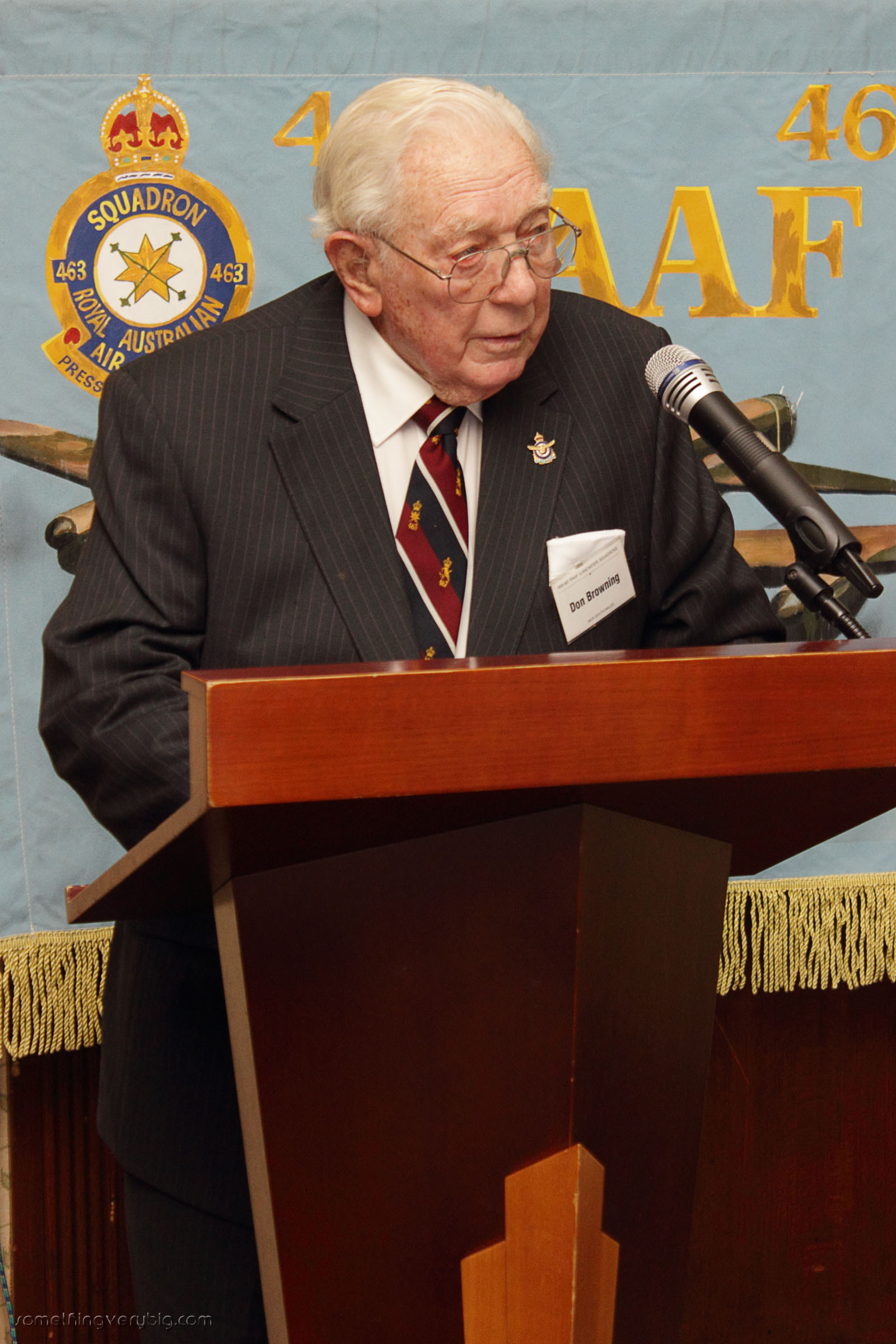
Such were the origins, says veteran 463 Squadron wireless operator Don Browning, of the now-annual ‘Ladies’ Day’ luncheon. AGMs are no longer required following the winding up of the official body some years ago but the loose association continues to hold the lunches on the Sunday nearest Remembrance Day each November. This year’s edition took place yesterday. And I was there, one of about 55 people in the crowd.

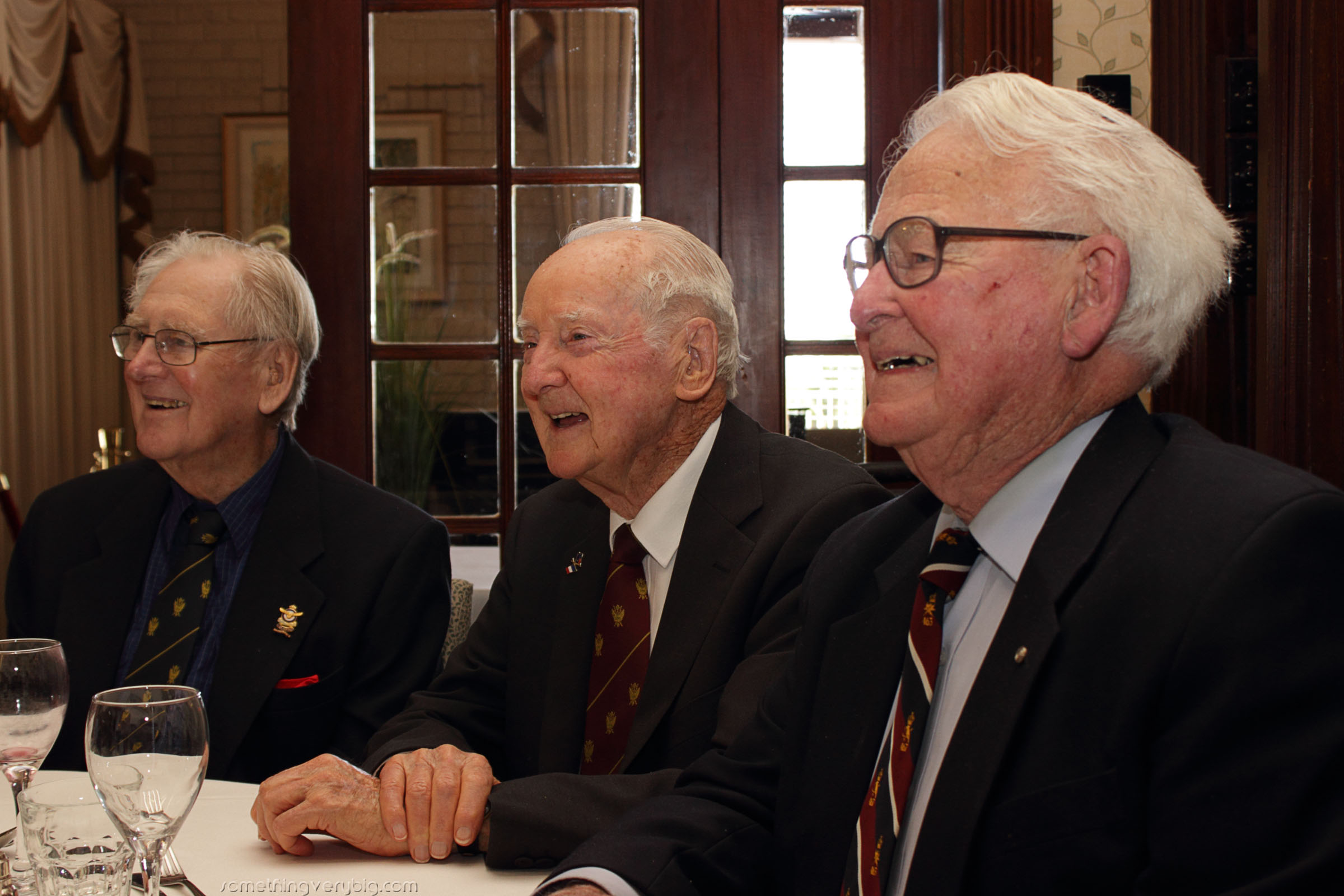
There was a little shuffling of the seats happening at Table 3 when I arrived to stake my claim. No fewer than three Bomber Command veterans were at the table so I cunningly found a spot in between two of them. Don Southwell apologised as he took his seat on my left. “Sorry you got me,” he said. “I thought you’d want to sit next to someone interesting!” I raised an eyebrow. Sitting next to me on my right, was Ron Houghton, who flew a full tour as a Halifax pilot on 102 Squadron and after the war had a long career flying Constellations and B707s with Qantas. To his right, Keith Campbell, a bomb aimer who was the only survivor when his 466 Squadron Halifax was shot down over Stuttgart in June 1944. Keith wore the little gold caterpillar badge that denotes a member of the Caterpillar Club. Don Southwell himself, of course, flew nine operations as a 463 Squadron navigator.

Don Southwell (right), Ron Houghton and Keith Campbell

I reckon I’d have a hard time finding anyone more interesting than this trio.

I was, in reality, extraordinarily lucky to have three veterans at my table. In all there were nine present, down three on last year, mostly through illness both short and long-term. Most obviously missing for me were Tom Hopkinson, who had to cancel at short notice, and Harry Brown, who is still recovering from complications after breaking a hip a few months ago. Even some of those who were there have been a little in the wars lately. Keith Campbell got the most points for effort though. He’s had a hip operation recently but managed to wrangle a leave pass from hospital for the afternoon.

After a superb meal at which, as you’d expect in this company, the conversation was free-flowing, it was time for some speeches. Don Southwell welcomed the reasonably significant number of visitors, and proposed the traditional Toast to the Ladies:

SOLD! To the man in the blue suit!

Annette Guterres responded on behalf of the Ladies, both present and not:

14Nov-LadiesDay 031
Annette Guterres

The day’s main speaker was Bill Purdy. Before he spoke, however, Don Browning shared a story about him:

Don Browning
Don Browning

Following his tour of operations, Bill was posted to a Heavy Conversion Unit at Wigsley as an instructor. Returning from a training sortie one day Bill found himself close to Waddington and decided it would be fun to buzz the control tower there. So he did. Word of his indiscretion, of course, made its way back to Wigsley, where the Commanding Officer there happened to be the former CO from 463 Squadron, Rollo Kingsford-Smith. Kingsford-Smith gave Bill a good dressing-down and told him that Group Captain Bonham-Carter had demanded an apology in person.
“You are to go to Waddington”, Rollo said.

No problem, Bill thought. It’s only about nine miles away as the crow flies, a short hop in a Lancaster. No sweat.

But Rollo wasn’t finished yet.

“…by bicycle!”

Bill says he hasn’t forgotten that bike ride.

Apart from Phil Smith, of course, Bill was the first Bomber Command veteran I had met who actually flew on the Lille raid of 10 May 1944 from which the crew of B for Baker failed to return. He’s also the only Bomber Command airman I know who still has a pilot licence, flying around in a Tiger Moth from Luskintyre, north of Sydney. But this talk was about his experiences in June of this year, when a delegation of seven Australian veterans went to France to take part in the official 70th anniversary commemorations of the Normandy landings.

14Nov-LadiesDay 044

Bill had been on the raid on the morning of the invasion against Pointe du Hoc, a very large German gun emplacement, and it was in this capacity as a veteran of D-Day that he was selected. Interestingly another one of the seven was present at Killara: my lunch companion Ron Houghton.

In any case, Bill gave a good talk. Security on the French trip was tight, he said, with multiple checkpoints to negotiate on the way to the official ceremonies, and traffic was a nightmare with half a million people in the area. But it was one of the best-organised events he had ever been part of and a most memorable occasion, particularly seeing first-hand the damage their 1,000-pounders had done to Pointe du Hoc. Having been there myself a few years ago, he’s right – there are craters everywhere.

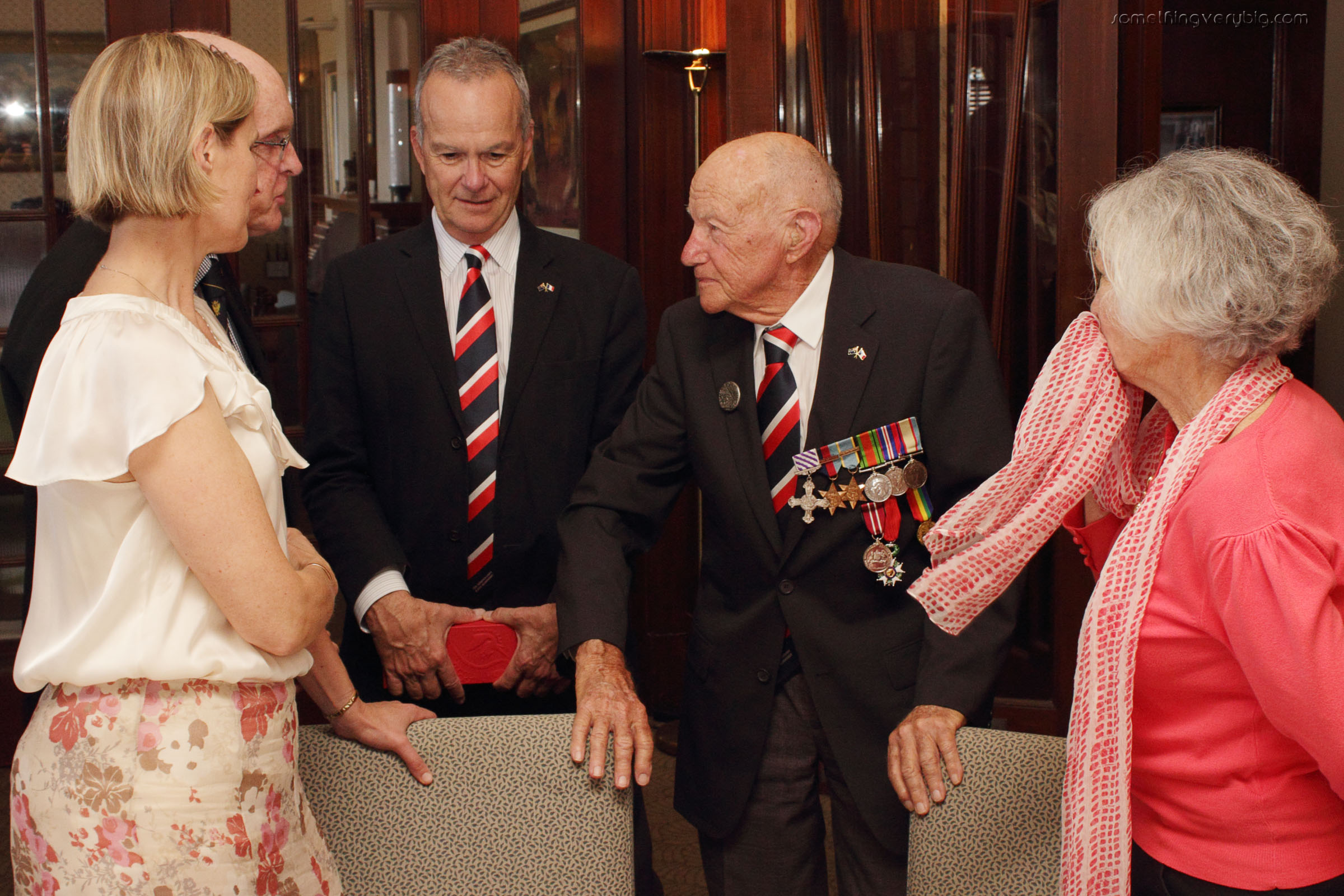
Bill was wearing his medals, and they included a particularly impressive-looking one hanging from a red ribbon. While the veterans were overseas the French presented each of them with the Légion d’Honneur, one of the country’s highest honours. It’s the one hanging from his left thumb in this photo:

14Nov-LadiesDay 045

Following the talk there was one more bit of official business to take care of: the group photo. Once again, all we were missing was a flight engineer… and a Lancaster, otherwise I would have suggested they all took us for a fly.

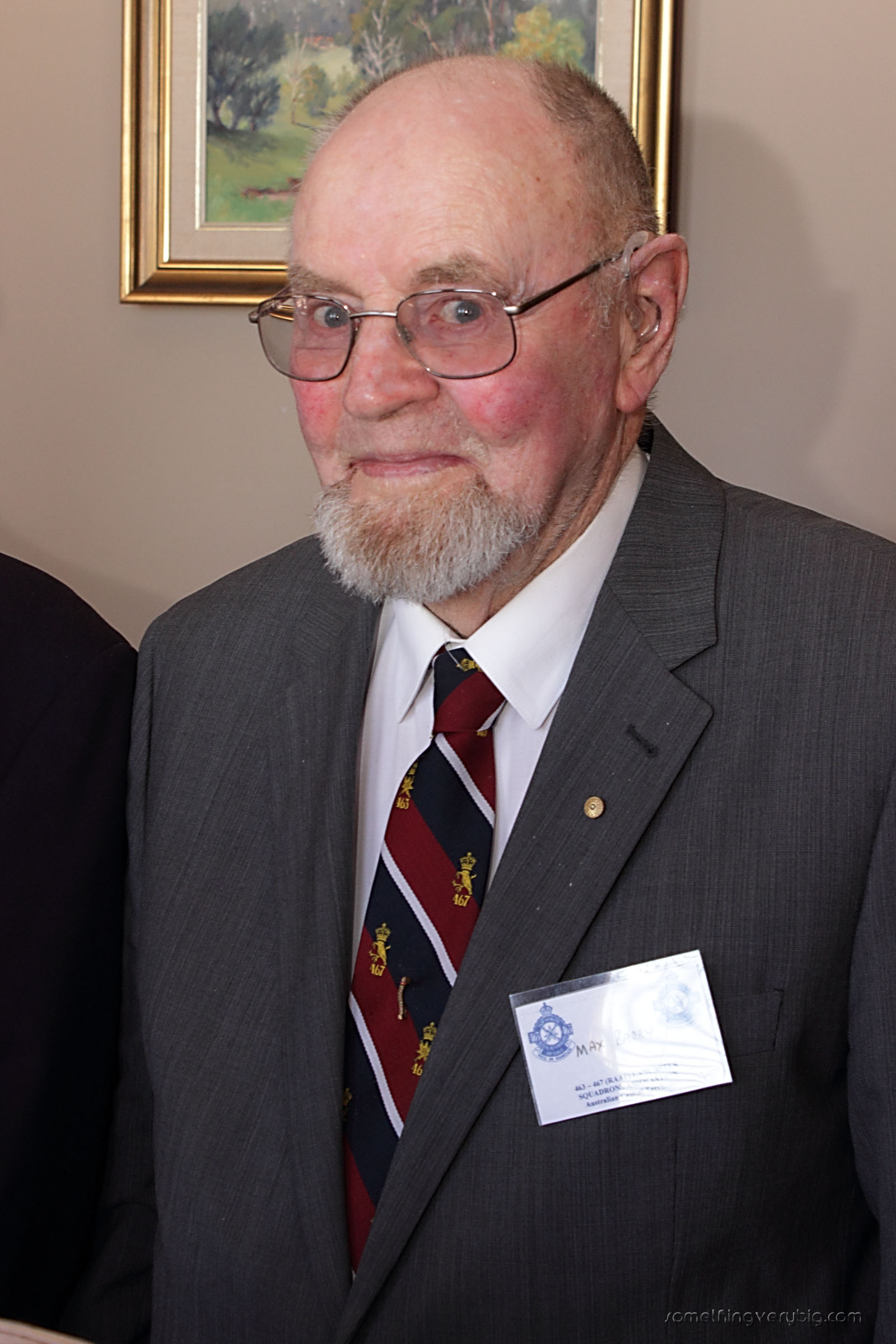
Back row L-R: Don Southwell (463 Sqn Navigator), Bill Purdy (463 Sqn Pilot), Hugh McLeod (49 Sqn Rear Gunner), Max Barry (463 Sqn Mid Upper Gunner), Roy Pegler (467 Sqn Bomb Aimer). Front Row L-R: Don Huxtable (463 Sqn Pilot), Don Browning (463 Sqn Wireless Operator), Ron Houghton (102 Sqn Pilot) and Keith Campbell (466 Sqn Bomb Aimer).

I really enjoy the company of these ‘old lags’ and I feel very lucky that I’ve been able to make the trip up from Melbourne to catch up with them a couple of times a year. May it continue for a good few years yet.

Max Barry
Max Barry
Roy Pegler
Roy Pegler
Don Huxtable
Don Huxtable
Ron Houghton
Ron Houghton
14Nov-LadiesDay 051
Keith Campbell
Hugh McLeod
Hugh McLeod
Keith Campbell and Ron Houghton
"How do you work this thing anyway?"
“How do you work this thing anyway?”
Hux and his 'Top Gun Hands". Once a pilot, always a pilot...
“There I was, nothing on the clock but the maker’s name…” Once a pilot, always a pilot…
Keith Campbell, Ross Browning and Ross' socks
Keith Campbell, Ross Browning and Ross’ socks

14Nov-LadiesDay 070

Text and images (c) 2014 Adam Purcell
 

Visiting Hux

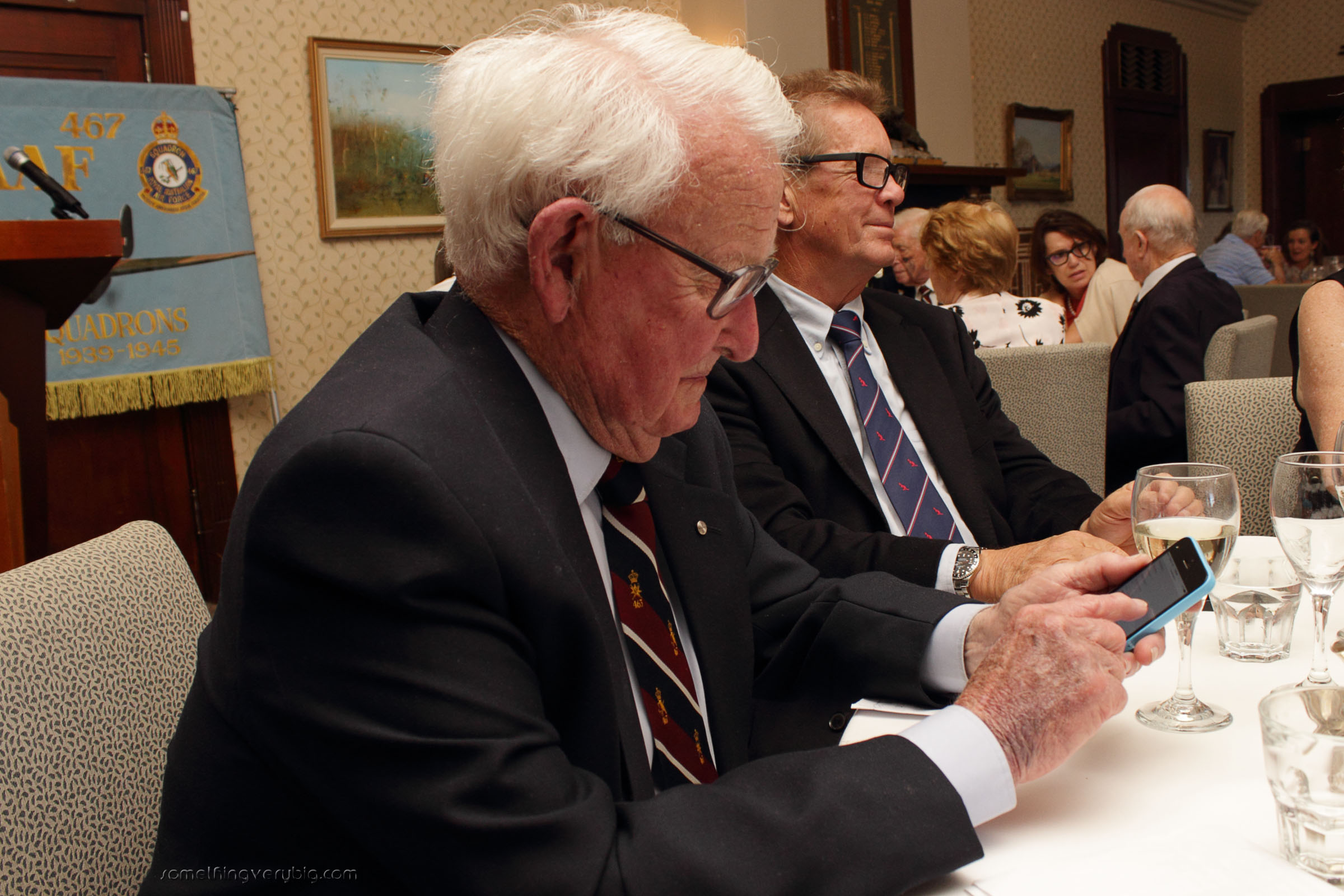
Don Huxtable has featured on this blog before. A Lancaster pilot, he remains one of the living legends of 463 Squadron. He and his crew flew 32 operations between between September 1944 and April 1945, earning Hux a Distinguished Flying Cross in the process.

He has been a little in the wars in the last few months with a recent extended stay in various hospitals and rehabilitation centres. I made a mid-week dash to Sydney a couple of weeks ago and, with the prospect of a few hours to spare before my flight home, decided to see if I could arrange a visit.

The first step was to find out where he actually was. And when I rang his daughter a week before my trip I was most pleased to discover that Hux had returned home again. So on an unassuming Thursday morning I caught a train to Hornsby, on Sydney’s upper North Shore, and walked up the hill from the station to a simple weatherboard house on a quiet tree-lined street.

The importance of the ‘crew’ is one of the central themes of the Bomber Command experience, and in Hux’s case it was no different. In the words of Peta Fitzgerald, grand-daughter of Hux’s mid-upper gunner Brian Fallon[1], they had “[flown] together, lived together, drank together, prayed together, and on more than a few occasions saved each other’s lives… they became as close as brothers.”

In the years immediately following their return from war, the four members of Hux’s crew who were from Sydney stayed together as they settled back into normal life. They built four houses on adjacent blocks in the same street. Hux’s own house was the second to be finished. “We built that one first,” he told me, pointing through a window towards next door. Well, not that one, he corrected. “We built the one that used to be there!” And he raised the blind to reveal the solid brick wall of a huge McMansion now pressing up against his fence. Today, Hux is the only one of the four who is still there. The rest have all died.

When I first arrived Hux had just begun makinga simple salad for lunch, but after pondering it for all of, oh I don’t know, two and a half seconds, he suggested we instead went to “the Club” for lunch. I readily agreed.

I thought about it as we waited for the taxi. I’d seen the Hornsby RSL Club as I walked up the street from the station. Hux has been involved with the club for a very, very long time. In fact, the last time I spoke to him on the phone, when he was still in hospital and it appeared likely that he would need to move into full-time care, his main comment about it was that he did not mind whatever facility he ended up in if “at least I can still get to the club!” Knowing how special the place is for him I realised the honour implicit in an invitation to lunch there with him.

After a stimulating conversation about the quality or otherwise of the refereeing in the previous weekend’s rugby league semi-finals, the taxi driver dropped us off at the downstairs entrance. ‘When I first came here,” Hux told me, “the club was in a little tin shed about there,” pointing to what is now a large car park. “Look at it now!” It soon became clear just how well-known Hux is at the club. Every corner we turned was someone who said a cheery “morning, Mr Huxtable!” as we went past.

I was given the grand tour, then we ended up in the bistro for a classic RSL lunch: simple, cheap and lots of it. I drank beer; Hux had his usual scotch and soda. We chatted about all sorts of things: Hornsby, Hux’s post-war career in the meat trade, the recent tour of England by the Canadian Lancaster, the perils of shift work, life in Melbourne, the future of Bomber Command commemoration in Australia… I even found time for a quick portrait:

14Oct-Sydney 097

And on the way out we made a short detour. As if anyone needed any more proof of the importance of Hornsby RSL to Hux, or of his importance to them, there’s a room named after him:.

Don Huxtable outside the roon maned for him, Hornsby RSL, October 2014
Don Huxtable outside the roon named for him, Hornsby RSL, October 2014

“I thought they only named rooms after people when they died,” he said gruffly, though even as he said it I’m sure I could detect a touch of quiet pride in his voice.

We shuffled out into the Sydney spring sunshine, and Hux bade me farewell. When I looked back, I saw the old pilot waiting at the street corner for the lights to change. Slightly stooped as he leant on his walking stick, he still towered over the rest of the crowd.

(c) 2014 Adam Purcell

[1] Fitzgerald was writing in the preface to Brian’s posthumously-published memoirs, Press On Regardless: Memories of Bomber Command, which she edited. Privately published.

VeRA and the crew of B for Baker

Some awesome photographs have filtered out over the last couple of months as the world’s only two airworthy Lancasters toured the UK. ‘VeRA’, the Canadian Warplane Heritage Museum’s Lancaster, was flown across the Atlantic in early August and joined PA474 of the Battle of Britain Memorial Flight at numerous airshows and other events across the country. ‘VeRA’ was due to leave the UK around the time that this post is published, having participated in sights and sounds not experienced in at least five decades. They even arranged a rendezvous with Just Jane at East Kirkby, where 5,000 lucky people got to experience not one, not two, but THREE Lancasters with engines running at the same time.

The CWHM aircraft is dedicated to the memory of a man named Andrew Mynarski, who was a 419 Squadron mid-upper gunner in June 1944. Remarkably, I recently discovered a direct connection between Mynarski and the crew of B for Baker.

In June 1944 Mynarski’s aircraft was shot down by nightfighters during an attack on marshalling yards at Cambrai, France. [1]The pilot ordered his crew to abandon the aircraft and, after giving them some time to do so, he parachuted himself. But meanwhile the rear gunner – a man named Pat Brophy – was trapped in his turret, with burning hydraulic fluid in the rear fuselage. Mynarski was about to leave the aircraft via the rear door when he saw Brophy. Without hesitation he crawled through the flames and tried to break into the turret with the crash axe. By this time his uniform was on fire and the rear gunner waved him away, but he tried again with his bare hands.

But it was not enough. With time running out, Brophy screamed at him to get out. Mynarski realised it was hopeless and, because there was no space to turn around, he crawled backwards through the flames. He reached the door. He stood up. Still looking at Brophy, he slowly came to attention, clothes in flames, and saluted. Then he mouthed the words, “Good night, Sir,” and jumped.

Mynarski’s clothes were on fire as he fell – and so was his parachute. While he was found by people on the ground he died of his injuries shortly afterwards. Most incredibly, Pat Brophy, the rear gunner still in his turret, survived the crash. On his return to England he was able to tell the story of Mynarski’s final act – and Pilot Officer Andrew Charles Mynarski was awarded a posthumous Victoria Cross, gazetted in October 1946. In his memory, the Canadian Warplane Heritage Museum’s Lancaster is named the Mynarski Memorial Lancaster, and carries the Victoria Cross insignia on both sides of its nose.

So where is the connection to the crew of B for Baker? Earlier this year I was contacted – through this blog – by Dale Higgins, a niece of wireless operator Dale Johnston. Among other things she sent me a copy of his logbook, which includes this particularly useful page:

Alastair Dale Johnston Flight Log-13

Mynarski’s name, because it is so unusual, immediately set bells ringing. The timing matched. A quick google confirmed that the initial matched as well. But Mynarski was serving on a Canadian squadron when he met his death, and Dale Johnston and his crew ended up at 467 Squadron. And he was a mid-upper gunner at 419 Squadron, though Dale lists him as a rear gunner. I needed some more evidence.

Enter Jim on the Bomber Command History Forum. He managed to pull up Mynarski’s service record[2] (caution: 96Mb pdf) from the Archives Canada website. And there is an overlap.

Dale Johnston, Ken Tabor, Jerry Parker and Eric Hill arrived at 1661 Heavy Conversion Unit – Mynarski was already there – in September 1943. Jack Purcell arrived a week and a half later. All their posting dates in and out of 9 Squadron are identical. Their paths diverge again at 1668 Heavy Conversion Unit, when Dale et al. joined Phil Smith and went to 467 Squadron on 31 December. Mynarski stayed on, leaving the HCU to a Royal Canadian Air Force depot on 20 January 1944.

So we know that Mynarski’s movements were identical to those of the group of men who made up the core of the crew of B for Baker from September until December 1943. And we have Mynarski’s name in the crew list in Dale Johnston’s logbook.

It would be nice to see a copy of Mynarski’s logbook to be sure (and I have feelers out to that end, but no joy yet), but the available evidence supports a strong case that Andrew Mynarski, VC, was for a few months at least, part of the crew of B for Baker.

And that, if it’s possible, gives even more meaning to ‘VeRA’s recent visit to the UK.


© 2014 Adam Purcell
[1] The following description of Mynarski’s actions comes from http://www.bombercommandmuseum.ca/s,mynarski.html and the citation for his decoration, found in his Service Record (see No. 2, below)

[2] Item Number 26336, via http://www.bac-lac.gc.ca/eng/discover/military-heritage/second-world-war/second-world-war-dead-1939-1947/Pages/search.aspx

One Mystery Solved

Operational Record Books are fantastic historical sources. They are extensive chronological records of everything that happened, day by day, to a squadron in an operational sense. They cover information like targets, aircraft and crews, and usually describe details of any operational flying carried out. Very useful, then, if you’re trying to trace the lives and times of a particular Lancaster crew.

But they do not yield all the answers. The documents are seven decades old. They are faded, smudged, illegible and fragile, either on paper or (shudder) a microfiche machine. The information that was once there can sometimes disappear.

And sometimes the information was left out, mistyped or never even there in the first place.

The Monthly Summary (the so-called ‘Form 540’) in the 463 Squadron ORB records that Pilot Officer ‘Dud’ Ward received word on 9 May 1944 that he had been awarded an immediate Distinguished Flying Cross. The summary shows that the decoration was for a “grand effort” during an operation, but the date of that operation is smudged. It could be 6/7 April, or it could be 26/27 April. It’s unlikely that it was the earlier date because on that night nothing happened. The Form 540 entry for 26 April does however relate a story which is a possible candidate for the action that resulted in Ward’s DFC.

After losing two engines on return from a raid on Schweinfurt and ordering his crew to man ditching stations, Dud Ward managed to coax his aircraft across the Channel and land at Tangmere. The problem is, however, that the sortie list (or Form 541) has no record of Ward or his crew having flown that night. So while it appears most likely that it was indeed the Schweinfurt trip on which Ward won his DFC, there is contradictory evidence and thus some doubt remains.

I came across this quandary while I was writing my 467 Postblog series. Being early May at the time, I was pushing the deadline to publish the post so I had no time to find other sources to swing the balance one way or the other. I had to make do with a short description of the problem, and moved on.

And there the not-quite-satisfactorily-resolved issue remained, largely forgotten. Until I recently started to dig into the large pile of stuff that has been accumulating on my desk (and on my hard drive), waiting patiently for me to find time to go through it properly.

A not insignificant part of this pile is made up by one of the better collections of wartime letters I’ve seen. It’s from Arnold Easton, a 467 Squadron navigator who was at Waddington from mid February 1944. His letters, provided by his very proud son Geoff, are in places extremely detailed and I have been finding interesting little nuggets all through them. Including this, from a letter written on 9 May, 1944:

By the way George Jones’ pilot was notified today that he has won the D.F.C. for a very good show he put up on the return trip from Schweinfurt on 26.4.44.

Jones was a good friend of Arnold’s, and his name appears frequently in his letters. Reading this line set off a small bell in my memory. Could George Jones’ pilot have been ‘Dud’ Ward?

He most certainly was. The crew list is in the ORBs (though not for the Schweinfurt raid!). And, sadly, both Jones and Ward are buried at Forest-sur-Marque in France, just a few miles east of Lille, the city they were attacking when they were killed two nights after Easton wrote his letter home. “George Jones – best pal gone”, wrote Arnold in his logbook the next day.

So, satisfyingly, the ambiguity in the ORB was solved by another primary source, one that came from an entirely different place. I still have almost a hundred of Arnold’s letters to read – what else might I find?


© 2014 Adam Purcell
 

Norm Kobelke and the mystery of the man in the suit

Earlier this year I was sent a fantastic photo of a bomber crew standing in front of their Lancaster. It came about because of a comment I received on this post in my 467 Postblog series. Richard Kobelke, who sent me the photo, is the son of the man on the far left in this highly distinguished crew:

The Kingsford-Smith/Kobelke crew at Waddington. Photo courtesy Richard Kobelke

Because it is so unusual Richard’s surname rang a bell instantly: I’d come across it a lot while transcribing sections of the 463 Squadron Operational Record Book. His father, Norman Kobelke, was a navigator who flew in the winter-spring of 1943-44 with Wing Commander Rollo Kingsford-Smith. The entire crew in the photo, left to right, are as follows:

  • Navigator: Flying Officer N.H Kobelke
  • Wireless Operator: Flying Officer M.J. McLeod
  • Bomb Aimer: Flight Sergeant B.W. Webb
  • Pilot: Wing Commander R Kingsford-Smith
  • Flight Engineer: Sergeant A Fairburn
  • Rear Gunner: Flying Officer D Proctor
  • Mid-Upper Gunner: Flying Officer J.K.R. Rees

Norm Kobelke’s first tour of operations was with 458 Squadron, flying in the Middle East. In October 1943 however, he joined 467 Squadron as part of Kingsford-Smith’s crew, then went across with “C” Flight when it was split off to form half of the new 463 Squadron. Norm completed 55 operations in total, the last 20 with Rollo. His final trip was 24 May 1944 to Duisberg (“Last of 2nd tour,” he wrote in his log book. “You beaut!”) and about the same time he was awarded a Distinguished Flying Cross. After the war Norm stayed in the Air Force but sadly, in February 1948 he was killed in the crash of a Lincoln bomber at Amberley, Queensland.

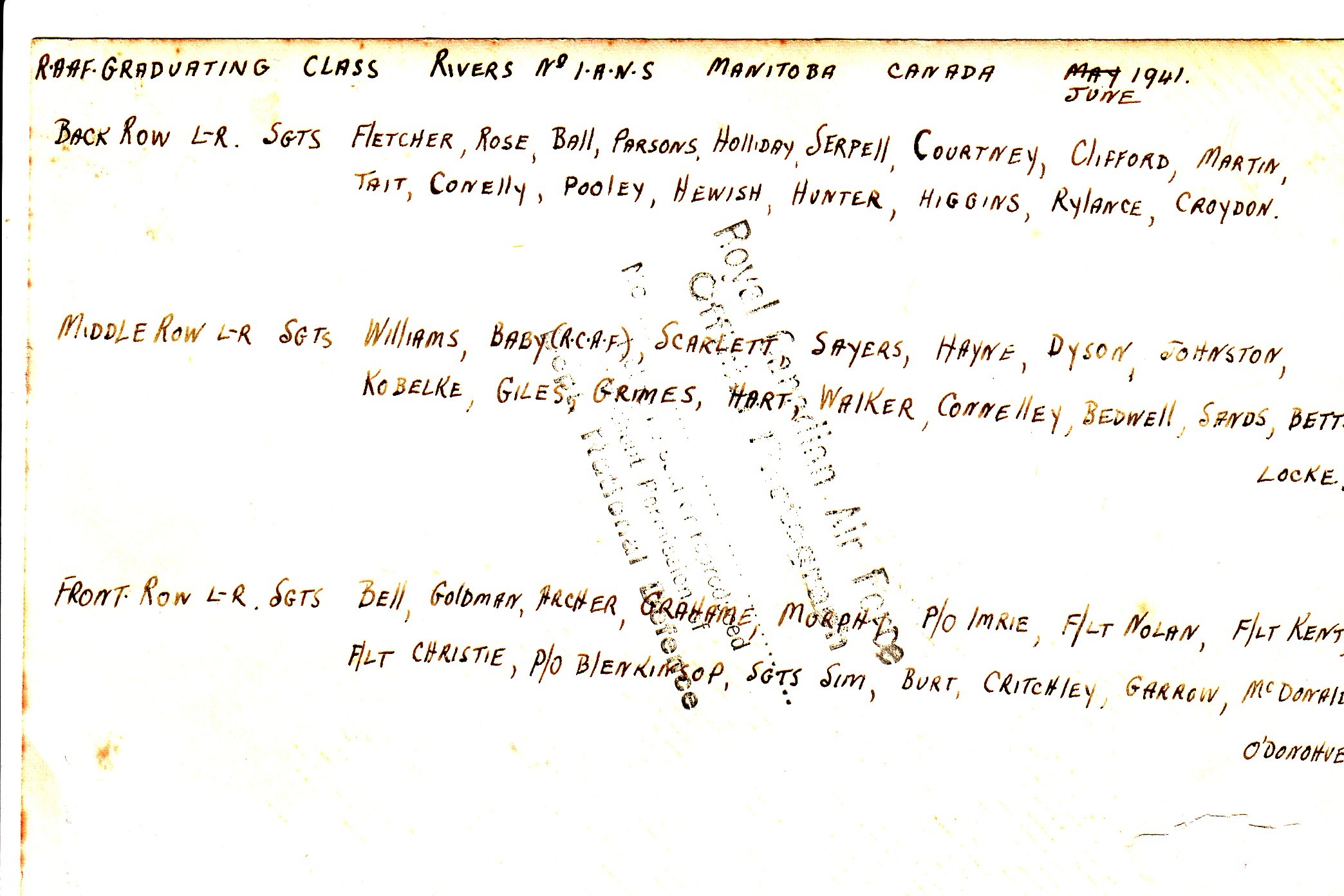
Richard has sent me a few really interesting photos including his father. Norm trained in Canada; here is his graduating class from No. 1 Air Navigation School in Rivers, Manitoba, Canada, in June 1941. Norm is eighth from the left (almost under the Anson’s nose) in the middle row:

RAAF Graduating Class Rivers No. 1 ANS, Manitoba, Canada, June 1941. Photo courtesy Richard Kobelke

Jul06251

Richard thinks the next photo may have been taken at Amberley. If that is the case it is almost certainly in the immediate post-war period: Norm is far right in the front row and he is wearing two rows of rank braid on his sleeves showing he was a Flight Lieutenant and the ribbon of the DFC:

Photo courtesy Richard Kobelke. His father Norm is seated on the far right.

This is probably the most interesting out of the photos in the small collection that Richard sent me.

Who is the man in the civilian suit? Photo courtesy Richard Kobelke

In amongst a big group of airmen (Norm is there too, in the top right of the photo) is a man in a civilian suit. Clearly he is someone important, but we have not yet been able to pin down a definite identification. The best guess so far is Lester B Pearson, a Canadian politician who would go on to become Prime Minister two decades after the war. Certainly we know Norm trained in Canada and the rest of the airmen in the photo appear to be all Australian, and the man bears something of a resemblance to the two photos in this link, but for the moment his identity remains a guess at best.

Richard also sent me some extracts of his father’s wartime diary, covering the period when he was at Waddington. It’s a brilliant source. He describes some of his operations in the sort of detail you don’t normally read in letters:

And now a Berlin in the log book. […] A real bind of a trip. Met winds from all over the place – early at target and well north of track crossing French coast home… (19NOV43)

He describes his leaves:

Had a 48 [hour leave] last week whilst Smithy [Rollo Kingsford-Smith] was on leave. Went on car with rear gunner Proctor, spent night at dam-buster squadron + rest of time at the ‘White Horse’ in Braton. Spent all my money. (21DEC43)

There is some serious personal reflection as well:

Have practically decided to marry Biddy – will have to look around for money for rings. Future very unsafe financially, but have a grand pal in Biddy & I’ve told her my exact position. Here’s hoping. (05APR44)

The pair would marry a month later, with Kingsford-Smith attending and rear gunner Proctor the best man.

Norm even notes how the wider war was progressing:

Russians still winning. Stalemate in Italy due to bad, wintry weather… (19NOV43)

What is really interesting for me, however, is the talk of various rumours around the squadrons:

Many rumours flying about re Aussies flying home in Liberators before XMAS. Will believe it when it happens. (20MAR44)

Staying on squadron for a while but now a strong rumour about all tours extended to another 3. So I’d better get out quick. (29MAY44, after last operation of 2nd tour)

Diaries are really the only source of this sort of information. It is certainly never something you find in official records (because they were rumours) and is unlikely to make it to letters sent home, but it’s very much part of the life and times for Bomber Command aircrew. I can well imagine aircrew discussing the latest rumour in the crew room or over a pint or two at the pub.

A diary was the one place where aircrew could put down their thoughts and feelings if they wanted to. They are in many cases a great little uncensored snapshot of what was going on at the time. (Well, almost uncensored – Norm’s diary shows evidence of some parts being cut out, apparently cleaning up when he married Biddy!).

In all, it’s a great little collection of photos and documents and I’m grateful that Richard has allowed me to see and share them.


© 2014 Adam Purcell
Bill and the demons of Dresden

When I arrange to meet a Bomber Command veteran I typically try to find out beforehand some basic details of his service, to put the visit in some sort of context. It was no different when I recently met a former bomb aimer who had served on an Australian squadron in the closing months of the war.

The veteran – who I’ll call ‘Bill’ – flew his first operation on 13 February, 1945.

In hindsight, I probably should have realised the significance of that date much earlier than I did.

Dresden.

Even though in recent years there has been a re-assessment of the causes and consequences of the firestorm (most notably in Frederick Taylor’s excellent 2004 book Dresden: Tuesday 13 February 1945), the name of the city still induces a sharp, involuntary intake of breath. It would come to haunt Bill for the next seven decades.

On 9 February 1995, The Age newspaper published two articles marking the 50th anniversary of the raid. “Dresden put to fire and the sword”, said the headline on one of them, an article by Simon Jenkins. “The war was almost over and military installations round Dresden were not attacked,” Jenkins wrote. “Harris used incendiaries on Dresden to create a firestorm where in other cities he used high explosive.” And in dealing with the reaction after the raid, he wrote, even the Americans “distanced themselves from avowedly “terrorist” air attacks, after their own planes had gunned down people fleeing the burning city the morning after the British raid.”

The second article, titled “Unease lingers 50 years after a city’s ruin” by John Lahey, quotes a 463 Squadron navigator, Brian Luscombe. “Mr Luscombe says he become uneasy about 20 years after the war ‘when people would ask where you had been and what you had done. It was only then we realised the enormity of it. It was a holocaust.’” Bill underlined that paragraph in red ink. As the bomb aimer, he had been the man on board his Lancaster who pressed the button to send his munitions into the maelstrom below. Ashamed at the personal responsibility he felt for what happened to Dresden, he threw away his service medals and declared himself a pacifist.

But the irony is the two articles which apparently affected him so much demonstrate a view of the Dresden raid which is now well out of date. As 227 Squadron rear gunner Dennis Over – who also flew to Dresden – suggested to me a few years ago, how did anybody at the time know that the war was almost over? Squadron Operational Record Books confirm that bomb loads used at Dresden were no different to other raids on urban targets around the same time. And Frederick Taylor, in an appendix to his book, effectively blows the theory of post-raid strafing of civilians out of the water (see p.440 for a summary and explanation). The theory was raised in David Irving’s now-discredited 1963 book The Destruction of Dresden, but there is precisely no reliable documentary evidence that anything of the sort actually happened.

This is not the first time that I’ve met a veteran of Dresden. Indeed, given that it happened at the end of the war, I’d say most veterans still alive today would have been operating at the time. But Bill is one of the first I have met who has been affected by it this much. It wasn’t the only part of his wartime service which appears to have scarred him however.

Bill is well over 90 now and quite frail, and was sitting in an armchair reading a newspaper when his wife showed me in. She introduced us and his first comment was that “it was a very very very long time ago and my memory isn’t very good anymore.” Nevertheless we were able to have a conversation, however rambling and confused it might have been.

Prompted by a photo of his crew sitting on the engine of a Lancaster, Bill shared with me one of the more shocking events of his operational career. Just a couple of weeks from the end of the war in Europe, his crew was on the final leg to a target in Germany when they were attacked by an unidentified aircraft, badly damaging their Lancaster. As was standard practice, once the immediate emergency was over the pilot checked on the intercom to make sure everyone was ok. He managed to raise everyone but ‘Jock’, the flight engineer. He asked Bill to check on him.

Bill was within arm’s reach of his comrade. He reached across and placed a hand on his wrist and felt – nothing.

I don’t think Jock’s with us anymore.

Jock was dead. The crew later got permission to fly to Scotland for the funeral – but after that life (and the war) went on. They got a replacement flight engineer and continued flying on operations.

Having experiences like this can badly affect people, especially young people. Bill was not quite 24 when this happened. Five or so years ago he became ill. His memory began to fail him and consequently when I visited the story was difficult for him to find in his mind. As he finished his story I began to feel like maybe he had shared enough, that the memories, as difficult as they were physically to find, were now beginning to get too much. He suddenly realised the time. “Oh, the football will be on,” he said, and shuffled out with his walking frame to watch it on a television out the back.

His wife came back in around that point, and over a cup of tea I found out a little more about him. “He was very difficult to live with,” she told me. It got to the point where their daughter would refuse to be in the house without her mother. It’s only been in recent years – since Bill became ill and, ironically, since his memory began to fail – that he began opening up just a little bit about his experiences. To try and better understand the sorts of things he would have gone through, she has begun to seek out more about his story. There’s an impressive collection of Bomber Command books on her shelf and, though Bill himself is now unable to travel she regularly attends Squadron reunions and Bomber Command events. Their daughter went to the UK for the opening of the Bomber Command memorial in 2012 (with replacement medals arranged through the Australian Department of Defence and her local Member of Parliament). His wife even went to the UK as well a few years ago to visit some of the sites associated with Bill’s service, including what’s left of the airfield his unit flew from. One day she had lunch at the Petwood Hotel in Woodhall Spa, most famous as being the one-time 617 Squadron Officers’ Mess. Hanging on a wall in the Squadron Bar inside the hotel, she found a framed print showing a Lancaster flying low over a Dutch windmill. It’s a painting called ‘And They Called It Manna’, done in 1989 by an artist called Howard Bourne, and try as she might, she has been unable to find a copy of it.

For Bill also took part in some of the food drops carried out by Bomber Command to starving Dutch civilians in the very final days of the war in Europe. They counted as full operations and were flown fully crewed and armed because no-one could be certain that the Germans, who still occupied western parts of the Netherlands, would not fire on the aircraft. And then there were two flights for Operation Exodus, the repatriation of Allied prisoners of war, following the German surrender. On one of these, one of the 24 or so passengers who had been picked up in Antwerp became so emotional when he sighted the White Cliffs of Dover that he gave Bill a German SS dagger he had souvenired. Bill still has it. It’s an evil-looking weapon, with a swastika in a red and white diamond-shaped enamel badge set in the hilt, and will soon find a home in an appropriate museum.

The football match had developed into a very one-sided contest but despite that Bill had regained his spark by the time I went into the back room to say goodbye. I left in a very thoughtful mood. For many in Bomber Command, the food drops and prisoner repatriations were some of the most satisfying trips they took part in, giving them the chance to be part of something constructive rather than destructive. Perhaps the joy at having survived the war (though an offensive against Japan still looked possible) had something to do with it.

But it is clear that for some, even seven decades on there are still some demons hanging around. It was not Manna or Exodus which Bill remembered. It was instead one particularly infamous raid on which he took part which would come to define his wartime service and, subsequently, his life. It’s a desperately sad story and very much one of the forgotten but longest-lasting effects of the war.

Scredington and the crew of Lancaster ED439

It is right, that the nine men who perished that day, ready and willing to defend the United Kingdom, Australia, Canada and all those standing with us… are remembered with honour and dignity on the quiet walls of an English church.

With these words, Reverend Chris Harrington closed the service held last year to dedicate a memorial stone to the crew of 83 Squadron Lancaster ED439, which crashed in the English village of Scredington 71 years ago today.

I’ve posted about Scredington before, but I recently received a small package in the mail from the UK. Mike Galvin – Honorary Secretary of the National Service (RAF) Association, Lincolnshire Branch – sent me a DVD made up of footage that was taken on the day. It’s quite a production.

St Andrews Church in Scredington is fairly small, as these things go, though it does have an imposingly tall steeple. The building – decorated for the occasion with red white and blue RAF standards – can nominally seat 145 people, but somehow on the day they managed to squeeze 185 inside, including 33 relatives of six members of the crew. The ceremony appears to have gone off to plan. A reading from a book written by a local man who was a young lad at the time of the crash set the scene. Neil Trotter, the man whose childhood memories and dedication sparked the memorial project, addressed the congregation and made a point that resonates with the ethos behind somethingverybig.com.

Having retired after 37 years serving in the Royal Air Force, Neil wanted to find out what he could about the crash he remembered as a child. He wrote a letter which was posted online and, eventually, seen by someone who knew more of the story and got in touch. This contact came about because of the extraordinary reach of the internet. I’ve had similar success connecting with people from all over the world as a direct result of posts I’ve made on this blog. In part, that’s why I write here. It lets me get the story out to a much wider audience than has ever been possible before, and the power of search engines means that anybody with an internet connection can find it and get in touch. It’s certainly been a really useful concept for my research so far, as it was for Neil.

The main section of the video ends with the bugler inside the church. It’s been over-dubbed and merged with footage of the Battle of Britain Memorial Flight Lancaster making a fly-past over the village. The Merlins swell as the Last Post rings out.

It’s spine-tingling stuff, even if you weren’t there.


There’s a television news report from ITV available online here, and footage of the Lancaster flypasts here.

©2014 Adam Purcell