Ten Veterans

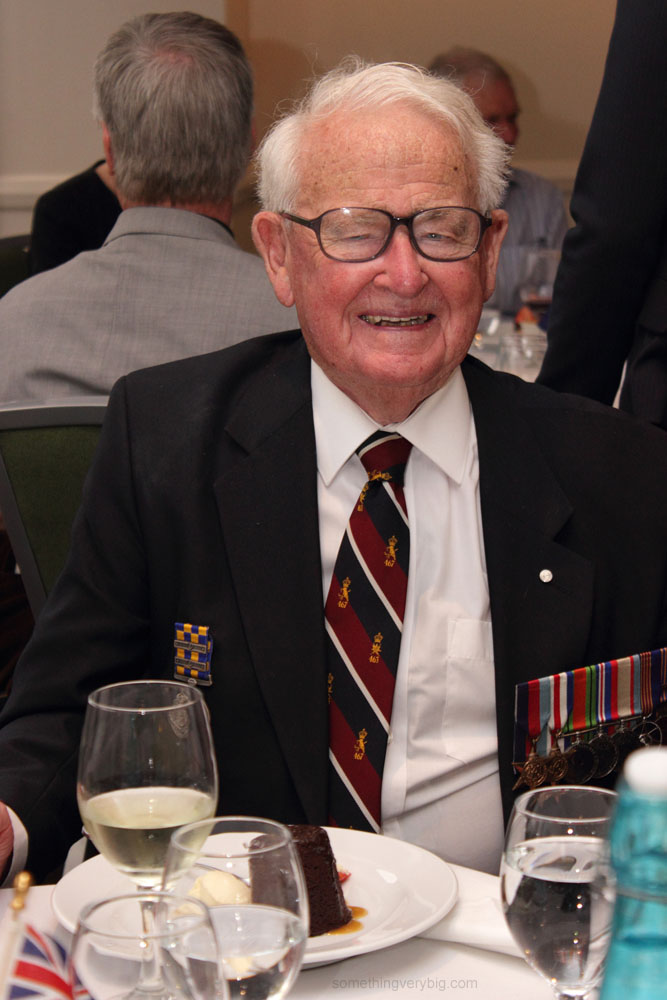
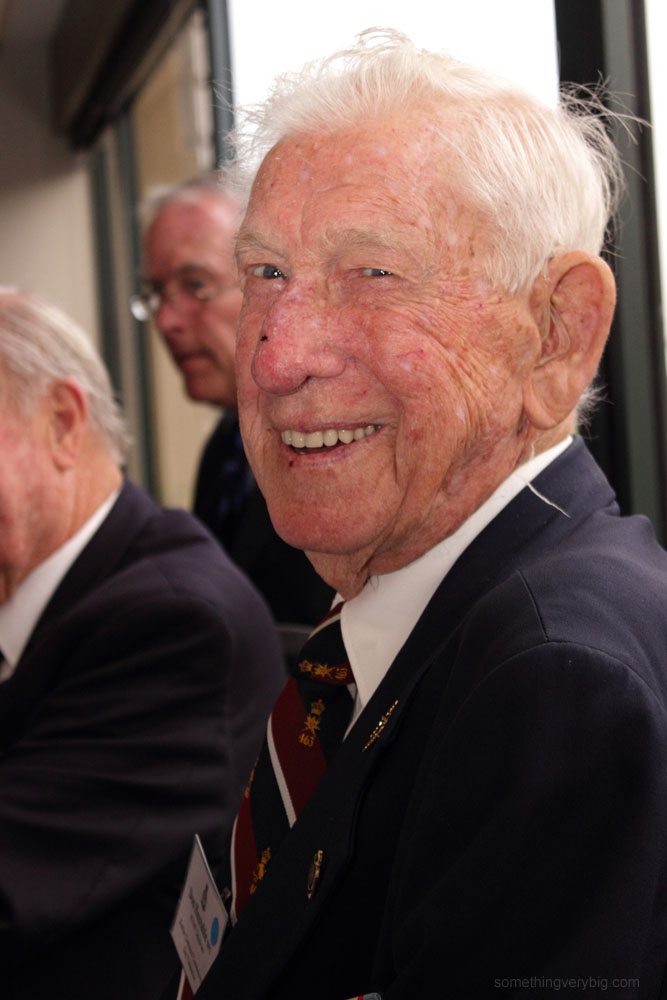
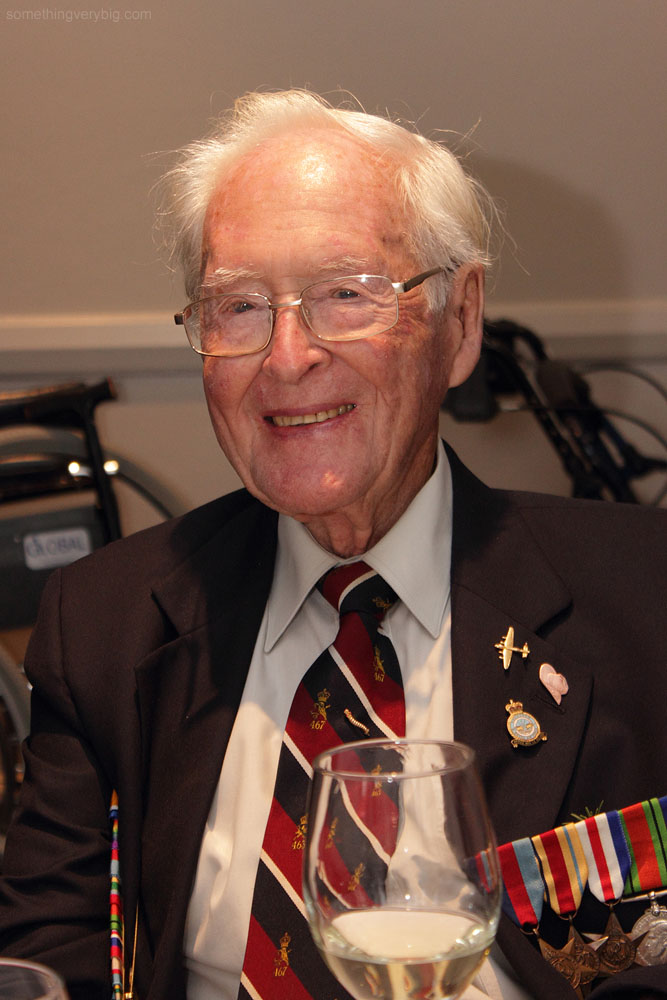
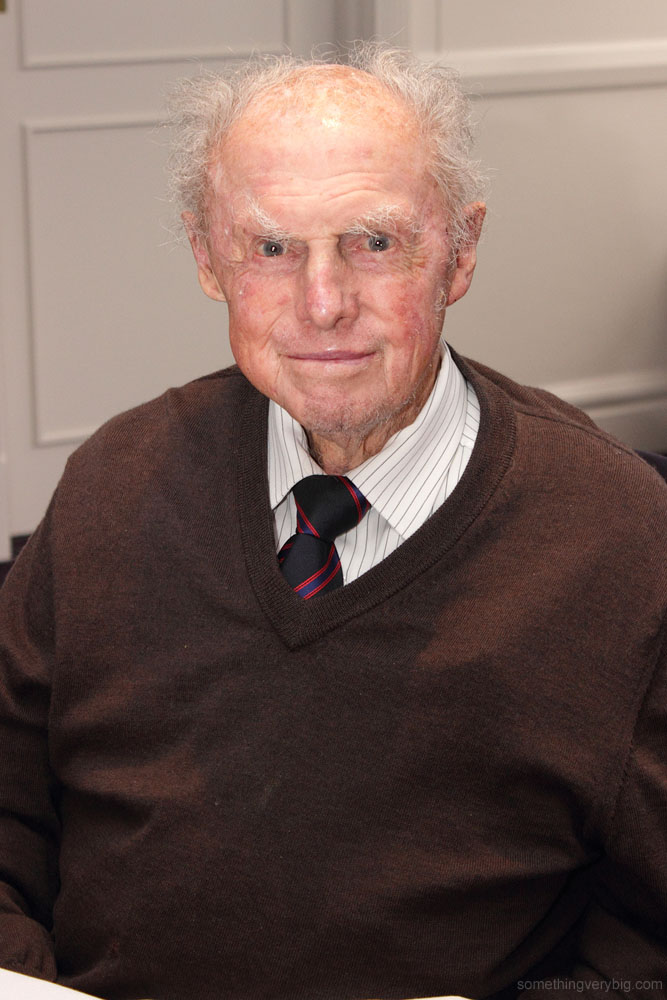
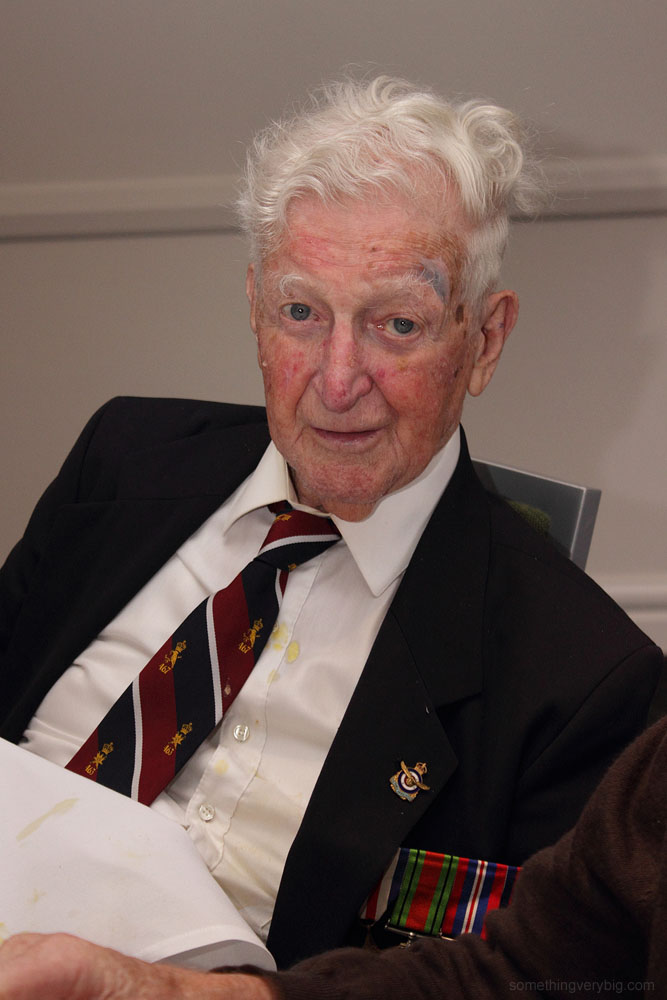
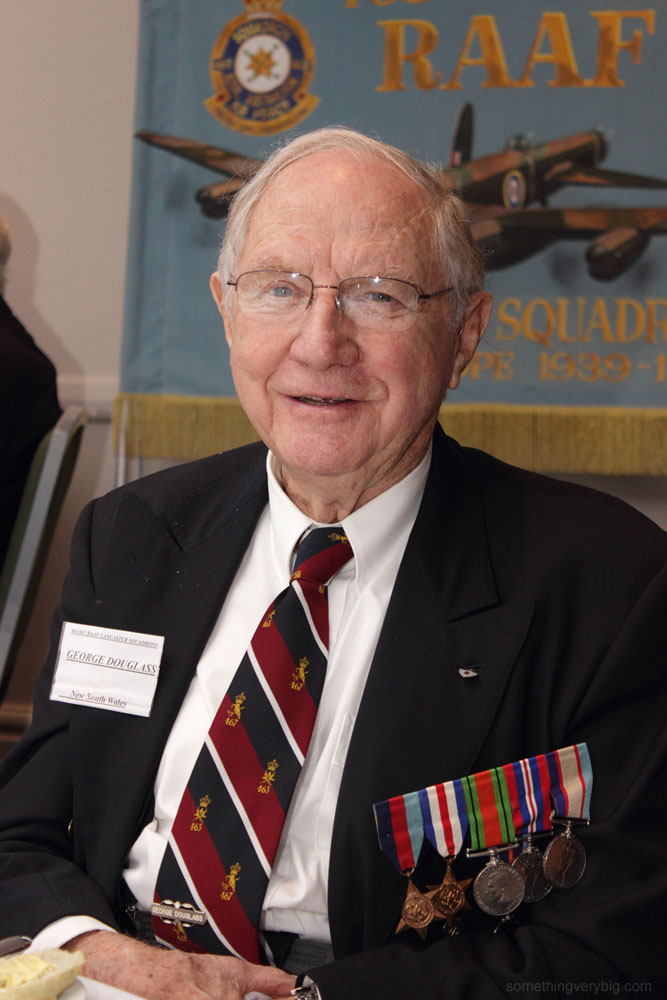
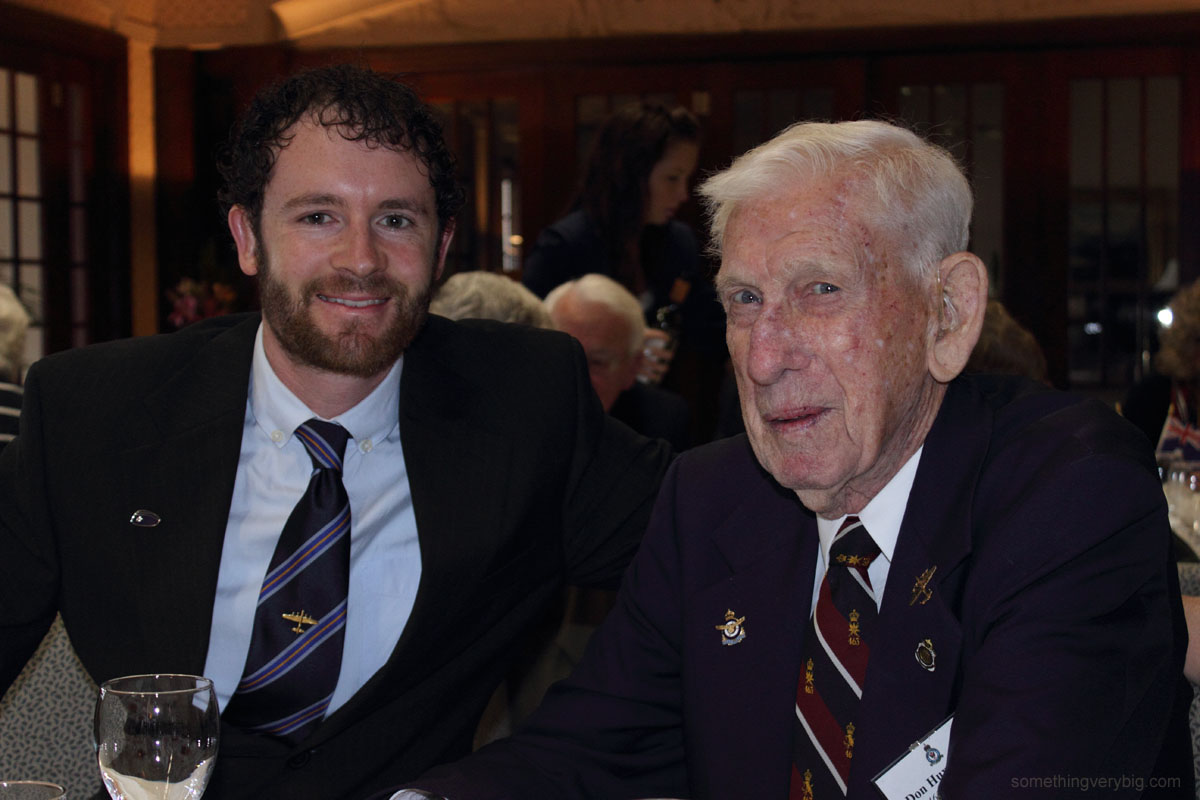
At the 463-467 RAAF Squadrons Association lunch which followed the 2014 ANZAC Day march in Sydney last Friday we were privileged to have no fewer than ten Bomber Command veterans amongst the 50 or so people present. I’m still putting together You can find a full post about the day here, but for now here is a collection of photographic portraits, one of each veteran:

Don Browning
Don Browning
Don Southwell
Don Southwell
Don Huxtable
Don Huxtable
Keith Campbell
Keith Campbell
Alan Buxton
Alan Buxton
Albert Wallace
Albert Wallace
Hugh McLeod
Hugh McLeod
David Skinner
David Skinner
Harry Brown
Harry Brown
George Douglass
George Douglass


Photos (c) 2014 Adam Purcell

The crash of Wellington LP437, 30 July 1944 – appeal for information

It was on a training flight from nearby 27 Operational Training Unit, RAF Lichfield, when Wellington LP437 apparently stalled, crashed and caught fire in a field near Stafford, England, on 30 July 1944. The crew – six Australians – were all killed in the crash.

It’s now approaching 70 years since the accident, and this has prompted a local historian and archaeologist, Bruce Braithwaite, to begin work to trace the families of the six airmen, with an aim to appropriately commemorating the anniversary when it comes around in July.

The details of the crew are as follows:

Pilot: 424927  Flight Sergeant Frederick Luckman Stephens, from Sydney
Navigator: 430243 Flight Sergeant Ray Kethel Bolger, from Williamstown in Melbourne
Bomb Aimer: 432627 Flight Sergeant John Hilary Normyle, from Sydney
Wireless Operator: 436249 Flight Sergeant Jack James Manners, from Sydney
Rear Gunner: 435557 Sergeant Earl Hume Beatson, from Queensland
Mid Upper Gunner: Sergeant 44993 Hugh Alexander Smyth, from Brisbane

The burials of the crew of LP437. Photo via Bruce Braithwaite

If anyone has any information on any of these aircrew or their families, please get in touch through the handy form on this page.

The click that crossed seven decades

While the Imperial War Museum undergoes significant redevelopment in preparation for the centenary of the First World War, some of its bigger and most well-known exhibits have been removed from its main site on Lambeth Road in London and temporarily installed at Duxford. Among them is the forward section of a rather significant Lancaster.

Avro Lancaster Mk I DV372 of 467 Squadron flew its first operation on 18 November 1943. The target was Berlin. Over the next seven months the aircraft would fly on 50 raids, [1] including the entire Battle of Berlin period, the infamous Nuremberg Raid and the Transportation Plan operations on French railway targets in the lead-up to D-Day. Old Fred, as it was known on account of its squadron code letters PO-F, was on the strength of 467 Squadron at the same time as the crew of B for Baker, and indeed Phil Smith and most of his crew took it on its 16th trip, to Berlin on 28 January 1944. But the man with whom Old Fred is probably most associated is Flight Lieutenant Arnold Easton, a 467 Squadron navigator who flew 20 trips in the aircraft from March until May 1944. I was lucky enough to get a copy of Arnold’s logbook a few years ago. Befitting his civilian career as a civil engineer, it is one of the most detailed and comprehensive wartime logbooks I’ve seen and forms the basis of a book, We Flew Old Fred – The Fox, compiled by Arnold after the war.

After its front-line service it appears that the aircraft was damaged in an accident, requiring repairs that took several months to complete. It was sent to 1651 Conversion Unit where it saw out the war before being broken up in October 1945. Happily someone thought to save the nose section which eventually is how it became part of the collection of the Imperial War Museum. It was one of three Lancasters I ‘visited’ while in the UK in 2009.

30JUN10001 copy

Among the people I met at the recent Bomber Command Panel Discussion event held at the Shrine of Remembrance in Melbourne was Arnold’s son Geoff. As well as discussing the intriguing possibility of reissuing his father’s book (now out of print and extremely difficult to get hold of), Geoff told me a lovely story of what happened when he was in the UK in June 2013.

Like many surviving Bomber Command aircrew, Arnold kept some bits and pieces relating to his wartime service when he returned to Australia. Geoff used to play with his flying helmet, putting it on and pretending to connect the intercom cable, with its distinctive bell-shaped Bakelite plug, into an imaginary ‘aeroplane’. Somehow it never stayed plugged in.

Since his father’s death some years ago, Geoff and his wife decided to donate his leather flying helmet and metal circular navigational computer to the Imperial War Museum, unique relics with a direct connection to Old Fred. They arranged to take the artefacts to Duxford where the IWM’s Andy Marriott is taking the opportunity, while it is out of London, to clean and conserve the remains of the aeroplane. Indeed, Andy asked Geoff at one stage whether his father had chewed gum. While ferreting around in various locations under the navigator’s position he had found some lolly wrappers, a chewed-up wad of gum and a NAAFI form with aerodrome weather written on it:

NAAFI sheet found in Old Fred
NAAFI sheet found in Old Fred – photo courtesy Geoff Easton

Andy allowed Geoff and his wife to crawl into the aeroplane through the bomb aimer’s escape hatch in the nose. They then used the yellow handrails on the side of the fuselage to move up underneath the flight engineer’s position into the cockpit proper. There, just behind the pilot’s seat, was the navigator’s bench and, tucked in underneath it, attached to a swinging arm, the unpadded metal bucket chair in which Geoff’s father sat for twenty operations over enemy territory. Pulling the chair out, Geoff sat down and placed the helmet on the desk. He looked around, soaking up the atmosphere. Among the instruments and equipment remaining in the cramped compartment, hanging from the bulkhead to his left was a rather familiar-looking bell-shaped Bakelite plug. Could it be?

It was.

Geoff picked up the end of the intercom cable on the helmet. He pushed the two bell-shaped plugs together.

There was a snug click.

For the first time in nearly 70 years, the flying helmet was reunited with Old Fred.

Geoff stood up, stooping somewhat under the low roof of the fuselage. He exited the aeroplane the same way he came in, leaving his father’s flying helmet on the desk.

Arnold's flying helmet reunited with Old Fred. Photo courtesy Geoff Easton
Arnold’s flying helmet reunited with Old Fred. Photo courtesy Geoff Easton

Thanks to Geoff Easton for the photos and for allowing me to read the entry from his diary that inspired this post. © 2013 Adam Purcell


[1] While most sources list 49 trips, Geoff Easton believes he has found a 50th, to Berlin on 28JAN44. The 467 Squadron ORBs certainly appear to support this.

Bomber Command Panel Discussion at the Shrine

The Panel Discussion On Tuesday a large crowd of at least 150 people gathered at the Shrine of Remembrance here in Melbourne to take part in perhaps the largest of the events to be held in conjunction with the Bomber Command exhibition currently showing at the Shrine. I was particularly looking forward to this one, and it didn’t disappoint.

The occasion was a Panel Discussion about Bomber Command, chaired by Air Vice Marshal Chris Spence (Retd), Chairman of the Shrine Trustees. The panel was made up of three veterans, covering the entire period from the beginning of the war to the end. Jack Bell was a Wireless/Air Gunner who served in the Middle East early in the conflict before being shot down in a Bristol Bombay and becoming a prisoner of war in Italy and then in Germany. Peter Isaacson was a Pilot with 460 and 156 Squadrons, later famous as the man who flew Lancaster Q for Queenie to Australia (and under the Sydney Harbour Bridge) on a War Bonds tour in 1943. And Maurie O’Keefe was a Wireless/Air Gunner who served with 460 Squadron at the tail end of the war.

Left to Right: Jack Bell, Peter Isaacson, Maurie O'Keefe and Chris Spence
Left to Right: Jack Bell, Peter Isaacson, Maurie O’Keefe and Chris Spence

With Air Vice Marshal Spence asking questions and gently prodding the veterans along, over the next fifty minutes or so the discussion covered the entire war: from enlistment to training to operations and beyond. Peter joined up, he said, after seeing a mannequin wearing an Air Force uniform in a recruitment display in the window of Myer in Bourke St, Melbourne. It was a very smart blue suit, he said, and he decided that he would like one of those. So he enlisted. Maurie concurred. “You used to go to dances,” he said, “and the girls made a bit of a fuss of you if you’d joined up… so that was the main attraction, really!”

The theme continued. Peter related a story of landing a Tiger Moth in a farmer’s field so he could sneak an illicit smoke while at 8 Elementary Flying Training School. Unfortunately he was seen by an overflying aircraft and was as a result confined to barracks, the indiscretion, he said slightly wistfully, “rather spoiling a little romance I had going with a girl in Narrandera…” Once aircrew, always aircrew.

But there were also some desperately sad stories. Jack was shot down after his aircraft stumbled over the German 15th Panzer Division in Libya. The navigator was killed in the ensuing crash and, after he returned to Australia following three years, three months and three days as a prisoner of war Jack went to visit his dead crewman’s family. He could see in the mother’s eyes the unasked question, ‘why my son and not you?’ It was, he said, the hardest thing he ever had to do.

Following the formal part of the discussion, the microphone was opened to questions from the floor. And there were some very good questions, too. One was relating to Schräge Musik, the fixed upward-firing guns fitted to nightfighters which were so devastatingly effective and utterly unsuspected by Bomber Command until quite late in 1944. What was it like, the questioner asked, to encounter Schräge Musik? Incredibly enough, a first-hand answer was available. In the audience were at least ten other veterans, and one of these – Jim Cahir – was actually in Stalag Luft III with Jack Bell. Jim’s aircraft was shot down by Schräge Musik over Germany one night. He first became aware of it – “too late, of course” – when shells started hitting his aircraft. Having someone there who, well, was there, gave the answer a real meaning and brought the subject home in a very personal and tangible way.

Inevitably at a public event of this nature the discussion eventually turned to Dresden and, as Peter Rees emphasised both in his book and in his talk last week, there were some passionate defences of the rationale and of the attack itself, both from the floor and the panel.

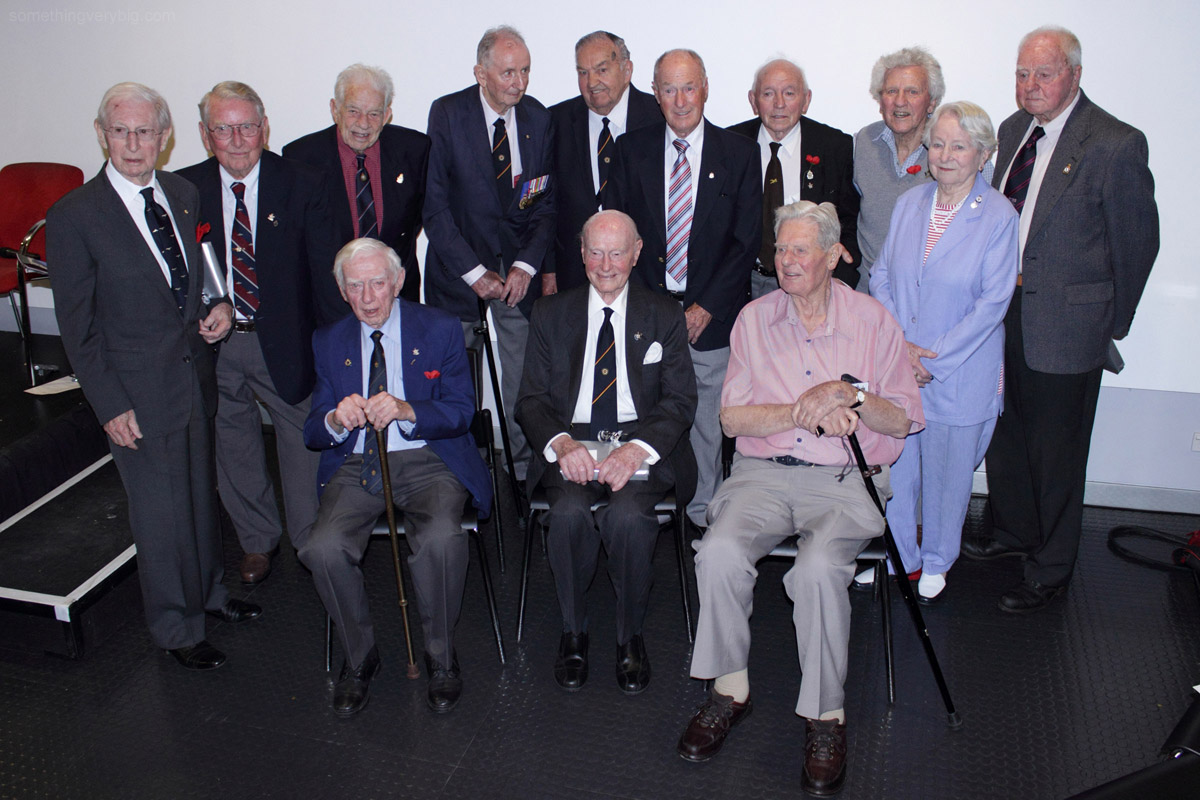
Following the discussion someone suggested organising a group photograph of all of the veterans present. In all there were thirteen in the photo, though I suspect one or two others may have slipped off before we had a chance to get everyone gathered near the front of the room. Unfortunately I was unable to get everyone’s names so only the following are identified in the photograph below: Back row, L-R: Peter Isaacson, Bruce Clifton, Wal McCulloch, [unknown], Gerald McPherson, Allan Beavis, John Wyke, Gordon Laidlaw, Jean Smith, Maurie O’Keefe. Front row, L-R: Bill Wilkie, Jack Bell, Jim Cahir(Most of) the veterans Other veterans who were present but for whom I cannot match a name with a face were Jim Carr, Col Fraser and Ron Fitch. (If you are able to identify any of the unknowns in this photo, please get in touch)

The opportunity then arose to mix a little bit over a cup of tea. I knew a few veterans (among them Allan Beavis, a Mosquito navigator who I visited at home in Geelong earlier this year) but most were new to me. Most notably, I recognised a tiny golden caterpillar with ruby red eyes on Bill Wilkie’s tie. When I asked him about it he immediately opened his wallet and pulled out his Caterpillar Club membership card, which he carries around with him everywhere even today. He had been a 15 Squadron rear gunner flying out of Mildenhall when his Lancaster was shot down over Germany in January 1945.

There were of course other people to see as well. Robyn Bell was there and I finally got to meet Neil Sharkey, the curator at the Shrine responsible for the current Bomber Command exhibition. Happily I was also able meet a man named Geoff Easton. His father was Arnold Easton, a 467 Squadron navigator who was operating at much the same time that my great uncle Jack and his crew were at Waddington. Arnold’s logbook, which I have a copy of, is one of the most precise examples I’ve ever seen and has been a great help in my research so far. But apart from a few emails about five years ago I’d never actually met Geoff. We had a good chat and he offered to send me copies of his late father’s wartime correspondence and a few photos of a very special visit he made recently to what’s left of ‘Old Fred’, Lancaster DV372 in which Arnold completed 20 sorties (and Phil Smith flew at least once), at the Imperial War Museum’s Duxford site. That will be the subject of a future post (it’s a wonderful story). Geoff has since sent me the files and I’m going to enjoy diving into them to see what nuggets come to the surface.

On my way out, I saw Gordon Laidlaw, the 50 Squadron pilot who I first met when visiting the exhibition a few weeks ago. He was waiting for his lift to arrive and I couldn’t resist one last photo of him: Gordon Laidlaw In all, a fantastic event. The Shrine of Remembrance has embraced the Bomber Command theme in the last few months and the interest from the public has been obvious, with big crowds turning out to the two events which I’ve been able to attend in the last week. Peter Rees said to me in an email after his talk last week, “It really feels like the book has tapped into something out there. Maybe people have long sensed [the airmen] were given a bum deal; if I’ve made it accessible for them to understand, then that’s a good outcome.”

The same could be said of the Shrine’s efforts over the last few months. It’s quite strange – but also very encouraging – to see big banners around the city of Melbourne emblazoned with the legend ‘BOMBER COMMAND’ with a photo of a crew in front of a Lancaster. It’s far too late for the vast majority of those who were there, of course, but while we still have some left, events and exhibitions like these allow the stories to be told and the memories to live on.

Download a podcast of the discussion from the Shrine website here.

© Adam Purcell 2013

Ladies’ Day with 463-467 Squadrons Association, Sydney

The 463-467 Squadrons Association (NSW) holds a luncheon every November, on the Sunday after Remembrance Day. For as long as anyone can remember it’s taken place in the rather classy surroundings of the Killara Golf Club in Sydney’s North Shore, and this year was no different. I was able to wrangle the day off work so I flew up from Melbourne last Sunday to attend.

I was staying at my sister’s place in Marrickville so I travelled to Killara by train, walking to the station in teeming rain. One of the stops along the way was Town Hall and here I noticed a tall, slim older gent and a middle-aged woman among the passengers getting on the train. I caught a fleeting glimpse of his tie and it looked rather familiar. They sat across the aisle from me in an otherwise nearly empty top deck compartment and continued the conversation they had been engaged in when they boarded the train. First I overheard the word ‘Killara’, then, a little later, ‘Southwell.’

Clearly, I decided, we were going to the same place. So I moved across the seat and introduced myself. The older gent was Tom Hopkinson, a 463 Squadron mid-upper gunner. He was up from Canberra for the function, staying with his second cousin Pamela who was travelling on the train with him. We had a great little chat on the way and while sheltering from the rain waiting for our lift to arrive at the station to take us to the golf club. It’s not very far away and last year, I thought to myself, I got sunburnt as I walked it…

A nice little crowd had gathered in the atrium area when we arrived. Most of the usual suspects were around, though there had been one or two cancellations as a result of the weather (it was still bucketing down outside).

The next couple of hours saw some good conversation amongst forty-odd guests with twelve veterans in total present. I found myself seated between Ron Houghton, a 102 Squadron Halifax skipper, and my frequent neighbour at these sorts of events, 49 Squadron rear gunner Hugh McLeod. The Golf Club put on a good meal again and, as is traditional, Don Browning proposed a toast to the ladies, present and elsewhere, for their support of their veteran husbands, fathers and grandfathers, which is the reason that this function is known as Ladies’ Day.

A remarkable photograph followed. By my count we had three pilots, a navigator, a bomb aimer, three wireless operators, two mid-upper gunners and two rear gunners in the group. Between them they covered almost every position in a typical heavy bomber crew. Unfortunately there were very few Australian flight engineers, and none were present here or I would have suggested we find ourselves a Lancaster and go flying.

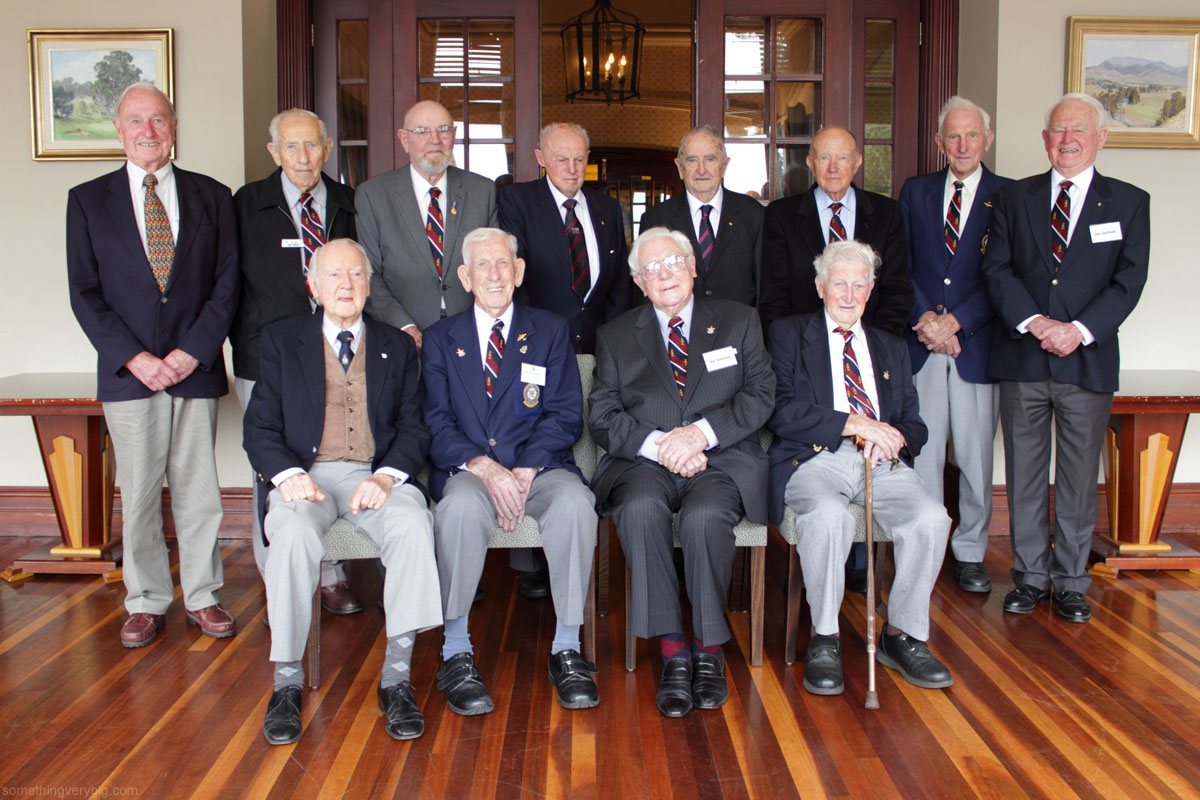
Bomber Command veterans in Killara, November 2013

Seated, left to right: Ron Houghton (102 Squadron Halifax pilot), Don Huxtable (463 Squadron pilot), Don Browning (463 Squadron wireless operator), Harry Brown (467 Squadron wireless operator)

Standing, left to right: Hugh McLeod (49 Squadron rear gunner), Roy Pegler (467 Squadron bomb aimer), Max Barry (463 Squadron rear gunner), Albert Wallace (467 Squadron mid-upper gunner), Ross Pearson (102 Squadron wireless operator/air gunner), Bill Purdy (463 Squadron pilot), Tom Hopkinson (463 Squadron mid-upper gunner), Don Southwell (463 Squadron navigator)

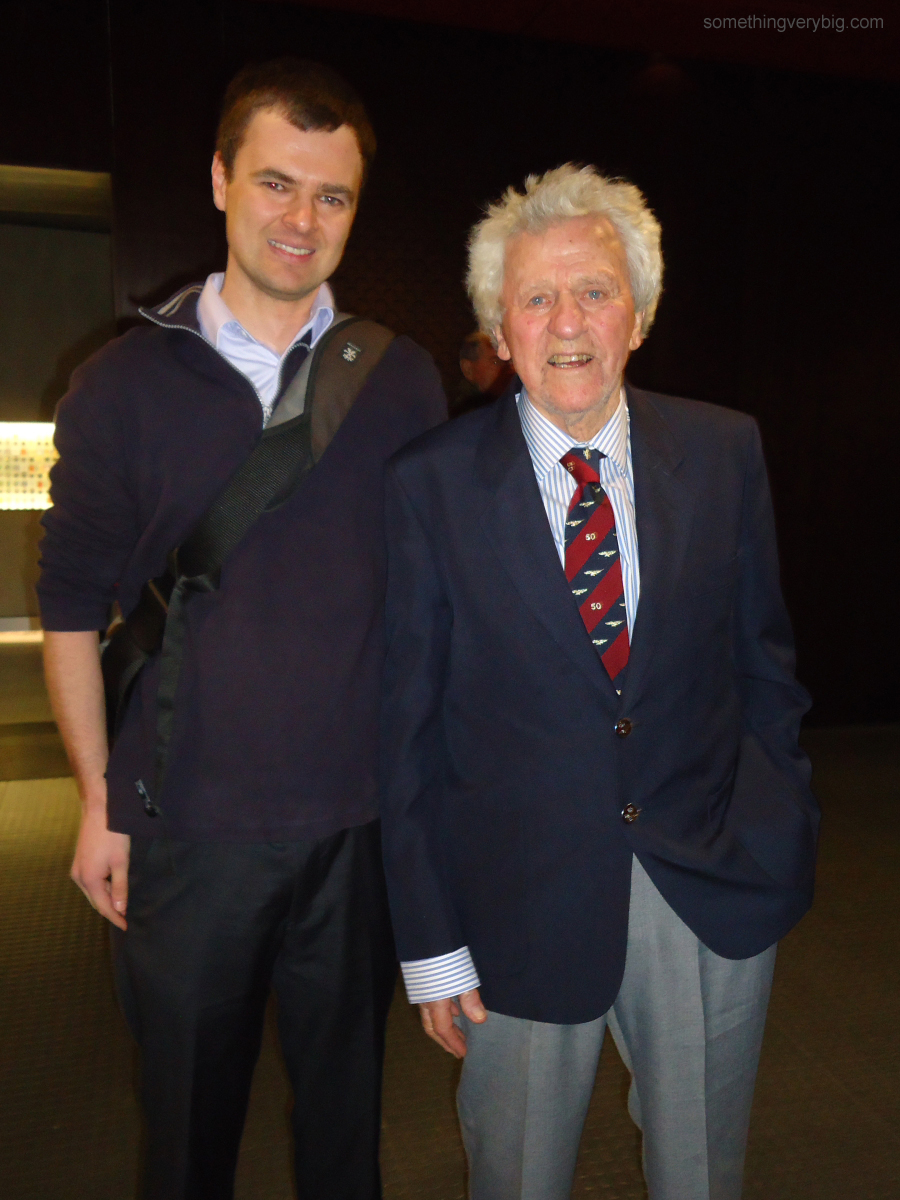
I also made sure that I got a photo with Albert Wallace. In June last year I received a comment on somethingverybig.com from a veteran called Albert Wallace. Unbelievably, it was a different Albert Wallace, who lives in Canada. At the opening of the Bomber Command memorial in London earlier that year he (Canadian Albert) was amazed to meet an Australian veteran of the same name who had also been a mid-upper gunner. I helped both Alberts get in touch with each other, though unfortunately they did not get a photo with both of them together!

Bomber Command veterans at Killara, November 2013

Left to right, in this photo we have Ron Houghton, Hugh McLeod, Albert Wallace and myself.

A couple of photos to finish off, then. Bryan Cook and Don Huxtable:

Bryan Cook and Don Huxtable

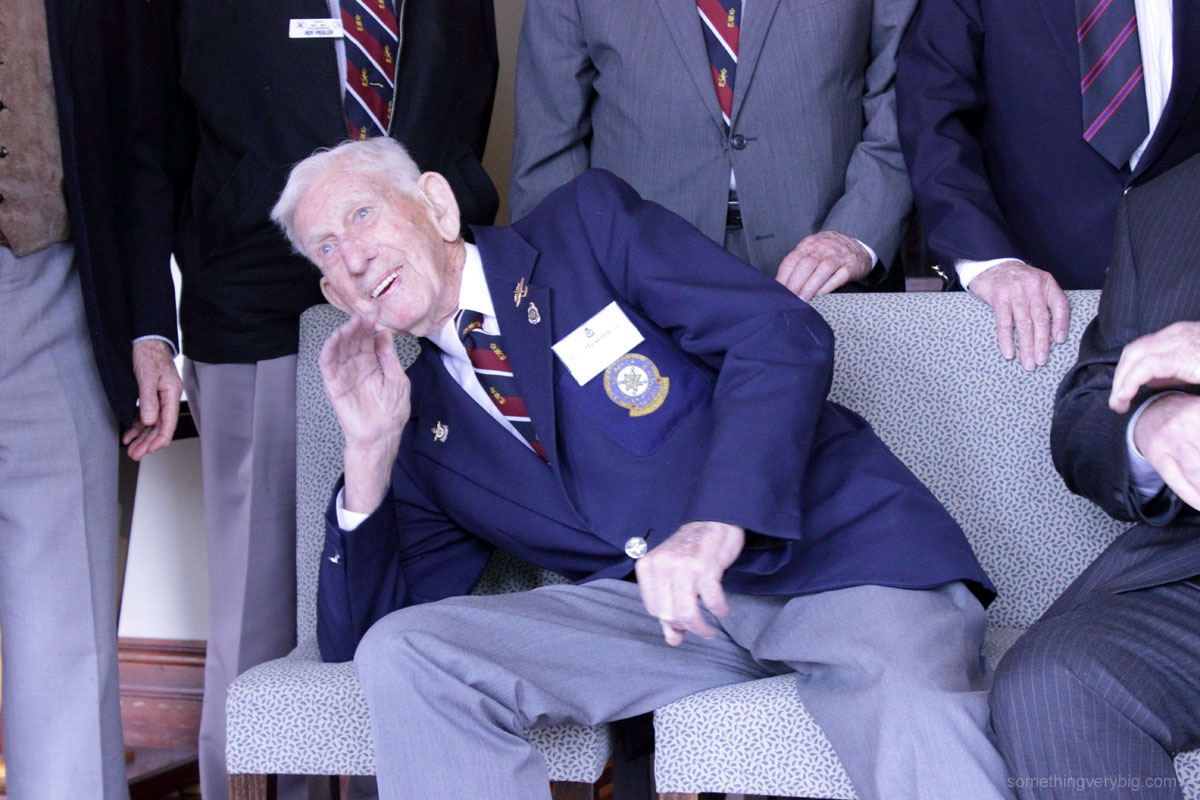
Hux had a minor heart attack a few months ago but though he looks a little more frail than I have seen him in recent years it clearly has not affected his mischievous nature. Here he is clowning about before the group photo:

Don Huxtable

Again, a great little function and well worth making the trip up from Melbourne. I’ll be back next year.

© 2013 Adam Purcell

Bomber Command at the Shrine of Remembrance

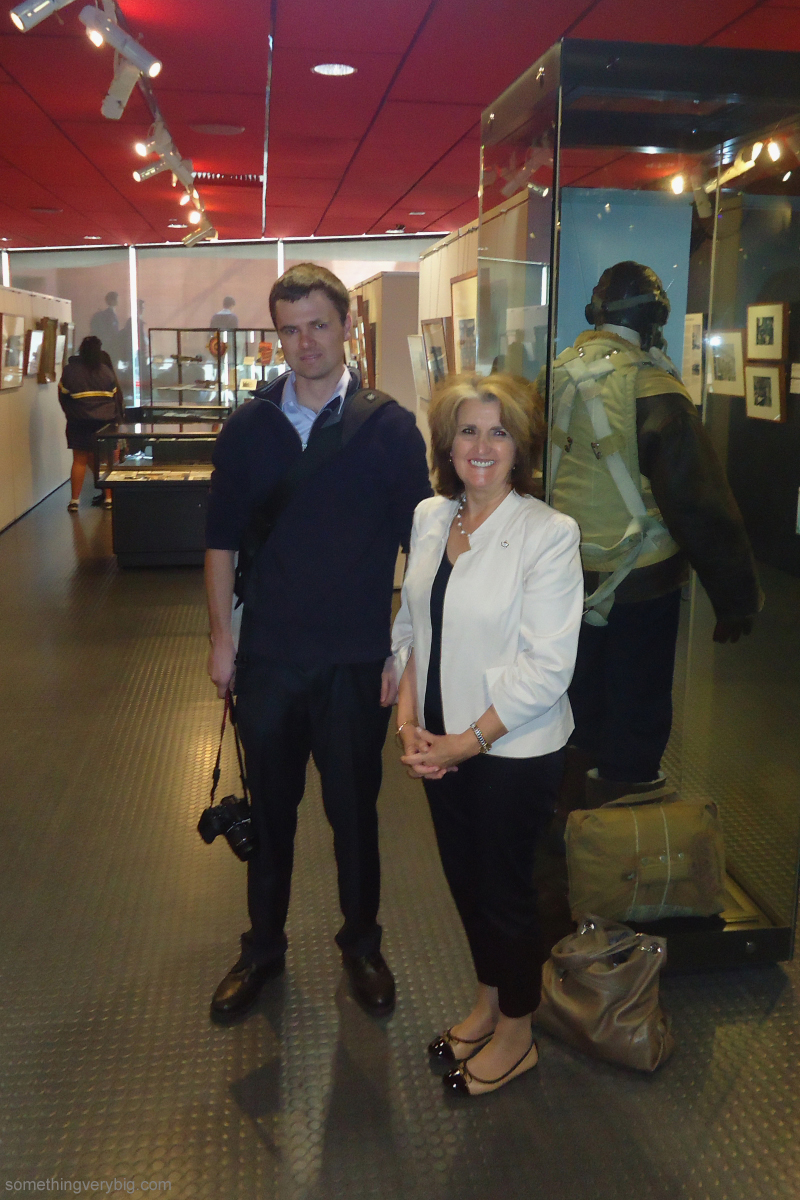
The Shrine of Remembrance in Melbourne has gone all Bomber Command on us. As I’ve posted previously, there are a number of events happening there over the next couple of months. All tie in with a major temporary exhibition which opened earlier this month in the Shrine Visitor Centre. Bomber Command: Australians in the air war over Europe 1939-45 is open until 1 May next year. It’s only a fairly small exhibition but it covers much ground concerning the Australian experience of Bomber Command, from enlistment, through training to operations and afterwards, including a significant section on prisoners of war. There are photos, artwork and memorabilia that have all been put together in a professional manner, and it is already beginning to draw visitors from all across Victoria and other parts of Australia. I visited last week with Robyn Bell, one of my Bomber Command contacts in Melbourne.

13oct-robyn-bells-pics-393 copy

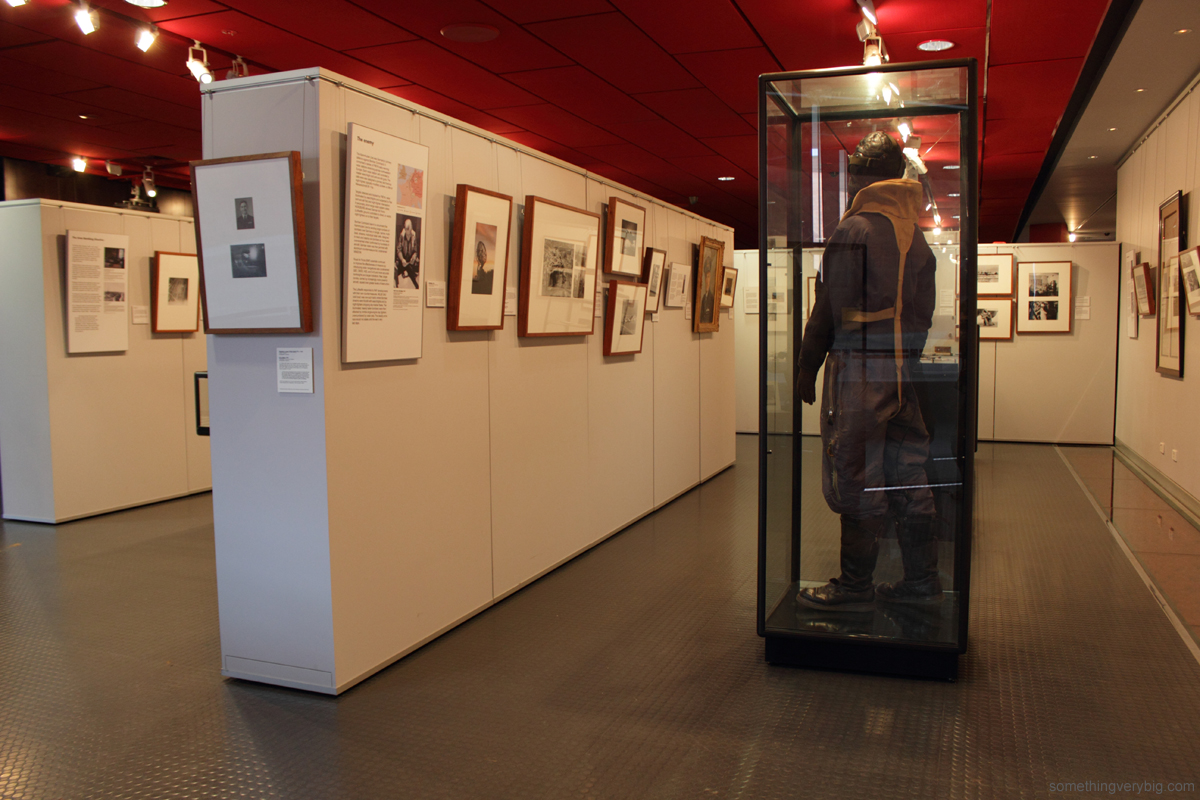
I suspect that if you hang around this exhibition for long enough you’ll see a fair number of Bomber Command veterans coming through for a look. And, happily, so it was when we visited. There was an older gent wearing a blazer and an Air Force tie looking at the mannequin in the photo above, talking to a middle-aged man about parachutes. Robyn recognised him as Gordon Laidlaw, a 50 Squadron pilot who she has been in touch with before, and talking to his mate later I discovered that they had come up from Mornington, an hour or so south of Melbourne, especially to have a look at the exhibition. It was great to chat briefly with Gordon. He was also talking to another pair of visitors who were in Melbourne on holidays from Perth who had come to the Shrine to see the exhibition:

13oct-robyn-bells-pics-381 copy

Rosemary Grigg (on the left) was overwhelmed to meet a real-life Bomber Command veteran – Gordon – because her father had been an airman too. Allan Joseph Grigg was killed on 22 July 1944 in a Wellington accident near Lossiemouth in Scotland, where he had been serving with No. 20 Operational Training Unit. She is keen to find out more about her father’s service so I’ve given her a few pointers on where to begin. As always, the fact he was Australian makes life much easier.

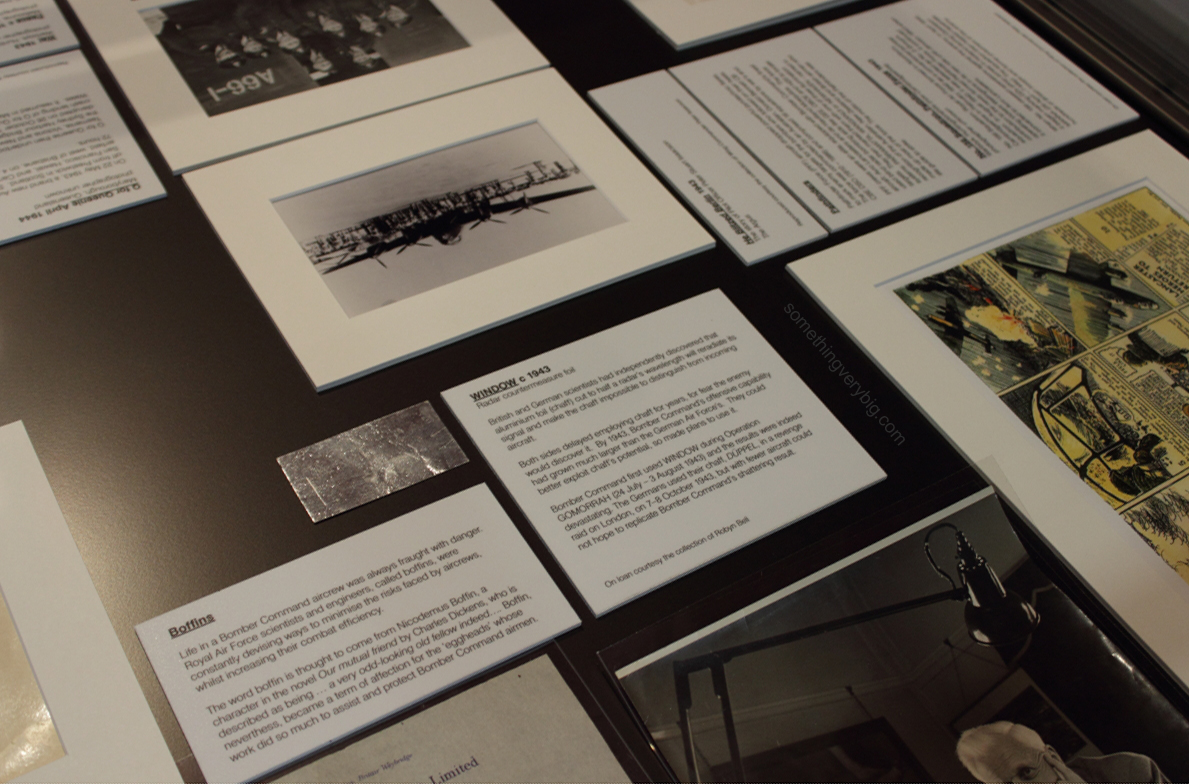
Moving around the exhibition, Robyn found her small contribution. She has been liaising with Neil Sharkey from the Shrine who was responsible for setting up the exhibition, and he was looking for some Window, the foil ‘chaff’ used to confuse German radar. As it happened Robyn had a small piece and was happy to allow it to go on display:

13oct-adamimport-183 copy

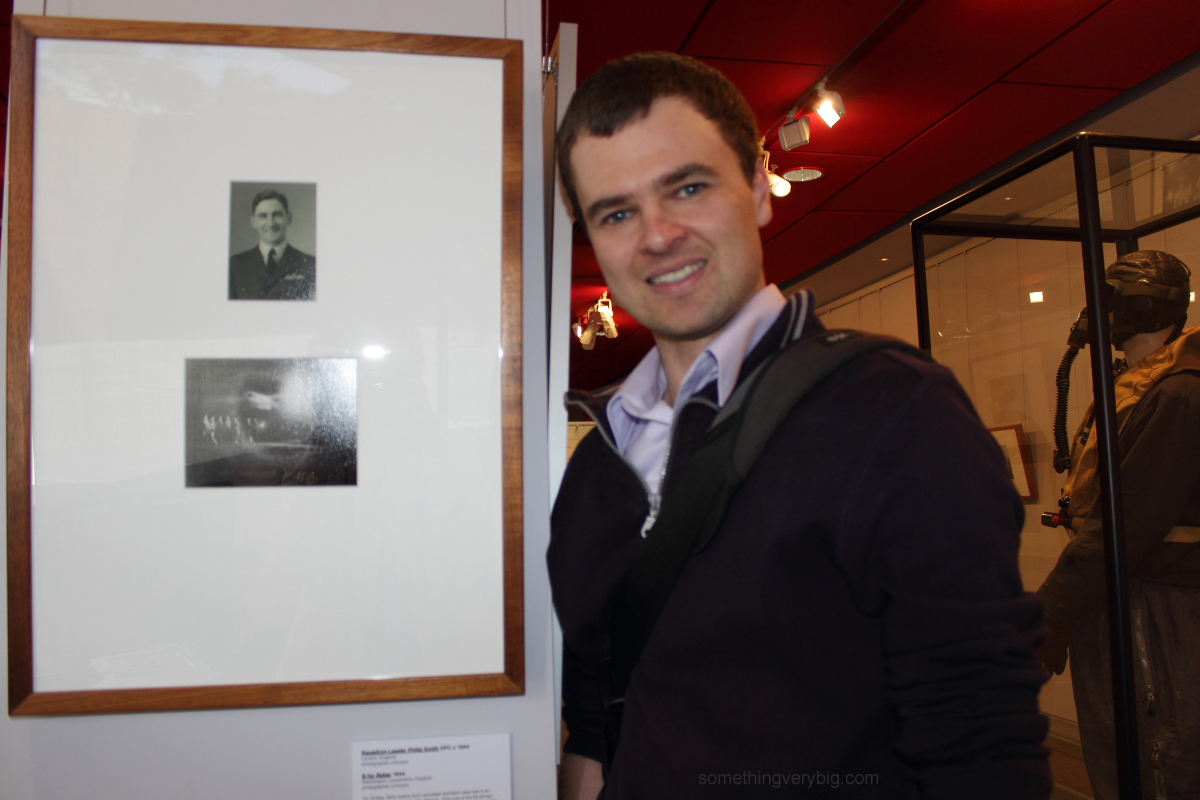
What was most unexpected for me, though, was in a frame hanging at the end of one of the exhibition partitions. We had almost finished our walk around when I found it:

13oct-adamimport-186 copy

Regular readers of SomethingVeryBig (those, at least, with very good eyesight) will recognise the lower photograph, the only known photo of the entire crew of B for Baker. And the one above it? It’s a portrait of a ridiculously young-looking Phil Smith, taken in London during the war. It was in fact sourced for the exhibition from this website, and has been credited to Mollie Smith at my request:

13Oct-MEL and Shrine 022

It’s clear that, in the last two or three years in particular, Bomber Command is finally receiving the recognition it deserves. An official memorial was opened last year in London. A Bomber Command clasp is now in the process of being awarded to surviving veterans, before being extended to the next-of-kin of those killed during service or who have died since. And the Canberra weekend is now the third largest annual event held at the Australian War Memorial (behind ANZAC Day and Remembrance Day). There’s no doubt that interest in Bomber Command, and respect and recognition for those who were involved, is growing. It’s great to see some of that interest manifesting itself in this exhibition. More people will visit and learn about Bomber Command and the men who were part of it. The stories will live on.

And that’s the most important thing.

13oct-adamimport-1841 copy

13Oct-MEL and Shrine 025


13oct-robyn-bells-pics-379 copy

© 2013 Adam Purcell

Similarities

Henry wanted to be a pilot.

He learnt to fly gliders before the war and, when asked which branch of the Services he wanted to join, said simply that “I would like to fly aeroplanes because I already have a glider pilot’s licence”. Initially rejected for being too short, he served for a while on an anti-aircraft unit. But after a few months someone at headquarters evidently had a change of heart, and Henry found himself posted to pilot training school. Once he got there, so keen was he to learn everything he could about his new job that he would continue to study by torchlight, under the blankets, after lights out. After qualifying Henry flew many operational flights on a dozen or so different types of aircraft, ranging from twin-engined fighters and medium bombers to his country’s largest four-engined aeroplanes. Henry’s story is similar to those of so many World War II aircrew, and is included in Michael Veitch’s excellent book Fly (Penguin, 2008). But there is one key difference.

Henry’s real name is Heinz Hampel, and he was a pilot in Germany’s Luftwaffe.

What is eerily noticeable is how much Henry’s story parallels those of many Commonwealth airmen. Gil Pate, for example, served as a sapper in an anti-aircraft searchlight unit before enlisting as aircrew. Don Southwell told me of staying awake until one or two in the morning to study while at ITS. And a key motivation for many aircrew – for example David Mattingley (C07-052-015) – was the desire to learn to fly. The fighter pilots that the bomber aircrew would come up against in the skies over Germany were, in so many ways, just like themselves: ordinary young men who wanted to fly caught up in decidedly extraordinary circumstances. As Veitch writes in the same book about Peter Mehrtens, another German pilot, “sadly, it was the similarities rather than the differences with the people he was fighting that stood out for me the most”.

My friend Bryan, on a trip to Oktoberfest in Munich a couple of years ago, started chatting with a local lad of about the same age. Somehow the topic of the war came up. The young German had recently discovered a stash of his grandfather’s wartime memorabilia, including photos, medals and a Luger pistol. He had, as it transpired, been an anti-aircraft gunner in Dortmund. Bryan could relate a similar experience – his own grandfather, after whom he was named, was a man named Brian Fallon, a mid-upper gunner with 463 Squadron, and Bryan has his medals at home. “Brian had been on bombing trips to Dortmund so often”, he told me a few weeks ago, “that they called it the Milk Run.” He was staggered to realise that his grandfather and his new German friend’s grandfather had quite possibly been shooting at each other over the city. And now the two young men were sitting in a large tent, in the middle of a huge crowd of people, having a friendly conversation while drinking enormous steins of beer.

Seven decades earlier they might have met in very different circumstances.

© 2013 Adam Purcell

Talking

I did my first research project about my great uncle Jack at the age of about 12. It was for an entry in a national history competition and my project was to write a series of letters as if Jack had been writing home from the war. This work led directly to our discovering that Phil Smith, who had been Jack’s pilot, was still alive and was living in Sydney. We first met Phil and his wife Mollie in early 1997.

There then came a break of a few years. We stayed in contact with Phil and Mollie and occasionally travelled to Sydney to visit them and while I was aware of ‘Uncle Jack’ the bug had not yet bitten in earnest to find out more about him myself. In 2003 I took a year off between school and university, and that’s when I had some time to once again delve into the subject. Sadly the catalyst for this work was news of Phil’s death in March of that year. The starting point this time was all the original documents that we had about Jack, which I scanned and wrote explanatory notes about to put on a CD-ROM and share around my family. Then university and moving out of home got in the way and it was some years before I felt the urge again and started the work that has evolved into SomethingVeryBig.

The slightly frustrating thing is that I never had the opportunity to speak to Phil in detail about his experiences. I was quite young when I first started researching the story of B for Baker. This phase of work was what led us to him in the first place – and the second phase started after he passed away. I remember one discussion, over the lunch table at Phil and Mollie’s home in Sydney, when my father was asked to read out Phil’s wartime letter about the time his troop ship hit an iceberg in mid-Atlantic (a story in itself) while Phil added comments here and there, but that’s the only occasion that I can recall where we spoke directly about his experiences. I’m lucky that since his death I’ve had access to the superb archive of letters and photos and other documents that his father carefully collated while Phil was in the Air Force, but there’s nothing like actually talking to the people who were there for a ‘feel’ of what it was like.

Which is why I’m slowly collecting veterans, so to speak – contacting as many as I can, writing letters (yes, real letters, with stamps and envelopes and everything), phoning up and generally picking their brains. Each has a story to tell and each little insight adds to what I understand of what it was like to fly for Bomber Command. I can’t ask my great uncle or any members of his crew what their war was like – but I can still talk to other veterans. While it’s not quite the same story, they would have shared many similar experiences with each other so I reckon it’s enough to build a picture of the ‘feel’ of the times they lived in and the tasks they carried out.

© 2013 Adam Purcell

“Lancaster 739:” 60 Minutes, Crashes and Cover-Ups

Australian investigative journalism program 60 Minutes last night broadcast a very interesting story about a 97 Squadron navigator called Ron Conley, who went missing on a raid on the Pointe du Hoc gun emplacements, very early on D-Day morning, 6 June 1944. The report, called “Lancaster 739”, followed the story of Conley’s crew who were presumed lost at sea. The reporter, Michael Usher, suggested that there had been an official cover-up about the circumstances of the crash, and that a ‘top secret’ radar system that was on board might have had something to do with it. As always, I like to think cock-up before I think conspiracy, so on hearing this bit my ears pricked up. I thought I would do a little digging.

Conveniently, Conley’s Casualty File[1] is available to view at the National Archives of Australia website. It contains a letter written after the crew failed to return by the new 97 Squadron Officer Commanding to the RAF Air Ministry. It’s a poor-quality photostat and is rather difficult to read, but it does appear to report the circumstances of the loss of Lancaster LD739 ND739 (Edit September 2014: see comments below). There was an extra man in the crew – the eighth member being named in this letter as a Special Air Bomber. Pathfinder crews regularly had extra men on board to operate some of the special navigational equipment they carried – in this case possibly the Oboe blind-bombing aid. Ground defences were “inactive”, the letter says, but “a few fighters were known to be over the target area”. Critically, the pilot of this aircraft, W/C EJ (Jimmy) Carter, DFC, who was the 97 Squadron CO until he failed to return from this trip, had been nominated Deputy Controller for the operation and so was required to keep in radio communication with the rest of his force over the target, relaying orders from the Master Bomber who was flying a Mosquito. Carter’s voice was heard but apparently “ceased in the middle of a sentence” just after 5am and no further signals were received from the aircraft. “It is believed,” wrote the replacement CO to Conley’s father, “that an enemy fighter must have intercepted the aircraft while over the target, but although one or two of our aircraft were seen to be shot down, nothing much could be identified owing to a certain amount of cloud.”

Also in the Casualty File is a copy of an internal signal dated 22 December 1944 sent from London to the RAAF in Melbourne advising that enquiries made to the International Red Cross Committee in Geneva had failed to turn up any news of Conley or the rest of his crew. This shows that the RAAF had made efforts to trace the missing crew. But in the absence of any further word, in March 1945 they wrote to Mr Conley again advising that “it has now become necessary to consider the question whether in these circumstances an official presumption of your son’s death should be made.” I’ve seen very similar letters in the files of many of my great uncle Jack’s crew as well. In May 1945 Conley was officially presumed dead.

In 1949, the Air Force explained (and this letter was quoted in the report). “All efforts to find any trace of your son’s aircraft or to establish whether the bodies of any of the crew were ever recovered for burial have proved unsuccessful. In view of this complete lack of evidence, it is now concluded that your son and his comrades were lost at sea. It is proposed, therefore, to commemorate your son by including his name on a memorial which will be erected at a later date by the Imperial War Graves Commission, to the memory of those deceased members who have no known grave.” Ron Conley’s name, and those of the rest of his crew, are now on the Runnymede memorial in England.

So far, all of this is very much like so many other stories about Bomber Command airmen. The 60 Minutes team interviewed cousins of Ron Conley and found family of other members of the crew as well. What sets this story apart just a little, however, is that an English aviation archaeologist named Tony Graves has only recently found the remains of the aircraft – not in the English Channel as was officially presumed, but in a field on an abandoned farm in Normandy. The wreck was positively identified on the basis of a gold wedding ring engraved with the initials “A.C.” and with the words “Love Vera” on the inside. This was traced to F/L Albert Chambers, the wireless operator on the crew, whose wife was named Vera. They also showed a small fragment of a uniform with the remains of a Distinguished Flying Medal ribbon still sewn on. Three members of the crew had received that particular decoration. (In fact this was a highly experienced and decorated crew. As well as the Squadron Commander, W/C Carter, it also carried the Gunnery and Signals Leaders. Six of the eight had already been awarded DFMs or DFCs, and Conley himself would be posthumously given a DFC as well.) Though smashed into almost unrecognisable fragments from the force of the impact of the crash, what remained had been preserved remarkably well, with paper maps and charts that would have been from Conley’s nav bag recovered from the wreckage. How Graves knew that the wreck was there was not explained beyond a reference to “enough evidence and eyewitness accounts,” but congratulations are due to him for making the discovery and following the story up to the extent that he has.

The report was, I thought, going well up to this point. But then they started talking about the “new, secret” radar called “HS2” that was on this “customised” Lancaster.

Oh dear.

By the middle of 1944, H2S (note not ‘HS2’) was well-established as a ground-mapping radar system. So while it was still nominally a ‘secret’, it certainly was not a brand-new piece of equipment and was in general use by the Main Force throughout the Battle of Berlin period (November 1943 – March 1944). It’s mentioned many times in the Night Raid Reports[2] of this period, being fitted to both heavy bombers and Mosquitos. In fact, the interrogation of German nightfighter commander Josef ‘Beppo’ Schmid after the war confirmed that as early as November 1943 the Germans were using the emissions from the H2S sets to home in on the bomber stream.[3] In short, it was by no means an unusual thing to find on a Lancaster at that time, and cannot therefore be used as a reason for a potential cover-up.

Also appearing in the report was Keith Dunning, the son of P/O Guy Dunning, the flight engineer on ND739. He remembered a visit to his family, after the war, by an RAF airman who said he was on the same trip and had seen the aircraft go down over land. The RAF had, Keith said, later written to Dunning’s family to say that this had been a “mistake” and the airman had later withdrawn his testimony. This was presented in the 60 Minutes report as further evidence of a cover-up. However, as was written in the CO’s letter to Conley’s father I quoted earlier, cloud prevented the exact identification of any of the aircraft that were seen to be shot down. There is also the fact that the raid took place half an hour or so before dawn so light levels would have been low. It’s difficult to say, in the face of that, that the airman was definitively correct in his original identification of the crashing aircraft, and with no further evidence to support the theory coming to light after the event, the Air Force appears to have acted quite reasonably in discounting his report.

The logbook belonging to Guy Dunning was featured, with some pages apparently removed covering the operation on which the crew went missing. Keith Dunning said other logbooks that he has seen from the same crew showed the same pages missing. Again, 60 Minutes called this evidence of a cover-up. But the final pages would have been filled in by someone at the squadron after the crew failed to return, not by the aircrew themselves (who were dead by this stage). Jack Purcell’s logbook records the wrong aircraft for his final flight,  and squadron Operational Record Books are littered with similar clerical errors. It’s quite possible that whoever wrote the last entry in the logbooks made a mistake and decided to remove the pages and start again.

Finally, there is the fact that no bodies were found when the aircraft was excavated. No-one appears to know where the bodies are, or who might have moved them. “Eight bodies don’t vanish”, said Dunning. 60 Minutes, by now predictably, again called it a cover-up. But an understanding of RAF Missing Research and Enquiry Service methods would suggest that, more likely, the investigators simply couldn’t find anyone who could tell them what happened. Tony Graves apparently found reports by eyewitnesses to the crash but perhaps any witnesses to the burial did not survive the fairly intense fighting that occurred in the general area in the immediate aftermath of the invasion (as happened to a young Dutch girl who witnessed a Tempest crash in March 1945). There would have been considerable confusion in the area in the following weeks and months and if any records were made of the burials, they could well have simply disappeared in the fog of war. There are, according to the report, some graves marked as ‘unknown airmen’ in the local cemetery and there is of course a possibility that these hold the crew of ND739. But two 97 Squadron aircraft were lost on this raid so they could also belong to the other crew. The MRES could well have been aware of these graves and opened them up (though no MRES report appears in Conley’s A705 file), but perhaps were unable to make a positive identification of the airmen buried there. There was some talk on the program, if the required documents could be found, of identifying the men in the graves and giving names to the headstones, but as the crew are already appropriately commemorated elsewhere (at Runnymede), this is not something that the Commonwealth War Graves Commission would approve.

So most of the evidence that 60 Minutes used to decide there had been a cover-up could, and in my view probably does, have a far less sinister explanation. On the positive side, I’m happy to see some Bomber Command coverage on a high-rating television program in the lead-up to ANZAC Day. Another crash site has been identified, and, though graves have not been found, some more families now have a little more closure on what really happened to their lost airmen. It’s a fascinating story. But that’s just the point. It’s a fascinating story in its own right, and it does not need to be sensationalised.


Further information about the Conley crew can be found here:  http://www.97squadron.co.uk/Coningsby%20crew%20Carter.html

Sources:

[1] NAA: A705, 166/8/495. CONLEY, Ronald John – (Flight Lieutenant); Service Number – 425606; File type – Casualty – Repatriation; Aircraft – Lancaster LD739; Place – Cherbourg, France; Date – 6 June 1944

[2] The National Archives of the UK (TNA): Public Record Office (PRO), AIR 14/3411, B.C. (O.R.S.) Final Reports on operations, Night Raids Nos. 416-620, September 1943 to May 1944, vol. 4

[3] Isby, David C (2003) p.104: Fighting the Bombers: the Luftwaffe’s Struggle against the Allied Bomber Offensive, Greenhill Books 2003, Lionel Leventhal Limited, Park House, 1 RussellGardens, London, NM11 9NN. ISBN 1-85367-532-6

© 2013 Adam Purcell

Finding the Missing

At the end of the Second World War, the Royal Air Force (and associated dominion forces) had some 41,881 personnel listed as missing, worldwide (C07-049-007). A large proportion of these were scattered throughout the European Continent from which, while the battles were still raging, reliable information was difficult to obtain. The unit set up to deal with the problem of searching for and identifying as many of the missing as possible went through a number of guises but is probably best known as the Missing Research and Enquiry Service (MRES). Their task was to investigate the fates of missing aircrew through records and by putting people ‘on the ground’ in Germany and the former occupied territories to interview local officials and civilians and, if necessary, open graves to find clues on the bodies themselves.

Author Stuart Hadaway, writing in a book called Missing Believed Killed: Casualty Policy and the Missing Research and Enquiry Service 1939-1952 (Pen & Sword Books Ltd 2012), notes that by the end of 1950, just 8,719 aircrew were still officially listed as missing, with 23,881 now having known graves and 9,281 formally recorded as lost at sea (p.7). This, having been achieved without the use of modern technologies such as DNA profiling, is an astonishing success rate.

Once a crashed aircraft had been located, authorities could trace the identity of that aircraft through serial numbers on any number of parts. Knowing which aircraft and squadron it came from, they could then determine which crew was flying in it when it went missing. Identification then often came down to a process of elimination: the body with the pilot’s brevet must be the pilot, for example… identity discs might have survived revealing the wireless operator… one air gunner might have had remnants of his Flight Sergeant’s stripes, which meant that the other body with an air gunner’s brevet must be the other gunner… and so on.

The MRES report of losses from the Lille raid of 10MAY44 (A04-071-017) records how the unit identified the body of F/O J.F. Tucker, who was from Doug Hislop’s 467 Squadron crew, flying in EE143. Post war, six graves in the commune of Hellemes, near Lille, were exhumed. In one was found the remains of an RAAF battle dress with an Air Gunner’s brevet, along with an officer-type shirt on the body. Tucker was at the time the only Australian officer air gunner missing from this operation who remained unaccounted for, and the investigating MRES officer was happy to accept identification on this basis.

It wasn’t always so straightforward however. Often German information was somewhat muddled by events. Hadaway cites the case of a man initially buried by the Germans as ‘Haidee  Silver, 40851’, being traced by the service number to a Pilot Officer Michael Rawlinson, who had been wearing a silver bracelet that his father told the MRES had been given to him by a female relative, inscribed ‘From Haidee’ (p.39). Other men were identified through serial numbers on their standard-issue watches, for example, or through laundry labels on their clothing.

Tracing serial numbers through the many layers of RAF bureaucracy could be a tedious job. What fascinates me about the work they did is the detective effort involved, and how unorthodox methods sometimes yielded the key that unravelled the case. I suppose I can draw certain parallels with the historical research I have been carrying out as part of this project. Throughout the war, files were maintained in the MRES offices in London where any little snippet of information relating to cases was kept. The files would regularly be reviewed and cross-referenced with any new information that might have come in later to see if anything jumped out. One little snippet could lead to another, which lead to another, which might have led up the garden path a bit until something else made sense of everything. And on so many of the cases, they were able to find a match.

Theirs was a gruesome and difficult task, and it was one that continued well after the war had ended and everyone else had ‘gone home’. But each case solved meant one more airman could be taken off the list of the missing. And one more family could have closure. For that, the investigators of the MRES deserve to be remembered.

© 2013 Adam Purcell
This post was scheduled for some time in May but I brought it forward after tonight’s 60 Minutes program on Australian TV. Further post on that program is in the works!