Letters

I’m currently reading through and transcribing Phil Smith’s wartime letters. Phil joined the Air Force in September 1940 and was discharged in December 1945 – and, except for a notable period between May and September 1944 when he was ‘otherwise occupied’ in France, he tried to write home once a week. Lucky for me, his father kept more or less every one of his letters. So going through the lot – a couple of hundred in all – has not been a trivial (or short) job.

Phil’s letters reflect his methodical, calm personality. For example, he wrote about his first solo in a letter to Don Smith, his father, 28NOV40. For most aspiring pilots, the moment of flying an aeroplane alone for the first time is one of the most memorable of all. But to Phil, it was just another day:

I still don’t make good landings but they say I am fairly safe. So, this morning I did my first solo flight. Altogether I made three solo flights and landed satisfactorily each time. I had flown about 8 hours dual before going solo which is slightly longer than the average but, considering that a week without flying came in the 8 hours I think it is satisfactory. (A01-132-001).

Or in July 1941, after dropping his first practice bombs:

I actually dropped bombs for the first time this week. It was low level attacking which is a matter of judgement only. I am sorry to say that I did very badly but feel that with practice I could improve. (A01-145-001)

Perhaps my favourite example of Phil’s understated way of writing letters comes from April 1943 at RAF Honeybourne, where he was an instructor for a year or so between his two operational tours. On a training flight a practice bomb ‘hung up’ in one of the Operational Training Unit’s Whitleys. After landing Phil clambered down from the aircraft to find out what had happened and instructed his pupil to open the bomb bay doors, and the offending bomb crashed out onto the tarmac in front of his nose. It failed to explode. Phil described this rather alarming incident as merely “another minor adventure” (A01-270-001).

The meaty stuff that I’m really interested in, of course, is Phil’s thoughts on operational flying. Once he got onto an operational squadron he wrote in a letter about his first raid. The language used here is indicative of his new status as operational aircrew – note the RAF slang:

“I was cracking at the real job three days after I arrived and took part in a raid on theRuhrdistrict. It was quite an adventure. We dropped our bombs OK but had engine trouble on the way back and had quite a shaky do getting back on terra firma” (A01-177-001).

The ‘shaky do’ he referred to was an emergency landing on one engine at Martlesham Heath, a coastal aerodrome that they needed assistance from the ground to find. This is one of the only times that Phil actually mentions in one of his letters an incident that occurred on operations, and it’s also the only time the RAF slang comes out. Later letters are much more restrained.

While security concerns were undoubtedly a consideration, I suspect that this lack of detail of what Phil was doing in his letters home was more a product of the type of person he was. Before the war – and after he returned – Phil was a chemist with the Commonwealth Sugar Refining Company (CSR), and his father Don was an engineer. He therefore always had a very practical and straightforward personality. Though he was living in quite extraordinary times in theUKand despite having a rather unique job flying a heavy bomber, for Phil it was just that – a job. While he was there, he just got on with it. And so in a letter in December 1941 (A01-194-001) Phil says ‘we were busy on Sunday evening” (referring to an operation to Wilhelmshafen, 28DEC41) and writes simply that Christmas was menaced “by a constant threat of work which fortunately did not come off.” Just another day at the office.

So while there is the odd little tidbit in Phil’s letters that I can pull out to derive some idea of his operational flying, overall they are remarkable mainly for their ordinariness. He would typically spend some time and ink apologising for his letter being late this week, then list the mail and parcels he had received from home since his last letter, ask about the family in Australia, report on the family he had visited in England, talk about the weather and conclude with words to the effect of “no more news at the moment”. And that was that. It’s almost frustrating at times to read what amounts to the same thing in every letter, over and over again. Nevertheless, I still read and transcribe them all. You never know where your next clue might come from.

Phil is one of two members of the crew for whom I have significant collections of letters. Reading so much that was written by the men I am studying opens a unique door into the thoughts, minds and personalities of the men concerned. I remain grateful to Mollie Smith and Gil Thew for so kindly letting me open those doors.

© 2012 Adam Purcell

Dealing with the stress

“I promise that if you had witnessed normal Mess night booze up “goings on” during stand-downs then you would think that we were all ‘Flack Happy'” – Dennis Over, 227 Sqn rear gunner (C03-021-020).

Aircrew have always had something of a reputation for wildness, and in wartime particularly so. The mess on a wartime bomber station was often the scene of raucous gatherings of airmen getting up to no good. Often there was a reason to celebrate – a crew finished a tour of operations, perhaps, or a Lancaster chalked up 100 operations. Phil Smith, while at 103 Sqn, Elsham Wolds, learnt one day that the Squadron commander was posted overseas and was to leave early the next morning:

We had a party in the mess last night to wish him farewell. It was a very noisy and rowdy affair but quite good fun. It ended up with us all, including the C.O, with our coats off, cockfighting and wrestling on the floor. (A01-207-001).

As Phil wrote in his usual understated way in his diary the next day, “Good fun but not very dignified” (B03-001-001).

On another occasion Phil and a few comrades received visitors at RAF Long Marston in September 1943:

The Chief Instructor + my old flight commander and some others came over from Honeybourne to pay a friendly call. We ended up by returning the compliment – to liven up their mess. It resulted in a certain amount of broken furniture cups and glasses…. The met man had quite a brawl with the chief bombing leader up in the rafters like monkeys (A01-296-002).

Peter Brett, a 183 Sqn Typhoon pilot in France late in the war, was not the only airman to write of aircrew leaving blackened footprints on the ceiling during an impromptu mess party resulting from a three-day stand-down:

Most of us used to drink a pint or two every night but on party nights it was almost obligatory to become legless!

At first glance, there’s nothing surprising about a bunch of young men in the armed forces drinking and carrying on in the mess. Mess parties were a way to blow off a bit of steam, to maybe forget for a while the stresses and never-ending tension of nightly raids over enemy territory. But there is evidence that some men figured it was more important than that. Bob Murphy, a navigator on 467 Sqn then 61 Sqn, spoke about this in a video interview, taped for a documentary called “Wings of the Storm” in the 1980s:

Those who stayed home in the mess – read books, wrote letters home every night – for some reason or other seemed to be the ones that got shot down early’ […] others, a little bit wild like myself, seemed to be the ones who lived. (C07-044-001).

Letting off steam through drinking was (and still is) a common reaction to a prolonged stressful situation. Murphy took it even further when his pilot, Arthur Doubleday, took command of 61 Sqn in 1944. The entire crew was posted to Skellingthorpe, as Hank Nelson writes in Chased by the Sun (C07-036-178):

Given short warning of his posting, Doubleday and his crew arrived at Skellingthorpe to find that 61 Squadron had suffered high losses overBerlinand had just had three aircraft shot down on the Nuremburg raid and another two damaged in crashes. Bob Murphy said that they walked into the mess, and ‘you could hear a pin drop’. On their second night at Skellingthorpe, Doubleday’s crew tried to lift morale: ‘We decided to put on a party. Got the beer flowing, blackened a few bottoms and put the impressions on the ceiling of the mess – generally livened the place up’

Rollo Kingsford-Smith, Nelson wrote, “said that in the dark days of early 1944 he ‘was keeping going by drinking solidly’ and the company in the bar was part of the ‘therapy’.” (C07-036-178)

Nelson also reports that when Dan Conway, a 467 Sqn skipper, needed a new flight engineer,

…he asked the ‘spruce RAF sergeant’ who came forward, ‘Do you drink?’ The sergeant hesitated, but confessed that he did. Conway immediately said, ‘You’ll do’.Conway had decided that the camaraderie of the pubs was important to the crew and was not to be jeopardised. (C07-036-081)

Bomber Command aircrew were lucky that they had access to the mess and pubs and fairly frequent opportunities to visit them. But wartime restrictions meant that the English beer did not impress everyone. The last word on that subject goes to Don Huxtable, a 463 Sqn skipper. The beer was so weak it took 16 pints to really get started, he said. “It couldn’t go flat ‘cos it was flat already… and it couldn’t go warm ‘cos it was warm already too!”

Following the ANZAC Day march in Sydney this year, Don beat all of us to the bar.

© 2011 Adam Purcell

 Wings of the Storm interviews are available to view in the Research Centre of the Australian War Memorial

The Men in the Photographs

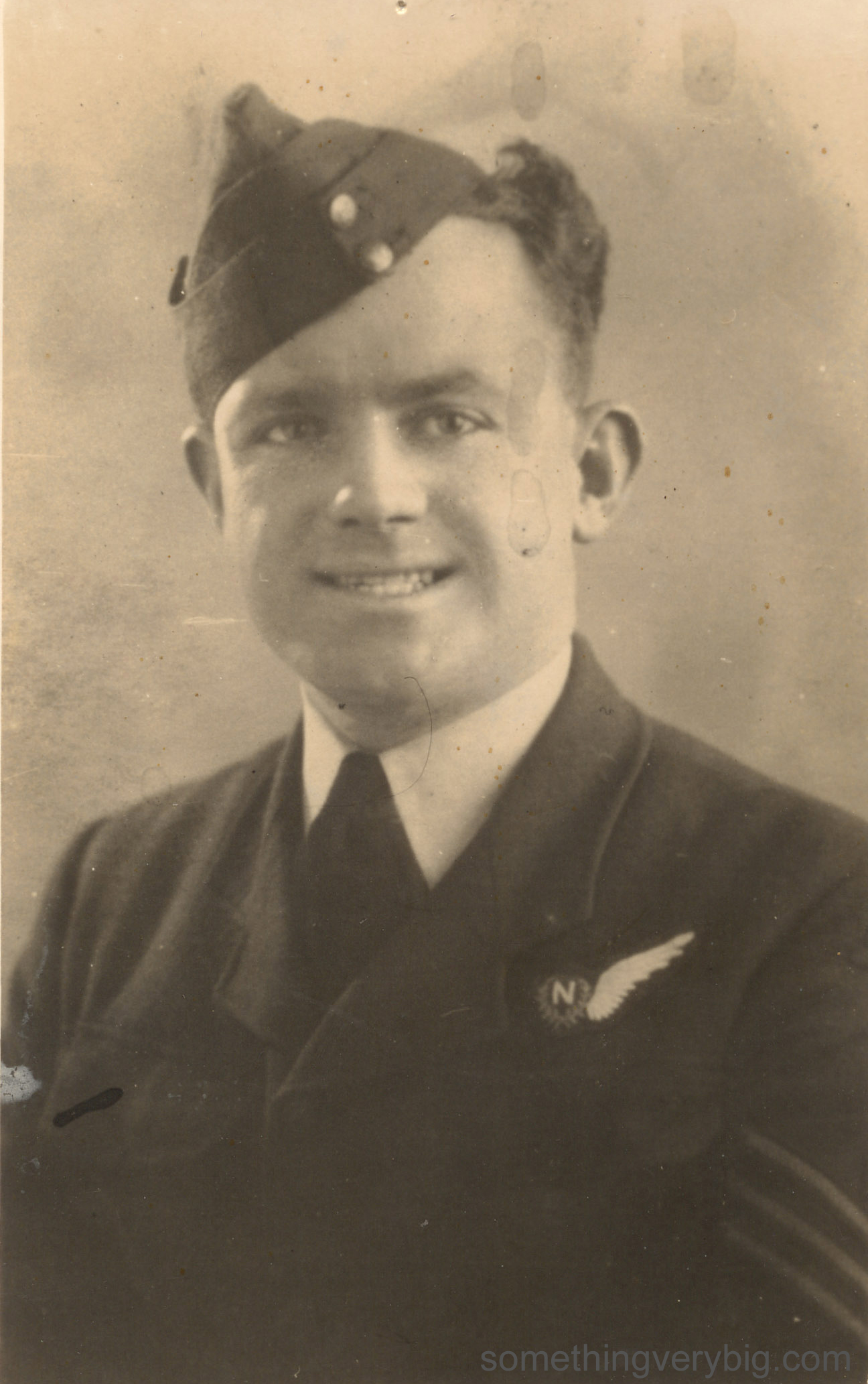
Before he left Australia, Jack Purcell had a formal portrait taken of him wearing his Royal Australian Air Force uniform. The half-wing with the ‘N’, denoting a qualified navigator, is clearly visible, as are his Sergeant’s stripes. It is one of only a small number of photos that we have of Jack and, along with his logbook, it was that photograph of Jack that first fired my interest in the subject of Bomber Command and the part that he played in it.

Giving a face to match a man’s name is an important part of telling his history. It makes the stories somehow more real – as if saying that they are not mere words. They are real stories about real people. As such finding photographs of each of the seven men who flew in B for Baker was something I have been very keen to achieve. And now, having recently made contact with the final family, I have done exactly that.

So here, all together for the first time, are photographs of each of the crew of B for Baker. As is traditional, we will begin with the pilot.

Pilot: Squadron Leader Donald Philip Smeed Smith (Phil)

A05-081-001 large

A fine portrait of a remarkably young-looking Phil Smith, taken while on leave in London.

Flight Engineer: Sergeant Kenneth Harold Tabor

Tabor-big copy

By far the youngest on the crew, Ken was just 19 when he was killed over Lille. This photograph shows him on the left, with his brother Bill. He is wearing the Flight Engineer’s brevet so it was probably taken in late 1943.

Navigator: Warrant Officer Royston William Purcell (Jack)

A05-041-001 large

The presence of an N half wing and sergeants’ stripes (and the stamp from a Sydney photographer on the back of it) dates this photo to mid 1942. This was the photo of Jack that started my journey to find out more about him.

Bomb Aimer: Flight Sergeant Jeremiah Parker (Jerry)

A05-071-001 large

At 30, Jerry Parker was the oldest member of the crew. He was married with a young daughter.

Wireless Operator: Flight Sergeant Alastair Dale Johnston (Dale)

A05-144-001 large

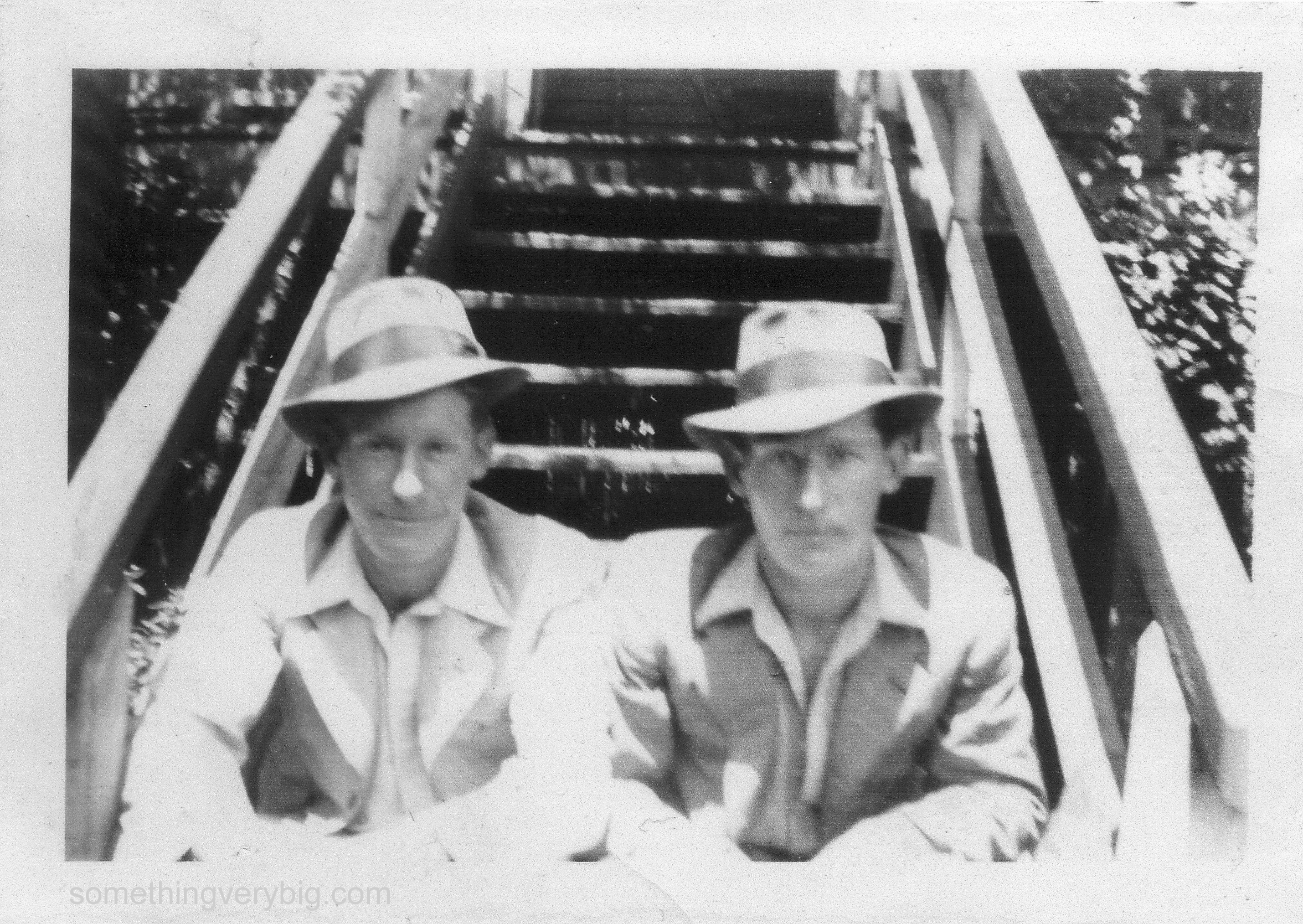
Dale Johnston was from Queensland. He is seen here on the left on the steps of the family home with his twin brother Ian.

Mid-Upper Gunner: Sergeant Eric Reginald Hill

Hill-small copy

From Goring in Berkshire, Eric Hill served in the RAF Regiment before he became a member of aircrew. He first enlisted in June 1940, by far the first member of the crew to begin war service.

Rear Gunner: Flight Sergeant Gilbert Firth Pate (Gil)

A05-118-001 med

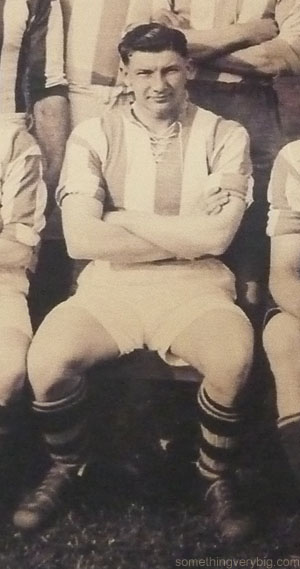
A short stocky man, Gilbert had a brief flirtation with becoming a jockey as a teenager, until his father put a stop to all further dealings with the stables where he was working. He trained as a wool classifier before joining up.

The Crew of B for Baker

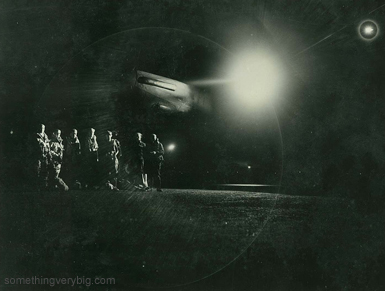
There is just one photograph that shows the entire crew. It is backlit by the landing light of a Lancaster, it’s shadowy, grainy and indistinct, but it’s an atmospheric photo.

a05-019-001-med copy

Photos kindly provided by:

Mollie Smith

Steve Butson

Martin Purcell

Freda Hamer

Don Webster

Barry Hill

Gil Thew

(c) 2011 Adam Purcell 

How They Crewed Up

The concept of the ‘crew’ is of far-reaching significance to the Bomber Command legend. A Lancaster needed seven men to operate efficiently. Each man would be specially trained in his respective trade, and each trade underwent their training separately. The way those individual airmen formed into crews remains one of the more unique parts of the story. In an Air Force so demanding of rigid procedures and highly developed organisation, the majority of crews came together in a curious, almost haphazard fashion.

The typical venue was a large hall at an Operational Training Unit. In the room would be gathered equal numbers of each aircrew ‘trade’. After a welcoming speech from the Commanding Officer, the assembled airmen would be told, essentially, to sort themselves out. Hank Nelson, in his excellent book Chased by the Sun, described it like “selecting a horse in a yard or a girl at a dance. You made your choice then the test of performance came later.” (C07-039-080). While seemingly chaotic, the system appeared to work well. Individual airmen would learn to work as an effective team and by the time they got to a squadron, most crews would live, work and play together. In the air they would fight together as a more or less autonomous unit. And the camaraderie would develop into extremely close friendships, some of which continue even to this day. It all started, in so many cases, in some draughty hangar at an Operational Training Unit.

Yet despite this being the ‘traditional’ way that crews were made, the men of B for Baker got together in entirely different ways. The available evidence suggests that only three of them crewed up at an OTU in what could be considered the conventional sense. After qualifying as their respective trades, Jerry Parker, Dale Johnston and Eric Hill all arrived at 14 OTU, RAF Cottesmore, in early June 1943. Just over three months later, on 08SEP43, all three were posted to 1661 Conversion Unit at RAF Winthorpe. The fact that all three were posted on the same day suggests that they were all part of the same crew.

The first member of the eventual crew of B for Baker to reach Winthorpe was actually Ken Tabor, the flight engineer, a week or so before the three arrived from Cottesmore. Because the aircraft flown at the OTU stage of training were typically Wellingtons which were less complicated than the four-engined heavies, flight engineers would normally go straight from their School of Technical Training to the HCUs and meet a crew there. This is exactly what happened in Ken’s case. In fact, it is highly likely that he had not yet even been flying until this point – Tom Knox, who flew on Stirlings with 149 Sqn, recently told me that like many flight engineers, “at this stage I had never had my feet off the ground” (C01-480-002).

Meanwhile Jack Purcell was undergoing his own operational training. He was the only member of the eventual crew of B for Baker to pass through 27 OTU at RAF Lichfield, from 22JUN43. What became of his OTU crew is not (yet) known – but on 19SEP43, Jack found himself posted to RAF Winthorpe, where the other four had been for at least week and a half. He most likely joined their crew at this stage. All five would be posted to 9 Squadron, RAF Bardney, on 31 October. After their pilot, a man named JG ‘Paddy’ McComb, was lost on a second dickey trip to Berlin on 18 November, at the end of the month the crew – none of whom had completed any operational flying with 9 Squadron – were posted to 1668 Heavy Conversion Unit, Syerston.

In parallel with the other five, Gilbert Pate went to an OTU (No. 17 at Silverstone) shortly after arriving in England in June 1943. He also went to 1661 Conversion Unit, Winthorpe, in September 1943. However instead of Bardney, Gilbert’s crew was posted to 49 Squadron at Fiskerton on the 22nd of that month. On 3 November, Gilbert took part in his first operational sortie, a raid on Dusseldorf. He was filling in for an injured gunner with an experienced crew. On the same night, P/O JEW Teager, Gilbert’s own pilot, went on the same operation as a ‘second dickey’. But Teager didn’t return. He was shot down and became a prisoner of war. Like five of his future crewmates, Gilbert’s crew now found themselves without a pilot. They went to 1654 Conversion Unit and got a new pilot, but, returning to flying after an accident, the pilot lost his nerve and this time the powers that were split the crew up. Gilbert went to 1668 Heavy Conversion Unit, Syerston, on 14 November 1943. Two weeks later, on 1 December, Jack, Jerry, Dale, Ken and Eric were posted to the same unit.

Also posted in to Syerston on 1 December was an Australian Squadron Leader, DPS (Phil) Smith. He was already an experienced operational pilot, having completed a tour on Wellingtons with 103 Squadron in 1941 and 1942. Phil had been ‘screened’, instructing for a year at 24 Operational Training Unit in Honeybourne. He joined up with the three Australians and three Englishmen at Syerston and his logbook shows that his first flight with these men was 10 December 1943. After flying a total of 16.45 hours by day and 16.05 hours at night in a Lancaster, all seven were posted to 467 Squadron, Waddington, on the last day of 1943.

The crew was now formed, and ready for battle.

Sources for this post:

Service records of all seven men in the crew, from the National Archives of Australia or the RAF Disclosures Section

Phil Smith’s logbook – courtesy Mollie Smith

Chased by the Sun by Hank Nelson

Tom Knox – Stirling flight engineer, 149 and 199 Sqns

9 Sqn Association – Roger Audis

The 4T9ers – 49 Sqn Association and Dom Howard

© 2011 Adam Purcell

The Story So Far

It occurred to me this week that some people who have been reading this blog might not know the basic background to the story I’m attempting to tell. So this post is a general introduction to The Story So Far.

In broad terms, this blog charts the development of my research into my grandfather’s uncle and his wartime story. W/O Royston William Purcell (known as Jack) was a navigator with 467 Squadron, Royal Australian Air Force. He was shot down and killed on a bombing operation to Lille in France in May 1944. Jack was 22 years old.

There were seven men in Jack’s Lancaster crew. The pilot was Phil Smith, an industrial chemist from Mosman in Sydney. Flight engineer was Ken Tabor from Bournemouth, England. Jack Purcell, of course, was the navigator. He was from Strathfield, NSW, and had been a shop boy with NSW Government Railways. Wireless operator Dale Johnston was a motor mechanic from Dayboro, Queensland. Postal worker Jerry Parker, from Leyland in the UK, was the bomb aimer. Englishman Eric Hill, from Goring in Berkshire, manned the mid-upper turret, and Gilbert Pate, a wool classifier from Kogarah, NSW, was the rear gunner. They ranged in age from 19 to 30. Only one would see the end of the war.

Over Lille that May night in 1944, their Lancaster exploded. Ejected by the force of the blast, Phil Smith parachuted to safety, evaded capture and was sheltered by a French farmer before Allied invasion forces passed his position four months later. His six crewmates were killed in either the blast or the ensuing crash and are now buried in French soil a few miles from the crash site.

The perception of ‘Uncle Jack’ and his place in the collective Purcell family memory has been passed down through the generations, and indeed down  different branches of the family tree. I was lucky that it was my father who showed an interest in, and was eventually given, Jack’s logbook and the handful of photographs and documents that goes along with it. When he first showed them to me (I was eight or nine years old at the time), it planted the seed that in recent years has turned into something approaching obsession. I have now gathered a fairly significant body of information about this crew and what they were doing in a Lancaster over Northern France in May 1944. I have traced and contacted the families of six of the all seven men in the crew. I have a worldwide network of research contacts. I have even travelled overseas twice in an effort to chase down leads and visit some of the significant sites associated with Jack’s war. Most importantly, I’ve realised that this story – one of more or less ordinary lads caught up in far from ordinary times and doing far from ordinary things – is well worth telling.
So where to from here?

I’m aiming to write a book about this story over the next few years. There remains much work still to do. At this stage I am focussing on the crew themselves, looking at where they came from, who they were and the very different paths that they took to 467 Squadron – while also continuing the search for the family of Ken Tabor, the one member of the crew remaining outstanding. I’m planning future work to concentrate on training and the journey to an operational squadron for each of these men. Then I’ll look at bomber operations in the first part of 1944 when they were on squadron, particularly emphasising the Lille raid on which the men were lost and its part in the overall context of the war in the lead-up to the Normandy invasion. I’m also hoping to investigate some theories on what actually caused the loss of B for Baker, the Lancaster they were flying.

This is the story so far. Who knows where it will end up!

© 2011 Adam Purcell

First Solo

“I’ll always remember my first solo”

-463 Sqn navigator Don Southwell in conversation, October 2010

There is a certain mystique about a pilot’s first solo. It is one of those moments that separate them from the common ground-dweller. Quite simply, there are those who have flown solo, and there are those who have not.

I remember my own first solo well. It was 28 November 2002, in a Cessna 152. It didn’t take long – just one circuit, taking off from Runway 16 at Wollongong in NSW. Flying downwind, I distinctly recall the euphoric feeling as I looked at the empty seat to my right, where my instructor had been sitting just a few minutes before, and realised that I was flying the aeroplane – all by myself. I ballooned slightly in the landing flare, but at least it was a reasonably soft touchdown.

World War Two provided many aircrew with the opportunity to join that elite ‘solo’ club. Phil Smith flew alone for the first time on 28 November 1940 (exactly 62 years to the day before I did so myself). He flew a Tiger Moth from No. 6 Elementary Flying Training School, Tamworth, NSW. Despite the achievement, Phil’s letter to his father written later that day is in the same measured, almost formal language as all the rest of his correspondence:

“I still don’t make good landings but they say I am fairly safe. So, this morning I did my first solo flight. Altogether I made three solo flights and landed satisfactorily each time” (A01-132-001)

Don Southwell was originally chosen for pilot training. He was posted to 8 EFTS in Narrandera, NSW, and before he was scrubbed and re-mustered as a navigator, he managed to go solo in the Tiger Moth. His solo flight was not entirely uneventful however. He told me the story when I visited him in October 2010. Don was at one of Narrandera’s four satellite fields, which he described as ‘a paddock with a hut’. Shortly after he took off the wind changed. His instructor came up beside him in another Tiger Moth, gesticulating wildly and pointing to the windsock, but Don couldn’t work out what he was trying to tell him. So he simply landed in the same direction that he had taken off in, in a significant crosswind – and made a ‘pearler of a crosswind landing’. I commented on this because I know from experience how much Tiger Moths do not like crosswinds – Don admitted it had been a ‘bit of a fluke’!

Amusing anecdotes aside, however, some aircrew did see their early solo flying as special. In his memoirs published posthumously in 2009, 467 Sqn mid-upper gunner Brian Fallon described his first solo cross country flight in slightly more descriptive terms:

“On 17 June 1943 I flew my first solo cross-country. It was magic. The thrill of sitting alone in an open cockpit with the wind in your hair floating above the earth is something to be experienced.”

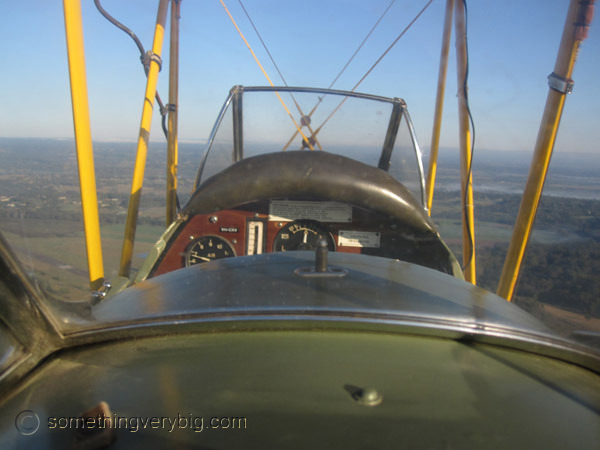
I can only say that the first time I flew a Tiger Moth by myself – in April 2010 – I knew exactly what Brian had been getting at. To look forward and not see the back of the instructor’s head in the front cockpit, to hear the wind through the wires and to feel its force on your face is to experience in a small way something of what it was like for so many aircrew of the Commonwealth air forces of World War Two.

Brian’s writing encapsulates a lot of how much it means for pilots to join a very special club:

“They say that flying is as close to heaven as you can get in this life. I think it is so, for you could not help wondering at God’s greatness as you flew around flirting in and out of the clouds with the earth stretched out below, its cultivated squares looking like a quilt. Up there I had a feeling of detachment from all the petty squabbling in society and could not bring myself to believe that all was not right with the world below.”

If there was one good thing to come out of World War Two, it was the opportunity for so many to experience that joy of flight that Brian writes about.

© 2011 Adam Purcell

Painting Complete!

Here is the completed painting, now framed and hanging on my wall. I reckon it looks pretty damn fine:

painting-007 copy

Avro Lancaster LM475 PO-B for Baker, of 467 Sqn RAAF, sits on its dispersal at RAF Waddington on 11 April 1944. Its crew has just arrived for a bombing raid on the German city of Aachen.

This painting serves as a tribute to the crew of this aircraft:

S/L DPS Smith

W/O RW Purcell

Sgt KH Tabor

Sgt J Parker

F/Sgt AD Johnston

Sgt ER Hill

F/Sgt GF Pate

These men were shot down in this aircraft on an operation to Lille, France, on 10 May 1944. Only the pilot, Phil Smith, survived.

The painting, by Steve Leadenham, was specially commissioned by Adam Purcell, the great nephew of the navigator.

Steve advises that prints of this painting will be available in the future – details on how to get one will be posted here in due course.

Finding Phil Smith

It was a very significant letter.

A single page of A4, written in a steady but flowing hand, it was this correspondence of November 1996 which turned a passing interest in Uncle Jack’s story into something much bigger. The letter was from Doug Wheeler, himself a former Bomber Command navigator and, at the time, the secretary of the NSW branch of the 463-467 RAAF Lancaster Squadrons Association. Doug lived a couple of towns from where I grew up. I’d done quite well earlier in the year in a national history competition with an entry based around what I knew then about Jack. Doug saw an article about my entry in the local paper and contacted me through my school.

It was, in fact, this letter which led us directly to the sole surviving member of the crew of Lancaster LM475.

“Squadron Leader D.P. Smith survived and evaded capture […] I have been in touch with him a couple of times in recent years. I am sure that if you wished to contact him at any point he would be happy to help.”

Happy to help, he was. We made contact and, early in 1997, visited the old pilot and his wife Mollie in Sydney:

Donald Philip Smeed Smith – better known as Phil – was an industrial chemist working in the sugar industry when he joined the RAAF in 1940. By November of that year he had made his first solo in a Tiger Moth at Tamworth. He arrived in the UK in July 1941 and flew the first operation of his tour in October of that year with 103 Squadron, Elsham Wolds. That tour was completed in June 1942 and Phil became an instructor pilot for a spell. In late 1943 he returned to operations via 1668 Conversion Unit at Syerston – which is where, as a Squadron Leader, he was joined by the rest of the crew that he would lead to 467 Squadron.

The Lille raid was Phil’s 51st operational flight. Not even he could remember exactly what brought the aeroplane down. He simply found himself being ejected from the aircraft, by whatever means, and descended by parachute. After a short-lived attempt to walk to neutral territory in Spain, Phil was sheltered by a French family until the invasion forces caught up in September 1944.

Phil returned to Australia shortly thereafter. He was hospitalised in early 1945 with peritonitis. Mollie tells me that he was saved by a massive dose of penicillin. Phil wasn’t demobbed until late 1945, spending the remaining time of his five years in the Air Force as Commanding Officer of 88 Operational Base Unit, Bundaberg. He met and married Mollie after the war, had a family and returned to the sugar industry.

Phil Smith died in 2003. I remain in touch with Mollie who still lives in Sydney.

Receiving the letter from Doug Wheeler in 1996 and making contact with Phil Smith turned out to be a substantial factor in turning my interest in my great uncle into, well, Something Very Big. Here was someone who had actually known my great uncle Jack. Here was a living connection to the Man in the Photograph. In more recent years Mollie has allowed me to borrow and study Phil’s archive of letters and photographs, which has added immeasurably to my understanding of his experiences. I think this archive inspired me to start looking to see if there was anything else like it still out there, waiting to be found.

There have indeed been other collections like it that I have found. The search goes on for more.

C05-043-002med(c) 2010 Adam Purcell

This will be the last entry on SomethingVeryBig for 2010. The out-of-hours workload in the new job is significant, and I’ve discovered that I don’t at this stage have sufficient time to devote to properly researching and writing new posts. I’ve therefore decided to take a break from it for a month or so. 

I should be back by mid January.  

Adam 

Accidents

Life in Bomber Command was a hazardous affair. Apart from the obvious – anything the Germans could throw at them – aircrew faced many other dangers in the long road to an operational squadron. Out of more than 55,000 aircrew killed serving in Bomber Command, some 8,000 died in accidents.

In the early 1940s, the aeroplane had existed for just four decades. Equipment was still primitive – especially compared with modern aircraft. Engine and other system failures were common, particularly when pushed beyond their design limits by the realities of wartime all-weather flying. Aircraft used at Operational Training Unit level – the unit at which airmen would ‘crew up’ and learn to fight – were often older, tired-out aircraft because the priority for the best equipment understandably lay with the operational squadrons themselves.

The aircraft on which most of the eventual crew of LM475 completed their OTUs in late 1943 was the Vickers Wellington. This was the type of aircraft on which Phil Smith flew his first tour of operations with 103 Squadron from Elsham Wolds from October 1941-June 1942. Phil’s first operation was as a second pilot on 16 October 1941 to Duisberg. Due to an oil problem they shut down one engine crossing the Dutch coast on the return flight. The second engine faltered shortly after crossing into England so they sought out an emergency aerodrome and, in Phil’s memorable understatement… (B03-001-016)

“…we crash landed rather unsuccessfully…”

All got out with only cuts and bruises.

But while Phil’s first crash in a Wellington was caused by mechanical failure, accidents could also come about from somewhat more mundane problems. Chief amongst these was human error. “I have come to the conclusion since I have been flying”, wrote Phil Smith to his mother in 1941, “that the machines are much more reliable than the humans that fly them.” (A01-147-001)

While the truly unsuitable were theoretically weeded out at the elementary flying training stage, even the best could occasionally make mistakes. On first arrival at Elementary Flying Training School in Tamworth in November 1940, Phil Smith wrote to his mother: (A01-126-001)

“The discipline up here appears unpleasantly severe, partly, we are told, because there was a fatal accident not long ago due to lack of flying discipline.”

An accident in a Tiger Moth witnessed by Phil at Elementary Flying Training School at Tamworth, NSW, in January 1941 was, according to the RAAF Preliminary Report of Flying Accident, put down to (A04-072-001)

“Poor technique and lack of anticipation on the part of the instructor”.

What happened to the instructor’s career subsequently is not recorded.

Inexperience played a big role in air accidents. The pilot of the Tamworth accident that Phil saw was lucky enough to walk away – but sometimes aircrew were not that lucky. During Phil’s time at 21 OTU, Moreton-in-Marsh, between August and October 1941, he witnessed or heard about many incidents. At least four are recorded in his diary – ranging from less-serious accidents like a burst tyre in August to an aeroplane flying into a hill and killing all seven on board in early October. The cemetery on the road between the airfield and the town of Moreton-in-Marsh bears witness to the appalling loss of life both from this accident and, sadly, from many more just like it. In all 46 airmen from the OTU are buried there. In a similar way, just outside the site of the old RAF Lichfield airfield is Fradley Church. 35 airmen rest here – which, according to Chris Pointon (RAF Lichfield Association historian) are only casualties from the period prior to August 1943. To avoid taking over the church yard, he says, following that date burials took place at Chester Blacon, almost 100km to the north west of RAF Lichfield. – there are 35 more there. A further six casualties were buried at Oxford Botley, 100km south.

Even then, that is not all of Lichfield’s victims. One of the men to die at Lichfield was Sgt AH Ashwood. He was killed on 27 September 1941 after sustaining serious burns in a Wellington crash which Phil Smith witnessed while out on a training flight himself (B03-001-013):

“We went first to Lichfield which is north of Birmingham.” […] We landed and no sooner had we got out of the plane than we saw a Wimpy start to burn on the runway. A very nasty memory, these planes are certainly death traps if they catch alight.”

Sgt Ashwood was buried in Margate, Kent – which was where his parents lived during the war.

Phil, of course, was not entirely immune himself. On squadron at Elsham, he was flying night time practice circuits with another pilot in January 1942. Bad visibility hampered their efforts but all went well until Phil’s last landing. They touched down nicely, but then (B03-001-015):

“the wheels collapsed and we settled down on our belly in the middle of the runway. It looks as though I selected the wheels up instead of flaps.”

Phil received a negative endorsement in his logbook following this incident, the cause being called “faulty cockpit drill”, put down to “inexperience”.

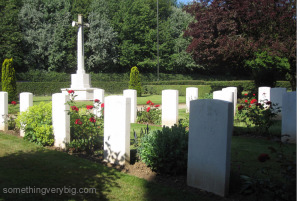
Perhaps the saddest epitaph of them all, however, is carved into one of the headstones in Moreton-in-Marsh and has nothing to do with aeroplanes.

“Killed in a road accident”, it reads. “Thy will be done.”

25jun10-056 copy

(c) 2010 Adam Purcell

Tiger Moth

How I imagine Phil Smith’s solo might have happened…

“It’s all yours, Smith – just do what Maguire told you to”, the senior instructor yelled into Phil’s ear, as he dropped off the wing and walked away from the Tiger Moth. It was early on one of those mornings that had the promise of turning into a real stinker in Tamworth. “And don’t bend it!” He waggled the elevator up and down – oh yes, keep that stick back, Phil, you twit – as he left. Phil blipped the throttle to get her moving, pushing the rudder pedals one way and then the other to keep the Tiger Moth weaving but heading, on average at least, in the direction he wanted it to. As the nose moved to each side, he peeked down the other side of the fuselage to make sure they would not taxi into anything.

Still rolling, Phil pushed the throttle forward to carry out his run-up checks – reaching outside the cockpit to flick the magneto switches off and on one at a time while  listening for a faint drop in RPM, closing the throttle and checking it idled smoothly, ‘stirring the pot’ with the control stick and rudder pedals – then released the trim. Nearing the far end of the field now, he checked the windsock, satisfied that from here he could take off directly into the light breeze that was blowing. He checked for any approaching aeroplanes, then turned into the wind and opened the throttle.

As the Tiger started to accelerate, he added progressively more left rudder to counteract the swing to starboard – the tail came up and suddenly he could (after a fashion) see ahead. Like the graceful creature she was, the Tiger Moth lifted from the grass, seemingly all by itself. Wow, he wasn’t kidding, they do climb better empty. Phil pushed forward slightly on the stick to place the horizon just below the edge of senior instructor F/O Maddocks’ windscreen (speaking of Maddocks, where was he?), adjusted the throttle back to 2150 rpm and checked the airspeed indicator. Good, he thought, it’s reading about 55 knots, just where it should be. Gee, it’s chilly up here. Keep those b—-d wings level – still got the power on, still got the left boot jammed into the rudder pedal. Sneak a glance at the airfield behind, the slipstream clawing at the top of his leather cap. Flying straight, that’s good.

Approaching 500’ on the altimeter now – lead the turn with a little rudder, then ease into the bank. Stop the turn. Still climbing. Nearing 1000’, circuit altitude. Turn downwind, lower the nose a little and reduce the power to about 1900 rpm – there, that sounds about right. Trim out the control forces – airfield off to the left, its far boundary just outside the wingtip. There goes another Tiger, he thought, as a little yellow biplane lifted off. With the power back it’s marginally warmer, but it’s still jolly cold in here. Wow, I’m actually flying – by myself! He looked all around, but it was true – he was the only one in the aeroplane. Solo!

“Wings level”, growled Maddocks through the Gosport.  Or he would have, had he been there. Whoops. Phil came back to reality. His touchdown point slipped past the left wingtip and it was time to think about the approach. I thought I’d be more nervous than this. Pull the throttle back to idle now – the engine coughed a bit, must have moved the throttle a bit too fast. It settled, and Phil kept the nose up as the aeroplane decelerated. Rolling into the base turn – don’t forget that rudder – he looked through the wires at the touchdown point. Looks a little high, he thought. Wait… don’t fall for that one again. Maguire had always told him it was easier to lose height than try and find it again. With the power at idle, all went comparitively quiet and he listened to the sound of the wind through the wires. Whoops. The singing wires turned higher in pitch. Too fast. Nose up a bit – the noise fell away and the aeroplane slowed down. There. That’s better. He shifted his backside on his parachute – the aeroplane wobbling from the inadvertant rudder movement. Aiming point – that rough patch of grass – stayed framed by the wings, just where it should be.

He started rolling into the final turn – added a bit of right rudder to sideslip neatly towards the ground. Too high – watch that airspeed – more aileron and more rudder to steepen the sideslip, then the aiming point disappeared below the nose and it was time to straighten up. Kicked her straight, brought the wings level – put on a trickle of power for the extra control authority. Transitioning into the flare, Phil brought the stick back a little bit. Feeling for the runway – lots of little, almost imperceptible jerks on the controls – then he felt the wheels kiss the grass. Power off – a tiny bounce – then she settled. Stick forward a tiny bit to pin the wheels onto the deck. Keep her straight! The Tiger Moth slowed down and Phil’s view forward disappeared as the tailskid dropped neatly onto the ground. Keep her straight! At walking pace now. Phil turned off the runway. There’s Maddocks, out to the side – how curious, he almost looks pleased. Taxied to the flight line, weaving back and forth – there’s that erk again, waving him in. There now – throw the switches, the engine stopped, the Tiger Moth rolled tidily to a halt, perfectly lined up with all the others. Helmet off, harness unbuckled, stand up – on shaking legs – climb out of the aeroplane (don’t forget to turn off the front switches). It’s only then that he realises what he’s just achieved.

Big silly grin.

Solo.

First Solo in a Tiger Moth

(c) 2010 Adam Purcell

Read and post comments | Send to a friend