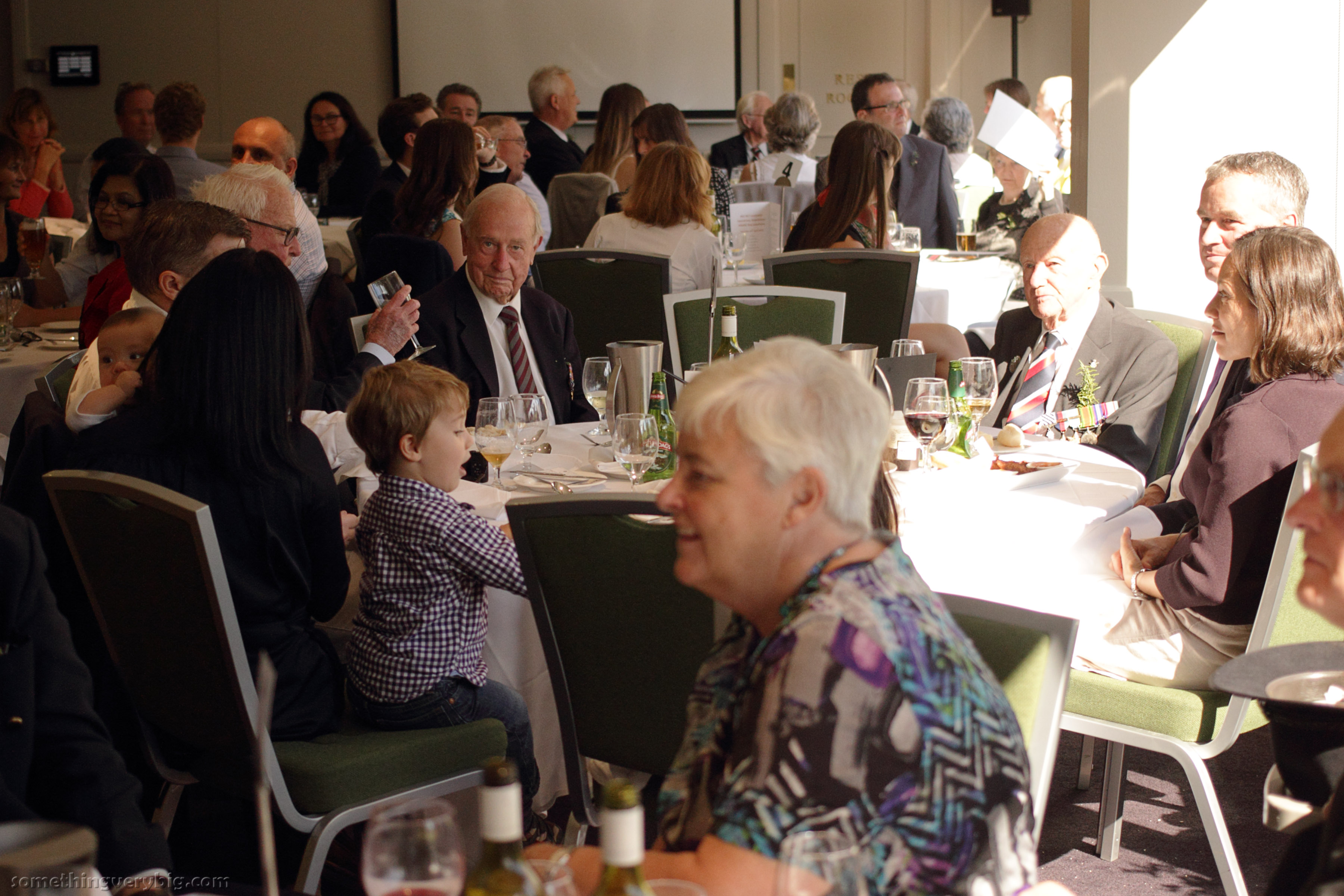
The Empire Air Training Scheme was an agreement between Britain and its Dominion countries that trained ab-initio aircrew and put them into a joint ‘pool’ from which they could be drawn to serve with various RAF units. Some 37,000 Australian aircrew were trained under the agreement, serving in Coastal, Fighter and Bomber Commands. And I recently had lunch with almost 40 of them.
My post written after the Bomber Command Commemorative Day Foundation (Vic)’s Cocktail Party in March started thusly:
“I love collecting veterans.”
It was a throw-away line, really. I was referring to my habit of coming away from Bomber Command-related events with a few new contacts, addresses and things to follow up on. But the line obviously tickled the fancy of Fay McPherson. While we were organising my visit to her husband Gerald a couple of months ago, she mentioned that she and Gerald are involved in running the biannual Empire Air Training Scheme luncheon.
The what?
Fay told me that a lunch is held in Caulfield, Melbourne, every six months for trainees and staff of the Empire Air Training Scheme. In other words, just about any member of Commonwealth aircrew from WWII can attend. Would I like to go along too, she enquired?
Would I what!
I had no idea that such a group existed. I’ve been pretty happy with groups of ten or so veterans from various lunches and events, and we might reach 40 on a good year for the Bomber Command Commemorative Day in Canberra, but the old blokes are usually well and truly outnumbered by family, friends and assorted hangers-on like, well, me. But I felt quite special to be invited to this one: fully two-thirds of those present had served in the Royal Australian Air Force in some capacity during WWII. Such a concentration of veterans I haven’t seen in a long, long time.
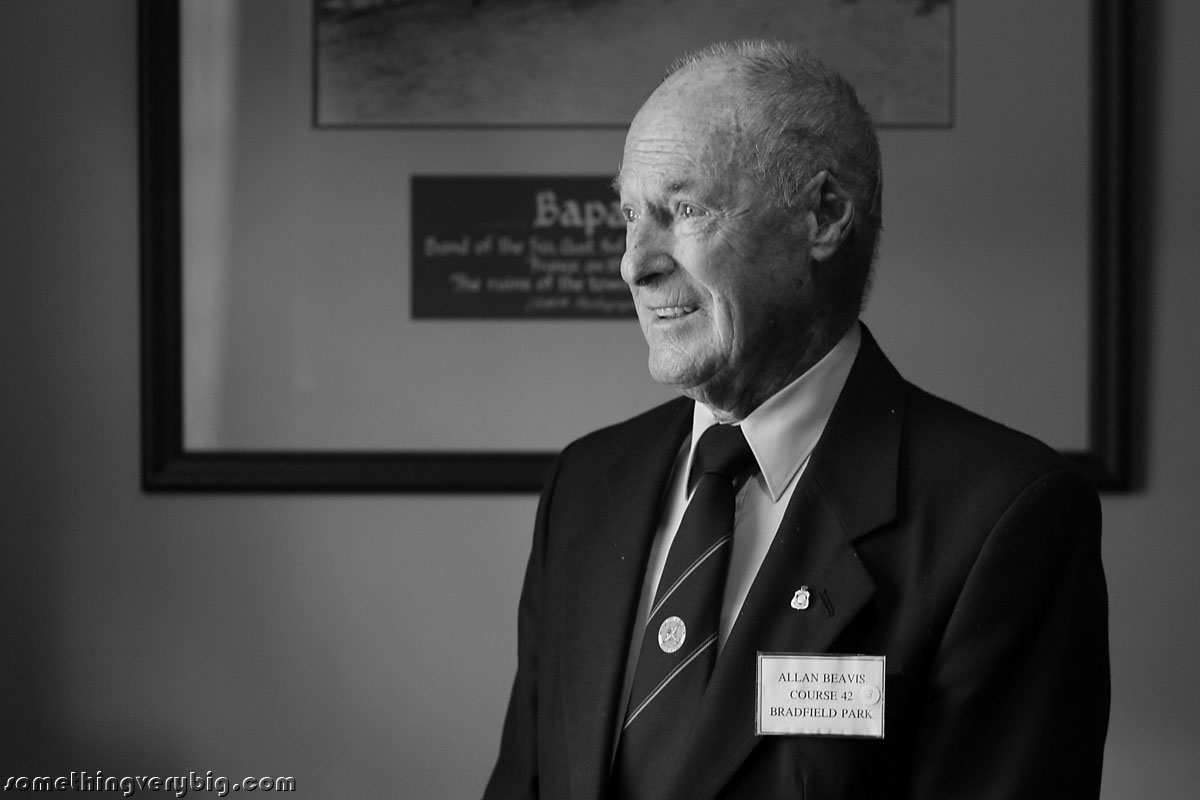
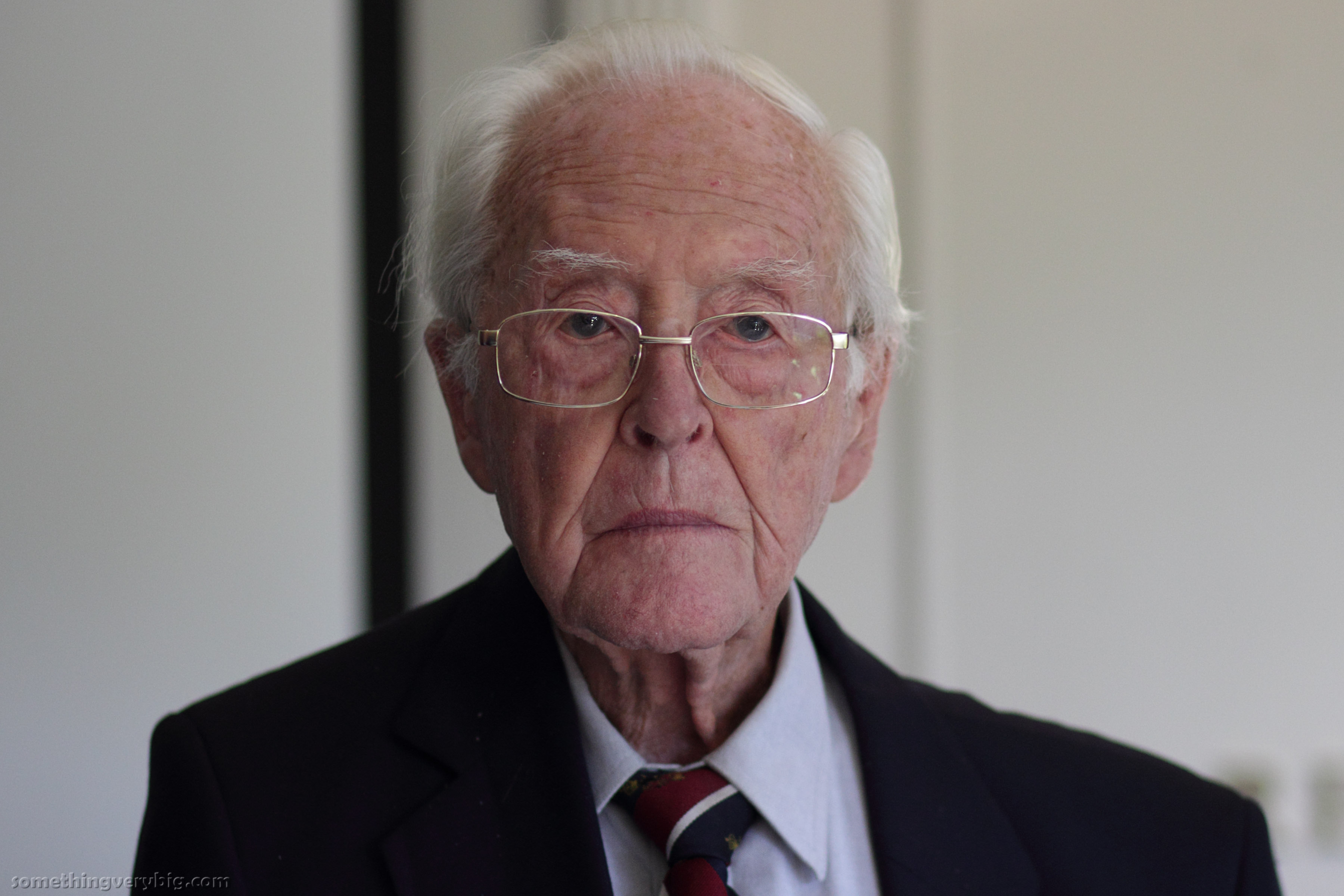
Al Beavis, a 608 Squadron Mosquito navigator
And so it was that, a few weeks ago, almost sixty people descended on the Caulfield RSL. As it turns out the RSL isn’t even in Caulfield. It’s housed in a handsome 90-ish-year-old mock Tudor building in neighbouring Elsternwick, and when I turned up last week people were already starting to gather in the bar, where the staff had set up jugs of beer with glasses for a very civilised serve-it-yourself opener. I recognised one or two people but decided I’d go introduce myself to someone new.
John Missen was his name, a genial man with a big white beard and a hearty laugh. John had been in Course 55 at 1 Initial Training School at Somers in Victoria in late 1944, right before the Empire Air Training Scheme began to wind up (I believe Course 57 was the final one). Just 18 years old, he and a mate reckoned they’d have a better chance of seeing action if they volunteered directly for training as air gunners but as you couldn’t be posted overseas until you were 19 someone talked them out of that. John ended up at Signals School at Point Cook and did eventually see service on the ground as a RAAF signaller in Borneo. The war ended before some others from his course, who had been accepted as gunners, got to an operational squadron. A writer and a painter, John told me he’s written a novel and is wondering if he should try to get it published. “It needs a good editor”, he said, “but the problem is that once you get to my age…”
The RSL had decided on this, of all days, to renovate its kitchen, so the meal was a somewhat slap-up affair cooked mostly on a BBQ. But it was hearty enough and the conversation was great. I’d asked to be seated next to “someone interesting”, and Fay more than delivered. At my table were two Halifax skippers (Laurie Larmer of 51 Sqn and Ralph White of 192 Sqn) and a Mosquito navigator (Ken Munro). One of the others at the table was Geoff Clark, who while not a veteran himself was pretty close: he’d completed his National Service in the RAF in the 1950s, working in the Photographic Section with reconnaissance cameras. And the other person was a man named Ian Stevenson, who’d brought along a logbook belonging to his uncle who had been a Spitfire pilot killed over Italy. So we all had plenty to talk about, and even more so when I discovered that Laurie lives just two suburbs over from me.
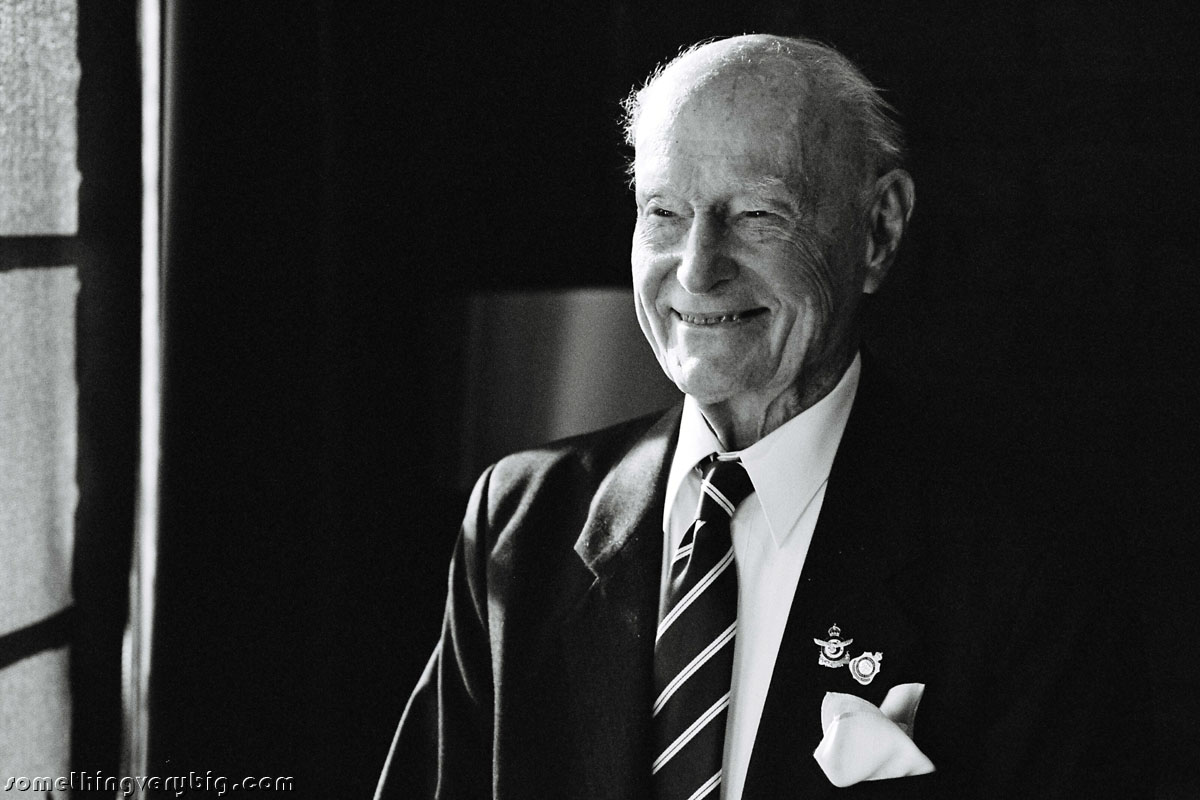
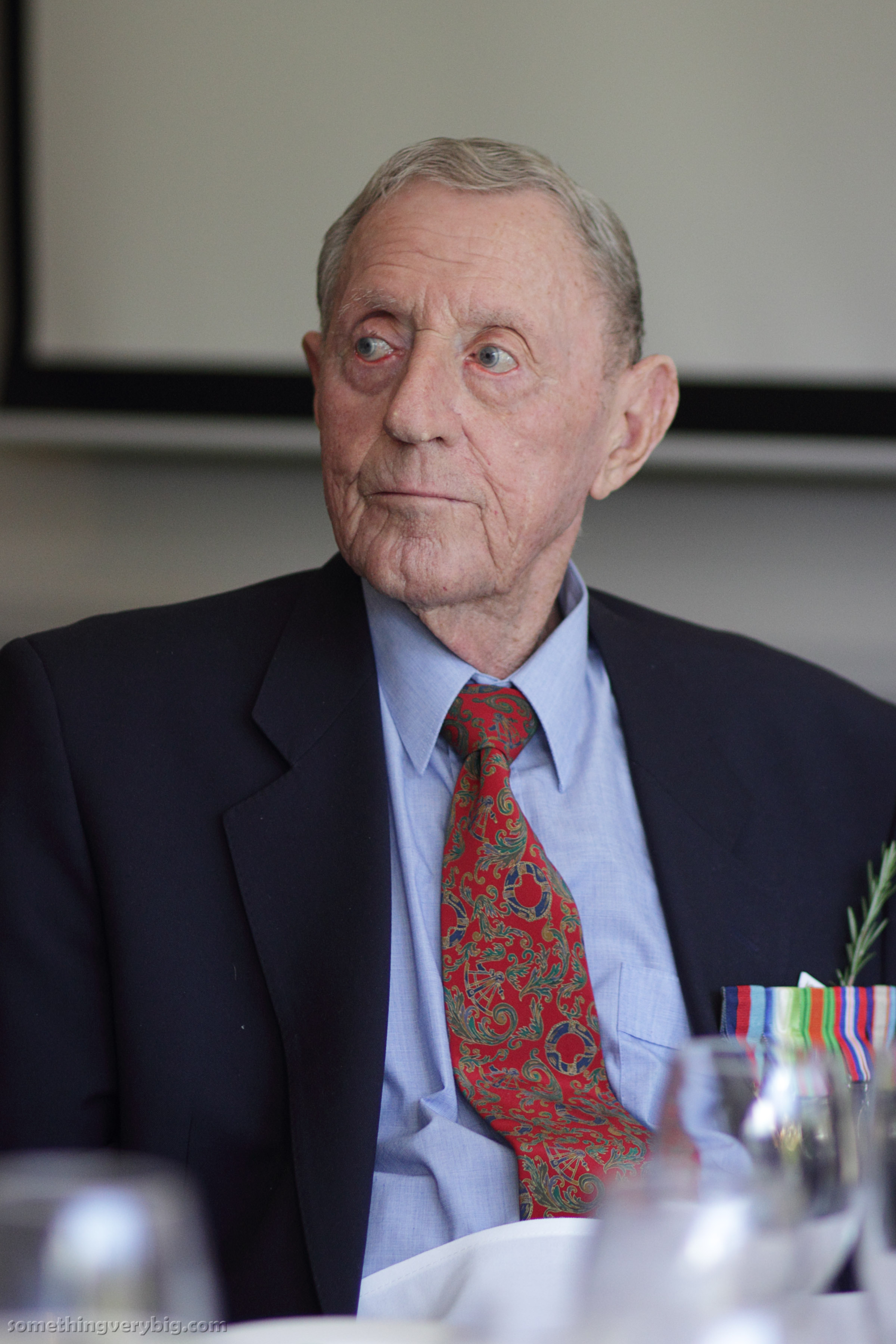
Ralph White, 192 Sqn Halifax pilot
I wandered around to some of the other tables between lunch and dessert. Someone mentioned the primitive conditions when the Initial Training School at Somers first opened. Apparently it was quite cold and the buildings were very draughty. At this point I heard Ken Wilkinson, a 77 Sqn Kittyhawk pilot, snort. “I was there in July…” he said. Ken thought at first that, as my interest is mainly Bomber Command, he wouldn’t be of much use to me, and pointed me to the two 460 Squadron men across the table. But then he said he had also done some air traffic control while in the Air Force… I’ll be seeing Mr Wilkinson again for a deeper chat, methinks!
Ken Wilkinson – a 77 Sqn Wirraway pilot – calls a taxi to go home after the lunch.
I also talked with Jack Bell, who I had heard speak during the Bomber Command Panel Discussion at the Shrine of Remembrance in 2013.I mentioned how happy I was to see so many veterans in the one place, and he concurred. But he had a very interesting point too. “A lot of these blokes haven’t told their stories”, he said. “This isn’t the place for it though – too many distractions. You really need to get them on their own.”
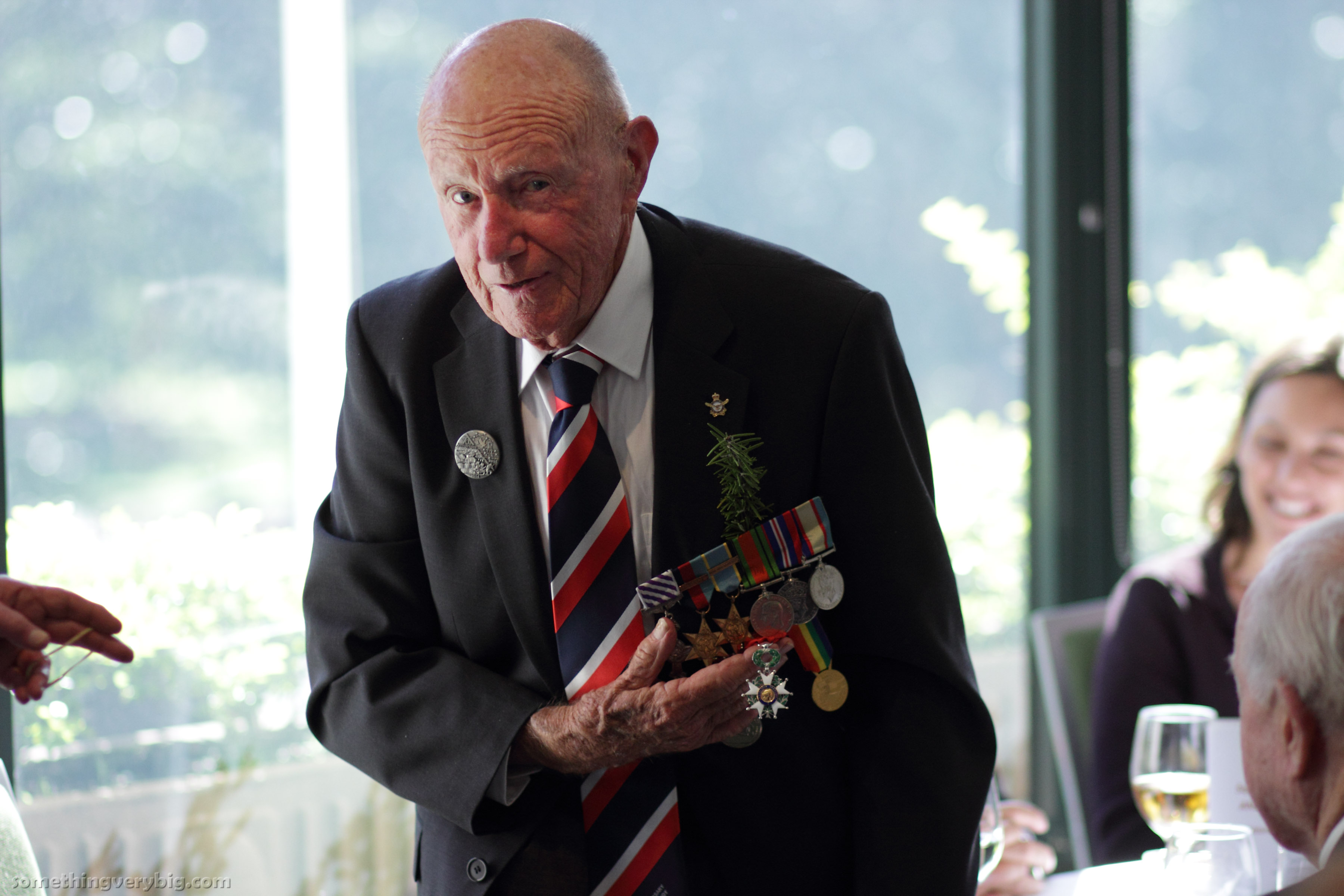
Jack Bell, 216 Squadron Vickers Valencia and Bristol Bombay Wireless Operator/Air Gunner
Which, I thought, is very true. I go to a lot of these sort of functions (indeed I’m madly trying to get this post finished in time before heading to Canberra for a whole weekend of them) and, while they are an excellent way to meet people initially, they are not usually the right sort of environment for a detailed talk. If the old blokes are up for something like that, as Jack said, you really do need to go and visit them.
So six old men will shortly get a letter from me requesting just such a visit. And hopefully I’ll get the chance to go and get some stories from them.
April 25, 2008 was one of the first years that I joined the 463-467 Squadrons Association for the Sydney Anzac Day March. It was, as I remember it, quite wet.
There were a good few more veterans marching then than there have been in more recent times – I guess age catches up quickly for most people sometime between their late 80s and early 90s. And so that wet April morning seven years ago, back when the old blokes weren’t quite so old, the march was moving a little quicker than it now does.
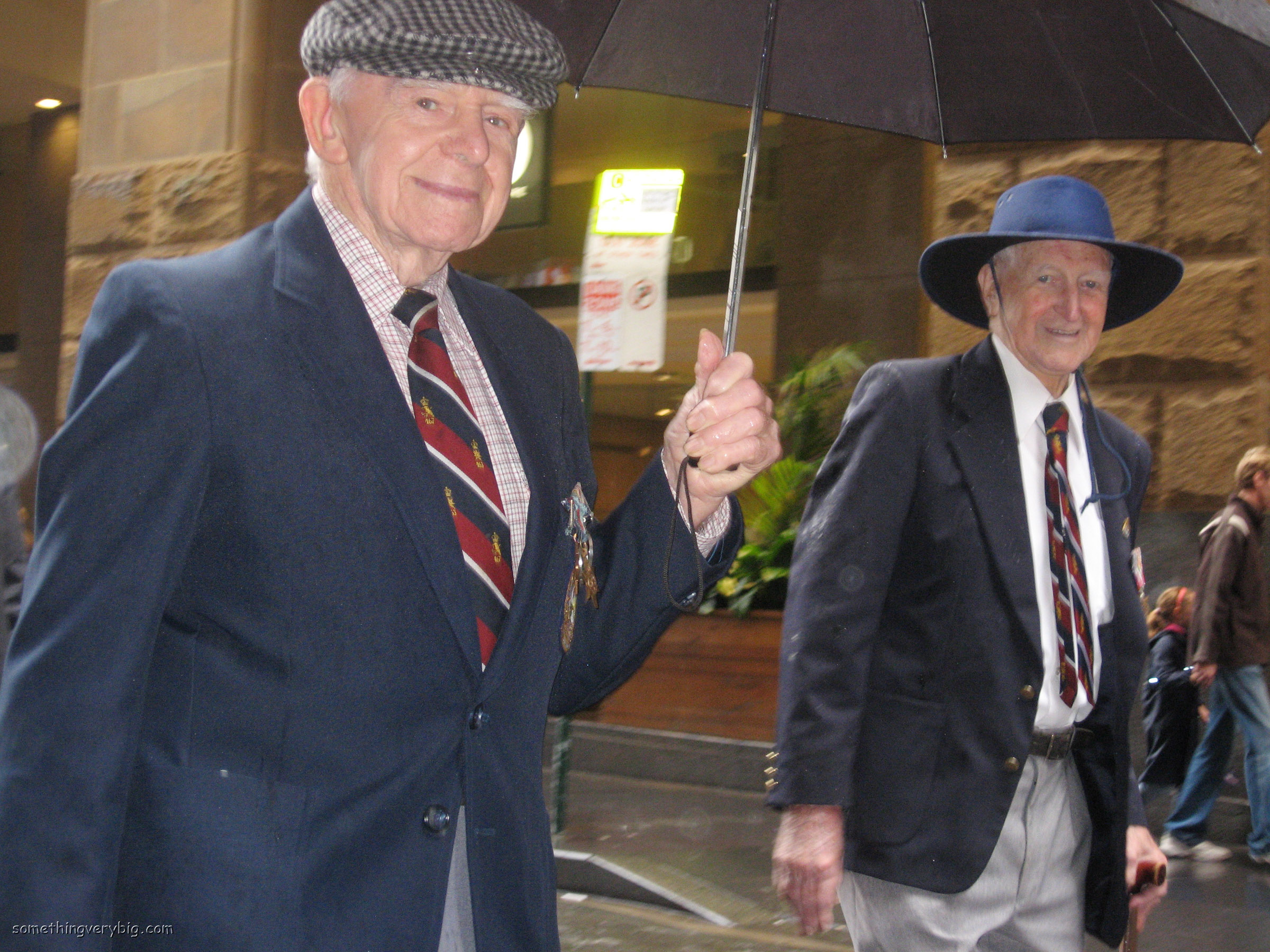
One veteran, though, was falling slightly behind, so I dropped back to offer him the shelter of my umbrella. We chatted as we marched. His name was Harry, he said, and “I was doing ok until I lost my marbles a few years ago!” I had to admit he looked in pretty good shape to me, notwithstanding the ever-increasing distance between us and the main group of marchers ahead.
Harry (on the right), before the marchers got away from him. Anzac Day 2008., Sydney. The other veteran is David Walter, a 467 Squadron W/Op, who died a few years ago.
But Harry, determined to complete the march on his own two feet, had a plan for that.
Just after the Sydney Town Hall, the traditional march route passes St Andrews Cathedral and then turns left into Bathurst St. We watched the Squadron wheel left in something that may have once resembled parade ground style (it had been over sixty years for these blokes, after all). Cheekily, though, my new friend Harry led me and my umbrella not so much around the corner as across it, cutting the corner and neatly closing the gap (at least a little bit).
No problems with marbles there, then, lost or otherwise.
This happy memory came to mind recently when I learned that Harry – actually Henry Emanuel Brown – 106 Squadron Wireless Operator, died peacefully in hospital on a Sunday night in May.
Harry had completed a year at Teachers College training to be a science teacher (having not yet reached the age of seventeen years) when he enlisted in the Royal Australian Air Force, using his brother’s birthday to try and sneak in four months underage. Alas, his family tell me, the duty sergeant knew him and ‘misplaced’ the paperwork until after Harry’s actual birthday. He was called up in August 1942, completed wireless operator/air gunner training in Canada and flew twelve operations with 106 Squadron from Metheringham. Then in March 1945 he went to RAF Warboys, in what is now Cambridgeshire, for a Pathfinder training course.
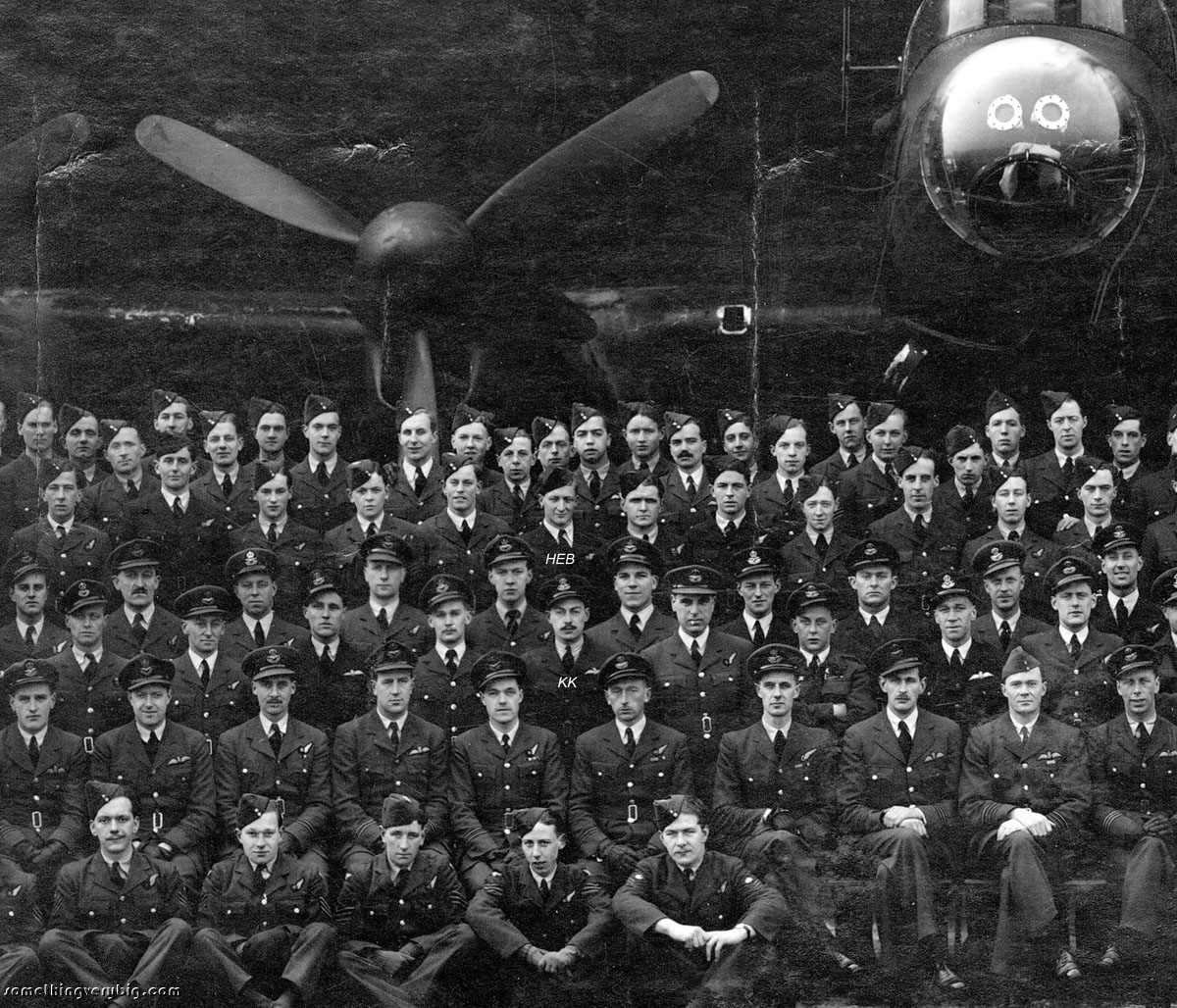
Harry (centre, marked with his initials HEB) among 106 Squadron aircrew. The man marked KK in front of him is his pilot, Ken Kiesling. Photo courtesy Nancy Jacobs
By the time this course ended, in late April 1945, the end of the war in Europe was but a fortnight away and Harry flew no more operations. He received a commission a week after VE Day and was posted to 467 Squadron, which moved from Waddington to (surprise!) Metheringham at around the same time. There Harry took part in the training for Tiger Force, the planned bomber offensive against Japan. Then the atomic bombs, as we now know, removed the requirement for that, and 467 Squadron disbanded at Metheringham at the end of September 1945. Shortly thereafter Harry returned to Australia and following discharge studied Physics at Sydney University under the Commonwealth Reconstruction Training Scheme and worked as a research physicist in atmospherics and minerals. Though he told his family that “the last time I saw Europe was out of the back of a bomber and I never want to see it again!” he did eventually return, well into his late eighties, to visit his children.
For the last few years Harry and I had corresponded occasionally after I posted him a copy of the group photograph of aircrew from Killara in 2013. He was one of the rare veterans with an email address (using dictation software rather than a keyboard) and this came in handy when I had technical questions about the role of wireless operator. There were many different types of radios in Lancasters and Harry was a great help in sorting out their various roles.
One of his emails mentioned using one of them to get a fix from “0512 East and 56 North when we were shot up over Hampden” (I suspect that was a dictation error from the software and it should have read Hamburg). My calculations place that position over the North Sea, rather closer to Denmark than to England. To my eternal regret I never got around to asking Harry to tell me more about that particular story.
Anzac Day 2015
Like many veterans though, most of the stories with which he did go into more detail concerned what could be called the lighter side of life in Bomber Command. As the wireless operator, Harry had a spare moment every 15 minutes or so. He had specially prepared an empty 7lb jam tin and would use that spare time, he told me at an Anzac Day lunch one year, to wander around between each man in the crew, offering them the use of it to answer calls of nature. “Not only was I the wireless operator”, so his punch line went, “I was the piss-pot too!”
Harry had broken his hip in a fall about a year ago and complications arising out of that had meant that he was in various hospitals and nursing homes more or less ever since. We didn’t see him at the Ladies’ Day lunch last November, but he was determined to come to Anzac Day this year, where his grandson Geordie, who is now a member of the Royal Australian Air Force himself, pushed his wheelchair during the march.
A little over two weeks later Harry passed away. He was the last remaining member of both his 106 Squadron and his 467 Squadron crews.
Thanks to Nancy (Harry’s daughter) and Geordie (his grandson) Jacobs for their help with supplying details and the wartime images in this post.
Servicemen of all hues have long carried identification tags into battle. Frequently, when soldiers are killed the tags of fibreboard or tin are all that is left to identify the bodies of their owners. But just as frequently, even the tags themselves are missing or destroyed, making the task of identifying the casualty that much harder.
Perhaps in anticipation of this – but probably more likely as a good luck charm – it has not been unknown for servicemen to wear their own, private ‘identity’ tags. And not uncommonly, it has indeed been these unofficial trinkets which proved crucial in identifying a dead soldier.
Such was the case when WWI infantryman Private Richard John Moffat, service number 2698, from Carlton in Melbourne, was killed in France in August 1918. On exhumation of the battlefield grave some years later, Moffat’s official identity tags were missing – but on the body was a small piece of curved brass, crudely cut into the shape of Australia and engraved with his name. He was identified on the basis of this piece of personal property.
His file at the National Archives of Australia[1] notes personal effects connected with Moffat. All it says is “DISC”. Usually personal effects like these would be returned to the family. But, as related by reporter Bridie Smith in an article published in October last year in The Age newspaper, instead of being forwarded on to Moffat’s grieving mother, for unknown reasons the disc was included in his official service record. It was still in the folder when, in 1993, the Army transferred its records to the National Archives. And it was still there when Moffat’s niece, Deirdre Meredith, opened the folder in the reading room at the National Archives in 2001. “It was a heart-stopping moment because it was such a personal thing,” Mrs Meredith is quoted as saying.
But when the file was returned to the Archive’s storage, the identity disc had to go back too. And so started a two-and-a-half year battle to get it back to the family.
The National Archives held the view that the little piece of brass was part of a Commonwealth record, and thus needed to remain under its jurisdiction. But for the Merediths, it was clearly a family heirloom – it had been part of Private Moffat’s personal possessions. Letters were written to the National Archives, Commonwealth Ombudsman, Government Ministers and Members of Parliament. And she wrote to the Australian Army. Expert advice from historians and legal advisors eventually persuaded the Army that the brass plate was, in fact, the property of Private Moffat’s next-of-kin. And so, in September last year, an Army officer flew to Melbourne from Canberra, and returned the little brass identity plate to its rightful owners.
“It was like him coming home”, Mrs Meredith said.
This story caught my eye because I can remember similar feelings to those experienced by Mrs Meredith when the plate fell out of the file from one of my first visits to the National Archives a few years ago. The file I was looking at was Jack Purcell’s A705 Casualty File.[2] About halfway into the stack of papers, I found a letter from January 1945 signed ‘EF Purcell’.
That would be Edward Francis Purcell. One of Jack’s brothers.
And my great grandfather.
It’s a very official letter, dealing with important issues like wills and deferred pay. But the signature pulled me up for a moment. It suddenly reminded me that it was written by someone with whom I share a name, and to some extent a family identity.
There are other letters from Edward Purcell. All are typed, as is the letter in the NAA file. All are signed with the same almost copperplate hand. And all are written in beautiful, almost painfully polite language. As far as I know just four other letters exist – all in Mollie Smith’s collection – and so because they are so rare I must confess to feeling a little disappointed that I had to give the NAA one back when I returned the file after looking at it.
Of course, this is a different scenario to the brass identity plate in Richard Moffat’s service record. Edward’s letter was an official one, written to the Air Force, and so it legitimately forms part of a Commonwealth record. Thus it quite properly stays in the National Archives, ready for anyone else who is interested to read it.
[1] NAA: B2455, MOFFAT RICHARD JOHN. The digital copy of this record still contains a scan of the disc.
[2] NAA: A705, 166/33/163 PURCHELL, Royston William – (Warrant Officer); Service Number – 412686; File type – Casualty – Repatriation; Aircraft – Lancaster LM475; Place – Lille, France; Date – 10 May 1944 [Note mis-spelling of PURCELL]
Last week, Sydney got hit by the “storm of this century”. Extremely heavy rain – 255mm over three days, or almost exactly twice the average for the entire month of April – combined with flooding and winds of over 130km/h to cause eight deaths, thousands of fallen trees and untold millions of dollars of damage.
So it was with some relief that the city awoke on Saturday to one of those beautiful gin-clear blue sky autumn days for which it is so known. Patrons at the Grand Hotel, on the corner of Hunter and Pitt Streets, were well and truly into it even as I walked past just before 8.30am to the starting point for the 2015 Anzac Day march.
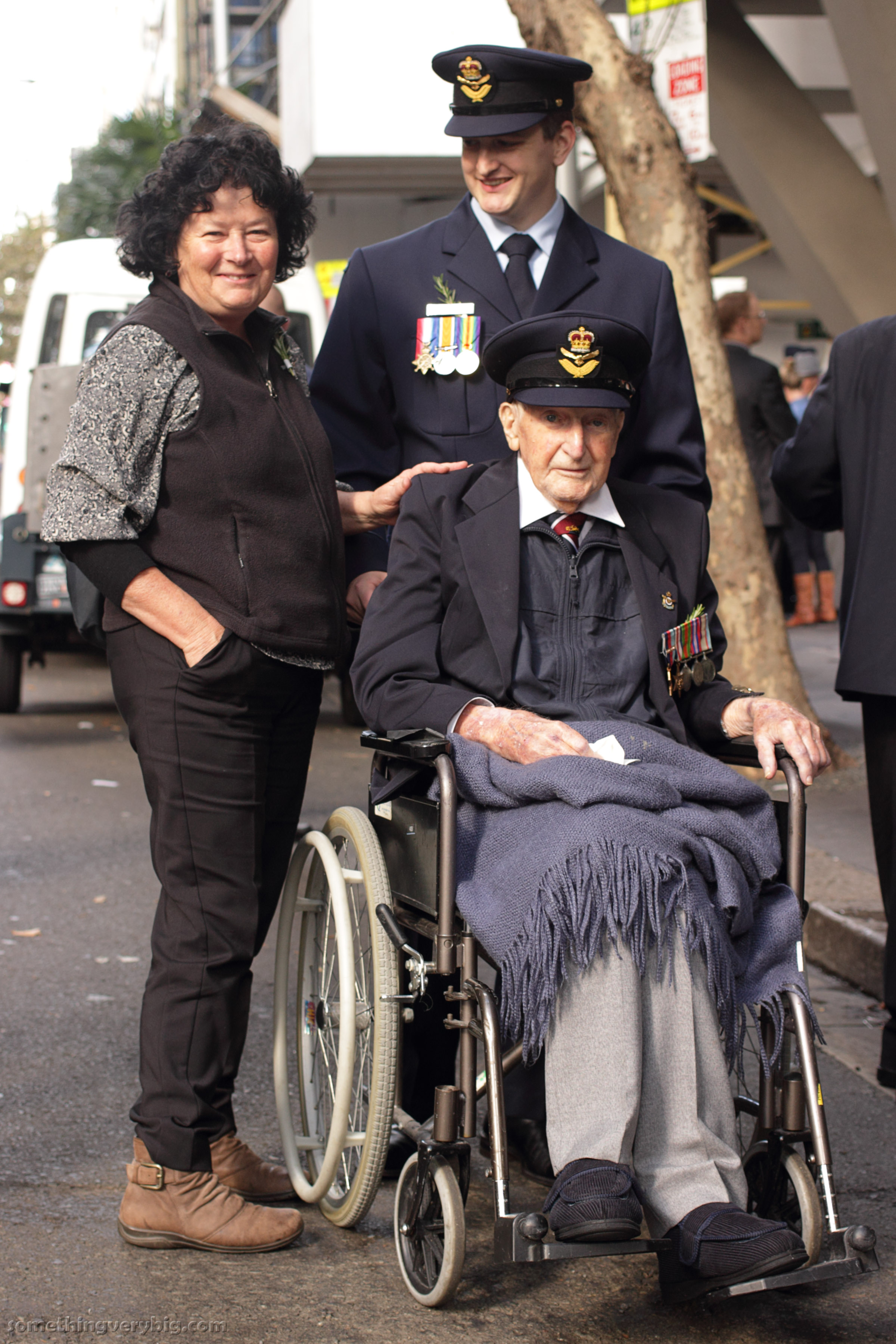
Just three veterans marched with the 463-467 Squadrons Association last year (with three more in trucks) and, with three of those having since suffered from deteriorating health, my fellow banner-carrier Bryan Cook and I were uncertain that we would have anyone marching at all this year. So we were both happy to find that numbers had in fact grown. In all there were eight veterans taking part. Bill Purdy missed last year as he was flying a Tiger Moth over the city. This year he led the 463-467 Squadron group. Don Southwell was back, feeling comfortable enough to march on foot for the first time in several years. Don Huxtable wasn’t going to let the trifling matter of a recent operation to remove a tumour from his neck stop him (he wore a beanie to cover the bandages). Riding in the trucks were Keith Campbell and Don Browning, and we had two veterans in wheelchairs: Albert Wallace and Harry Brown. Harry was pushed along by his grandson Geordie Jacobs, himself a member of the Royal Australian Air Force:
Harry Brown with his daughter Nancy Jacobs and grandson Geordie
And we had a ring-in with us too. David Wylie, a wireless operator, radar operator and air gunner who served on Coastal Command, had been ‘adopted’ by the Southwells.
A Coastal Command veteran marching with a bomber unit? “Well, we did air-sea rescue patrols,” David said, “and when these blokes ditched into the ocean, we’d go to fish them out!”
Sounds reasonable to me, I thought.
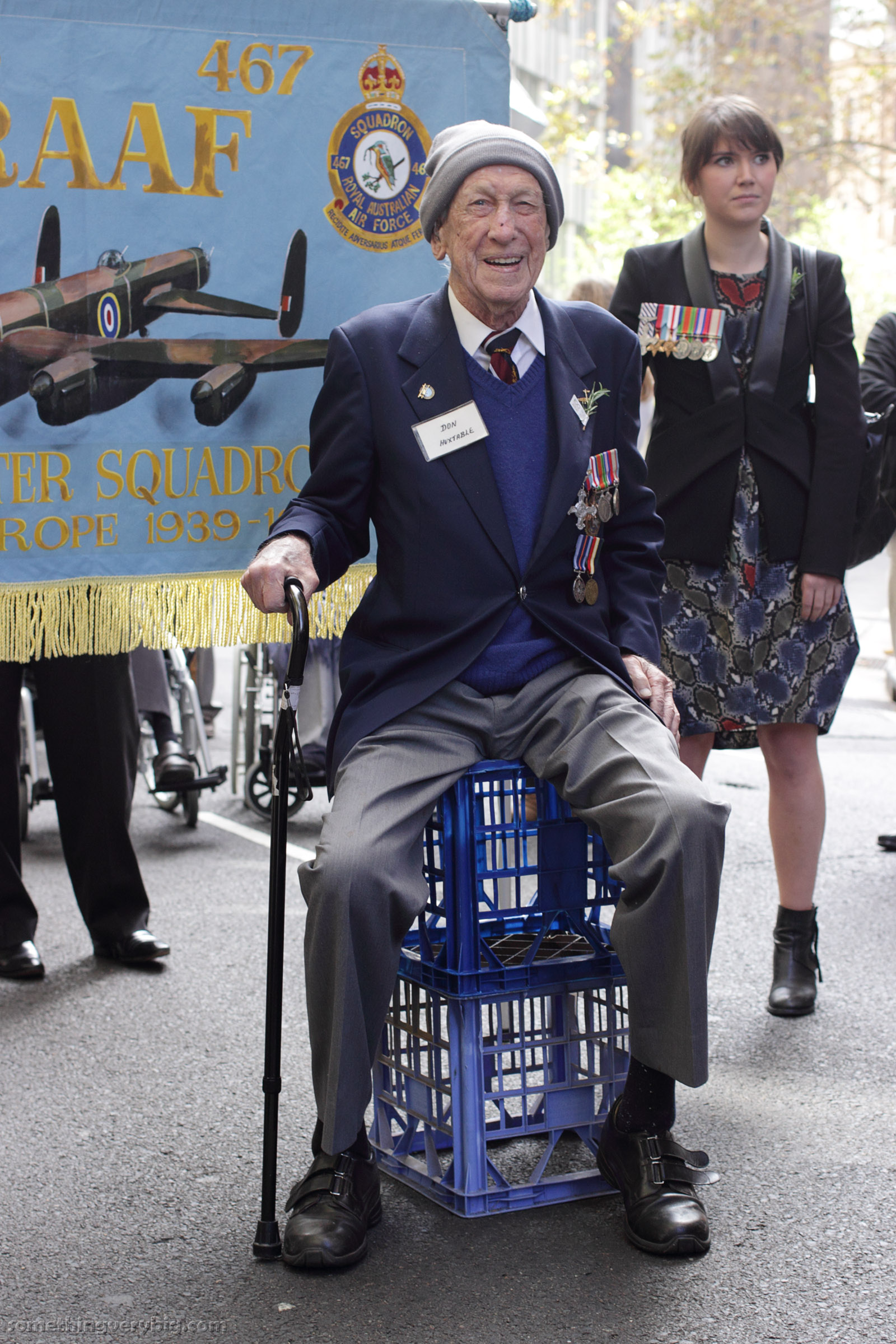
There was a rather long delay while waiting for the march to get going. Bryan found Hux a couple of milk crates to sit on in the meantime, which caused much merriment:
But finally, we were off. There was just one thing missing.
“Where’s our music?!?” asked Bill Purdy from the front.
Just as he said that I heard a shouted command – and the Castle Hill Pipe Band appeared out of a side street and slotted themselves in behind us.
There’s our music, Bill.
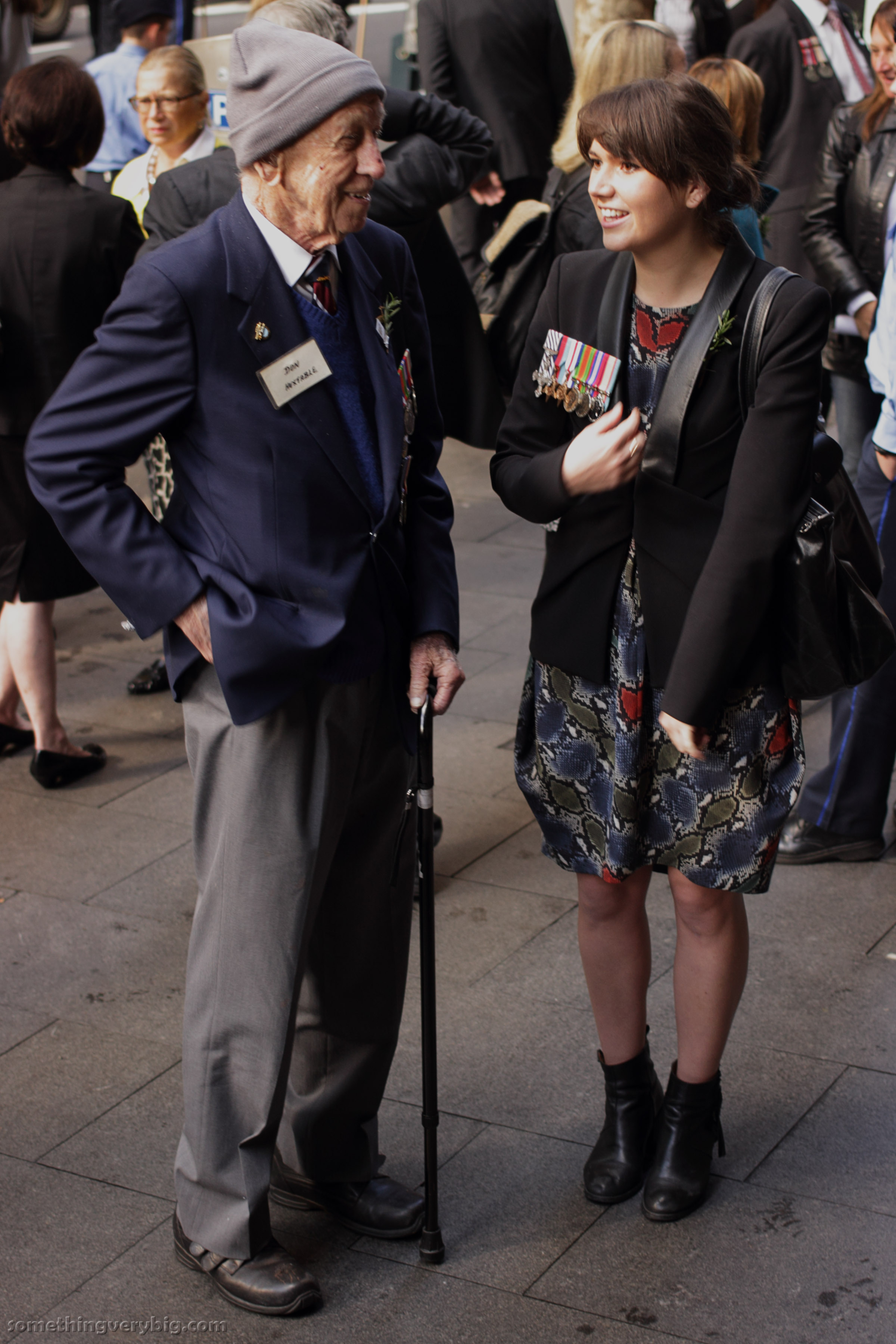
With the pipes behind us and the cheers of the crowd the noise was spine-tingling, especially where Pitt St narrows just before we turned down Martin Place. It seemed to me, and to at least one or two others, like the biggest crowd ever, and it probably was. We heard later that there were some 220,000 people lining the streets. Hux – ably assisted by Hannah Beech-Allen, and I don’t think Hux was complaining at all about that – was determined to see through to the end of the march. I thought he had finally conceded defeat on the last leg up Bathurst St, but it turned out he just wanted to high-five some young kids who were hanging on the fenceline.
Hux with Hannah
Intrepid leader Bill finally turned around when we reached the end of the march. I saw his eyes widen when he saw the rag-tag bunch of veterans and friends bunched behind the banner. “What a gaggle!” he said. We’d win no prizes for the crispness of our marching this year.
A short stroll followed across Hyde Park to the Pullman Hotel for lunch.
It was a bit squeezy. The room is built for about 45 guests – but we had almost 60, I think the biggest group ever, with more on a waiting list. Two more veterans joined the eight who had taken part in the march: Alan Buxton and my good friend Hugh McLeod. I’m not sure quite how I managed it but once again I had some extremely interesting dining companions. I was seated between Hugh and Bill Purdy, with Don Southwell off Hugh’s starboard wing. The conversation was as stimulating as you’d imagine with that calibre of gentlemen involved (“Did you ever have a nightfighter come in during the landing procedure?” Hugh asked Bill at one point, and I knew he was speaking from experience) and the lunch passed quickly.
The crowdKeith CampbellHugh McLeod
I overheard an interesting conversation between Alan Buxton and David Wylie. They were talking about parachutes. David related the time when he and his crew were returning from a patrol in their Vickers Warwick (a development of the Wellington)and one of the wheels would not come down. The ground controller told them to point the aircraft east towards the sea and bail out, but they elected to try and land instead because, David said, “I’m afraid of heights”. Here Alan chuckled. He was wearing his little golden caterpillar badge, earned departing his Lancaster by parachute when all four engines caught alight crossing the English coast on the way home from an operation. “It’s different when you have to get out”, he said. “And we had to get out.”
David WylieAlan Buxton
And so another Anzac Day passes. The World War II veterans are getting fewer, and many of those who were there are much more frail than they were even a year ago. But they are still there, and while they keep coming to march, I’ll keep carrying the banner they so proudly march beneath.
Tommy Knox and Keith Campbell on the truckBill Purdy showing off his Legion d’HonneurThe paparazzi at work. Back row, L-R: Bill Purdy, Alan Buxton, Hugh McLeod, David Wylie, Don Southwell, Don Browning. Front row, L-R: Albert Wallace, Keith Campbell, Harry Brown and Don Huxtable.Don Huxtable
Carrying a big old photo album and a familiar-looking blue-covered notebook, the old man led the way up a narrow staircase. Upstairs a table and a few chairs were in the middle of a big light-filled room. He pointed me to a chair, settled himself into the other one, and looked me fair in the eyes.
“So,” he said. “What do you want to know?”
Always a difficult question, that. And particularly so when the old man asking it is a Bomber Command veteran with 37 operations to his credit. But this was the situation that I found myself in one Wednesday afternoon recently, when I went out to Melbourne’s eastern suburbs to talk to one Gerald McPherson.
Gerald grew up in Horsham, in country Victoria. He grew up one of eight children, with one sister (the eldest of the lot), three older brothers and three younger brothers. At nineteen he enlisted in the Royal Australian Air Force in January 1943. Two older brothers were already in the Air Force: Cyril, a pilot on Vultee Vengeances in Darwin, and Harry, a rear gunner on Halifaxes with Bomber Command in the UK. One of the photos in the big album that Gerald had brought up with him shows all three in uniform:
Cyril, Harry and Gerald McPherson.
One of his other brothers was in a reserved occupation and thus unable to enlist. He was a telegraphist at the Horsham Post Office. “If anything had happened to us”, Gerald said soberly, “he would have been the first to know.” But while Gerald was awaiting call-up, his brother taught him Morse code at the Post Office. And so when this became known at Initial Training School, he found himself earmarked for training as a wireless operator.
At that stage in the war, a Wireless Air Gunners School was operating at Ballarat, north-west of Melbourne. Gerald was there between April and August 1943 – straight through winter. And Ballarat is, he reckons, one of the coldest places in the country. “We wore our complete flying kit to bed at night!” he told me. Matters were not helped by the gap of several inches between the bottom of the doors and the floor of the Nissen hut in which they were accommodated.
Gerald made an important discovery at Ballarat. While he could send and receive messages – a legacy of the lessons with his brother – he realised that he had no aptitude at all for taking a wireless set apart, finding and repairing any faults and putting it together again. As this was a vital part of the wireless operator’s role in a heavy bomber crew, he asked to be transferred to become a straight air gunner only.
Logbooks are good things to pore through. The entries are usually brief, to the point and largely emotionless. But they offer a convenient stepping-off point for further discussion, particularly when their owner is sitting across the table from you. The first page of Gerald’s revealed, over a week and a half in August-September 1943, a little over nine hours of flying, all by day, at No. 3 Bombing and Gunnery School, West Sale.
“You trained in Fairey Battles, I see?” I asked.
“Terrible aeroplanes. Cramped… and the glycol fumes!” he said, rolling his eyes. “And I almost fell out of one once.” Apparently he dropped a full magazine of bullets over the side, leant over and caught it – “good thing I was playing so much cricket then” – and only then realised that his safety belt was not secured to the aircraft.
Shaking my head in amazement, I turned to the next the page of the logbook. Here the entries begin on 3 March 1944, and the flying is in Wellingtons from 17 Operational Training Unit at Turweston, in the UK.
Wait a second. Now he’s in the UK? But what about the rest of his training? Surely he can’t have had just nine hours of dedicated gunnery training in the air before he qualified as an air gunner?
I looked for the page that I felt sure I had missed. But there was none.
Air gunners in Bomber Command really were sent overseas and joined a crew with fewer than ten hours flying time.
Dale Johnston, the wireless operator on B for Baker had been in the service for a year and nine months and navigator Jack Purcell for more than two years when they first arrived at 9 Squadron at the end of October 1943. In contrast, Gilbert Pate, their rear gunner, took about a year and a quarter from enlistment to arriving at his first operational squadron, and he spent a month and a half in transit to the UK. Eric Hill, B for Baker’s English mid-upper gunner who, of course, did not have to travel half way around the world, was in the Royal Air Force for just six and a half months before he arrived at his first operational squadron. I knew that it didn’t take long to train a gunner to the point where they qualified to wear the half-wing with ‘AG’ on it.
But seeing Gerald’s logbook brought home with a thud just how little flying experience was involved before a gunner crewed up at an OTU. Gerald had been in the Air Force for nearly 18 months by the time he reached an operational squadron, but getting to the UK took four and a half months of that. He was packed off to war having completed a three month course at an Initial Training School and three weeks at Air Gunnery School, with a total of nine hours and ten minutes in his logbook.
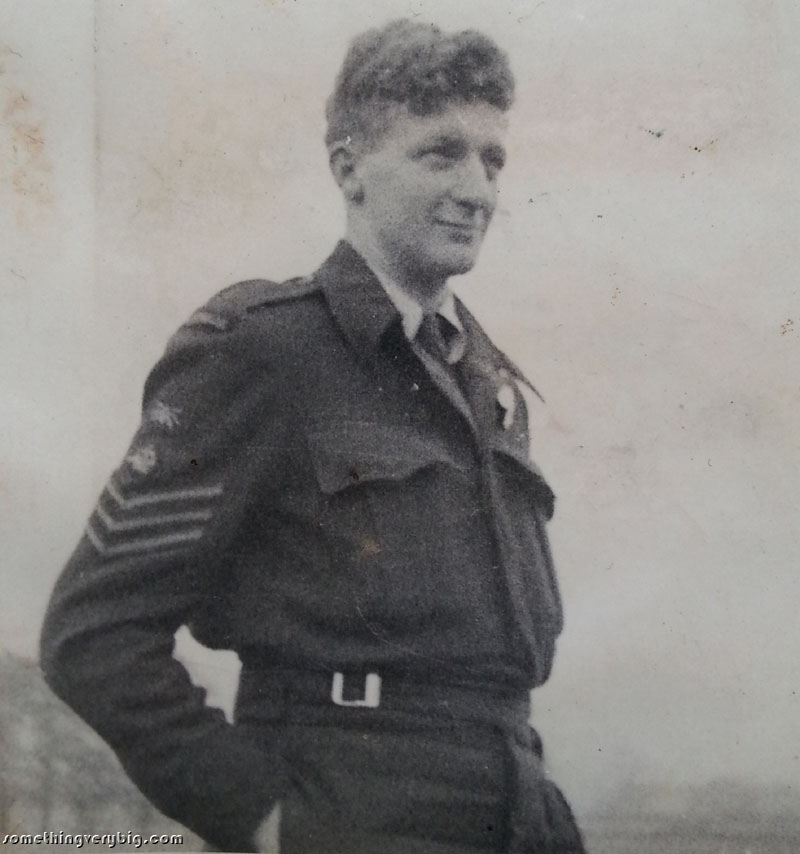
Gerald McPherson circa 1943
Gerald crewed up at OTU in the usual fashion: equal numbers of each trade were sent into a big room and told to sort themselves out. Shortly afterwards they needed to replace their wireless operator, who had filled in for another crew on a training flight but was killed when the Wellington in which he was flying ditched into the North Sea after an engine failure. And soon after they got to 15 Squadron at Mildenhall, their pilot – Kiwi Flight Sergeant Jim Houghton – went on the usual second dickie trip to gain some experience before taking his own crew on ops. But as happened far too often, the aircraft he was on failed to return and Houghton was killed. Gerald told me that the Squadron Commanding Officer called them into his office and offered for them to remain on the squadron as ‘spare bods’, filling in for aircrew temporarily unable to fly with their own crews. Knowing from the loss of first their wireless operator and then their skipper that flying with strange crews was frequently a virtual death sentence, however, the crew managed to convince the CO to send them back to a Heavy Conversion Unit so they could find another pilot.
Finally Gerald and his crew – now led by Australian Flight Lieutenant Jeff Clarson – arrived at 186 Squadron, newly reformed at Tuddenham in Norfolk and under the command of Wing Commander JH Giles, a Canadian. Gerald maintains a very high degree of respect for his ‘Wingco’, telling me that instead of sending newly arrived pilots on second dickie trips, Giles would take the entire crew on their first trip himself. This being a very unofficial practice, Giles apparently did not even put the flights into his own logbook.
So it came to pass, as it were, that on 28 October 1944, Gerald and his crew climbed into a Lancaster with Wing Commander Giles for a daylight raid on Flushing. But they needed to swap at the last minute into a spare aircraft, and as they clambered aboard and did their pre-flight checks, Gerald discovered that the rear turret had no guns fitted. He told Giles over the intercom – but they were already late and there was no time to fix it. “Just keep a good look-out”, Gerald was told, “and sing out if you see anything”. He now reckons he’s the only gunner in Bomber Command to have gone on his first trip without guns!
Incidentally, this kicked off an interesting discussion about just how useful four Brownings weren’t against cannon-armed German fighters. Gerald confirmed my impression that most of the time it was considered better to evade nightfighters than to engage them in an uneven firefight. Indeed, just over a week after the attack on Flushing, Gerald and his crew flew on their first night raid to Coblenz in Germany. “Attacked by JU-88”, I read from his logbook.
“Not really”, Gerald said.
What actually happened was that the mid-upper gunner spotted the fighter close above them and reported it to the pilot. They altered course to see if it would follow them. It didn’t, probably indicating that the German pilot did not spot the bomber at all, and the Lancaster slipped away. Had either of the gunners opened up, the flashes from their muzzles would have drawn the attention of not just the JU-88 pilot, but of any enemy fighter nearby, putting them into a very dangerous situation. “You can’t fight cannon with machine guns”, Gerald said.
The crew, from left to right: P/O. Jock Hepburn D.F.M. Flight Engineer, P/O. Dennis Parrish Bomb Aimer, P/O. Gerald McPherson Rear Gunner. P/O. Ron Liversidge Navigator, P/O. Jim Mallinson Mid Upper Gunner, Flt./Lt. Jeff Clarson D.F.C. Pilot, W/O. Wilbert Perry Wireless Operator.
Their tour continued, not exactly uneventfully. They were shot at by a nightfighter on the way home from Leuna on 6 December 1944. The ‘cookie’ hung up over Gelsenkirchen three months later and had to be cut out with an axe. They thought they’d lost another wireless operator when ‘Grandad’ Perry (at all of 23 years, the eldest in the crew) went to fill in for a sick wireless operator with another crew to Dortmund. The aircraft crashed and blew up at the end of the runway and the rest of Gerald’s crew had been told that all on board had been killed and had already begun drinking to the memory of their late friend in the mess when the man himself appeared at the door. Apparently the other crew’s own wireless operator had been cleared to fly and turned up at the last minute and took over (full story here).
But as their tally approached the magic 30 that would usually mean the end of their tour, Bomber Command decided to raise the requirement to 35 because more crews were being lost than could be replaced. Gerald’s crew struggled to 33… and then it went up again, to 40. And so on 9 April 1945 they went on a night trip to Kiel, Gerald’s 37th all up. Over the target they were coned by a big pack of searchlights. For ten or fifteen minutes, pilot Jeff Clarson struggled to escape the blinding light. Flak damaged an aileron and it was a massive effort to recover, losing 16,000 feet in the process. At one point, flight engineer Jock Hepburn later told Gerald, they were actually upside down, not that Gerald could perceive that in his turret.
They managed to return safely – though not before almost hitting another Lancaster near the Danish coast – and it was only after landing that they discovered that in fact they had no obligation to go on the operation in the first place. The previous day – before they took off for Kiel – the requirement for a tour had been dropped back to 30. Apparently this was brought to the attention of the new Commanding Officer, an Englishman, but he decided to leave them on the Battle Order.
So Gerald finally finished his tour having completed 37 operations. Unusually among the veterans I’ve met, this included no fewer than 31 daylight trips. He was sent back to Australia and quite quickly demobbed, eventually to return to his pre-war job in the Personnel Department of ANZ Bank. He lived quite near Essendon Airport (in fact on my way to visit Gerald I had ridden the scooter past the site of his old house – it now hosts a block of serviced apartments) and played first-grade cricket for Essendon for many years. And it was after a cricket training session about a decade after the war when Gerald was in the bar at the Essendon Club with his team-mates and someone tapped him on the shoulder. It was Jeff Clarson, now a pilot with Ansett-ANA, in Melbourne on a night-stop.
That turned into a much later night than had been planned, Gerald told me.
When I next looked at my watch, Gerald and I had been sitting at that upstairs table for three and a half hours. The time had flown by and we had covered a lot of ground. Gerald’s wife, Fay – who had organised the visit for me – had stuck her head up once or twice to offer tea refills but otherwise just let us talk. By the time I arrived home she had already emailed me a copy of Gerald’s logbook (she also provided the photos in this post).
I’m not, of course, the first person to interview Gerald (though this was more a chat than an interview). He also features in Michael Veitch’s excellent book, Flak.
Between that and my afternoon with Gerald, I had indeed discovered everything I wanted to know.
Text (c) 2015 Adam Purcell. Images courtesy Gerald and Fay McPherson
While the ‘national’ event is held in Canberra each year, there are also other Bomber Command Commemorative Day events being held across Australia around the same time.
Note that as the Canberra event was brought forward a week this year to avoid clashing with the Queens’ Birthday long weekend, these ceremonies will not be all held on the same day.
At the time of publication not all states had advised their details. This page will be updated when and if they do.
Melbourne:
Sunday 7 June 2015, 12:00pm
in the Auditorium of the Shrine of Remembrance, Melbourne
Contact: Robyn Bell, 03 9890 3107 or brucebell (at) netspace.net.au
Details have now been released for the ‘national’ Bomber Command Commemorative Day events in Canberra, to be held on the weekend 30-31 May 2015. Note the change in date, one week earlier than has been traditional. There are as usual three events taking place:
The Ceremony
The Bomber Command Memorial, Western Sculpture Garden at the Australian War Memorial, Canberra
Sunday 31 May 2015, 11:00 (please be seated by 10:50)
Contact and bookings: Don Southwell 02 9449 6515 or southwelldonald (at) gmail.com
The Meet & Greet
In the shadow of G for George, ANZAC Hall, Australian War Memorial, Canberra
Saturday night 30 May, 18:30-20:30
$60 per person, includes canapes, beer, wine, soft drink.
The Lunch:
QT Hotel
Sunday 31 May 2015, 12:30 for 13:00
$60 per person, includes two-course sit-down lunch. A cash bar will be operating.
Note that the Lunch has been moved back to the QT due to high demand
Contact for Meet & Greet and Lunch bookings: Ros Ingram, 2A Kitchener St Oatley NSW 2223, ros (at) ingram.org.au or 02 9570 6176
Tony Wright, National Affairs editor at The Age newspaper here in Melbourne, usually writes about the goings-on in and around Parliament House in Canberra. His series of Sketch columns usually throw an interesting light on the events of the day (and, if you’ve been following Australian politics, he’s had a not inconsiderable amount of material for inspiration recently).
But every Saturday, Wright gets the opportunity to write about something other than politics. One week last year it was about Mike Druce, the man who made a modern-day escape from Colditz Castle in September, then walked unsupported to Switzerland. Wright wrote another interesting one early in February.
“They are disappearing fast now”, he wrote, “the generation who experienced a world war.”
It seems not so long ago that those who had lived through World War I and had seen horses step aside for internal combustion engines and a lot more were being put in the ground, but memory plays tricks – it’s 100 years since that war began.
Those who knew it, even those who lived to astonishing ages, breathed the last of this earth’s air a long time ago.
Now it is the turn of the last of the survivors of World War II.
Some of those shuffling off into the sunset in recent times, of course, were well-known in life and widely mourned in death. Giants of politics like Gough Whitlam (an RAAF navigator) and Tom Uren (a survivor of the Burma-Thai Railway). Journalist and Korean War correspondent Harry Gordon. “These are, of course, big and extraordinary lives”, Wright says:
…generous spirits well documented, celebrated on a broad stage, their stories teaching us something that transcends the experiences that will go into books about their achievements: call it wisdom.
But while these were some of the better-known men whose lives intersected with some of the biggest conflicts in the history of mankind, so many others were there too. In Wright’s words:
…each day others whose lives were not destined to be celebrated so publicly or granted obituaries pass beyond this existence. Every one of them has a story, and in those stories we can often find ourselves enriched, because wisdom often resides there.
He’s dead right.
This is more or less why I flew to Sydney last month to have lunch with a Bomber Command veteran who also happens to be a good friend of mine. Hugh is a former rear gunner and we arranged to meet at one of those very old and very exclusive clubs in the city, all cedar panelling and leather Chesterfield armchairs. Hugh has been a member for a quarter-century.
He’s clearly well-known here. As we entered the bar the bartender poured my beer but gave Hugh the bottle and an empty mug. “I like to pour it myself”, he explained. Somehow, I imagine, with its sharply-dressed, exclusively male clientele, beer in pewter mugs and discreet murmur of conversation, the atmosphere in the bar at a wartime Officer’s Mess (in one of its quieter moments) might have been something similar. And perhaps for Hugh that’s at least part of where the attraction lies.
With that thought in my head, it’s not surprising that our conversation very quickly turned to flying. As we drank our beers we shared experiences flying the Tiger Moth and I mentioned my recent visit to Nhill and the Anson that is under restoration there. “I loved the old Aggie”, he said simply. We continued talking in the dining room as we waited for and then enjoyed a scrumptious meal while looking out over the State Library across the street.
Hugh is a little unique. He actually trained as a pilot but when he arrived at his squadron, he was one of twelve who were asked/chosen to re-train as gunners to operate a special ‘secret weapon’. It turned out to be ‘Village Inn’, an automatic radar-guided gun system. Despite what you might read on that link, Hugh’s opinion of the equipment is not very high. It was unserviceable half the time, he said, and the rear turret was not a nice place to be. Nor was it safe. On his first trip – to Bremen, in October 1944 – two of the twelve Village Inn men failed to return.
Hugh flew on his last operation – his 32nd – a matter of weeks before the end of the war. There followed the traditional fortnight’s end-of-tour leave, part of which coincided with the regular 12-days-every-six-weeks leave of a good friend at the squadron called Johnny Garrett. Hugh had arranged to meet up with Johnny in Cardiff but was a bit surprised when he did not show up. On return to the squadron he found out why.
On 22 April 1945, 49 Squadron was moving from Fulbeck to Syerston. As happened frequently on these occasions, on departure each bomber “beat up” the control tower before setting course for their new home. One aircraft flew past at extremely low level. Johnny, like Hugh a pilot/rear gunner, was in the rear turret.
The pilot pulled the Lancaster up into the air.
Too late.
The tail of the aircraft hit the MT shed. The Lancaster fell to the ground, killing all six on board. Fifteen more people – part of the works party which were about to begin runway extentions at Fulbeck – were killed on the ground.(1)
It was a sobering story to hear over an otherwise very civilised lunch. But that’s just the point. Such was life, and death, in Bomber Command. Tragic as they are, stories like these actually happened. While official records like the squadron Operational Record Book reveal something of what happened to the aircraft, they won’t include the personal details – like the friends of those killed who wondered why they did not show up for an arranged meet-up while on leave.
These are the sorts of details and stories that can only come direct from those who were there at the time. So I see part of my role, as a Bomber Command researcher, but also as a member of the human race, to collect those stories while I still can. Hugh is one of the younger Bomber Command veterans I know, but he turned 90 last year. He’s no spring chicken. And one day I’m going to want to ask him something… but he won’t be there anymore. So in the meantime, says Tony Wright as he finishes his piece:
…the rest of us could do worse than sit with those close to us and explore what they might have to share and teach before they are gone and we find ourselves turning, bereft, to their shadow.
Amen to that.
Hugh McLeod, 49 Squadron rear gunner and my good friend, died on 7 July 2015.
(1) The ‘Fulbeck Tragedy’, as it is known, is described in Ward, J 1997: Beware of the Dog at War: Operational Diary of 49 Squadron Spanning Forty Nine Years, 1916-1965, pp. 542-5. Thanks to Colin Cripps for the steer.
Though their numbers are undeniably dwindling, it seems that every time I go to a Bomber Command-related event I come away having met a new veteran or two. And last Saturday night, a fundraising cocktail party for the Bomber Command Commemorative Day Foundation (Vic) in Melbourne, was no different.
Because of my own history of living in Sydney most of the events I go to are still in the Harbour City, and so despite living in Melbourne for four and a half years now I regularly travel there for ANZAC Days or other events. Consequently I’m still getting to know the Melbourne-based Bomber Command community. So it was great to see that among the fifty or so guests who gathered on Saturday night at the Nurses’ Memorial Centre on St Kilda Road were five Bomber Command veterans, three of whom I had not properly met yet. Rest assured that was remedied by the end of the evening!
The other two I know well. 578 and 466 Squadron Halifax skipper Don McDonald brought his wife Ailsa, and was working the room as he always does. Though he was wearing a badge with joined Australian and French flags I didn’t get the chance, unfortunately, to ask him about his recent award of the Legion d’Honneur, but that story will have to wait until the next time we meet. 463 Squadron navigator Don Southwell came down from Sydney as a representative of the national Bomber Command Commemorative Day Foundation committee. Don, as well as being a friend of mine is very active on numerous Bomber Command committees and it was nice to have the chance to talk to him at an event which, for once, he did not organise.
Gerald McPherson and Don Southwell
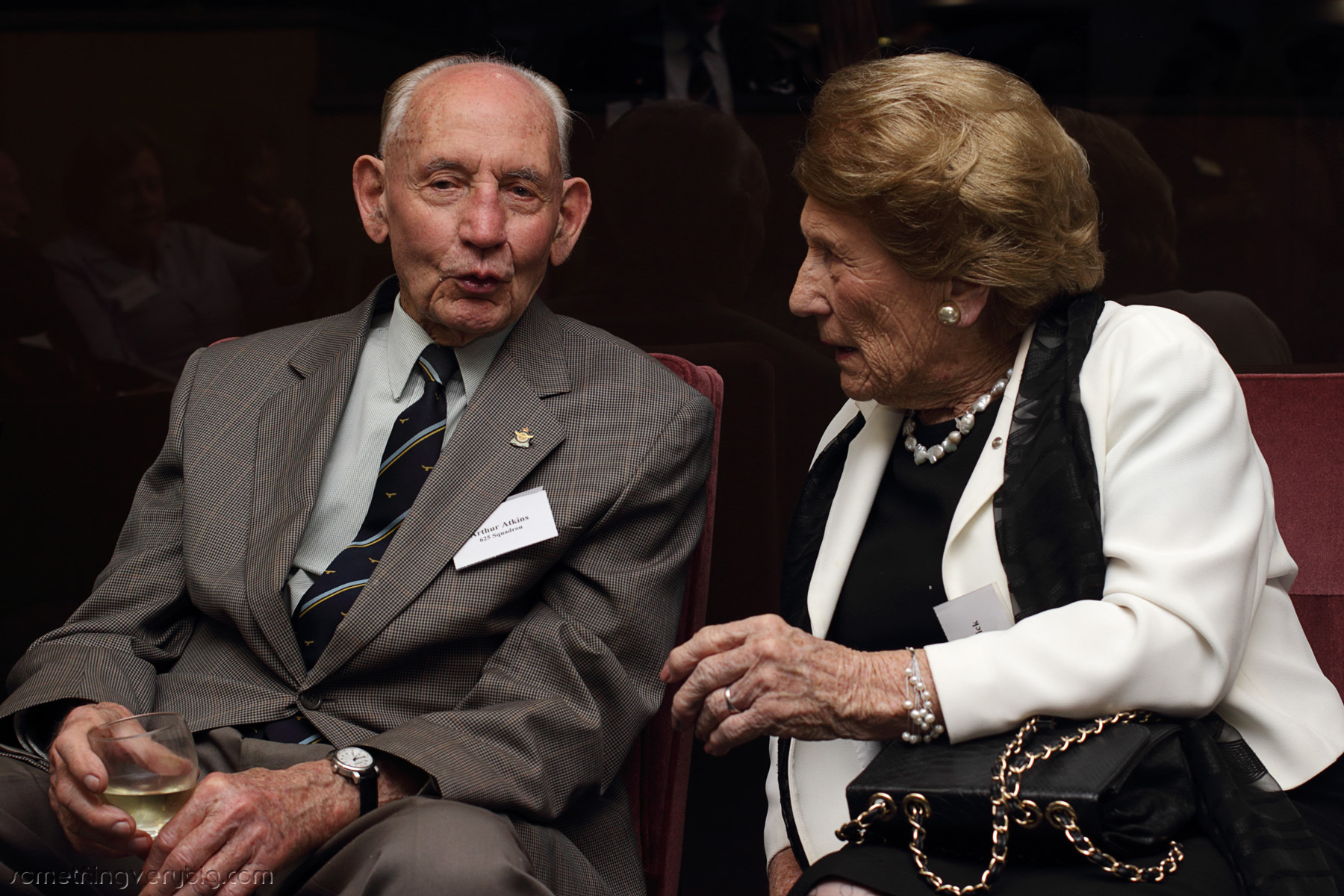
The other three are all Melbourne veterans. “Poor old Wally McCulloch”, as he introduced himself, was a 460 Squadron bomb aimer. He and his wife had braved a long and difficult journey to get to the function… from their apartment upstairs in the same building! And Arthur Atkins was a 625 Squadron pilot, with a DFC. He approached me after Don Southwell pointed me out as someone with a 463-467 Squadron connection, saying he had a mate who was lost flying from Waddington.
I’d briefly met the third Melbourne veteran, Gerald McPherson, at the panel discussion at the Shrine of Remembrance in 2013 but, until now, had not had a chance to talk to him. He was a rear gunner in 186 Squadron and related the story of his first ever trip in a Lancaster. Up to that point, he told me, flying Wellingtons and Stirlings, he’d always said a small prayer to himself at the top of the runway to help the aeroplanes take off safely. “I never needed to do that in the Lanc”, he said. “You could feel the power as it took off.” He was wearing a Bomber Command clasp so we talked about that for a little while. Coincidentally I had dropped the application for my great uncle Jack’s clasp into the postbox as I was walking to the tram to travel into the city for this event.
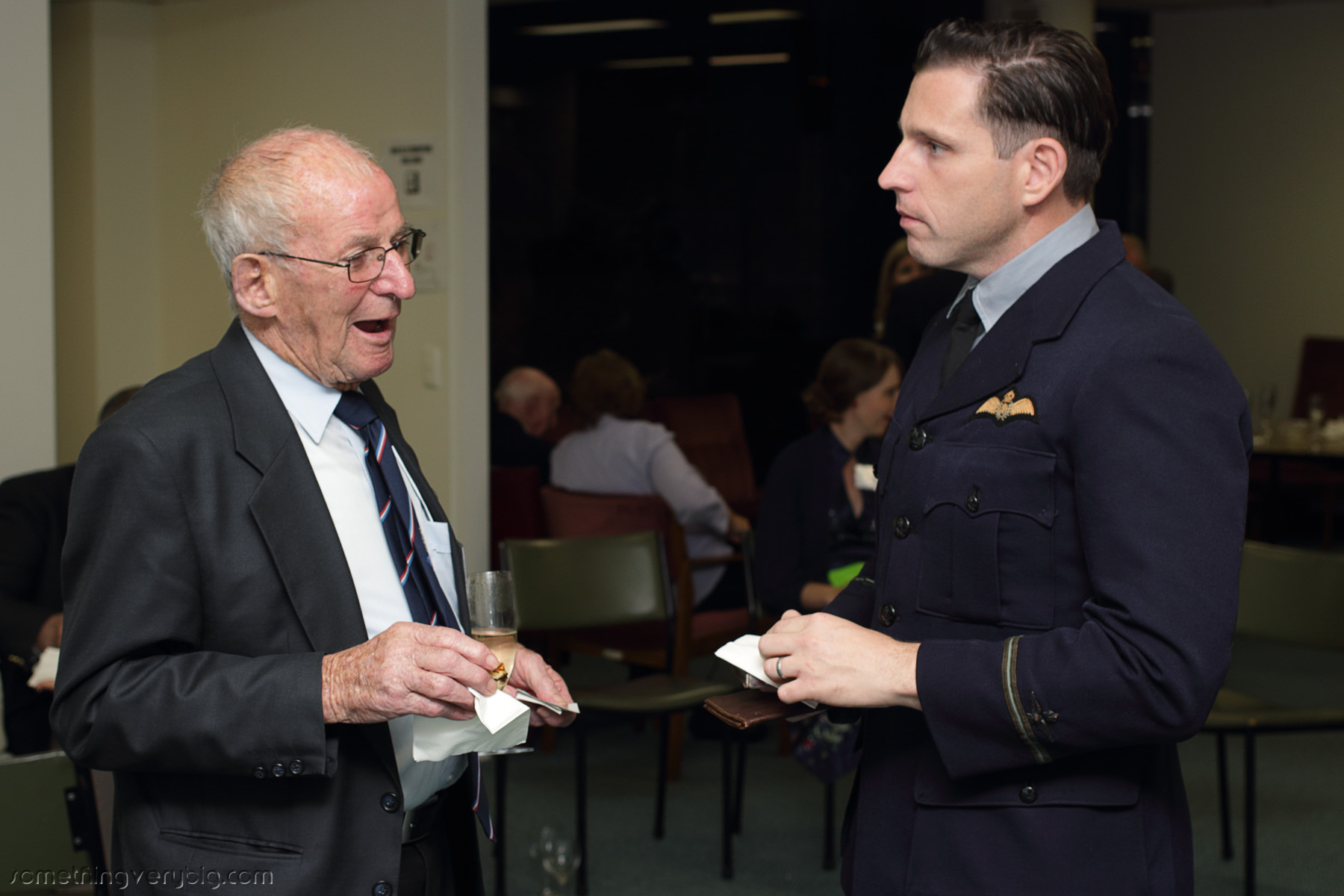
It’s not just the veterans, of course. I came away with some other useful contacts too. David Howell works at the Shrine as a Development Officer and is their resident Kokoda expert. In fact he even leads tours along the Kokoda Track (see www.kokodahistorical.com). David is clearly a military history nut – he turned up to the function wearing a WWII RAAF uniform, along with a mate:
I also, finally, met Andy Wright of Aircrew Book Review. We’ve corresponded before, mostly about blogging and book-ish issues, and we’ve been trying to arrange a time to catch up since he moved to Melbourne from central NSW with his young family a few months ago. This cocktail party offered a good chance to meet. Very generously, Andy had used some of his publishing contacts to source for us some very nice books for our raffle.
The raffle had been my main contribution to the running of the event. It turned out to be very successful with everyone getting involved, and Andy’s efforts, along with a couple more books and an Easter basket or two from Jan Dimmick (one of my fellow committee members), really made it worthwhile. Here are a couple of the winners:
Andy Wright with David Howell, the winner of the ‘main prize’ – a complete set of Chris Ward’s Bomber Command Groups books, donated by Pen and Sword in the UKIan Gibson with his prize, a Fighting High book donated by Capricorn Link (Australia)
Thanks to Capricorn Link (Australia) and Pen and Sword Books (UK) for their very generous donations. And I must also mention the Royal Australian Air Force Association (Victoria), whose treasurer Richard Orr announced a significant donation of funds to the group on the night.
And at the end of the day, fundraising was what it was all about. The Bomber Command Commemorative Day ceremony gets bigger in Melbourne each year, and it is beginning to cost a fair amount to put on. The aim of the cocktail party, as well as being a good chance to bring together people with an interest in Bomber Command in the city, was to raise money to ensure that the ceremony – set down for June 7 this year – can continue to be held. In this it was a success, and I think a good night was had by all.
One last thing, before I get stuck into some more photos. I wrote back in January about a programme run by the Shrine of Remembrance to connect veterans’ groups with schools, to pass the legacies of some of these groups on to a new generation. I’ve been holding this news back for a while now but, as it was effectively announced publicly on Saturday night, it’s time it got a run on SomethingVeryBig.
The Bomber Command Commemorative Day Foundation (Vic) is now part of this important Shrine initiative.
Present at the cocktail party was Scott Bramley, who is the Middle School Chaplain at Carey Baptist Grammar School, in Kew, Melbourne. (His seven-year-old son Hamish was also there and won the final prize in the raffle – a great big Easter basket – but no one believes me when I say it was emphatically not a set-up!!)
Scott Bramley
Carey was the school attended by Frank Dimmick, who was a 460 Squadron navigator and the husband of Jan Dimmick, one of my fellow committee members. Though Frank died in 2013 Jan has maintained contact with Carey’s Old Grammarians network and it is through this association that the school was approached and agreed to become part of the ceremony each June. Scott has been the main point of contact, and his enthusiasm for the project is infectious. He’s effectively thrown the resources of the school at our disposal. Year 9 students will learn about Bomber Command as part of their history studies and Carey students are expected to take an active role at the ceremony in June. Let’s hope it’s the beginning of a long and mutually beneficial association between the two groups.
RAAAFA (Vic) Treasurer Richard OrrDon McDonald with David HowellArthur Atkins wih Jan Dimmick
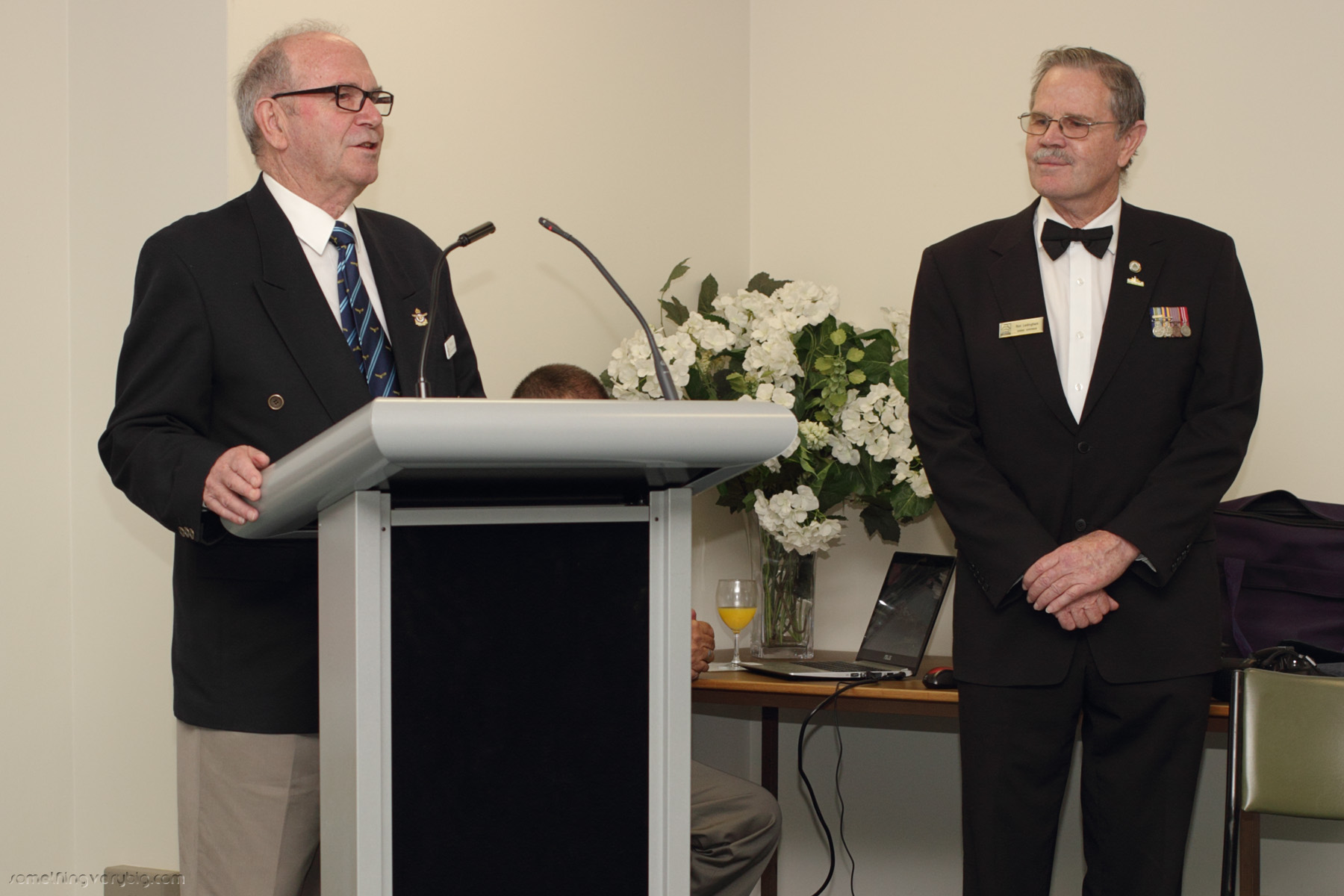
Vic Leigh of the Royal Air Forces Association (Melbourne Branch). He is a veteran from an RAF Mosquito squadron but served in Australia and the Pacific, and so very modestly refused to appear in the group photograph. Lovely bloke though!Don Southwell. Ron Ledingham looking on.Back, L-R: Robyn Bell (Organiser), Don Southwell, Don McDonald, Elaine McCulloch, Wal McCulloch. Front, L-R: Ailsa McDonald, Fay McPherson, Gerald McPherson, Arthur Atkins















 Something Very Big