IBCC Interview #4: Don McDonald, 578 and 466 Squadron Halifax pilot

I first met 578 and 466 Squadron Halifax skipper Don McDonald when he emerged from the shadows of the mighty Lancaster G for George on the Saturday evening of the Bomber Command Commemorative Weekend in Canberra in June 2012. When he discovered I had recently moved to Melbourne, he and his wife Ailsa promptly invited my partner and I to their house for dinner if we ever felt like what he called “grandparent time”. We took them up on their invitation and spent several riotous evenings with them over the next couple of years.

And while I know Don because he is a veteran, in all the times I’ve spoken to him we’d never really gone into much detail about his Bomber Command experiences. Until, that is, he recently became my fourth interview subject for the International Bomber Command Centre’s Digital Archive – and the first who I already knew before turning up with my laptop and a couple of microphones.

I knew Don can talk. But I wasn’t expecting that our interview would go for quite as long as it did!

Money was tight growing up in Koo-Wee-Rup in country Victoria, so Don left school aged 14 to work in the local general store. Shortly afterwards, having won a job in the Public Service, he moved to Melbourne to live with an aunt. “By the time I’d paid fares plus board and lodging there was no money left for anything else”, he said. A mate, equally short on funds, suggested that they apply to join the part-time Militia, specifically the 4th Division Signals.

One night on parade earned each of them five shillings every week, which in 1937 was a pretty good deal. And so Don enlisted in the military. “There was no war, there was no ‘your country needs you’, no call on loyalty, no drums banging, and cymbals playing to get you to enlist,” he said of his recruitment. “It was pure economic necessity.”

Unfortunately Don was, in his words, “a terrible soldier… I didn’t think much of the Army and I didn’t give the Army any reason to think much of me.” When war broke out in September 1939, Don’s one-night-a-week became a full-time training camp at Mount Martha. The encampment was so new it was still being built, and the WWI-era tents in which Don and his mates lived leaked. This was no way to fight a war.

So, like so many others, Don applied for aircrew. Having left school so early the initial study – at 1 Initial Training School, Somers – was challenging. But with the help of his classmates, he got through it all and was selected for pilot training, on the venerable Tiger Moth at Western Junction (what is now Launceston Airport in Tasmania). The little yellow biplane was “said to be unprangable”, Don reckoned…. except that he managed to prang one, approaching the airfield too low on his second solo and hitting a fence. On the subsequent ‘scrubbo’ test, Don did “probably the best landing of my career.”

Years later when I would try to relate this story about the perfect touch-down to my crew on a squadron, they would all laugh like hell because they couldn’t believe I could ever have done a decent landing.”

I got the distinct impression that Don has told many of these stories before. His delivery was clear and logical and he peppered his memories with sometimes hilarious asides (“To me, life in the Air Force is very much like life in marriage”, he said at one point. “Best you do what you’re told, most times, the quicker the better.”).

Completing his flying training to wings standard at Point Cook, Don stayed at the Melbourne Showgrounds for several weeks before boarding a ship to war. At this point, their destination was unknown. After a quick stop in New Zealand (where they were not allowed to leave the ship) they went in a generally north-easterly direction.

…After a certain time we realised, no, we’re not going around the Cape, we’re too far north… it was guesswork, where the heck are we going?”

And then, one bright, sunny Saturday morning, Don climbed up on deck to find the ship underneath the Golden Gate Bridge. No time for any leave, though. They were bundled straight on to a train which took them clear across the States. Billeted near Boston at Camp Myles Standish for a couple of week, Don and four mates realised that they were relatively close to New York. But they had been given no leave.

“Fancy being within a few hours of the Big Apple and not getting there,” they lamented. The temptation proved too great, so the five of them slipped under a fence and went AWL for a few days. Crucially, they bought return train tickets. Over the next four days they had a great time (“the Australian Air Force uniform stood out fairly well”, Don said with a knowing nod) and spent all their money. “The Australian pound didn’t go very far in New York at a sergeant’s pay!” Having no money left at all, the return tickets they’d so shrewdly bought on the way down allowed them to get back to camp where at 2am they slipped in undetected and collapsed into bed – to be awoken a couple of hours later and loaded onto a train to continue their journey.

The airmen sailed across the Atlantic on the Louis Pasteur, with some 14,000 troops, in five days. They disembarked in Liverpool and went to Brighton by train.

Next morning, Don suddenly realised “boy oh boy, this is a war zone.” It was a Sunday and the airmen had just come out of Church Parade, having been in England for less than 12 hours. All of a sudden “there was a clatter clatter clatter clatter… it was machine gun fire.” The guns were firing at a German ‘tip and run’ raider, which caused little damage but much disruption.

Apart from this initiation, the main thing that struck Don was how green it was in England. Having left Australia right in the middle of a harsh summer, they’d arrived in England in the northern spring. “The various shades of green on the trees [were] such a contrast to what we’d left back home.” That, and the food rationing. “Two ounces, per person, per week, of meat, two ounces of either butter or margarine per person per week, one egg per person per week, perhaps…”

He crewed up at OTU (“like picking numbers out of a hat, really”), and here, flying the pedestrian-at-best Armstrong Whitworth Whitley twin-engined bomber, Don was involved in a nasty incident when he was detailed for a cross-country flight on a night on which poor weather had already delayed take-off several times. Five aircraft were scheduled to go. Of these, one had engine trouble and didn’t take off. The second lost a crew member to illness and didn’t go either. The third crew got airborne but turned back with a faulty engine.

Don’s crew was the fourth. Not long after take-off he could hear something hitting the fuselage. It was ice being flung off the rotating propellers. Then the pitot head iced up, and the airspeed indicator failed. The aircraft was icing up badly and was even heavier on the controls than was the norm for a Whitley. They somehow managed to complete the navigation exercise and, on return to base, Don radioed to ask for assistance. He was told to land “high and fast”. He successfully did so, but much further down the runway than normal and going far too fast. Then the brakes started to overheat.

(As Don reached this part of the story he started squeezing an imaginary brake lever on an imaginary set of controls in front of him).

Screaming down the runway, suddenly he remembered… there was a newly-dug excavation at the end of the strip.

“…so I jammed on hard left rudder, going quite fast, and we went into a magnificent bloody groundloop and ultimately shuddered to a halt.”

The next day the crew drove out to the runway to have a look at their valiant steed. On the runway were some “bloody great slabs of rubber” which had been ripped out of the tyres in the groundloop. “But we were by no means the main topic of conversation that day.”

The fifth crew which had been detailed for the night cross-country had become so iced up in flight that the pilot had lost control. Three men got out – including the pilot – but the bomb aimer and rear gunner were killed when the aircraft crashed.

On completion of their Heavy Conversion Unit course the crew was posted to the Middle East. Before they went, though, they were given leave. Don started by visiting some aunts and cousins of his in Scotland before going on to London. “There won’t be much to spend my money on in the Middle East”, he thought, “so I may as well have a good time… there was no show I couldn’t afford to go to, there was no pub I couldn’t afford to drink at and I had an absolute ball… and a la New York, I was stone motherless broke [by the end].” He returned to his station to find that his crew had been re-posted to 578 Squadron at Burn instead of the Middle East, and were already there waiting for him. The signal recalling him from leave had failed to get through to him.

Don found the relaxed discipline on a squadron refreshing. No bulldust, no drill, you just had to do what was required of you: flying on operations. Don’s first was as a second dickie to Berlin, sitting on a little wooden seat dangling his feet “like a very small kid in a church pew.” Over France on the way back they were attacked by a nightfighter, which knocked out one engine. Don then got a demonstration of just how much a Halifax could be thrown around. Gus Stephens, the first pilot, threw the aircraft into such a steep and violent dive that the fuel intakes in the tanks were uncovered and the engines stopped.

There was almost like a deadly silence, just the air swishing around…”

At the bottom of the dive the fuel started flowing again and the engines came back with a roar and a terrible vibration. “I didn’t realise what punishment a Hally could take until that moment,” Don said. “I thought I’d done some pretty rough and tough stuff when we were doing fighter affiliation but nothing like this…”

Don’s tour proceeded mostly without incident, though he did mention that Karlsruhe and Essen were two particularly “hot” targets, and D-Day was very memorable. “All those watercraft,” he said, “God, it was an unbelievable sight.”

On completion of his tour, Don was posted to 21 OTU at Moreton-in-Marsh as an instructor on Wellingtons. This proved almost as dangerous as ops. The Wellington was a “lovely kite to fly”, but Don endured three single-engine landings in them in five weeks. The first two, he told me, were highly successful. But he was very lucky to walk away from the third one. He finished up in an ambulance but was released and decided, seeing as he’d been told his flying was done for the day, that a beer at lunch would be in order.

I was just about to have my first sip of it when the Medical Officer came up to me and said, ‘well I think you can put that down and you’d better come with me.’”

It turned out that Don shouldn’t have been released by the medical orderlies who had checked him out after the crash: he had concussion and spent the next few nights in the station sick quarters.

Some miserable sod got that pint of beer and drunk it and never owned up to me!”

“Looking back”, he reflected, “I think that possibly we were pretty much at the stage if eat, drink and be merry, for tomorrow you may die, and I think that did tend to take over…”

After his stint as an instructor ended, Don was posted to 466 Squadron for a second tour, but after just one trip the war ended and he came home to Australia.

At this point in the interview I think Don was the most thoughtful I’d seen him, as he told me that he took a year’s leave without pay from his old Public Service job to try and readjust to civilian life. He returned to the family farm in Koo-Wee-Rup and for the first three weeks, he would get up early to help with the milking, and then spend the rest of the day just sitting under a big pine tree.

“I’ve got no idea what I would have been thinking…”

Perhaps realising what Don was going through, the owner of the general store in which he had worked before he left home offered him his old job back, and Don jumped at the chance. “It meant I had to be meeting people, getting out amongst them,” he said. “I think that was a good move.” He would resign from the Public Service at the end of his year off without ever actually returning to work there before he went into business himself.

I asked Don my final question more than two hours after we had started the tape. What legacy did Bomber Command leave?

“The legacy of Bomber Command?” he said. “If they hadn’t done the things they were called upon to do, the ruddy war might still be going on!”

And that, I thought, was a very appropriate note to finish on.

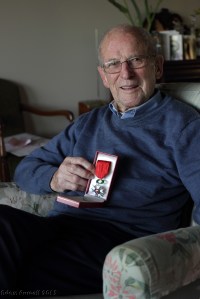
Don McDonald was my interview subject #4 for the International Bomber Command Centre's Digital Archive, and the first of those I've interviewed so far who I already knew beforehand. In fact we are quite good friends, and Don and his wife Ailsa have entertained my partner Rachel and I for dinner on a number of occasions. We spent the afternoon visiting them today only this time I had the laptop and microphones handy... And boy oh boy can he talk! The interview recording goes for more than two hours, by far the longest of those I've collected so far. And there is never a dull moment in it.  Don's war followed much of the "standard" path for Australians in Bomber Command: he was in the Militia when war was declared, transferring to the Royal Australian Air Force a few months later. He completed his pilot training in Australia before going to the UK via the USA. He went through a further succession of training units before being posted to 578 Squadron on Halifaxes at RAF Burn, North Yorkshire, from which he completed his first tour of operations. After a stint as an instructor pilot at an Operational Training Unit he went to 466 Squadron, where he'd done one trip when the war in Europe ended. Don told me of some amazing experiences: crashing a Tiger Moth on his second solo, a close call in a Whitley, and seeing the invasion fleet below on the morning of D-Day. And then there was the lighter side of life: absconding from a transit camp in the USA to visit New York, serving Christmas lunch at RAF Moreton-in-Marsh in 1944 and a particularly memorable leave in London where he met the Queen at a theatre show, queue-jumped a group of American GIs at a hotel and ending up with the crystal glass he's holding in this photo, purloined from the famous Strand Palace hotel. Don finished the war with a Distinguished Flying Cross (he still has the invitation letter from the Investiture ceremony at Buckingham Palace) and earlier this year was awarded a French Legion of Honour. He's als
Don McDonald with his recently-awarded Legion of Honour

(c) 2015 Adam Purcell

IBCC Interview #3: John McCredie, 99 Squadron Liberator pilot

This is the vital thing in war, to have good fortune. – John McCredie

John McCredie’s story started off in a reasonably familiar fashion. “My military career was a bit frustrated by having a mother whose brother had had his face shot away in World War One,” he said. “She didn’t want me to have anything to do with the military.”

Until John’s 18th birthday in August 1939, that is, when he took the liberty of enrolling in the Militia – specifically, the Melbourne University Rifles.

War broke out three weeks later.

The third of my interview subjects for the International Bomber Command Centre’s Digital Archive, John is a tall and distinguished-looking fellow who was wearing a natty neck scarf when I went to his home in very swish multi-storey retirement complex in Melbourne’s inner south-east. As we walked through the lobby I thought it looked less like an aged care facility and more like a rather exclusive hotel, except that all the guests I could see were over 80. We settled in his unit and he poured some pre-prepared coffee while I set up my recording equipment. And then he began telling me his remarkable story.

John didn’t last too long in the Militia, despite (or perhaps because of) at one point being offered a commission in the regular Army. “If you took a commission in the Commandos it tended to be considered a one-way ticket”, he explained. Besides, like many of his generation he was inspired by the stories of Kingsford-Smith, Bert Hinkler, Amy Johnson, the Centenary Air Race and then, of course, the Battle of Britain. So once the Army let him he transferred to the Air Force.

We all probably wanted to be fighter pilots but you had to show that aptitude and I don’t think I quite had it as a flyer, so I was put on twins.

John learnt to fly at Temora and Point Cook and was then sent to England. Flying an Oxford at an Advanced Flying Unit at South Cerney one night, that good fortune he spoke about played its part for the first time. “I had an instructor who saw the crash coming before I did,” he said.

… dived and we just missed a crash at night, in mid-air… that was a lesson in alertness.

At the Casablanca Conference in early 1943, Churchill and Roosevelt discussed, among other things, the question of supply and demand for aircrew. The Empire Air Training Scheme had been in existence for several years and was churning out trained aircrew faster than even Bomber Command could use them. Meanwhile the Americans had lots of aircraft in the Far East but not enough crews to fly them. So it was decided, John said, to send a number of Commonwealth aircrew to India. He long believed that he had been given no choice in the matter but only a few years ago discovered, on reading some of his old letters, that he had in fact volunteered to be one of them. He was posted to 15 Operational Training Unit at Harwell, a unit which had become focused on providing those crews for the Far East.

Flying from Harwell was the closest to Bomber Command that John got in his career. Here he carried out what he called “two little flights over France”, dropping leaflets. The first went more or less uneventfully, but on the second one the Wellington iced up and could not climb above 8,000 feet. Then his navigator, struggling a bit, took them over the defended town of Lisieux.

“I don’t know if as a small boy you ever ran along a picket fence with a stick making a noise?” John asked.

Well that’s exactly what it’s like listening to the flak hitting a canvas-covered aircraft.

They escaped with a couple of holes.

John’s good fortune again came to the fore during his time at Harwell. John having in his words given his Flight Commander “some cheek” at some point, the senior officer decided to get his own back at briefing one day when he picked on John to refresh the crews on the emergency fire drill for a Wellington.

He said, ‘McCredie, you tell us what you’d do in fire drill’, and McCredie got up and stuttered and stammered…

After he mucked it up, John was made to repeat the correct procedure, word for word, in front of everyone. And then, not very long after he had been singled out in briefing, John had an engine fire for real – and, having been so recently and embarrassingly reminded of the correct procedure, was able to carry it out in a timely manner and allow his crew to bale out before making an emergency landing at Silverstone.

John eventually got to India where his good fortune continued. On a ‘show-the-flag’ formation flight (called a ‘Glaxo’) over one of the big cities in India in a 99 Squadron Liberator, he had a runaway propeller. This necessitated three or four hours flying on three engines – which proved very useful experience when, a couple of months later, he was attacking a ship near Kaligauk Island and was hit by anti-aircraft gunfire.

We moved quickly enough, we had a fire… the boys reported the fire to me and I boldly told them to put it out!

They returned without further incident.

Prior to this, though, John was flying as second pilot with 355 Squadron based at a place called Salbani. Here there was apparently an issue with morale and, as it was difficult to keep the squadrons supplied with fuel because they were at the end of a very long supply chain, there was a certain amount of pressure to reduce fuel consumption. John’s Flight Commander and skipper, a man named Joe Morphett, advocated flying “on the step”, a method of reducing engine power slightly in the cruise that was reputed to reduce drag. This led directly to what was one of the closest calls that John had in an eventful Air Force career.

They were returning from bombing Mandalay, needing to cross the 10,000-foot Mt Victoria to get home. Flying ‘on the step’ had resulted in a gradual and unnoticed loss of altitude, until Morphett saw the mountain looming large in his windscreen. He poured on the power to climb, and they made it over the terrain. But the emergency climb had cost them too much fuel. Some time later, an engine faltered and stopped. John immediately turned on the emergency pump and it came back to life. But then it failed again, and this time the other three went with it. They had run the tanks dry. Somewhere over Bengal, Morphett held his aircraft steady while the rest of his crew, including John, baled out into the bright moonlight (the flight engineer needing some ‘encouragement’ courtesy of the wireless operator’s boot in his backside on the way). They got out at “God knows what height, because we were within very short walking distance of Joe’s crashed aircraft,” John said. With the help of some villagers they proceeded to the aircraft to find Morphett laid out under a mango tree, with half his scalp peeled back. “I couldn’t eat mangoes for years after that.”

Morphett survived and would be given a bar to his DFC for his efforts.

Interviewing John was an absolute pleasure. The bombing war in the Far East is a story seldom told and he is one of the most erudite and eloquent people I have ever met. John tells his stories with good humour, his face crinkling into a grin at frequent intervals. Before I’d even arrived home after our interview he had sent me an email correcting one or two facts.

The third of my interview subjects for the International Bomber Command Centre's Digital Archive, I spoke to John this morning. He served in the Australian Militia for the first few years of the war before joining the RAAF and training as a pilot. He was sent to the UK for further training and flew two "Nickels" over France before then being posted to India where he flew Liberators on operations. He crash landed in a Wellington at OTU in England, bailed out of his Liberator (as a second pilot) after it ran out of fuel returning from an operation and was badly shot up on another operation, for which he was awarded a DFC. He finished the war flying transports. Quite an eventful war, then. John's extremely well-spoken and the three and a half hours I spent with him flew by. John McCredie at home in Melbourne
John McCredie at home in Melbourne

It’s no wonder John was a career diplomat after the war, having taken advantage of the Australian government’s offer of a university education on his return. “The first year at university was very difficult because I had all sorts of unfulfilled ambitions… it was very much a party year, first year back, so I had a bit of trouble settling down and it wasn’t until I saw myself on the brink of being thrown off the course that I could really get down to applying myself full-time to study.”

What struck me most of all, though, apart from the extraordinary good fortune that seemed to follow him around the world, were the people John spoke of who made the stories come to life. He encountered a range of colourful characters throughout his Air Force career, and indeed would run into many of them years later. Men like Hubert Opperman, the Australian cyclist known as ‘Oppy’ who was his Flight Commander at Initial Training School and later went into politics, and to whom John would later sell a car. Like Lionel Watters, the ex-Broken Hill tin miner who, as a “rough diamond” of a flight instructor, had such an effect on John’s early flying training. Like Brian Inglis, a close friend with whom John shared many adventures. (Inglis would go on to become the CEO of Ford Australia). And there was Major Crennan, the overly-enthusiastic disciplinarian whose antics on the ship to the US earned him a poem in the on-board newsletter.

Perhaps the man who John most respected, though, was his 99 Squadron Commanding Officer Lucien Ercolani, who he called “an outstanding man by any classification”. Ercolani had turned morale at the squadron around by sheer force of leadership, John said, and the results in terms of aircraft serviceability spoke for themselves.

Ercolani interrupted a successful career in the furniture business to serve in the Air Force. After the war, when John was serving as a diplomat in Holland, he encountered his old Commanding Officer, who gave him a striking mid-century coffee table.

The table was between us as we did the interview.


Two months after this interview I visited John for lunch, where he presented me with a copy of the book he wrote about 10 years ago called ‘Survival of the Fortunate’. It’s a beautifully-written book and I could hear his voice as I read it. Sadly I never got a chance to discuss it with him. Six weeks after our lunch meeting John died, on 29 January 2016.

© 2015 Adam Purcell


Interviewing 460 Squadron navigator Max Spence

It started with a very cryptic email.

I may have some items of interest for you. Max Spence, Former 460 Squadron.

And that, word for word, was it.

And when I rang Max to arrange a time for our International Bomber Command Centre interview (my second), he answered in what I discovered was typical economical fashion.

Hello.

Again, word for word, that was it.

A man of few words, then, I thought.

Until I turned up to Max’s house in a north-eastern suburb of Melbourne recently, one very hot and extraordinarily windy afternoon.

Once I’d set up the recording equipment I asked my standard opener. “Can you tell me something of your early life, what you did before the war?”

“Well… I grew up in Briar Hill”, he began… and then he was off. A full eight minutes later, it seemed like he finally drew a breath and finished with the words, “And then I came home and the war ended in Japan and I was discharged and I went back to work… and that’s about it.”

Not so much a man of few words, it seemed. We backed up a bit and went over his story in more detail, and over the next three quarters of an hour Max told me some very interesting stuff. I would eventually have to work harder to bring it out though.

“We knew in 1938 that a war was going to start soon”, Max said.

Before it broke out, Max and a mate resolved to join the Royal Scottish Regiment. But in those pre-war days, recruits had to cough up £12 of their own money for the uniform. That was the equivalent of three months’ wages for the average man. Not particularly enamoured with that idea, Max and his mate withdrew their applications.

War came, of course, in September 1939. Max’s father was a Gallipoli veteran and Max was an only child, so gaining parental permission to enlist was difficult. But suddenly his father changed his mind – and so Max applied to join the Royal Australian Air Force. Initially he wanted to be ground staff, but the recruiter convinced him to try for aircrew. All went well until it was time to sign the enlistment papers, in front of a panel of officers. He picked up a pen and was hovering over the paper, just about to sign away his life for the duration of the War and a period of twelve months thereafter, when one of the officers stopped him. “You’re no good to us”, he said, “you’re left-handed! You’ll never be able to handle a Morse key!”

Such was the competition for places in the Royal Australian Air Force in the early years that the Air Force could afford to be very choosy. Fuming at the rejection, Max says that at that point he altogether lost interest in the war.

They could run it without me!

Having decided that, naturally he was called up a few months later for Army service. And in one of those ironies of war, he was trained as a signaller, which included using Morse code. Transferred to the 19th Machine Gun Regiment he arrived in Darwin in time to endure some of the Japanese air raids on that city.

Which was a bit… you know… ordinary…

Then the RAAF Recruiting train rolled into town. 54 members of Max’s Regiment applied for a transfer – just 18 were accepted. Max was accepted as a navigator – with no word said about his kack-handedness this time – and was quickly on a ship to Canada for a five-month training course. On completion of that he had an 11-day leave in Chicago, and then Max crossed the Atlantic on the Andes and was in wartime Britain.

Max Spence

And what struck him most about wartime Britain, I asked? “The women all smoked!” he said incredulously. That and the food. It was, he said, pretty frugal.

We were ok in the services, got fed pretty well. Ordinary food, but it was food, a lot more of it than the general public got.

What about English beer, I wondered?

First time I went to Tommy Farr’s bar (he was the British Empire heavyweight champion), I ordered a beer, it tasted like tar and water! It was mild beer, so I talked to a couple of other blokes who’d been there for a while and they said oh no, start off with bottled beer, and then gradually move over to bitter… which we did.

Once he got there, Max reckoned life on 460 Squadron was pretty good. As well as a good amount of food, accommodation at Binbrook wasn’t bad:

We lived in a house actually, all in a unit, but we were all together in one big room. We had comfortable beds and then we used to go to the Sergeants’ Mess for meals.

The pilot was the only commissioned officer in the crew, though, so he went off to the Officer’s Mess alone. “For an organisation fighting for democracy”, Max reckons, “the services weren’t very democratic!”

Max began operations with a trip to Mannheim on 1 February 1945. He was on the Dresden operation nearly two weeks later – at 9 hours 45 minutes it’s the longest flight in his logbook, but according to Max he has “no particular memories of it… it was just another flight.” He reckoned that as a navigator he had the best job. “All the documentaries… sort of emphasise the drama, but largely it was just hard work. I had to fix my position every six minutes and then dead reckon ahead another six minutes, so I was like a one-armed paper hanger.”

I asked Max what would have happened when a gunner spotted a fighter. He had a story about that. Coming back from a target one night, Max heard the intercom crackle into life. It was the rear gunner.

Enemy fighter. Skip – prepare to corkscrew left! … no na na no prepare to corkscrew right… no no no it doesn’t matter, he’s gone past!

After 18 operations, Max’s crew was posted for Pathfinder training early in April 1945. The war in Europe ended before they could go back on operations and he was back in Australia by September 1945. I asked him how he readjusted to civilian life. “One of my mates had a breakdown and a few of them have suffered Post Traumatic Stress as they call it, but I didn’t think I had worries… used to drink too much, that was the main problem.”

I sensed a story in that last comment, but I couldn’t quite draw it out of him. “I don’t think about it much at all”, he said of his wartime service. “It was just a job, and I did it the best I could. Doesn’t have any special place in me memory.”

But maybe it does. Max admitted to being annoyed at documentaries about Bomber Command “because they emphasise the dramatic,” and still seems bitter about the way that some Bomber Command aircrew received an Air Crew Europe Star but any survivors who did not operate before D-Day did not. He’s not at all happy about the recently-awarded Bomber Command Clasp, calling it “a piddly little thing… a sort of second prize.” He also revealed that he’d once taken a journalist to the Press Council about a newspaper article that spread what he perceived as misinformation about Dresden. So it’s clear that he still maintains very strong feelings about his experiences and about Bomber Command’s place in history.

I found this interview quite challenging. Where my first interview with Ern was very easy – I’d ask one question, he answered it and then kept riffing on about anything else that came to mind – with Max I had to work a lot harder to keep things moving. Consequently, it was the shortest out of the IBCC interviews that I’ve conducted. But we covered some interesting ground and I’m very pleased that I was able to record it for the Archive.

Bomber Command veteran Max Spence, a 460 Squadron navigator, at

B+W photo courtesy Max Spence. Colour photo and text (c) Adam Purcell 2015

Interviewing 466 Squadron rear gunner Ern Cutts

Ern Cutts was (and still is) the youngest of seven children in his family. One brother was ground staff in the Royal Australian Air Force. Two other brothers were in the AIF. A sister was a RAAF nurse. His other two sisters were married to servicemen. So it was just about inevitable, as soon as he turned 18, that Ern would himself enlist.

There was just one small hurdle to jump first. His father.

Think about it for a second. Four of seven children were already in the services. Two others married to servicemen. Surely that was enough?

Well, maybe. But Ern was made of sterner stuff. There was what he called “trouble” involved, but eventually Ern managed to convince his father to sign his enlistment papers and went off to the recruitment centre in Melbourne. “I wanted to be aircrew”, he said. “And I was!”

Ern had the doubtful honour of being my first victim interview subject for the International Bomber Command Centre’s Digital Archive. My first sight of him was of an older but still fit-looking gent waving his arm at me as, about 10 minutes late, I sailed straight past the entry to his retirement complex on my motorbike. I turned around and rumbled up the path towards him, and he warmly shook my hand, grinning, and led me to the unit where he and his wife Beryl live.

I’ve been visiting veterans much like Ern for a number of years now, but the IBCC project is the first time I’ve done formal, recorded interviews with them. Perhaps I looked a little nervous as I grappled with my recording equipment. “Take your time”, Ern said. It was one of the first beautiful spring days in Melbourne this year and the birds were twittering outside as, opening the front door (“to shed some light on the subject,” he said with a chuckle), with everything ready and Beryl sitting quietly on the other side of the room listening in, we began.

It was a very entertaining interview. Ern is an easy person to talk to, and there were plenty of laughs. I asked him at one point what memories he has of the Fairey Battle. “I don’t want memories of Fairey Battles!” he said of the single-engined aircraft laughably called fighter-bombers at the beginning of the war that were hopelessly outclassed, shot down in large numbers during the Battle of France and eventually relegated to towing targets used for gunnery training, which is where Ern encountered them. “They were bloody hideous things.” Or talking about why he wanted to join the Air Force: “We didn’t have to be super fit like the young infantry blokes because we never walked anywhere – we were always driven!”

Ern was full of praise for the British people he encountered while he was overseas. “We were treated like kings”, he said more than once. He often wondered why, when he was visiting the home of a particular girl he was keen on, he and she would eat very well but the girl’s mother wouldn’t be eating. He asked his girlfriend – who said that his mother was giving up her own rations for Ern. “That’s English people for you”, he said, shaking his head. “Really tops.”

Ern was posted to 466 Squadron, flying in Halifaxes. I asked him if he did any particularly memorable ops. “My first trip”, he said instantly. It was a daylight raid to a synthetic oil plant at Sterkrade in the Ruhr Valley on 6 October 1944. “I never lived this down,” he said:

“I saw all these black puffs in the air, black things, and I said to someone, to the crew – cos everyone was excited, y’know, our first op, it was a daylight op which was good, because they did try to give you a daylight to give you a bit of an idea of what you were going into – and I said, what’s all these black things out there, and everyone started laughing… it was bloody anti-aircraft exploding… that’s how raw [I was]… by the time I got to the 34th op I didn’t need to ask!”

Logbooks are always a favourite thing for me to look at when I’m talking to veteran aircrew because they allow me to put in some sort of context their owner’s service. Most are fairly dry, but others include comments about particularly memorable trips. Ern’s even had a number of pictures stuck to the pages, of aircraft he’d flown in.

And a Messerschmitt 410, a German nightfighter. Part of the IBCC project is to scan original documents for inclusion, along with the interview itself, in the Digital Archive, so I carry a scanner to hook up to my laptop and copy any originals on the spot. At the time I missed the significance of the ME410. But when I was at home later, reviewing the scans, there it was.

7 February 1945. Halifax III. Pilot: Flying Officer McCallum. Operation No. 24: 6:00 to Goch (Army Cooperation Target). FIRST KILL – ME410 FIGHTER CONFIRMED.

Ern actually shot down an enemy aircraft.

This is less common than you might think for a wartime gunner. British bombers at the time were armed with Browning .303 machine guns – with an effective range of some 400 yards. Nightfighters, on the other hand, usually had cannon with a maximum range of about 1,000 yards. The inevitable result was that the favoured method of attack was for a fighter to stand off, undetected, outside the range of the Brownings and fire at leisure. The best chance of escape for the bomber crew was in spotting the fighter before it saw them. Many gunners who survived a tour, then, did so without firing a gun in anger, let alone actually scoring any hits. Having a confirmed kill to his name is actually quite an achievement.

And during our interview, about shooting down a nightfighter he said exactly nothing. He was similarly reticent when I enquired about an immediate DFC awarded to his pilot, the aforementioned F/O A.B. McCallum, after the aircraft was hit by anti-aircraft fire on a trip to Gelsenkirchen (Ern’s 9th) in November 1944. It wasn’t anything out of the ordinary, Ern suggested. Otherwise it would be remarked upon in his logbook.

Ern Cutts and his Halifax rear turret

Most likely it’s that legendary modesty often found in veterans of Bomber Command coming through here. They didn’t think they were doing anything special: there was a job to do, and it fell on their shoulders to do it. And so their stories frequently concentrate on the lighter side of life in wartime England.

Finishing his tour in March 1945, Ern was eventually posted to 467 Squadron at Metheringham, preparing to begin training for Tiger Force to continue the war against the Japanese. After the atomic bombs ended the requirement for that he flew a couple of POW repatriation flights, taking part in Operation Spasm to Berlin and Operation Dodge to Bari in Italy in September 1945. Both trips, he told me, were completed with all non-essential equipment stripped from the Lancasters. Including all the guns and all the ammunition.

I had to ask the obvious question. If there were no guns on board, why did they need gunners?

Well, someone had to look after the repatriating POWs, many of whom had never been in an aeroplane before. “Believe it or not”, he said, “we were just air hostesses!”

The tone turned a little more serious, however, when I asked Ern how he thought Bomber Command was remembered. There was a lengthy pause before he answered.

Bomber Command, he said, was until D-Day the only organisation taking the war direct to Germany. For that reason, the English people in particular treated the men of Bomber Command with the same respect and admiration that they had for, say, the French Resistance. “If I go to an RSL,” he said,

“…and a bloke says, what were you in, Ern, were you in the Navy or Army or something, I say, no, I was in Bomber Command, and if he is an English person, ‘oh were you… oh… you blokes, gee… y’know. So it makes you kinda feel very humble, very proud and very humble.”

And that, I thought, was a beautiful way to finish our interview.

Ern Cutts was a 466 and 467 Squadron rear gunner during WWII. This photo was taken after an interview with Ern at his home in Melbourne in October 2015

Text and colour photo (c) 2015 Adam Purcell. Wartime photo (c) Ern Cutts

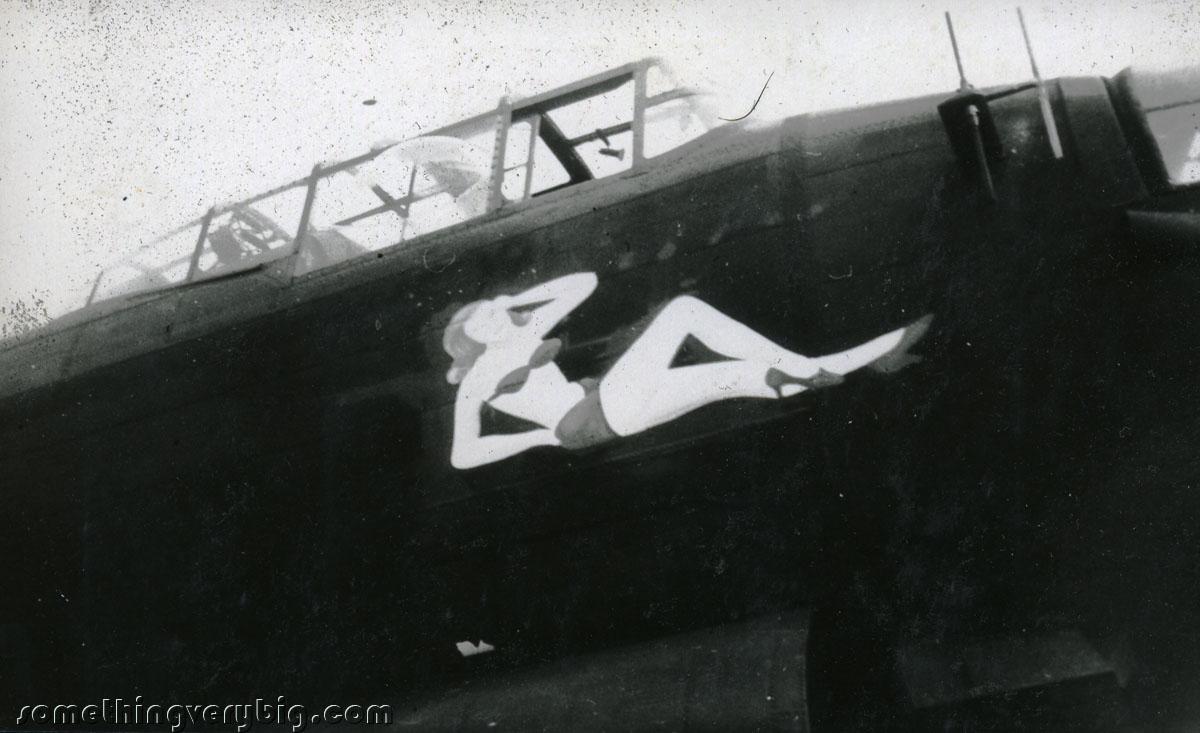
Nose Art

It’s quite uncommon to get artwork on aeroplanes these days. ‘Nose art’ usually conjures up visions of pin-ups, bomber jackets and B-17s. Ahh yes, the old Memphis Belle effect:  clearly Hollywood has a lot to answer for.

But of course, painting (usually) scantily-clad women onto aeroplanes is not the sole preserve of the USAAF or Hollywood’s interpretation of it. I once flew a light aeroplane that had some rather alarming airbrushed artwork on the tail:

08May-Canberra 026

VH-RWK was a somewhat older Cessna 182Q, with a great big two-bladed propeller which gave it a distinctive sound in the air. It had sheepskin seat covers and was a very comfortable aeroplane to fly. But then, one night in September 2009, for reasons that were never determined, the aeroplane caught alight and burnt to the ground. All that was left? That tail with the scary witch!

Burnt_Cessna_001

Poor old RWK was an exception though. It’s far more common to find nose art on military aircraft, and particularly vintage military aircraft. And it turns out that there’s a fair bit of interest in the phenomenon. I even found an academic paper about it: Caitlin McWilliams (2010), Camaraderie, Morale and Material Culture: Reflections on the Nose Art of No. 6 Group Royal Canadian Air Force, Canadian Military History: Vol. 19: Iss. 4, Article 3.[1]

“Airmen were notoriously superstitious, and nose art became part a distinct “bomber culture” of good luck charms and rituals, the emblazoned designs linking the entire crew with their aircraft,” McWilliams writes. This link, she says, extended to the groundcrew assigned to each aircraft – and it was frequently the ground staff who actually got up on a ladder and did the painting. Indeed, some squadrons might have been blessed with a particularly talented artist among their ground staff who henceforth did all the nose art. 61 Squadron pilot John Boland, in an interview in the Australians at War Film Archive, described the man who painted his aircraft: a “little short artist” named Webb who created a classic nude-reclining-with-bomb in such detail that the CO “made him put a towel over her”!

“Nose art showcasing pin-up girls and other risqué subjects are most prominent, followed by designs which feature Walt Disney characters”, McWilliams writes. “More interestingly,” she continues, “many of the designs signal ties to Canada, sometimes through national symbols but also in more subtle ways.”

Not surprisingly similar patterns can be seen coming out of the nominally Australian units. The following images are all from The Waddington Collection, a series of photo albums which trace the ‘official’ history of RAF Waddington at war. There’s the pin-up girl: cd file 164

Here’s a Disney character: cd file 150

And where else could these pilots be from but Australia?cd file 291

cd file 181

(I think my favourite part of this one is the beer mugs used to denote completed ops)

In many cases the characters used in nose art were inspired in some way by the code letters assigned to the aircraft.

Witness JO-J Jumpin’ Jive, showing a man playing a trumpet.cd file 073

Or JO-N Nick the Nazi Neutralizer, with a grinning devil. Vol XI Pt1 137

Piratical Pete, below a skull and crossbones motif, was JO-P. cd file 120

All of which raises a question.

What, if any, nose art was on B for Baker?

Nose art being what it is, it is necessarily temporary. “By its nature, nose art is adaptable and accommodating, there when airmen need it but gone as soon as the conflict is finished,” says McWilliams. Many of the Lancasters depicted here were lost during the war, in action or accident. And even those that survived the conflict didn’t survive their subsequent encounters with the scrap man. And so out of all the artwork in the photos in this post, nothing – not a single bit – survives in its original form. All we have are those photographs. And, as you’ll have heard me whining about for quite some time now, of B for Baker there isn’t even one of those.

In short, there’s a reason that my painting of the aircraft shows its starboard side. Any nose art, should any have existed, would traditionally appear on the port side (under the pilot’s side window). By orienting the aircraft the way we did, we leave open the possibility that should a photograph float out of a dusty box somewhere  and prove one way or the other that B for Baker did or didn’t have nose art, my painting won’t be wrong.

But it’s probably likely that, even if I do find that magical photograph one day in the future, it will show an unadorned space below the pilot’s window. Phil Smith wrote a letter to his mother in July 1942 from the Operational Training Unit in Honeybourne, Worcestershire, where he was an instructor between his operational tours. When he was second pilot during the first part of his tour on Wellingtons, he wrote, the captain, a man named Taffy Jones, had a boomerang painted on the side of the aeroplane. But…

“I never went in for emblems however, always feeling superstitious about them”

And as it would appear that it was the captain’s call about what, if anything, was painted on their aeroplanes, there’s a good chance that Phil’s superstitions carried through to his second tour and B for Baker did not have nose art.


[1] Available at: http://scholars.wlu.ca/cmh/vol19/iss4/3

(c) 2015 Adam Purcell

B for Baker in print

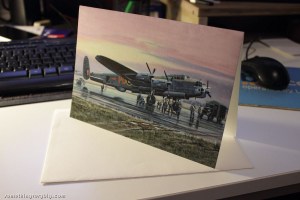
About five years ago now, I commissioned aviation artist and friend of mine Steve Leadenham to paint me a picture of B for Baker sitting at its dispersal as its crew arrived for an operation. I’d just moved to Melbourne when it was completed and I remember driving all the way to Sydney and back one weekend to pick it up.

As well as the original oil painting (which is hanging on my living room wall as I type), this imagined image of B for Baker and her crew graces several walls around the world in the form of high-quality archival prints. It’s also available in the form of 21x15cm greeting cards. Both the prints and the cards are produced by Steve in-house.
IMG_5583

I liked the cards so much that I ordered a small supply of them and they have been winging their way to people who have helped my research all over Australia and the world ever since. But with the number of new people I’ve met recently, I was starting to run out, so I asked Steve to send me some more. He did – and told me a nice little story to go along with them.

About a year ago he was at the Powerhouse Museum’s Discovery Centre in Castle Hill in Sydney’s north-west, exhibiting some of his work during one of the centre’s open days. Also exhibiting there were representatives from the Australian Aviation Museum at Bankstown Airport. They evidently liked Steve’s work, because they suggested putting some of his prints and cards into their shop. They preferred his historical scenes (like this one, this one and this one), and that, of course, included B for Baker.

Steve says it took a while to actually happen, but the long and the short of it is that cards and prints featuring my painting of B for Baker can now be purchased in the shop at the Australian Aviation Museum. Sales, Steve says, have been steady (though not in particularly large numbers) ever since.

Apart from the basic reason that I didn’t (and still don’t) have a confirmed photo of B for Baker, I originally commissioned the painting to act, if you like, as my own little memorial and tribute to my great uncle Jack and his Lancaster crew. So I made sure when Steve first proposed putting the image onto prints and cards that we included some information about the crew and the aircraft below the image or, in the case of the card, inside the top flap. So anyone who likes the cards or prints enough to buy one from the museum will have at least the very basic details of who the men were and what happened to them.  Who knows, maybe they’ll even search online and find this little blog.

Getting the story out there.

Ensuring that those seven men – and all the rest who served with Bomber Command – are never, ever forgotten.

That’s why we do it.


These prints and cards are also available direct from the artist. Contact Steve through his website

© 2015 Adam Purcell


Calling All Veterans!

The International Bomber Command Centre (IBCC) is a very significant project currently underway in Lincolnshire in the UK. It’s made up of multiple strands: a Memorial Spire (recently erected) and steel walls which will be engraved with the names of all Bomber Command aircrew lost flying from Lincolnshire bases in WWII, the “Chadwick Centre” to house exhibitions and education facilities, and Peace Gardens and sculpture parks.

Of most relevance to this blog, however, is the Bomber Command Digital Archive. The Archive aims to hold digitised copies of documents, photographs and stories about the people who were part of and affected by Bomber Command, bringing together things held by museums and other institutions with information in private collections. In the process it hopes to become the leading source for Bomber Command information in the world.

IBCC-WE-NEED-YOU

There are already a lot of sources of Bomber Command-related information out there. Some of them are even pretty good. So this is a very ambitious goal. But one of the most interesting parts of the Archive is a large-scale oral history project, being completed in conjunction with the University of Lincoln. And this, somewhat alarmingly, is where I come in.

In Canberra for the Bomber Command Commemorative Day event at the end of May I met Nicky Barr, who is the Director of the International Bomber Command Centre. She was there as part of a delegation from Lincolnshire who were raising awareness of the project, and recruiting people to volunteer. She was very excited when she discovered that I was from Melbourne. “We don’t have anyone there yet…” she said thoughtfully.

Well, they do now. The long and the short of it is that I’m now officially a volunteer interviewer for the IBCC’s Bomber Command Digital Archive, and I’m just about ready to begin interviewing veterans. Interviews will be recorded and the sound files sent to the UK for eventual inclusion in the Digital Archive along with a transcription and scanned copies of any other documents or photographs.

While the statistics and the overall narrative about Bomber Command is reasonably well known, it’s the personal stories that ensure that the memories of the people who contributed to it lives on. The Bomber Command Digital Archive will be a very important record of the personal stories behind the Bomber Command experience. While the focus is obviously on the veterans themselves, the Archive aims to cover anyone who was part of, or affected by Bomber Command, and that includes people from both sides.

I have a small list of veterans in and around Melbourne with whom I am already acquainted, and I will be sending them letters in the near future to invite them to take part. But if you were part of the Bomber Command story yourself, or if you know of someone else who might be interested, please get in touch.

I’d love to hear your stories.

(c) 2015 Adam Purcell

Vale Ross Pearson

When I was growing up it was always tradition that my parents would give each of my sisters and I a book for Christmas. In 1996 mine was a large-format paperback with a blue cover and a picture of a scared-looking bloke in the rear turret of a Stirling bomber. It was called Australians at War in the Air 1939-1945, Volume One*,  and it was in fact the first book about Bomber Command in my now not insignificant collection.

Twelve years old at the time, I would not have even considered that one day many years later I would meet the book’s author, and indeed would come get to know him quite well. Sadly, Ross Pearson OAM, a 102 Squadron wireless operator, died on 13 June 2015.

Ross Pearson as a sergeant wireless air gunner. Taken from his book Australians at War in the Air 1939-1945 Vol One

Ross started collecting stories in the form of recordings, diary excerpts and written reminiscences when he began attending reunions with the Air Force Association’s Halifax Branch in the late 1980s. Based entirely on primary sources – direct from ex-servicemen living in Australia and only lightly edited – those stories formed the basis of two books that were published in 1995. One of them, concentrates on Coastal Command, the Middle East, South-East Asia and the Pacific, and the 2nd Tactical Air Force, and the other – about training, the journey to war, Bomber Command and PoWs – was the book that I was given that Christmas.

Like many eventual aircrew, Ross was in the Army first and his time in the bush, perhaps, influenced his decision to join the Air Force. That and, as a Sydney boy, “training at Bradfield [meant] being able to see my girlfriend regularly”, he wrote to me in January 2014. As usual, though, the Air Force had other ideas and Ross ended up at 1 Initial Training School, Somers – in Victoria. “Picture my feelings of disappointment,” he wrote.

Told he could not become a pilot because he had not attended Morse code classes while on the Reserve, he was selected instead (and somewhat ironically) as a wireless operator and sent to 2 Wireless Air Gunners School in Parkes, NSW. Here he decided that, because of his self-described lack of technical ability (“I’m all thumbs…”), he would put in for training as a straight gunner… until he spoke with a few operational gunners who were on leave. “They’re hosing them out of the turrets up north”, he was told.

Cue a rapid change of mind. Ross suddenly found a new enthusiasm for his studies, eventually passing out at 30 words per minute in Morse and with a top-level assessment.

“And so”, he wrote to me, “to the UK and finally a Squadron.”

In Ross’ case, it was 102 Squadron, flying Halifaxes. Ross remained an extremely proud Halifax man throughout his life and I well remember the banter each year at the Bomber Command Commemorative Day Meet & Greet functions, when Ross would defiantly put on his Halifax cap and from the lectern poke fun at the majority of the veterans present who flew “that other four-engined bomber”, an example of which, of course, was over his shoulder at the time.

Ross Pearson (before he pulled out his Halifax cap) speaking at the Bomber Command Commemorative Day Meet & Greet, Canberra, June 2012

Ross was a story-teller. I received a very good letter from him a couple of years ago in which he covered many of his wartime adventures.

“I had some instruction from a very arrogant pommie instructor who claimed he could fix anything,” he wrote:

What a mistake he made so boasting. Someone (I won’t say who) tampered with the Morse key by going back one evening and doctoring the instructional key – pulled it apart – put a little varnish on the contacts and painted over this. Next day our boastful instructor was called to help find a key fault – he couldn’t and spent considerable time searching for the fault.

They had to return early from their first operation, Ross said, because their “Gee” set went on the blink. Ross had to use his equipment to get “QDM” bearings to find their way back to base, and they were in the circuit when their R/T radio also broke. Ross’s pilot was not happy, wanted Ross to fix it and gave him what Ross called a “vivid set of advice”. Predictably, the pilot’s transmitter was jammed on and all the colourful language was relayed to base.

“I understand the WAAF operator learned a few new words…”

After 34 trips Ross was posted to 27 OTU, Lichfield, as a “screened” instructor. This, he reckoned, was almost as risky as ops. “Indeed, I was on the verge of requesting to go on a second tour.” When on training flights over the Irish Sea, the procedure was to report in every 30 minutes to confirm everything was ok. Instructing the trainee to do this on one occasion, he said, he then retired to the back of the aeroplane to have a snooze. But 40 minutes later the trainee woke him up to tell him that he had not been able to make contact because the frequency was so congested by other callers.  So Ross sent his message at ten words per minute, much slower than the usual, thus indicating to the ground operator that this caller was clearly not a wireless operator and needed priority, so he got straight through.

I later heard that the trainee told his colleagues of this great Aussie WAG who could get through almost immediately despite the crowded channel – great for the ego.

In recent years Ross was one of the original group of veterans who conceived of and then established what we now know as the Bomber Command Commemorative Day. Indeed he was the President of the Foundation that was set up to organise the event each year. So it was especially sad that he suffered a stroke on the morning that he was to leave for Canberra for this year’s event.

I, and I think a great many more people, will deeply miss hearing Ross telling more of his stories.

14Jun-BomberCommandinCanberra 124

*Kangaroo Press Pty Ltd. Kenthurstn NSW 1995. ISBN 0 86417 708 9

© 2015 Adam Purcell

Bomber Command Commemorative Day in Melbourne 2015

“Here they come!”

The cry went up among the crowd waiting outside the Shrine of Remembrance in the blustery winds of early last Sunday afternoon.

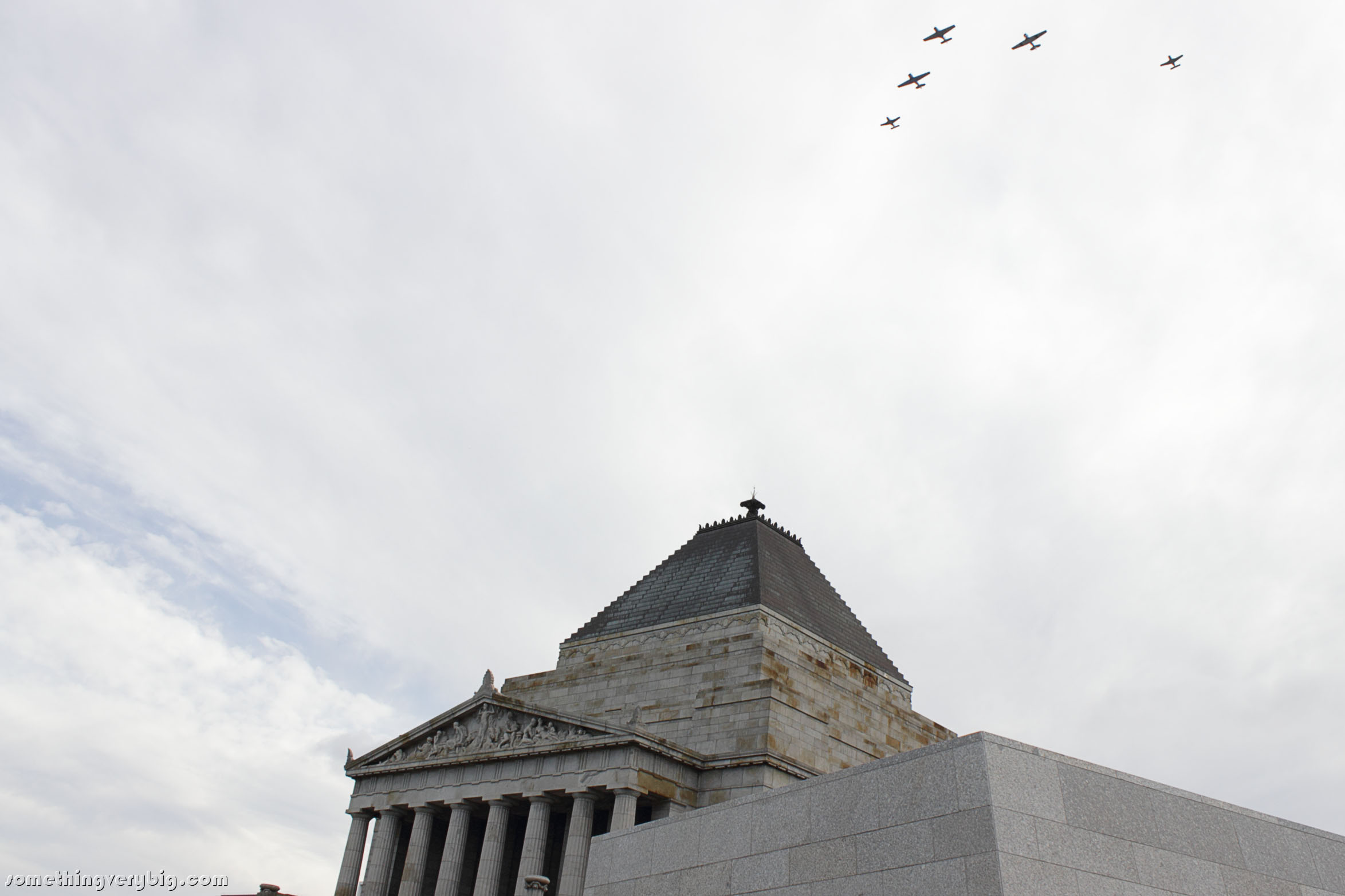
And there they were, right over the target and bang on 1:00pm as briefed. Five aeroplanes from the RAAF Museum’s Historical Trainer Flight – two Harvards, a Winjeel and a pair of CT-4s– swept down St Kilda Road and roared over the crowd. The ‘Sound of Round’ echoed off the buildings. The formation continued south, made a big left-hand turn and then came back across the Shrine again, this time from east to west. The crowd broke into spontaneous applause.

The RAAF Museum Flight passing the Shrine of Remembrance

A few minutes later the second formation appeared, out of the south this time and made up of seven Warriors and a Cessna from the Royal Victorian Aero Club. Flying lighter aeroplanes than the Air Force pilots, these guys were copping the full force of the windy, bumpy conditions as they turned to the west from dead over the Shrine. But it looked and sounded fantastic. The old flyers on the ground certainly appreciated the dedication and commitment of the pilots from both formations.

The Royal Victorian Aero Club formation passes the Shrine of Remembrance

It was a fitting conclusion to the Bomber Command Commemorative Day ceremony which had finished in the new Auditorium inside the Shrine just a few moments before.

The Auditorium was only officially opened last year and this was the first time it has been used for ceremonial purposes. With cold and blustery conditions outside it was certainly a much more comfortable venue for the estimated 140 or so people who packed it to the rafters for the service.

The MC was the unflappable Brian Smith:

Master of Ceremonies Brian SMith

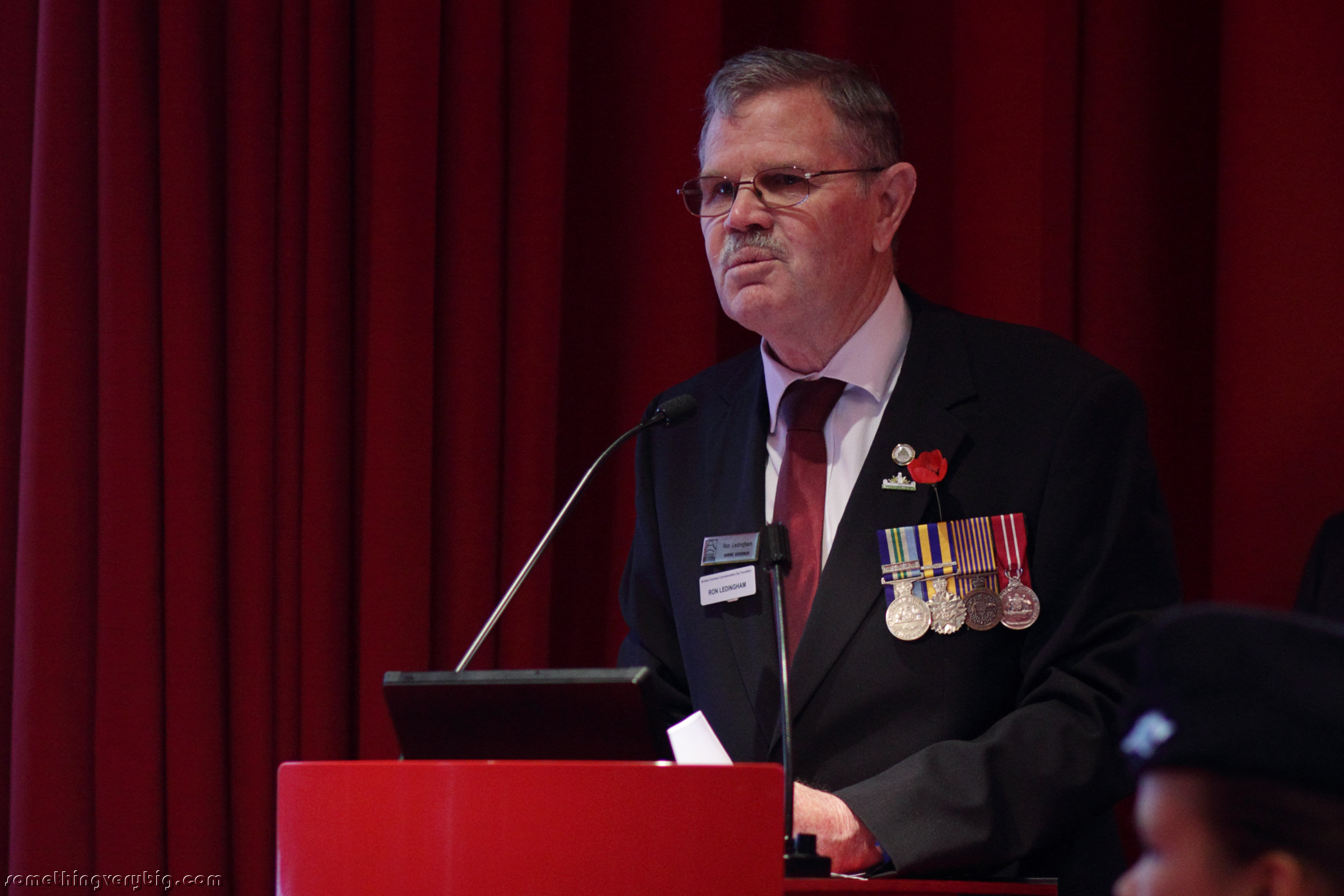
Squadron Leader Ron Ledingham, Shrine Governor and Bomber Command Commemorative Day Foundation (Vic) committee member, opened the ceremony by discussing its importance to the Shrine and to the Bomber Command community.

Shrine Governor Ron Ledingham

John Brownbill RFD KSJ, an Army chaplain, looked after the religious aspect of the service and set the scene with a few words on Bomber Command and its part in the Second World War:

Chaplain John Brownbill

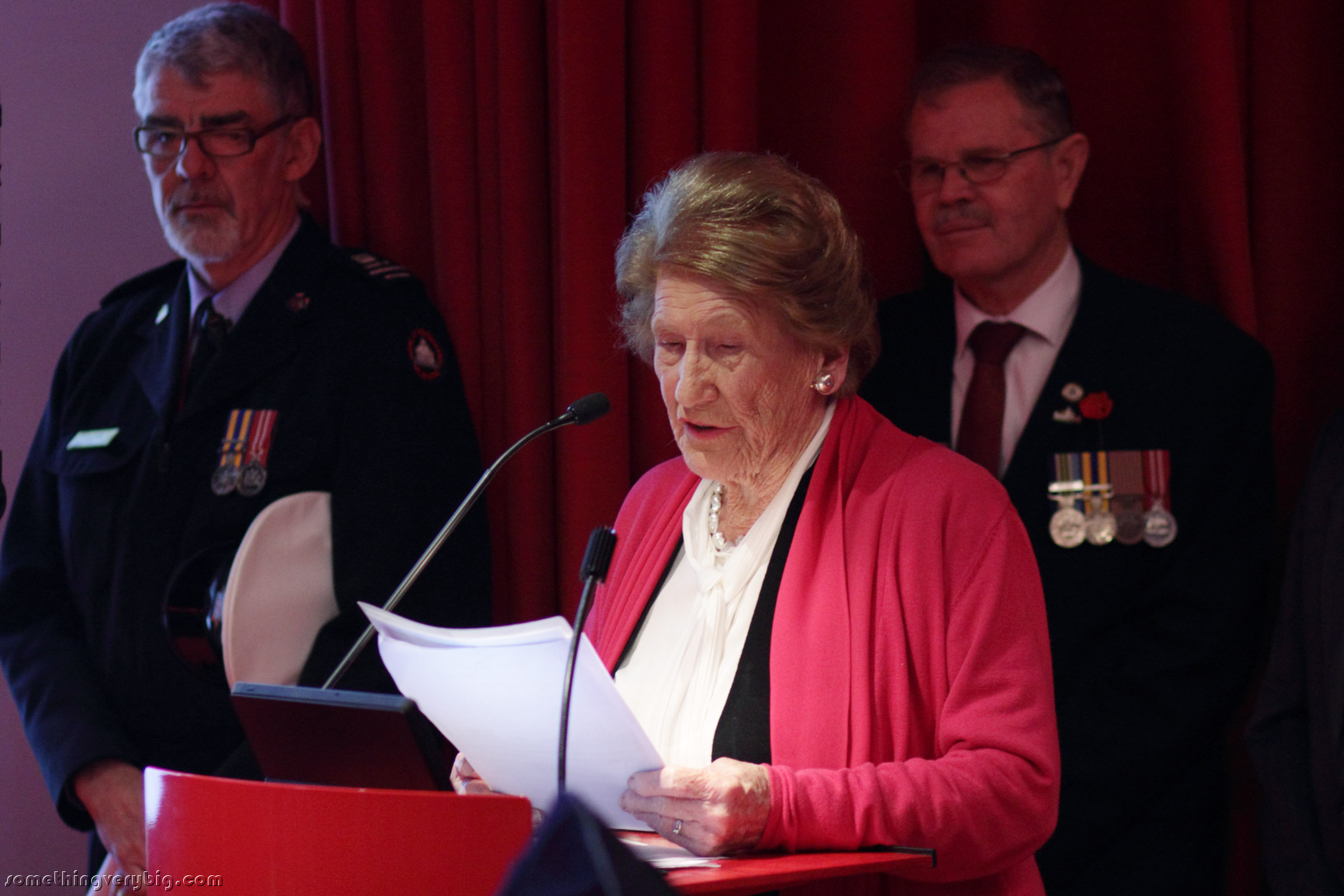
Committee member Jan Dimmick – her late husband Frank was a 460 Squadron navigator – read the Epitaph from a poem called Requiem for a Rear Gunner:

BCCDF (Vic) Committee Member Jan Dimmick

 My brief, sweet life is over, my eyes no longer see,

No summer walks, no Christmas trees,

No pretty girls for me.

I’ve got the chop, I’ve had it.

My nightly ops are done.

Yet in another hundred years, I’ll still be twenty one.

                -R.W Gilbert

The guest speaker for the ceremony was former Victorian premier and current Chairman of the Victorian Centenary of Anzac Committee, the Hon Ted Baillieu. He picked up on Jan’s “21 years” theme, remarking that WWII started 21 years after the Great War ended. We commemorate anniversaries like Anzac and the end of WWII, he said, for three reasons: to honour those who served, to educate current generations, and to pass the torch of remembrance on to future generations.

The Hon Ted Baillieu

Then came the wreathes, including one from Carey Baptist Grammar School, which has now officially adopted this ceremony as part of the Shrine’s ‘Adopt an Ex-Service Organisation’ initiative.

Students from Carey Baptist Grammar School laying a wreath

This was their first involvement with the ceremony, and it’s a partnership we hope can continue long into the future – first-hand evidence of the passing on of Mr Baillieu’s metaphoric “torch of remembrance”.

On the way out following the service we just had enough time to take a group photo of all the veterans present:

Bomber Command veterans following a commemorative ceremony held at the Shrine of Remembrance in Melbourne
Bomber Command veterans following a commemorative ceremony held at the Shrine of Remembrance in Melbourne. Left to Right: Laurie Larmer (51 Sqn), Jim Cahir (466 Sqn), Laurie Williams (460 Sqn), Alan Day, Gerald McPherson (186 Sqn), Jack Bell (216 Sqn), Arthur Atkins (625 Sqn), Colin Fraser (460 Sqn), Don McDonald (578 and 466 Sqns), Don Southwell (463 Sqn), [Unidentified] at rear,  Steve Downes (467 Sqn – seated), Maurie O’Keefe (460 Sqn), Peter Isaacson (460 Sqn), Lachie McBean (467 Sqn)

And then the roar of radial engines heralded the arrival of the flypast.

Afterwards afternoon tea was served in the foyer area. And it was here that something remarkable happened:

1505 BCCDF MEL 88

On the left of this photo is, of course, Don Southwell. He’d come down from Sydney with his son David for the ceremony, representing the ‘national’ Bomber Command Commemorative Day Foundation. He’s talking to Steve Downes, centre, and Lachie McBean, right. Steve, a wireless operator, and Lachie, a pilot, were on the same crew. The only two Australians in the crew, they were posted to 467 Squadron right at the end of the war so they never flew any operations. But they had gone through training together. Then the war ended and everyone was posted away or discharged from the Air Force entirely. “We were best mates while we were on the same crew”, Lachie told me, “but we never knew much about what each other had done before the war, and then we were all posted away and lost contact.”

Until recently, Lachie thought that Steve had been killed in a post-war car crash. But about three months ago Lachie’s wife died.

Steve – very much still alive – saw the death notice and recognised his old pilot’s name. He contacted Lachie through the funeral director, and their respective daughters conspired to arrange a meeting at the ceremony– and so the two old crew mates saw each other again on Sunday for the first time in seventy years.

I was lucky enough to be the proverbial fly-on-the-wall as the two old men chatted. Seven decades simply melted away as they just picked up where they had left off.

It was a lovely moment to cap off a most memorable day.

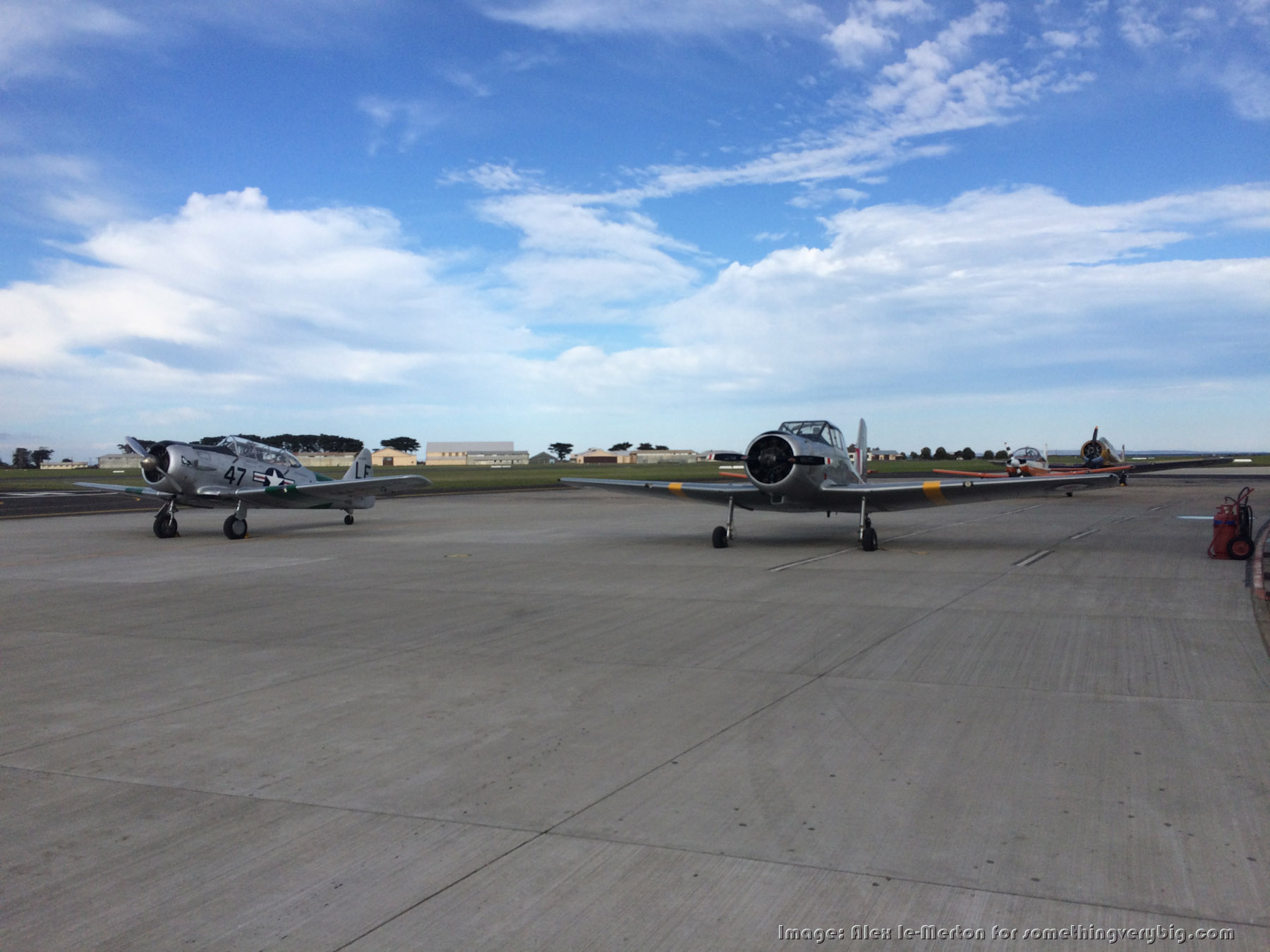
The RAAF Museum Heritage Trainer Flight taxis at Point Cook prior to their formation flypast of the Shrine of Remembrance. Photo courtesy Alex le-Merton
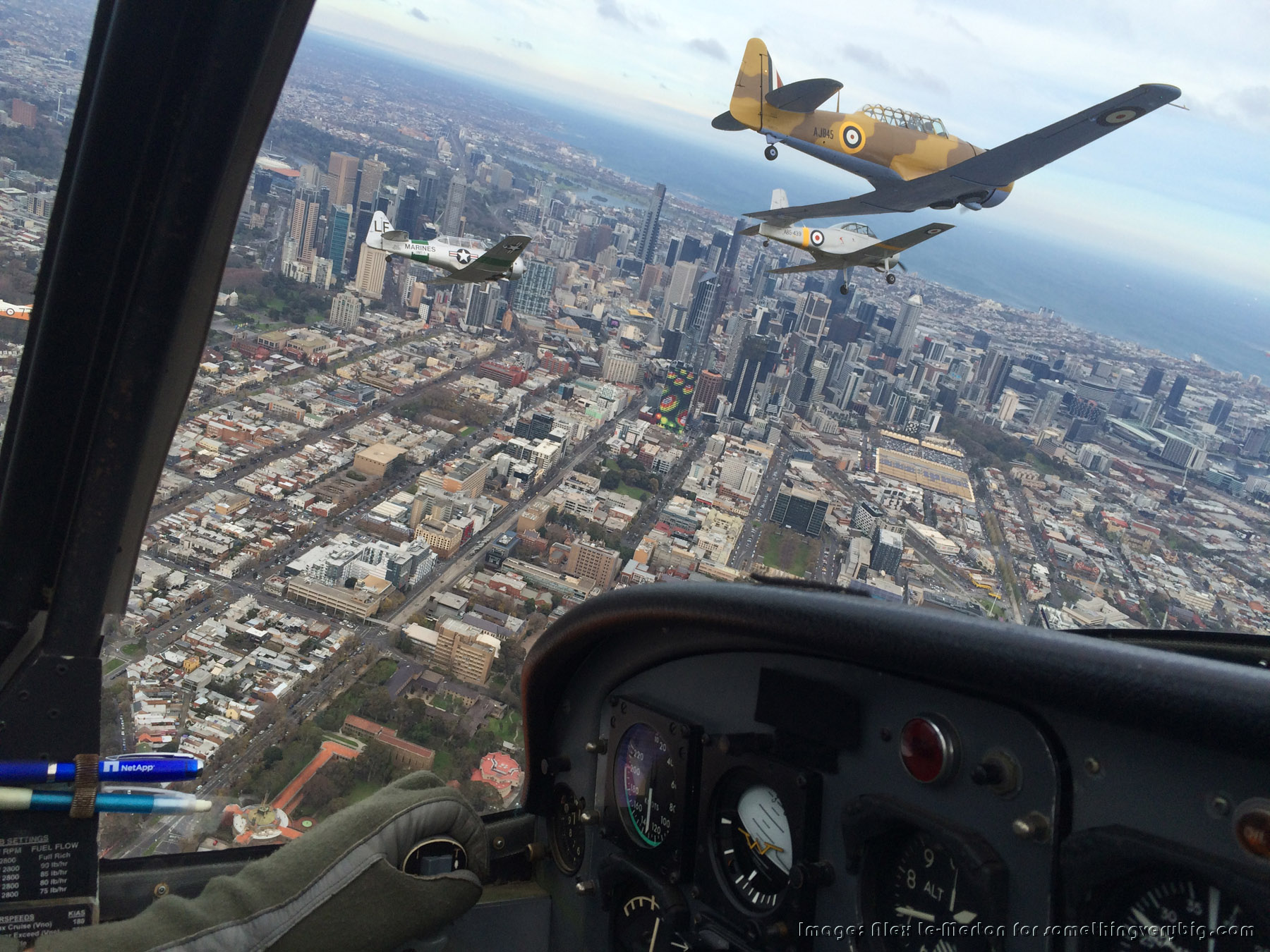
The RAAF Museum Heritage Trainer Flight turns towards the Shrine, Melbourne. Photo from one of the CT-4s in the formation courtesy Matt Henderson
The Shrine Guard
The Shrine Guard
Bomber Command veterans assembling for a group photo
The Bomber Command Commemorative Day Foundation (Vic) Committee

Many thanks to Matt Henderson and Alex le-Merton, the crew of one of the RAAF CT-4s, for the airborne photos.

The Bomber Command Commemorative Day Foundation (Vic) Committee sincerely thanks both the Royal Australian Air Force and the Royal Victorian Aero Club for their critical parts in making the commemorative flypast happen.

© 2015 Adam Purcell.

Bomber Command in Canberra 2015

The cabbie who picked me up from the airport couldn’t work out why I would be coming to Canberra for non-work reasons.

On a weekend.

In winter.

He perked up, though, as he drove me down Fairburn Avenue and through a big roundabout, pointing to a big domed building up the hill.

“That War Memorial. You must go there.”

Don’t worry, I said. I’ll be going there alright.

The Australian War Memorial, that big domed building on the hill in front of Mount Ainslie, is the traditional and spiritual home of much of the activity associated with the annual Bomber Command Commemorative Day. The weekend just gone saw the 8th edition take place, under blue skies for once.

It began, though, with sad news. While preparing to leave for the commemorations, Bomber Command Commemorative Day Foundation President Ross Pearson suffered a stroke. As I write it is still too soon to know much but the early signs are, I hear, not good. The knowledge of Ross’ illness cast a dark shadow on the weekend, and he remained in the thoughts of many of those present. But the show, as they say, must go on, and in the best spirit of Bomber Command, we pressed on regardless.

First up was the Meet & Greet function, in the shadow of the great black bomber named G for George. It was one of the bigger crowds in recent memory I thought, and was quite a good evening.

The crowd at the Meet & Greet

A highlight was seeing two old pilots sitting next to each other having a chat. Alan Finch (who I met at this function last year) was posted to 467 Squadron in August 1943 and completed his tour on 19 March 1944. Bill Purdy arrived at 463 Squadron two weeks after Alan left. So while they were not quite both at Waddington at the same time, they were there at the same time as the crew of B for Baker. There are not many men around these days who were operating around that time, so to find two of them sitting next to each other was a special moment for me.

Bill was telling a story when I passed by. After his tour ended in August 1944, he was posted to a Heavy Conversion Unit as an instructor on Stirlings. His first pupil, he said, could fly better than he did. “We didn’t even realise we had landed!” His second pupil was even better. But Number Three? There was much swerving all over the sky. “It was a controlled crash every time!”

Once they all got to their operational squadrons, though, it was a different story. The first man was lost on his first trip. The second man lasted three. But the third pilot survived his tour. “Maybe the other two were too good…” Bill mused thoughtfully.

It strangely makes sense. Flying perfectly straight and level in a combat zone could be fatal when flak and nightfighters were around.

There was an attempt to get a group photo of all the veterans present but it was less than successful. But seeing as everyone was gathered near the lectern at the tail end of George, 467 Squadron mid-upper gunner Albert Wallace took to the microphone to tell a few stories about Australians, WAAFs and sugar tongs. He mentioned being one of the last crews to fly S-Sugar, the Lancaster preserved at the RAF Museum in Hendon.

Bomber Command veterans gather to hear Albert Wallace speak

That brought Alan Finch to the front. “We were the first crew to fly Sugar on 467 Squadron!” he said. He wasn’t impressed: “I said it wasn’t fit for operational service…” As we now know, of course, Sugar would go on to fly over 100 operations.

Can’t win ‘em all, I guess.

While all this was going on, I noticed Don Southwell sitting on a convenient ledge in front of a painting of a flight engineer. He had some interesting light falling on his face from a set of lamps that were ostensibly there to illuminate the speaker at the lectern.

Don Southwell
Don Southwell

I got an idea…

VETERAN PHOTO BOOTH!

Tom Hopkinson and Don Browning
Tommy Knox
Tommy Knox
Alan Finch. What a brilliantly relaxed pose!!

As the event wrapped up I also dragged the lights over to get a nice portrait of two of the key organisers of the event, Don and David Southwell:

Don and David Southwell

The ‘official’ hotel for the Bomber Command group had changed to the brand-new Avenue, in the heart of the city. A small group repaired to the hotel bar there following the function for a few drinks. The group was down a little on numbers from previous years, partly because some were still staying at the QT hotel as usual and also because some of the usual suspects were missing (Don Huxtable being a very noticeable absence, being in hospital in Sydney). The ghosts of absent friends were very evident. But it was still a very useful and enjoyable evening. At one point I asked Keith Campbell, who had just been served the biggest ‘little’ beer he had ever seen, what he thought of wartime English beer. Not much, as it turns out. “It was weak and tasteless!” he said.

The grass in front of the Bomber Command memorial sculpture in the western grounds of the War Memorial is the original venue for the Bomber Command Commemorative Day, and given it is a dedicated memorial to Bomber Command it makes sense to hold the ceremony in its shadow. But having experienced the heightened atmosphere and mood in the cloisters of the War Memorial for the last two years, I reckon it’s much better up there. And so I was almost hoping for rain when I awoke this morning. But for the first time in three years the ceremony on Sunday morning was held outside under blue skies, and it went rather well.

1505 BCCDF CBR 123

I’m told there were 600 seats provided, and they were all full well before the ceremony kicked off at 11:00, with other people standing around the periphery. Sitting behind me was Tom Stewart, a Canberra local who was a 77 Squadron (Royal Air Force, not the Australian fighter squadron!) wireless operator. I snapped a quick photo before the ceremony started:

Tom Stewart
Tom Stewart

A representative flight of the reformed 460 Squadron ‘marched on’ to open the ceremony. Dr Brendan Nelson, AWM Director, again spoke well and mostly without notes, quoting the words that end Striking by Night presentation in which G for George plays such a starring role. “My memories are of young men, Aussie men,” it goes, “laughing, dancing, singing and enjoying the moment…  Never to be heard of again.”

Well, Dr Nelson told us, setting the theme for the weekend, “they are to be heard of again: here, today.”

I was most impressed, however, by the speech from Dr Peter Hendy, the Federal Member for Eden-Monaro. It started off the usual way and I was a little worried that it would be a typical politician’s speech, saying the right things but without really knowing or believing in what was being said. But then he veered off into much more personal territory. Dr Hendy, it turned out, had an Uncle Jack, actually a cousin of his father’s, who was a rear gunner in Bomber Command. And so, just like I did, Dr Hendy grew up with stories of “Uncle Jack,” bombers and gun turrets. He said that while it’s tempting to speak of Bomber Command airmen as being superhuman, they were actually ordinary people caught up in extraordinary circumstances. “The extraordinary, ordinary Australians”, he called them, and I thought that a most appropriate description.

Keith Campbell (who at breakfast that morning was singularly unruffled by the short notice) gave the Reflections address in place of Ross Pearson. He spoke of the WAAFs who would issue parachutes to the airmen with the old line “if it doesn’t open, bring it back!”, of “the longest ten seconds you would ever know” after the bombs went down, waiting for the camera to tick over, and of listening to a Master Bomber’s voice on the radio over the target one night: “Goodbye chaps, we’re going in – we’ve been hit by flak and we’ve had it.” And he spoke of his demob: “There was no tickertape parade. Just a suit, new hat and best wishes.”

Keith Campbell giving the 'Reflections' address.
Keith Campbell giving the ‘Reflections’ address.

But it was Keith’s conclusion that rang most true for me. He was speaking to the veterans present, urging them to tell their stories while they still can. “Maybe you can pass the torch on to others,” he said. “Make sure that their name lives forevermore.”

Bill Purdy and Alan Finch

1505 BCCDF CBR 099

The Australian Rugby Choir led the singing
Tom Hopkinson and Don Browning, laying a wreath for 463-467 Squadrons at the Bomber Command memorial. Don's daughter Jocelyn providing support.
Tom Hopkinson and Don Browning, laying a wreath for 463-467 Squadrons at the Bomber Command memorial. Don’s daughter Jocelyn providing support.
Bomber Command veterans in Canberra

The luncheon was moved from the War Memorial at quite short notice to the QT Hotel because of high demand. More than 180 people were there.

There was a lot of brass there. The soon-to-retire Chief of Air Force, Air Marshall Geoff Brown, delivered an intriguing address looking at current capability of the Royal Australian Air Force, including some very rare bombing footage of recent operations in Iraq.

Air Marshal Geoff Brown, Chief of Air Force

Where in Bomber Command’s day 1,000 aircraft might be sent to one target, these days one aircraft might engage four individual targets on a single sortie. He even showed an example of the requirement to avoid collateral damage, when non-combatant vehicles were observed nearing a target and the laser targeting system was used to push the munitions off target after the weapons were released. A capability, one suspects, which Bomber Command would have found quite useful.

Also speaking was the Chairman of the Trustees of the International Bomber Command Centre, Tony Worth. Tony was in Australia as part of a delegation of IBCC people who are working on “an international story of Recognition, Remembrance and Reconciliation”.

Tony Worth from IBCC

The Centre, in the early stages of being established on a hillside within sight of Lincoln Cathedral, will consist of a Memorial Spire (which was erected last month), steel walls engraved with the names of those who died in Bomber Command, an education and exhibition centre, ‘Peace Garden’ and, most significantly for me, an ambitious digital archive that aims to become a comprehensive research resource – the ‘go-to’ point for Bomber Command information into the future. As such they are looking for people worldwide to scan documents and interview veterans and it’s possible that I may become a point of contact for this in Melbourne. It’s a big project with very lofty goals but it certainly looks like they have an enthusiastic team behind it and it will be very interesting to watch their progress.

Ron Houghton launching a new book, called Severed Wings about a Bomber Command crew who were shot down and bailed out over Germany. Four members of the crew were subsequently murdered by German civilians. Looking on is the RSL's Ken Doolan and Peter Rees
Ron Houghton launching a new book, called Severed Wings about a Bomber Command crew who were shot down and bailed out over Germany. Four members of the crew were subsequently murdered by German civilians. Looking on is the RSL’s Ken Doolan and Peter Rees

Veterans at the Lunch gathered for a group photo with the two top-ranking members of the current Royal Australian Air Force. Front row, L-R: Tom Hopkinson, [unknown], Keith Campbell, Max Barry, Rex Austin, Ray Merrill, Jim Clayton.  Back row L-R: Deputy Chief of Air Force Air Vice Marshal Gavin 'Leo' Davies, Tommy Knox, Angus Cameron, Bill Purdy, Chief of Air Force Air Marshal Geoff Brown, Ron Houghton, Don Southwell.
Veterans at the Lunch gathered for a group photo with the two top-ranking members of the current Royal Australian Air Force.
Front row, L-R: Tom Hopkinson, [unknown], Keith Campbell, Max Barry, Rex Austin, Ray Merrill, Jim Clayton.
Back row L-R: Deputy Chief of Air Force Air Vice Marshal Gavin ‘Leo’ Davies, Tommy Knox, Angus Cameron, Bill Purdy, Chief of Air Force Air Marshal Geoff Brown, Ron Houghton, Don Southwell.
The increased interest in Bomber Command and events of this type can easily be seen in the numbers attending this year. While not the “biggest ever” I think it was a modest increase on last year, even with those notable absentees. While I didn’t come away with as many ‘new’ veterans as I have in the past I still made a lot of contacts and there were many family, friends and hangers-on present. (Including, incredibly enough, one of my high school PE teachers whose wife has a 467 Squadron connection).

The news of Ross Pearson’s stroke concentrated some minds on thoughts of what the future might look like for the organisation of this event and others like it, and there was discussion of this important question at various points over the weekend. The intention of the group of veterans – led by the late Rollo Kingsford-Smith – who developed the concept for the first Bomber Command Commemorative Day was that it would continue “in perpetuity”, and this intention was restated a couple of times on the weekend. Certainly the numbers present demonstrate that the demand is there and indeed is growing for events of this type. Much of the burden of organising this event already falls on the younger generation, but the inspiration for it is still drawn from the hardy but dwindling band of Bomber Command ‘originals’. Some hard questions will need to be answered when the last of the ‘extraordinary, ordinary Australians’ finally leave this life.

Ian Coffey (left) talking to Keith Campbell and Tom Hopkinson at the lunch
Tommy Knox, Angus Cameron and Rex Austin. Angus and Rex have just recognised each other for the first time in about 20 years. In the early 1950s, both rejoined the Air Force and were on the same ITS course together.

The luncheon was beginning to wrap up and the crowd was thinning. As I prepared to leave I saw two old blokes, the last people sitting at a table. They were Angus Cameron and Tom Hopkinson, two Canberra-based veterans, and they looked very relaxed.

Two extraordinary, ordinary Australians, sitting back and having a lively chat.

They were still at it as I left the room.


© 2015 Adam Purcell

The official photos from the AWM are now on their Flickr stream, here