Who did what, when and in which aircraft?

At the Canberra Bomber Command weekend a few years ago, Don Southwell made an off-hand comment about how he wanted to re-do the Squadron histories. I’m beginning to see why!

I’m currently having a fairly close look at the activities of 463 and 467 Squadrons for the time that the crew of B for Baker were at Waddington. I’ve pulled a variety of sources that I’m going through and cross-referencing to try and build a picture of what happened for each day in the period – and, not surprisingly, I’ve found a number of inconsistencies. Take the latest one, for example. Here is an entry from Nobby Blundell’s squadron history, They Flew From Waddington!, written in 1975 and privately published, concerning 29 January 1944:

Berlin again. 467 Sqn F/Lt Simpson’s a/c was attacked by an ME110 – F/Sgt Campbell, the rear gunner, shot it down. We lost 6 a/c from Waddington, 3 from each Squadron, our worse [sic] night to date, 467: ED772, DV378 and ME575. 463: HK537, JA973 and ED949. 43 aircrew in one op. lost.

On the face of it, this seems straightforward. From a single operation to Berlin in late January 1944, Waddington lost six crews. It is true that this was right in the thick of the period that later became known as the Battle of Berlin, and as such there were many raids to that city around that time. The only problem is, this particular Berlin trip appears in none of the other records I’ve looked at. The 463 Squadron Operational Record Book for example, says this:

A dull day. No Ops. Routine work.

And 467 Squadron said this:

Much sleeping today, and a stand down in the afternoon. The usual Saturday night dance was held.

No sign of any operations there, then. Indeed, the Night Raid Report for this date shows that only small forces of Mosquitos were operating on this night.

But I always like to think cock-up before I think conspiracy. It’s unlikely that Blundell would have made the entry up entirely. Far more likely, I think, is that he’s mixed up a few raids and put them into one entry. So I thought I’d have a look around that date and see what went on elsewhere. From the Bomber Command Night Raid Reports and Operational Record Books for 463 and 467 Squadrons, here are the main operations for a few days:

  • 27 January: 530 heavies to BERLIN; 32 lost. 32 aircraft from Waddington; 463 lost one and 467 lost two.
  • 28 January: 683 heavies to BERLIN; 43 lost. 26 from Waddington, one lost from each Squadron.
  • 29 January: No Main Force operations. Squadrons stood down.
  • 30 January: 540 heavies to BERLIN. 33 lost. Waddington sent 24 aircraft. 463 Squadron lost four and 467 Squadron lost one.
  • 31 January: No Night Raid Report, so no ops.

The most likely suspect, looking at this run of operations, is the trip on the 30th. But Blundell claims six losses on that night, not the five in the ORBs. I needed to look deeper.

The only other details that Blundell recorded are the serial numbers of the aircraft lost:

From 467 Squadron:

  • ED772
  • DV378
  • ME575

From 463 Squadron:

  • HK537
  • JA973
  • ED949

So I thought that was a good place to go next. From the Operational Record Books, we get this:

Pilot                             Squadron                     Aircraft

Messenger                   463                              ED772

Hanson                        463                              JA973

Dunn                           463                              ED949

Fairclough                   463                              ED545

Riley                            467                              DV372

Comparing that to Blundell’s list, we see he has accounted for the first three, so I’m now fairly confident that he’s got the wrong date and the operation he is referring to is indeed that of the 30th. But he attributes ED772 to the other squadron, includes DV378, ME575 and HK537 in his list and completely misses ED545 and DV372. To work this one out, it’s time to find another source.

Bruce Robertson wrote a book called Lancaster: The Story of a Famous Bomber, published in 1964. In the back section are lists upon lists of Lancaster serial numbers, and what happened to each aircraft. So I checked the serial numbers from the ORB, and from Blundell’s extract. Robertson agrees that the first three were lost on 30 January and shows it as 463 – which agrees with the ORBs. ED545, says Robertson, was lost on 14 May 1943 – seven months before the night in question – so it must be an error in the ORB. DV372 survived the war and was scrapped in October 1945, so that one must also be incorrect. With those two ORB records now empty we have two outstanding aircraft (those flown by Fairclough and Riley) and three unknown serials (DV378, ME575 and HK537).

Robertson comes to the rescue again: ME575 was lost on January 27 (one of the other Berlin trips at the end of that month), and indeed the 467 Squadron ORB agrees that this aircraft went missing on that night.

DV378 is very close to DV372, so it is possible that the Orderly Room clerk who typed up the ORB made an error. And indeed, Robertson shows that DV378 went missing on 31 January. Since aircraft returned from the 30 January operation close to and in many cases beyond midnight, and there is no Night Raid Report for the 31st, it is reasonable to suggest that this is the correct serial number for the aircraft flown by P/O Riley.

That, then, leaves HK537 which, again, Robertson records as being lost on 31 January. That is fairly solid evidence that it was indeed the aircraft flown by P/O Fairclough.

So based on this, the list from above should, I believe, actually look like this:

Pilot                             Squadron                     Aircraft

Messenger                   463                              ED772

Hanson                        463                              JA973

Dunn                           463                              ED949

Fairclough                   463                              HK537

Riley                            467                              DV378

All of this goes to show how important it is to cross-check your sources. The ORBs, while considered the definitive record of what happened on each squadron, vary significantly in quality, depending on the individual officer who wrote them at the time. They were compiled at a time when aircraft were being lost and new aircraft and crews were arriving on squadron virtually every day and as such errors could and did creep in. It takes a bit of patience to painstakingly sort through the records and check other relevant sources to try and find out what actually happened.

I think Don Southwell is on to something when he says he’d like to re-do the squadron histories. It would be a very long job to go through the entire Operational Record Books for both Squadrons to try and find these sorts of errors, but I think it would be a worthwhile exercise if it meant that the histories could be more accurate. What form the histories would then take needs more thought and is, perhaps, a subject for a future post.

©2013 Adam Purcell
Vale Pat Kerrins

Bomber Command attracted, and got, the best men of a generation. They were (in general) more highly educated than many of their time, they were carefully selected and they were highly trained. Many achieved great things during their time with the Air Force. A significant proportion – those who didn’t come back – never got the chance to follow that achievement up with similar success in post-war life. For some who did survive, their few short months on an operational squadron would come to define the rest of their lives. But there were also others who went to war, flew a tour of operations, returned to Australia – and, putting all thoughts of the war behind them, simply got on with life. One of those was Pat Kerrins, who died on Easter Sunday.

Pat was a Lancaster pilot. He grew up on a farm just outside the northern Victorian town of Tatura and, after leaving home, worked for the Postmaster General’s department in Melbourne and Sale. It was while he was at Sale that war broke out and, perhaps having caught the flying bug from the close proximity to the RAAF base nearby, as soon as he was old enough he joined up, first as a transport driver but eventually as a trainee pilot.

Pat trained in Australia and was selected as a fighter pilot. He travelled via the US to England, but on arrival found a long wait to get onto a fighter squadron. Bomber pilots, on the other hand, were needed immediately – so he swapped over, and would eventually fly 32 operations with 115 Squadron. He ended the war as a Flying Officer.

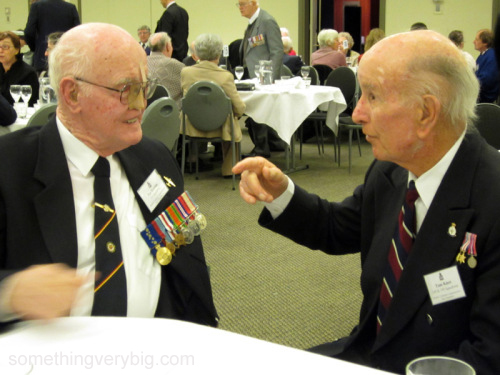
I first met Pat at the Bomber Command Commemorative Day weekend in Canberra  in June 2011. He was engaged at the time in a lively conversation with another veteran (Tommy Knox, a 149 Squadron Stirling flight engineer) about a mutual acquaintance both had known during the war, and I took a photo of them both in the midst of it:

11jun-bombercommandcanberra-067s copy

I sent Pat a copy of this photo (he’s on the left), and after exchanging a few letters I even drove up to Tatura to visit him for lunch one day. We pored over his logbook and a few photos and he shared a story or two of his service. It turned out that, along with his mid-upper gunner Nobby Clarke, he had been interviewed by writer and broadcaster Michael Veitch for a book called Fly, published in 2008. It’s worth quoting a passage from this book (p.83) which I think reveals much about Pat’s character and cheeky sense of humour:

“You’re writing a story about us old blokes, are you?’ asked Pat. ‘Why didn’t you get onto us fifty years ago when we could remember something?’

‘Sorry about that, Pat,’ I replied. ‘So when did you join up?’

’26 June 1942,’ he rattled off in a flash. Somehow I didn’t think his memory would present too much of a problem.

I think it was Pat’s favourite self-deprecating joke; he asked me the same thing the day that I visited him!

But talking about his wartime experiences was only a fairly recent development. After the war, Pat never flew an aeroplane again. He returned to Tatura and settled down on the family farm. He raised a family (eventually becoming a grandfather and then a ‘2-Pa’), played an important role in the developing Tatura dairy industry and was generally involved in the life of the town, volunteering with groups like Legacy, the local AFL club and horseracing club. He was awarded the Order of Australia Medal in 2001 for his services to the local community. Pat was such a legend in and around Tatura that about one thousand people attended his funeral there last week, and a large crowd of those who couldn’t fit inside the church spilled over into the driveway outside. He had been baptised and married in the same church.

I spotted perhaps my most favourite tribute to a real character of the local area as I was driving out of Tatura after the funeral on Saturday. Pat had a lifelong love of horses and was heavily involved in the Tatura horseracing club, officiating as a steward for many years at race meetings. I happened to glance to my left as I was passing the racecourse, just in time to flash past a sign proudly proclaiming the name of a large expanse of dirt. It was, the sign said, the Pat Kerrins Carpark.

I only knew Pat because he was a Bomber Command veteran. But while his two or three years in the Air Force were an important part of his life, they did not come to define it, and arguably his greatest successes came after he returned to Australia. His impish grin and cheeky sense of humour will be much missed.

© 2013 Adam Purcell

Use the Source, Luke

My research catalogue for this project includes about a thousand individual items. And those are just the ones that I have catalogued; there are many more that sit in a great pile on my bookshelf waiting to be looked at. They are from a wide variety of sources and types. There are personal letters, logbooks and photographs. There are service records, casualty files and night raid reports. There are audio recordings, interview transcripts and videos. And there are books – there are many, many books; some written by people who were there, and some written by people who were not there.

No one source can tell the whole story, though – in one sense, this is why there are so many individual items in my catalogue! To build a more complete picture of ‘what really happened and why’ (which, after all, is one of the reasons for doing this work in the first place), multiple sources need to be consulted and compared as a whole.

A pilot’s logbook, for example, can offer a full record of what flights the pilot made and when they went on them. The more fastidious pilots also recorded who they flew with, in which aircraft, and even over which route they flew, which are all Really Useful Facts for a historian. But what a logbook doesn’t necessarily reveal is why each flight was made. Take, for example, this one, which appears in S/Ldr Phil Smith’s wartime logbook on 06MAY44:

Aircraft: Oxford. Pilot: Self. Crew: -. Duty: Base – Coningsby and return. 0.30hrs Day.

This is the first flight in an Oxford that I can find in Phil’s logbook at all (though he did significant flying in the very similar Avro Anson during his training), and it is quite an odd flight to find in the logbook of an operational bomber pilot. Indeed, later that night, Phil led his crew on a bombing operation to an ammunition dump at a place called Sable-sur-Sarthe in France. So what on earth could he have been going to Coningsby for?  To find the answer, I needed some other sources.

A few years before he died, Phil wrote an unpublished 29-page typescript for the benefit of his grandson, entitled ‘Phil’s Recollections of 1939-45 War’. I’m lucky enough to have a copy of it and I had cause recently to go through it to see if I could match his (mostly undated) reminiscences with actual flights in his logbook. And, funnily enough, that odd little flight the fifteen or so miles from Waddington to Coningsby is one of those he wrote about.

“For this raid I was appointed ‘Controller’ which meant that I would maintain contact between the target marking Mosquitoes and the main force of Lancasters carrying the bombs. In the afternoon before the raid, the station commander ordered me to visit the target marking people on the nearby aerodrome, Conningsby [sic]. I duly went over there in our Oxford aircraft, a type I had not flown for more than a year.”

But why would Phil need to do that? At the time of the Sable-sur-Sarthe operation, Bomber Command was increasingly becoming engaged on operations against French targets in the lead-up to D-Day. That much is clear from a perusal of Night Raid Reports for this period, in the UK National Archives (AIR14/3411). This trip was no exception. Great care was taken to be accurate on these trips – for the sake of effectiveness of the attack itself, but also to avoid French civilian casualties – and new, far more accurate marking techniques had begun to be developed. This is touched on in a 1951 book called No. 5 Bomber Group RAF by WJ Lawrence (p.164) Indeed a week previously the crew of B for Baker were on an operation to attack a munitions factory at St Medard-en-Jalles, near Bordeaux, but were ordered to return with their bombs when smoke and haze made accurate visual marking of the target impossible. (The bombers returned the next night and blew the munitions factory out of existence.) Phil Smith, having been appointed Controller for the upcoming raid, went to Coningsby to discuss tactics with the people who would be marking the target for the force he was to control.

So that curious little trip in Phil’s logbook now has an explanation. The primary source (logbook) has been complemented by a range of other documents, both primary (night raid reports) and secondary (Phil’s typescript and the 5 Group book) to come up with a picture of what happened and why.

It’s only a minor detail in the overall scheme of things, but it adds a little bit of colour to an otherwise dry logbook entry. And it gives the history just that little bit more life.

© 2013 Adam Purcell

Halam Lancaster

There was an article published in the Sydney Morning Herald in April 2011, about a couple of Australian aircrew who had been killed when their Lancaster crashed while on a training flight. It was 10 April 1943, and the crew was on their last exercise at 1661 Heavy Conversion Unit, Winthorpe, before being posted to an operational squadron. Shortly after take-off the aircraft crashed in the small village of Halam, eight miles from the aerodrome and aligned with the runway they had departed from.

Sixty nine years later to the day, a memorial was unveiled in Halam commemorating the seven men who died in the crash. It was the culmination of some years of work by a local man named Andrew Paris who has now researched the story of the crew and how they came to be on that aircraft.

Jack Purcell was posted to RAF Winthorpe between September and November 1943 and I visited the excellent Newark Air Museum that now occupies a corner of the old airfield while visiting the UK in 2009. But that wasn’t why the story in the Herald set some faint bells of recognition chiming in my mind. As part of his research Andrew had been looking for information on what the crew might have been up to during their time at 1661 HCU. I got in touch with him through the Lancaster Archive Forum and was able to share an extract of Jack’s logbook covering the time he had been at the unit. While only a very small piece of the overall story, every little bit helps towards developing an understanding of ‘what they were doing there’.

It’s another good demonstration, I think, of how the Internet has revolutionised historical research. The reach of the web is world-wide, and it’s made finding this information much easier because it’s now a simple matter to find someone on the other side of the world who might have the information that you seek. And it’s then made it very easy to share the results of your work with a much greater audience than in the past.

(c) 2013 Adam Purcell

Remembering Scredington

In June 1943, a seven year old lad named Neil Trotter was in the playground at school in a tiny English village called Scredington when he saw a big black bomber flying very low overhead. After walking home that afternoon, he was told by his mother that the aircraft had crashed in the fields behind the house (about two miles from the school). Neil later learnt that his mother had approached the aircraft intending to render what assistance she could, but because of exploding ammunition was unable to get anywhere near the wreck. All on board perished in the crash.

The aircraft was Lancaster I ED439, of 83 Squadron. It had taken off from Wyton at around 11.00am on 18 June 1943 with a crew of seven, plus two passengers believed to have been wireless technicians:

Pilot: AUS409804 F/Sgt M.K. Cummings

Flight Engineer: AUS6756 Sgt H.W. Luker

Navigator: 537936 Sgt F.W. Wilcox

Bomb Aimer: 1431821 Sgt J. Roughley

Wireless Operator: 1396788 Sgt Cheshire

Mid Upper Gunner: 1588938 Sgt N. Woodcock

Rear Gunner: Can. R113958 Sgt R. Taylor

Passengers: 1024724 Cpl Bond and 1544915 Cpl. Sloss

The ‘Report on Flying Accident or Forced Landing Not Attributable to Enemy Action’ in Max Cummings’ casualty file at the National Archives of Australia shows that the aircraft was on a practice bombing flight “but did not carry out [its] detail”. It was seen to dive out of cloud near Highgate Farm, Scredington, about 45 minutes after take-off. The aircraft burnt on impact. While the Commanding Officer, 83 Squadron, recommended a Court of Enquiry be held as “this was a fully capable crew”, he appears to have been overruled by the Station Commander, RAF Wyton, Group Captain H.R. Graham, who wrote that “pending [the] report of Accident Investigation branch, I doubt that any useful purpose can be gained by holding [a] Court of Enquiry”. A report by the Engineer Officer, 83 Squadron, written after examination of the accident scene, states that “the starboard wing hit a farm building, and demolished one end wall, the fuselage and probably undercarriage nacelle tore off the roof of an unoccupied house close to the Barn.” The aircraft was identified by means of a number plate attached to one of the four engines. Because of the lack of a formal Court of Enquiry, the exact cause of the crash remains unknown to this day.

The idea to properly commemorate the men who died in this crash has been percolating around in Neil Trotter’s mind for some years and, now he’s retired after a long career in the post-war RAF, he’s had the time to do something about it. With the assistance of the RAF Association (Lincolnshire Branch), he has been working on organising for an appropriate memorial plaque to be placed in the village church in memory of the crew. He has managed to contact the families of six of the nine men who were on board the Lancaster when it crashed, and representatives of some of these families will be attending the unveiling ceremony in June this year. Other parties involved in the ceremony will be a large crowd of Scredington villagers, the Mayor of the local area, a considerable current RAF presence from the stations at Waddington, Coningsby and Wyton, and the local Air Training Corps, who will become custodians of the memorial after the ceremony. All in all, it’s a significant undertaking and it all comes, primarily, from Neil Trotter’s desire to find out more about that fleeting childhood glimpse of a Lancaster.

Ultimately stories like these are about the airmen themselves. They deserve to be remembered, and it’s heartening to see the work that people like Neil have done in the UK to ensure the stories live on.


© 2013 Adam Purcell


Sources:

Emails between Neil Trotter, Ian Milnes, Bill Hauxwell, Gerrit Kuijper and myself, November 2012- March 2013

Research into P/O Max Cummings, carried out by Victor Harbour RSL Sub Branch, South Australia

NAA: A705, 166/8/141; CUMMINGS, Max Keiran – (Pilot Officer); Service Number – 408904; File type – Casualty – Repatriation; Aircraft – Lancaster ED 439; Place – Lincolnshire; Date – 18 June 1943

I became involved in this story through a very small part that I played in the search for the family of P/O Cummings.

Another Satisfied Customer

In July last year I wrote here about a 463 Squadron Flight Engineer named Sergeant Peter Taylor, and his sister-in-law, Joni, who has been trying to find relatives of Sgt Taylor’s crew. I published the names of the rest of the crew on the blog, in the hope that it might attract a passing Google search.

And it did.

At the end of January I received a blog comment from a lady named Susan Little, the niece and God-daughter of the only survivor from the crew, bomb aimer Flight Sergeant Tom Malcolm. It’s taken a little bit of too-ing and fro-ing but Joni and Susan are now in touch with each other. Susan’s sent copies of a photo of Tom and his crew:

tom-malcolm-007 copy

The men wearing the white lifejackets are Sgt taylor and his crew (the others are their ground crew). Aircrew in the back row, left to right are pilot P/O J.F. Martin, wireless operator F/S G.W. Bateman and bomb aimer F/S Tom Malcolm. In the front row, left to right, airmen are flight engineer Sgt Peter Taylor, navigator W/O Bernard Kelly, mid-upper gunner F/S L.G.L. Hunter and F/S Bramwell Barber.

There’s also this photo from Susan, showing some of the crew outside a pub:

tom-malcolm-008 copy

Bramwell Barber is on the far left, Tom Malcolm is next to him. The airman in the middle is unidentified. Next along is Peter Taylor, and on the far right is skipper J.F. Martin.

Once again, the power of the internet is demonstrated. Two people, on opposite sides of the planet, brought together simply through a little bit of curiosity, a blog post and the wonders of the Google search algorithm. I’m happy I was able to help. And finding Susan has inspired Joni to continue her search for the rest of her brother in law’s crew.

I’d call that another satisfied customer!

© 2013 Adam Purcell

(Edited 13MAR13 with identification of Peter Taylor in photos following correspondence from Joni)

What happened to Jack’s letters?

Something that intrigues, and slightly frustrates, me on this journey into the story of my great uncle Jack is that we have very little original personal material about him. Being in possession of his wartime logbook, I concede, is more than many people have (and indeed was significant in capturing my interest in the first place), and there are official records available at the National Australian Archives and other places, but beyond a couple of official portraits I have nothing in the way of personal photographs, diaries or correspondence. What is most frustrating is that I know that such material once existed. What has happened to it since is a mystery.

There are a number of sources where correspondence to or from Jack is mentioned. His ‘last letter’, as his brother Edward wrote to Don Smith in July 1944 (A01-344-001), spoke of his “hope of being home for next Xmas and, as he phrased it, in a place where he could count on seeing the sun every day”. A note in his Casualty File reports that a letter to his late mother was discovered amongst his personal effects following his being posted missing, which was forwarded to RAAF Headquarters in Melbourne ‘for appropriate action’ (A04-071-061). There’s also talk in another of Edward’s letters to Don Smith of two letters from “Jack’s English sweetheart’ (which is a story in itself), and the intriguing suggestion that she might have sent some ‘snaps of all the boys [of the crew of B for Baker]’ to Edward (A01-111-001). So there was definitely correspondence that came from England to Australia, either written by Jack or by his mysterious girlfriend. And presumably his relatives in Australia would have replied to those letters – which could account for a bundle of “correspondence and photographs” that was included in the list of personal effects in his Casualty File (A04-071-024).

Unfortunately, somewhere between England and Australia, the bundle (along with a pillowcase) went missing. Its listing is marked with an asterisk on the list in the Casualty File, showing it never arrived at RAAF Central Depositories in Melbourne. And sometime in the ensuing decades, everything else apart from his logbook , a small collection of photographs and two unsent postcards went missing too. What happened to it is unknown. I have vague recollections of being told that a great aunt (one of Jack’s sisters) might have destroyed anything that she could find to do with her late brother in a fit of pique sometime in the 1960s. Or less menacingly, perhaps it was all simply thrown out in a big clean-up, just a bunch of papers found in a file somewhere that surely couldn’t be of any use to anyone any more. Whatever happened, it is clear that what was once a valuable archive (at least for someone like me) has simply disappeared.

I live in hope that one of my long-lost relatives will one day clear out their shed and stumble upon a bundle of ‘old papers’, thus solving a decades-old family mystery. But I suspect the history might have been lost forever.

© 2012 Adam Purcell

Book Review: A Grave Too Far Away – A Tribute to Australians in Bomber Command Europe

Note this photo - from the publisher's website - appers to be of an earlier version of the book, with a different subtitle to that on the copy I bought.

A Grave Too Far Away: A Tribute to Australians in Bomber Command Europe is a new book by military historian and lecturer Kathryn Spurling. Essentially the book comprises stories about many Australian aircrew who were killed in action during WWII, adding together with each name a little bit of information about their backgrounds and eventual fates. Interestingly for me, included in the book is a short paragraph or two about the crew of B for Baker, along with a photograph of my great uncle Jack.

The general intention of this book was to tell the stories of some of Australia’s Bomber Command airmen and the effects that their deaths had on the families they left behind. It was certainly a worthwhile aim, but unfortunately A Grave Too Far is somewhat let down in its execution.

The book has a definite Australian focus. This becomes quite parochial in places, with much criticism of the way that Australian airmen were placed under the unfettered control of the British. The focus continues even to the point of completely failing to mention non-Australian airmen in some crews or, as for the crew of B for Baker, relegating the names of the three Englishmen to an endnote. The author has made heavy use of records from the National Archives of Australia, predominantly files from the A9300 and A705 series (service records and casualty files). This is conceivably a reason for the lack of information on some of the other members of the crews – it’s far easier to get access to Australian service records than it is British. It is clear that Spurling has accessed and read an extraordinarily large number of files from the NAA, and she should be congratulated for that, but the result overall appears to have favoured quantity over quality. The sections where the author has had more information available from a wider range of sources are done quite well – for example those concerning Don Charlwood and her own father Max Norris – but where the NAA files were the only sources used there is little to tie the individual stories together. Consequently the book reads like an endless stream of names, facts and figures, presented in a repetitive and almost formulaic manner. As such, I must admit that it becomes rather monotonous to read at times.

Unfortunately the overall impact of the book is diminished by poor editing. In places it appears not to have been effectively proof-read at all, with confused sentences and spelling errors littered throughout and entire sentences apparently missing. There are also a number of factual errors and inconsistencies: for example, on a couple of occasions the conversion between metric and imperial weights is messed up, and more than once there is confusion between aircraft and aircrew numbers lost on the Mailly-le-Camp raid of 3 May 1944.

Kathryn Spurling’s father was a Bomber Command wireless operator (indeed, he is mentioned in the dedication). Consequently she has a close connection with the overall Bomber Command story. Perhaps here is an explanation for some of the deeper structural problems with this book. It would appear that the emotional impact of the material covered, when combined with the author’s very personal stake in the story, has gotten in the way of a more balanced result. A desire to honour as many individual Australians as possible is a noble one, but here it has interfered with the coherence and hence the quality of the narrative presented. This shows the danger of ‘history as a tribute’ – where emotion hinders the dispassionate analysis of the story and indeed affects the factual accuracy of the writing.

History is, by its nature, a very human subject, both in its making and in its telling. And humans are emotional creatures. As such, one would expect a certain amount of emotion to come out in the telling of a story like that of Bomber Command, its airmen and the families so many of them left behind. But in this case, that emotion has been allowed to influence the author too much, resulting in an apparent ‘scattergun’ approach that tries to do too much for too many different people. In the end, sadly, some of it is not done particularly well.

A Grave Too Far Away – A Tribute to Australians in Bomber Command Europe is published by New Holland Publishers (Australia) Pty Ltd, ISBN 9781742571614. RRP $29.95.

© 2013 Adam Purcell

Sergeant Taylor

On 10 May 1944, the crew of B for Baker failed to return from an operation to Lille in France. As the next day dawned at Waddington and the survivors of the raid began to come to terms with what had been the worst night of the war for the station, a new crew was posted in to 463 Squadron. Led by 16203 P/O J.F. Martin, it was made up mainly by Australians. The Flight Engineer, one 1324017 Sgt P.D. Taylor, was the sole Englishman. This crew, flying Lancaster LM571 JO-E, would make eleven un-eventful trips, mainly to targets supporting the invasion in France, but would be lost on their twelfth, to Prouville on 24/25 June 1944. The bomb aimer would be the only survivor, and his six crewmates today lie in Bussuss-Bussuel Communal Cemetery in France. They were one of three 463 Sqn crews to be lost that night, while 467 Sqn lost two. Only the 10 May Lille raid was more costly.

I received an email last night from Phil Bonner, who was the Squadron Leader who showed me around RAF Waddington when I visited in 2009. Now retired from the RAF, he runs Aviation Heritage Lincolnshire and remains a key contact for me in the area. Phil passed on a query from the sister-in-law of Sgt Taylor, a Mrs Joni Taylor, who is searching for relatives of the Australians in this crew. He wondered if I might be able to help.

The full crew list is as follows:

Pilot: 16203 P/O J.F. Martin

Flight Engineer: 1324017 Sgt P.D. Taylor

Navigator: 415430 W/O B.E. Kelly

Bomb Aimer: F/S T.A. Malcolm

Wireless Operator: 417327 F/S G.W. Bateman

Mid-Upper Gunner: 424761 F/S L.G.L. Hunter

Rear Gunner: 408433 F/S B.R. Barber

The National Archives of Australia has digitised records for W/O Kelly and F/S Barber. Before enlistment Kelly was a ‘Junior Clerk’ with the Chief Secretary’s Department of the Government of Western Australia. His next-of-kin was listed as an aunt, Mary O’Grady of 70 Lindsay St, Perth, WA. Also to be informed of any news was Miss Valerie O’Sullivan, 45 London St, Mt.   Hawthorn, WA. Barber was a bank clerk from Ulverstone in Tasmania. His next of kin was recorded as his father, Fletcher Bramwell Barber, 12 Richards Ave, Launceston, TAS.

I’ve pointed Phil towards the secretaries of the Queensland and the NSW Branches of the 463-467 Squadron Association, and in the meantime thought I’d try to publicise Mrs Taylor’s search online. If anyone has any leads that may be of assistance, please leave a comment below or drop me an email – details through this link.

© 2012 Adam Purcell

Bomber Command in Canberra 2012

The 2012 Bomber Command Commemoration Weekend has just wrapped up in Canberra. There were slightly fewer people present, to my eye, than on previous years but I think it was still a fair turnout. Perhaps the forecast rain kept some away – it certainly was a wet welcome to Canberra when my Virgin E-Jet broke clear of the thick cloud that we’d been descending through just before landing.

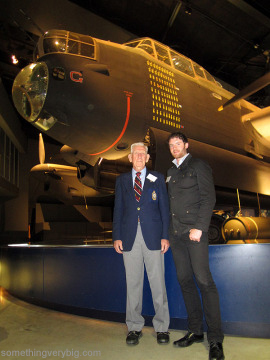
This was the fifth such commemoration to be held in the nation’s capital and the event has settled down into a familiar but effective pattern. G for George provided the setting for the now traditional ‘Meet & Greet’ function. There were indeed many people to meet and greet. Tommy Knox and Pat Kerrins, who I’d met here last year, were both there again. Don Browning and Ross Pearson traded their usual good-natured banter about which between the Halifax and the Lancaster was the ‘proper’ aircraft to have flown in (at least we all thought it was good-natured…). And I met a few new people too.

12-jun-bomber-command-in-canberra-007 copy

Early in the evening as I was wandering around to see who else I recognised, out of the shadows of the Lancaster’s nose came a man named Don McDonald, a 466 Sqn Halifax skipper from Melbourne, a veteran I had not yet met. He was a lovely bloke and we chatted about all sorts of things for a good while – and upon learning that I now also live in the southern capital he and his wife Ailsa promptly invited me to visit them for dinner sometime. You never do know who you will meet at these events! I also spoke with the former Commanding Officer of the reformed 462 Squadron, which was previously a Halifax squadron of Bomber Command and is now an electronic intelligence unit based at RAAF Edinburgh in Adelaide. The superb Striking by Night sound and light show was again played at the end of the event. The final moments of the production feature a WAAF speaking about the Australian airmen she worked with. “They were young… handsome…” she says, “…and full of life.” At which point Don Huxtable was heard to mutter “well two out of three ain’t bad…”12-jun-bomber-command-in-canberra-012 copy

Many of us repaired to the hotel bar at the Rydges after returning from the AWM. It was a memorable night, sharing beers with the two Toms Knox sitting on one side and Hux on the other as a great variety of stories, of both tall and short varieties, were told.

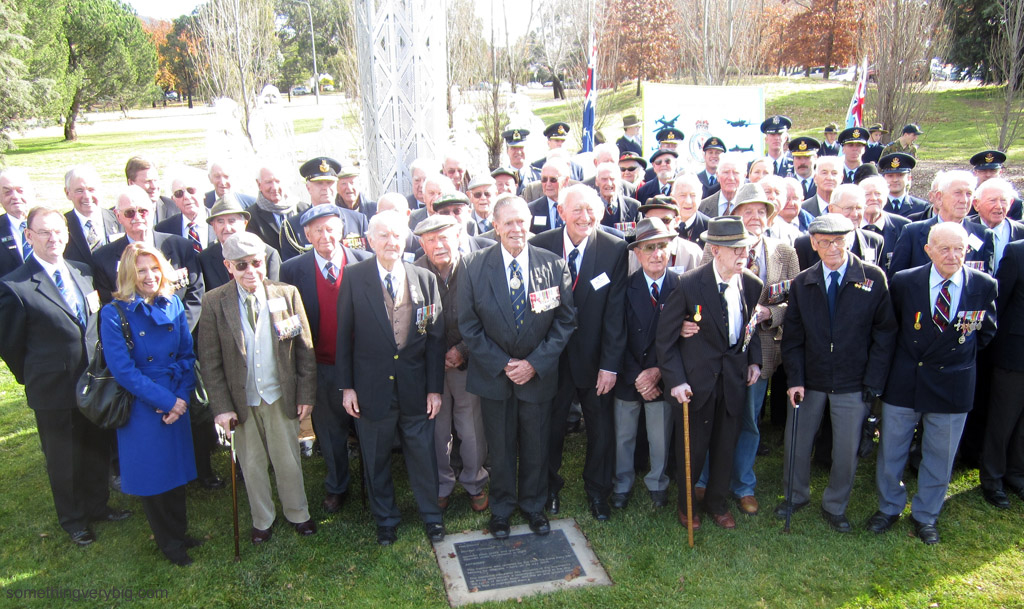
Canberra received almost an inch of rain on Saturday and it looked very much like it had set in for a week. But upon peering out of my hotel room window in the morning I saw a scene that was wet, but not actually raining. The clouds gradually cleared as the morning went on and in fact it turned out into a delightfully mild Canberra morning. The Commemorative Address was given by Air Marshal Mark Binskin, Deputy Chief of  Defence Force (and a former Chief of Air Force), who spoke about the legacy of teamwork from the men of Bomber Command, and how the Air Force has reformed two Bomber Command squadrons as a tribute. Fittingly a large group of 460 Squadron personnel were present standing in three neat rows at the back of the crowd. There was an attempt to get an official photo of all the veterans who were present but it was not as organised as last year’s effort:

12-jun-bomber-command-in-canberra-032 copy

Back to the Rydges, then, for the luncheon, always for me the highlight of the weekend. Despite the slightly lower numbers present this year, it is still one of the largest gatherings of Bomber Command veterans, families and other interested people in this country. Once again there were many extremely interesting people to talk to. I finally met Diane Strub of the Queensland Branch of the 463-467 Squadrons Association, and Fred Murray-Walker, whose father was killed in the crash of 463 Squadron Lancaster JO-G on the Scottish hillside in 1944. Peter Rees, a Canberra-based author who is currently finalising a book focusing on Australians in Bomber Command, was also there, and brought with him a magnificent folio of target photographs cheekily entitled “The Collected Works of 463 Squadron, as told to the Third Reich, September 1944 to May 1945”.

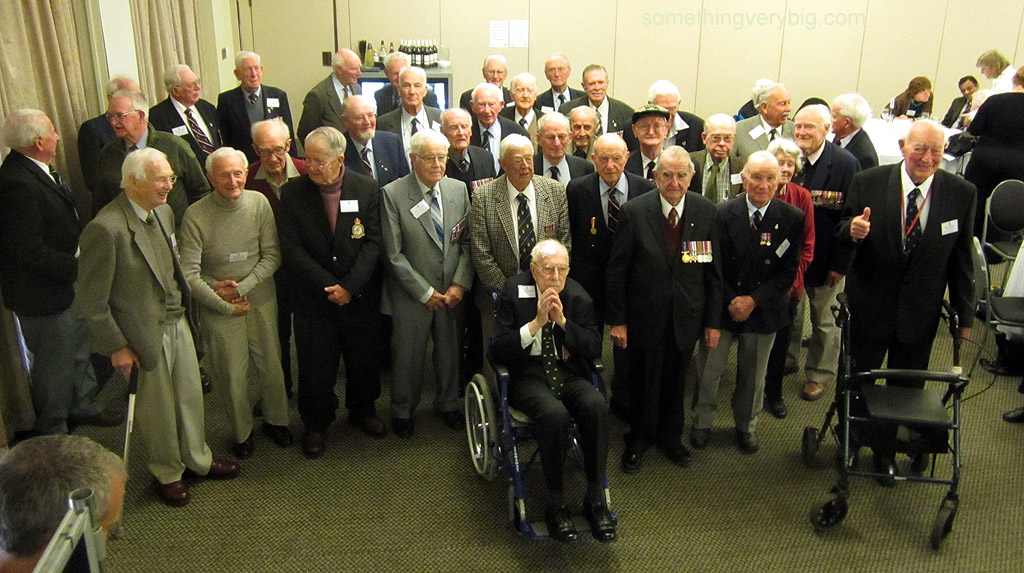
Perhaps the most remarkable person I met was sitting at a table at the back of the function room with her son and daughter in law. An Englishwoman, her name was Maude and, as it turned out, she had been on the staff at Bomber Command Headquarters – she was Deputy Commander in Chief Sir Robert Saundby’s secretary from 1943 until the end of the war. I asked her what the atmosphere was like at Bomber Command HQ. She said it was always busy – she was at work whenever her boss was and might – might – get the occasional half-day off on a Sunday if she was lucky. It was only a short conversation but it was an absolute pleasure to meet and talk to a unique lady. I even managed to convince her to get up for the group photo of all present who had served in Bomber Command (she is front right here, wearing red, behind Tommy Knox):

12-jun-bomber-command-in-canberra-066 copy

Some more photographs from the weekend:

Some of the crowd at the Meet & Greet function in the shadow of Lancaster G for George:

12-jun-bomber-command-in-canberra-010 copy

The Ceremony, in front of the AWM’s Bomber Command memorial:

12-jun-bomber-command-in-canberra-015 copy

The Three Dons: Don Southwell reading a copy of a ‘Tribute to Mr Don Huxtable’ as tabled in NSW State Parliament recently, while Don Browning and Don Huxtable himself look on:

12-jun-bomber-command-in-canberra-041 copy

Bryan Cook, Don Huxtable, Don Browning and Adam Purcell in Canberra, 03JUN12:

12-jun-bomber-command-in-canberra-048 copy

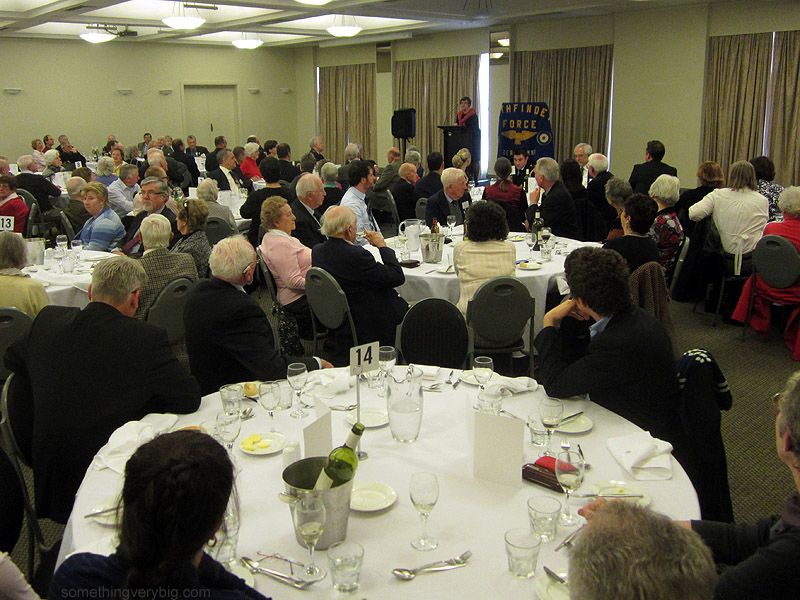
Part of the 220-strong crowd at the Lunch that followed the Ceremony on Sunday:

12-jun-bomber-command-in-canberra-052 copy

In all, then, another fine weekend of commemoration and friendship. Another pile of things to follow up on. Another piece of proof that, even after almost seventy decades, the deeds of Bomber Command live on. I’ll leave the closing words to Don Southwell, who delivered the Reflections address during the Ceremony on Sunday.

“I will always be proud”, he said, “that I flew with Bomber Command”.

Text and images (c) 2012 Adam Purcell