Three Lancasters

For an Australian, seeing even one Lancaster is something of an achievement. There are only two in the entire country – and they’re separated by some 2000 miles. So while I was in the UK in June 2010, managing to visit no less than three in about four days was pretty special. They were all around London – R5868 ‘S-Sugar’ at Hendon, DV372 ‘Old Fred’ at the Imperial War Museum, and PA474 ‘City of Lincoln’ at Biggin Hill. Each one inspired some sort of feeling, but not entirely as one might have expected.

Old Fred is the least complete of the three. In fact, it’s only the front cockpit section – forward of the main spar – that sits in majestic splendour on the second level of the Imperial War Museum in Lambeth:

30JUN10001 copy
This is of course the Lancaster that was immortalised by navigator Arnold Easton’s book ‘We Flew Old Fred – The Fox’. It has a personal connection for me as well, appearing at least once in the logbook of S/Ldr DPS (Phil) Smith, who led my great uncle Jack’s 467 Sqn crew. Jack himself was not on this operation but the rest of the crew were. I’m told that, except for a great big sheet of perspex over the flight engineer’s panel, the cockpit appears more or less untouched from the way it looked at the end of the war.
There’s another great big sheet of perspex across the end that seals off the inside from the sweaty hands of the thousands of school children who were visiting at the same time that I was. It also, of course, carries out the same protective function against slightly emotional relatives of bomber aircrew… like me.
30JUN10004 copy
I was pressed up against the plastic for some time, gazing at a bucket seat that Phil Smith sat in… a navigator’s desk like those Jack Purcell worked at… the knobs on the radio sets that wireless op Dale Johnston fiddled with. Half the aeroplane is missing, but standing there looking forward it wasn’t hard to imagine the three of them, plus the hulking figure of Ken Tabor at the flight engineer’s station (without the perspex) and, beyond those yellow railings, right up the front in the big bulbous blister, bomb aimer Jerry Parker. The chatter of the schoolchildren became the drone of four Merlins as the Lancaster flew through the night. There was definitely a connection here.

S-Sugar is an aeroplane that should evoke similar feelings. It’s certainly an aeroplane that was on squadron at the same time that my great uncle and his crew were. In fact I can almost imagine their anticipation at the prospect of a party in the mess when Sugar approached its 100th operation. Sadly, they were not to enjoy any celebrations, being shot down the night before Sugar chalked up its ‘Ton’.

The first sight, once you enter the main aircraft halls at the RAF Museum at Hendon, is certainly impressive:
29JUN10023 copy
But as I approached the aeroplane I saw tape blocking off one side. The Museum was doing work to their Bomber Command exhibition and so half the hall was closed. I couldn’t even walk a full circuit around the Lancaster. One of my favourite things to do when in close proximity to a Lancaster is to just walk around it, looking up. I think it’s got something to do with realising how big the thing is.

But I couldn’t do that on this day.

I don’t know why, but Sugar just didn’t have the effect on me that I was expecting it to. I couldn’t walk all the way around the aeroplane. There was the sound of power tools over on the other side of the hall (the side that was closed off). There was the ‘beeping’ of a moving cherry picker. The atmosphere – that I think the Australian War Memorial has captured with their Striking by Night display using G-George in Canberra – just wasn’t there.
I realise that here was an aeroplane that was at Waddington when Jack’s crew were there – it was even on the same operation to Lille from which they failed to return. But I found nothing there. The collection of metal bits and pieces looked like a Lancaster but I detected none of the ‘something else’ that I found at Canberra. It just wasn’t there for me. S for Sugar was a bit disappointing.

One aeroplane that definitely still has that something special is PA474. Unique amongst those Lancasters that I’ve laid eyes on, this one still flies.
I spent three weeks on the Bomber Command trail in Lincolnshire last year. Despite chasing it half way across the county, I failed on that occasion to see City of Lincoln in the air.

There was no way it was going to beat me this time around!

I thought the Biggin Hill airshow would be a pretty safe bet. When I arrived – early in the morning – I could see the Lancaster in the distance, parked somewhat improbably behind an Me 109:
27JUN10012 copy
The anticipation began to build.

The airshow was fantastic. All sorts of aeroplanes that we just can’t see in Australia, displayed in professional and entertaining ways. The large crowd lapped it up.

In the afternoon, England was playing Germany in the game that would ultimately send the Poms home from the World Cup. The airshow organisers had thoughtfully provided a few very big video screens on which to show the match.

The Lancaster started up and taxied out shortly after kick-off.
27JUN10083 copy
And do you know what?

Every person on that airfield had their eyes glued to the old bomber. The football never stood a chance.

There is something about the sound of a Lancaster at take-off power. You can’t look away (even if a contentious refereeing decision just cost England any chance they might have had of reaching the next round). The aeroplane made several low, slow passes with the grace of a beautiful lady in her element, the Merlins purring as she swept past. That silhouette is unmistakeable.
The crowd’s attention was wandering back towards the football after the Lancaster made its final pass. I kept watching though, as it headed into the distance. The wings became stumps, then they disappeared altogether and the aeroplane became but a dot. I was still watching as the dot disappeared over the horizon, the throb of those engines finally fading away. A minute or two later I was still watching, still searching, but it was gone.

I’d travelled half-way across the world, and finally I’d managed to see a Lancaster in the air.

Satisfied, I turned my attention to the big screen to watch the rest of the match.

27JUN10092 copyThis post originally appeared on the Lancaster Archive Forum (http://lancaster-archive.com/forum/viewtopic.php?f=11&t=2810&st=0&sk=t&sd=a&hilit=three+lancasters)

© 2010 Adam Purcell

Bicycle

Another update from Steve:

lancaster_7 copy

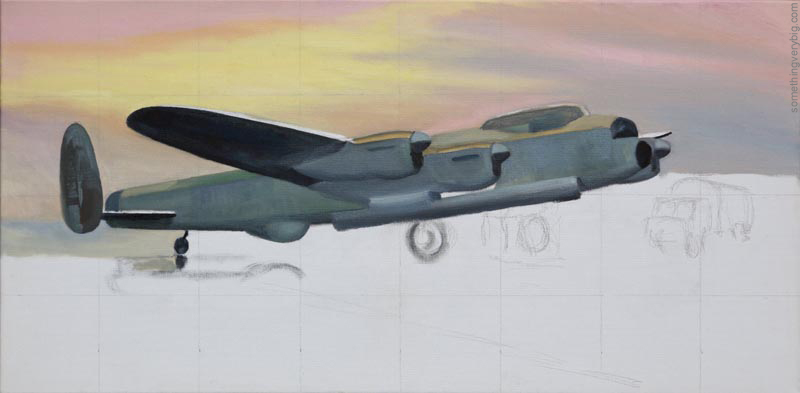
The crew are gaining some definition. There is even the hint of a ‘flare chute’ inside the door to the Lancaster. The saucepan shape of the dispersal pan is beginning to take shape. And you’ll see that the bicycle has arrived, leaning against some oil drums.

The bike is an important part of the story. I have documentary evidence that at least Phil Smith and Gil Pate had bicycles that they acquired during their time at training units. The RAF bicycle was ubiquitous around airfields – used to get around the sprawling sites, where accommodation could be a couple of miles from the mess, the briefing room and of course the dispersals. A great pile of bicycles outside a pub in the nearby village was a sure sign that aircrew would be inside.

There’s a personal connection as well – a bicycle has been my primary mode of transport around Sydney for the last five or six years, and my bike has come to define me almost as much as my flying does. So I thought a bicycle would be a nice personal touch to make the painting ‘mine’.

It is now very close to completion – hopefully I’ll be able to pick up the finished painting when I drive to Sydney next weekend.

Objects

”For me it is a strange emotional feeling to hold this knife considering where it has been and also the fact that it was a prized possession of my father when he was just 21 years old.”

-Clive Rattray, son of Lieutenant Kenneth Rattray, a Rat of Tobruk, on being handed his father’s wartime knife. From a story in the Sydney Morning Herald in October 2010 (link: http://www.smh.com.au/national/tobruk-knife-finds-way-home-20101016-16oat.html).

The knife in question had been lost for nearly 70 years. Lt Rattray carried it – a simple pocket knife, engraved with his name and his service history – through the Siege of Tobruk, then through Bougainville and to Darwin in 1943, when it disappeared. It turned up in, of all places, an English cinema some years later. It then disappeared again, before being found in an old suitcase in Kent in the house of the cinema’s former usher. The family of the usher was intrigued by the inscription on the knife and set about tracing its real owner – until, finally, just a few weeks ago, the knife was returned to Lt Rattray’s son.

It’s the story of the knife – seeing action in two major theatres of WWII, then its unlikely journey to England and its equally improbable return to Australia – that makes it so special. On its own, it’s ‘just another knife’, albeit one engraved with faint letters. But knowing its intriguing history somehow gives it extra meaning. It adds a human element to an otherwise unremarkable inanimate object.

I was reminded of this story when I visited the Powerhouse Museum’s Discovery Centre in Castle Hill in north-west Sydney for one of their recent monthly Open Days. I went along and enjoyed a tour of the warehouse – an esoteric collection of fantastic and fascinating objects covering Australia’s technological history.

Among the collections in the warehouse were a number of models of biplanes. They had been built, we were told by our guide, by a young man with a keen interest in aeronautics in the 1920s. The man later followed his dreams of flight, joined the RAF and flew fighters in WWII. He was shot down and disappeared over Crete. Many years later his son found some limited information about where his father was buried. He visited the island armed with only some bare facts – but he managed to find someone who was there when his father was shot down. Someone who, in fact, had sat with his father while he took his last breaths. It was a special moment for the son when the old man led him to the gravestone under which his father lay.

A very special story, then. Knowing the story of the man who built them gives the models something extra. It raises them above the wood, wire and fabric of which they were built. Like the Tobruk knife, they are otherwise ordinary objects that become representative of something more.

Incidentally, Steve Leadenham had a small stand in the main foyer at the Powerhouse and was displaying some of his work – which offered a chance to see the Lancaster painting in the flesh, so to speak. Steve was talking to a small group of people at his stand when I arrived back from the tour. The Lancaster was there too, on his easel. Underneath the canvas there was a small palette with smears of paint and a brush – evidently he had been doing a little ‘touch-up’ work. We talked for some time about the painting, the Lancaster and the men who flew it. Steve’s wife Glenda took a photo of Steve and I with the painting:

mg_6586-copy_1 copy

Encouragingly, Steve reported some good interest in the painting from some of the people who had wandered through. Some even asked about the possibility of getting a print of it. I was happy to hear that – it means that the story of B for Baker and her crew won’t be forgotten.

(c) 2010 Adam Purcell

Seven Crew


Here’s Steve’s latest update on the Lancaster. You’ll see our missing seventh crewman has been painted in, sitting on a kitbag. Steve says that at this stage he looks like he’s searching for something on the ground. The kitbag gives him away – it must be the navigator, who could usually be recognised by the large bag of maps and instruments he had to carry to and from the aircraft. Other changes in this update include a bit more definition in the shadows on the aircraft and some grass that has appeared in the foreground. Click on the image to enlarge:

little-lancaster_5 copy

I’m not sure how that seventh crew member got there, his bicycle isn’t evident yet… but Steve tells me it’s coming!

 This post was edited for clarity on 31 October 2010. Meanwhile, I’m now in Melbourne and, happily, I have internet access again. So, pending job commitments, posting on this blog should from now on be back to what passes for its usual schedule.

The Search for Eric Hill

In late November 1944, Gilbert Pate’s mother Kathleen received a telegram from the Royal Australian Air Force Casualties Department:

“FURTHER INFORMATION RECEIVED ADVISES THAT ONE AUSTRALIAN MEMBER OF YOUR SONS CREW WARRENT OFFICER R W PURCELL AND ONE ROYAL AIR FORCE MEMBER SERGEANT HILL ALSO LOST THEIR LIVES STOP THESE MEMBERS HAVE BEEN RECLASSIFIED MISSING BELIEVED KILLED” (A01-428-001)

It appears from this message that Jack Purcell and Eric Hill had both been identified and more or less confirmed dead at around the same time. But apart from the mention of his name on this and other similar telegrams, the Pates were told very little else about Sgt Hill.

When I first started this research, I also knew very little about the crew’s mid-upper gunner. Like Ken Tabor, Hill appears in the crew photograph:

a05-019-001-large copy

His record at the Commonwealth War Graves tells us that his parents were Frederick and Fannie Rebecca Hill, and that they came from North Weald in Essex. A simple handwritten note in Gil Thew’s archive (A01-373-001) gave an address for Fred Hill, at 18 Bassett Gardens, North Weald. In September 1944 his address was Station House, Goring, Reading, Berkshire (A01-074-001). When I visited the British Library in July 2010 I was hoping to use this information to search for an electoral record and perhaps find names of further members of the family living at the same address.

Sadly this was one of the records that the Library was in the process of moving to another location when I visited, so a new angle was required. Enter Dave Franks with his Ancestry.com membership.

Dave is a family friend who lives in Nottingham and who is working on his own family history. I stayed with him and his family briefly on my last trip and we were able to spend a great night bouncing ideas off each other and searching through ancestry.com. We found a family tree which included Eric Hill, submitted by a man named Harry White. While only very distantly related to Eric, Harry when we contacted him was able to throw some light on the man and his family.

Eric Reginald Hill was, he told us, born in Goring on Thames, Oxfordshire on 7 June 1921. His parents were Frederick Hill, a GWR stationmaster – hence living in Station House – and Fannie Rebecca Noakes, both born in Reading in 1882. They married in the same town in 1904. Harry knew of five children:

  • Winifred Margaret born about 1905 in Reading
  • Marjorie Kathleen born about 1910 in Didcot
  • Rita Ellen Francis born 1911 in the Wellingford Registration District
  • George C born 1913 in Reading
  • Eric Reginald born 1921 in Goring

There is another address on Gil Thew’s piece of paper (A01-073-001). It appears to read as follows:

 “C.J. Duncan, 6 Ulster Rd Gainsborough, Lincs England. Married daughter of Mr Hill”

None of the names from Harry White match those initials. This raises the possibility of either another daughter or, perhaps, I’ve misread a document somewhere.

At the time of writing this was all I had in the search for Eric Hill’s family. Possible avenues for further research from here could involve tracing any further children belonging to Eric’s siblings, chasing up the C J Duncan lead or even searching for a possible archive or other records belonging to the GWR.

(c) 2010 Adam Purcell

I’m now in the middle of moving and so internet access may be a little intermittant for the next little while. Please bear with me, and hopefully normal service can resume shortly!

I hate moving.

I’m in the middle of moving house interstate…  so everything’s all packed up and, mostly, in Mum and Dad’s garage. This morning I took down the B707 print from my wall… and so the flat is now looking rather depressing.

To cheer myself up, here’s the next update from Steve…

I’ve made some progress and a few revisions (see attached).  I decided the vast expanse of concrete was all rather too much and have resorted to the same fudge used in so many “dispersal” paintings – mud and grass and tyre ruts leading into the picture.  Still a lot to do there but you get the idea.  The GPU is there with an attending erk but not quite at the plugging in stage – I need to suggest the lead though. 

little-lancaster_41 copy

We have propellers! We have more Lancasters! We have an erk! We have a battery cart! We have (crucially) an entrance door into the aeroplane! We have… erm… (one, two, three, four, five, six) six crew!

Perhaps the seventh airman is pedalling furiously from the ops block on his bicycle…

Chipmunk

And now for something completely different. A few weeks ago I had the pleasure of going for a flight in a de Havilland DHC-1 Chipmunk. I know it isn’t quite connected with the overall topic of this blog, but I had a great time and felt I had to share it… Normal service will resume shortly!

 IMG_7035 copy

From the outside, it’s a very pretty-looking aeroplane. A narrow nose, with a single metal propeller. A single sliding canopy covering two seats. Beautifully shaped wings and the unmistakably de Havilland tail. It’s not a very big aeroplane, and it’s not particularly powerful, but it shaped a generation of British pilots in much the same way as its immediate predecessor, the famed Tiger Moth.

But inside the cockpit, underneath that narrow framed canopy, ‘pretty’ is not the word to describe the DHC-1 Chipmunk. The design dates back to the immediate post-war period in British aviation, and it shows. The concept of ergonomics simply hadn’t been invented yet and many of the controls are tucked into slightly bewildering places around the cockpit. The master switch is positioned on the sidewall, down near your left shin. Sticking out of the floor nearby is the brake lever – pull to activate, then push the appropriate rudder for something approximating differential braking. The mixture control is pulled aft to select fully rich – the exact opposite of more or less every other aeroplane ever built. The throttle lever has a little ball on top (helpfully marked with a “T” in the Tiger Moth fashion) and is mounted with the mixture lever on the left side of the cockpit. The flap lever, with a ratchet to keep it in place, is reached for with a nearly fully-extended right arm and pulled up like a really big handbrake. The designers did away with the need for a complicated mechanism to adjust seat height by simply bolting the seat firmly to the floor. If it’s too low for you, get some cushions. If it’s too high, bad luck!

Priming the engine on VH-AKB, the Chipmunk that I flew recently, is accomplished by the highly technical means of pouring a small amount of fuel into the carburettor intake (the original priming mechanism having long ago given up the ghost). Once settled into the cockpit, the start procedure feels like it needs four arms. You cradle the stick in the crook of your right elbow, while keeping pressure on the brake lever with your right hand. Your left hand cracks the throttle open, then moves across to the starter button which is positioned about as far away from the throttle as it physically can be, high up on the top right-hand corner of the instrument panel. Once the engine fires, that left hand needs to be quick to move to the throttle to ‘juggle’ it and catch the engine before it dies – otherwise you need to unstrap, climb out to reprime the engine, and try again.

Taxiing in this aeroplane is an exercise in coordination. Juggling the throttle and the brake lever with your left hand while holding the stick back with your right (as is essential in any taildragger), weaving down the taxiway to see past the nose and trying not to hit anything is quite difficult. Slow and steady is the answer. Hopefully you’ll manage not to bend the aeroplane before taking off.

But get the aeroplane in the air and all the niggles involved in its ground handling simply disappear. The controls are beautifully light – ailerons especially so. A standard turn requires very little control movement. Even an aileron roll can be flown with much less stick than I was expecting. Aerobatics are graceful in a Chipmunk. Sure, there are many more capable aerobatic aeroplanes out there. But not many have the combination of finely balanced ailerons, responsive elevators and sheer old-world charm that this one does. She loops, rolls, stalls, wings over and generally has a whale of a time. And that all-over canopy gives a beautiful view of the ground when you’re upside down.

Back to the airport, then, to see if modern-day spamcan pilots like me can land a Chipmunk. Like the Tiger Moth, this machine likes the ‘wheeler’ style of landing, with a trickle of power on, because the oleos soak up any excess sink rate on touchdown. The actual touchdown is relatively easy to judge. But the problems start once the aeroplane slows up and the tailwheel came down. The rudder is extremely light and it’s very easy to overcontrol, leading to some not particularly dignified swerving down the runway if you’re not careful. The second attempt – once you tell your feet to wake up on the rudder bars – is usually much neater. But slow down to taxi speed and once again you need to juggle that awkward but very British brake system to get back to the hangar. It’s almost like the aeroplane doesn’t want to stay on the ground, like it’s trying to convince you that up in the air is where it belongs.

One thing that Gypsy Majors like is oil. After some aerobatics, the engine bay of the Chipmunk certainly shows why:

IMG_7027 copy

Apparently that’s normal. Like all good vintage aero engines, if it stops dripping oil, it simply means it’s run out.

Despite her awkwardness on the ground, there’s no doubt that these aeroplanes have a certain ‘class’ that modern-day aircraft just don’t have. The heritage of the Chipmunk, stretching back to the Tiger Moth days, is certainly evident. Many pilots learnt to fly on aeroplanes just like this one in the 1950s and 1960s, and it’s great to try and capture some of that era of flying if you ever get the chance.

   IMG_7025 copy

(c) 2010 Adam Purcell

What Steve Did Next

Oh ok then. Here is another update from Steve’s studio:

Some more progress for you.  We probably need to start thinking about the guy working on the engine, the bike, etc.  I’m still looking to include one or two distant Lancs dispersed around the airfield.  Lots still to do, especially in the foreground.


lancaster_3-blog copyThe crew themselves are starting to appear, and the truck that brought them to the aeroplane is hanging around in the background. As for the erk working on an engine, I’m starting to think that a workstand might ‘clutter’ the scene a little too much, so I’m thinking of a few other options that will get him into the scene but not take over too much…

But looking good, no?

Lichfield

Among the small collection of photos that my family has belonging to Jack Purcell are two postcards from the English town of Lichfield. Both are unwritten and unsent. The only mark on either is a tiny cross in pen, at top right of this one:

lichfield3 copy

Jack was stationed at the nearby RAF Lichfield between 22 June and 9 September, 1943. The airfield – actually closer to the village of Fradley than to Lichfield itself – was the site of No 27 Operational Training Unit during the war.

The OTU stage of an airman’s training was where, in general, he first ‘crewed up’. The concept of the ‘crew’ is central to the Bomber Command legend – even transcending class boundaries in the RAF. Crews would, by the time they got onto a squadron, live together, play together, fight together and, all too often, die together. While officers and NCOs might have lived and messed separately, most crews socialised together when off-duty. In many cases airmen began strong friendships that would last them the rest of their lives.

But it took time for those uniquely close bonds to develop within the crews. The OTU was where it started and where the crews learnt to operate as an interdependent unit, but they were not there yet. As Don Charlwood wrote of his first flight at an OTU, in his superb book No Moon Tonight:

we were not a crew, we were a ‘plane load of bewildered individuals” (C07-035-023)

Consequently in many cases crews would not therefore come to regard their time on an OTU with any particular affection like they would their time on an operational squadron. The OTUs, it could be said, were the forgotten part of Bomber Command.

They were nevertheless an extremely important part of the Bomber Command machine. Many Australians passed through the gates of Lichfield. In the forecourt of Lichfield Cathedral is a memorial park bench which was paid for by Charlwood after the war. The plaque on it reads as follows:

“To the memory of the many hundreds of Australian airmen who trained at No. 27 Operational Training Unit Fradley during the Second World War. In Lichfield they found peace and friendship”

Years later Charlwood wrote a second, more thorough book of his time in Bomber Command called Journeys into Night:

“It always tantalized me when I gazed from the sergeant’s mess across the fields to the cathedral and thought of life going on in Lichfield, not as in peacetime to be sure, but at least with semblances of normality. Most of us were glad to escape [to] there” (C07-034-093)

While Lichfield will never be as famous as Waddington or Binbrook, it is clear that airmen like Charlwood understood its significance to the war effort and to the development of the crews of Bomber Command. It is also significant on a personal level for Jack Purcell, simply because of the existence of those two postcards.

Unlike the superb archive of letters and documents that I have been lucky enough to study from Mollie Smith and Gil Thew, we have very little bar a few photographs from Jack. I know he wrote letters while he was in the Air Force but what happened to them is unknown. These two postcards – though unwritten – are therefore particularly special.

So special, in fact, that in 2009 I visited Lichfield in an attempt to discover what the mysterious cross might have been marking. Chris Pointon of the RAF Lichfield Association was my guide. We first visited the Cathedral, in front of which was the park bench donated by Don Charlwood. Interestingly the bench is the only memorial to the OTU in the city – the building’s importance to the airmen seemingly less spiritual (as a religious place) than it was practical (as a prominent landmark nearby the airfield). Down a hill from the Cathedral we came to the Pond. At first Chris could not recognise the postcard – sixty-five years of tree growth has significantly changed the scene. But the road bridge with its three arches stands out. Walking towards it I could make out the distinctive façade of the Library and Museum through the thick tree growth:

01MAY09024 copy

And the cross? Standing in front of the Library, looking up the street, I spotted two buildings.

One is the Probate Court.

The other is the Angel Croft Hotel.

For some reason, I reckon Jack was marking the pub.

 01MAY09029 copy

(c) 2010 Adam Purcell

Hat tip to Chris Pointon for the idea that inspired this post.