Chapter One, Part Two: A Logbook By The Fire

At the time, it was one of those moments that did not seem all that significant.

In mid 1993, I was a not-quite-ten-year-old boy who was interested in things like astronomy, science and space travel. I lived with my parents and two sisters in a big brick veneer house in a semi-rural village in the Southern Highlands region of New South Wales.

On this day, the sun was not yet above the horizon when, for once the first in the family to wake up, I opened my bedroom door and walked out to begin getting ready for school. Outside it was cold, the kind of cold where when it’s raining the freezing drizzle sticks to your face, and when it’s not raining, thick white frost  covers the lawn and crunches underfoot. In the corner of the family room was our old wood-burning fireplace, which was lit around Easter each year and which we usually kept burning all the way until my mother’s birthday in October. It was normal in our household for Mum and Dad – who were both teachers – to leave important things at our respective places on the dining table, for us to find the next day. Normally they were boring but necessary things like lunch money or signed permission slips for school excursions, but this time I found something different. On that morning, by the glow of the fire’s smouldering embers, I first saw the box.

 Of the old-fashioned foolscap size, the box was made out of rather tattered green and black cardboard. It might once have held overhead transparencies or some other tool of the teachers’ trade, but on this chilly morning, as I curiously opened it I found it now held very old photographs.

There was one of a man in uniform who, I thought, if I squinted a bit and looked at it from just the right angle, bore a startling resemblance to my dad.

There was one of several dark and indistinct figures, dramatically backlit, standing in front of a big aeroplane.

There were several photos that showed what looked like graves, marked with white crosses and covered in flowers.

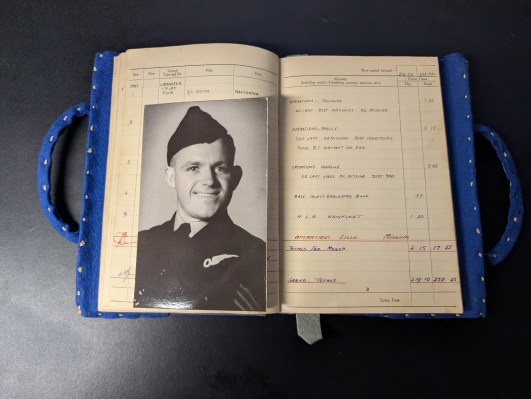
I found a small blue notebook in the box, too. Tucked into a hand-made cover of blue felt, the book was clearly old, its pages yellowed and brittle. It was filled with columns of numbers, times and unfamiliar place names, all inked in with a wide-nibbed fountain pen.

Nhill. Llandwrog. Lichfield.

Munich. Nuremberg. Berlin.

And on the final line, in red ink and different handwriting:

“OPERATIONS. Lille,” I read.

“MISSING.”

I had many questions for my father when he emerged from bed a short time later. Who was the man in the photograph? Why was he missing? And why did he look sort-of like Dad?

The man, it turned out, was “Uncle Jack”, and he had been a relative of ours. Dad told me that he had been in the Air Force , and that he’d been killed during the Second World War. The photos, and the logbook, were all that were left of him.

This post is part of a series, publishing writing originally completed as part of my now-discontinued book project. Find an explanation of the series and an evolving table of contents here.

(c) 2025 Adam Purcell

Chapter One, Part One: A Beginning, Of Sorts

From the very first day of the war, right up until the final week of hostilities in Europe more than five and a half years later, Royal Air Force Bomber Command operated on nearly every date in the calendar. It fought an exceptionally long war.

It was an exceptionally dangerous one, too. More than 125,000 aircrew served in Bomber Command; of those, at least 55,573 were killed in action or training. Thousands of the bombers that took off on bombing raids failed to return; from the majority of bombers that were lost there were no survivors.

Bomber Command fought in a way war had never been fought before, and in a way in which it will never be fought again. It was the biggest, most powerful aerial armada the world had ever seen – right up until the moment the first atomic bomb dropped on Hiroshima and rendered the whole operation instantly obsolete. There are several experiences that most veterans will mention when you ask them about their time in Bomber Command, things that together made the force a unique product of its time, place and context.

Some of these things might be the way you formed your own crew, for example, and the extraordinarily strong bonds that typically developed between the airmen thus joined. The high tension of the briefing room, with the collective gasps as the curtain was flung aside to reveal a long red ribbon stretching into the very heart of Germany. The ‘operational egg’, a genuine treat in severely rationed wartime Britain, and the predictable jokes about who would get yours if you didn’t come back tonight. The female drivers who ferried you out to your aeroplane, and the dread of waiting before take-off, with nothing to do except think about the upcoming operation. The sudden churning of your stomach as you heard the rear gunner’s voice in your headphones saying “corkscrew port, go!” The bomb aimer over the target, calmly guiding the pilot: “left left, steady, steeeaaaady… OK bombs gone, let’s get out of here!” The sudden silence and palpable sense of relief as the engines shut down after landing, and the dog-tiredness as you fell gratefully into bed as the sun came up. And then doing it again and again, all the while watching others simply disappear and knowing full well the high probability that you, too, would join them on the list of the missing well before you reached the magic number of thirty operations that entitled you to a rest.

It’s hard for anyone today to fathom just how dangerous a job it was. Consider this: in very rough numbers, your chances of dying by accident or some other external cause, on any one day, is approximately one in a million. The average RAF bomber aircrew, on the other hand, faced the same level of risk of violent death that you or I face in an entire day – one in a million – each and every second that they were in the air during an operation[1].

The longest operation in Jack Purcell’s logbook is a raid to Munich in April 1944 that lasted for a little over ten hours, or more than 36,000 seconds. That’s 36,000 times the daily risk of death for the average man on the street. Or, to put it another way, it would take you or I close to 100 years to be exposed to the same risk of death by external causes that a bomber crew faced on that single raid. And that was one raid, on one night, of a very long war.

This is something that still astonishes me, every time I think about the aircrew of Bomber Command. They were volunteers, every last one of them. They saw other bombers blowing up, they saw the empty places at the table the next morning. They could do the maths: five percent loss rates from every operation. 30 operations required for a tour. As one of them said, “we sort of end up owing them something…”[2] They knew the danger – and yet they went anyway, night after night.

What was it like, I wondered? What was it like to be a member of a bomber crew during the Second World War? What was it like to go to the other side of the world? To live on a wartime airfield? To knowingly face that level of risk, night after night?

What happened to these men happened within a unique and very specific intersection of place, time and context. Those things all combine with individual experiences to make what we call history. I suspect we cannot ever truly know wer es eigentlich gewesen – how it actually was – if we weren’t there, at that time, in that place, and influenced by that context. But any historical event leaves echoes that can be heard if you listen closely enough.

We can’t travel back in time. But nowhere, perhaps, are the echoes of the past stronger than in the places where the past happened. And that is somewhere to which we can go.

This post is part of a series, publishing writing originally completed as part of my now-discontinued book project. Find an explanation of the series here, and an evolving list of contents here.


[1] Taken from Blastand & Spiegelhalter (2013), The Norm Chronicles: Stories and numbers about danger. Profile Books Ltd Great Britain. p.17. They base the “one in a million” calculation on 18,000 recorded accidental deaths out of a population of 54 million in the UK in 2010. The RAF calculation is based on 55,000 deaths, 364,000 sorties and an average crew size of six. The figure is necessarily an approximation, but it’s a vivid illustration for our purposes.

[2] Charlwood, Don (2002), Australians at War Film Archive #0666. Accessed from http://www.australiansatwarfilmarchive.gov.au/aawfa/interviews/1767.aspx 13SEP12

An Announcement

“My ultimate aim with this research is to write a significant piece of work – a book – to tell the story of the crew of B for Baker.”

So starts a post on this blog that was written in March 2012.

That’s now more than thirteen years ago.

After I wrote that post, I spent a few years thinking about the idea of writing a book, then a bit of time thinking about actually writing it, and then maybe two more years organising and manipulating sources into something that I thought I might be able to turn into a coherent story. And finally, in July 2017, I started actually writing.

I wrote several thousand words, and then I pretty quickly realised I wasn’t getting anywhere useful, so I re-started my draft. And then I re-started it again, and again, so that the current file is version 5.

Ha, ‘current’. My laptop tells me the last time I opened my draft, before tonight, was on 6 June 2022.

I’ve not been able to prioritise this project enough to do something about it for more than three years. Heck, I’ve barely even posted on this blog.

Life has intervened, and other priorities have come up (not least of which, my partner and I are expecting a baby in a few weeks). I’m simply unable to make the time needed to finish a draft, edit it, and do all the other work that’s needed to get a book printed and promoted.

So, I’ve made a difficult but necessary decision. It’s time to stop kidding myself: the book about B for Baker that I was planning and working on is no longer going to happen, and I have accepted the need to abandon the project in its originally imagined form.

All is, however, not yet lost. I do still have that draft: all 56,000 words of it. And some of it, even if I do say so myself, is pretty good, actually. It seems a shame to just chuck that out without giving anyone else the chance to read it, without sharing the story of B for Baker, and what it was like for her crew, with a wider audience.

Like, say, the audience who reads this blog…

So though a book in the traditional sense is not going to happen, I’ve decided to share the guts of the story with you, right here. Over the next little while, I will turn each chapter of my draft into a series of posts, and then publish them one at a time. There will be no set posting schedule: you’ll get them as they come. The important thing is that the story will be out there, and seven more members of Bomber Command won’t be forgotten.

Because that, at the end of the day, is what I’ve been trying to achieve the whole time.

Let’s see how it goes!

An Evolving Table of Contents:
  • Chapter One: Beginnings
  • Chapter Two: Learning to Fly

(c) 2025 Adam Purcell

Just another name in a logbook

I’ve been trying to find more time recently to devote to my Bomber Command research – or, more specifically, to my Bomber Command writing. For several years the focus of that writing was this blog, but as those of you who’ve recently had to fight your way through the cobwebs and tumbleweeds to get here would know, there’s been not much of that over the last little while. I’ve had unrelated projects to work on which have taken much of my spare time in the last year or two in particular, but I’ve also been working on some Bomber Command-related projects too – including that book I’ve been threatening to write for a very, very long time.

One of the things about that is that, despite all that research over a couple of decades, there’s still stuff I don’t know. And as I’ve discovered, the best way for revealing exactly where the gaps are in my research is by trying to write about it. So occasionally, despite setting aside a day for “writing my book,” as I rather grandly call it, I have to hit the archives.

And that is exactly what happened yesterday.

For me, the concept of “the crew” and the surprisingly informal way in which they were formed is still one of the most fascinating things about Bomber Command. Putting equal numbers of each aircrew trade in a big room and telling them to sort themselves out was a remarkably effective strategy, and the generally accepted story is that, thus formed, crews stayed together through thick and thin, becoming as close as brothers.

The problem for me is that the evidence shows this is not what happened in Jack Purcell’s case. The pilot that he crewed up with at 27 Operational Training Unit (Lichfield) in June 1943 is recorded in his logbook as Flight Sergeant Saunders. But Jack had a new pilot by the end of his Heavy Conversion Unit course (F/Sgt J McComb) and, as we know, actually flew operations with yet another (S/Ldr Phil Smith). Somewhere along the way, belying if you like the “traditional” narrative, his crew changed.

Trying to write about this yesterday, I realised that I didn’t know what happened to Saunders. To fix that, I decided to go for a dig through my files. The first thing I needed to find was a full name. The 27 OTU Operational Record Book, fortuitously, lists the members of each course, along with the day they arrived and where they came from. Here I found my first clue. The only Saunders who appears in the lists for the period around when Jack was at Lichfield is AUS8687 Flight Sergeant A J Saunders, a pilot who arrived there on 1 July 1943.

Saunders’ service number is unusual: I would normally expect an Australian number to be six digits starting with a 4. Knowing that original documents are often hard to read or have errors, I checked what I had against the DVA WWII Nominal Roll. This revealed that the ORB was correct. Born in Charters Towers in 1917, Alexander James Saunders enlisted at Laverton in Victoria on 5 February 1940. Enlisting so early probably explains the unusual service number: perhaps the format had not yet been worked out at the time.

All I really wanted to know was where Saunders went after 27 OTU, so the list of postings in his Service Record at the National Archives of Australia would be sufficient for my purposes today. Unfortunately while that record exists, it hasn’t been digitised yet. It hasn’t even been examined for release. I could order the record online, but because there is a fee and a delay associated with that and all I really wanted was that list of postings, I decided to first check if there was any other way to find it.

What the hey, I thought. I’ve been lucky with Google before. I tried a simple search for his name and number… and found one little nugget of information that cracked the whole case open for me.

It’s hidden inside Volume IV of the so-called Official History of the RAAF during WWII[1], an account of an operation to an oil target at Wesseling on 21-22 June 1944:

A third Australian, Flight Lieutenant Saunders, also of 83 Squadron, was attacked six times by fighter aircraft before reaching Wesseling. (p.204)

In itself, this quote doesn’t show me much: there would have been more than one airman named Saunders. How do I know it’s the right one?

Happily for me, the author left a footnote, and that’s what made all the difference. “F-Lt AJ Saunders,” it says, “8687. 467 and 463 Squadrons, 83 Sqn RAF. Accountant, of Townsville, QLD”

There’s that strange service number again, which told me I’d definitely found the right man. And, more usefully, three squadrons are mentioned – two for which I happen to have full operational records.

I went to Nobby Blundell’s ‘Yellow Books’ which revealed that Alec Saunders and his crew had been posted to 467 Squadron on 31 October 1943. From here it was easy. Going to the original Operational Record Books, I discovered that Saunders flew twice as a second dickey before taking his own crew on one trip to Berlin on 23-24 November. A day later, they were all posted to the newly-formed 463 Squadron, with which they flew a further six operations. In early February 1944 they were posted to 83 Squadron, a Pathfinder unit.

Blundell records the names of the rest of Alec Saunders’ 467 Squadron crew:

  • A J Saunders (Pilot)
  • F D Redding (Flight Engineer)
  • J S Falconer (Navigator)
  • D D Govett (Bomb Aimer)
  • T A Sheen (Wireless Operator)
  • K G Tennent (Air Gunner)
  • D M Robinson (Air Gunner)

I cross-checked these against course lists in the 27 OTU Operational Record Book, finding records for four of them (Saunders, Govett, Sheen and Robinson). It makes sense that flight engineer Redding and second gunner Tennent wouldn’t be at the OTU because the aircraft in use at OTUs did not require flight engineers and had no mid-upper turret, so the extra men didn’t join the crew until the Heavy Conversion Unit. But what about Falconer, the navigator?

It took me a moment to make the connection: at OTU, the navigator was Jack Purcell. He is included in the course lists, of course, but he wasn’t on Saunders’ crew by the time they got to the squadron. Where did he go? And where did Falconer come from?

Amazingly enough, in my collection was another little gem of a piece of information which brought it all together. This is a page from Dale Johnston’s logbook, recording the names of his crewmates. Johnston was the wireless operator on the McComb crew – the bones of which became the crew of LM475 B for Baker:

Alastair Dale Johnston Flight Log-13

See the third name? The one that’s been scratched out and replaced?

Sgt J S Falconer.

Falconer was Paddy McComb’s navigator right up to the end of Heavy Conversion Unit. Then he disappears, to be replaced by…

Jack Purcell.

Purcell and Falconer swapped crews.

I don’t know why.

But for whatever reason, at the end of October or the beginning of November 1943, just before their final flights at Heavy Conversion Unit, two crews swapped navigators.

Falconer went off with Alec Saunders and his crew and survived the war.

Jack Purcell went off with Paddy McComb and his crew – and didn’t.

Such, I suppose, are the fortunes of war.

© 2020 Adam Purcell

[1] Herington, John (1963) Australia in the War of 1939-1945. Series 3 – Air. Volume IV, Air Power over Europe 1944-45, Australian War Memorial, Canberra. Available from https://www.awm.gov.au/collection/C1417318

Releasing the Brakes

The shadows were only just beginning to lengthen as Phil Smith released the brakes to let B for Baker roll from its parking bay. He’d done it so many times before – pulled the lever with his fingers, flicked off the catch with his thumb – but it was only now that he considered what it meant

This was it.

It had already been a long day. The tension – as if he had a lump of cold lead in the very bottom of his stomach – started with a phone call from Group Headquarters, telling him that the squadron was ‘on’ tonight. No matter how many times he’d done this, that lump of lead was always there. It sat in the background during the scramble to work out how many aeroplanes his Flight could offer for the coming operation, and through the endless meetings and conferences to thrash out tactics, and in a way he was grateful that he’d been so busy: it took his mind off what he’d be doing, where he’d be going, when the sun went down. But despite the distraction, the lump of lead grew larger as the day went on: by the time he’d been to the briefing, eaten the ‘Last Supper’ of eggs and bacon, pulled on his flying gear and climbed into the truck that took them to their aeroplane, it must have weighed half a pound at least. And then the wait, that endless, awful wait, sprawled on the grass next to the bomber: forced jokes, nervous laughter, cigarettes lit with shaking hands, with nothing to do except think about the coming operation. In that hour, the ball of lead in his stomach felt like it doubled in size.

But then he’d climbed up the ladder and into the aeroplane. Walked, crouching, up the angled fuselage. Scrambled over the main spar. Strapped himself into his seat and started the engines.

And released the brakes.

Pull, flick.

Everything that had happened today – the conferences, the briefing, the truck to dispersal – had been preparing for this moment. The armourers who loaded the bombs, the fitters who tuned the engines, the airmen who filled the fuel tanks, all had been working to a timetable based on this: the moment the aeroplanes started rolling and the raid began.

This was it.

Phil had flicked off an aeroplane’s brakes for a raid many times before. Fifty times, to be precise. And that fact meant that this was the last time he would have to do it. This trip – a short one, they’d said at briefing, just three hours return, a piece of cake really – was the last one of his second tour of operations. After that, he knew, he could no longer be compelled to do any more. He’d be posted to a training school for another stint of instructing, perhaps. Or maybe he’d be given a staff job somewhere. Maybe he’d even be sent home to Australia. That might be nice, he thought. It had been more than three years, after all.

But there was his crew to think about, too. They were all still on their first tours and most of them still had about ten trips to fly before they were done. If Phil finished tonight, he knew they’d all have to keep going without him. That meant they’d have a new pilot to get used to, a less-experienced man most likely, and it would take time before they were as efficient a unit as he knew they now were. Survival on bombers was at least as much about luck as anything the crew themselves brought to the table, but they at least felt that they could favourably influence their chances if they were as effective and careful as they could be. Having to deal with an unfamiliar pilot could be just enough to tip the delicate balance from surviving to not. Despite having more than done his bit for the war effort, Phil was in two minds about whether he was prepared to make the rest of the crew take that chance.

He would have to make that decision soon, he thought. But first, he had to complete one more trip, and it started the same way as every other one:

Pull, flick.

This was it.


(c) 2019 Adam Purcell

Book Review: From the Top of the Hill, by Kevin Peoples

Jack Peoples was nobody particularly unusual. One day in August 1915 the 18-year-old farmhand from country Victoria walked with his younger brother up a small rise near the family property. Leaving the younger boy at the top of the hill, he walked down the other side and into the nearby town of Mortlake to enlist in the Australian Imperial Force. He never came back, killed in action in France with no known grave.

The story was a familiar backdrop when a man named Kevin Peoples grew up. Sitting by the fire with his brother and sister, he would ask his father – who had been the boy who watched from the top of that hill as his brother Jack walked away – to “tell us about the day Uncle Jack went to war, Dad”. Aware of the shadow that the memory had cast on his father’s life, and aware of how little he knew beyond that oft-related vignette, Kevin would, after his father’s death, embark on a life-long journey to find the story of his lost uncle.

The result is a little blue self-published book named, appropriately, From the Top of the Hill, which I discovered after Tony Wright wrote about it in the Saturday paper a few months ago. It’s not a long book (I read it in a single afternoon), but it is a deeply heartfelt and honest account.

fttoth-peoples

Peoples breaks the book into three sections. The first is the shortest at just four pages and tells his father’s story, writing about how the “dark, solemn presence of Jack lived on the wall in the corner, directly above my father’s chair.” Oh how I can relate to that concept. The second bit (twelve pages) is what perhaps you’d expect from a self-published book like this: a reasonably straight account of what Peoples knows of Jack’s life. But it’s what comes next, and what makes up the remaining 45-odd pages of the book, that is what sets this little story apart.

Starting with watching his university history lecturer breaking down in tears when trying to describe the horror of what happened at Pozieres, Peoples explains how he came to understand something of what his father felt when thinking of Jack. He visits what’s left of the old homestead to which Jack never returned, describing how “the sad old ghosts of my people have come out to welcome us”. He searches in dusty files at the Central Army Records Office (this was in 1977, pre-National Archives of Australia online catalogues) for something tangible of his uncle’s life. He visits France, twice, and he watches as the Unknown Australian Soldier is entombed at the Australian War Memorial in 1993, feeling somehow that the man in the coffin is Jack even while knowing it’s pretty well impossible. “That’s the wonderful thing about being unknown”, he writes. “…we can all name him and claim him as our own.”

There are occasional little things that betray the book’s self-published origins: one or two typesetting errors, one photograph that’s been printed upside down, and some inconsistent editing: I’m not a fan of the way Peoples mixes the present tense with the past tense. But From the Top of the Hill is for the most part beautifully written, and occasionally reaches the eloquence of poetry. “I see a letter signed by my grandfather, which I push to one side and instead start writing down all the dates and statistics,” Peoples writes of viewing Jack’s files at the Central Army Records Office. “As I write I become conscious of an old brown couch, an open fire, long legs resting on the sides of the fireplace and a hill with a young boy sitting and watching his brother walk away.”

What’s clear is that Peoples realises the importance of place when trying to understand history. The description of his first return to the ruins of the family homestead hints of an even darker history to that place, nearby which 35 or more Aboriginals had been massacred in 1839. His first visit to France, in 1998, left him feeling like there was an “unease insisting this matter of Jack and me was not yet finished.” (Funnily enough, I can relate to that feeling too.) So he returned to France a decade later – and you’re going to have to read the book to find out what happens there.

I found From the Top of the Hill a sad but lovely tale, well-told. I can very much relate to several aspects of Kevin Peoples’ search for ‘Uncle Jack’, to his sense of story and place and to the way an old family story like this one can embed itself in your bones and not let go. Well worth a read.


From the Top of the Hill (ISBN 9780994570307) is available as a print-on-demand title from BookPOD Australia, $19.95


(c) 2017 Adam Purcell

Guest Reviewer

It’s been a bit quiet around these parts recently.

There have been several distractions in recent months, both Bomber Command-related and outside. A few things have changed. But never fear – I’m still here, and I continue to write, read, and interview my way across the Bomber Command universe.

Occasionally I even get asked to write things for other people – like this article, just in time for Christmas, for my good friend Andy Wright. It’s a review of Norman Franks’ new book Veteran Lancs, and you can find it on Andy’s website Aircrew Book Review.

Thanks for your support of SomethingVeryBig, have a wonderful Christmas and, all going well, normal service will resume here early next year.


Published!

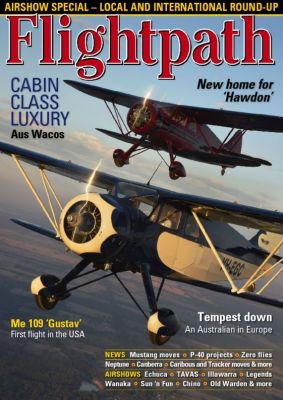
The August issue of Flightpath magazine (Vol 28 No. 1 – in newsagents now) includes a feature article that I wrote on Leo McAuliffe, an Australian fighter pilot who was killed over Holland in a Tempest in March 1945.

Leo,Harley & sidecar copy
Leo on a sidecar, pre-enlistment. Photo from Craig Bennett

I wrote a little about Leo here and here, and since I did that new letters, photos and even Leo’s logbook has come to light, shared by Craig Bennett, Leo’s nephew who lives in Cootamundra. I had put together a piece about Leo for my family several years ago, and Craig’s generously-shared collection gave me enough new material to update it – and that’s what you can now find in Flightpath.

Quite an exciting moment to see the new issue in the newsagent and open it to find my article inside! My grateful thanks to Craig Bennett, Chris Thomas and Andy Wright for making it happen.

416385832_lg

You can find Flightpath in most newsagents in Australia – or a digital version is available to purchase here

“Sablé bombardé : un Australien raconte” – some French media coverage for somethingverybig.com

Early last month I had just published my 467 Postblog Part LXXVI which covered an attack on a munitions dump outside the French town of Sable-sur-Sarthe on 6 May seventy years ago. I was subsequently contacted over Twitter by a journalist from “Les Nouvelles de Sablé”, a weekly newspaper based the town. Lucile Ageron was her name, and she was wondering how someone all the way over here in Australia might be sufficiently interested in her little town to write about it.

Truth be told, I’d never heard of the place until I saw its name in Phil Smith’s logbook (it’s not even in Jack’s – he mistakenly entered the target in his own logbook as Louaille, a nearby town, and he got the date wrong too). But it was a highly siccessful raid and some rather spectacular film footage of the raid has survived.

Having read my posts, Lucile sent me a list of questions, I answered them, and now she’s written an article for her newspaper. Particularly with the anniversary of the D-Day landings coming up tomorrow, it’s great to get a bit of media coverage for my little website – and of course for getting the story of the seven airmen in the crew of B for Baker out there once more.

If you can read French (or even if you can’t), an online version of the article can be found here.

467 Postblog: Final Wrap

The idea of writing a ‘real time’ project following the crew of B for Baker first came to me in late 2012. I’d realised the significance of 2014 as the 70th anniversary of the loss of the crew, and wanted to mark it in an appropriate way. A few weeks later I took the first steps in sorting through and assessing what information I had.

A year and a half, 102 posts and more than 81,000 words later, what has come out of the project? In pure blogging terms, I’ve seen a 50% increase in traffic – average daily views – since this series began. This is not to say that my traffic has ever been particularly high to begin with (let’s face it, it is a fairly niche subject), but I’ve been happy to see the level of interest increase as I’ve gone deeper into the story. Comments received through the blog have also been excellent and have produced some good contacts. It turns out there are more people interested in the Lille raid than I previously thought!

As I said right at the beginning, digital publishing is ideally suited to a project of this nature. 80,000 words is almost a book in itself, but I wouldn’t want to read all of these posts in one hit. Each post, by design, is really a stand-alone article (though it helps to have some idea of the back story to follow the thread). Publishing the story in chunks spreads out the effort of reading all that detail at once and, I hope, keeps the interest going.

The other advantage of digital publishing, of course, is that revisions can be made if and when new information becomes known. My copy of the ORBs in particular is sometimes not very clear to read and there are errors dotted throughout the original documents… and sometimes I’ve simply mistyped in either transcription or writing. In particular I am indebted to Graham Wallace of the Bomber Command History Forum who sent numerous corrections through as the project progressed. Thanks are also due to Chris Dean of the RAF Waddington Heritage Centre, who reminded me of the existence of the excellent ‘Waddington Collection’ of photos that follow the history of the squadrons on that airfield. Among others, the highly atmospheric photo of the bombers taking off from Waddington for Munich on 24 April 1944 came from that collection.

All in all, I think this was a very worthwhile exercise. I’ve researched and produced what is probably the biggest single piece of work I’ve ever written. I’ve gained a reasonably detailed knowledge of what those seven men were doing while they were on the squadron. I’ve been able to share the story of the crew, seven decades to the day since the events described, with a whole host of interested people, from all around the world.

And that was the main aim. While people know about them, the memory of those seven men will live on. If I’ve contributed to that in some way, I’ve achieved what I set out to achieve.


© 2014 Adam Purcell