It is right, that the nine men who perished that day, ready and willing to defend the United Kingdom, Australia, Canada and all those standing with us… are remembered with honour and dignity on the quiet walls of an English church.
With these words, Reverend Chris Harrington closed the service held last year to dedicate a memorial stone to the crew of 83 Squadron Lancaster ED439, which crashed in the English village of Scredington 71 years ago today.
I’ve posted about Scredington before, but I recently received a small package in the mail from the UK. Mike Galvin – Honorary Secretary of the National Service (RAF) Association, Lincolnshire Branch – sent me a DVD made up of footage that was taken on the day. It’s quite a production.
St Andrews Church in Scredington is fairly small, as these things go, though it does have an imposingly tall steeple. The building – decorated for the occasion with red white and blue RAF standards – can nominally seat 145 people, but somehow on the day they managed to squeeze 185 inside, including 33 relatives of six members of the crew. The ceremony appears to have gone off to plan. A reading from a book written by a local man who was a young lad at the time of the crash set the scene. Neil Trotter, the man whose childhood memories and dedication sparked the memorial project, addressed the congregation and made a point that resonates with the ethos behind somethingverybig.com.
Having retired after 37 years serving in the Royal Air Force, Neil wanted to find out what he could about the crash he remembered as a child. He wrote a letter which was posted online and, eventually, seen by someone who knew more of the story and got in touch. This contact came about because of the extraordinary reach of the internet. I’ve had similar success connecting with people from all over the world as a direct result of posts I’ve made on this blog. In part, that’s why I write here. It lets me get the story out to a much wider audience than has ever been possible before, and the power of search engines means that anybody with an internet connection can find it and get in touch. It’s certainly been a really useful concept for my research so far, as it was for Neil.
The main section of the video ends with the bugler inside the church. It’s been over-dubbed and merged with footage of the Battle of Britain Memorial Flight Lancaster making a fly-past over the village. The Merlins swell as the Last Post rings out.
It’s spine-tingling stuff, even if you weren’t there.
There’s a television news report from ITV available online here, and footage of the Lancaster flypasts here.
This post written by Squadron Leader (Retired) Ron Ledingham, Shrine Governer, Shrine of Remembrance, Melbourne, who I worked with on the committee which organised the Melbourne event
The annual Victorian Memorial Bomber Command service was held at the Nurses Memorial Centre (NMC) St Kilda Road Melbourne at 2 PM Sunday 1 June 2014.
All up some 100 people attended and we all but bulked out the NMC facility. The Shrine of Remembrance was unavailable due to the significant extension works currently underway there so the nearby NMC facility was chosen instead. The NMC staff were very helpful and of great assistance.
Of interest, as we did not have the traditional direct support of the Shrine facilities, we ported all of the service music requirements, etc to a lap top computer and ran this through the NMC integrated IT network-worked well. We also introduced specific Bomber Command popular band music and pictures from the Bomber Command Memorial in London-all well appreciated by those attending.
The Shrine did provide direct support in the form of:
SQNLDR RAAF (Retired) Ron Ledingham, Shrine Governor, as the convener of the service on behalf of the Shrine Trustees.
Supply of 100 poppies.
Printing of a number of Order Of Service (OOS) booklets.
Printing and distribution of a flyer for the service particularly since it was being held off site from the Shrine.
We also received support from the Air Cadets and had some 8 boys and girls with adult escorts who held banners and basically assisted with seating of guests and general support during and after the service.
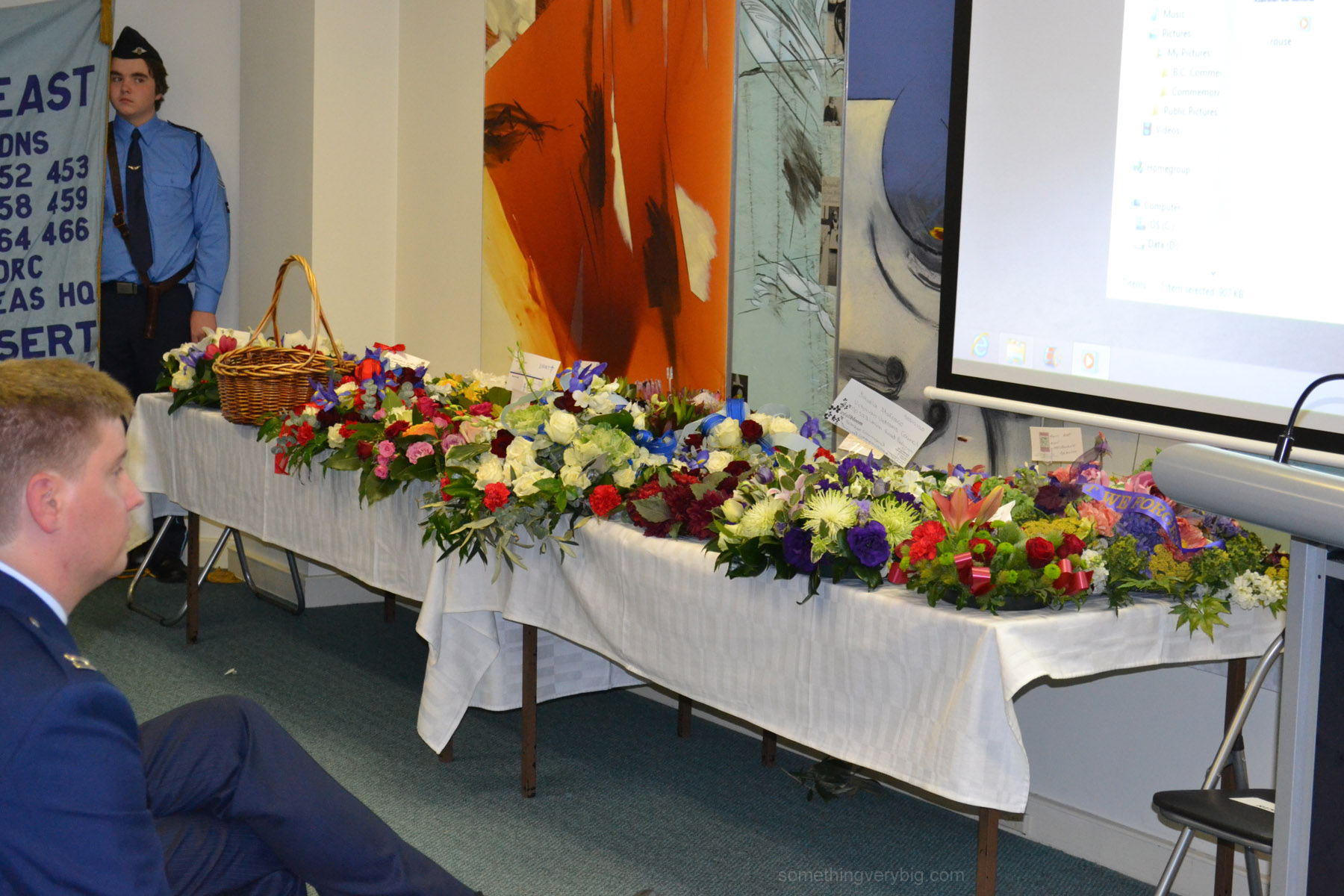
The list of dignitaries was most impressive including the Hon.Josh Frydenberg MP, Parliamentary Secretary to the Prime Minister who laid a wreath before departing to Canberra. Some 12-15 wreaths total were laid.
Wreathes at the Bomber Command Commemoration in Melbourne. Photo: Ron Ledingham
The service was opened and managed by Ron Ledingham . He explained why we were holding the service at the NMC in lieu of the Shrine and also pointed out that it was for this year only due to the extension works current being done at the Shrine.
There were three speakers being Wing Commander Peter Isaacson AM DFC AFC DFM (key speaker), Group Captain Terence Deeth as RAAF PAF Representative and the Hon Ted Baillieu, Chairman, Victorian ANZAC Centenary. All were very well received. Peter in particular was actively sought out by many after the service for signatures and conversations and delivered a very moving talk.
Peter Isaacson giving the Keynote Address Photo: Ron Ledingham
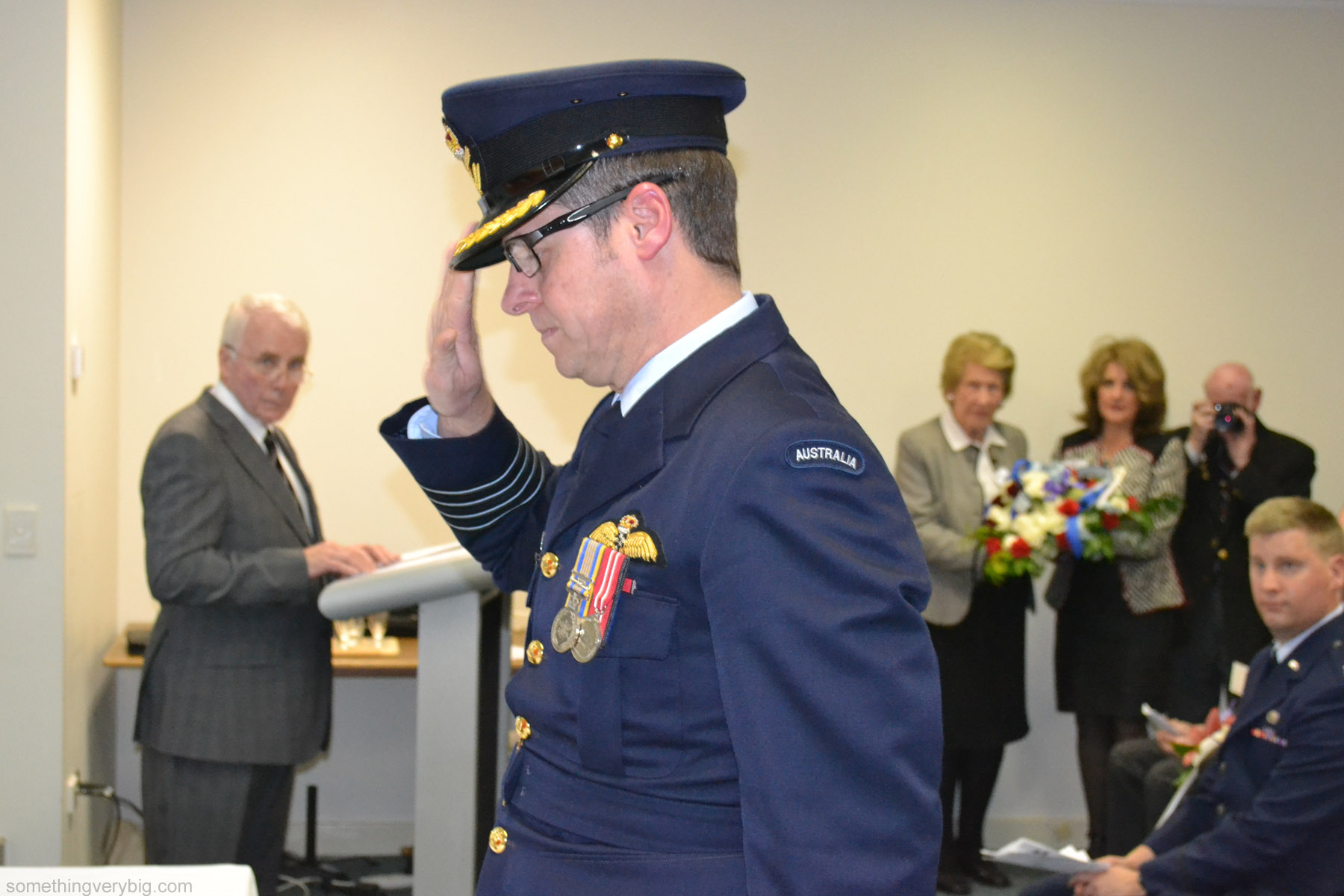
Group Captain Terence Deeth, RAAF. Photo: Ron Ledingham
The following people carried out official roles during the ceremony:
Key Guest Speaker Wing Commander P.S.Isaacson AM DFC AFC DFM
Chaplain John Brownbill RFD KSJ
Jan Charlwood Daughter of Don Charlwood
Laurie Williams Ode
Jan Dimmick Bomber Command Poem
Brian Smith MC
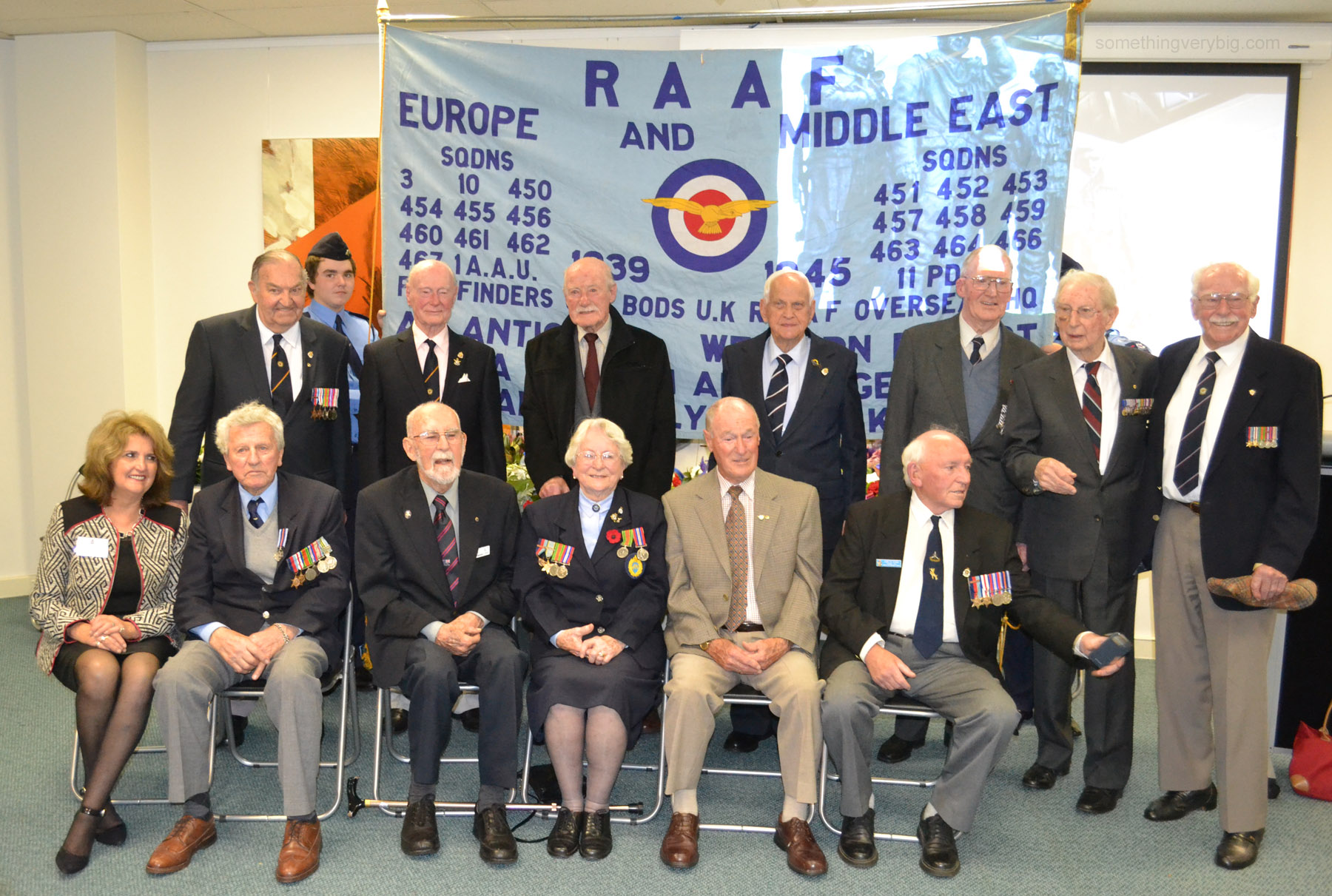
Following the service light refreshments with hot finger food were provided. This was also very well received and created a very interactive and friendly opportunity for people to mingle and catch up. A group photo was taken of all veterans present and many, many photos were taken.
Bomber Command veterans in Melbourne, June 2014. Robyn Bell, Committee convenor, front left. Photo: Ron Ledingham
The after service get-together proved to be just as important as the service itself and was considered by all to whom I spoke to be a key component and opportunity to care and share. I was personally approached by a number of people who really appreciated the service and efforts taken to pull it together as well as other questions and offers relating to the Shrine and memorabilia.
Overall it was a very moving and very well attended and received service function. The numbers were up by about 50% on last year even though it was held off site.
In 2015 the annual memorial service will return to the Melbourne Shrine of Remembrance.
On 10 April 1944, 467 Squadron joined a force of 166 aircraft from 5 Group sent to attack the railway marshalling yards in Tours in central France. The Tours trip occupies an interesting period of the bomber offensive when ‘precision’ targets were being attacked more frequently than big cities, so, springboarding off my earlier Tours post, here is an examination of how tactics developed during this time.
Tours and four other marshalling yards attacked that night were included in what was known as the Transportation Plan, part of the preparations for the upcoming invasion of Europe which by this time was less than two months away. The Plan called for the “destruction of thirty-seven railway centres in France, Belgium and western Germany, and especially of the locomotive depots and repair and maintenance facilities in these places, in order to prevent the flow of reinforcements and supplies for the German army in the invasion area.”[1] A key aim was the avoidance wherever possible of French civilian casualties, so accuracy was a priority (indeed, Max Hastings recounts the internal battles between Harris and Churchill on one side and Eisenhower and Tedder on the other about the ability or otherwise of Bomber Command to be accurate enough for the task[2]). The first railway target – Trappes in France – was attacked by 267 Halifaxes and Mosquitos on 6 March 1944 and over the next three weeks, Bomber Command would visit Le Mans, Amiens (twice), Laon, Aulnoye and Courtrai. By 10 May, the Lille raid was by my count the 43rd operation in the series, to a total of 26 distinct railway targets.[3]
For the first month or so of the Transportation Plan, the bombers used Parramatta tactics, very much like those used on German cities, where bombs were aimed at ground markers dropped by Oboe-equipped Mosquitos. The Main Force would attack in one or two waves, usually with a ‘reserve’ period in which the marking would be kept up for any late-running bombers. Crucially, on French targets crews were told not to drop their bombs until the markers went down and if no markers were visible at all, they were to bring their bombs back (as occurred for the second wave on Laon on 23 March). This was clearly an attempt to ensure bombs only fell, wherever possible, on the actual target and not on civilian housing nearby.
Though these attacks were in the main reasonably successful, there were improvements that could be made. Oboe was normally a sufficiently accurate system for city-busting raids but it was fiddly to work with, occasionally failed and was sometimes not accurate enough for precision targets like marshalling yards. If the markers went wide, so did the bombs – a situation seen to varying degrees at Amiens on 15 March, Aulnoye on 25 March, Courtrai on 26 March and Lille on 9 April. In an apparent attempt to reduce French civilian losses (and to avoid wasted effort), on 10 April a Master Bomber was introduced to direct the second attack on Aulnoye. In this case the Mosquitos still dropped their markers by Oboe but instead of then heading for home they stuck around to direct the bombing by radio.
This was, of course, the same night as the Tours operation. Tactics on this raid were somewhat different from the pattern which had become the ‘norm’. Surprisingly, no Mosquitos were sent to Tours and Oboe was not used. The raid was a 5 Group only affair. Lancasters dropped white ‘hooded’ flares to illuminate the ground, and the Master Bomber himself – flying a Lancaster – marked the target visually, by their light. The Main Force attacked in two waves and whilst the first part was highly accurate, the second was hampered by the smoke and flames caused by the earlier raiders and there was subsequently a delay while the Master Bomber re-marked the target.
The Tours trip occurred during a period of clear weather and a three-quarter moon, which meant reasonably bright conditions for bombing and resulted in accurate marking. The vast majority of subsequent railway operations were conducted with another refinement in tactics, which would have helped when the general light levels were not so bright. The pattern was set on 18 April 1944 on a marshalling yard at Juvisy, near Paris.
Oboe Mosquitos would first drop their ground markers, followed immediately by illuminating flares by Lancasters in the Newhaven style. The Master Bomber would assess the fall of the target indicators by the light of the flares, determine the required correction or even drop his own markers and instruct the Main Force to attack accordingly. The results, when everything went to plan, were immediate and effective. Juvisy suffered “immense” damage. On the same night, Rouen got “exceptionally severe” effects from a “magnificent” concentration of bombing.
The problem, however, was when things went wrong. At Tergnier, also on 18 April, the Oboe Mosquitos failed and the visual markers fell wide. So did the bombing. Communications between the Master Bomber and the Main Force were absolutely critical. It was an unwieldy system because if the Master Bomber was in a Mosquito he could not talk directly to the Main Force. The VHF radios in the Mosquitos were in relative short supply, so a ‘Controller,’ whose Lancaster had been fitted with one of the VHF radios, was required to relay instructions to the rest of the Main Force over standard radio and wireless telegraphy. When communications failed, so, on many occasions, did the bombing, such as what happened to the second wave at Villeneuve-St-George on 26 April and Malines on 1 May. But when everything worked it proved most effective in highlighting which target indicators the crews should aim at. On 6 May, for example, 143 aircraft attacked the marshalling yards at Mantes-Gassicourt. The first Oboe marking failed so the illuminating flares dropped first, followed by three loads of target indicators which were scattered wide of the aiming point. Crews were ordered to bomb in between all sets of markers, until a salvo of reds landed bang on the aiming point. The Master Bomber was able to adjust and instruct crews to aim at the new, accurate, markers, until more reds fell off the target. The resulting confusion was resolved when a set of white markers was dropped accurately, but by now smoke and fire obscured all the indicators, so the Master Bomber ordered crews to simply aim at the fires. Had the Master Bomber not been there, or had the radio been jammed or otherwise unavailable, the raid would certainly have been far more scattered than it was.
The other issue with direct marking of the aiming point happened when the bombing was, well, too good and the markers were obscured by smoke. This, of course, is what happened following the first wave of the attack on Tours, and it happened again at La Chappelle on 20 April. On this occasion the aiming point requiring remarking slightly away from the original target indicators.
Yet another development in target marking was devised to counter this. It was first deployed in an attack against an airfield at Lanveoc-Poulmic, near Brest, on 8 May.[4] Here the markers were deliberately dropped upwind of the actual aiming point. The Master Bomber would determine how far away and in what direction from the aiming point the markers had fallen and then calculate a ‘false bombing wind’ which could be fed into bombsights. The theory was that, if the sight was aimed at the marker, the adjusted wind setting would ensure that the bombs themselves landed on the real aiming point. It was a good theory and the resulting bombing was highly accurate. The only problem was that it took time for the markers to be dropped and assessed and for the false bombing wind to be calculated. The Main Force was timed to arrive having allowed sufficient time for the process to be completed but it needed good communications and good timing from all crews to be practical.
The next night the new system was used again. The date was 10 May 1944, and the target was Lille. Like the Tours trip, this used slightly different tactics to others in use at the time. While the three other railway raids carried out on the same night (to Courtrai, Ghent and Lens) all used Oboe Mosquitos, the target at Lille was marked visually under the light of illuminating flares – a classic Newhaven attack. Unfortunately what happened was exactly what offset marking was intended to avoid, when the first markers were extinguished by the early bombing, perhaps because crews were not yet used to the new tactics and simply forgot to apply the correction. After a short period the master bomber called a halt to proceedings so that new markers could be dropped, but it appears the resulting delay of some 20 minutes allowed the defences to get their act together, and they extracted a heavy price. Twelve out of 89 aircraft failed to return, among them B for Baker.
Early last month I had just published my 467 PostblogPart LXXVI which covered an attack on a munitions dump outside the French town of Sable-sur-Sarthe on 6 May seventy years ago. I was subsequently contacted over Twitter by a journalist from “Les Nouvelles de Sablé”, a weekly newspaper based the town. Lucile Ageron was her name, and she was wondering how someone all the way over here in Australia might be sufficiently interested in her little town to write about it.
Truth be told, I’d never heard of the place until I saw its name in Phil Smith’s logbook (it’s not even in Jack’s – he mistakenly entered the target in his own logbook as Louaille, a nearby town, and he got the date wrong too). But it was a highly siccessful raid and some rather spectacular film footage of the raid has survived.
Having read my posts, Lucile sent me a list of questions, I answered them, and now she’s written an article for her newspaper. Particularly with the anniversary of the D-Day landings coming up tomorrow, it’s great to get a bit of media coverage for my little website – and of course for getting the story of the seven airmen in the crew of B for Baker out there once more.
If you can read French (or even if you can’t), an online version of the article can be found here.
As I headed north up the Hume Highway from Melbourne early on Saturday morning, thin mist was still settled in low valleys and smoke rose directly upwards from the chimneys of roadside homesteads. It was an atmospheric start to my journey to Canberra for the annual Bomber Command Commemoration weekend.
This was the seventh time that the first weekend in June saw Bomber Command veterans, families, researchers, authors and assorted hangers-on converge on the national capital for a weekend of remembrance and reminiscing.
My base for the weekend is no longer called the Rydges Lakeside. It’s been turned into a slick, shiny and slightly pricier hotel called “QT Canberra”, full of odd political references and surprise images of photographers in the lifts. But I digress. On arrival at the hotel I quickly found my first veteran for the weekend, a man named Kevin Dennis. He was wearing, amongst the more usual service medals, an unfamiliar decoration hanging from a light blue ribbon – a Conspicuous Gallantry Medal. More about him later.
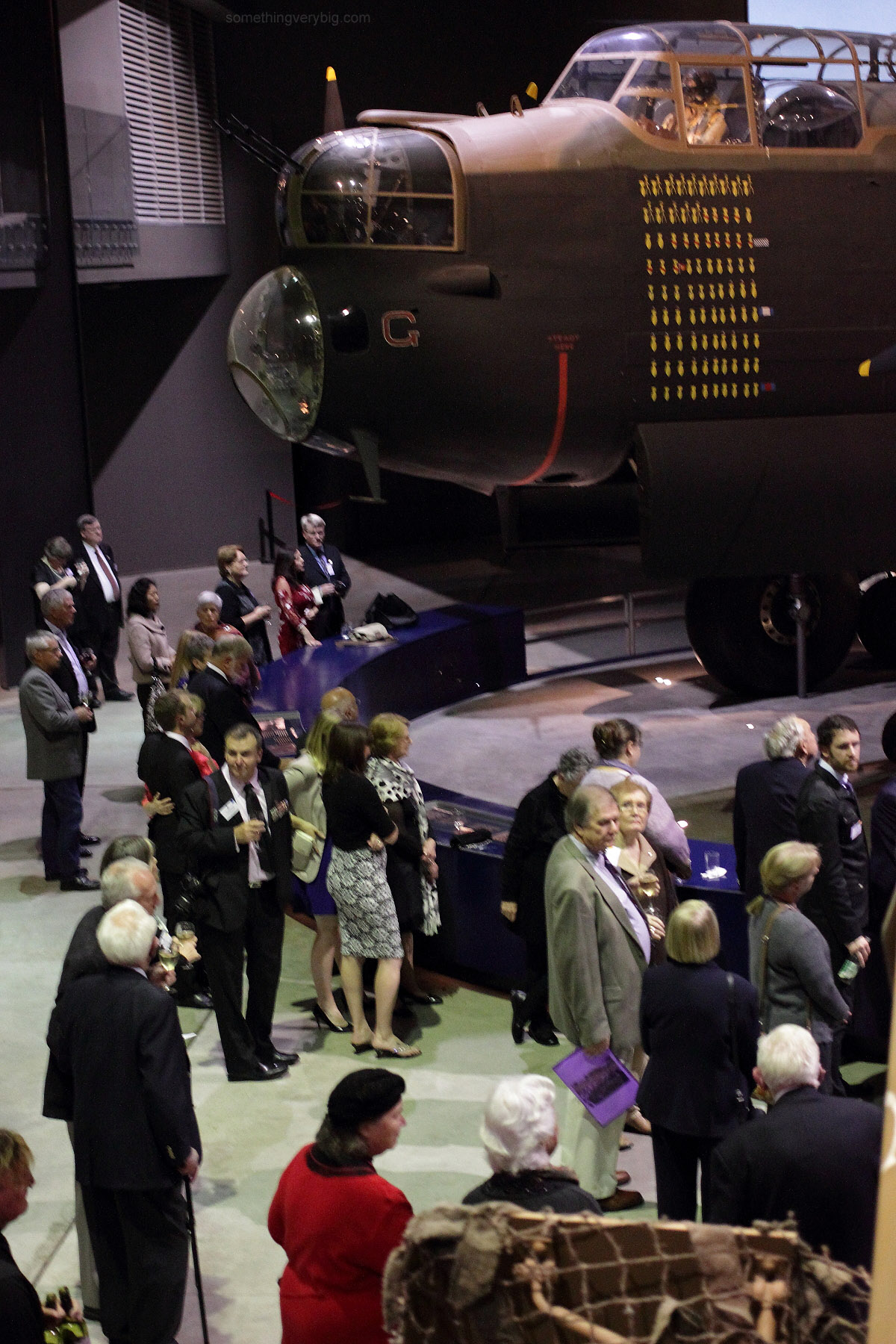
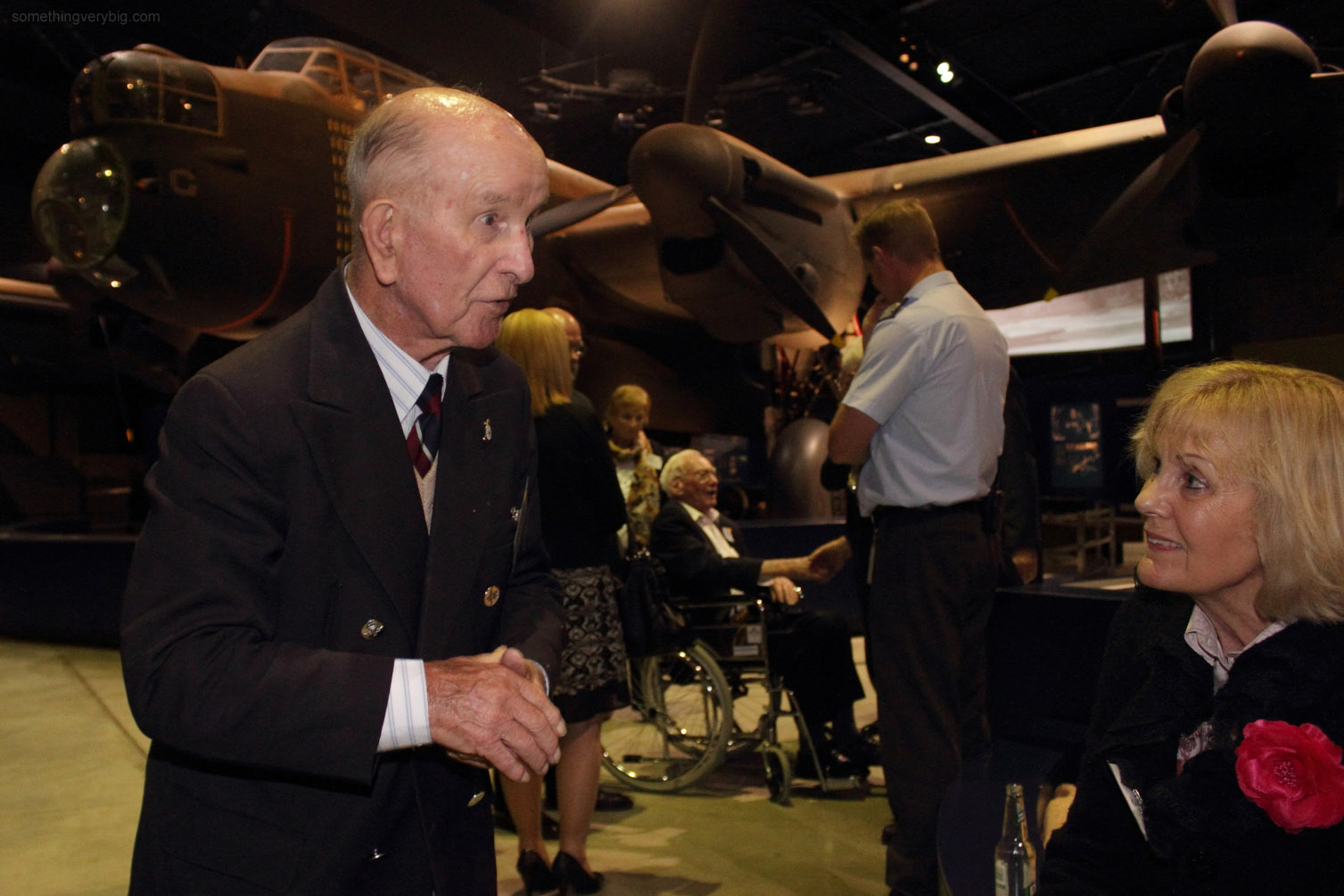
Off to the weekend’s first organised event, then: the Meet & Greet function in the shadows of Lancaster G for George at the Australian War Memorial.
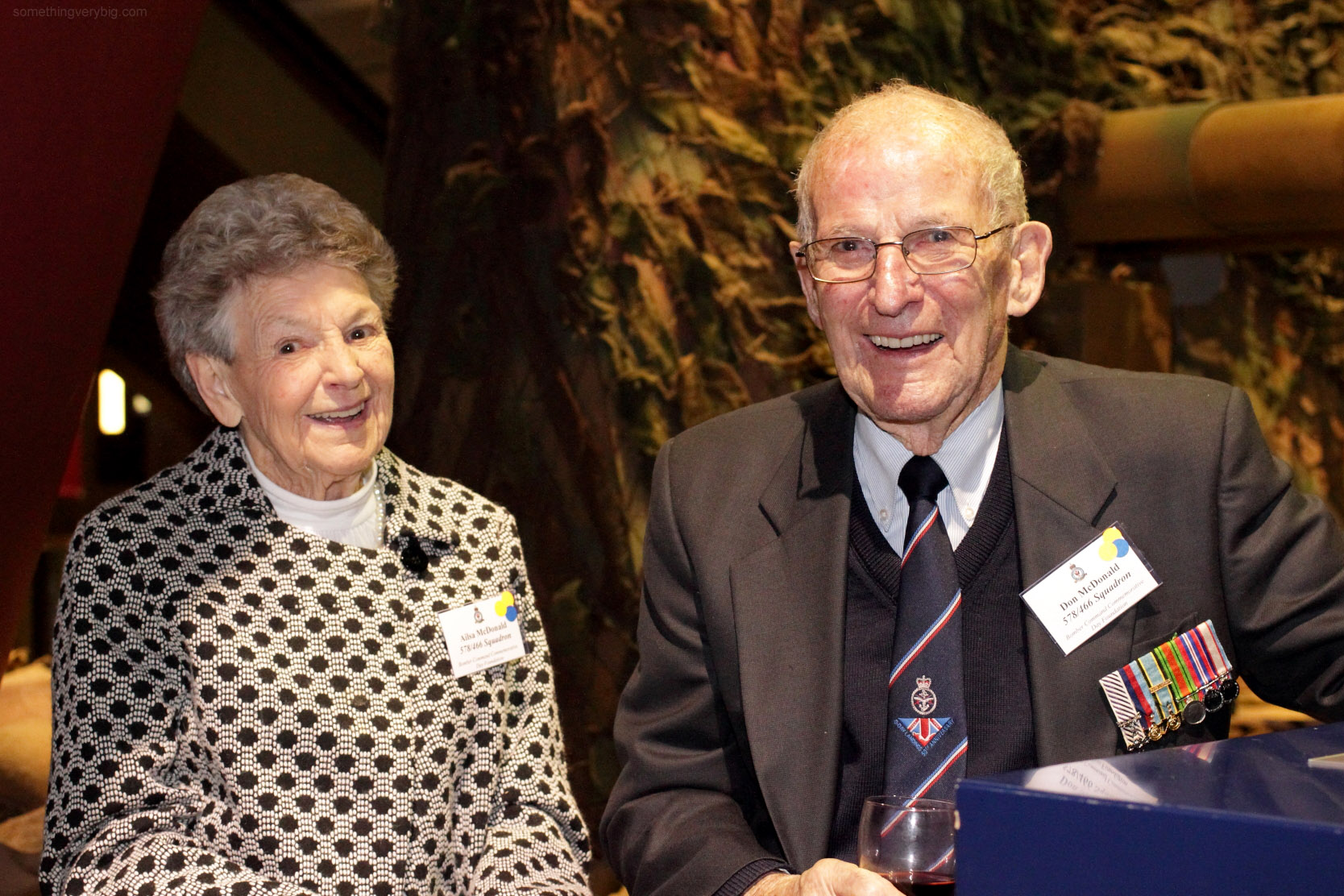
The crowd under G for GeorgeAilsa and Don McDonaldThe two Toms KnoxTommy Knox
It was an excellent function. There was a good-sized crowd present, the speeches were (like a good skirt) short enough to be interesting but long enough to cover everything, the food was good and there were some very interesting people to talk to. At one point, down near George’s tail I was talking to Tom Hopkinson, a 463 Squadron veteran mid-upper gunner. Two ladies approached: Lorna Archer and her daughter Rowena. Lorna’s husband Ken was a 460 Squadron bomb aimer. He is still alive but, at 90, is now too frail to travel and stayed at home in Melbourne this weekend. Lorna wanted to know, if Ken was in a Lancaster and it was hit and he had to bail out, how would he do it?
A fair question. I had a pretty good idea of the answer, but, well, we were standing under a Lancaster and we were talking to a man who used to fly in the things and so… well… why not? I asked Tom if he would like to do the honours. So we weaved our way through the crowd to the nose of the great big black bomber. Tom pointed up. And there, under the nose was the big square escape hatch through which the bomb aimer would have, if the circumstances dictated, been the first out. Which answered the question in a most satisfying manner.
Tom Hopkinson explaining how a bomb aimer would evacuate a Lancaster
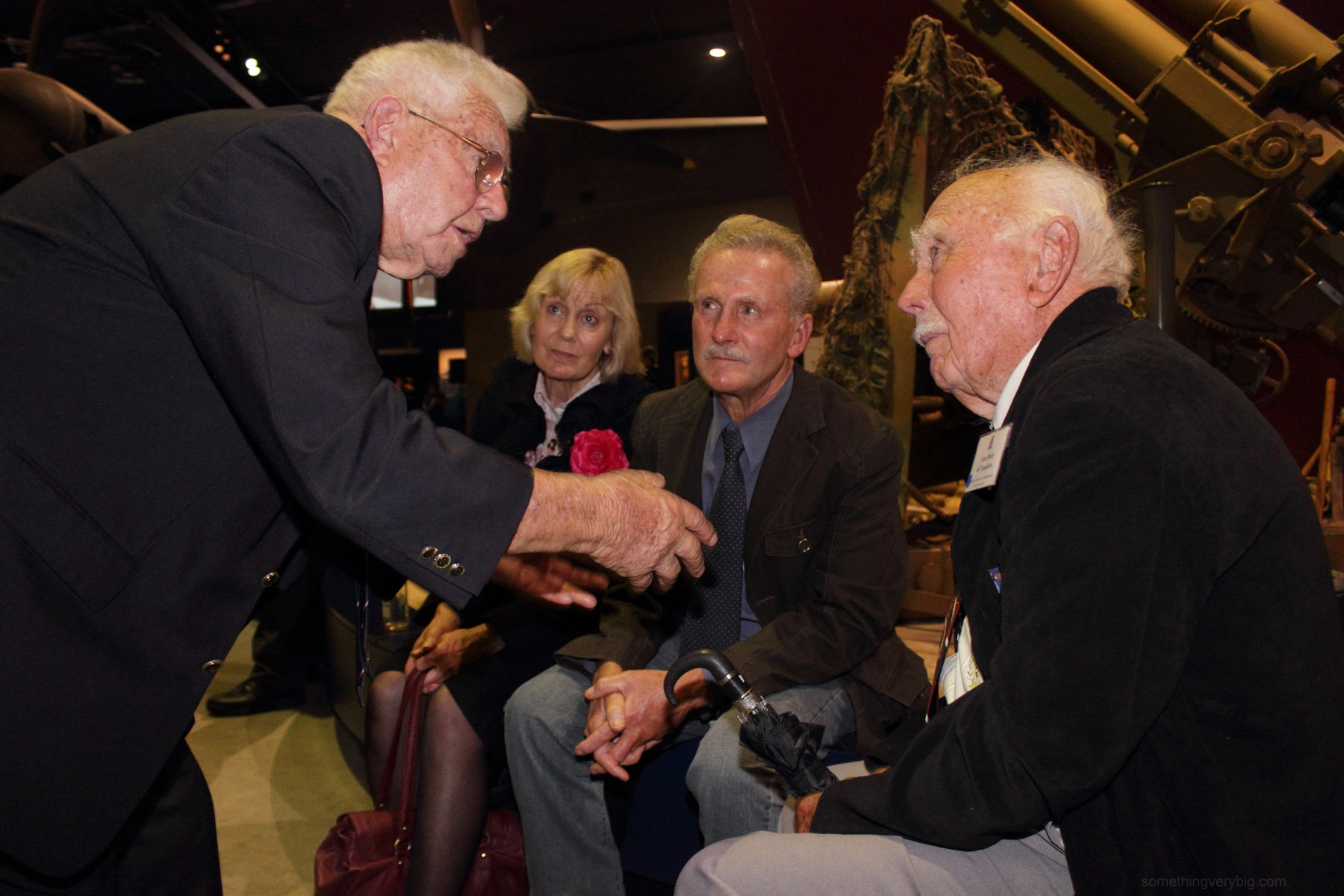
Towards the end of the event, I spied an old man sitting down surrounded by family under (of all things) the German 88mm flak gun that’s on display next to George. His name badge said Alan Finch, 467 Squadron. Good enough for me, I thought. So I sat down and introduced myself. When Alan said he had done his first operation in August 1943 and had remained with the squadron throughout 1944 his name suddenly sounded strangely familiar.
I love modern technology. I pulled out my phone and searched for his name on this website. And there it was: I’d used two of his interrogation reports in my 467 Postblog series. I asked Alan, “Where were you on 24 February 1944?” He responded, “In the air!” Correct! Specifically, Schweinfurt. “Oh yes”, he said, “that was a bad one.”
Alan Finch, 467 Squadron pilot
No kidding. As I wrote here, his aircraft was coned over the target by some 24 searchlights. “Target more formidable than briefed,” he reported nonchalantly on return to Waddington.
This is why I come to these events. I’ve become quite familiar over the last few months with the names of the aircrew who were operating at 463 and 467 Squadrons between January and May 1944. I never suspected that I might run into one of them, sitting under the wing of a Lancaster at the War Memorial.
Laurie Woods talking to Alan Finch
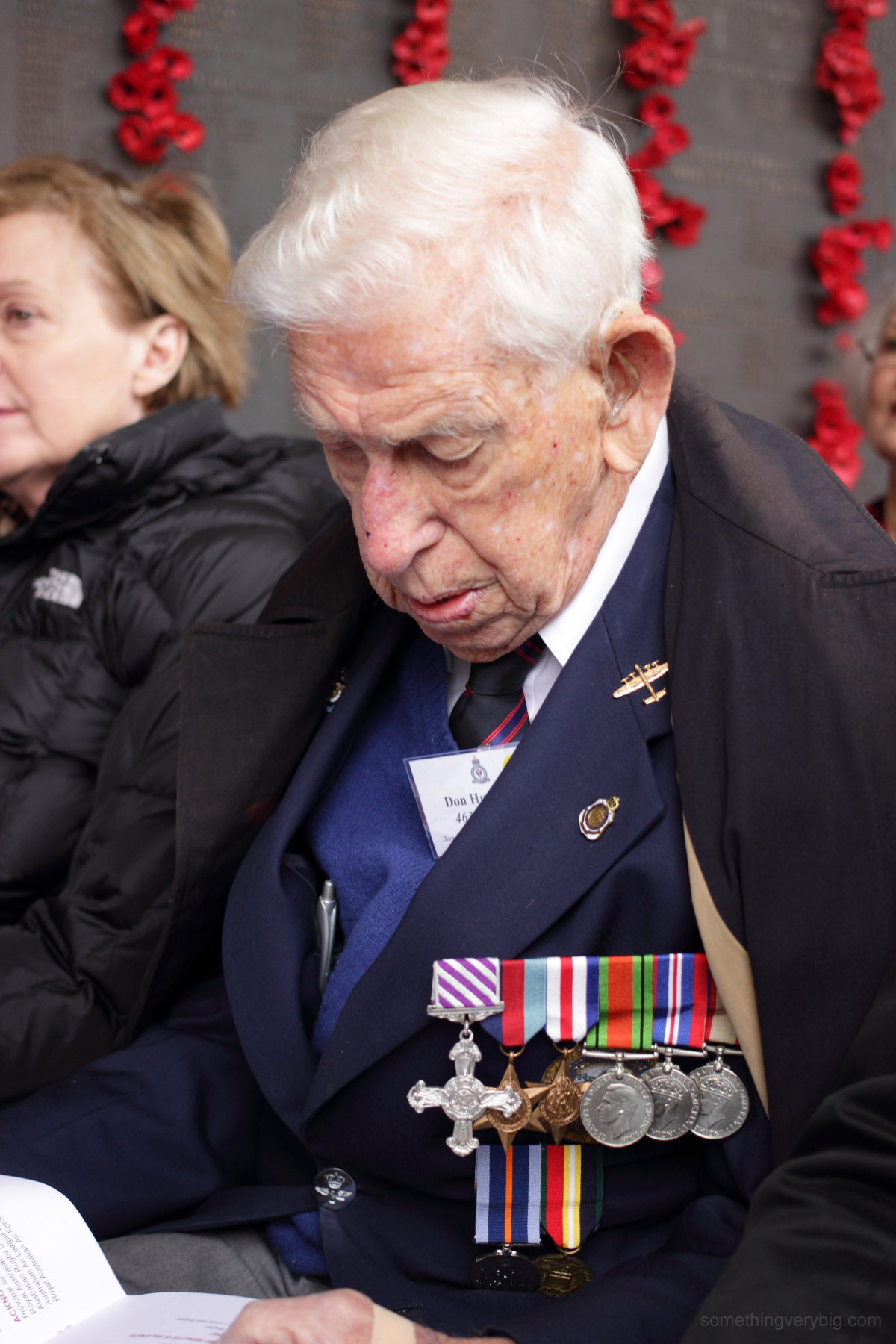
Following the function, a fair sized group of those who were staying at the QT met in the hotel bar for a wee nightcap. What followed was one of the better sessions I can remember in some time. Holding court in the corner near the fire was, yes, Don Huxtable. Gathered around him, most of the younger crowd (that is, those under about 60…). Over beers, scotch and sodas the night passed quickly with many, many line shoots.
Don Huxtable, Nikki Harris and Don SouthwellHux and Nikki
Numbers dropped off as the night got later but, still there as the bar staff called last drinks, were an old pilot and his entranced audience.
Dawn broke in Canberra the next day with cloud, mist and rain. Telecom Tower was disappearing into the grey skies.
Where’s Black Mountain Tower going?!??
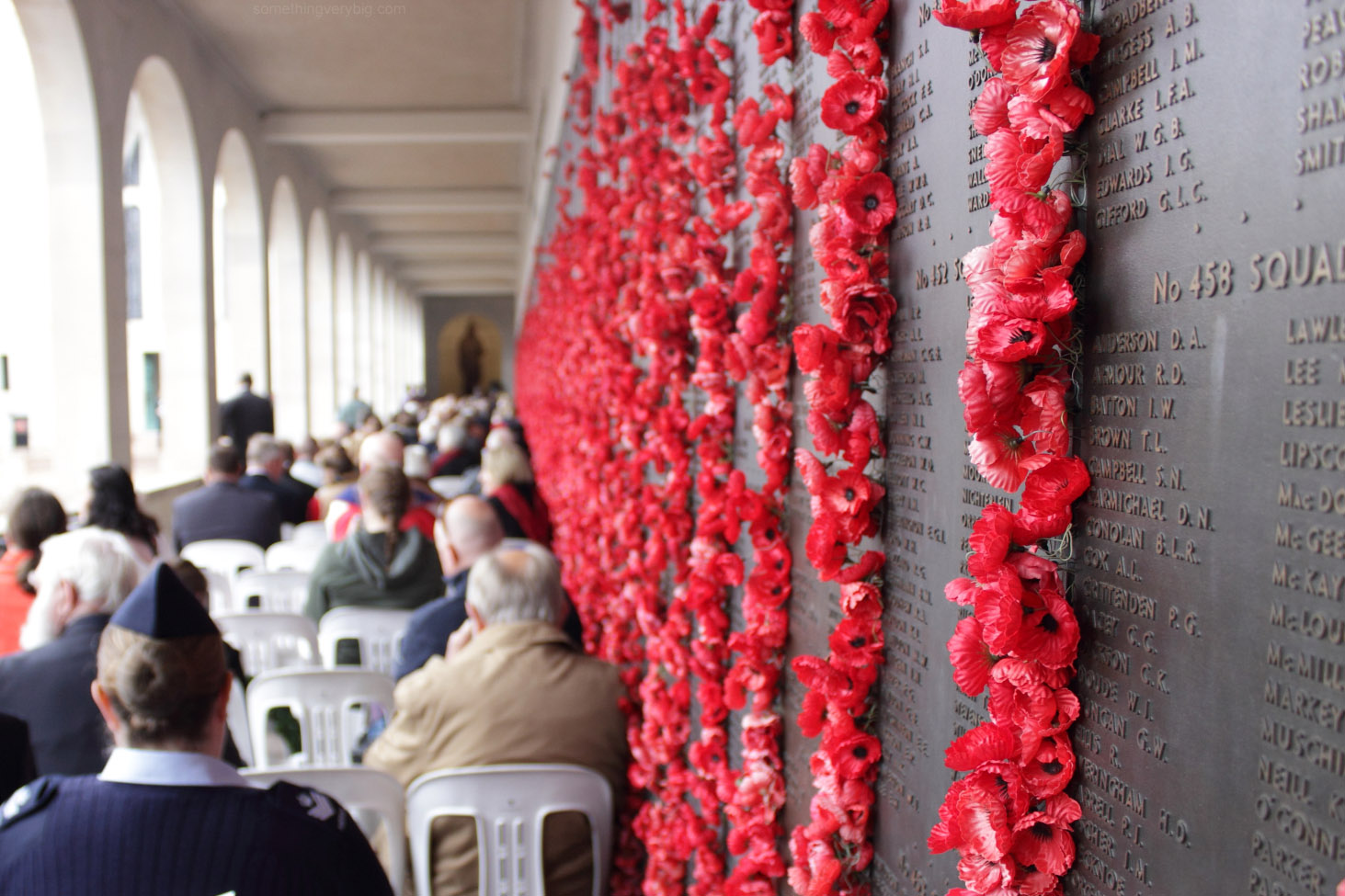
This did not bode well for the morning’s ceremony, planned for the lawn in front of the Bomber Command sculpture at the War Memorial. The decision was made early to move the ceremony to the Commemorative Area, with rows of chairs placed in the cloisters under the names on the Roll of Honour.
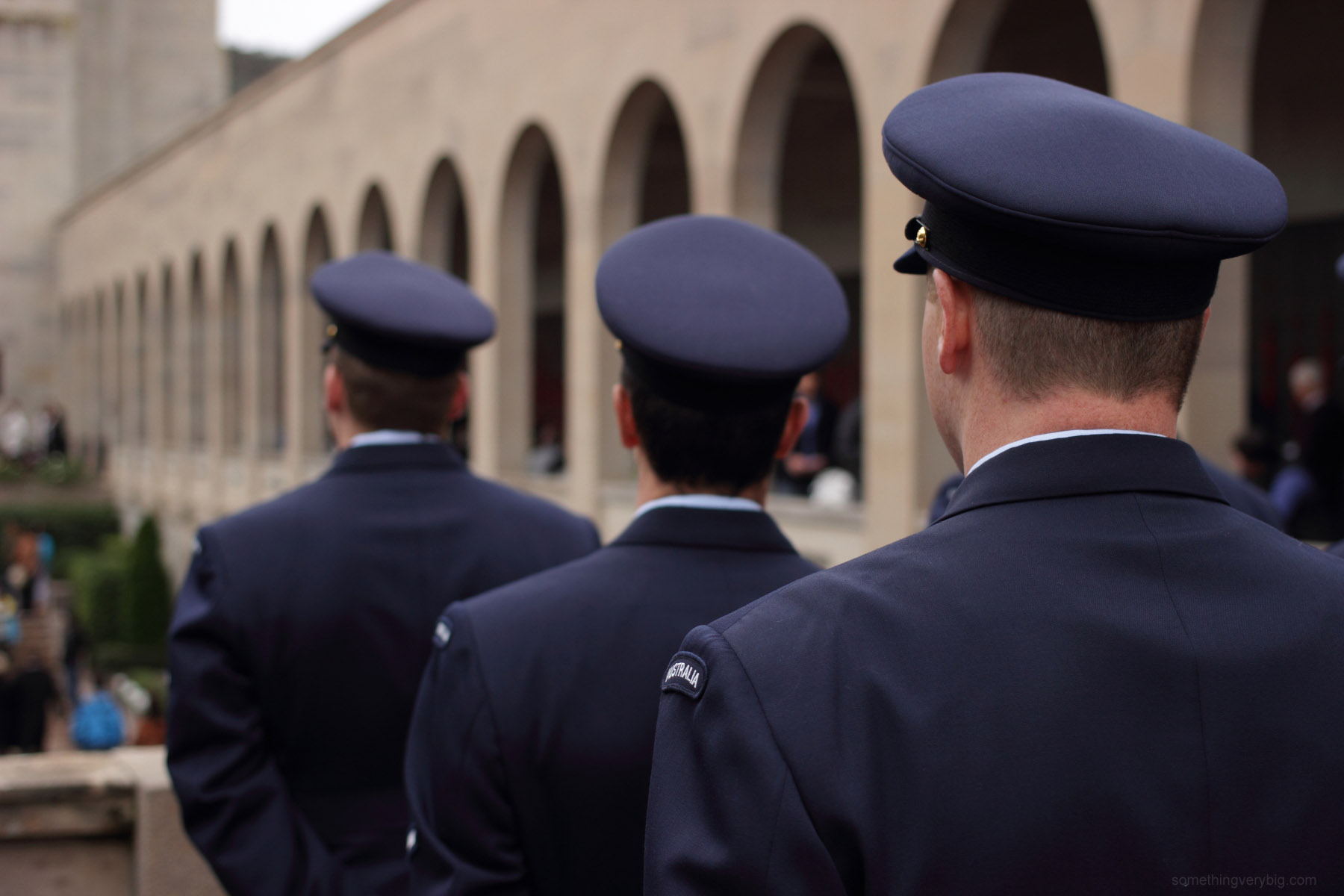
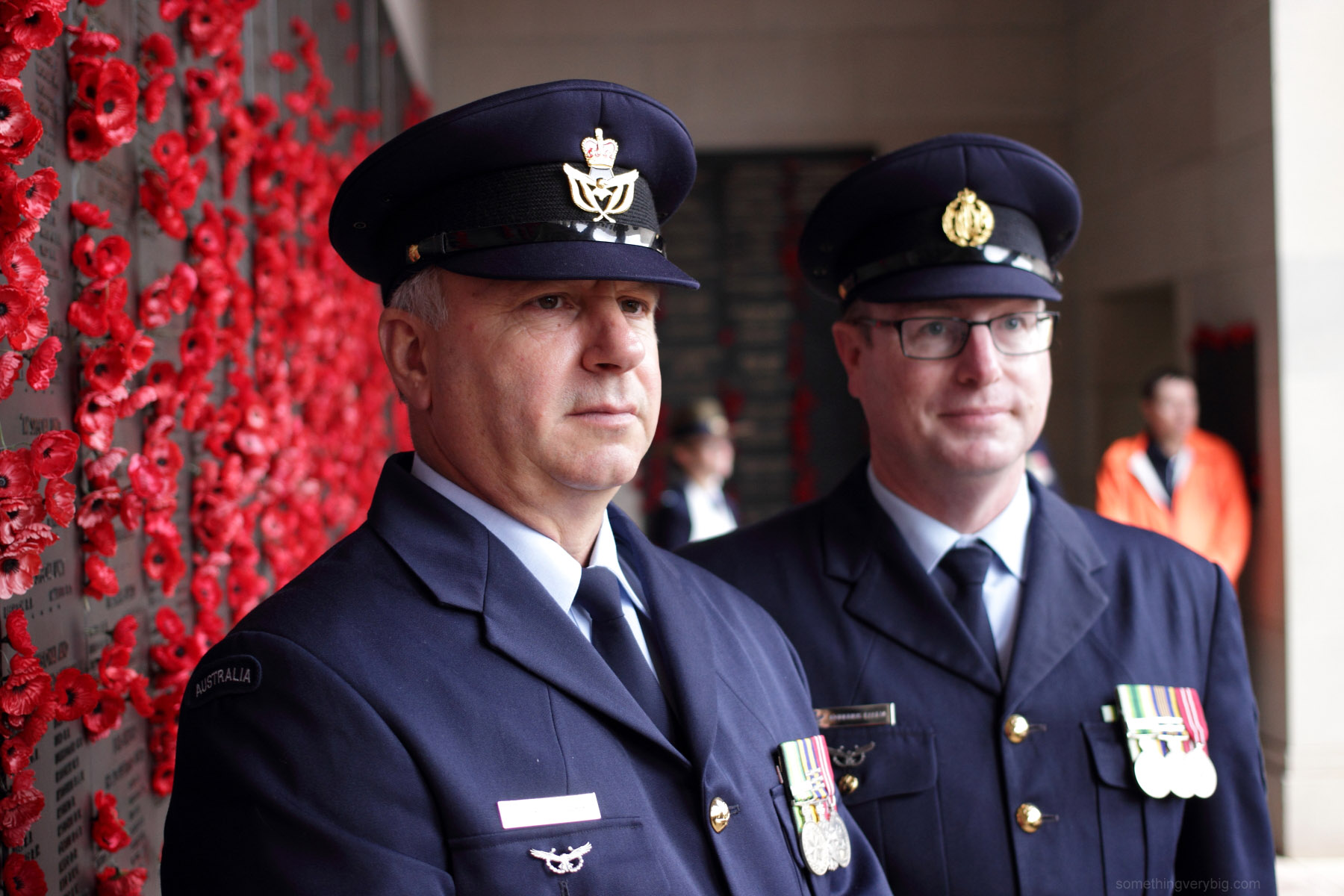
At the back of the crowd, personnel of the current iteration of 460 Squadron, Royal Australian Air Force, lined up under the leaden skies.
The Director of the Australian War Memorial, Dr Brendan Nelson, opened the service, delivering a moving tribute to the aircrew of Bomber Command. Speaking without notes, he quoted a letter written by Colin Flockhart, a 619 Squadron pilot, for delivery in the event of his death:
I love you all very dearly. Please don’t think I’m pessimistic but I do realise what the odds are and I have seen too many of my friends pass on without leaving any words of hope or encouragement behind. Cheerio and keep smiling though your hearts are breaking.
Flockhart was killed on the way home from Munich on 7 January 1945.[1]
Attending the ceremony was His Excellency General the Honourable Sir Peter Cosgrove AK, MC (Ret’d), Governor-General of the Commonwealth of Australia, who spoke about how Australians in particular traveled so far from home to fly in Bomber Command. The veterans present were invited to move to the inside of the Hall of Memory to view the wreathlaying at the Tomb of the Unknown Soldier. Ross Pearson delivered the Reflections address, paying tribute to those unsung support staff who also served: the armourers, the WAAFs, the parachute packers, the cooks (who worked miracles to make Spam palatable), the briefing officers. He also spoke eloquently on the unique “spirit of aircrew,” reading the citation for the award of the Conspicuous Gallantry Medal to Kevin Dennis, the veteran I had met at the hotel the previous evening. Kevin was a wireless operator who, badly injured by flak during an operation in March 1945, refused to leave his post until the damaged aircraft landed safely. In considerable pain with one foot almost severed from the explosion he had continued to carry out his duties, receiving the critical weather message which resulted in a successful diversion to an emergency airfield. For this, in the process saving his entire crew, he was awarded the CGM, one small step below a Victoria Cross.
This led to the most moving, unplanned, part of the service. After the notes of the bugler’s Rouse echoed off the stone cloisters, Brendan Nelson made his move. It was a breach in protocol, he said, “but we’re Australian and we can breach protocol occasionally.” He invited Kevin to come to the front while he explained why. Kevin is one of just ten RAAF personnel to be awarded the decoration during WWII. But because he required an extended hospital stay to recover, he missed the investiture and instead received his medal in the post. It had never been properly presented to him. Since we had the Governor-General present, Dr Nelson reasoned, it offered a good opportunity to fix that. Kevin came forward, shook Sir Peter’s hand and occupied a position of honour amongst the official party for the remainder of the ceremony.
This was one of those things which have become typical of Dr Nelson’s time at the helm of the War Memorial. I may not have agreed with him while he was in politics but it’s clear he has a sense of history and a sense of occasion and is a good fit in his current role. This was an inspired moment and it was fantastic to see Kevin being honoured in this very special way.
Kevin Dennis in the media scrum post-ceremony
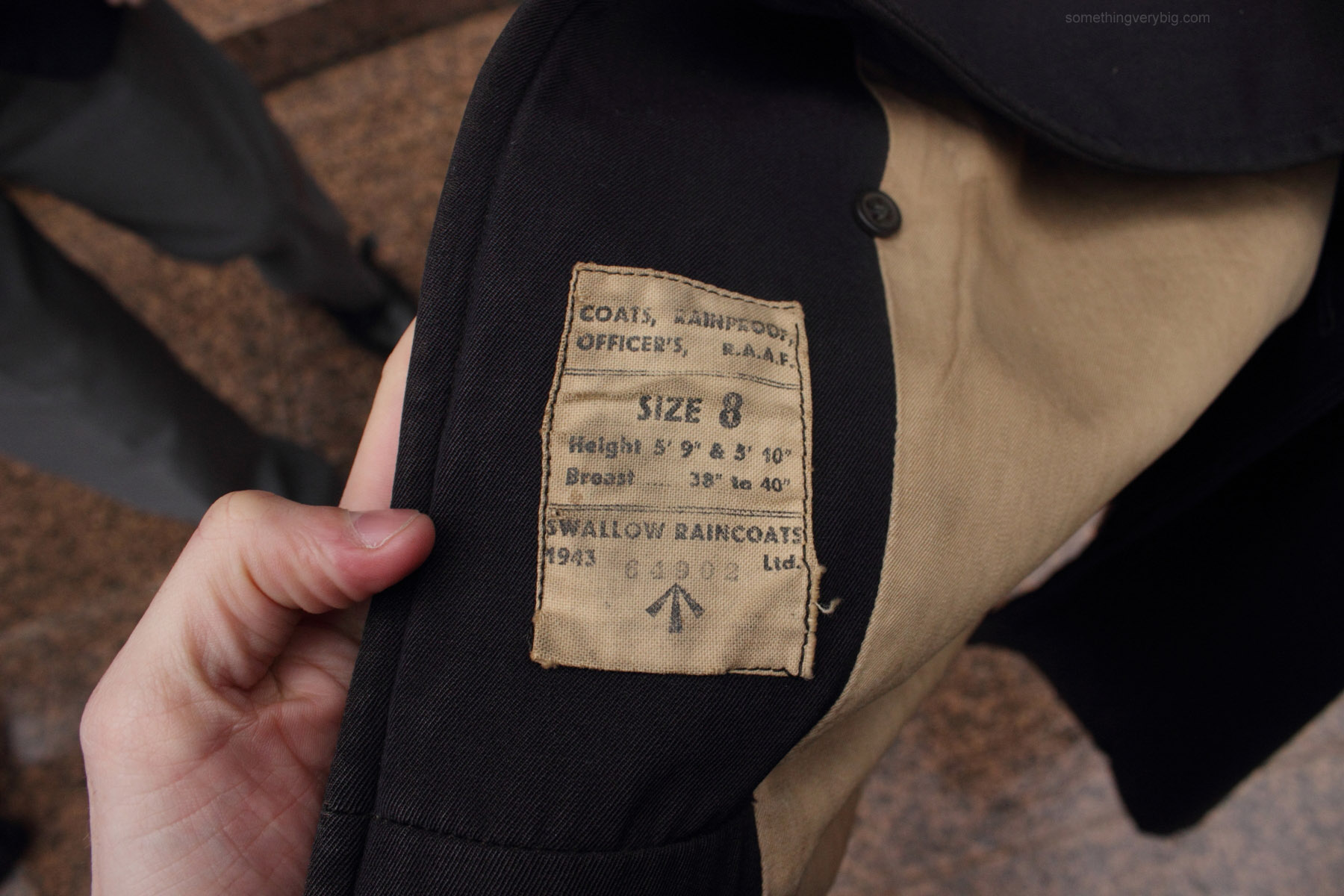
ABC Canberra had sent a camera crew and, following the ceremony, they interviewed a number of veterans, including Don Huxtable. Given the weather, Hux was wearing a long blue greatcoat.
Believe it or not, it’s part of his original RAAF-issue uniform.
Further photos from the ceremony:
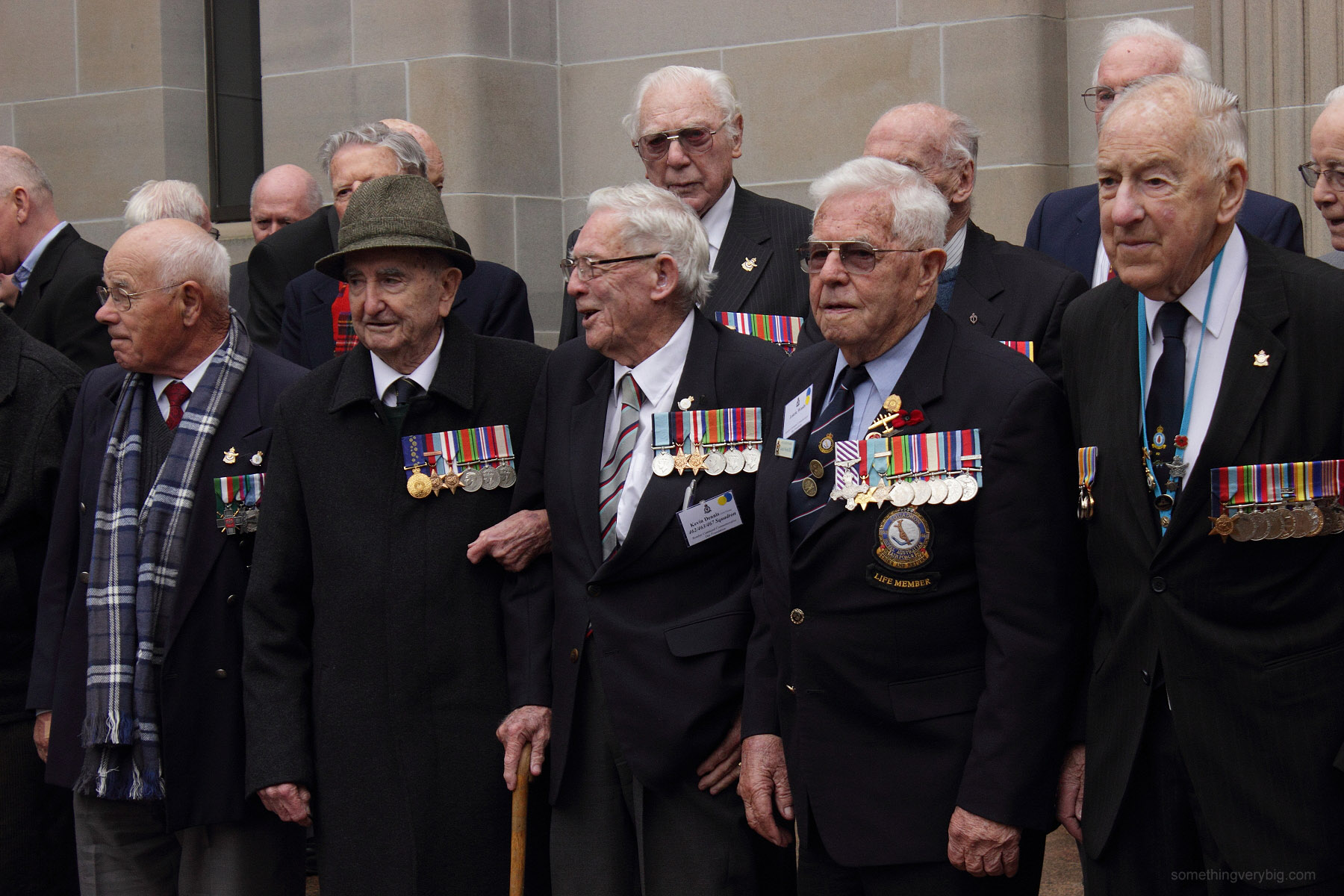
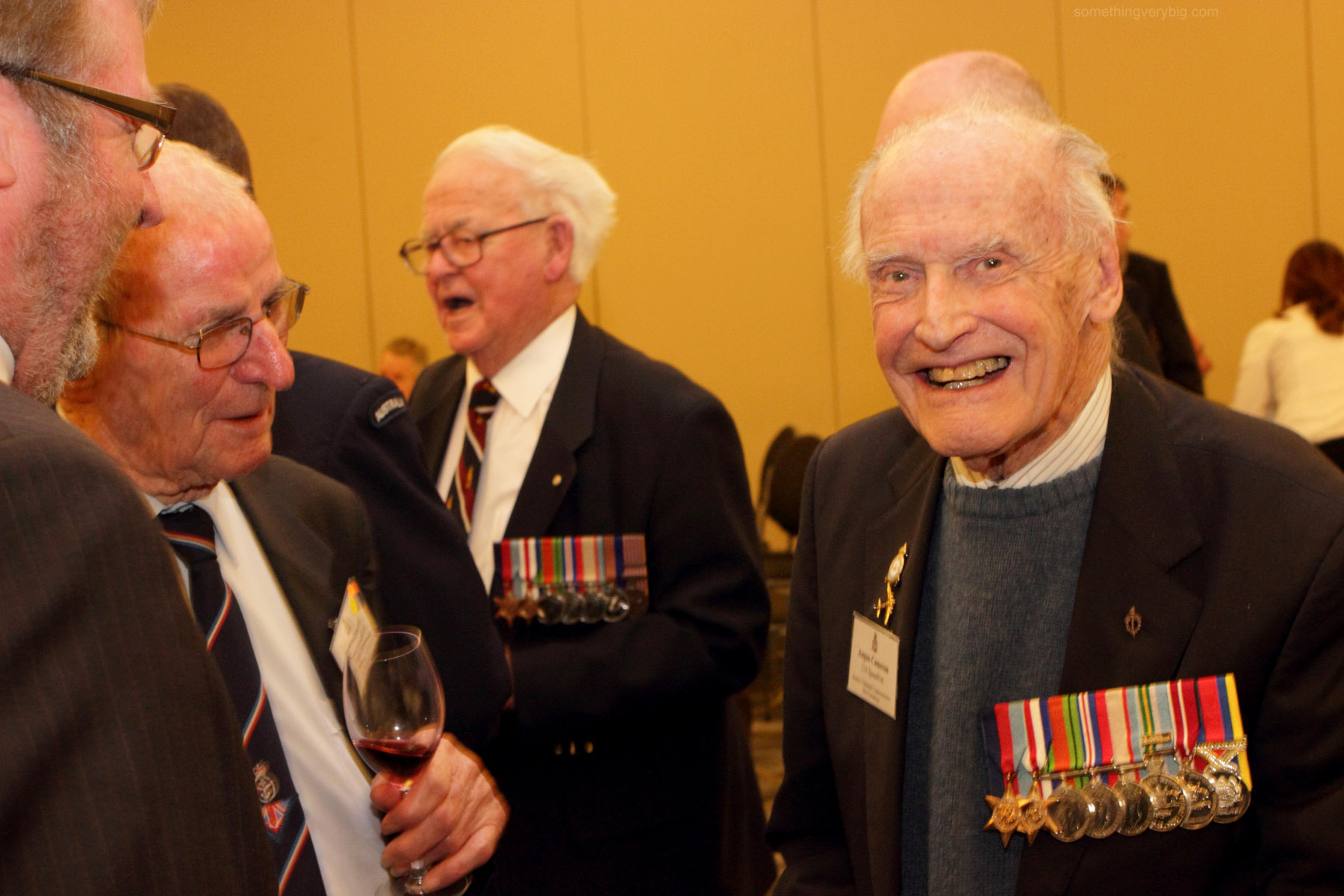
Tom Hopkinson and Angus CameronDon HuxtableAngus Cameron (214 Sqn wireless operator)The Group Photograph with the Governor-GeneralKevin Dennis amongst the groupDr Brendan Nelson speaking with Don Southwell
Back to the hotel, afterwards, for the lunch. As well as catching up with some of the usual suspects (the McDonalds, the Toms Knox, Knox and Hopkinson, and various assorted Dons) I met a few new people. Stories were shared with Richard Munro, who is the man to contact for 460 Squadron queries. I had a good chat with Wing Commander Tony Bull, the outgoing air attache at the British High Commission in Canberra. And I met Tony Buckland, who was the son of a camera operator with the 463 Squadron film crew, and was carrying his father’s logbook and a spectacular album containing a collection of still photographs from operations.
Bob Buckland operated with 463 Squadron from June 1944. Among the pilot’s names listed I recognised that of Freddy Merrill, who was another one of the skippers I mentioned in my Postblog. Tony had seen on the guest list that a Merrill was present at the lunch, and wondered if it was the same person.
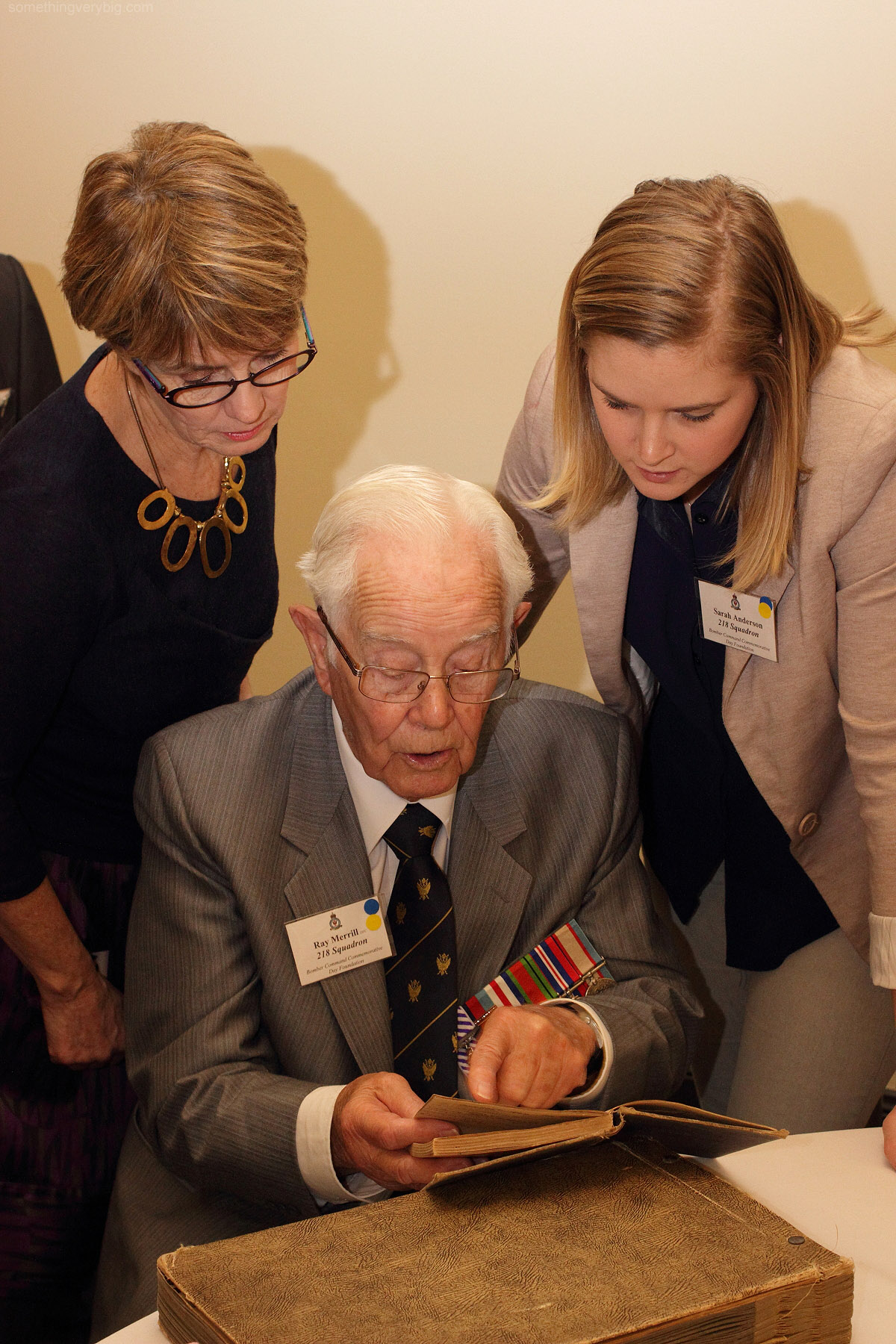
I thought it probably wouldn’t be. I’d earlier been speaking to Ray Merrill, who is on the right here:
Ray was a 218 Squadron rear gunner and he is pictured here with Jim Clayton, a wireless operator from the same unit.
As he was not on 463 Squadron at any stage, Ray would not be the Pilot Officer Merrill in Bob’s logbook. But, amazingly, he was connected.
It turned out that Freddy was Ray’s brother. Here’s a photo of Ray pointing his brother’s name in the logbook:
Ray Merrill pointing out his brother’s name
A good lunch, then – good food, good conversation and good conversation. It was an enjoyable finish to a fantastic weekend. There were many highlights over the two days. Catching up with many good friends. Meeting new contacts. Drinking with Hux late into Saturday night. Kevin Dennis’ CGM. The Merrill coincidence.
Ross Pearson, Wing Commander Tony Bull, Don Southwell and Pete RyanDon McDonald, Don Southwell (background) and Angus Cameron
But the main purpose of the weekend, of course, was commemoration and remembrance for and of the men of Bomber Command. In this it was most successful. One of the more poignant moments happened at the Meet & Greet on Saturday evening.
After the speeches the lights dimmed and the sound and light show centred around G for George began. I was talking to Don Huxtable at the time. At the end of the presentation Hux was suddenly quiet for a moment.
“I don’t know how the hell I flew straight and level through all that,” he whispered.
Phil Smith’s safe return to the United Kingdom was arguably the final direct act in the story of the crew of B for Baker, and hence is where we leave this 467 Postblog series. Before we sign off however, there are a few loose threads to tie up.
After Lille and Mailly-le-Camp it was becoming clear that French targets could be just as heavily defended as the big German cities. As we saw on 20 April and 3 May, the aircrew had begun to protest in their post-raid interrogations after some of the ‘hotter’ operations such as La Chapelle and Mailly-le-Camp about being credited with just one-third of an operation for French trips. In early May someone at Bomber Command Headquarters evidently realised that the policy was perhaps a little unreasonable. There is a document at the Australian War Memorial[1] which, while it is incomplete, comes from the 467 Squadron Orderly Room and contains aircrew names against a list of their operations. Critically, it includes a ‘running total’ of operational sorties against each trip. While the longer flights to French targets like St-Medard-en-Jalles and Toulouse were awarded a full trip from the outset, the operations to Tours on 10 April and La Chapelle on 20 April were each been credited with only one-third of a sortie. But from 8 May, French targets (like Brest on the 8th, Lille on the 10th and Tours on the 19th) were given full sorties. So somewhere in May, the policy evidently changed.
What is interesting, however, is that some of the records show evidence of having been changed retrospectively. The trips to Mailly-le-Camp on 3 May, Louailles on 6 May and Tours on 7 May were all originally given only one-third credit each, but at some stage these were all amended to full trips. And it appears that Mailly-le-Camp was the catalyst. The airmen got their wish and, finally, French operations from the beginning of May 1944 onwards were given the credit they deserved.
[After Mailly-le-Camp and Lille] there was no more talk of French targets counting a third of an ‘op’. These were two exceptionally bad nights, but they were a tough reminder of what the Luftwaffe could still do, give the chance. Lingering around a target for accurate visual marking could be fatal.[2]
Between 1 January and 11 May 1944 a total of 1091 operational sorties were flown from Waddington. The Squadrons operated on 40 out of 132 nights, attacking 26 different targets. In the course of these operations 38 bombers were lost, seventeen from 467 Squadron and 21 from 463. One Lancaster failed to return to Waddington approximately every 29 sorties. 268 airmen failed to return with the missing aircraft. The majority of these – 241 airmen – were killed in action. Twenty were taken prisoner of war and just seven became evaders.[3] If you were on one of the aircraft that went missing, you had an almost 90% chance of being killed.
Five aircraft were lost on the 30 January 1944 raid on Berlin, and this number of missing aircraft would be seen again after the period covered by the 467 Postblog on Prouville, 25 June 1944, and Konigsberg, 29 August 1944. But the Lille raid, with six missing aircraft, remained the worst night of the war for 463 and 467 Squadrons. The Battle of Berlin period is generally considered one of the more dangerous times to have been flying in Bomber Command – of course the Nuremberg raid also fell in this period, with a total of 94 losses across Bomber Command (467 Squadron lost two) – and there is no doubt that losses dropped off as French targets became the norm throughout April and May. But, as graphically demonstrated at both Mailly-le-Camp and Lille, on occasion things for the attackers could go very, very wrong and loss rates could climb dramatically.
And so the crew of B for Baker found themselves flying to Lille on 10 May 1944. They were just seven out of an estimated 125,000 airmen who flew in Bomber Command. Just six out of 55,573 killed. Just one out of some 2,500 evaders. Their stories are of entirely ordinary men, living an extraordinary existence and doing extraordinary things. I can only hope that, over the last four and a half months, 102 posts and more than 81,000 words, I’ve managed to capture and convey a little of what it was like for these seven men as they played their parts in the most dramatic period of 20th Century history.
Phil Smith spent a little over a week attempting to walk to Switzerland. He walked mostly at night, hiding during the day in either fields or farmers’ barns. In the early morning two days after his aeroplane crashed, Phil made it to a town called Orchies (some eleven miles south of Lezennes as the crow flies), but he was running out of food and still had no boots. He knew he now needed to seek help from local civilians. An elderly woman he approached could be of no direct assistance but pointed him towards a farmhouse not far away, whose inhabitants provided food but asked that he hide in the fields during the day and come back after dark. This he did and, after being well fed he was shown to a hayloft where he could sleep for the night.
I did not volunteer to leave and the next 24 hours followed the same pattern.[1]
After a few days hiding in the hayloft in Orchies, his shelterers told Phil that, as a German garrison was about to be billeted in the area it was too dangerous for him to stay. They gave Phil food, drink, an old pair of sandshoes and a hessian sack for a blanket and sent him on his way. In turn Phil wrote his Australian address on the back of one of the spare passport photos carried by aircrew on operations and left it with the family.
For the next few hours Phil avoided roads, walking cross-country to minimise the chances of encountering people. But it was hard going with a number of drains – mostly dry but some not – to be crossed. So when he stumbled onto a road going in roughly the right direction later in the night, Phil abandoned his cross-country policy. Following the road, he passed several small cemeteries which he thought probably contained graves from the Great War.
I saw a faint light in the distance at the side of the road. I assumed it to be a guard post and approached the area with the utmost caution. However my caution was quite unnecessary as the light turned out to be a glow-worm, the only one I saw in my night walking.
Phil kept walking by night and hiding by day. At one stage he saw a Spitfire making several low passes nearby. “I had fantasies of being seen and picked up and flown home which made me feel a little homesick,” he would later write. Apart from an incident where he was asked for the time by a group of young men and responded with the British Double Summer Time to which his watch was still set, the most dangerous encounter he had occurred when crossing a bridge one night over a large canal, possibly the Canal de la Sensee a few miles north of Cambrai. Exhausted after about a week on foot he was trudging slowly on when, about half-way across, he was challenged from a guard post which he had just passed without noticing.
I did not understand what was said but was able to respond immediately with a tired “bon soir’ and walked slowly on with no hesitation. The guard must have taken me for a drunk as he took no action…
The timeline in his Recollections document is somewhat vague but it was probably around 19 or 20 May when Phil walked through Cambrai itself and, seven or eight miles further east, came to the small village of Caudry. Just after that he could see some big farming establishments in a settlement called Audencourt and he decided to hide for the approaching day in one of the big sheds.
So ended my attempt to walk across France.
The Allied invasion of the Continent was imminent and, because it was considered too dangerous for Phil to continue on his own because of his lack of fluency in French, for the next three and a half months he was looked after by locals:
With the absolute need for secrecy, hiding in the small town of Caudry was, in some aspects, like being in prison. However, in all other ways I was cared for as a member of a husband and wife family.
He was still strapped into the pilot’s seat of B for Baker, having a moment ago been preparing for the jolt that usually accompanied the release of the bomb load from a Lancaster. But then something extraordinarily and suddenly violent had happened, and now he could feel no aeroplane around him.
He quickly came to the obvious conclusion:
I immediately released my seat belts and then my parachute. It seemed to open immediately.[1]
Looking up, he could see that one of the two risers from which he was hanging had been half cut through in the blast, so he hung on above the break with both hands until he landed on a large grassy field.
I seemed to be all in one piece but my flying helmet and one flying boot had gone. There was no indication that I had been seen.
His left wrist and hand were somewhat sore but otherwise he felt unharmed. Gathering up his parachute, he crept off in a direction away from some nearby houses in order to find somewhere to hide it.
Apart from the two Lancasters which came down in Flanders on the way home, there is little surviving evidence to show exactly which fate befell the remaining ten aircraft that failed to return from Lille that night. Richard Jozefiak shows that all ten crashed within about five miles of the target. Out of these, the night raid report suggests that four had been seen to go down in combat with fighters and two had collided. There was perhaps one more victim of a collision (the aircraft which hit Pilot Officer Dear in ND896), which leaves three lost to entirely unknown causes. It appears unlikely, however, that sufficient evidence has or will ever come to light to be able to make a determination, with any degree of confidence, of what happened to these aircraft, and by extension, of what exactly caused the crash of B for Baker. Even Phil Smith himself never knew for certain. “All I can say about the accident is that I was extremely lucky to get away with it,” he wrote to his parents shortly following his liberation a few months later.[2] Theories abounded. “He must have had a miraculous escape,” wrote his aunt Cis to her brother, Phil’s father Don Smith.[3] “He didn’t know if another plane hit them or if their own bombs exploded, as directly their own bombs were released he remembers a terrific flash of light – but felt absolutely nothing.” In November 1944 the Air Force sent an extract from Phil’s official evasion report to the family of his rear gunner, Gilbert Pate:[4]
…while bombs were falling from the aircraft it was hit either by flak or by enemy aircraft and exploded in mid air
Later still, Phil wrote a letter which he sent to the Air Force for onwards transmission to the family of his wireless operator, Dale Johnston:[5]
We had a straightforward trip up to the time when the bombs were falling away from the aircraft when something hit us and the aero-plane exploded. I have no idea what happened to the rest of the crew or the remains of the aircraft – after seeing flame in front of my eyes I did not see or feel anything solid until my parachute opened.
And three years after the Lille raid, Phil’s father told him of a letter received from Fannie Johnston. She had been to France, it seems, and spoke to a local who suggested the aircraft had been involved in a collision. “I suppose they found the remains of two aircraft together”, Phil guessed[6]. “A collision is as likely as any other cause…”
Collision? Own bombs? Flak? Nightfighter? Even when my own family spoke with Phil a few years before he died, he was still unclear on exactly what caused the loss of his aeroplane.
All that was some time off, though. Right now he had far more pressing matters to deal with. Squadron Leader Phil Smith was on the ground, alone, in enemy-occupied territory. He did not know it yet, but out of the 84 aircrew on board the twelve Lancasters which had failed to return from Lille, he was the only man still alive. After gathering up his parachute, Phil began heading roughly south-east, navigating roughly by the North Star.[7] His vague plan was to walk to Switzerland, which he considered a better prospect than trying to escape via Spain. He hid his parachute and mae-west lifevest in a pile of roadbuilding stones and carried on, soon coming to a big barbed wire fence. This, he supposed, was probably the Luftwaffe airfield which he knew was south-east of the target. He decided that walking across the airfield would be easier than going around it and looked for a gap in the wire. But then he heard gun shots.
I had not been challenged but felt sure that they were meant for me. I changed my mind and immediately crept off as quietly as possible in a North-Easterly direction.
Planning to avoid contact with any people and to get as far from the crash site as he could on the first night, Phil walked on. Having lost one fur-lined flying boot in the explosion, he now found his remaining boot soaking up dew from the ground. It became too heavy and he was forced to abandon it.
I was then committed to walking cross-country in my socks.
After wading across a narrow canal of some sort (”an unpleasant process”, he wrote in his usual understated way), he found himself walking up steadily rising, wooded ground.
By this time I was tiring, there were signs of dawn and the cover seemed quite good for lying up during daylight.
Phil picked a likely-looking spot, hid himself as best he could, and fell into a fitful sleep.
On the night of 10 May, 1944, more than eighty heavy bombers of RAF Bomber Command were attacking railway yards at Lille in France. A new offset target marking technique had failed to work as planned and instead of overshooting onto the aiming point the early bombing fell on top of the red spot fires and obscured or extinguished them. Shortly after 23:40 the Director of the main force, Wing Commander Anthony Heward of 50 Squadron, fired two red Verey cartridges in quick succession and called a halt to the raid to allow the target to be re-marked.
Aircraft that had not yet bombed now began to orbit to the south or east of the target. Heward himself orbited for some sixteen minutes.[1] With more than fifty aircraft milling around the target waiting for new markers to be dropped, things began to feel uncomfortably reminiscent of the disastrous Mailly-le-Camp raidof a week ago.
There is evidence for perhaps two collisions over the target. One 61 Squadron crew – that of Flight Lieutenant HH Farmiloe – reported visually identifying the railway yards in the “light of [an] explosion from [the] collision of two aircraft”.[2] And Pilot Officer RA Dear, also of 61 Squadron, hit another Lancaster that crossed his path from port to starboard, “shearing off about 2 ft of port rudder and holing port elevator.”[3] We do not know which aircraft it was that Dear hit. There are no further reports in the various Operational Record Books of surviving crews being involved in a collision, so it is quite likely that whoever it was failed to return to base – which, if added to the two presumed destroyed in the earlier collision seen by Farmiloe, gives us three potential victims of collisions on this night.
And worse was to come. Nightfighters found the bombers as they orbited and shot down at least four of them. Arnold Easton recorded in his logbook being chased by a twin-engined aircraft. Then another bomber went down in flames. “One chute seen to open”, Easton wrote. His aircraft, DV372 Old Fred, had orbited the target for 23 minutes, finally bombing at midnight.
A number of crews reported seeing so-called ‘scarecrows’ over the target:
Before bombing two dummy runs were made and on a second run two scarecrows burst above and a third scarecrow burst just below aircraft.
-Squadron Leader HR Foley, 9 Squadron
Given that post-war it was established that there were in fact no such things as ‘scarecrows’,[4] it is most likely that what Foley witnessed actually were the sudden ends of three aircraft and crews. His crew bombed at 23:54, one of the first to do so after the order to resume the attack had been broadcast and the ‘green-green’ Verey cartridges had been fired.
The second phase of the bombing, it seems, went appreciably better than the first. Much smoke was again generated and now and again the new markers were obscured by it but most crews thought there was little or no scatter in the bombing that followed. Some crews reported seeing fires but many others did not. Shortly before midnight there were several large explosions. But once again it appears that the bombing was concentrated around the spot fires themselves, against the intent of the offset marking technique. Some crews, like that of Pilot Officer E Berry of 50 Squadron, noted that the bombs were falling on the marker “instead of on overshoot”, and others saw bombs overshooting the markers by 100 yards as planned, but many more, on the face of the limited evidence from the operational record books, thought there was a good concentration of bombing around the spot fires. This suggests that the new technique was not quite working as planned and perhaps showed a lack of understanding among some of the crews.
There is no doubt however that the bombing was effective. The Night Raid Report described a “great concentration” on and around the railways and sidings, and a repair workshop and two locomotive sheds were destroyed. And of course, the cost to the attackers had also been high. As the bombers turned back to the west and then the north-west towards the coast, they were followed by nightfighters which claimed perhaps two more victims on the way home. Flak also destroyed a bomber near Ypres, and crossing the coast a 97 Squadron aircraft was hit by heavy flak. It severely damaged the mid-upper turret and the gunner who was in it at the time, Flying Officer Henry Ward, was badly injured. His crewmates removed Ward from his turret but sadly he died shortly afterwards.[5] The aircraft landed safely.
In all twelve aircraft failed to return from Lille.[6] Three squadrons lost two aircraft each. From 50 Squadron, LM429 was probably the aircraft that was claimed by flak near Ypres and NN694 crashed near the suburb of Forest-sur-Marque, a suburb some five miles east of the target. 9 Squadron lost LM520 which also crashed near Forest-sur-Marque and LM528, which came down near what used to be called Annappes, now part of the community of Villeneuve d’Ascq, some three miles to the east of the marshalling yards. 97 Squadron lost the raid’s Deputy Controller, Flight Lieutenant John Smith, when JB708 crashed just north of the Lille-Sud, or flugplatz Vendeville Luftwaffe airfield. The other aircraft to go down from this squadron was ND813 which crashed in Lezennes, another suburb of Lille a couple of miles to the south-east of the target.
For Waddington, however, it had been, in the words of Pilot Officer Arnold Easton, a “grim trip”.[7] The two Australian squadrons lost three aircraft each and it would remain their worst night of the war. From 463 Squadron, LL882, captained by Squadron Leader Merv Powell, crashed in a brick pit near Langemark in western Flanders, likely one of the two reported victims of nightfighters on the return leg. LL881, flown by Flying Officer Dud Ward, who had been told just yesterday that he had been awarded a DFC, crashed at Lezennes. HK535, flown by Flight Lieutenant Eric Scott, crashed at Annappes.
467 Squadron, meanwhile, lost LL788 with Flying Officer Bill Felstead and crew, who also crashed at Annappes. Pilot Officer Doug Hislop was flying EE143 – the aircraft that until very recently had not flown straight – when it crashed between Lezennes and neighbouring Ronchin. And the final Lancaster that failed to return from the Lille operation crashed in the north-eastern corner of Lezennes, near what is now a no-frills motel and petrol station.
It was B for Baker.
The last known fact is that at 23:45, around the time the bombing was stopped to allow the target to be re-marked, Dale Johnston was heard to send a signal on his T1154 wireless telegraphy transmitter.[8]
Sometime after that, just as Jerry Parker was at the point of pushing the switch that would send B for Baker’s bombs falling into the smoke below, something catastrophic happened.
Perhaps the aeroplane was hit by flak.
Perhaps a nightfighter attacked.
Perhaps they collided with another aeroplane.
We simply do not know. But whatever the proximate cause was, some time after 23:45, everything on B for Baker suddenly went very hot, and dry, and red.[9]
[1] Wing Commander Heward in 50 Squadron Operational Record Book
[2] Flight Lieutenant HH Farmiloe, reporting in the 61 Squadron Operational Record Book
[3] Pilot Officer Dear in the 61 Squadron Operational Record Book
[4] Hastings, Max 1979, p.197
[5] Ward’s story is mentioned in the 97 Squadron Operational Record Book. He is buried in Cambridge City Cemetery.
[6] Locations of crashes sourced from Jozefiak, 1995 and Storr, 2006. This section also draws from Night Raid Report No. 602 and the various Operational Record Books.
[7] Easton, AR. Flying Log Book
[8] As recorded in the 467 Squadron Operational Record Book, this was one of two signals heard from B for Baker. The other had been sent at the beginning of the attack, at 23:30.
[9] Smith, Phil. Recollections of 1939-1945 War. p. 24
Bomber Command sent more than six hundred sorties on operations across much of north-west Europe tonight. Mosquitos attacked Châteaudun, Ludwigshafen and enemy airfields. More carried out radio counter-measure or intruder patrols. 26 Whitleys and Wellingtons scattered leaflets over enemy territory. 26 Lancasters, Stirlings and Halifaxes laid mines at ten locations off the French coast and in the Heligoland Bight. But by far the largest proportion of the aircraft flying operationally on this night were detailed to attack four marshalling yards and one coastal gun battery, all in Belgium or northern France.[1] Bomber Command, on 10 May 1944, was firmly engaged in invasion preparation.
The coastal battery was at Dieppe, hit by concentrated bombing from 60 Lancasters and eight Mosquitos around “well-laid” markers. Transportation Plan targets included marshalling yards at Lens, Ghent, and Courtrai, all attacked by forces of between 90 and 130 bombers. Ghent was bombed accurately and the raids on Lens and Courtrai were concentrated but centred somewhat outside the target areas. But for this story we have a special interest in the final marshalling yard on tonight’s target list: Lille.
It was to be a short flight and I thought it would be simple but I could not have been more wrong.
There would be 85 heavy bombers, all of 5 Group, making the hop across the Channel to Lille. They were supported by four Mosquitos of 627 Squadron, 5 Group’s own target-marking unit. Tactics were broadly similar to those used elsewhere on Transportation Plan raids: by the light of flares dropped by Lancasters from 97 Squadron, the target would be marked with red spot fires by the Mosquitos.[3] Lawrence[4] writes that this would be the second time that the newly-developed ‘offset marking’ technique would be used. The spot fires were intended to be deliberately dropped a short distance away from the aiming point and a ‘false bombing wind’ calculated and transmitted to the main force to use when aiming their bombs so that they dropped onto the actual aiming point and clear of the markers themselves. As for the Sable-sur-Sarthe raid of four nights ago, the role of Controller[5] for this raid was taken by Squadron Leader Harry Locke, a former 467 Squadron Flight Commander, who was now with 97 Squadron. His Deputy Controller was a New Zealander from the same squadron, Flight Lieutenant John Smith. There is evidence[6] that suggests that Squadron Leader Phil Smith also had a Deputy Controller role to play in this raid. Meanwhile the man in charge of the target-marking Mosquitos of 627 Squadron, was Squadron Leader Norman MacKenzie.
LM475 B for Baker was one of seventeen aircraft from 467 Squadron and fourteen from 463 Squadron to depart Waddington for this operation. The first bomber to take off, B for Baker left the runway at 21:57. EE143 was one of the following aircraft, departing eleven minutes later. Evidently cleared of its inability to fly straight, it was being flown by Pilot Officer Doug Hislop.
There were two early returns. A 9 Squadron Lancaster suffered an engine failure and turned around not long after taking off from Bardney,[7] and a 50 Squadron aircraft jettisoned its bombs off the Norfolk coast before returning to Skellingthorpe after the rear turret failed.[8] But the rest of the force carried on, crossing the Channel from Clacton in Essex to a point between Dunkirk and Ostende. From there they turned south-east to the Belgian border near Courtrai. Then, in clear air but with some haze visible lower down, they headed south-west towards the target.
The illuminating flares were dropped on time over Lille by Lancasters of 97 Squadron, most of which had identified the target by H2S. Harry Locke thought the initial flares were somewhat scattered, but Mosquito DZ468 dropped a red spot fire about 150 yards south of the marking point four minutes before H-Hour.[9] The bombing wind was calculated and broadcast to the Main Force “in good time”[10] and the first recorded aircraft to drop bombs was DZ418, a Mosquito, at 23:34. Over the next eleven minutes some 28 aircraft would drop their loads of high explosives. While some crews thought the bombing was not as concentrated as usual, many others considered the attack highly successful, with bombs exploding in close proximity to the marker. But they were too close:
As bombs were about to be released the red spot fire was hit by another bomb and practically extinguished.
-Pilot Officer H Forrest, 9 Squadron
This, of course, was precisely what offset marking was supposed to counter. The smoke was rising almost to the height from which the bombers were attacking and it was being blown by the wind back along their bombing runs. This was enough for Wing Commander Anthony Heward, the man in charge of the Main Force, to fire two red Verey cartridges at about 23:40 and call a halt to the bombing via W/T.[11]
Next post: The target is re-marked and the bombing begins again



















 Something Very Big